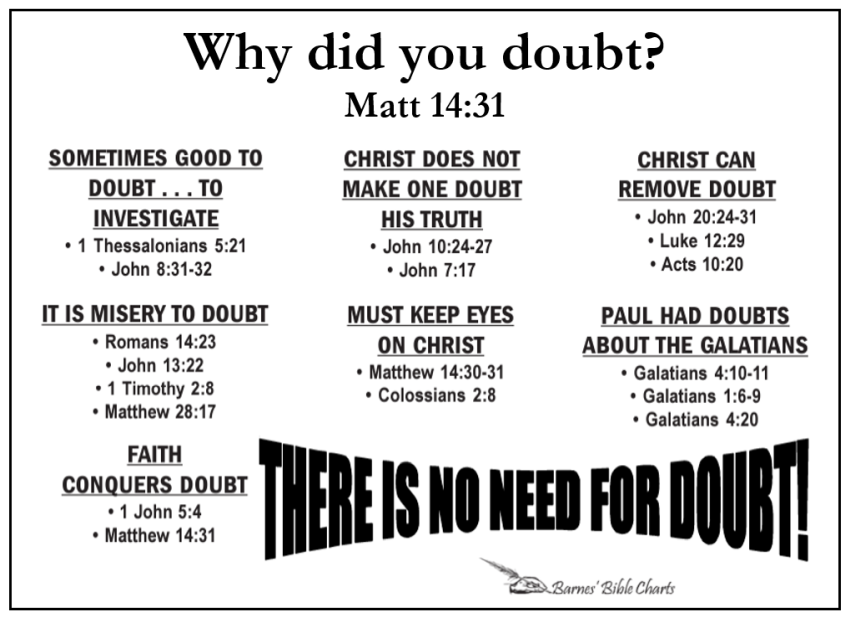
We have seen in this series of articles that doubt can develop from several places. Our job is to recognize the triggers for doubt and to avoid them.
So far we’ve learned about disbelief, opposition, uncertainty, and division. Today we talk about one more, distractions, or as Jesus put it, THORNS.
“And these are they which are sown among thorns; such as hear the word, And the cares of this world, and the deceitfulness of riches, and the lusts of other things entering in, choke the word, and it becometh unfruitful”
(Mark 4:18-19).
Distractions lead to doubt by taking our eyes off the goal, or diverting our time. When we focus on the vanities of life (see Ecclesiastes), we lose sight of hope and then doubt. Distractions give us less time for the study we need to strengthen our faith.
While there are many distractions, most of them can be grouped together into a few categories.
One of the main categories of thorns leading to doubt is from family TRADITIONS. “Howbeit in vain do they worship me, teaching for doctrines the commandments of men” (Mark 7:7). Family traditions (religious or other), can lead to doubt especially as the word of God conflict with their religious practices or family time. When I first became a Christian, the tradition of our Sunday morning brunch interfered with worship. There is often pressure from the family for the Christian to forego worship, bible study, or even beliefs. This is especially difficult for the new in the faith, as they lack the biblical knowledge to defend themselves. (see Matt 10:37; Luke 14:26).
Another areas of distraction that keep us from study, meditation, and serving the Lord (Rom 12:6-8) are HOBBIES, Social-Media, and entertainment that consumes a significant amount of time. While these are non-sinful activities (sinful activities are always to be avoided), they can become distractions when the time & resources needed for them leave little of the same for God. Some have led to neglect of the family and job that can lead to financial strain. Hobbies and such like can be used for godly service. I know of one family that intentionally plans their activities as a tool for meeting people for an opportunity to share the gospel. Some use Social-Media for advancing the kingdom. “He who tills his land will be satisfied with bread, But he who follows frivolity is devoid of understanding” (Prov 12:11; 28:19 NKJV).
Lust for OTHER THINGS is another area that affects us (Mark 4:19). “Ye ask, and receive not, because ye ask amiss, that ye may spend it in your pleasures” (James 4:3). We begin to doubt when our prayers seem to go unanswered not recognizing that we’re praying amiss. Prayer is very personal as we pour out our heart to God. Sometimes we pray for things that go against the will of God. When our desires and God’s will conflict, we need to align our will with His, or doubt will creep in (cf. Jas 1:13-15).
The parable in Mark 4 also warns about the deceitfulness of RICHES. Money is a tool we use to ease trade. Sadly, many of us begin to trust in wealth above trusting in God. “But they that are minded to be rich fall into a temptation and a snare and many foolish and hurtful lusts, such as drown men in destruction and perdition” (1Tim 6:9-17). It’s very easy to think that money solves all our problems and leads to an easier life. That’s what one rich man thought (Luke 12:15-21). If we have problems that can be solved with money, we don’t have a problem. Then, when a real problem comes (one not solved by money), our faith may begin to waver. Our treasure in heaven is far more valuable than any earthly treasure, let’s focus on that (Matt 13:44-45; 16:26).
Related to riches is our concern for the NEEDS of this world. We need what we need and stress about them may lead to doubt. Because they’re needs, they can quickly and easily distract us and cause doubt especially if we lack any need. “Therefore I say unto you, be not anxious for your life, what ye shall eat, or what ye shall drink; nor yet for your body, what ye shall put on. Is not the life more than the food, and the body than the raiment” (Matt 6:25-34)? The command of Christ is to seek first the kingdom of God and His righteousness.
The final category of thorns is found in SICKNESS, Sadness or Sorrows. The physical and emotional pains of life can quickly overwhelm our faith and become the focus of every conversation. When we’re asked how we’re doing, do we give an organ recital (listing all our ailments) or do we talk about our hope? “For our light affliction, which is but for a moment, worketh for us a far more exceeding and eternal weight of glory” (2Cor 4:17). Unhealed pain is a source of doubt for many of our brethren, and certainly for the world.
For me this is one of the most difficult thorns. Pain, Loss, Sickness, and Sorrows can drive our identity. A friend of mine noticed after the loss of his infant son that he could end any joyful moment for himself and others. Some pains can be healed, but the death of a loved one lives with us forever. This and other Sorrows can be a constant source of doubt.
Paul faced a physical thorn that he appealed to the Lord three times in prayer. However, the Lord’s answer changed his perception about the pain. “Concerning this thing I besought the Lord thrice, that it might depart from me. And he hath said unto me, My grace is sufficient for thee: for my power is made perfect in weakness. Most gladly therefore will I rather glory in my weaknesses, that the power of Christ may rest upon me. Wherefore I take pleasure in weaknesses, in injuries, in necessities, in persecutions, in distresses, for Christ’s sake: for when I am weak, then am I strong.” (2Cor 12:8-10). Instead of letting his thorn in the flesh become his identity, it became a motivation and a source of strength through faith in Jesus Christ.
Friends, we all have our fears and doubts, but we must never let it have a foothold in our hearts. When we are aware of how doubt develops, we’ll be better able to stave it off. The tried-and-true way to combat doubt is by keeping our eyes on Jesus. We do this by reading His word, encouraging and assembling with the saints, and being diligent to show ourselves approved unto God.
Agape,
Spencer
This is part 5 of a series on Overcoming Doubt.
 Borger church of Christ @ Franklin & Juniper