ALL SPIRITUAL BLESSINGS: FORGIVENESS

“Blessed be the God and Father of our Lord Jesus Christ, who hath blessed us with all spiritual blessings in heavenly places in Christ” (Eph 1:3)

The main spiritual blessing found only in Christ is the forgiveness of sins. Some erroneously say one can never lose salvation, while others claim we are immediately lost every time we stumble.

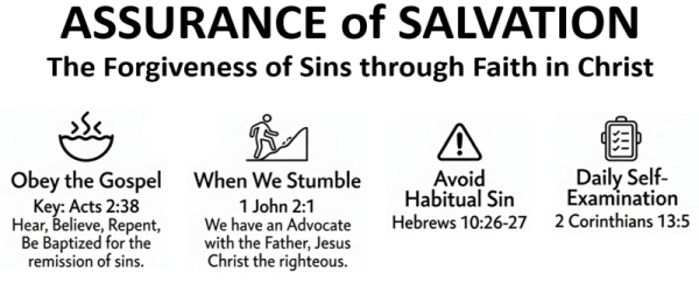
John wrote to the disciples so we may know that we have eternal life. “These things have I written unto you that believe on the name of the Son of God; that ye may know that ye have eternal life, and that ye may believe on the name of the Son of God” (1John 5:17). The written words of the New Testament give us this assurance. Let us consider a few simple questions that help us know where we stand.

Have we Heard and Obeyed the Gospel (2Thess 1:8)? (see the here for a simple outline of God’s plan of salvation). Assurance begins with a clear and obedient response to the gospel of Christ. The New Testament presents a consistent pattern for entering into Christ and remaining in Him. “Repent, and be baptized every one of you in the name of Jesus Christ for the remission of sins, and ye shall receive the gift of the Holy Ghost” (Acts 2:38). If we have obeyed the gospel of Jesus Christ, we have the forgiveness of sins.

What happens we do when we stumble? John acknowledged that we all sin at times, yet he pointed us to the remedy. “My little children, these things write I unto you, that ye sin not. And if any man sin, we have an advocate with the Father, Jesus Christ the righteous” (1 John 2:1; see also 1:7–2:2). John’s first letter distinguishes between the person who lives in habitual sin and the one who stumbles but turns back to the Lord.

Are we Knowingly, Willingly, and Habitually Violating the Doctrine of Christ Without Repentance? Assurance is not for those who deliberately and persistently reject the teaching of Christ while claiming faith. The New Testament issues solemn warnings; “For if we go on sinning deliberately after receiving the knowledge of the truth, there no longer remains a sacrifice for sins, but a fearful expectation of judgment” (Hebrews 10:26-27). Even in such a condition, repentance remains possible, as the example of Simon in Acts 8:18-24 shows.

Finally, are we practicing self-examination daily? True assurance involves honest, ongoing self-examination in light of Scripture, preparing us for the final judgment. “Examine yourselves, to see whether you are in the faith. Test yourselves” (2 Corinthians 13:5).

John was telling the truth when he said that that through these things “ye may know that ye have eternal life.” There are many things we do not know, but through faith which comes from reading, studying, and obeying God’s word, we can know the truth and be set free.

Agape

seb

All Spiritual Blessings In Christ: Adoption

Adoption & Heirs
Every spiritual blessing God gives comes to us only in Christ. The apostle Paul opens Ephesians with this sweeping truth: “Blessed be the God and Father of our Lord Jesus Christ, who has blessed us in Christ with every spiritual blessing in the heavenly places” (Ephesians 1:3).

Among the greatest of these blessings are adoption and inheritance. Through faith in Jesus, God takes us who were once outsiders and adopts us as His own children. We are no longer slaves or strangers but sons and daughters in His family. “But when the fulness of the time was come, God sent forth his Son, made of a woman, made under the law, To redeem them that were under the law, that we might receive the adoption of sons. And because ye are sons, God hath sent forth the Spirit of his Son into your hearts, crying, Abba, Father. Wherefore thou art no more a servant, but a son; and if a son, then an heir of God through Christ” (Galatians 4:4-7).

This adoption brings full rights. We receive the Spirit of adoption. And because we are now children, we become heirs of God and co-heirs with Christ. An eternal inheritance awaits us that nothing in this world can take away. “And if children, then heirs; heirs of God, and joint-heirs with Christ; if so be that we suffer with him, that we may be also glorified together” (Romans 8:15-17).

How did we come to this inheritance and adoption? Paul wrote by inspiration, “For ye are all the children of God by faith in Christ Jesus. For as many of you as have been baptized into Christ have put on Christ. There is neither Jew nor Greek, there is neither bond nor free, there is neither male nor female: for ye are all one in Christ Jesus. And if ye be Christ’s, then are ye Abraham’s seed, and heirs according to the promise” (Galatians 3:26-29).

We’re able to be baptized into Christ because of what He did on the cross. “And that he might reconcile both unto God in one body by the cross, having slain the enmity thereby… Now therefore ye are no more strangers and foreigners, but fellowcitizens with the saints, and of the household of God” (Ephesians 2:14-19);

All of it is found in Christ alone. Through Jesus we are welcomed home, fully adopted, and made rich with every spiritual blessing the Father has to give. Now all that remains is the redemption of our body when Christ returns. “…even we ourselves groan within ourselves, waiting for the adoption, to wit, the redemption of our body” (Romans 8:23). Having been justified by His grace we should become heirs according to the hope of eternal life (Titus 3:7).

Blessed be the God and Father of our Lord Jesus Christ, which according to his abundant mercy hath begotten us again unto a lively hope by the resurrection of Jesus Christ from the dead, To an inheritance incorruptible, and undefiled, and that fadeth not away, reserved in heaven for you, Who are kept by the power of God through faith unto salvation ready to be revealed in the last time” (1Peter 1:3-5).

Agape
spencer

All Spiritual Blessings in Christ: Prayer

“Blessed be the God and Father of our Lord Jesus Christ, who hath blessed us with all spiritual blessings in heavenly places in Christ” (Eph 1:3)

Prayer is one of those spiritual blessings enjoyed by those in a covenant relationship with God. Here are some passages about this spiritual blessing.

Prayer rejected due to sin
• Proverbs 28:9 “He that turneth away his ear from hearing the law, even his prayer shall be abomination.”
• Isaiah 1:15 “When ye make many prayers, I will not hear: your hands are full of blood.”
• Micah 3:4 “Then shall they cry unto the LORD, but he will not hear them… as they have behaved themselves ill in their doings.”
• Zechariah 7:13 “Therefore it is come to pass, that as he cried, and they would not hear; so they cried, and I would not hear.”
• John 9:31 “Now we know that God heareth not sinners: but if any man be a worshipper of God, and doeth his will, him he heareth.”

Hypocrisy / rebellion prevents prayer
• Proverbs 15:29 “The LORD is far from the wicked: but he heareth the prayer of the righteous.”
• Proverbs 21:27 “The sacrifice of the wicked is abomination: how much more, when he bringeth it with a wicked mind?”
• Psalm 66:18 “If I regard iniquity in my heart, the Lord will not hear me.”
• James 4:3 “Ye ask, and receive not, because ye ask amiss, that ye may consume it upon your lusts.”

Sin separates from God (prayer not heard)
• Isaiah 59:1–2 “Your iniquities have separated between you and your God… that he will not hear.”
• Jeremiah 11:11 “Though they shall cry unto me, I will not hearken unto them.”
• Jeremiah 14:12 “When they fast, I will not hear their cry… I will consume them.”
• 1 Peter 3:12 “The eyes of the Lord are over the righteous… but the face of the Lord is against them that do evil.”

Obedience required for answered prayer
• 1 John 3:22 “Whatsoever we ask, we receive of him, because we keep his commandments, and do those things that are pleasing in his sight.”
• Hebrews 5:9 “He became the author of eternal salvation unto all them that obey him.”

Here’s the good news, God hears our prayers “IN CHRIST.” Because we have obeyed the Gospel through faith we have access to God through prayer. “Let us therefore come boldly to the throne of grace, that we may obtain mercy and find grace to help in time of need” (Hebrews 4:16; Eph 2:18; 3:12).

Agape
spencer

Blood in God’s plan

Blessed be the God and Father of our Lord Jesus Christ, who hath blessed us with all spiritual blessings in heavenly places in Christ” (Eph 1:3)

As we continue to count our spiritual blessings in Christ, today is a fitting time to talk about the blessings we have in Christ through His blood. For us to appreciate the full impact of this blessing, we need to go back and see the impact of blood in the Old Testament.

The first implied reference to blood appears in Genesis 3, when God took animal skins to cover Adam and Eve after their sin. “Unto Adam also and to his wife did the LORD God make coats of skins, and clothed them” (Gen 3:21).

The next reference we find in the scene with Cain and Abel. Abel made an offering to the Lord from the firstlings of his flock. It says, “And the LORD had respect unto Abel and to his offering” (Gen 4:4; cf. Heb 11:4). Three things stand out: first, that Abel gave the ‘firstling’; second, that it was the shedding of blood; and third, he offered it by faith (Heb 11:4).

We see animal sacrifices continue throughout Genesis, often involving the building of an altar and the offering of clean animals as burnt offerings. They emphasize faith, obedience, thanksgiving, or covenant relationship. When we get to Abraham we see another important element. Initially, his son Isaac was to be offered as a burnt offering, but God provided a ram caught in a thicket, which Abraham sacrificed in his son’s place. This event is seen as a foreshadowing of substitutionary sacrifice. “And Abraham lifted up his eyes, and looked, and behold behind him a ram caught in a thicket by his horns: and Abraham went and took the ram, and offered him up for a burnt offering in the stead of his son. And Abraham called the name of that place Jehovahjireh (the LORD will see to it [will provide]): as it is said to this day, In the mount of the LORD it shall be seen” (Gen 22:13-14).

In Exodus God turned the waters of the Nile to blood and commanded the Israelites to apply blood to the doorposts and lintel during the final plague. This Passover event powerfully foreshadows the sacrifice of Christ. Jesus Himself used the elements of the Passover meal as symbols of His body and blood: “And as they were eating, Jesus took bread… this is my body… For this is my blood of the new testament, which is shed for many for the remission of sins” (Matt 26:26-28).

Another notable instance of the use of blood is at the dedication of the tabernacle. Blood was used—along with oil—to consecrate both the tabernacle and the priests setting them apart as holy for God’s service. Moses applied blood to the horns of the altar to purify it (Lev. 8:15), and he placed blood on the right ear, thumb, and big toe of Aaron and his sons before sprinkling them and their garments with a mixture of blood and oil (Lev. 8:23–24, 30; see also Ex. 29:12, 20-21, 36–37).

Blood plays a central role in God’s plan of redemption.

Agape
spencer

BLOOD

And almost all things are by the law purged with blood; and without shedding of blood is no remission.

(Hebrews 9:22)

For the life of the flesh is in the blood: and I have given it to you upon the altar to make an atonement for your souls: for it is the blood that maketh an atonement for the soul. (Leviticus 17:11)

How to get All The Spiritual Blessings that are in Christ

“Blessed be the God and Father of our Lord Jesus Christ, who hath blessed us with all spiritual blessings in heavenly places in Christ” (Eph 1:3)

Last month we saw how all spiritual blessings are IN CHRIST, and none are for those OUTSIDE of Christ. This month we shall answer the all-important question, “How to be in Christ?”

Continuing in the first chapter of Ephesians, all spiritual blessings (such as election, adoption, redemption, forgiveness, inheritance, and sealing with the Holy Spirit) belong exclusively to those who are “IN CHRIST” (Ephesians 1:3–14).

To be “IN CHRIST” means to be united with Him in His death, burial, and resurrection, then His righteousness, and blessings become yours (Romans 6:3–11; 2Cor 5:17, 21; Col 2:12; Gal 2:20).

The New Testament describes this union as happening through faith in Christ, through FAITH, REPENTANCE and BAPTISM:

Faith is the means: “Ye are all sons of God by faith in Christ Jesus” (Galatians 3:26). Believing the gospel of Jesus Christ begins our unity to Christ (Romans 10:9–10; Ephesians 2:8–9).

Repentance is inseparable from faith: Repentance was preached by Jesus at the beginning when Jesus said, “The time is fulfilled, and the kingdom of God is at hand: repent ye, and believe the gospel” (Mark 1:15). And continued to be preached after His death, burial, & resurrection, “Testifying both to the Jews, and also to the Greeks, repentance toward God, and faith toward our Lord Jesus Christ” (Acts 20:21; cf Acts 2:38).

Baptism in water is the point of inclusion: “Then they that gladly received his word were baptized: and the same day there were added unto them about three thousand souls” (Acts 2:42, 47). “For as many of you as have been baptized into Christ have put on Christ” (Galatians 3:27). “Know ye not, that so many of us as were baptized into Jesus Christ were baptized into his death” (Romans 6:3). “Buried with him in baptism, wherein also ye are risen with him through the faith of the operation of God, who hath raised him from the dead” (Colossians 2:12). Note that it is faith in God’s work as we obey the Gospel.

Thus, one becomes “IN CHRIST” by Hearing, Believing the gospel of Christ, Repentance, Confession (Romans 10:9), then being Baptized into Him (immersion in water in His name, Acts 2:38). It’s only then that a person is a new creation (2Corinthians 5:17), reconciled to God, and receives every spiritual blessing in Him.

Agape
Spencer

Hero of Faith: a little maid

What would you do if you were a captured slave in a foreign land, living among your adversaries? What would you do if the master of the house suffered from the dreaded, incurable disease of leprosy?

Would you tell your mistress about a possible cure in Israel? “And she said unto her mistress, Would God my lord were with the prophet that is in Samaria! for he would recover him of his leprosy” (2 Kings 5:3, KJV).

Would she even believe you? “And one went in, and told his lord, saying, Thus and thus said the maid that is of the land of Israel” (v. 4).

Would the master believe the secondhand report and pass it on to the king? Would the king believe? “And the king of Syria said, Go to, go, and I will send a letter unto the king of Israel. And he departed, and took with him ten talents of silver, and six thousand pieces of gold, and ten changes of raiment” (v. 5).

Surprisingly, something about the faith of this little maid compelled these people to believe her and take the necessary steps to seek the cure. “And he brought the letter to the king of Israel, saying, Now when this letter is come unto thee, behold, I have therewith sent Naaman my servant to thee, that thou mayest recover him of his leprosy” (v. 6).

At the next stage, fear and doubt arise. “And it came to pass, when the king of Israel had read the letter, that he rent his clothes, and said, Am I God, to kill and to make alive, that this man doth send unto me to recover a man of his leprosy? wherefore consider, I pray you, and see how he seeketh a quarrel against me” (v. 7).

You may already know the rest: Elisha hears of the matter, summons Naaman, and instructs him to dip seven times in the Jordan. Naaman rages and turns away at first, but his servants reason with him. He obeys, dips seven times, “and his flesh came again like unto the flesh of a little child, and he was clean” (v. 14).

That’s the familiar part. But did you know Jesus mentions this healing? “And many lepers were in Israel in the time of Eliseus the prophet; and none of them was cleansed, saving Naaman the Syrian” (Luke 4:27). Notice the key phrase: “none of them was cleansed, saving Naaman the Syrian.” Jesus reveals that, despite many lepers in Israel during Elisha’s time, none had been healed—only Naaman!

The implications are remarkable. This means the little captive maid, who set everything in motion toward God, had likely never seen a case of leprosy cured in her life! Yet she knew. She believed. And she lived with such consistent faith as a stolen child in a foreign land that, when she spoke of the cure, they believed her!

It reminds me of our faith today, as Peter sums it up: “Whom having not seen, ye love; in whom, though now ye see him not, yet believing, ye rejoice with joy unspeakable and full of glory: Receiving the end of your faith, even the salvation of your souls” (1 Peter 1:8-9). Will anyone believe our report?

Agape

spencer

All Spiritual Blessings are IN CHRIST

From this verse we learn that those who are “IN CHRIST” have been given spiritual blessings. There is a very important distinction being made by this verse; those “IN CHRIST” from those who are “OUTSIDE of CHRIST.”

Paul describes those who are (or were) outside of Christ: “…who were dead in trespasses and sins; Wherein in time past ye walked according to the course of this world, according to the prince of the power of the air, the spirit that now worketh in the children of disobedience: Among whom also we all had our conversation in times past in the lusts of our flesh, fulfilling the desires of the flesh and of the mind; and were by nature the children of wrath, even as others” (Eph 2:1-3), and “That at that time ye were without Christ, being aliens from the commonwealth of Israel, and strangers from the covenants of promise, having no hope, and without God in the world” (Eph 2:12, emphasis added seb). There’s more going on in these chapters, but for our discussion we must recognize that there are NO SPIRITUAL blessings for anyone OUTSIDE OF CHRIST! This must serve as a warning for everyone. Living outside of Christ is like standing exposed in the open wilderness during a ferocious storm—far beyond the sturdy walls of a fortified city or the secure shelter of a stormproof refuge.

The winds howl, lightning cracks without mercy, torrents of rain lash, and unseen predators circle in the darkness. Every step is perilous: the ground shifts underfoot, thunder drowns out any cry for help, and the cold seeps into the bones with no warmth to counter it. There is no barrier against the elements, no refuge from judgment, no covering from the wrath to come. There’s only vulnerability, isolation, and inevitable ruin.

Jesus Himself described this danger vividly in the parable of the two builders (Matthew 7:24-27): The foolish man built his house upon the sand. When the rain descended, the floods came, and the winds blew and beat upon that house, it fell: and great was the fall of it.

Outside of Christ, life is built on shifting, unstable ground. No matter how impressive the structure appears, the inevitable storms of life, temptation, trial, and final judgment will sweep it away completely.

In stark contrast, the wise man built his house upon the rock. The same rain fell, the same floods came, the same winds blew and beat upon that house—yet it stood: for it was founded upon a rock.

Do you remember what Jesus declared to Peter in Matthew 16:18? “And I say also unto thee, That thou art Peter, and upon this rock I will build my church; and the gates of hell shall not prevail against it.” That Rock is Christ!

ALL SPIRITUAL BLESSINGS ARE IN CHRIST!

Agape
Spencer

Evidence for our Faith: the Virgin Birth

In the fullness of time, the royal heir of David’s eternal throne was born—not in a palace, but in Bethlehem’s humble manger; not by natural means, but of a virgin—as God had promised centuries before. These four ancient prophecies, among dozens more surrounding His birth, converged in one miraculous moment, declaring with unbreakable certainty: Jesus is the promised Messiah, and heaven’s King has come to earth.

Jesus’ birth was not natural, it was miraculous.

One of the most distinctive and controversial assertions of Christianity is that Jesus of Nazareth was born of a virgin. The New Testament presents this as the deliberate fulfillment of an ancient Hebrew prophecy spoken 700 years earlier. “Therefore the Lord himself shall give you a sign; Behold, a virgin shall conceive, and bear a son, and shall call his name Immanuel.” (Isaiah 7:14)

New Testament Fulfillment Claims

Matthew’s Gospel opens with the clearest claim:

All this took place to fulfill what the Lord had spoken by the prophet: ‘Behold, the virgin shall conceive and bear a son, and they shall call his name Immanuel’” (Matthew 1:22–23). Luke 1:26–35 independently records the announcement to Mary, emphasizing that Mary was a virgin (Luke 1:27, 34), and the child would be conceived by the Holy Spirit.

The claim that Jesus of Nazareth is the literal fulfillment of Isaiah 7:14 (the virgin-born Immanuel) has profound, personal, and life-reorienting implications for anyone coming to Him. Here are some major takeaways:

God Keeps His Word, Perfectly and Literally: A prophecy given 700+ years earlier is fulfilled down to the detail of the virgin conception. This means every other promise God has made (about forgiveness, resurrection, judgment, eternal life, the restoration of all things) is equally reliable. You can stake your life on the Bible.

God Has Actually Entered the Human Story: “Immanuel” = “God with us.”

The virgin birth is not just a biological miracle; it is the miracle of the Incarnation. The eternal Son did not remain distant. He became one of us (flesh and blood) without ceasing to be God. The One who made the galaxies (John 1:3; Col 1:16) has come close enough to be held in a mother’s arms and, later, nailed to a cross for you.

Jesus Is Uniquely Qualified to Save: Because He is conceived by the Holy Spirit, He is the divine Son in human flesh (Luke 1:35). He can do what no mere prophet, priest, or good teacher can do; stand as the perfect mediator who is both sides of the covenant at once (Job 9:32-33). He can represent God to us and us to God.

Jesus Is Worthy of Worship, Not Just Admiration: Jesus is not merely a rabbi, moral genius, or martyr. He is the Mighty God (Isaiah 9:6) lying in a manger. The only fitting response is the response of the Magi; fall down and worship Him (Matthew 2:11).

History Has an Irreversible Turning Point: The virgin birth means the world is now divided into Before Christ and After Christ. The curse of Genesis 3:15 is being crushed by “the seed of the woman” has begun its defeat. The long exile of humanity from Eden is ending. Your life is not meaningless. You live on the fulfillment side of the greatest promise ever given.

You have a Future Hope: The same God who can raise the dead who brought life where no human seed existed can raise you with a glorified body when you die. The virgin womb and the empty tomb are bookends of the gospel.

In short, if the Bible is right (and it is) about the virgin-born Immanuel, then Jesus is exactly who He claimed to be. Therefore: Run to Him while there is time. Trust Him completely by obeying the Gospel—He can save to the uttermost. Worship Him exclusively—He is the Lord. Wait for Him expectantly—He is coming again.

Agape

spencer

Evidence for our Faith: the Royal Birth

The Royal Birth of the Humble King:

The New Testament opens with two royal genealogies for Jesus, boldly proclaiming Him as the long-awaited heir to David’s throne. Yet the circumstances of His birth could not be further from earthly expectations of royalty. Born not in a palace surrounded by courtiers, but in a stable and laid in an animal’s feeding trough; the conquering King of an eternal kingdom enters the world in poverty and lowliness.

Establishing the Royal Claim

Matthew 1:1–17 traces Jesus’ legal lineage through Joseph, His adoptive father, emphasizing His right to the throne of David: “The book of the genealogy of Jesus Christ, the son of David, the son of Abraham… So all the generations from Abraham to David were fourteen generations, and from David to the deportation to Babylon fourteen generations, and from the deportation to Babylon to the Christ fourteen generations.” (Matthew 1:1, 17)

Matthew structures the list in three sets of fourteen, highlighting Davidic kingship and fulfillment of covenant promises.

Luke 3:23–38 presents a different line, widely understood as tracing through Mary, Jesus’ biological mother, going backward all the way to “Adam, the son of God.” Both converge at David, but they diverge after David: Matthew follows Solomon’s royal line (the kings of Judah), while Luke follows Nathan’s line (another son of David). Together, they establish: Legal royal succession through Joseph. Bloodline descent from David through Mary. Ultimate humanity as Son of Adam and Son of God (Luke 1:32–33). Jesus is the promised eternal King (2 Samuel 7:12–16; Isaiah 9:6–7). The genealogies declare His right to rule.

The Stark Contrast: Born in Poverty, Not a Palace

While Herod the Great ruled from opulent palaces with theaters, frescoes, and Roman luxury, the true King arrived in obscurity. “And she gave birth to her firstborn son and wrapped him in swaddling cloths and laid him in a manger, because there was no place for them in the inn” (Luke 2:7). No royal announcement in Jerusalem. No midwives from the court. No cradle of gold. Just a feeding trough in Bethlehem, surrounded by animals, visited first by shepherds (the lowest class of society). This was no accident. It was prophetic fulfillment.

Recognized as the Conquering King of an Eternal Kingdom

Though He began in a manger, Jesus would be hailed as King: The Magi sought “the king of the Jews” (Matthew 2:2). On His final entry into Jerusalem, crowds shouted, “Blessed is the king who comes in the name of the Lord!” (Luke 19:38), fulfilling Zechariah 9:9: “Behold, your king is coming to you… humble and mounted on a donkey.” His conquest was not by sword but by the cross. He defeated sin, death, and Satan, rising victorious to ascend to His eternal throne where He reigns now!

Revelation portrays the final reality: “The kingdom of the world has become the kingdom of our Lord and of his Christ, and he shall reign forever and ever.” (Revelation 11:15)

Spencer

agape

Evidence for our Faith: Jesus, Right on Time

The birth of Jesus Christ stands as one of history’s most profound events, not merely because of who He is, but because of when He came. The Old Testament, written centuries before His arrival, contains precise prophecies about the timing of the Messiah’s appearance. These predictions, fulfilled in Jesus, provide compelling evidence that He is the promised Christ. As Paul declares in Galatians 4:4, “But when the fullness of the time had come, God sent forth His Son, born of a woman, born under the law.” These prophecies build unbreakable confidence in the Gospel today and obeying the gospel of the Kingdom of Christ is the right path because Jesus arrived precisely as foretold.

One of the most astonishing prophecies is Daniel’s 70 weeks (Daniel 9:24-27). Given around 538 BC, this vision outlines “seventy weeks” (or “sevens”) determined for the Jewish people to finish transgression, to make an end of sins, and anoint the Most Holy. Scholars widely interpret these as weeks of years; totaling 490 years. The prophecy begins “from the going forth of the command to restore and rebuild Jerusalem” until “Messiah the Prince.”

The clearest timing prophecy appears in Daniel 9:24–27. Daniel wrote during the Babylonian exile, yet he predicted the coming of “Messiah the Prince” with astonishing precision. He spoke of “seventy weeks” (symbolic weeks of years) counting from the decree to restore and rebuild Jerusalem. Daniel declares that after the sixty-nine weeks, “shall Messiah be cut off, but not for himself” (Daniel 9:26). This sets a specific window when the Messiah would appear and give His life as a sacrifice. History confirms that from the Persian decrees to rebuild Jerusalem to the first century AD fits Daniel’s prophetic timeline exactly; placing the arrival of the Messiah squarely at the time of Jesus of Nazareth. No other figure in history appears within that window fulfilling the works of the Messiah. That timing alone anchors our faith: God promised, and God delivered. Modern statisticians estimate 1 in 10^17 for Daniel’s Messianic prophecies alone.

Another key timing indicator is Genesis 49:10: “The scepter shall not depart from Judah, nor the lawgiver from between his feet, until Shiloh comes.” Jacob prophesied that Judah’s tribal authority would endure until the Messiah (“Shiloh,” meaning “He whose right it is”). Judah retained self-governance, including the right to execute capital punishment, until around AD 6-7, when Rome stripped the Sanhedrin of this power under Archelaus’ deposition. Jesus, from Judah’s line (Matthew 1:1-16; Luke 3:23-33), was crucified shortly after; precisely when the “scepter departed.” Had the Messiah come later, Judah would have lost its authority too soon.

The period between Malachi (c. 430 BC) and Jesus also aligns prophetically. After Haggai, Zechariah, and Malachi, a 400-year prophetic silence ensued; no major prophets arose in Israel. This “silence” heightened anticipation, as Malachi promised Elijah’s return before the great day of the Lord (Malachi 4:5-6). John the Baptist fulfilled this as the forerunner (Matthew 11:13-14; Luke 1:17), announcing Jesus. The silence ended exactly when the Messiah appeared.

These timings were no coincidence. The Roman Empire (also a predicted kingdom Dan 2:44) provided roads and peace (Pax Romana) for Gospel spread; Greek language unified communication; Jewish synagogues worldwide prepared diaspora hearts. Jesus came in the “fullness of time;” politically, culturally, and spiritually ripe.

Today, this evidence strengthens faith. If God orchestrated history with such precision (down to years and events) then Jesus is undeniably the Christ. He fulfilled not just timing prophecies, but many, many more: born in Bethlehem (Micah 5:2), of a virgin (Isaiah 7:14), from David’s line (2 Samuel 7:12-16). His life, death, and resurrection confirm the Old Testament’s promises.

Believer, take heart: Obeying the Gospel of the Kingdom of Christ is sound because history proves Jesus arrived at the predicted moment. The same God who timed the Messiah’s birth can be trusted for eternal life.

Agape

spencer