“I can do all things through Christ who strengthens me.” (Phil 4:13)
Saints in the Bible are people who believe in Jesus Christ and have obeyed the gospel. Launching from Paul’s statement, let’s look at 6 things all SAINTS can do through Christ.
We can stand firm against the schemes of the devil. Ephesians 6:13 says to take up the whole armor of God so that we may be able to withstand in the evil day and having done all to stand firm. Jesus stood against every temptation by answering with the written word of God (Matt 4:1-11). Joseph stood firm when tested in Egypt. Daniel and his friends stood firm in Babylon. The word of God gives the strength to stand.
We can have assurance of our salvation. “I write these things to you who believe in the name of the Son of God that you may know that you have eternal life.” (1John 5:13). Paul knew whom he had believed. This assurance rests on the clear promises of Scripture.
We can increase in love and good works. Hebrews 10:24 calls us to stir one another up to love and good works. The church in Thessalonica already showed love yet Paul told them to excel still more and more (1Thess 4:10). The early believers in Jerusalem grew in care for one another. Growth comes as we keep learning and obeying the word of God.
We can be nice, kind, and merciful. Colossians 3:12 tells God’s people to “put on tender mercies, kindness, humility, meekness, longsuffering.” These qualities come from knowing what God has said and choosing to live by it. “And be kind to one another, tenderhearted, forgiving one another, just as God in Christ forgave you” (Eph 4:24).
We can be thankful and joyful despite trials. James 1:2-3 says, “My brethren, count it all joy when you fall into various trials, knowing that the testing of your faith produces patience.” Paul and Silas sang hymns while in prison. Habakkuk chose to rejoice even when the fields failed (Hab 3:17). The word of God teaches us to give thanks in all circumstances.
We can share the reasons for the hope that is in us. 1Peter 3:15 says, “But sanctify the Lord God in your hearts, and always be ready to give a defense to everyone who asks you a reason for the hope that is in you, with meekness and fear.” The woman at the well told her whole town about Jesus. Hope grows strong through the knowledge of God’s word, people take notice, and then we speak of it.
These six things belong to every saint. They rest on the plain teaching of Scripture.
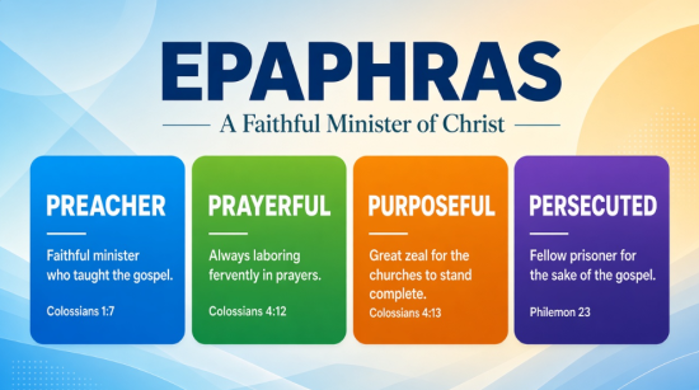
Epaphras Preacher, Prayerful, Purposeful, and Persecuted
The New Testament gives us a strong picture of Epaphras in just a few verses. He appears in Colossians 1:7-8, Colossians 4:12-13, and Philemon 23. From these passages alone we see a man who lived as a faithful servant of Christ.
Epaphras was a PREACHER. “As ye also learned of Epaphras our dear fellowservant, who is for you a faithful minister of Christ;” (Col 1:7).
The Colossians learned the grace of God in truth from him. He brought them the gospel. He also reported their love in the Spirit to Paul and those with him. The word reached Colossae through this man’s faithful work. He did not invent a message. He delivered the truth about Christ.
Epaphras was a PRAYERFUL man. “Epaphras, who is one of you, a bondservant of Christ, greets you, always laboring fervently for you in prayers, that you may stand perfect and complete in all the will of God” (Col 4:12).
Paul writes that he was always laboring fervently for the Colossian brethren in prayers. His goal in prayer was clear. He asked that they might stand perfect and complete in all the will of God. This was not occasional prayer. It was constant and intense. He cared deeply about their spiritual growth and full obedience to God’s will.
Epaphras was PURPOSEFUL. “For I bear him witness that he has a great zeal for you, and those who are in Laodicea, and those in Hierapolis” (Col 4:13).
His zeal reached beyond one group of believers. Paul bore witness that he had great zeal for the saints in Colossae, and also for those in Laodicea and Hierapolis. He wanted the churches to stand firm and complete. His purpose matched the will of God revealed in the gospel. He worked and prayed so that the brethren would grow to maturity in Christ.
Epaphras was PERSECUTED for the sake of the gospel. “There salute thee Epaphras, my fellowprisoner in Christ Jesus” (Philemon 23).
Paul calls him his fellow prisoner in Christ Jesus. He shared bonds with the apostle. Faithfulness to the message of Christ brought hardship. Yet he continued as a servant of Christ even while imprisoned.
These four marks stand on the plain statements of Scripture. Epaphras preached the gospel as a faithful minister. He prayed with fervent labor for the perfection of the saints. He showed purposeful zeal for multiple congregations. He suffered as a prisoner for Christ. No extra details are added. The record is short, but it is complete and true.
“Blessed be the God and Father of our Lord Jesus Christ, who hath blessed us with all spiritual blessings in heavenly places in Christ” (Eph 1:3)
One of the spiritual blessings for those who have obeyed the gospel is that we are now kingdom citizens.
Some say that the kingdom of Christ has not come, and that we’re still waiting for Jesus to set up His Kingdom. The bible tells a different story.
First, the Kingdom Jesus said would come did come on Pentecost. “And he said unto them, Verily I say unto you, That there be some of them that stand here, which shall not taste of death, till they have seen the kingdom of God come with power.” (Mark 9:1; cf. Matthew 16:28; Luke 9:27)
This was fulfilled at Pentecost when the Holy Spirit was poured out with power and the apostles began preaching Christ crucified and raised: Acts 1:8 “ye shall receive power, after that the Holy Ghost is come upon you”; (Acts 2:1-4, 16-21, 32-36). Peter declared that Jesus, raised and exalted, had poured out what was seen and heard, and that God had made Him both Lord and Christ (Acts 2:33-36). The gospel of the kingdom was to be preached, and the power of God unto salvation is the gospel itself (Romans 1:16; cf. Matthew 24:14).
CHRIST IS REIGNING NOW: “For he must reign, till he hath put all enemies under his feet.” (1 Cor 15:25). This reign continues until the end, when He delivers the kingdom to God the Father (1Cor 15:24-28).
All authority has already been given to Him: “All power is given unto me in heaven and in earth.” (Matthew 28:18). He is seated at the right hand of God (Acts 2:33-36; Hebrews 1:3, 13; 8:1; 10:12-13; 12:2), far above all principality and power (Ephesians 1:20-22), and is “the head over all things to the church, which is his body” (Ephesians 1:22-23).
Second, all those who are in Christ have been translated “ into the kingdom of his dear Son” (Colossians 1:13). Entrance is through being in Christ: “For as many of you as have been baptized into Christ have put on Christ.” (Galatians 3:27). Those in Christ are new creatures (2Cor 5:17) and have redemption through His blood (Colossians 1:14). Paul tells the church at Philippi, “For our conversation [citizenship] is in heaven; from whence also we look for the Saviour, the Lord Jesus Christ.” (Philippians 3:20). Believers are “fellowcitizens with the saints, and of the household of God” (Ephesians 2:19) after being made nigh by the blood of Christ (Ephesians 2:13). The same people are described as having been called “unto his kingdom and glory” (1Thess 2:12) and as receiving “a kingdom which cannot be moved” (Hebrews 12:28).
Three, the promise to build the church is immediately linked with the keys of the kingdom. Jesus told Peter “I will build My church.” Then He said, “And I will give unto thee the keys of the kingdom of heaven: and whatsoever thou shalt bind on earth shall be bound in heaven: and whatsoever thou shalt loose on earth shall be loosed in heaven” (Matthew 16:18-19). The same authority opens the kingdom to those who obey (Acts 2:38-41, 47 “the Lord added to the church daily such as should be saved”).
Those who have obeyed the gospel (hearing, believing, repenting, confessing Christ, and being baptized into Christ—Romans 10:9-10, 17; Acts 2:38; 8:35-39; 22:16; Galatians 3:26-27) are delivered from darkness and translated into the kingdom of the Son.
They now live as citizens under the present reign of Jesus Christ, members of His body the church, awaiting the final delivery of the kingdom to the Father.
No future establishment of the kingdom is required; the Scriptures cited show it has come with power, Christ is reigning, and the transferred people constitute its citizens now. The language of a future kingdom makes Jesus a liar and a failure. We serve a King (1Tim 6:15) who did not fail, did not lie, and given us a new and living way (Heb 10:20).
“Blessed is the man that walketh not in the counsel of the ungodly, nor standeth in the way of sinners, nor sitteth in the seat of the scornful. But his delight is in the law of the LORD; and in his law doth he meditate day and night. And he shall be like a tree planted by the rivers of water, that bringeth forth his fruit in his season; his leaf also shall not wither; and whatsoever he doeth shall prosper.” (Psalms 1:1-3)
We all know someone who seems to meet every standard of goodness that human opinion can invent.
I can recall a person in my life who left an impression of goodness, kindness, generosity, and made me feel special just for being me. Some things I recall about them is that they were believers in God, prayerful, and had a good reputation among all. This kind person lit up every room they entered, and nearly everyone smiled and was glad to see them.
If you were to ask my opinion back then I would say these folks exemplified someone bound for heaven. If anyone was ready for heaven it would be them.
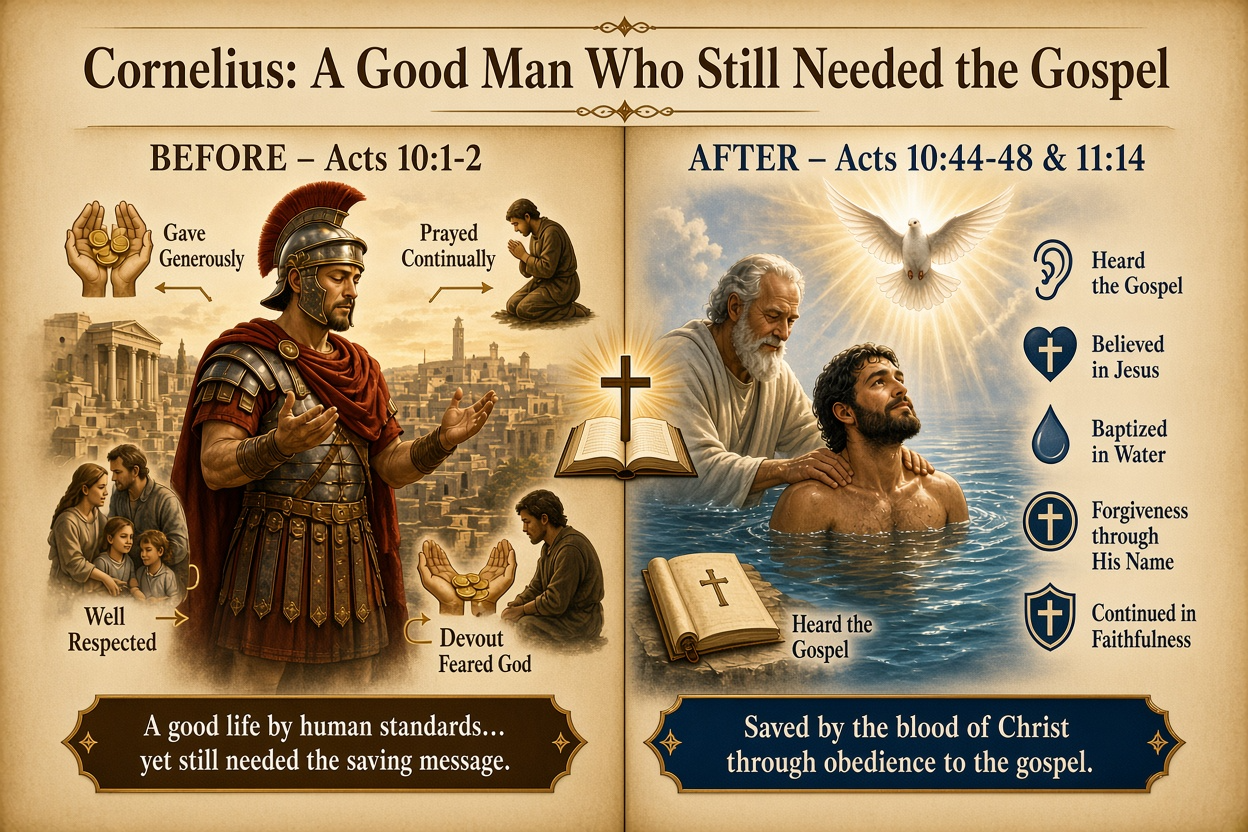
A similar real person appears in the pages of Scripture. Acts 10 and 11 tell us of a man named Cornelius, a centurion of the Italian cohort stationed in Caesarea. The text states that he was a devout man who feared God with all his household, gave alms generously to the people, and prayed continually to God. The report about him among men was, “a just man, and one that feareth God, and of good report among all the nation of the Jews…” (Acts 10:22). Left to us that would be the whole of the story. That would be our eulogy at his funeral had he died before the rest of the events in Acts 10 & 11.
An angel of God appeared to him and said that his prayers and alms had ascended as a memorial before God. The angel directed him to send men to Joppa for Simon who is called Peter. Cornelius obeyed at once. When Peter arrived, Cornelius gathered his relatives and close friends to hear the message. Peter would relate later what Cornelius told him, “how he had seen an angel standing in his house, who said to him, ‘Send men to Joppa, and call for Simon whose surname is Peter, who will tell you words by which you and all your household will be saved’” (Acts 11:13-14). You see, the angel told him he needed to hear words to be SAVED.
Peter proclaimed Jesus of Nazareth: how God anointed Him with the Holy Spirit and with power, how He went about doing good and healing, how He was put to death and raised on the third day, and how God appointed Him to be judge of the living and the dead. Peter declared that to Him all the prophets bear witness that everyone who believes in Him receives forgiveness of sins through His name. He preached the Gospel (v38-43).
While Peter was still speaking these words, the Holy Spirit fell on all who heard the message. The circumcised believers who had come with Peter were amazed because the gift of the Holy Spirit had been poured out even on the Gentiles. They heard them speaking in tongues and extolling God. “And as I began to speak, the Holy Spirit fell upon them, as upon us at the beginning” (Acts 11:15-16). This outpouring served as clear evidence that God was accepting the Gentiles.
Peter then asked “Can any man forbid water, that these should not be baptized,” (Acts 10:47). He commanded them, “to be baptized in the name of the Lord” (v48). Cornelius heard that message, believed in Jesus, and was baptized in water. He and his household continued thereafter in the way of the Lord.
The account leaves no room for doubt. Despite the genuine devotion, generous alms, continual prayer, and godly fear that marked Cornelius’s life, he still needed to hear the words by which he would be saved. Human reasoning might have concluded that such a person already stood accepted. Scripture records otherwise. The gospel required hearing about Jesus, believing in Him for the forgiveness of sins, and being baptized in water. The Holy Spirit’s descent confirmed God’s acceptance of the Gentiles, yet water baptism still followed as the commanded completion of faith.
We must not confuse a good life with having earned or owed salvation. A life filled with generosity, prayer, and respect may impress others, yet it cannot purchase forgiveness. We all need the blood of Christ. Nobody is saved outside of Christ, no matter how good we think they are. The same truth applies to the kind person I talked about at the beginning.
No matter how generous, prayerful, respected, or devout that individual may seem, the same need remains. Romans 3:23 states that “all have sinned and fall short of the glory of God.” Character that impresses people does not remove the requirement to hear the gospel of Jesus Christ, believe in Him, be baptized in water, and continue in faithfulness.
Cornelius’s story stands as a clear demonstration that even the most admirable life by human standards still requires obedience to the message that saves through the blood of Christ.
“Herein is my Father glorified, that ye bear much fruit; so shall ye be my disciples.” (John 15:8)
One morning Jesus felt hungry and saw a fig tree full of green leaves by the road. It looked healthy and promising. But when He got closer, there was no fruit at all. The tree had leaves but nothing to give. Jesus said to the tree, “May no one ever eat fruit from you again.” The next day the disciples saw that the whole tree had withered from the roots.
That story is not just about a tree. It is about us. Jesus wants real fruit in our lives, not just the look of it. The Father cuts off branches that do not bear fruit, and He prunes the ones that do so they bear even more. Jesus is straight with us. He expects fruit.
What does this fruit look like? The Bible shows it in how we live every day. It is love, joy, peace, patience, kindness, goodness, faithfulness, gentleness, and self-control. These are not just nice feelings. They show up in actions. When someone needs help, we give it. When anger rises, we choose peace. When people are lost, we point them to Jesus. Fruit is not just church attendance or looking spiritual on the outside. The fig tree had plenty of leaves. It looked good from far away. But up close it offered nothing. Jesus judged it for that.
Do we live like that fig tree today? We go through the motions. We say the right words and wear the right smile. From a distance we look like strong Christians. But inside there is no real fruit. No changed heart. No love that costs us something. No time spent helping others know God. Jesus notices. He still walks up close and checks for fruit. The withering of the fig tree shows us that empty religion does not last. God wants genuine life flowing from us.
The scary part is what happens when we stay empty. The fig tree withered because it had nothing to offer when the time came. Jesus expects fruit in season. Life brings moments when people around us need spiritual food. A friend loses hope. A neighbor wonders about God. A stranger feels empty inside. They look for something real. If they turn to us, what will they find? Will there be love that listens? Will there be truth from God’s word that gives life? Or will they walk away still hungry because we only had leaves?
The story of the fig tree is a warning but also a hope. Jesus did not leave His disciples confused. Right after the tree withered, He taught them about faith and prayer. He is always near for help to bear fruit. He is ready to supply what we need to bear fruit (2Cor 9:10).
Let us take this seriously. Let us stay connected to the true Vine every single day. When spiritually hungry people look our way, may they find real fruit. May they taste the goodness of God through our lives and want more of Jesus. The world is full of empty trees. Let us be different. Let us be branches full of life that feed those who need it most. This is from God’s word. The choice is ours. Will we bear fruit that lasts?
“So Joshua did as Moses had said to him, and fought with Amalek: and Moses, Aaron, and Hur went up to the top of the hill. And it came to pass, when Moses held up his hand, that Israel prevailed: and when he let down his hand, Amalek prevailed. But Moses’ hands were heavy; and they took a stone, and put it under him, and he sat thereon; and Aaron and Hur stayed up his hands, the one on the one side, and the other on the other side; and his hands were steady until the going down of the sun. And Joshua discomfited Amalek and his people with the edge of the sword.” (Exodus 17:10-13)
This scene unfolds early in the Exodus journey. Little is recorded about Hur except here and in Exodus 24, where he appears alongside Aaron. In the heat of the first battle after leaving Egypt, Hur stood faithfully on the hilltop with Moses and Aaron while Joshua fought below.
When Moses’ hands grew heavy as he lifted them (he was holding them up so Joshua would prevail), Hur and Aaron stepped in. They held his arms up, one on each side, through the entire day until sunset. Because of their support, Moses’ hands remained steady, and Israel triumphed.
Helping Weary Hands Leaders grow tired. Even Moses, who confronted Pharaoh and parted the Red Sea, reached a point of exhaustion. Hur shows us that one meaningful way to serve is by lifting what another can no longer hold alone. In daily life, this means encouraging a weary spouse, supporting an overburdened leader, or helping a friend through a difficult season. You do not need a title or spotlight. Quiet support can help another endure through whatever battle rages.
Staying by Their Side Through the Length of the Day Hur did not offer a quick boost and leave. He stayed until the sun went down. The battle lasted all day, and his presence remained steady and reliable. True support requires endurance and unwavering commitment. In a world quick to give temporary encouragement, Hur models consistent loyalty. Whether the season is long or the struggle intense, staying nearby can make all the difference.
Remaining Steady So the One Helped Remains Steady The Scripture notes that Moses’ hands were steady because Aaron and Hur held them up. Their strength created stability for Moses, which brought victory for the entire nation. When we help others remain steady, the impact can multiply beyond the one being steadied. Our faithfulness can lead to greater victories.
Be a Hur in Someone’s Battle Hur never led the army or stood in the spotlight like Moses. Yet his quiet strength proved essential. From his example we may want to ask: Whose hands can I help hold up today?
Look around. Someone near you may be growing weary. You can be the steady presence that keeps their hands and heart lifted. Let’s learn from Hur to serve humbly, stay faithfully, and hold steady until the end. Your quiet faithfulness matters in the eyes of God. Go and be a Hur.
Producing Fruit in Keeping with Repentance “Herein is my Father glorified, that ye bear much fruit; so shall ye be my disciples.” (John 15:8)
John the baptizer told the Pharisees, “Bring forth therefore fruits meet for repentance” (Matt 3:8).
What are the “Fruits Worthy of Repentance?” The simple answer is that it means to produce visible, ongoing evidence of an ongoing unity with Christ, in a Christlike character, in obedience (especially love), and a life that glorifies (points toward) God through abiding (keeping His commands) in Him. It also includes being profitable (useful) to Him in His ultimate purpose that “all men to be saved, and to come unto the knowledge of the truth” (1Tim 2:4).
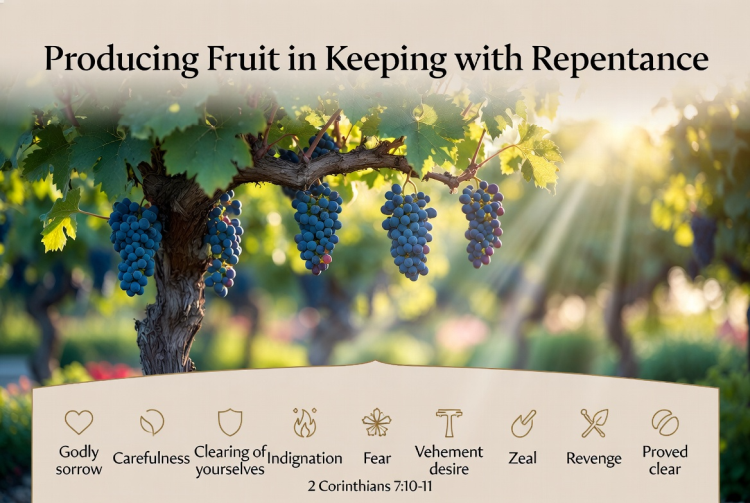
Repentance always begins in the heart. We can’t read hearts, but the Holy Spirit has given an example of true and complete repentance from the heart as seen in the church at Corinth. They had need of repentance, the specifics of the charges and their repentance can be found by studying 1Corinthians. In Paul’s 2nd letter they had taken steps to repent, and Paul expresses how complete and thorough that repentance was. “For godly sorrow worketh repentance to salvation not to be repented of: but the sorrow of the world worketh death. For behold this selfsame thing, that ye sorrowed after a godly sort, what carefulness it wrought in you, yea, what clearing of yourselves, yea, what indignation, yea, what fear, yea, what vehement desire, yea, what zeal, yea, what revenge! In all things ye have approved yourselves to be clear in this matter” (2Cor 7:10-11). Notice the 9 attitudes the church at Corinth displayed proving true repentance.
• “ye sorrowed after a godly sort” [lupeo, & theos] A deep, God-centered grief over sin, contrasted with worldly sorrow, which is self-focused. • “what carefulness it wrought in you, yea,” [spoudē] a diligent, active resolve to turn from sin and pursue obedience, rather than passive regret. • “what clearing of yourselves, yea,” [apologia] A strong desire to vindicate or clear one’s name and conscience by openly acknowledging the sin, taking responsibility, and demonstrating innocence going forward. • “what indignation, yea,” [aganaktēsis] Righteous anger or outrage, directed toward the sin itself, one’s own participation in it, and the damage it caused. • “what fear, yea,” [phobo] Reverential fear of God, awareness of His holiness, and a wholesome dread of sin’s consequences. • “what vehement desire, yea,” [epipothēsis] Intense, heartfelt longing for restoration to God, and to avoiding sin in the future. • “what zeal, yea,” [zēlos] It shows fervent enthusiasm and passionate commitment to God and His word as opposed to indifference. • “what revenge!” [ekdikēsis] A determined desire to see justice done by punishing (1Cor 5:4-5; 2Cor 2:6) or removing the evil involving self-discipline, and decisive action against sin in the church or personal life. • “In all things ye have approved (proved) yourselves to be clear in this matter.” [sunistao] A complete demonstration of innocence and purity in the matter through consistent, observable change.
Bringing forth fruit worth of repentance is first a change in heart and attitude along with decisive, and determined action. True repentance includes both.
Through faith, the writer of Hebrews tells us, some believers “subdued kingdoms, wrought righteousness, obtained promises, stopped the mouths of lions, quenched the violence of fire, escaped the edge of the sword.” Out of weakness they “were made strong, waxed valiant in fight, turned to flight the armies of the aliens.” Women “received their dead raised to life again.” Others, though, faced much darker days. They “were tortured, not accepting deliverance, that they might obtain a better resurrection.” Some went through “cruel mockings and scourgings,” through “bonds and imprisonment.” They “were stoned, they were sawn asunder,” and “slain with the sword.” These faithful people “wandered about in sheepskins and goatskins, being destitute, afflicted, tormented.” The world was not worthy of them. They wandered “in deserts, and in mountains, and in dens and caves of the earth.” And yet, “these all, having obtained a good report through faith, received not the promise.” It’s a powerful mix of triumph and terrible suffering, all held together by simple trust in God.
Could we endure like that?
Reading these lines makes me stop and wonder. The wins sound amazing. Who wouldn’t want to be part of stories where faith shuts the mouth of danger and turns the tide of battle? But then the tone shifts, and we see the cost. People choosing torture over compromise. Choosing a future hope over present relief. Living homeless and hunted, with nothing but their faith to keep them going.
We probably won’t face lions or flames in our everyday lives. Still, the question feels real. When smaller pressures come, when standing up for what’s right costs us friends or comfort or security, will we hold on? When answers don’t come quickly and the waiting gets heavy, can we keep believing there’s something better ahead?
These believers weren’t superhuman. What they had was a deep-rooted confidence that God is trustworthy, even when life hurts. They lived like this world isn’t the final chapter.
Can I honestly say I can do what they did? But the same God who carried them is the same God we hope in today. The real question is whether we’ll fix our eyes on Him and say He’s worth it, no matter what comes. Whether in the good days or the hard ones, may we run our part of the race, looking to Jesus, with the same quiet faithfulness (12:1-3). One day, faith will become sight, and all the waiting will have been worth it.
The writer concludes “God having provided some better thing for us, that they without us should not be made perfect.” The picture is that they will receive the promise when we receive the promise in Christ. The faithful from yesterday and the faithful today will share in the same perfect blessing in Christ.
“Herein is my Father glorified, that ye bear much fruit; so shall ye be my disciples.” (John 15:8)
The Apostle Paul writes about bearing fruit, comparing our former lives to our new life having been baptized into Christ.
“For when ye were the servants of sin, ye were free from righteousness. What fruit had ye then in those things whereof ye are now ashamed? for the end of those things is death. But now being made free from sin, and become servants to God, ye have your fruit unto holiness, and the end everlasting life. For the wages of sin is death; but the gift of God is eternal life through Jesus Christ our Lord” (Romans 6:20-23).
In this passage he had reminded the saints in Rome they had died to sin when they were baptized into the death of Christ. “How shall we, that are dead to sin, live any longer therein? Know ye not, that so many of us as were baptized into Jesus Christ were baptized into his death? Therefore we are buried with him by baptism into death: that like as Christ was raised up from the dead by the glory of the Father, even so we also should walk in newness of life” (vss 2-4).
What does all of this mean for us today? Prior to obeying the gospel the fruit of our shameful lives was leading to death (eternal separation from God Isaiah 59:2). Do you remember Romans chapter one? “Who knowing the judgment of God, that they which commit such things are worthy of death, not only do the same, but have pleasure in them that do them” (Rom 1:32). Read that whole chapter and see those shameful things worthy of death. Recall what Paul wrote to the church at Corinth; “Know ye not that the unrighteous shall not inherit the kingdom of God? Be not deceived: neither fornicators, nor idolaters, nor adulterers, nor effeminate, nor abusers of themselves with mankind, Nor thieves, nor covetous, nor drunkards, nor revilers, nor extortioners, shall inherit the kingdom of God. And such were some of you: but ye are washed, but ye are sanctified, but ye are justified in the name of the Lord Jesus, and by the Spirit of our God” (1Corinthians 6:9-11).
Here’s the comfort: Those who have been baptized into Christ’s death, for the forgiveness of sins, have put on Christ, and have the circumcision of the heart by the working of God, have been set free from sin, and are now on that narrow path that leads to eternal life as servants of God!* We have been washed, we are sanctified, we are justified in the name of the Lord Jesus, and by the Spirit of our God.
“I am the vine, ye are the branches: He that abideth in me, and I in him, the same bringeth forth much fruit: for without me ye can do nothing” (John 15:5).
Today is the first day of summer. While we in Texas thought it already began, it’s officially today.
I find it interesting that last winter I complained about the cold, and now I’m complaining about the heat. I guess I’m shocked by each season’s weather. Perhaps it’s just me?
Spiritually speaking, the seasons are there for our benefit. Paul told those in Lystra about God and His seasons, “Nevertheless He did not leave Himself without witness, in that He did good, gave us rain from heaven and fruitful seasons, filling our hearts with food and gladness” (Acts 14:17).
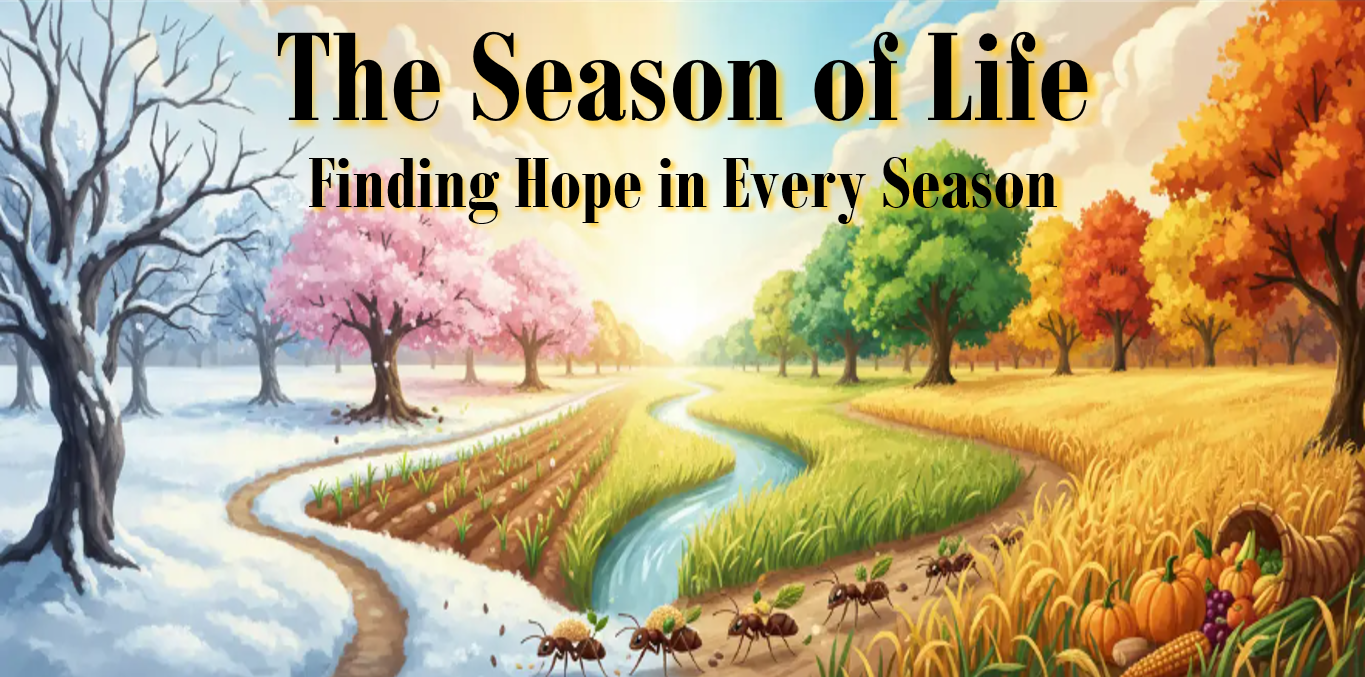
God’s regulated creation gives us constancy in our lives which allows us to live, plan, and grow. If nature did not have this constant regularity we could not survive. The seasons have their order and their purpose. There is WINTER (preparation), which every single time is followed by SPRING (planting), bringing us back to SUMMER (cultivation) after which is AUTUMN (harvesting). Every human everywhere can count on the seasons (within their regions). These seasons, a part of God’s overall creation, is there for us, for our health, and for our spiritual well-being. “For the invisible things of him from the creation of the world are clearly seen, being understood by the things that are made, even his eternal power and Godhead; so that they are without excuse” (Romans 1:20; cf Matt 5:45).
Other parts of God’s creation teach us about the seasons of life, “Go to the ant, you sluggard! Consider her ways and be wise…Provides her supplies in the summer, And gathers her food in the harvest” (Prov 6:6-8). Ants are all in all the time. They Never quit, and they take advantage of every season in its TIME.
Other scriptures give us spiritual lessons through the physical seasons. The law of Sowing & Reaping is a powerful lesson both physically and spiritually. Let us be Sowing & or Reaping in its proper season.
The famous passage in Ecclesiastes 3 teaches us the seasons of life have a certain opportunity, “To everything there is a season, A time for every purpose under heaven” (Ecc 3:1). We often view these negatively (read most times at funerals), but that view overlooks the opportunities available in every season of life, both the positive and the negative.
A lesson for me from the seasons and its regularity is to never give up when you’re in one particularly hard season. Winter reminds me of death and sadness. When we lived in Alaska we were warned about cabin fever. That’s when folks experience the distressing irritability, restlessness, and anxiety from being confined inside during the harsh subzero weather and prolonged darkness. Never let one hard season ruin all the seasons.
We need to stay strong and remember that SPRING follows every WINTER. It might be hot today, but very soon we’ll enjoy the beautiful cooler Autumn weather. But I haven’t been talking about weather.




 Borger church of Christ @ Franklin & Juniper