
Why some don’t Read the Bible

Why don’t people read the Bible?

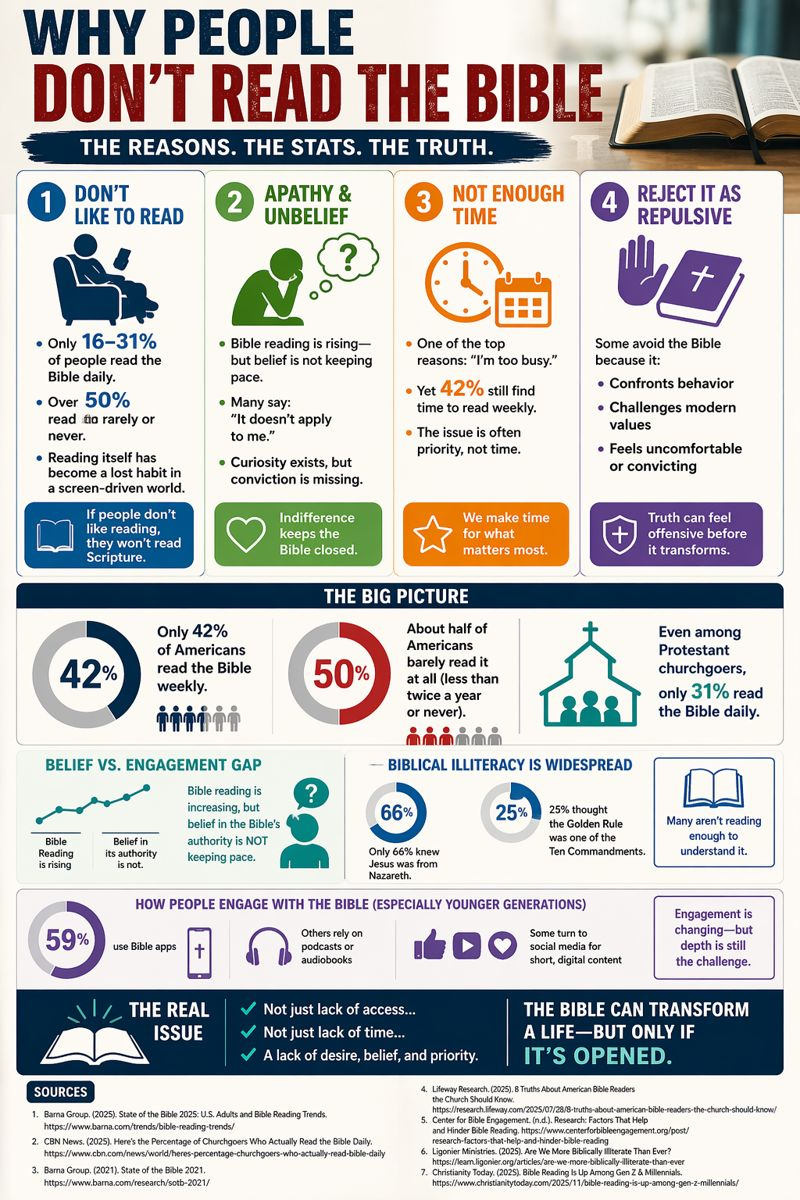
They DON’T like to read.

they’re APATHETIC & have unbelief

Not ENOUGH time to read.

They Reject it because it’s too REPULSIVE.

For a book that has shaped history, guided nations, and transformed lives, the Bible often sits unopened. The reasons are not always complex—but they are revealing.

First, some simply don’t like to read. In a fast-paced world driven by screens and short attention spans, reading itself feels like a chore. The Bible, with its length and depth, can seem especially intimidating. For those who already avoid reading, opening Scripture rarely becomes a priority.

Jesus answered and said unto them, Ye do err, not knowing the scriptures, nor the power of God. (Matthew 22:29)

Others struggle with apathy and unbelief. If someone doubts the Bible’s relevance or truth, motivation quickly fades. It becomes easy to think, “It doesn’t apply to me,” or “I don’t believe it anyway.” This quiet indifference can be more powerful than outright rejection, because it removes any urgency to explore what the Bible actually says.

He that rejecteth me, and receiveth not my words, hath one that judgeth him: the word that I have spoken, the same shall judge him in the last day.” (John 12:48)

A common excuse is lack of time. Life fills up with work, responsibilities, family, and constant distractions. Yet this reason often reveals more about priorities than availability. People tend to make time for what they value. When the Bible is seen as optional, it is often the first thing pushed aside.

And these are they which are sown among thorns; such as hear the word,
And the cares of this world, and the deceitfulness of riches, and the lusts of other things entering in, choke the word, and it becometh unfruitful
.” (Mark 4:18)

Finally, some reject the Bible because they find it repulsive. Certain passages challenge modern values, confront personal behavior, present difficult truths, and in some cases are gruesome to them. Rather than wrestle with these tensions, some choose to dismiss the message entirely. Conviction can feel uncomfortable, and avoidance becomes the easier path.

For whatsoever things were written aforetime were written for our learning, that we through patience and comfort of the scriptures might have hope.” (Romans 15:4)

These reasons—dislike of reading, apathy, busyness, and rejection—may differ on the surface, but they share a common thread: they keep people from engaging with something that has the power to shape their lives. Understanding these barriers is the first step toward overcoming them.

My people are destroyed for lack of knowledge: because thou hast rejected knowledge, I will also reject thee, that thou shalt be no priest to me: seeing thou hast forgotten the law of thy God, I will also forget thy children.” (Hosea 4:6)

What’s your reason?

agape

spencer
Leadership without Humility

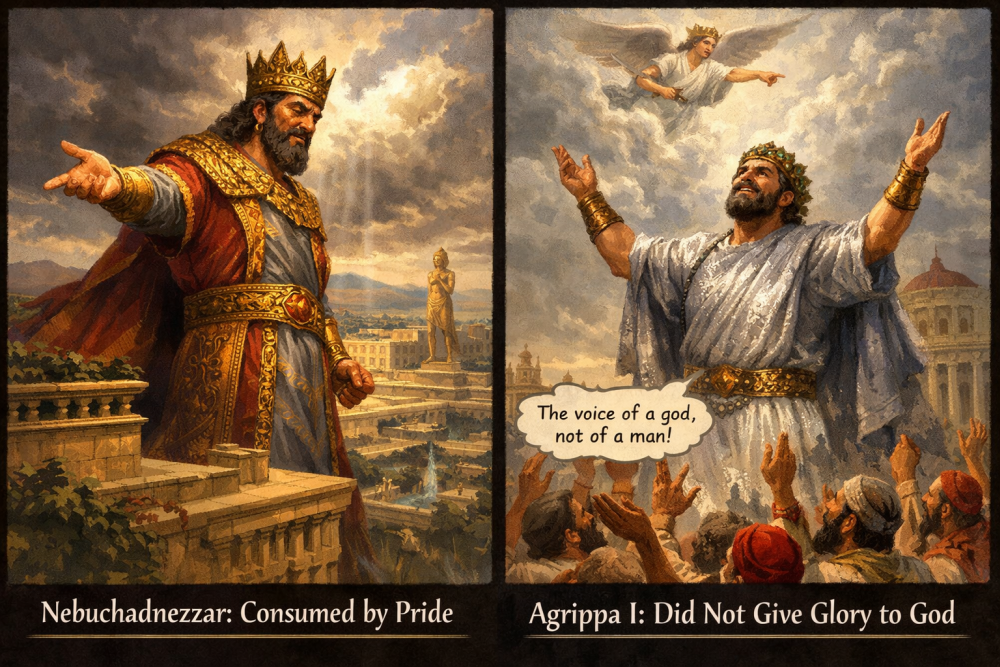
Nebuchadnezzar & Agrippa I: Leadership Without Humility

The Bible does not shy away from showing the consequences when leaders forget their place before God. Two striking accounts—one from the Old Testament and one from the New—illustrate a timeless warning: when earthly rulers exalt themselves or accept the exaltation of others, the outcome is always ruinous. These stories serve as sober reminders for any generation about the perils of pride in positions of power.

King Nebuchadnezzar of Babylon stands as a vivid example of self-aggrandizement. After great military victories, he erected a massive golden image and commanded all his subjects to bow down and worship it under penalty of death (Daniel 3). His pride reached its peak when he boasted of his own achievements while surveying his magnificent city: “Is not this the great Babylon I have built as the royal residence, by my mighty power and for the glory of my majesty?” (Daniel 4:30). A divine warning had come in a dream, urging him to acknowledge that “the Most High is sovereign over all kingdoms on earth and gives them to anyone he wishes” (Daniel 4:17). Yet he refused to humble himself. As judgment, he was driven away from people, lived like a wild animal, eating grass, with his body drenched by the dew of heaven, until seven times passed over him. Only after he lifted his eyes to heaven and praised the Most High God was his sanity and kingdom restored (Daniel 4:34-37). The lesson is clear: God opposes the proud, and no leader, no matter how powerful, can claim glory that belongs to God alone.

A different but equally sobering example appears in the New Testament with King Herod Agrippa I. After a period of persecution against the early church, Herod delivered a public address in Caesarea. The people, seeking his favor, shouted, “This is the voice of a god, not of a man!” (Acts 12:22). Herod did not rebuke the flattery or redirect the praise to the living God. Instead, he accepted it in silence. Immediately, “an angel of the Lord struck him down, because he did not give God the glory, and he was eaten by worms and died” (Acts 12:23). His end was swift, painful, and public. The contrast is striking: where Nebuchadnezzar actively demanded worship, Herod passively allowed it. In both cases, the failure to humble oneself before God brought severe judgment.

These two accounts reveal a common pattern. Leadership without humility inevitably leads to idolatry—either self-imposed or encouraged by followers. Whether a ruler builds his own monument to greatness or simply fails to correct those who offer divine honors, the result is the same: divine opposition. Scripture repeatedly emphasizes that “God opposes the proud but shows favor to the humble” (James 4:6; 1 Peter 5:5). Pride in high places does not merely affect the individual leader; it corrupts those under authority, distorts truth, and invites disorder and decay.

The Bible’s warning is therefore general and enduring. Any leader—whether in government, business, religion, or any sphere of influence—who forgets that all authority comes from God and who fails to give Him the glory due His name risks the same tragic trajectory. Nebuchadnezzar’s madness and Herod’s gruesome death stand as monuments to the truth that exaltation of self, whether bold or subtle, always precedes a fall. True leadership begins with the fear of the Lord and the recognition that “the Most High rules over the kingdom of men” (Daniel 4:17). Without such humility, even the mightiest throne becomes a path to humiliation.

May every person in authority—and every citizen who supports them—heed this ancient scriptural counsel: give glory to God alone, walk in humility, and reject every form of self-deification. For in the end, only God is worthy of worship, and He will not share His glory with another (Isaiah 42:8).

agape

spencer

Blood in God’s plan

Blessed be the God and Father of our Lord Jesus Christ, who hath blessed us with all spiritual blessings in heavenly places in Christ” (Eph 1:3)

As we continue to count our spiritual blessings in Christ, today is a fitting time to talk about the blessings we have in Christ through His blood. For us to appreciate the full impact of this blessing, we need to go back and see the impact of blood in the Old Testament.

The first implied reference to blood appears in Genesis 3, when God took animal skins to cover Adam and Eve after their sin. “Unto Adam also and to his wife did the LORD God make coats of skins, and clothed them” (Gen 3:21).

The next reference we find in the scene with Cain and Abel. Abel made an offering to the Lord from the firstlings of his flock. It says, “And the LORD had respect unto Abel and to his offering” (Gen 4:4; cf. Heb 11:4). Three things stand out: first, that Abel gave the ‘firstling’; second, that it was the shedding of blood; and third, he offered it by faith (Heb 11:4).

We see animal sacrifices continue throughout Genesis, often involving the building of an altar and the offering of clean animals as burnt offerings. They emphasize faith, obedience, thanksgiving, or covenant relationship. When we get to Abraham we see another important element. Initially, his son Isaac was to be offered as a burnt offering, but God provided a ram caught in a thicket, which Abraham sacrificed in his son’s place. This event is seen as a foreshadowing of substitutionary sacrifice. “And Abraham lifted up his eyes, and looked, and behold behind him a ram caught in a thicket by his horns: and Abraham went and took the ram, and offered him up for a burnt offering in the stead of his son. And Abraham called the name of that place Jehovahjireh (the LORD will see to it [will provide]): as it is said to this day, In the mount of the LORD it shall be seen” (Gen 22:13-14).

In Exodus God turned the waters of the Nile to blood and commanded the Israelites to apply blood to the doorposts and lintel during the final plague. This Passover event powerfully foreshadows the sacrifice of Christ. Jesus Himself used the elements of the Passover meal as symbols of His body and blood: “And as they were eating, Jesus took bread… this is my body… For this is my blood of the new testament, which is shed for many for the remission of sins” (Matt 26:26-28).

Another notable instance of the use of blood is at the dedication of the tabernacle. Blood was used—along with oil—to consecrate both the tabernacle and the priests setting them apart as holy for God’s service. Moses applied blood to the horns of the altar to purify it (Lev. 8:15), and he placed blood on the right ear, thumb, and big toe of Aaron and his sons before sprinkling them and their garments with a mixture of blood and oil (Lev. 8:23–24, 30; see also Ex. 29:12, 20-21, 36–37).

Blood plays a central role in God’s plan of redemption.

Agape
spencer

BLOOD

And almost all things are by the law purged with blood; and without shedding of blood is no remission.

(Hebrews 9:22)

For the life of the flesh is in the blood: and I have given it to you upon the altar to make an atonement for your souls: for it is the blood that maketh an atonement for the soul. (Leviticus 17:11)