Let’s Talk about Jesus, the Joy Giver

We have no need of a season to talk about our Lord. Let it be continually on the tip of our tongue. While everyone around us is scurrying to find a reason for the season, we already have reason to rejoice.

Let’s talk about Jesus” will be the theme of the next several articles. It’s not because I desire to put Christ back into Christmas, He never really was part of that holiday. I write about things that are already on people’s minds, and perhaps we can persuade them to look into the True Jesus of the Bible (2Cor 11:4).

Since this is the season of giving and joy, in this first article Let’s talk about Jesus as being the Real Joy Giver. To do that we will look at the JOYS in Jesus from the book of Philippians.

This book is described as the book of Joy. Over and over, we can see the words “Joy” & “rejoice.”  This book is also one of the “prison epistles” of Paul, which makes those words even more astounding.

Let’s talk about the JOYS of Jesus.

JESUS IS PREACHED. While Paul was imprisoned for the cause of Christ (1:13), he found joy because JESUS was being preached. “What then? notwithstanding, every way, whether in pretence, or in truth, Christ is preached; and I therein do rejoice, yea, and will rejoice” (1:18). Some preached Christ out of insincerely, and out of contention, seeking to add to Paul’s bonds. While others preached Jesus out of Love and Good will. Paul rejoiced that Jesus is preached, and that many brethren had grown bolder. They preached boldly the word of Jesus without fear (1:14).

We can rejoice today knowing that Jesus is being preached. Certainly, many preach from error, but I see it as an opportunity to preach boldly the word of Jesus from sincerity and truth. Instead of taking the negative nelly approach, we can ask friendly questions to help folks think accurately about the truth. One was is to ask about the birth story of Christ. Here are a couple of ice-breaker questions to Preach Jesus more accurately (cf. Acts 8:26).

How many wise men are listed in the nativity story (Matt 2:1-12)?

How old was Jesus when the wise men came to Him (Matt 2:11-16)?

Open up your bible and show the answers to these questions. Perhaps a deeper discussion will occur because we were bold to preach Jesus.

ONE MIND IN CHRIST. Paul called for the Joy of having unity, ONE MIND in CHRIST. “If there be therefore any consolation in Christ, if any comfort of love, if any fellowship of the Spirit, if any bowels and mercies, Fulfil ye my joy, that ye be likeminded, having the same love, being of one accord, of one mind. Let nothing be done through strife or vainglory; but in lowliness of mind let each esteem other better than themselves” (Phil 2:1-3). Joy would be made complete when we have the same LOVE, being of one ACCORD (harmony), and of one MIND.

Does it bring you Joy to know that there are others out there who have come to the same conclusions when they read and study the truth for themselves? While the world is on a mission to have contrarian view points on everything, there is Joy in the church when folks from different backgrounds and walks of life come together in Unity having learned the truth and obey it. “Endeavouring to keep the unity of the Spirit in the bond of peace. There is one body, and one Spirit, even as ye are called in one hope of your calling; One Lord, one faith, one baptism, One God and Father of all, who is above all, and through all, and in you all” (Eph 4:2-6).

When we talk with folks about our faith with joy, we might meet someone who is coming to the same conclusions. Part of my evangelism is around seeking seekers. I’ve met several folks (pray for the seed to grow) who have started to question the practices in their religion. 

YOU AND I ARE TO REJOICE IN THE LORD. Paul continued to write about joy even as he gave warning about false teachers. “Finally, my brethren, rejoice in the Lord. To write the same things to you, to me indeed is not grievous, but for you it is safe. Beware of dogs, beware of evil workers, beware of the concision” (Phil 3:1-2). It seems a bit odd to rejoice in the midst of false teachers, but as you read you will see that it makes perfect sense. Because we know the truth, and how to recognize error, we can have Joy and Rejoice knowing that we have a home in heaven! “For our conversation is in heaven; from whence also we look for the Saviour, the Lord Jesus Christ: Who shall change our vile body, that it may be fashioned like unto his glorious body, according to the working whereby he is able even to subdue all things unto himself” (Phil 3:20-21).

While we still have the same problem today, let us rejoice in the fact we have the wisdom to recognize it, and that we have God’s word available to show the truth to others.

STRENGTHENED BY CHRIST. Paul could rejoice in all of these seemingly difficult obstacles to the cause of Christ because he drew his strength from Christ. “I can do all things through Christ which strengtheneth me” (4:13). He wasn’t saying that he could do whatever he wanted through Christ. He was saying that he could be strengthened to endure all the hardships of preaching Jesus as an Apostle and evangelist through Christ.

While we’re surrounded by a vexing world (2Pet 2:7-9), we can have the same joy and strength through the truth of God’s word. We can have joy because we have heard the truth, believed the truth, and obeyed the truth. We can have joy knowing that our names are written above in the Lamb’s book of life.

And I intreat thee also, true yokefellow, help those women which laboured with me in the gospel, with Clement also, and with other my fellowlabourers, whose names are in the book of life. Rejoice in the Lord alway: and again I say, Rejoice (Phil 3:3-4).

Agape,

Spencer is an evangelist for the Franklin & Juniper st church of Christ in Borger, Tx.

This is part of a series of articles about reasons to Talk About Jesus.
Rejoice Always, Phil 4:4

There is a direct command in scripture that is often overlooked by even the most zealous Saint. “Rejoice in the Lord alway: and again I say, Rejoice.” (Phil 4:4).

It is a discriminating command. In matters of the Lord of what does an alien sinner have to rejoice? All spiritual blessings are “in Christ” (Eph 1:3), and only those that have obeyed the Gospel are in the Lord (Gal 3:26-27). Those that have obeyed the Gospel are the only ones that have reason to rejoice (Acts 8:37).

The command is discriminating in that it also excludes rejoicing in the flesh (Phil 3:3,7). It excludes rejoicing in the wisdom of the world (1Cor 1:20-21). It also excludes rejoicing in one’s own works (Titus 3:5; Is 64:6). We are to work God’s righteousness (Acts 10:34-35; Rom 10:1-3).

By the words of some one is led to wonder if Christians are aware of this command to rejoice.

Let us see about what it means to rejoice always in the Lord.

ALWAYS” tells us it is a perpetual command without regard to external conditions. The Apostle Paul wrote this by inspiration while imprisoned in Rome for his faith. This epistle has been called the epistle of joy, for it contains the words “joy,” “rejoice,” or “rejoicing” some sixteen times.

The command is without regard to Adversity or Prosperity. “Yea, and if I be offered upon the sacrifice and service of your faith, I joy, and rejoice with you all. For the same cause also do ye joy, and rejoice with me” (Phil 2:17-18). Paul is able to rejoice in adversity because it was in service to Christ. “But I have all, and abound: I am full, having received of Epaphroditus the things which were sent from you, an odour of a sweet smell, a sacrifice acceptable, wellpleasing to God” (Phil 4:18).

The command is without regard to being Loved or Hated. “The one preach Christ of contention, not sincerely, supposing to add affliction to my bonds: But the other of love, knowing that I am set for the defence of the gospel. What then? notwithstanding, every way, whether in pretence, or in truth, Christ is preached; and I therein do rejoice, yea, and will rejoice” (Phil 1:16-18). Paul is able to rejoice despite the haters because Christ was being preached. “And I will very gladly spend and be spent for you; though the more abundantly I love you, the less I be loved” (2Cor 12:15).

The command is without regard to Weariness or Strength. “I know both how to be abased, and I know how to abound: every where and in all things I am instructed both to be full and to be hungry, both to abound and to suffer need. I can do all things through Christ which strengtheneth me” (Phil 4:12-13). Paul’s life in the Lord is marked by great adversity (2Cor 11:22-29), but it was from his pen the Holy Spirit wrote, “And let us not be weary in well doing: for in due season we shall reap, if we faint not” (Gal 6:9).

The command is without regard to Arrest or Among Friends. “But I would ye should understand, brethren, that the things which happened unto me have fallen out rather unto the furtherance of the gospel; So that my bonds in Christ are manifest in all the palace, and in all other places; And many of the brethren in the Lord, waxing confident by my bonds, are much more bold to speak the word without fear” (Phil 1:12-14). Paul could rejoice in his arrest and detainment because of the increased boldness of others to speak the gospel. Peter and John could rejoice for being beaten for the name of Christ. “And to him they agreed: and when they had called the apostles, and beaten them, they commanded that they should not speak in the name of Jesus, and let them go. And they departed from the presence of the council, rejoicing that they were counted worthy to suffer shame for his name” (Acts 5:41).

The command is without regard even for Your very life. “For to me to live is Christ, and to die is gain. But if I live in the flesh, this is the fruit of my labour: yet what I shall choose I wot not. For I am in a strait betwixt two, having a desire to depart, and to be with Christ; which is far better: Nevertheless to abide in the flesh is more needful for you.” (Phil 1:21-24). The life that one lives in the Lord prepares him for the appointment of death (Heb 9:27). “And I heard a voice from heaven saying unto me, Write, Blessed are the dead which die in the Lord from henceforth: Yea, saith the Spirit, that they may rest from their labours; and their works do follow them” (Rev 14:13). There is comfort in the death of faithful saints (1Thess 4:13-18). For them “to die is gain.”

The command is without regard to Sickness or Health. Paul could rejoice in the highs or lows of his physical life because of the grace of Christ. “Therefore I take pleasure in infirmities, in reproaches, in necessities, in persecutions, in distresses for Christ’s sake: for when I am weak, then am I strong” (2Cor 12:9-10). There was rejoicing for Epaphroditus despite his sickness because he didn’t regard his life to supply those things that were lacking from the church at Philippi. “I sent him therefore the more carefully, that, when ye see him again, ye may rejoice, and that I may be the less sorrowful” (Phil 2:28; cf, 25-30).

Rejoicing in the Lord always brings about many gratifying results. It is the means by which hope can be seen in the midst of adversity (cf. 1Pet 3:14-15). Rejoicing can put to death the PLAGUES of the mind. Rejoicing and negativity cannot coexist nor be done at the same time.

Rejoicing in the Lord always is the means by which our light can shine in this dark world. Our rejoicing in the Lord becomes a beacon of attraction to the lost and our religion will radiate a wholesome influence upon the lives of those around us. 

Rejoicing in the Lord always can do us no harm, but rather only bring about good, and in many ways will preserve our health and effectiveness.

Rejoicing in the Lord always is easy when we remember that our names are written in the heaven as we obey the Gospel of Christ. “And I intreat thee also, true yokefellow, help those women which laboured with me in the gospel, with Clement also, and with other my fellowlabourers, whose names are in the book of life” (Phil 4:3; Acts 2:38-41; Heb 12:23).

Agape,

Spencer

7 Plagues of the mind pt5

The last plague of the mind on our list is vacillation, or being like a See-Saw. This plague can be described as a person that is easily pulled away from one thing to another without being resolute on any one thing. This is a problem when dealing with the truth.

Paul described it this way, “That we henceforth be no more children, tossed to and fro, and carried about with every wind of doctrine, by the sleight of men, and cunning craftiness, whereby they lie in wait to deceive” (Eph 4:14).

Being irresolute is different from being indecisive. A See-Saw person bounces back and forth and appears to be very confident about opposing viewpoints.

Elijah said it this way, “How long go ye limping between the two sides? if the LORD be God, follow him: but if Baal, then follow him. And the people answered him not a word” (1Kings 18:21).

He calls it “limping between two sides” (ASV). Everyone can see it, but seldom in ourselves. Let’s see why this plague of the mind is so dangerous.

Our Lord warned us that it’s impossible to SERVE two masters. “No man can serve two masters; for either he will hate the one, and love the other; or else he will hold to one, and despise the other. Ye cannot serve God and mammon” (Matt 6:24). He then connects it to anxiety in verse 25, “Therefore I say unto you, be not anxious for your life…”

It’s impossible to serve and please everyone. “For am I now seeking the favor of men, or of God? or am I striving to please men? if I were still pleasing men, I should not be a servant of Christ” (Gal 1:10). If we seek to SERVE man, we will not be a SERVANT of Christ! THIS IS WHY IT’S DANGEROUS!

Another illustration of this comes from Paul, “Know ye not that your bodies are members of Christ? shall I then take away the members of Christ, and make them members of a harlot? God forbid” (1Cor 6:15). We cannot be both a member of the body of Christ while still trying to remain in sin.

Paul would give the solution in his 2nd letter to the Corinthians. “Be not unequally yoked with unbelievers: for what fellowship have righteousness and iniquity? or what communion hath light with darkness? And what concord hath Christ with Belial? or what portion hath a believer with an unbeliever? And what agreement hath a temple of God with idols? for we are a temple of the living God; even as God said, I will dwell in them, and walk in them; and I will be their God, and they shall be my people. Wherefore Come ye out from among them, and be ye separate, saith the Lord, And touch no unclean thing; And I will receive you, And will be to you a Father, And ye shall be to me sons and daughters, saith the Lord Almighty” (2Cor 6:14-18).

Our next point on this topic comes from this same warning, (quoting from Luke). “No servant can serve two masters: for either he will hate the one, and love the other; or else he will hold to the one, and despise the other” (Luke 16:13).

To limp between two opinions places us in opposition to Christ. We become ENEMIES to God! “Ye adulterers and adulteresses, know ye not that the friendship of the world is enmity with God? whosoever therefore will be a friend of the world is the enemy of God” (James 4:4). The Apostle John wrote, “Love not the world, neither the things that are in the world. If any man love the world, the love of the Father is not in him” (1John 2:15). THIS IS WHY IT’S DANGEROUS!

Finally, believing that everyone or anyone’s opinion is the truth ie, “your truth, my truth, we all have truth,” is a belief of confusion. “For God is not the AUTHOR of confusion,” (1Cor 14:33). There is only ONE truth. “There is one body, and one Spirit, even as also ye were called in one hope of your calling; one Lord, one faith, one baptism, one God and Father of all, who is over all, and through all, and in all” (Eph 4:4-6).

Recognition of the fact that there is only one truth will move us from duplicity to certainty. It’s here we had our starting place, “that we may be no longer children, tossed to and fro and carried about with every wind of doctrine, by the sleight of men, in craftiness, after the wiles of error.” Error leads to sin and sin leads to death. “For it were better for them not to have known the way of righteousness, than, after knowing it, to turn back from the holy commandment delivered unto them. It has happened unto them according to the true proverb, The dog turning to his own vomit again, and the sow that had washed to wallowing in the mire” (2Peter 2:21-22).

THIS IS WHY IT’S DANGEROUS! To limp, halt, falter between serving mankind or serving the Lord puts us in an impossibility, puts us in the position of being an enemy of God, and makes us confused! Is it any wonder that people are living wandering, hopeless, and worry filled lives?

The solution is a simple one; CHOOSE TO SERVE THE LORD.

This is the solution that Joshua presented to the Israelites after conquering the promised land, “And if it seem evil unto you to serve the LORD, choose you this day whom ye will serve; whether the gods which your fathers served that were on the other side of the flood, or the gods of the Amorites, in whose land ye dwell: but as for me and my house, we will serve the LORD” (Joshua 24:15; emph mine SEB).

Solomon concluded, “Let us hear the conclusion of the whole matter: Fear God, and keep his commandments: for this is the whole duty of man” (Ecc 12:13).

This is the same answer Jesus gives when asked what is the greatest commandment, “Thou shalt love the Lord thy God with all thy heart, and with all thy soul, and with all thy mind. This is the first and great commandment” (Matt 22:37).

When Jesus was being tempted by Satan, this was His answer, “Then saith Jesus unto him, Get thee hence, Satan: for it is written, Thou shalt worship the Lord thy God, and him only shalt thou serve” (Matt 4:10).

Let us be focused, and singular in purpose. Anything else is idolatry.

Agape,

Spencer

This is part of a series on the 7 PLAGUES of the mind.

7 PLAGUES of the mind pt4

The next two plagues of the mind in our list are UNCERTAINTY (duplicity) & EXASPERATION (worry).

These two are related to one another in their effect on our faith. Two key passages to remember related to these diseases of the mind;

No man can serve two masters: for either he will hate the one, and love the other; or else he will hold to the one, and despise the other. Ye cannot serve God and mammon.” (Matt 6:24).

And which of you by being anxious can add one cubit unto the measure of his life” (Matt 6:27 ASV)?

These are so interconnected that it can be difficult to distinguish one from the other. It’s like the age old which comes first question?

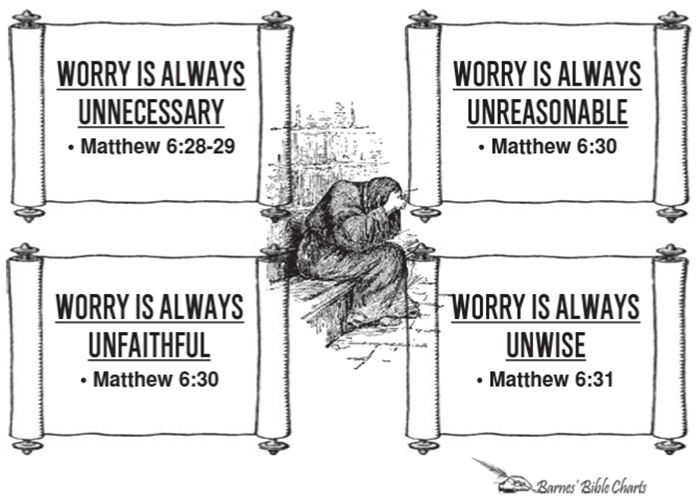
Therefore, we will examine these two plagues of the mind together. “Wherefore, if God so clothe the grass of the field, which to day is, and to morrow is cast into the oven, shall he not much more clothe you, O ye of little faith” (Matt 6:30)?

UNCERTAINTY is a form of doubt that is seen when a person is torn between two things. We’re not talking about trying to decide between two good and righteous things. This plague of the mind is about being torn between the world and God. Remember Lot’s wife (Luke 17:32; Gen 19:26).

During the divided Kingdom years under Ahab, the people were torn between two Gods, the One and Only True God of heaven, and the false, pretend little “g” god of Baalim. “And Elijah came unto all the people, and said, How long halt ye between two opinions? if the LORD be God, follow him: but if Baal, then follow him. And the people answered him not a word” (1Kings 18:21).

Jesus spoke of this duplicity in His teaching on worry in the Sermon on the Mount. “For where your treasure is, there will your heart be also” (Matt 6:19-24). There are only two treasure, an earthly one, and a heavenly one. “Ye cannot serve God and mammon.”

James wrote this, “Ye adulterers and adulteresses, know ye not that the friendship of the world is enmity with God? whosoever therefore will be a friend of the world is the enemy of God” (James 4:4). We can either seek friendship with the world, or seek to be a friend of the Lord, “Ye are my friends, if ye do whatsoever I command you” (John 15:14). James would continue the warning about becoming too focused on worldly wealth, “But now ye rejoice in your boastings: all such rejoicing is evil. Therefore to him that knoweth to do good, and doeth it not, to him it is sin” (James 4:16-17). “Ye have lived delicately on the earth, and taken your pleasure; ye have nourished your hearts in a day of slaughter” (5:5).

Paul, in his concern for the Galatians as they turned from the gospel to another he wrote, “For do I now persuade men, or God? or do I seek to please men? for if I yet pleased men, I should not be the servant of Christ” (Gal 1:10). The Apostle John wrote, “Love not the world, neither the things that are in the world. If any man love the world, the love of the Father is not in him. For all that is in the world, the lust of the flesh, and the lust of the eyes, and the pride of life, is not of the Father, but is of the world” (1John 2:14-15).

Indecision about our faith in God is serious business. Does it matter what one believes? Apparently, it does. We cannot serve two masters. Idolatry is another word to describe this duplicity. Paul’s teaching on covetousness and worldliness is very much related, “covetousness, which is idolatry” (Col 3:5b).

The words of Joshua still ring true today, “And if it seem evil unto you to serve the LORD, choose you this day whom ye will serve; whether the gods which your fathers served that were on the other side of the flood, or the gods of the Amorites, in whose land ye dwell: but as for me and my house, we will serve the LORD” (Joshua 24:15).

Which brings us to the plague of worry. A duplicitous life leads to a worrisome one. It may be that our uncertainty about God or mammon is why so many of us are living exasperated, worrisome lives. The best answer about this subject comes from our Lord in His sermon on the mount.

Therefore I say unto you, Take no thought for your life, what ye shall eat, or what ye shall drink; nor yet for your body, what ye shall put on. Is not the life more than meat, and the body than raiment?

26 Behold the fowls of the air: for they sow not, neither do they reap, nor gather into barns; yet your heavenly Father feedeth them. Are ye not much better than they?

 27 Which of you by taking thought can add one cubit unto his stature?

 28 And why take ye thought for raiment? Consider the lilies of the field, how they grow; they toil not, neither do they spin:

29 And yet I say unto you, That even Solomon in all his glory was not arrayed like one of these.

30 Wherefore, if God so clothe the grass of the field, which to day is, and to morrow is cast into the oven, shall he not much more clothe you, O ye of little faith?

31 Therefore take no thought, saying, What shall we eat? or, What shall we drink? or, Wherewithal shall we be clothed?

32 (For after all these things do the Gentiles seek:) for your heavenly Father knoweth that ye have need of all these things.

33 But seek ye first the kingdom of God, and his righteousness; and all these things shall be added unto you.

34 Take therefore no thought for the morrow: for the morrow shall take thought for the things of itself. Sufficient unto the day is the evil thereof.” (Matt 6:25-34)

Worry that overwhelms our thinking can become an interference to our faith. Are we Worrier or Warrior? Paul was able to face persecution because of his trust in God. “Nay, in all these things we are more than conquerors through him that loved us” (Rom 8:37). Having joy in trial tells us that we will have difficulty, but that we can also exemplify hope (cf. James 1:2-4; 2Tim 3:12). Faithfulness doesn’t mean free from difficulty, but a path to be free from worry.

The Kingdom of God is a treasure to be desired (Matt 13:44), and if we’re able to have a singular focus for Him and His righteousness in our daily lives, we may just see that this life is more tolerable when we know a better life awaits.

Agape,

Spencer

This is part of a series on the 7 PLAGUES of the mind.