The Sure STONE

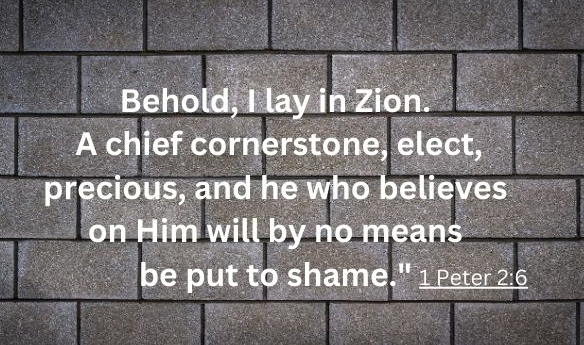
Therefore thus saith the Lord GOD, Behold, I lay in Zion for a foundation a stone, a tried stone, a precious corner stone, a sure foundation: he that believeth shall not make haste.” (Isaiah 28:16).

In this language we hear the voice of God predicting the coming of the Messiah who is described as a “sure foundation.”

God has used this language of building before. “And when thy days be fulfilled, and thou shalt sleep with thy fathers, I will set up thy seed after thee, which shall proceed out of thy bowels, and I will establish his kingdom. He shall build an house for my name, and I will stablish the throne of his kingdom for ever” (2Sam 7:12, 13).

It’s axiomatic that before building of any structure one must begin with a foundation that is strong, level, and sure. Every other building block will be aligned to the foundation.

We’re speaking about a spiritual building which is divine in origin, and therefore worthy to be built upon.

The OT prophecies identify Jerusalem as the place of the building, also called SION (ZION). “I lay in Zion.” This is a Synonym for the Jewish nation, Jerusalem in particular. Jesus was a Jew, of the family of David (Matt 1). In Jerusalem He was crucified, Buried, and raised. In Jerusalem the gospel was 1st preached. (Acts 2). “And he shall be for a sanctuary; but for a stone of stumbling and for a rock of offence to both the houses of Israel, for a gin and for a snare to the inhabitants of Jerusalem” (Isaiah 8:14). Many at that time expected a physical building, but God laid the foundation to a spiritual building in Jerusalem. This continues to be a common error of denominationalism.

Jesus said, “I will build my church.” and “My kingdom is not of this world.” (Matt 16:18; John 18:36). Jerusalem (Zion / Sion) is the place where the spiritual kingdom of God would begin. Prophecy prevents Jesus from having a physical building & throne in Jerusalem. “Thus saith the LORD, Write ye this man childless, a man that shall not prosper in his days: for no man of his seed shall prosper, sitting upon the throne of David, and ruling any more in Judah” (Jer 22:30).

Isaiah says that this would be a TRIED Stone. A tried stone is a stone for solidarity, for strength, for duration. Jesus was tried by Satan, by men, and by God. “For we have not an high priest which cannot be touched with the feeling of our infirmities; but was in all points tempted like as we are, yet without sin” (Heb 3:15).

While there are many stones in a building, there is only ONE foundation stone. It is of Precious value to God, the Father. The ONLY begotten Son, (John 1:14; 3:16; Mark 1:11). Precious to Man, the believer (1Pet 2:7). The ONLY sufficient sacrifice, (1Pet 1:18,19). The ONLY hope of salvation. “This is the stone which was set at nought of you builders, which is become the head of the corner” (Acts 4:11,12).

Christ is the chief cornerstone. The cornerstone is the NUMBER ONE stone. His position is chief (Col 1:18). He has the Preeminence. The chief cornerstone unites both sides of the edifice. He is Deity & Humanity, the old and the new dispensations. He brings together both Jew & Gentile united in HIM (Eph 2:19,20).

We are warned about how we build. “Except the LORD build the house, they labour in vain that build it: except the LORD keep the city, the watchman waketh but in vain” (Psalm 127:1). We must be careful to build on this stone.

Agape,

Spencer

God Gave them Up

Wherefore God also gave them up to uncleanness through the lusts of their own hearts, to dishonour their own bodies between themselves” (Rom 1:24).

People often cite the Letter to the Romans for their erroneous view on election and predestination. While these concepts are here, their view that God preselects individuals to be lost or saved before they were born and without any reason is error.

We can answer this erroneous view beginning with chapter one where we are told why God gave them up to their sin. People are not lost because God randomly chose them to be lost. People are lost because of their disobedience to Him (sin), neither does He cause them to sin.

Note verse 26, “For this cause God gave them up.” Paul is telling us WHY God gave them up, and the reason is not because God just didn’t want them to be saved. There are reasons.

For God to give someone up to sin, there must be some standard by which the guilt is determined.

God gave them up to their sins because they gave Him up. Notice what people had done BEFORE God gave them up.

Because that which may be known of God is manifest in them; for God hath shewed it unto them. For the invisible things of him from the creation of the world are clearly seen, being understood by the things that are made, even his eternal power and Godhead; so that they are without excuse: Because that, when they knew God, they glorified him not as God, neither were thankful; but became vain in their imaginations, and their foolish heart was darkened. Professing themselves to be wise, they became fools, And changed the glory of the uncorruptible God into an image made like to corruptible man, and to birds, and fourfooted beasts, and creeping things. Wherefore God also gave them up to uncleanness through the lusts of their own hearts, to dishonour their own bodies between themselves” (Rom 1:19-24 emphasis mine seb).

God had revealed to mankind His existence through His creation. Instead of glorifying Him, they were ungrateful, turned to their own wisdom, and then to idolatry. They took a piece of creation and worshiped it.

Jeremiah described their foolishness this way; “For the customs of the people are vain: for one cutteth a tree out of the forest, the work of the hands of the workman, with the axe. They deck it with silver and with gold; they fasten it with nails and with hammers, that it move not. They are upright as the palm tree, but speak not: they must needs be borne, because they cannot go. Be not afraid of them; for they cannot do evil, neither also is it in them to do good” (Jer 10:3-5). Jeremiah then warns them, “Every man is brutish in his knowledge: every founder is confounded by the graven image: for his molten image is falsehood, and there is no breath in them. They are vanity, and the work of errors: in the time of their visitation they shall perish” (10:14-15; cf, Isa 44:9-20).

Think about it. Created humans rejected their creator, then created a wooden image to worship, and did not give the God of Heaven thanks nor glory for His great might. Do we see anything different happening today? The only difference is the object of worship.

For many walk, of whom I have told you often, and now tell you even weeping, that they are the enemies of the cross of Christ: Whose end is destruction, whose God is their belly, and whose glory is in their shame, who mind earthly things” (Phil 3:18-19).

Agape,

Spencer

This article is part 1 of a series titled, God’s Moral Law. click here for part two.

You’re invited to attend one of our services at the church of Christ on Franklin and Juniper in Borger Texas.

STEPHEN’S Face

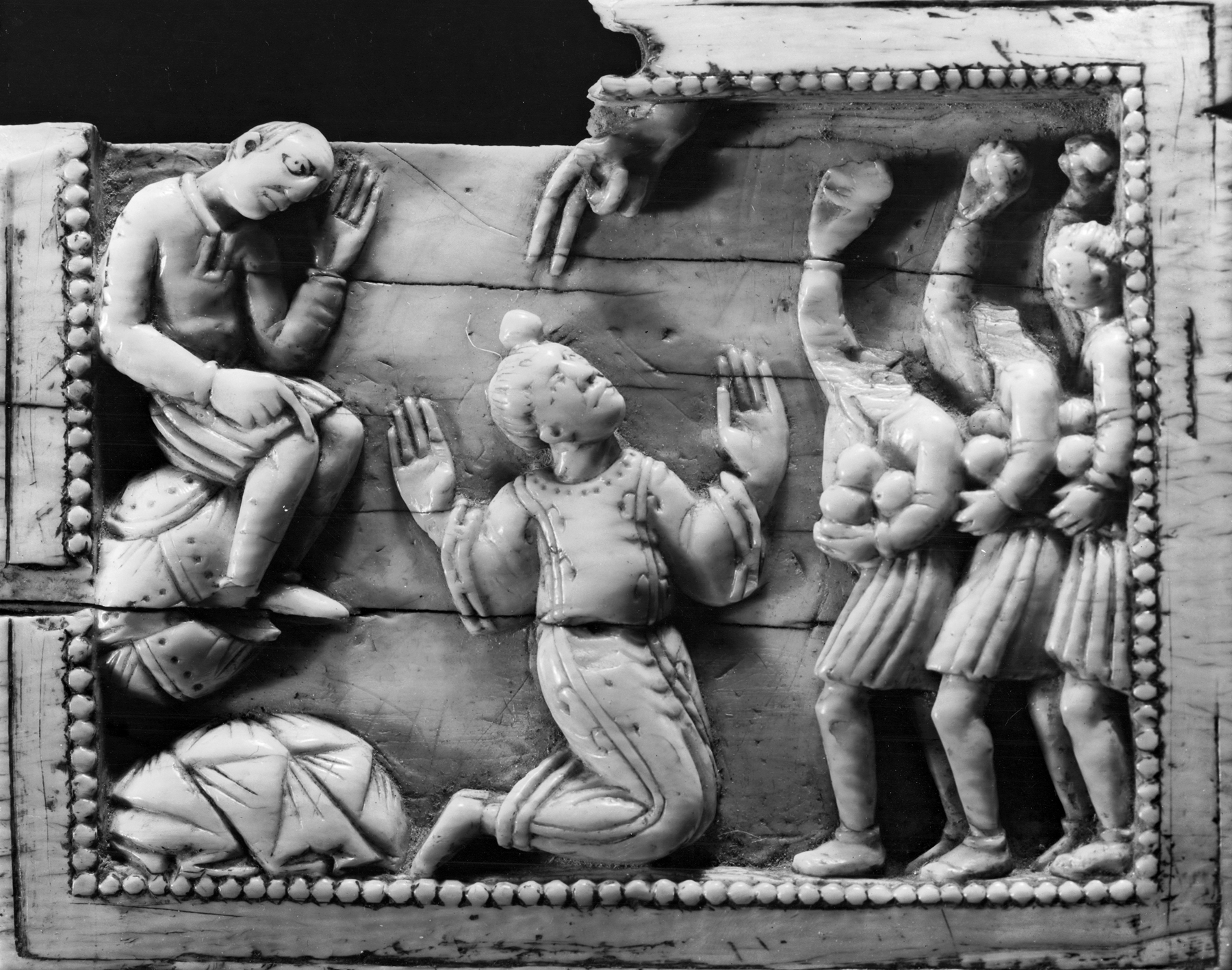
When I first read the account of Stephen in Acts 7, I thought he had brought it upon himself, because he had said, “Ye stiffnecked and uncircumcised in heart and ears, ye do always resist the Holy Ghost: as your fathers did, so do ye” (Acts 7:51). If you’re going to call someone stiffnecked, you ought to expect them to be angry.

As the years went by, and I continued to read and study, it became apparent that Stephen did not deserve death for what he said. He told them the truth. The blame lies on those who heard him. Here’s how I came to that conclusion.

The account actually begins in Acts 6, not 7. Before we even hear of Stephen, a description is given of those who should serve the Grecian widows. “men of honest report, full of the Holy Ghost and wisdom” (Acts 7:3). In verse 8 it says that Stephen was full of faith and power.

Then, as he spoke of Jesus, those that heard could not resist the wisdom and the spirit by which he spoke, (v10).

There was one more description of Stephen in verse 15.

And all that sat in the council, looking stedfastly on him, saw his face as it had been the face of an angel” (Acts 6:15).

These three verses about Stephen show us that all that he spoke were inspired by the HOLY SPIRIT, even those final hard words of truth about the hearts of his hearers. We cannot know the hearts of men, but God does. Stephen spoke the TRUTH as revealed by the Spirit.

Therefore, his execution by stoning of the mob was a persecution for righteousness’ sake, even as the Lord spoke about in the sermon on the mount, (Matt 5:10-12).

Stephen wasn’t speaking erratically, but with PURPOSE. He had shown himself to be a defender of the faith (Jude 3), and a deliverer of truth (Acts 7:2-53).

 We can see the beginning of his reward in the next verses, “But he, being full of the Holy Ghost, looked up stedfastly into heaven, and saw the glory of God, and Jesus standing on the right hand of God, And said, Behold, I see the heavens opened, and the Son of man standing on the right hand of God” (Acts 7:55-56). This speaks of reward. The view of Stephen’s heavenward gaze reveals God’s approval.

As we continue to look closely at his speech, this next statement reveals his heart about those who are stoning him. “And he kneeled down, and cried with a loud voice, Lord, lay not this sin to their charge” (Acts 7:60). This is what truth loving people say, and are not the words of hatred. His last words are words of forgiveness to seek EXONERATION for his attackers.

Stephen became for us an example of one living for Jesus with NO FEAR, No flinching, No whining, and No doubt. His boldness is an answer to the prayer of the Apostles, “And now, Lord, behold their threatenings: and grant unto thy servants, that with all boldness they may speak thy word” (Acts 4:29).

The final chapter of Stephen’s story is the beginning of another man’s story, the young man named SAUL. “…and the witnesses laid down their clothes at a young man’s feet, whose name was Saul” (Acts 7:58). But that is a story for another day.

Agape,

Spencer

Spencer is an evangelist for the Franklin & Juniper st church of Christ in Borger Texas.

Mark 1, My Beloved SON.

Chapter one of the Gospel of Mark may be concise, but it is full of information.

One could read this chapter as if it was the announcement and coronation of a King.

A New King has an announcement, “The beginning of the gospel of Jesus Christ, the Son of God” (Mark 1:1). To Romans and Jews, it would communicate the coming of a King.

A New King has a herald or a forerunner that announces the New King. In the Roman world, when someone took the throne, a messenger would go to all the villages announcing the good news of the King. John the Baptist serves as the forerunner of Jesus. “As it is written in the prophets, Behold, I send my messenger before thy face, which shall prepare thy way before thee. The voice of one crying in the wilderness, Prepare ye the way of the Lord, make his paths straight” (Mark 1:2-3).

John declares he is not the King. “There cometh one mightier than I after me, the latchet of whose shoes I am not worthy to stoop down and unloose” (Mark 1:7).

A New King has a coronation. This is when a King is anointed before all the people to identify the New King. When Jesus is baptized, the Holy Spirit comes upon Him. This was the sign given to John to identify the Christ. “And straightway coming up out of the water, he saw the heavens opened, and the Spirit like a dove descending upon him: And there came a voice from heaven, saying, Thou art my beloved Son, in whom I am well pleased” (Mark 1:10-11). “And I knew him not: but he that sent me to baptize with water, the same said unto me, Upon whom thou shalt see the Spirit descending, and remaining on him, the same is he which baptizeth with the Holy Ghost” (John 1:33).

A New King has an enemy to face. The New King brings peace by battling an enemy causing problems for the people. Jesus goes into the wilderness to battle against Satan. “And immediately the Spirit driveth him into the wilderness. And he was there in the wilderness forty days, tempted of Satan; and was with the wild beasts; and the angels ministered unto him” (Mark 1:12-13).

A New King has servants. We make note from above that Jesus has angels that ministered to Him. They didn’t come to prevent nor rescue Him from the battle against Satan. Consider the angels that brought Elijah food in the OT, (1Kings 19:5-8). It makes sense that these angels brought food for Jesus after having fasted 40 days in the wilderness.

A New King has a message. Jesus begins preaching; “Now after that John was put in prison, Jesus came into Galilee, preaching the gospel of the kingdom of God, And saying, The time is fulfilled, and the kingdom of God is at hand: repent ye, and believe the gospel” (Mark 1:14-15). This verse is significant in that it declares the prophecy from the Old Testament is fulfilled in Christ (cf. Dan 2:44; 7:14; 9:25)

A New King has followers and citizens. The first people called are four fishermen. The number will grow, but the text reveals that King Jesus has followers. “Now as he walked by the sea of Galilee, he saw Simon and Andrew his brother casting a net into the sea: for they were fishers. And Jesus said unto them, Come ye after me, and I will make you to become fishers of men. And straightway they forsook their nets, and followed him. And when he had gone a little further thence, he saw James the son of Zebedee, and John his brother, who also were in the ship mending their nets. And straightway he called them: and they left their father Zebedee in the ship with the hired servants, and went after him” (Mark 1:16-20).

Mark Chapter One is the announcing, coronation, and the beginning reign of our King.

Agape,

Spencer

This is part of a series of sermons preached at the Franklin & Juniper st church of Christ in Borger, Texas. Click here for Mark 2.

Preaching through the Gospel of Mark in 2024

Lord Willing, Each first Sunday of the month in 2024 will come from the Gospel of Mark. While there are 16 chapters in Mark and only 12 first Sundays, we will follow each chapter until chapter 12-16 which will have one sermon in December.

January: Mark 1. My Beloved SON.

February: Mark 2. Jesus is GOD.

March: Mark 3. Sinning against the Holy Spirit.

April: Mark 4. What Kind of SOIL am I?

May: Mark 5. Fearing Jesus, Mocking Jesus, Seeing Jesus.

June: Mark 6. How well do we TRUST Jesus?

July: Mark 7. LIP Service toward God.

August: Mark 8. The Value of a SOUL.

September: Mark 9. HEAR Him.

October: Mark 10. What do you WANT me to do?

November: Mark 11. From Heaven for from Men?

December: Mark 12-16. What did Judas BRING to the garden?

We invite you to attend one of our services at the Franklin & Juniper St church of Christ in Borger Texas.

What to EXPECT in the New Year

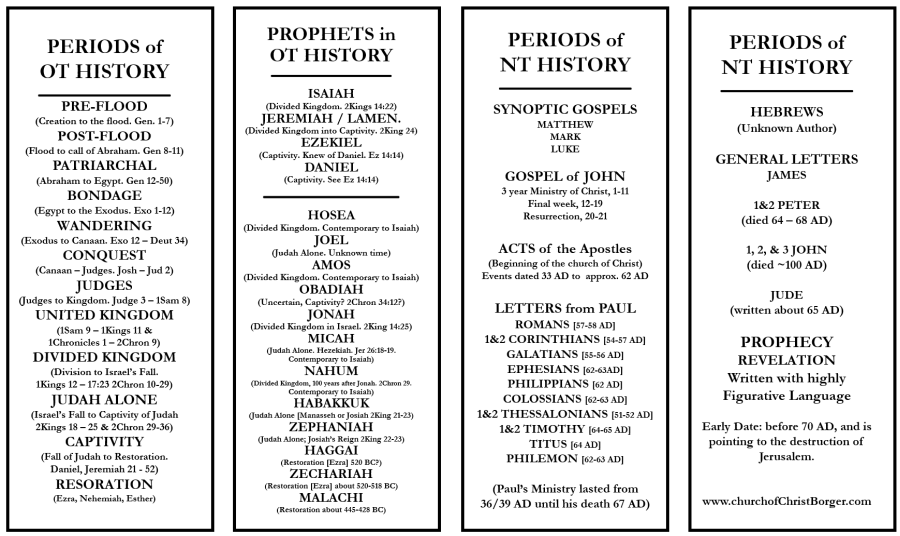
Bible Reading Bookmarks for the Old & New Testament

The thing that hath been, it is that which shall be; and that which is done is that which shall be done: and there is no new thing under the sun.” (Ecclesiastes 1:9).

A large corporation brought in a consultant to give them a forecast about the next 5 years. As they surrounded the conference table awaiting his prognostication, the consultant said, “everything will be about the way it’s always been.”

There will be weather, seasons, traffic, births, deaths, holidays, elections, etc. There will be good times and low ones. That is the record of history. The sad condition of mankind is that many live expecting it always to be different, to always be better, and are unhappy and bitter when it’s not.

The preacher wrote, “there is no new thing under the sun.” We can reasonably predict what life will be like next year.

We will never predict the details, but we can reasonably expect certain things.

We all should be expecting to pile up a TREASURE. We need money & stuff for our earthly needs, and to share with those in need (Eph 4:28). We should expect those things if we’re doing those things God has prescribed in His word. A word of caution, we may become distracted from serving God and will be heaping up treasure against ourselves in judgment. “Your gold and silver is cankered; and the rust of them shall be a witness against you, and shall eat your flesh as it were fire. Ye have heaped treasure together for the last days” (James 5:3; cf. Matt 6:19-21).

We as Christians ought to expect to bear our Cross. “Whosoever will come after me, let him deny himself, and take up his cross, and follow me” (Mark 8:34). This is about commitment to the Cause of Christ and not about some personal pain or shortcoming.

We also ought to expect more wisdom, but we must seek it. Education is one thing nobody can take away from us. Divine wisdom is the most precious of all (Prov 8:1-11).

Christians ought to expect Persecution, but we think it strange even though the Holy Spirit said to expect it (2Tim 3:12).

Everyone ought to expect High & Low eXtremes (Ecc 3:1-10). Sadly, folks expect things to always be better than they are with no pain whatsoever. That condition is in Heaven, and we ought to see the pain in this life as motivation to qualify for the next.

Finally, we all ought to expect Eternity to begin for us. Whether we meet Jesus after our death, or we remain alive when he returns, there is an Eternal hereafter. Where do you want to spend your ETERNITY? “Then we which are alive and remain shall be caught up together with them in the clouds, to meet the Lord in the air: and so shall we ever be with the Lord” (1Thess 4:17).

Agape, Spencer

We invite you to visit one of our services at the Franklin & Juniper st church of Christ in Borger, Texas.