
Evidence for our Faith: Bible Prophecy compared to other religious texts

Uniqueness of Biblical Prophecy Compared to Other Religious Texts

Biblical prophecy stands apart from the sacred texts of other mainstream religions due to its specificity, historical fulfillment, and divine coherence across centuries. Unlike the often vague or symbolic predictions found in other religious writings, the Bible’s prophecies offer detailed, verifiable claims that have been demonstrably fulfilled, lending credibility to its divine inspiration.

First, the Bible’s prophecies are remarkably precise. For instance, the prophecy in Isaiah 44:28–45:1 (circa 700 BCE) names Cyrus, a Persian king, as the one who would allow the Jews to return to Jerusalem and rebuild the temple. This prophecy was fulfilled over 150 years later when Cyrus issued the decree in 538 BCE (Ezra 1:1-4). No other religious text matches this level of specificity, naming a future individual and their actions centuries in advance. The Qur’an, for example, lacks detailed predictive prophecies tied to historical events. Similarly, the Bhagavad Gita offers no specific, testable predictions about future rulers or events.

Second, biblical prophecies span centuries and demonstrate consistent fulfillment. The book of Daniel (circa 6th century BCE) predicts the rise and fall of empires (Babylon, Persia, Greece, and Rome) with astonishing accuracy (Daniel 2:31-45; 7:1-28). Historical records, such as those from Herodotus and archaeological findings, confirm these empires’ timelines and transitions. In contrast, texts like the Buddhist Pali Canon or the Vedas focus on cyclical time or spiritual principles without offering verifiable historical predictions. The Bible’s ability to predict geopolitical shifts with precision sets it apart as a text rooted in a divine perspective of history.

Third, the sheer volume and interconnectedness of biblical prophecies create a cohesive narrative. Over 300 prophecies about the Messiah, spanning from Genesis 3:15 to Malachi 3:1, find fulfillment in Jesus’ life, death, and resurrection. For example, Micah 5:2 predicts the Messiah’s birthplace in Bethlehem, fulfilled in Matthew 2:1. Psalm 22:16-18 foretells the crucifixion’s details, including pierced hands and feet and the casting of lots for clothing, fulfilled in John 19:23-24. This intricate web of predictions, written by multiple authors over centuries, demonstrates a unified divine purpose. Other religious texts, such as the Taoist Tao Te Ching, lacks a comparable prophetic framework that ties together historical events and spiritual promises.

Skeptics might argue that these fulfillments are coincidental or retroactively interpreted. However, the Dead Sea Scrolls, dated to the 2nd century BCE, confirm the antiquity of these prophecies, predating their fulfillment. No other religious text provides such a robust, historically verifiable prophetic record.

Biblical prophecy’s unmatched precision and fulfillment reveal a divine hand. No other text dares to predict with such clarity and succeed.

agape

Sources:

  • The Bible (ESV): Isaiah 44:28–45:1, Ezra 1:1-4, Daniel 2:31-45, Micah 5:2, Psalm 22:16-18, Matthew 2:1, John 19:23-24.
  • McDowell, Josh. Evidence That Demands a Verdict. Thomas Nelson, 2017.

Archer, Gleason L. A Survey of Old Testament Introduction. Moody Press, 1994.
Evidence for our Faith: The Bible’s Influence on Western Law

The Bible’s Enduring Influence on Western Law and the U.S. Constitution

It is apparent to me that the Bible has profoundly shaped Western civilization and the U.S. Constitution, providing moral and legal principles. Its scriptural teachings influenced the cultural and intellectual society of the West and the American founding, creating a legacy evident in modern legal systems and constitutional governance.

The biblical concept of human dignity, derived from the idea that humans are created in God’s image (Genesis 1:26-27), laid the foundation for Western notions of individual rights. Historian David Landes, in The Wealth and Poverty of Nations, argues that this principle inspired accountability and fairness, influencing documents like the Magna Carta (1215), which echoes Deuteronomy 16:20’s call for justice. This idea can be seen in the Declaration of Independence’s “unalienable rights” and the Constitution’s Bill of Rights, particularly the First Amendment’s protections of speech and religion. James Madison, a key framer, drew on biblical notions of human worth, as noted by Carl Richard in The Founders and the Bible.

The Ten Commandments (Exodus 20:1-17) provided a moral framework for Western jurisprudence, with prohibitions against murder, theft, and perjury shaping legal codes from medieval Europe to colonial America. Legal scholar Harold Berman, in Law and Revolution, highlights how biblical ethics standardized justice in fragmented societies, a legacy reflected in the Constitution’s emphasis on impartiality (Leviticus 19:15). The command to “love your neighbor as yourself” (Leviticus 19:18; Matthew 22:39) further inspired Western social welfare laws and the Constitution’s reliance on civic virtue, as Benjamin Franklin emphasized in his writings.

The Bible’s warnings against unchecked power (1 Samuel 8:10-18; Deuteronomy 17:14-20) influenced the Western concept of the rule of law and the Constitution’s checks and balances. John Locke’s Two Treatises of Government, which cites scripture, argued for limited government, shaping the Constitution’s separation of powers (Articles I-III). Historian Donald Lutz, in The Origins of American Constitutionalism, notes that colonial sermons often referenced Exodus 18:21-22’s decentralized governance, influencing federalism. John Adams, in his Defence of the Constitutions, tied governance to biblical morality (Proverbs 29:2), reinforcing accountability.

The Great Awakening (1730s-1740s) embedded biblical values in colonial culture, shaping the framers’ commitment to liberty, as Daniel Dreisbach details in Reading the Bible with the Founding Fathers. While Enlightenment ideas contributed, the Bible’s influence provided a moral compass for constitutional principles like forgiveness (Colossians 3:13), evident in rehabilitative justice systems. Critics may emphasize secular influences, but the framers’ biblical worldview, as seen in their writings, brought together faith and reason.

agape

Sources:
Berman, Harold. Law and Revolution. Harvard University Press, 1983.
Dreisbach, Daniel L. Reading the Bible with the Founding Fathers. Oxford University Press, 2017.
Landes, David. The Wealth and Poverty of Nations. W.W. Norton, 1998.
Lutz, Donald S. The Origins of American Constitutionalism. LSU Press, 1988.
Richard, Carl J. The Founders and the Bible. Rowman & Littlefield, 2016.
The Bible (KJV): Genesis 1:26-27, Exodus 18:21-22, 20:1-17, Leviticus 19:15, 19:18, Deuteronomy 16:20, 17:14-20, 1 Samuel 8:10-18, Proverbs 29:2, Matthew 22:39, Colossians 3:13.

Evidence for our Faith: How 66 Books, 40 Authors, and 1,500 Years Create One Unified Bible Story!

The Bible’s 66 books, penned across millennia, weave a seamless tapestry of truth, revealing a divine hand guiding its every word.

The Internal Consistency of the Bible Across 66 Books

The Bible, a collection of 66 books written by over 40 authors across 1,500 years, displays remarkable internal consistency, weaving a unified narrative despite its diverse origins. This coherence is evident in its thematic unity, fulfilled prophecies, and consistent theological principles, offering compelling evidence of its divine inspiration.

First, the Bible’s thematic unity binds its books into a cohesive story. From Genesis to Revelation, the narrative centers on God’s relationship with humanity, His redemptive plan, and the promise of a Messiah. Genesis 3:15 introduces the first mention of the gospel or “good news” in the Bible, the first hint of a savior who will crush the serpent’s head, a theme that culminates in Christ’s victory in Revelation 20:10.

The Old Testament’s covenants (with Abraham (Genesis 12:3), Moses (Exodus 19:5-6), and David (2 Samuel 7:12-16)) find fulfillment in the New Testament through Jesus, who establishes the New Covenant (Luke 22:20; Heb 8:8-11). This continuity across centuries and authors suggests a purposeful design.

Second, fulfilled prophecies demonstrate the Bible’s reliability. Over 300 Old Testament prophecies, such as Isaiah 7:14 (the virgin birth) and Micah 5:2 (Bethlehem as the Messiah’s birthplace), are fulfilled in Jesus’ life, as recorded in the Gospels (Matthew 1:22-23; 2:5-6). The precision of these predictions, written centuries earlier, defies coincidence and human invention. For example, Psalm 22:16-18, written long before crucifixion was practiced, vividly describes Jesus’ death, including pierced hands and feet and divided garments (John 19:23-24). The consistency between prophecy and fulfillment across books reinforces the Bible’s unified message.

Third, the Bible maintains consistent theological principles despite its diverse cultural and historical contexts. The concept of God’s holiness, justice, and mercy remains constant. Leviticus 19:2 calls Israel to be holy because God is holy, a principle echoed in 1 Peter 1:15-16 for New Testament believers. Similarly, the emphasis on active faith as the basis for righteousness spans from Abraham (Genesis 15:6) to Paul’s teachings (Romans 4:3). These shared doctrines, articulated by authors from shepherds to kings, suggest a singular guiding intelligence.

Skeptics might argue that apparent contradictions, such as differing Gospel accounts, undermine this consistency. However, these variations often reflect complementary perspectives rather than errors. For instance, the number of women at Jesus’ tomb varies across Gospels (John 20:1 vs. Luke 24:10), but this reflects selective emphasis, not contradiction, as ancient biographies prioritized thematic truth over exhaustive detail (Carson, The Gospel According to John, 1991). Harmonizing these accounts reveals a coherent resurrection narrative.

The Bible’s internal consistency is not merely literary but points to a divine author orchestrating its message. As 2Timothy 3:16 states, “All Scripture is God-breathed,” suggesting a supernatural unity that transcends human effort. This coherence gives its readers confidence to explore its claims.

Sources:
Carson, D.A. The Gospel According to John. Eerdmans, 1991.

Are you WASHED?

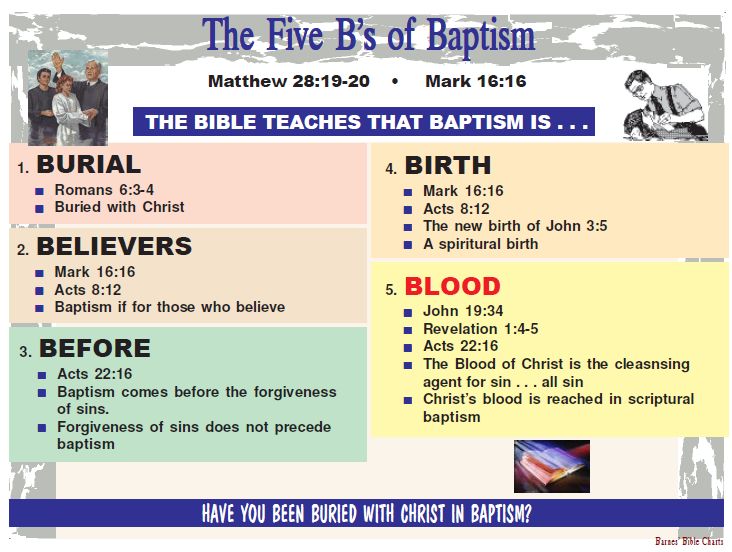
Far from a mere ritual, BAPTISM is a divinely ordained step that aligns believers with Christ’s redemptive work. Through baptism, individuals experience a cleansing of sins, union with Christ’s church, salvation, and an inheritance as heirs of God’s promises.

1. Washing Away Our Sins

Baptism serves as a divine act of cleansing, washing away the stain of sin. In Acts 22:16, Ananias urges Saul, “And now why do you wait? Rise and be baptized and wash away your sins, calling on his name.” This passage emphasizes baptism’s role in cleansing the believer’s conscience before God. Similarly, Acts 2:38 declares, “Repent and be baptized every one of you in the name of Jesus Christ for the forgiveness of your sins, and you will receive the gift of the Holy Spirit.” Here, baptism is linked directly to the remission of sins and the reception of the Holy Spirit. Additionally, Matthew 26:28 connects the concept of forgiveness to Christ’s sacrifice: “For this is my blood of the covenant, which is poured out for many for the forgiveness of sins.” Baptism, therefore, is the moment when a believer appropriates the forgiveness secured by Christ’s blood. Supporting this, Ephesians 5:26 describes Christ sanctifying the church “by the washing of water with the word,” reinforcing baptism’s cleansing power.

2. Added to the Church That Christ Built

Through baptism, believers are united with the body of Christ, the church He established. Acts 2:47 states, “And the Lord added to their number day by day those who were being saved.” This follows the account of 3,000 souls being baptized and added to the church after Peter’s sermon (Acts 2:41). Baptism is the entry point into Christ’s church, as seen in 1 Corinthians 12:13: “For in one Spirit we were all baptized into one body—Jews or Greeks, slaves or free—and all were made to drink of one Spirit.” This passage highlights the unity of believers in the church through baptism. Additionally, Colossians 1:18 affirms Christ as “the head of the body, the church,” underscoring that baptism incorporates individuals into this divine institution, built by Christ Himself (Matthew 16:18).

3. Saved Through Baptism

Baptism is intricately tied to salvation, as it is the moment when a believer’s faith is actualized in obedience to God’s command. 1 Peter 3:21 explicitly states, “Baptism, which corresponds to this, now saves you, not as a removal of dirt from the body but as an appeal to God for a good conscience, through the resurrection of Jesus Christ.” This verse clarifies that baptism is not a mere physical cleansing but a spiritual act that appeals to God for salvation. Mark 16:16 further supports this: “Whoever believes and is baptized will be saved, but whoever does not believe will be condemned.” The connection between baptism and salvation is also evident in Romans 6:3-4, which describes believers being “baptized into his death” and raised to “walk in newness of life,” symbolizing the transformative power of baptism in securing salvation.

4. Becoming Heirs of Abraham

Baptism establishes believers as heirs of the promises made to Abraham, uniting them in God’s covenant family. Galatians 3:27-29 explains, “For as many of you as were baptized into Christ have put on Christ… And if you are Christ’s, then you are Abraham’s offspring, heirs according to promise.” Through baptism, believers become part of the spiritual lineage of Abraham, inheriting the blessings of God’s covenant. Romans 4:16 reinforces this, stating that the promise to Abraham comes “to the one who shares the faith of Abraham, who is the father of us all.” Additionally, Ephesians 3:6 affirms that through the gospel, Gentiles are “fellow heirs” with Israel, a reality actualized in baptism as believers are incorporated into Christ’s body.

5. Putting on Christ

In baptism, believers clothe themselves with Christ, taking on His identity and righteousness. Galatians 3:27 declares, “For as many of you as were baptized into Christ have put on Christ.” This vivid imagery portrays baptism as the moment when a believer is enveloped in Christ’s nature. Romans 13:14 echoes this, urging believers to “put on the Lord Jesus Christ,” a process initiated at baptism. Colossians 3:9-10 further supports this idea, describing believers as having “put off the old self with its practices and… put on the new self,” a transformation that begins with baptism’s symbolic burial and resurrection (Colossians 2:12).

6. Becoming a Disciple of Christ

Baptism marks the beginning of a life of discipleship, as believers commit to following Christ. Matthew 28:19 commands, “Go therefore and make disciples of all nations, baptizing them in the name of the Father and of the Son and of the Holy Spirit.” Baptism is the initiatory step in making disciples, signifying a public commitment to Christ’s teachings. Acts 8:12 illustrates this: “But when they believed Philip as he preached good news… they were baptized, both men and women,” showing that baptism follows belief and marks the start of discipleship. John 3:5 further emphasizes baptism’s role in entering the kingdom of God: “Unless one is born of water and the Spirit, he cannot enter the kingdom of God,” linking baptism to the disciple’s journey of faith.

Baptism is far more than a symbolic act; it is a transformative moment in the believer’s life, rich with spiritual significance. Through baptism, sins are washed away, believers are added to Christ’s church, salvation is received, the promises to Abraham are inherited, Christ is put on, and a lifelong journey of discipleship begins. These truths, grounded in Scripture, underscore baptism’s ESSENTIAL role in the Christian faith.

AGAPE

Evidence for our Faith: The Teachings of Jesus Provide Solutions to Modern Problems

In an era of social division, mental health crises, and moral ambiguity, the teachings of Jesus Christ offer timeless solutions rooted in love, forgiveness, and purpose. Grounded in a biblical worldview, these principles address modern challenges with clarity and hope. Let’s see how Jesus’ teachings, as recorded in Scripture, provide practical answers to today’s pressing issues.

First, Jesus’ emphasis on love as the greatest commandment counters the divisions that are plaguing society. In Matthew 22:37-39, He instructs to “love the Lord your God” and “love your neighbor as yourself.” Selfless love goes beyond political and cultural divides, fostering unity despite our differences. Studies show that communities practicing altruistic behaviors, like those Jesus modeled, experience lower conflict and higher social connection (Putnam, 2000). By prioritizing love over enmity, We can improve how we relate to one another in workplaces, families, and on social media.

Second, Jesus’ teachings on forgiveness address the mental health epidemic. Modern psychology links unforgiveness to anxiety and depression (Toussaint et al., 2015). In Matthew 6:14-15, Jesus teaches that forgiving others is a prerequisite to God’s forgiveness, which promotes better relationships with others. His parable of the unforgiving servant (Matthew 18:21-35) illustrates the destructive cycle of unforgiveness in light of the mercy shown to us. Applying the principle of forgiveness (whether it be exoneration, forbearance, or release) we are able to move forward in healing relationships strained by betrayal or misunderstanding.

Third, Jesus provides purpose in a world grappling with life altering despair. Rising rates of loneliness and suicide reflect a loss of meaning (Twenge, 2017). In John 10:10, Jesus declares, “I have come that they may have life, and have it to the full.” When we truly follow Jesus, we find purpose in our lives higher than ourselves. It moves us to serve our fellow man, and gives us hope a hopeless world. If you’re dealing with recovery of any sort, you’ll find a greater rate of success in your fight against addiction and despair by becoming anchored in purpose (Koenig, 2012). Jesus’ call to “follow me” (Matthew 4:19) offers a roadmap for navigating life’s uncertainties. “But be ye doers of the word, and not hearers only, deceiving your own selves.” (James 1:22) 

Critics may argue that Jesus’ teachings are outdated or impractical, yet their universal applicability endures. Loving one’s enemy (Luke 6:27) disarms hostility, forgiveness heals psychological wounds, and purpose through faith counters defeatism. These principles align with the evidence and human needs, proving their relevance.

Jesus’ teachings are not mere ideals but actionable solutions. By embracing love, forgiveness, and purpose, individuals and societies can overcome division, heal emotional wounds, and find meaning.

Agape,

spencer

Sources:

Koenig, H. G. (2012). Religion and Mental Health. Academic Press.

Putnam, R. D. (2000). Bowling Alone. Simon & Schuster.

Toussaint, L., et al. (2015). Forgiveness and Health. Springer.

Twenge, J. M. (2017). iGen. Atria Books. Zehr, H. (2015). Changing Lenses. Herald Press.