Evidence for our Faith: the Virgin Birth

In the fullness of time, the royal heir of David’s eternal throne was born—not in a palace, but in Bethlehem’s humble manger; not by natural means, but of a virgin—as God had promised centuries before. These four ancient prophecies, among dozens more surrounding His birth, converged in one miraculous moment, declaring with unbreakable certainty: Jesus is the promised Messiah, and heaven’s King has come to earth.

Jesus’ birth was not natural, it was miraculous.

One of the most distinctive and controversial assertions of Christianity is that Jesus of Nazareth was born of a virgin. The New Testament presents this as the deliberate fulfillment of an ancient Hebrew prophecy spoken 700 years earlier. “Therefore the Lord himself shall give you a sign; Behold, a virgin shall conceive, and bear a son, and shall call his name Immanuel.” (Isaiah 7:14)

New Testament Fulfillment Claims

Matthew’s Gospel opens with the clearest claim:

All this took place to fulfill what the Lord had spoken by the prophet: ‘Behold, the virgin shall conceive and bear a son, and they shall call his name Immanuel’” (Matthew 1:22–23). Luke 1:26–35 independently records the announcement to Mary, emphasizing that Mary was a virgin (Luke 1:27, 34), and the child would be conceived by the Holy Spirit.

The claim that Jesus of Nazareth is the literal fulfillment of Isaiah 7:14 (the virgin-born Immanuel) has profound, personal, and life-reorienting implications for anyone coming to Him. Here are some major takeaways:

God Keeps His Word, Perfectly and Literally: A prophecy given 700+ years earlier is fulfilled down to the detail of the virgin conception. This means every other promise God has made (about forgiveness, resurrection, judgment, eternal life, the restoration of all things) is equally reliable. You can stake your life on the Bible.

God Has Actually Entered the Human Story: “Immanuel” = “God with us.”

The virgin birth is not just a biological miracle; it is the miracle of the Incarnation. The eternal Son did not remain distant. He became one of us (flesh and blood) without ceasing to be God. The One who made the galaxies (John 1:3; Col 1:16) has come close enough to be held in a mother’s arms and, later, nailed to a cross for you.

Jesus Is Uniquely Qualified to Save: Because He is conceived by the Holy Spirit, He is the divine Son in human flesh (Luke 1:35). He can do what no mere prophet, priest, or good teacher can do; stand as the perfect mediator who is both sides of the covenant at once (Job 9:32-33). He can represent God to us and us to God.

Jesus Is Worthy of Worship, Not Just Admiration: Jesus is not merely a rabbi, moral genius, or martyr. He is the Mighty God (Isaiah 9:6) lying in a manger. The only fitting response is the response of the Magi; fall down and worship Him (Matthew 2:11).

History Has an Irreversible Turning Point: The virgin birth means the world is now divided into Before Christ and After Christ. The curse of Genesis 3:15 is being crushed by “the seed of the woman” has begun its defeat. The long exile of humanity from Eden is ending. Your life is not meaningless. You live on the fulfillment side of the greatest promise ever given.

You have a Future Hope: The same God who can raise the dead who brought life where no human seed existed can raise you with a glorified body when you die. The virgin womb and the empty tomb are bookends of the gospel.

In short, if the Bible is right (and it is) about the virgin-born Immanuel, then Jesus is exactly who He claimed to be. Therefore: Run to Him while there is time. Trust Him completely by obeying the Gospel—He can save to the uttermost. Worship Him exclusively—He is the Lord. Wait for Him expectantly—He is coming again.

Agape

spencer

Evidence for our Faith: the Royal Birth

The Royal Birth of the Humble King:

The New Testament opens with two royal genealogies for Jesus, boldly proclaiming Him as the long-awaited heir to David’s throne. Yet the circumstances of His birth could not be further from earthly expectations of royalty. Born not in a palace surrounded by courtiers, but in a stable and laid in an animal’s feeding trough; the conquering King of an eternal kingdom enters the world in poverty and lowliness.

Establishing the Royal Claim

Matthew 1:1–17 traces Jesus’ legal lineage through Joseph, His adoptive father, emphasizing His right to the throne of David: “The book of the genealogy of Jesus Christ, the son of David, the son of Abraham… So all the generations from Abraham to David were fourteen generations, and from David to the deportation to Babylon fourteen generations, and from the deportation to Babylon to the Christ fourteen generations.” (Matthew 1:1, 17)

Matthew structures the list in three sets of fourteen, highlighting Davidic kingship and fulfillment of covenant promises.

Luke 3:23–38 presents a different line, widely understood as tracing through Mary, Jesus’ biological mother, going backward all the way to “Adam, the son of God.” Both converge at David, but they diverge after David: Matthew follows Solomon’s royal line (the kings of Judah), while Luke follows Nathan’s line (another son of David). Together, they establish: Legal royal succession through Joseph. Bloodline descent from David through Mary. Ultimate humanity as Son of Adam and Son of God (Luke 1:32–33). Jesus is the promised eternal King (2 Samuel 7:12–16; Isaiah 9:6–7). The genealogies declare His right to rule.

The Stark Contrast: Born in Poverty, Not a Palace

While Herod the Great ruled from opulent palaces with theaters, frescoes, and Roman luxury, the true King arrived in obscurity. “And she gave birth to her firstborn son and wrapped him in swaddling cloths and laid him in a manger, because there was no place for them in the inn” (Luke 2:7). No royal announcement in Jerusalem. No midwives from the court. No cradle of gold. Just a feeding trough in Bethlehem, surrounded by animals, visited first by shepherds (the lowest class of society). This was no accident. It was prophetic fulfillment.

Recognized as the Conquering King of an Eternal Kingdom

Though He began in a manger, Jesus would be hailed as King: The Magi sought “the king of the Jews” (Matthew 2:2). On His final entry into Jerusalem, crowds shouted, “Blessed is the king who comes in the name of the Lord!” (Luke 19:38), fulfilling Zechariah 9:9: “Behold, your king is coming to you… humble and mounted on a donkey.” His conquest was not by sword but by the cross. He defeated sin, death, and Satan, rising victorious to ascend to His eternal throne where He reigns now!

Revelation portrays the final reality: “The kingdom of the world has become the kingdom of our Lord and of his Christ, and he shall reign forever and ever.” (Revelation 11:15)

Spencer

agape

Evidence for our Faith: Jesus, Right on Time

The birth of Jesus Christ stands as one of history’s most profound events, not merely because of who He is, but because of when He came. The Old Testament, written centuries before His arrival, contains precise prophecies about the timing of the Messiah’s appearance. These predictions, fulfilled in Jesus, provide compelling evidence that He is the promised Christ. As Paul declares in Galatians 4:4, “But when the fullness of the time had come, God sent forth His Son, born of a woman, born under the law.” These prophecies build unbreakable confidence in the Gospel today and obeying the gospel of the Kingdom of Christ is the right path because Jesus arrived precisely as foretold.

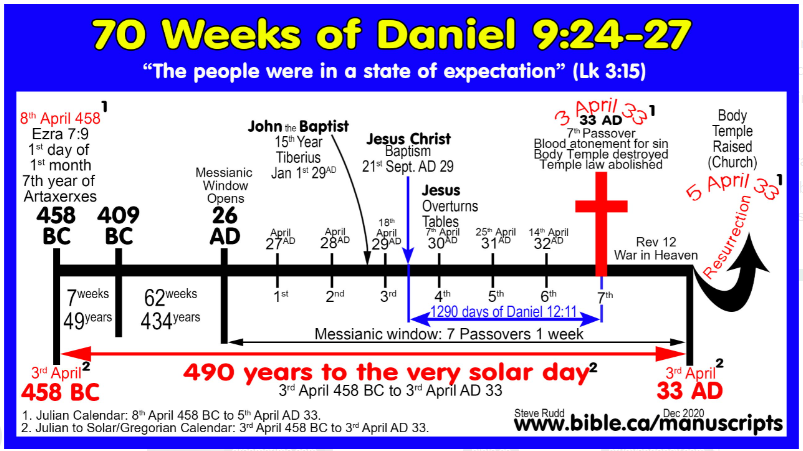
One of the most astonishing prophecies is Daniel’s 70 weeks (Daniel 9:24-27). Given around 538 BC, this vision outlines “seventy weeks” (or “sevens”) determined for the Jewish people to finish transgression, to make an end of sins, and anoint the Most Holy. Scholars widely interpret these as weeks of years; totaling 490 years. The prophecy begins “from the going forth of the command to restore and rebuild Jerusalem” until “Messiah the Prince.”

The clearest timing prophecy appears in Daniel 9:24–27. Daniel wrote during the Babylonian exile, yet he predicted the coming of “Messiah the Prince” with astonishing precision. He spoke of “seventy weeks” (symbolic weeks of years) counting from the decree to restore and rebuild Jerusalem. Daniel declares that after the sixty-nine weeks, “shall Messiah be cut off, but not for himself” (Daniel 9:26). This sets a specific window when the Messiah would appear and give His life as a sacrifice. History confirms that from the Persian decrees to rebuild Jerusalem to the first century AD fits Daniel’s prophetic timeline exactly; placing the arrival of the Messiah squarely at the time of Jesus of Nazareth. No other figure in history appears within that window fulfilling the works of the Messiah. That timing alone anchors our faith: God promised, and God delivered. Modern statisticians estimate 1 in 10^17 for Daniel’s Messianic prophecies alone.

Another key timing indicator is Genesis 49:10: “The scepter shall not depart from Judah, nor the lawgiver from between his feet, until Shiloh comes.” Jacob prophesied that Judah’s tribal authority would endure until the Messiah (“Shiloh,” meaning “He whose right it is”). Judah retained self-governance, including the right to execute capital punishment, until around AD 6-7, when Rome stripped the Sanhedrin of this power under Archelaus’ deposition. Jesus, from Judah’s line (Matthew 1:1-16; Luke 3:23-33), was crucified shortly after; precisely when the “scepter departed.” Had the Messiah come later, Judah would have lost its authority too soon.

The period between Malachi (c. 430 BC) and Jesus also aligns prophetically. After Haggai, Zechariah, and Malachi, a 400-year prophetic silence ensued; no major prophets arose in Israel. This “silence” heightened anticipation, as Malachi promised Elijah’s return before the great day of the Lord (Malachi 4:5-6). John the Baptist fulfilled this as the forerunner (Matthew 11:13-14; Luke 1:17), announcing Jesus. The silence ended exactly when the Messiah appeared.

These timings were no coincidence. The Roman Empire (also a predicted kingdom Dan 2:44) provided roads and peace (Pax Romana) for Gospel spread; Greek language unified communication; Jewish synagogues worldwide prepared diaspora hearts. Jesus came in the “fullness of time;” politically, culturally, and spiritually ripe.

Today, this evidence strengthens faith. If God orchestrated history with such precision (down to years and events) then Jesus is undeniably the Christ. He fulfilled not just timing prophecies, but many, many more: born in Bethlehem (Micah 5:2), of a virgin (Isaiah 7:14), from David’s line (2 Samuel 7:12-16). His life, death, and resurrection confirm the Old Testament’s promises.

Believer, take heart: Obeying the Gospel of the Kingdom of Christ is sound because history proves Jesus arrived at the predicted moment. The same God who timed the Messiah’s birth can be trusted for eternal life.

Agape

spencer

Evidence for our Faith: O Little Town of Bethlehem

Jesus Was Born in the Exact Town God Named 700 Years Earlier

Imagine you’re trying to prove to a friend that the Bible isn’t just a religious book, but something that actually predicts the future with crazy detail. One of the strongest pieces of evidence is the prophecy about where the Messiah would be born. It’s not vague like a horoscope; it’s specific, and it came true in a way nobody could have staged.

About 700 years before Jesus was born, a prophet named Micah stood up and said something wild: “But you, Bethlehem Ephrathah, though you are small among the thousands of Judah, yet out of you shall come forth to Me the One to be Ruler in Israel, whose goings forth are from of old, from everlasting.” (Micah 5:2)

Notice three things that make this jaw-dropping:

It names a tiny, no-name village. Bethlehem wasn’t Jerusalem, the capital. It wasn’t even a big town. In Micah’s day there were thousands of villages in Judah; picking Bethlehem is like saying “the Savior of the world will be born in Mayberry or some random small town nobody’s heard of.” There were maybe a couple hundred people living there. The odds of guessing the exact birthplace centuries ahead are ridiculous.

It says this Ruler existed “from of old, from everlasting.” That phrase in Hebrew literally means “from ancient days” or “from eternity.” In plain English: this isn’t just some future king who starts existing when he’s born; He already existed forever. Christians look at that and immediately think of John 1:1; “In the beginning was the Word, and the Word was with God, and the Word was God.” Same eternal person.

The prophecy says the promised Ruler will come out of Bethlehem. Not raised there, not crowned there; BORN THERE. Fast-forward 700 years. Mary and Joseph are living up north in Nazareth. Mary is nine months pregnant. There is zero reason for them to travel 90 miles south to Bethlehem. NONE. Except Caesar Augustus decides he wants a census and everybody has to go back to their ancestral hometown. Joseph’s family line goes back to King David… who is also from Bethlehem. So, a Roman emperor unknowingly forces a very pregnant woman to travel to the exact village Micah named centuries earlier. (Luke 2:1-7). God’s Son would be born in the precise delivery room He announced 700 years before.

Why is this one prophecy so powerful for our faith?

First, nobody could fake it. Joseph and Mary weren’t powerful people who could bribe officials or choose their birthplace. They were poor, ordinary, and obeying an inconvenient government order. The timing and location were completely out of their control.

Second, the Jewish leaders in Jesus’ day knew this prophecy very well. That’s why when the wise men showed up in Jerusalem asking, “Where is He who’s born King of the Jews?” the priests answered, “In Bethlehem of Judea, for thus it is written by the prophet” and quoted Micah 5:2 (Matthew 2:5-6). Even the people who rejected Jesus admitted the Messiah had to come from there.

Third, it shows Jesus is the Messiah promised of old. Seven centuries before it happened, God put the street address on record. Then His Son came into the world in that exact little town.

When you stack up details like this (tiny village named, eternal origin stated, Roman census forcing the trip), it’s not lucky guessing. It’s evidence that Someone outside of time knew the future and told us ahead of time so we’d recognize His Son when He showed up.

Bethlehem isn’t just a cute Christmas-card detail. It’s God saying, “I told you exactly where I was sending My Son; watch Me deliver.” And He did. That’s why this one prophecy still shuts down skeptics and strengthens believers two thousand years later. God kept His 700-year-old appointment to the very town He promised.

This is just one reason why the Bible can be trusted. The its fulfillment of this prophecy is just one rock in the mountain of evidence for our faith.

Agape

spencer