Who are God’s Chosen People today?

WHO ARE GOD’S CHOSEN PEOPLE TODAY?

The Bible presents the children of Abraham, specifically the twelve tribes of Israel, as God’s chosen people, selected for a divine purpose: to bring forth the Messiah, Jesus Christ, through whom all nations would be blessed. This narrative weaves through the Old and New Testaments, showing the progression from the Law of Moses to the New Covenant in Christ, culminating in the universal call to become God’s chosen through faith and obedience to the Gospel.

The Chosen People and the Promise.
God’s covenant with Abraham (Genesis 12:1-3) established his descendants as the vehicle for His redemptive plan. Through Abraham’s seed—ultimately Christ (Galatians 3:16)—all nations would be blessed. The twelve tribes of Israel, descending from Abraham through Isaac and Jacob (Genesis 17:19; 35:10-12), were chosen to preserve God’s covenant, carry His oracles, and prepare the world for the Messiah. Deuteronomy 7:6-8 emphasizes that Israel’s election was not due to their merit but God’s love and faithfulness to His promise.

The Purpose of the Law of Moses.
The Law of Moses, given to Israel at Sinai (Exodus 19-20), served as a tutor to lead humanity to Christ (Galatians 3:24-25). It revealed God’s holiness, exposed human sinfulness (Romans 3:20), and provided a framework for Israel’s covenant relationship with God. The Law included moral, ceremonial, and civil commands, pointing to Christ through types and shadows (Hebrews 10:1). For example, the Passover lamb (Exodus 12) prefigured Christ’s sacrificial death (1 Corinthians 5:7). However, the Law was temporary, unable to justify or remove sin permanently (Hebrews 7:19; 10:4). Its purpose was to prepare Israel—and the world—for the coming of the Messiah.

Fulfillment in Christ and the New Covenant.
With Christ’s death, burial, and resurrection—the Gospel (1 Corinthians 15:1-4)—the Law of Moses was fulfilled and abrogated (Colossians 2:14; Hebrews 8:6-13). Jesus, as the promised seed of Abraham (Galatians 3:16), accomplished what the Law could not: justification and reconciliation with God (Romans 5:1-2). The New Covenant, established through His blood (Matthew 26:28), replaced the Old Covenant, making salvation accessible to all—Jew and Gentile—through faith in Christ (Romans 10:12-13). The Great Commission (Matthew 28:18-20) commands the spread of this Gospel to all nations, inviting everyone to obey Christ’s doctrine (2 John 1:9).

Paul expresses his heart for Israel’s salvation in Romans 10:1, noting their zeal for God but lack of knowledge about the righteousness that comes through faith in Christ (Romans 10:3-4). The Law’s purpose was fulfilled in Christ, and now all who believe—whether Jew or Gentile—are justified by faith (Galatians 3:26-29).

The Saints as the Chosen People.
Under the New Covenant, the “chosen people” are no longer defined by ethnicity but by faith and obedience to the Gospel. 1 Peter 2:9 describes believers—Jew & Gentile—as a “chosen generation, a royal priesthood, a holy nation,” echoing Israel’s calling in Exodus 19:5-6 but now applied universally to the church. Anyone who obeys the Gospel by faith (Romans 1:16; Acts 2:38) becomes part of this spiritual Israel, grafted into God’s family (Romans 11:17-24). The saints, through Christ, inherit the promises made to Abraham (Galatians 3:29).


The twelve tribes of Israel were chosen to bring Christ into the world, with the Law of Moses guiding them toward this purpose while exposing humanity’s need for a Savior. Christ’s Gospel fulfilled and replaced the Law, opening salvation to all who obey Him by faith. The saints, as God’s new chosen people, reflect His redemptive plan: a universal call to become His own through the New Covenant, demonstrating His grace and power to save.

HOW IS ISRAEL SAVED TODAY?

Israel (and everyone else) is saved not by the Law of Moses but by the Law of Christ under the New Covenant. The fulfillment of Jeremiah 31:31-34, as affirmed in Hebrews 8, establishes that salvation for Israel—and all people—comes through faith and obedience to the Gospel of Christ.

Salvation Through the Law of Christ.

Since Pentecost, when the New Covenant was inaugurated with the outpouring of the Holy Spirit (Acts 2:1-4), salvation for Israel (and all nations) is through the Law of Christ, which is the Gospel—the message of His death, burial, and resurrection (1 Corinthians 15:1-4).

The Bible is clear:

  • Faith and Obedience to the Gospel: Romans 10:9-13 states that salvation comes by confessing Jesus as Lord and believing in His resurrection, with “no distinction between Jew and Greek, for the same Lord over all is rich to all who call upon Him.” Acts 2:38, preached to Jews on Pentecost, commands repentance and baptism in Jesus’ name for the forgiveness of sins, resulting in 3,000 Jews being saved (Acts 2:41). This marks the beginning of salvation under the Law of Christ.
  • The New Covenant Fulfilled: Jeremiah 31:31-34 promised a new covenant with Israel, where God would write His law on their hearts and forgive their sins. Hebrews 8:6-13 declares this fulfilled in Christ, who is the “mediator of a better covenant.” His sacrifice replaced the Old Covenant (Hebrews 8:13), making the Gospel the means of salvation for all, including Israel.
  • The Law of Christ: Galatians 6:2 refers to “the law of Christ” as the guiding principle for believers. This involves faith working through love (Galatians 5:6), obedience to Christ’s commands (John 14:15), and adherence to His doctrine (2 John 1:9). For Israel, this means accepting Jesus as the Messiah and obeying His Gospel, as seen in the Jewish believers of the early church (Acts 2:41; 6:7).

The Law of Moses Abrogated.

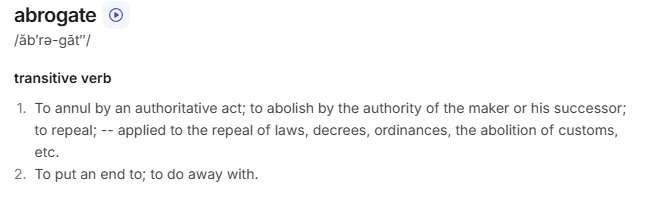
(Abrogated: To annul by an authoritative act; to abolish by the authority of the maker or his successor; To put an end to; to do away with.)

The Law of Moses, given to Israel at Sinai (Exodus 19-20), is no longer the means of salvation:

  • Fulfilled and Replaced: Jesus fulfilled the Law (Matthew 5:17-18), and His death on the cross abolished it as a system of justification (Colossians 2:14; Ephesians 2:15). Hebrews 10:9 states that Christ “takes away the first [covenant] that He may establish the second.” The Law’s sacrifices and ordinances could not perfect or justify (Hebrews 10:1-4; Galatians 3:10-13).
  • A Tutor to Christ: Galatians 3:24-25 explains that the Law was a “tutor to bring us to Christ,” but “after faith has come, we are no longer under a tutor.” For Israel, the Law pointed to the Messiah, but since His coming, salvation is through faith in Him, not the Law’s works (Romans 10:4).
  • Inability to Save: Acts 15:10-11, in the context of Jewish believers, affirms that neither Jews nor Gentiles are saved by the Law, which was a “yoke” they could not bear. Instead, “through the grace of the Lord Jesus Christ we shall be saved.”

Israel’s Salvation Today.

Since Pentecost, Jews (Israel) are saved by:

  • Hearing and Believing the Gospel: Romans 10:17 says faith comes by hearing the word of Christ. Jews must believe Jesus is the Messiah, as Peter proclaimed to Israel (Acts 2:36).
  • Repentance and Baptism: Acts 2:38 applies to Jews, as seen in the mass conversions at Pentecost. Baptism in Jesus’ name unites Jews and Gentiles with Christ (Galatians 3:27-29).
  • Ongoing Faithfulness: Like all believers, Jews must abide in Christ’s doctrine (2 John 1:9) and remain faithful (Hebrews 3:14). The remnant of Israel saved today includes Jews who obey the Gospel, such as the apostles and early disciples (Romans 11:5).

The Remnant and Future Hope.

Romans 11:5 speaks of a “remnant according to the election of grace” among Israel, saved by faith in Christ, as exemplified by Jewish believers in the New Testament (e.g., Acts 21:20). While Romans 11:26 anticipates a future time when “all Israel will be saved,” this does not imply salvation apart from the Gospel. The context (Romans 11:23-27) suggests Israel’s salvation comes through faith in Christ, aligning with the New Covenant promise of Jeremiah 31:31-34, fulfilled in Christ’s blood (Hebrews 8:8-12; Matthew 26:28).

Conclusion.

Since Pentecost, Israel is saved through the Law of Christ—the Gospel—not the Law of Moses, which was fulfilled and abrogated (Hebrews 8:13; Colossians 2:14). The New Covenant, promised in Jeremiah 31:31-34 and established through Christ (Hebrews 8:6), requires Jews to believe in Jesus as Messiah, repent, and be baptized (Acts 2:38; Romans 10:9-13). The remnant of Israel today, like all believers, enters God’s chosen people (1 Peter 2:9) by faith and obedience to the Gospel, fulfilling God’s redemptive plan through the eternal covenant of Christ.

agape

Testing the Spirits: Knowing God’s Will Through Scripture

Many who claim to follow Jesus assert they “hear God” or “feel the Holy Spirit” guiding them through personal experiences, visions, or inner promptings. While sincerity is commendable, the New Testament instructs believers to test such claims against the inspired Word of God, which alone reveals His will. The Bible warns that not every spirit is from God (1John 4:1), and it provides the sole standard for discerning truth. Today, no one receives divine revelation apart from Scripture, and we must lovingly but firmly guide others to this truth.

The New Testament teaches that God’s revelation was completed through the apostles and prophets. John 20:30-31 declares that the recorded signs of Jesus are sufficient for belief and life in His name. Similarly, 2Timothy 3:16-17 affirms that Scripture is “by inspiration of God” and equips believers for every good work, leaving no need for additional revelation. The apostles, uniquely inspired by the Holy Spirit (John 16:13; Acts 2:4), delivered the faith “once delivered unto the saints” (Jude 3). This completed revelation warns against adding to or subtracting from God’s Word (Revelation 22:18-19).

Claims of hearing God apart from Scripture often lead to confusion, as seen in the conflicting beliefs among denominations. The Bible cautions against deceptive spirits and false prophets (2Corinthians 11:13-15; 1Timothy 4:1). Jesus Himself warned of false christs and prophets who would mislead many (Matthew 24:24). If individuals claim divine guidance that contradicts Scripture or leads to opposing doctrines, such “spirits” fail the test of 1John 4:2-3, which demands alignment with the apostolic testimony about Christ.

The Holy Spirit’s work today is not to provide new revelations but to illuminate the written Word. Jesus promised the Holy Spirit would guide the apostles into all truth (John 16:13), a process fulfilled in the New Testament’s completion. Ephesians 3:3-5 reveals that God’s mystery was made known through apostolic writings, not ongoing personal revelations. Peter underscores that Scripture, inspired by the Spirit, surpasses even eyewitness experiences (2Peter 1:16-21). Thus, any claim of divine communication must be measured against the Bible’s unchanging standard.

To those who feel they “hear God,” we respond with compassion but clarity: God has spoken fully through His Word. Hebrews 1:1-2 contrasts God’s past revelations with His final word in Christ, recorded in Scripture.

Personal feelings, while powerful, are subjective and fallible (Jeremiah 17:9). The Bereans were commended for testing even Paul’s teachings against Scripture (Acts 17:11). We must do the same, trusting that the Bible alone is sufficient to guide us into God’s will (Psalm 119:105). In a world of competing voices, Christians must anchor their faith in the inspired, complete Word of God. By testing every spirit against Scripture, we guard against deception and find the true path to knowing God.

The heart is deceitful above all things, and desperately wicked: who can know it?” (Jeremiah 17:9)

I verily thought with myself, that I ought to do many things contrary to the name of Jesus of Nazareth.” (Acts 26:9)

agape

Spencer

Evidence for our Faith: I ain’t ‘fraid of no demons

Comfort in Christ: The Biblical Truth About Demons: Bound, Limited, and Not Possessing Us Today.

When people think of demons, their minds often race to Hollywood horror flicks (red-eyed creatures, spinning heads, and sinister voices). But the Bible paints a far less theatrical picture. What do the Scriptures actually say about the origin and limitations of demons? The comforting truth is this: demons, as fallen angels, are bound by God’s authority and no longer possess people today. The scary stuff? That’s the theatrical imaginations of entertainers or false teachers creating pictures running wild in our minds.

The Bible reveals that demons are angels who rebelled against God and fell from their heavenly roles. Revelation 12:7-9 describes a war in heaven where Satan, the dragon, and “his angels” fought against Michael and were “cast out into the earth.” Jude 1:6 speaks of angels who “kept not their first estate” and are now “reserved in everlasting chains under darkness unto the judgment of the great day.” Similarly, 2Peter 2:4 says God “cast them down to hell, and delivered them into chains of darkness, to be reserved unto judgment.” These verses point to demons as fallen angels, once glorious but now defeated and restricted, under God’s sovereign control (see Zech 13:2).

What about their power? The Bible shows demons as limited beings, not the all-powerful terrors of pop culture (Job 1:12, 2:6). In the Gospels, demons cause harm (like the Gerasene man’s possession in Mark 5:1-20) but Jesus casts them out with a word, proving His absolute authority (Matthew 8:16). Demons tremble before God (James 2:19), and their activity in the New Testament is tied to a specific time: Jesus’ earthly ministry (to prove Christ’s identity), when spiritual warfare peaked as He confronted Satan head-on (Luke 10:18). After His resurrection, Jesus declared, “All authority in heaven and on earth has been given to me” (Matthew 28:18). This victory binds Satan and his forces, keeping them from possessing people any longer (Colossians 2:15).

Here’s the comforting part: there’s no biblical evidence that demons possess people today as they did in Jesus’ time. The New Testament epistles, written to guide the early church, focus on resisting temptation and standing firm in faith (Ephesians 6:12; James 4:7), not casting out demons. When Paul did have to cast out demons they fulfilled the same purpose, to identify him as an approved messenger of Christ. “These men are the servants of the most high God, which shew unto us the way of salvation” (Acts 16:17; e.g., 19:15). The idea of possession today often stems from theatrical imaginations like movies, books, and spooky campfire stories that amplify fear. While Ephesians 6:12 mentions “spiritual wickedness,” it’s about their influence in the world, not body-snatching. Believers are sealed by the Holy Spirit (Ephesians 1:13), and 1 John 4:4 assures us, “because greater is he that is in you, than he that is in the world.” Demons can’t override God’s boundaries.

Our fascination with demons often comes from cultural exaggerations, not Scripture. The Bible doesn’t describe them with pitchforks or glowing eyes; that’s medieval art and modern cinema talking. Demons are real but restrained, awaiting final judgment (Matthew 25:41). There’s no need to fear demon possession; we need to trust in Christ’s triumph.

So, let’s set aside the horror movie hype. Demons are fallen angels, bound by God, and they’re no longer free to terrorize us (Satan’s teaching is still with us). Fear not; the victory’s already won!

Agape

Related Articles:

Is Demon Possession Possible today?

Is Demon Possession Possible today, pt 2?

Evidence for our Faith: Natural Law

The Role of Natural Law in Pointing to a Lawgiver

Look at the world around you; the way the stars hang in perfect balance or how a seed knows to become a towering oak. It’s not chaos; it’s order, governed by natural law, the consistent rules that keep the universe humming. These laws, from gravity’s pull to the intricate code in DNA, don’t just happen, they point to a purposeful intelligent design, a Lawgiver who crafted it all with intention. As a believer in the Bible’s account of a six-day creation, I see this order as evidence of God’s deliberate handiwork, not a cosmic accident.

Natural law is the framework of predictable principles that make life possible. The sun rises on schedule (Jeremiah 31:35-36), seasons shift like clockwork, and the laws of physics keep planets spinning. Romans 1:20 says God’s “eternal power and Godhead” are clear in what He made. The universe’s fine-tuning (like the precise gravitational constant that allows stars to form) is no fluke. Scientists estimate the odds of a life-sustaining universe by chance are 1 in 10^229 (Hugh Ross, The Creator and the Cosmos). That’s not luck; it’s design, echoing Genesis 1, where God spoke order into existence over six days.

Then there’s the moral side of natural law. Humans share a sense of justice, love, and truth across cultures. We see this in the oft asked questions about why is there evil in the world. Without God’s moral law, there is no such thing as good nor evil. Ecclesiastes 3:11 says God “set eternity in their heart,” (ASV) hinting at a universal compass. Psalm 19:1-4 adds that the heavens “declare the glory of God,” revealing Him through their silent order. This moral awareness sets us apart from animals. A lion’s instinct drives it to hunt, not to ponder fairness. Animal instincts are about survival (eat, mate, flee) void of elevated human traits like justice, compassion, or self-sacrifice. A dog might show loyalty, but it doesn’t wrestle with ethical dilemmas or seek meaning. This gap points to a Lawgiver who gave humans a unique moral capacity, reflecting His character.

Skeptics might say natural laws are just “there,” needing no explanation. But why do they exist, and why are they so perfectly balanced? Randomness can’t account for a universe where laws align to support life and human consciousness. It’s like expecting a hurricane to build a skyscraper. The Bible’s account of creation (God forming light, land, and life in Genesis 1) shows a purposeful design, not a cosmic roll of the dice.

Natural law, from the orbits of galaxies to the moral stirrings in our souls, is a testament to a Creator’s wisdom. It’s a quiet invitation to see His fingerprints everywhere. Natural law’s order and humanity’s unique moral spark reveal a Lawgiver who designed the universe and us with purpose and love.

agape

Sources:

Ross, Hugh. The Creator and the Cosmos. Reasons to Believe, 2018.

Evidence for our Faith: the Politarch

The Politarch Inscription

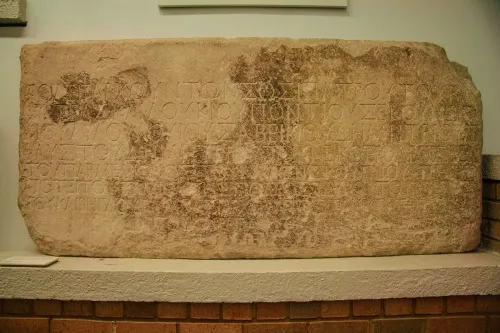
For years, critics of the Bible pointed to the Greek word politarch, used in Acts 17:6-8 to describe Thessalonian city officials, as evidence of scriptural inaccuracy. This term, unique to Luke’s account and absent from classical Greek literature, led some 19th-century scholars to argue that Luke fabricated details, casting doubt on the New Testament’s historical reliability. They claimed politarch was an anachronism or error, undermining Luke’s credibility as a historian.

However, the discovery of the Thessalonian Politarch Inscription1 in the 19th century, which explicitly lists “politarchs” as civic leaders in Thessaloniki, silenced these objections. As noted by historians like F.F. Bruce, this archaeological find confirmed Luke’s precision, showing that politarch was a legitimate title in first-century Macedonia. This turnaround highlights how critics’ challenges, when met with evidence, can strengthen faith in the Bible’s trustworthiness, echoing Psalm 119:160’s assurance that God’s Word is true.

Thessaloniki was a bustling Roman city, and the politarchs were civic leaders navigating the tensions of a diverse, often skeptical society. Acts 17:4-5 tells of locals and converts stirred by Paul’s preaching, clashing with those loyal to Roman order. The inscription, studied by scholars like N.T. Wright, reveals a city governed by these politarchs, who faced real pressures from crowds opposing the gospel. This context makes Paul’s courage, and the Thessalonians’ faith, more vivid. It reminds us that the Gospel continued to spread in a complex, real-world setting, encouraging us to live boldly for Christ today, as Paul urged in 1 Thessalonians 5:16-18, to “rejoice always” despite challenges.

The Politarch Inscription strengthens our confidence in scripture’s reliability. If Luke accurately recorded a minor detail like a local title (which was for centuries thought to be inaccurate until archaeological discovery), we can trust his accounts of greater events (like Jesus’ resurrection or Paul’s missionary journeys). Archaeological finds consistently show the Bible’s alignment with history. This harmony between faith and evidence invites us to approach scripture with confidence, not blind belief, knowing it withstands scrutiny. As John 17:17 reminds us, God’s Word is truth, a foundation that discovery affirms rather than contradicts.

The Thessalonian Politarch Inscription is more than a dusty relic; it’s a testament to the Bible’s trustworthiness. It encourages us to dig deeper into scripture, marvel at its accuracy, and live out our faith with boldness. Let this ancient stone inspire you to trust God’s Word, knowing it stands firm both then and now.

agape

1. The Thessalonian Politarch Inscription, discovered in Thessaloniki, Greece, in the 19th century, is a fragmented stone artifact from the first century AD, likely part of a public monument or building. This stone tablet discovered in Thessalonica (modern-day Thessaloniki, Greece) that dates to the second century A.D.  lists six officials known as “politarchs,”.

The Inscription on the Politarch as much as is possible due to its fragmented condition.

“In the time of [name of a Roman official or emperor, possibly missing], the politarchs of Thessaloniki, [names such as Sosipatros, Lucius, Sextus, Gaius, Secundus, as typical in Macedonian inscriptions], [served or dedicated this] to [a deity, civic institution, or event, possibly Zeus or the city], in the year [specific dating, often tied to a Roman or local calendar].”

INTERESTING NAMES ON THE STONE

Sosipater: A common Greek name, possibly linked to the biblical Sosipater in Romans 16:21.

C. (Gaius): another name that echoes biblical figures like the Gaius mentioned in Acts 20:4.

Secundus: A Roman name, similar to the Thessalonian Secundus in Acts 20:4.

Evidence for our Faith: Free Will

Let’s talk about this Calvinist idea of predestination. Basically, that God pulls every string, deciding who’s in and who’s out, with free will just a side note because God’s Sovereignty demands it. Sounds tidy, right? But the Bible keeps pushing back, shouting from the rooftops that we’ve got real choices to make. It’s not some robotic rerun; it’s a dynamic story where God hands us the reins and says, “Your move.”

God repeatedly tells individuals to make choices, implying free will. In Joshua 24:15, Joshua exhorts the Israelites, “Choose this day whom you will serve,” presenting a clear decision between serving God or idols. This command assumes the ability to choose freely, not a predetermined outcome. Similarly, Deuteronomy 30:19 declares, “I have set before you life and death, blessing and curse. Therefore choose life.” The imperative to “choose” underscores human responsibility to respond to God’s call, incompatible with a view where every decision is divinely dictated.

In the New Testament, Jesus’ invitations affirm free will. Matthew 11:28 says, “Come to me, all you who are weary and heavy laden, and I will give you rest.” This open invite requires a voluntary response, suggesting individuals can accept or reject it. Likewise, John 7:17 states, “If any man will do his will, he shall know of the doctrine, whether it be of God, or whether I speak of myself.” Jesus emphasizes choice as central to faith, countering the idea that God irresistibly determines belief.

Calvinists often cite Romans 9:16-18, which highlights God’s sovereignty in showing mercy, to support predestination. However, Paul’s broader argument in Romans emphasizes human responsibility. Romans 10:9 declares, “If you declare with your mouth, ‘Jesus is Lord,’ and believe in your heart… you will be saved.” (Paul will continue on in the text pointing to baptism & faith). The conditional “if” implies that salvation hinges on personal choice, not divine coercion. Furthermore, 2 Peter 3:9 reveals God’s desire that “not willing that any should perish, but that all should come to repentance,” suggesting universal opportunity for salvation through free response, not selective predetermination.

Ephesians 1:4-5, another Calvinist cornerstone, states God chose believers “before the foundation of the world.” Yet, this should be understood corporately; God predestining the church as a body for salvation, while individuals freely choose to obey the Gospel and are added to the church through faith (Ephesians 2:8-9; Acts 2:38,41,47). This harmonizes with passages like Revelation 3:20, where Jesus says, “I stand at the door and knock. If anyone hears my voice and opens the door, I will come in.” The imagery of opening the door underscores human agency in responding to divine initiative.

Moreover, Calvinism’s strict determinism raises concerns about God’s character. If God ordains all actions, including sin, it conflicts with James 1:13, which states, “God cannot be tempted by evil, nor does he tempt anyone.” Free will allows humans to bear responsibility for sin, preserving God’s holiness and justice. Neither the devil nor God made us do it. Scripture consistently portrays God as inviting, not compelling, human response. Scripture paints God as the ultimate pursuer, not puppet-master. Free will aligns with a God who desires genuine relationship over robotic obedience.

agape

spencer

Evidence for our Faith: the Faithful Word

Evidence for Our Bible Today

The Bible we hold today is a treasure, a book that has shaped lives for centuries. But how can we trust it’s the real deal, faithfully passed down through time? The early believers (often called church fathers) from the first few centuries after Christ give us compelling evidence that our Bible is reliable, rooted in their lives, writings, and devotion.

To begin with, people like Ignatius of Antioch and Polycarp, were taught by the apostles or their immediate followers. They didn’t just read about Jesus; they learned from those who walked with Him. Their writings, like Ignatius’ letters (circa 110 AD), echo the New Testament teachings, quoting books like Matthew, John, and Paul’s epistles as Scripture. For example, Ignatius references Jesus’ death and resurrection (Letter to the Smyrnaeans 1:1-2), aligning with 1 Corinthians 15:3-4. This shows the New Testament was already revered as God’s Word within a generation of the apostles, not some later invention.

Also, 2nd century believers defended the Bible’s truth against heresies. Irenaeus, in his Against Heresies (circa 180 AD), argued that the four Gospels (Matthew, Mark, Luke, and John) were uniquely authoritative, handed down through apostolic tradition. He tied their reliability to the Old Testament prophecies fulfilled in Christ, like Isaiah 53:5, which speaks of the Messiah’s suffering. Irenaeus’ work shows the early Church carefully preserved the Scriptures, ensuring no random texts slipped in. Their vigilance gives us confidence that our Bible matches what they held sacred.

Additionally, they sealed their trust in Scripture. Polycarp, martyred around 155 AD, faced death boldly, quoting Jesus’ words from Matthew 10:28: “Do not fear those who kill the body but cannot kill the soul.” His courage, recorded in The Martyrdom of Polycarp, proves he didn’t just believe the Bible, he staked his life on it. Countless others, like Justin Martyr, died for their faith, showing the Scriptures weren’t myths but truths worth everything. Their sacrifices declare to us: this Book is trustworthy. (BTW: their willingness to die wasn’t related in any way to a desire to kill as many folks as possible, as some religions do)

Finally, their meticulous copying and sharing of Scriptures ensured accuracy. Clement of Alexandria (c.150-c.215) and Origen (c.185-c.254) cataloged and taught from texts that match our modern Bible (long before the claims of the catholic church to have brought us the Bible), as seen in surviving manuscripts like the Codex Sinaiticus (4th century). Their efforts preserved God’s Word through persecution and time, a demonstration of faithfulness.

The early believers weren’t perfect, but their writings, lives, and love for Scripture shine as evidence: the Bible we have is the same one they cherished. They bridge the gap between us and the apostles, inviting us to trust God’s Word with the same fire they did.

The Bible stands firm because the early Church Fathers lived and died for it, passing down the truth we hold today.

agape

Sources:

Ignatius, Letter to the Smyrnaeans (Early Christian Writings, http://www.earlychristianwritings.com)

Irenaeus, Against Heresies (Book III, Christian Classics Ethereal Library, http://www.ccel.org)

The Martyrdom of Polycarp (Early Christian Writings) Codex Sinaiticus (www.codexsinaiticus.org) (www.codexsinaiticus.org)

Evidence for our Faith: the 4 Flaws of Evolution

The 4 flaws of Evolution

Evolution, as it’s often taught, leans on four major claims that sound convincing at first but start to wobble when you look closely. These ideas are the backbone of the theory, yet they’ve never been directly observed, no matter how much time passes or how many textbooks repeat them.

First up: the idea that life just popped out of non-living stuff, like some cosmic soup got zapped and poof! life appeared. This is called abiogenesis, but let’s keep it simple: lifeless chemicals somehow turning into living cells. Sounds like a sci-fi movie, right? The problem is, no one has ever seen this happen. Not in a lab, not in nature, nowhere. Scientists have tried mixing chemicals, adding heat, or even throwing in some electricity to mimic lightning, but they’ve never gotten anything close to a living cell. It’s like trying to bake a cake and ending up with a bicycle, it’s just not happening. Life is insanely complex, even at its tiniest level, and the leap from non-life to life is a massive gap that no experiment has bridged.

Next, there’s the claim that all life we see today, every tree, fish, bird, and human, came from a single-celled organism way back when. Picture this: one lonely cell somehow leads to elephants, oak trees, and you and me. The catch? There’s no evidence of any in-between steps. If life really went from one cell to everything else, you’d expect to find fossils or living examples of two-cell, three-cell, or four-cell creatures, right? But we don’t. It’s like the theory skips from a single-celled starting point straight to complex life without any middle ground. No transitional forms, no halfway creatures; just a big, bold story that asks us to take it on faith.

Then we’ve got the idea that time and chance are the magic ingredients driving evolution forward. The story goes that given enough years and a sprinkle of random mutations, simple life turns into complex life. But here’s the thing: time and chance often work against complexity. Mutations, which are like random typos in DNA, usually mess things up rather than improve them. Imagine spilling coffee on a book, does it make the story better? Nope, it just ruins the pages. Most mutations are harmful or neutral, and even the rare “good” ones don’t add the kind of new information needed to turn a fish into a frog. Plus, the more time you add, the more things tend to break down or stay the same, not magically get better. It’s like expecting a rusty old car to turn into a spaceship if you leave it in the garage long enough.

Finally, there’s the idea that microevolution (small tweaks we can actually see, like dogs getting fluffier or bacteria resisting antibiotics) proves macroevolution, the big jumps from one kind of creature to another. This one’s tricky because microevolution is real and observable. Think of it like tweaking a recipe: you can add a bit more sugar or swap cinnamon for nutmeg, and it’s still a cookie. But macroevolution? That’s like saying if you tweak the recipe enough, it’ll turn into a pizza. Small changes within a species don’t show that one species can transform into a totally different one, like a reptile becoming a bird. We’ve never seen that kind of leap, and the fossil record doesn’t show it either, no clear chain of creatures morphing from one kind to another.

These 4 ideas sound neat and tidy, but when you dig in, they’re more like bold guesses than things we’ve actually seen.

Agape

Evidence for our Faith: Faith comes by hearing

How Long Would It Take to Teach the Whole Bible Three Times a Week?

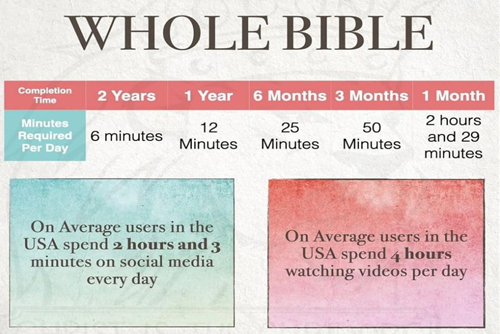
While planning the Bible studies for this congregation, I wondered how long it would take to teach the entire Bible in depth in only our 3 sessions per week?

The schedule in question was familiar: two Bible classes each week, each about 45 minutes long but with an introduction, prayer, discussion, and summary that left roughly 30 minutes for actual material. The third session would be a sermon (possibly as long as 45 minutes) but in reality, I only have about 30 minutes. That gave me three half-hour teaching slots per week to teach.

There are several common methods of teaching Scripture, each has its own pace. The first and perhaps most obvious is the EXPOSITORY method; going chapter-by-chapter in order. At first glance, this seems easy to measure: 1,189 chapters, one per session, for 1,189 classes; about 7.6 years at three sessions per week. But here’s the reality: many chapters require a minimum of two or even three sessions to capture the fullness of their meaning. You could go chapter-per-session if you only did an overview, but true depth would extend the timeline significantly. Recognizing this reality, a book-by-book overview may pick up the pace, but no real depth will be accomplished.

Other methods would take different amounts of time. A topical study, covering 100 major subjects like baptism, love, faith, or the church and giving each three sessions, would total 300 lessons; just under 2 years. Character studies (looking at lives like Abraham, David, Peter, and Paul) might only take around 100 sessions if you covered about 50 people with two classes each. That’s less than a year. Thematic or doctrinal studies, following threads like covenant, kingdom, or grace from Genesis to Revelation, would run about 120 sessions, taking nine months. A chronological narrative, telling the Bible’s story in the order events happened, would be more ambitious: about 250 sessions, or 1.6 years.

If you stacked all these methods back-to-back without repeating material, the grand total would be 2,105 sessions. That’s about 13½ years of steady teaching (three times a week, every week). Start now and finish somewhere in the late 2030s. But here’s the twist: this assumes each important doctrine, like salvation in Christ, IS GIVEN ONLY ONCE. That would be like a wilderness wandering of teaching and never helping anyone actually enter the Promised Land. If salvation (and many other vital subjects) is left as a single stop along the way, we risk people hearing the gospel once every few years.

The truth is, many of these methods overlap, and rightly so. Some themes, especially the gospel of Christ, must resurface again and again no matter which teaching plan is in use. Whether chapter-by-chapter, book-by-book, or topic-by-topic, there must be repeated lessons on repentance, faith, and obedience. Yes, we could make a plan that takes a decade or more to cover everything, but if we’re truly guiding people toward salvation in Christ, we won’t wait until year seven to bring up the cross again.

Agape

Evidence for our Faith: Why Atheism Fails to Explain the Universe’s Origin

Atheism, as a worldview, suggests that the universe exists without a purposeful intelligent design, relying instead on naturalistic explanations for its origin. Sadly, this perspective struggles to provide a coherent and comprehensive account of the universe’s beginning, leaving critical questions unanswered. In contrast, the Bible offers a logically compelling framework for understanding the universe.

One of atheism’s primary challenges is the question of what caused the beginning of the universe. The universe, according to modern cosmology, began with the Big Bang approximately 13.8 billion years ago (Hawking, 1988). Atheism often leans on theories like quantum fluctuations or multiverse hypotheses to explain this event without invoking a cause. Yet, these explanations falter, only pushing back the question without answering it. Quantum mechanics operates within the framework of space-time, which itself began at the Big Bang. To suggest quantum fluctuations caused the universe requires a pre-existing framework, which doesn’t answer but only blurs the discussion. The multiverse theory, while speculative, lacks any real evidence and merely shifts the question of origin to an unobservable realm (Krauss, 2012). Atheism’s reliance on such theories often feels like an attempt to avoid the question rather than answer it, and requires lots of faith.

In contrast, the Bible presents a clear cause: “In the beginning, God created the heavens and the earth” (Genesis 1:1). This aligns with the philosophical principle of sufficient reason, which argues that everything must have a reason or cause. A transcendent (beyond Time, Space, & Matter), purposeful intelligent design provides a logically consistent explanation for why the universe exists rather than nothing. As Psalm 19:1 states, “The heavens declare the glory of God; and the firmament sheweth his handywork,” suggesting a purposeful order to creation.

Another issue is the fine-tuning of the universe. The physical constants governing gravity, electromagnetism, and nuclear forces are precisely calibrated to allow life (Barrow & Tipler, 1986). Even slight deviations would render the universe inhospitable. Atheism attributes this to chance or necessity, but the odds of such precision arising randomly are astronomically low; it’s like winning a cosmic lottery trillions of times over. Theistic arguments, supported by Romans 1:20, assert that the universe’s order reflects a purposeful design: “For the invisible things of him from the creation of the world are clearly seen, being understood by the things that are made, even his eternal power and Godhead; so that they are without excuse.”

Atheism also struggles with the origin of consciousness and morality. Naturalistic processes like evolution falter in accounting for subjective experiences or objective moral standards as well as biological development. If humans are merely products of matter, why do we possess self-awareness or universal moral intuitions? John 1:3 suggests a divine source for all things: “All things were made by him; and without him was not any thing made that was made.” This implies a purposeful intelligent design behind both the physical and metaphysical aspects of existence.

While atheism offers skepticism, it lacks a robust explanation for the universe’s origin, fine-tuning, and the emergence of consciousness. Theistic arguments, grounded in biblical revelation, provide a coherent narrative that aligns with both reason and observation. Ultimately, atheism’s failure to explain why there is something rather than nothing points to a truth the Bible boldly declares: the universe exists because a purposeful God willed it into being.

The basic question for me is; did everything come from nothing, or did it come from someone who is outside of Time, Space, and Matter? To me, atheism is the least logical belief system (Atheism is the lack of belief in the existence of God). We as humans are currently unable to scan the known universe, let alone the unknown universe, let alone the bottom of our own oceans. How that can one state with confidence, “there is no God.”

AGAPE

Sources:
Barrow, J. D., & Tipler, F. J. (1986). The Anthropic Cosmological Principle. Oxford University Press.
Hawking, S. (1988). A Brief History of Time. Bantam Books.
Krauss, L. M. (2012). A Universe from Nothing. Free Press.
The Bible (KJV): Genesis 1:1, Psalm 19:1, Romans 1:20, John 1:3.