Following the Recipe

Follow the recipe

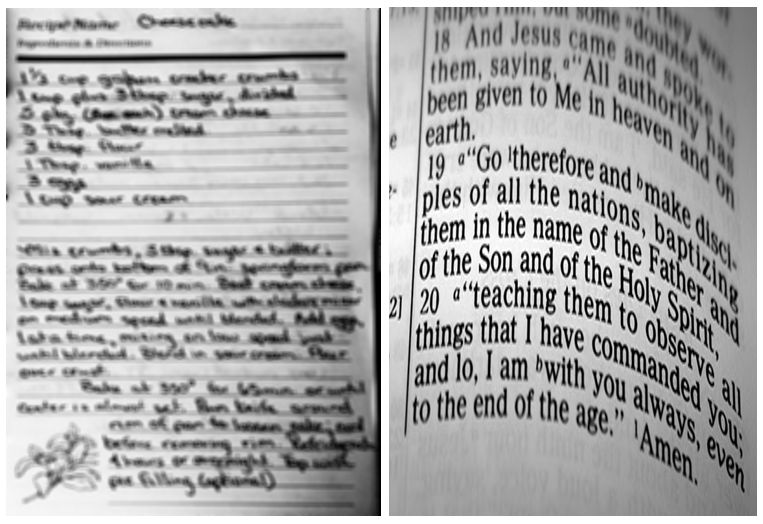
I WENT TO BAKE A particular cheesecake for Thanksgiving. It’s a very special cheesecake that my mother used to make. You see, my mother’s cheesecake won rave reviews among all the family, and we looked forward to it each time she made it.

So I reached for the recipe, the one my wife had made a verbatim transcript from my mom. You could say that this recipe is the gospel for mom’s cheesecake.

The main ingredient is cream cheese, a must for any cheesecake, but I’m not making just ANY cheesecake, I’m making mom’s.

She also called for melted butter, but I’m trying to lose a few pounds, so I decide to substitute margarine. She also wrote that graham cracker crumbs are a must, but I didn’t have any so I used saltine crackers instead. It’s similar, and she isn’t here to say I can’t.

The recipe calls for 3 eggs, but I only have 2. That shouldn’t make much of a difference, especially if I add just a bit more sour cream. As long as we keep the liquid about the same.

I mix it all together, following the instructions precisely, and put it into the 10” skillet (I can’t find our spring-form pan). Continuing to dutifully follow the instructions, I baked the cheesecake as directed.

Taking it out of the oven, it didn’t smell quite like I remembered, but it looked very similar to the way mom made it. I let it cool and placed it in the fridge for my wife to find. I couldn’t wait for her to taste it, she’ll be so thrilled to see the cheesecake that mom used to make.

Her excitement was just as I expected upon seeing that cake. She carefully removed the first piece, and I anxiously awaited her first bite. The look on her face was priceless and she said, “That’s NOT how your mom used to make it.” And that’s when the fight started. Of course this story is a bit of fiction, or is it?

“…and upon this rock I will build my church; and the gates of hell shall not prevail against it.” Matthew 16:18

And whatsoever ye do in word or deed, do all in the name of the Lord Jesus, giving thanks to God and the Father by him.” Colossians 3:17

“Whether it be good, or whether it be evil, we will obey the voice of the LORD our God, to whom we send thee; that it may be well with us, when we obey the voice of the LORD our God.”  (KJV) [Jeremiah 42:6]

4 duties toward Government

YOU’RE EITHER HAPPY with the result or not. Now what? What if your candidate wasn’t picked? What are you, as a Christian, supposed to do? To figure that out we must do what we always do. We ask, “What does the Bible Say?”

4 things every Christians must do for Government

The Word of God teaches us how to function with the civil authorities, especially those with whom we disagree. Whether we like who won or not, there are 4 things the Scriptures teach us about our duty to them.

1) SUBMIT –  God expects His people to submit to the civil authorities. Paul wrote, “Let every soul be subject to the governing authorities. For there is no authority except from God, and the authorities that exist are appointed by God” [Romans 13:1; Titus 3:1; 1Peter 2:13-16].

It’s more than just because God said so. He explains why we are to submit. The civil authorities are “God’s minister to you for good” [Romans 13:3-4]. When we resist, we bring judgement upon ourselves. We have no fear of government even if they, unjustly, cast us into prison for our faith [Acts 5:18; Revelation 2:10]. The civil agents, when acting as God intended, are not a terror to good works [1Timothy 2:1-2; Romans 13:3].

2) RESIST – There are limitations to the above rule. When the Apostles were commanded “not to teach in this name” Peter stood up and said, “We ought to obey God rather than men” [Acts 5:29]. We are citizens of a Superior Kingdom and follow a Superior King, Christ Jesus. “But you are a chosen generation, a royal priesthood, a holy nation, His own special people, that you may proclaim the praises of Him who called you out of darkness into His marvelous light;” [1Peter 2:9]. “He has delivered us from the power of darkness and conveyed us into the kingdom of the Son of His love,” [Colossians 1:13].

We can call out the authorities when they act unjustly. This is what Paul did when he was arrested & beaten in Phillipi. Paul said to them, “They have beaten us openly, uncondemned Romans, and have thrown us into prison. And now do they put us out secretly? No indeed! Let them come themselves and get us out” [Acts 16:22-24, 35-40]. We submit when they act justly & resist when they don’t. In either case, without sin; “Be angry, and do not sin” [Ephesians 4:26a]. Submission is not authorization for abuse [1Peter 2:16].

3) GIVE HONOR & PAY TAXES – Though few ever enjoy paying taxes, God has authorized government to collect them. Jesus taught this through His own example during His time here on earth. “They say unto him, Caesar’s. Then saith he unto them, Render therefore unto Caesar the things which are Caesar’s; and unto God the things that are God’s.” [Matthew 22:21; cr. Matthew 17:24]

God explained why, they bear the sword of justice, “For for this cause pay ye tribute also: for they are God’s ministers, attending continually upon this very thing. Render therefore to all their dues: tribute to whom tribute is due; custom to whom custom; fear to whom fear; honour to whom honour” [Romans 13:6 -7]. Tax evasion is against both the law of the land and the Law of Christ, but tax avoidance is legal under both.

4) PRAY FOR THEM – “Therefore I exhort first of all that supplications, prayers, intercessions, and giving of thanks be made for all men, for kings and all who are in authority, that we may lead a quiet and peaceable life in all godliness and reverence.” [1Timothy 2:1-4].

We should be thankful for living in a place that allows us to choose our government. We should be thankful for the peacemakers (police / military) who place themselves in harms way to maintain order. God has given us these authorities so that we can live in a free country and enjoy peace. This peace allows for us all to have a quite life and to worship God.

This peace serves another purpose. Paul continued, “For this is good and acceptable in the sight of God our Savior, who desires all men to be saved and to come to the knowledge of the truth.” The peace brought to us through the civil authorities allows free course to the gospel. This can and must be done when there is no peace, but I’m grateful that, for now, we can teach the Gospel without fear.

CONCLUSION: Regardless the winner, we remain citizens of a heavenly kingdom and God still reigns. In this we can take comfort and have joy. No government, president or king should ever stop us from glorifying God nor stop us from spreading the good news.

“This matter is by the decree of the watchers, and the demand by the word of the holy ones: to the intent that the living may know that the most High ruleth in the kingdom of men, and giveth it to whomsoever he will, and setteth up over it the basest of men.”  (KJV) [Daniel 4:17]

How Liberalism wins.

BEFORE WE BEGIN, for the purpose of this article, we shall use the simple definitions of liberal & conservative. Liberal means; “not opposed to new ideas or ways of behaving that are not traditional or widely accepted.”1 Conservative means; “the tendency to prefer an existing or traditional situation to change.”2

As it relates to religion, a conservative is one who wants to hold fast to the word of God. “If any man speak, let him speak as the oracles of God” [1Pe 4:11], means that we do not go beyond the text of the scriptures. We’re told to “Prove all things; hold fast that which is good” [1Thess 5:21], and “not to think beyond what is written” [1Cor 4:6]. [cr. 2Peter 1:19-21; John 12:48; 2Thess 2:15]. This is what the Christians here at Franklin & Juniper church of Christ in Borger Texas want to do, hold fast to the Word of God.

A liberal, therefore, is the one who believes that we have freedom to move from tradition and authority, and have the ability to adjust religious beliefs and practices for the culture. They believe that strict adherance to the word of God is legalistic and unloving.

Many folks will apply labels of “liberal” or “conservative” but those terms mean different things according to where you’re standing at the time. As for me, I start with the undefiled Word of God [John 12:48] and want to CONSERVE that purity in my life and the church. “Every word of God is pure: he is a shield unto them that put their trust in him” [Pr 30:5 (cr. Psalm 119)].

Have you ever wondered why folks with strong conservative values allow error to creep in and pledge support for these errors? How do the “grievous wolves” that Paul spoke about, appear and how do they lead astray so many, even causing division in the church? Paul warned the Ephesian elders; “For I know this, that after my departure savage wolves will come in among you, not sparing the flock. Also from among yourselves men will rise up, speaking perverse things, to draw away the disciples after themselves” [Ac 20:29-30]. He also warned that Satan himself would appear as an “angel of light” and his ministers would appear as “ministers of righteousness” [2Cor 11:14-15].

I’ve noticed 3 arguments that are most often used in support of error. They are EMOTIONALIZE, DEMONIZE & CRITICIZE. Remember also, that change agents appear as “angels of light” [2Cor 11:14]. Let’s examine how this works, not with hate toward others, rather as a warning to all of us as we strive to do God’s will.

The 3 Arguments in support of error

EMOTIONALIZE: “It’s for the children” is the most oft used emotional argument to promote error. The users of these arguments seldom use scripture and when they do they “wrest the scriptures” [2Pe 3:16]. We saw it when denominations pushed for infant baptism. Truth teaches that babies are safe in the Lord [2Sam 12:23; Mat 19:13-14]. This argument continues to be utilized to go around the clear commands of God. We have to resist the urge to break God’s word when our emotions begin to burn. “Whether it is pleasing or displeasing, we will obey the voice of the LORD our God to whom we send you, that it may be well with us when we obey the voice of the LORD our God” [Jer 42:6]. Remember, our hearts can be (and often are) deceived [2Thess 2:10-11; 2Cor 11:14; Gal 1:8-9; Gal 6:7].

If there’s no success with this, they move onto…

DEMONIZE; The promoters of error demonize those that oppose them. While hanging onto the emotional argument, they malign the opposition. Paul faced this himself, “Have I therefore become your enemy because I tell you the truth?” [Ga 4:16] They’ll say we hate children, or are unloving, calling us “anti’s” & “legalists” because we say “I could not go beyond the word of the LORD, to do good or bad of my own will. What the LORD says, that I must speak‘?” [Num 24:13]

Then they will….

CRITICIZE; the opposition for doing things that they themselves are doing. The Apostles faced this very thing. They were criticized for preaching for gain, or for being arrogant, while the critics themselves were doing the very things they spoke against. “I wrote to the church, but Diotrephes, who loves to have the preeminence among them, does not receive us. Therefore, if I come, I will call to mind his deeds which he does, prating against us with malicious words. And not content with that, he himself does not receive the brethren, and forbids those who wish to, putting them out of the church.” [3John 1:9-10 (cr 2Cor 11 & 12)].

Many errors begin due to a lack of understanding on how to determine scriptural authority (or permissions). They also come due to a misunderstanding of the true work of the church. The work of the church is found in “the Great commission”; “Go ye therefore, and teach all nations, baptizing them in the name of the Father, and of the Son, and of the Holy Ghost: Teaching them to observe all things whatsoever I have commanded you: and, lo, I am with you alway, even unto the end of the world. Amen [Mat 28:19-20]. It’s to TEACH the gospel and TEACH the new disciples to observe WHATSOEVER our Lord has commanded.

Please understand, I’m not against helping children, or being benevolent to strangers. I just want to do it God’s way. “And whatever you do in word or deed, do all in the name of the Lord Jesus, giving thanks to God the Father through Him” [Col 3:17].

1 – http://www.merriam-webster.com/dictionary/liberal

2 – http://www.merriam-webster.com/dictionary/conservate

Salvation by Faith ALONE?

If we’re saved by faith alone, as so many denominational pastors teach, then how do you explain all of these verses?

Christ’s words (John 6:63). “It is the Spirit who gives life; the flesh profits nothing. The words that I speak to you are spirit, and they are life.”
The Holy Spirit (John 16:8; Titus 3:5). …renewing of the Holy Spirit
Faith (Romans 10:10). For with the heart one believes unto righteousness, and with the mouth confession is made unto salvation.
Repentance (Luke 13:3; 2 Peter 3:9). “...except ye repent, ye shall all likewise perish.”
Baptism (Mark 16:16; 1 Peter 3:21; Titus 3:5). “…baptism does also now save us.”
God (John 3:16; Titus 2:11). “For the grace of God that brings salvation has appeared to all men,”
Christ’s works (John 20:30–31).”And truly Jesus did many other signs in the presence of His disciples, which are not written in this book; but these are written that you may believe that Jesus is the Christ, the Son of God, and that believing you may have life in His name.”
Calling on His name (Acts 2:21). “And it shall come to pass That whoever calls on the name of the LORD Shall be saved.’ (cr. Acts 22:16)
Christ’s name (Acts 4:12). “Nor is there salvation in any other, for there is no other name under heaven given among men by which we must be saved.”
Christ’s resurrection (Romans 4:25). “who was delivered up because of our offenses, and was raised because of our justification.”
Christ’s death (Romans 5:6). “For when we were still without strength, in due time Christ died for the ungodly.”
Hope (Romans 8:24). “For we were saved in this hope, but hope that is seen is not hope; for why does one still hope for what he sees?”
Confession of faith (Romans 10:10). “For with the heart one believes unto righteousness, and with the mouth confession is made unto salvation.”
Hearing (Romans 10:15–17). “And how shall they preach unless they are sent? As it is written: “How beautiful are the feet of those who preach the gospel of peace, Who bring glad tidings of good things!” But they have not all obeyed the gospel. For Isaiah says, “Lord, who has believed our report?” So then faith comes by hearing, and hearing by the word of God.”
Preaching (1 Corinthians 1:18). “For the message of the cross is foolishness to those who are perishing, but to us who are being saved it is the power of God.”
Fire (1 Corinthians 3:15). “If anyone’s work is burned, he will suffer loss; but he himself will be saved, yet so as through fire.”
The gospel (1 Corinthians 15:1–2). “Moreover, brethren, I declare to you the gospel which I preached to you, which also you received and in which you stand, by which also you are saved, if you hold fast that word which I preached to you–unless you believed in vain.”
Love (Galatians 5:6). “For in Christ Jesus neither circumcision nor uncircumcision avails anything, but faith working through love.”
Grace (Ephesians 2:8). “For by grace you have been saved through faith, and that not of yourselves; it is the gift of God,”
Ourselves (Philippians 2:12). “Therefore, my beloved, as you have always obeyed, not as in my presence only, but now much more in my absence, work out your own salvation with fear and trembling;”
The love of the truth (2 Thessalonians 2:10). “and with all unrighteous deception among those who perish, because they did not receive the love of the truth, that they might be saved.”
Christ (1 Timothy 1:15). “This is a faithful saying and worthy of all acceptance, that Christ Jesus came into the world to save sinners, of whom I am chief.”
Heeding and continuing in the doctrine (1 Timothy 4:16). “Take heed to yourself and to the doctrine. Continue in them, for in doing this you will save both yourself and those who hear you.”
God’s mercy (Titus 3:5). “not by works of righteousness which we have done, but according to His mercy He saved us,”
Obedience (Hebrews 5:9). “And having been perfected, He became the author of eternal salvation to all who obey Him,” (cr. 2Thess 1:8)
Christ’s blood (Hebrews 9:14). “how much more shall the blood of Christ, who through the eternal Spirit offered Himself without spot to God, cleanse your conscience from dead works to serve the living God?”
Works of faith (James 2:24). “You see then that a man is justified by works, and not by faith only.”

The question is not, “which one saves”, rather, “why have they ignored so many verses?

How shall we escape, if we neglect so great salvation? Hebrews 2:3

SHALL WE ADD TO OR TAKE AWAY FROM GOD’S WORD?

Deut 4:2 “You shall not add to the word which I command you, nor take from it, that you may keep the commandments of the LORD your God which I command you.

Deut 12:32 “Whatever I command you, be careful to observe it; you shall not add to it nor take away from it.

Proverbs 30:6 Do not add to His words, Lest He rebuke you, and you be found a liar.

Revelation 22:18-19 For I testify to everyone who hears the words of the prophecy of this book: If anyone adds to these things, God will add to him the plagues that are written in this book; and if anyone takes away from the words of the book of this prophecy, God shall take away his part from the Book of Life, from the holy city, and from the things which are written in this book.

Galatians 1:8-9 But even if we, or an angel from heaven, preach any other gospel to you than what we have preached to you, let him be accursed. As we have said before, so now I say again, if anyone preaches any other gospel to you than what you have received, let him be accursed.


I ain’t afraid of no Ghosts

IT’S THAT TIME of year again here in Borger Texas, Halloween. The time when many decorate their homes with ghosts, goblins and witches.  Even Netflix is promoting a plethora of scary zombie movies. The conversations about ghosts and goblins increase as well. I’ve spoken to several folks who actually believe in a potential zombie apocalypse. A zombie is a corpse said to be revived by witchcraft, in other words, the walking dead.

Regardless of the pop culture surrounding zombies, I ain’t afraid of no zombies either. I’m not afraid by faith. When we say “by faith”, what we mean is that we have revelation from God on any given subject. “So then faith comes by hearing, and hearing by the word of God” [Romans 10:17; Deut 29:29]. God has told us a few things about the evil spiritual realm.

[This article revisits a theme I wrote about in June, “Is demon possession possible].

What does the Bible say about the evil spirit world?

God revealed through the scriptures some things about spirit beings, or angels. Angels are beings with a higher nature than man [Psalm 8:5; Heb 2:7, 9], but some of them sinned against God [2Peter 2:4; Jude 1:6]. This fallen group seem to be identified as the devil’s angels [Matt 25:41; Rev 12:7,9]. They are identified by other terms as well; “demons” [Luke 11:15], “evil spirits” (Acts 19:12-13], “unclean spirits” [Matthew 10:1], or Satan’s angels [Matt. 25:41; Rev. 12:7, 9].

Though very little is said about the demonic & demon possession in the OT, in the NT it appears to have increased. Jesus, along with his disciples, frequently encountered the demonic and were able to cast them out of possessed peoples [Matt 1:21-27; Mark 9:14-29]. Jesus said, “I saw Satan fall like lightning from heaven” [Luke 10:18-20]. The context shows that He was speaking about the disciples’ power over evil spirits and the weakening of Satan’s power, including his influence.

This ability matches the prophecy from Zechariah; “I will also cause the prophets and the unclean spirit to depart from the land” [Zech 13:2]. Peter & Jude refer to evil spirits being in chains and bound [2Peter 2:1-4; Jude 1:6]. Revelation describes Satan being “bound” during the time in which Christ reigns over His kingdom—which is the church [Rev. 20:2]. This evidence points to the conclusion that demonic activity does not happen today, because the evil spirit realm has been “bound” awaiting the final judgement.

Then there’s the living dead…

Most of what we declare about ghosts is from the imaginations of the minds eye of fiction and not by faith (by revelation from God). Even in the Bible, we see the disciples “imagining” that they saw a ghost when they were actually seeing Jesus walk upon the water [Matt 14:26]. But it was their fear of the unknown that created the thought of a ghost, for they had never witnessed anyone ever walking upon the water. It’s important to note that the spirits of the dead are not the same as angels or demons. It is only after the resurrection of the righteous dead that they become “equal to the angels” [Luke 20:36]. Just because the disciples “supposed it was a ghost” is no evidence that ghosts exist [Mark 6:49].

Where do our spirits go when we die?

According to the word of God, all of the dead go to a place of the dead called in New Testament Greek, “Hades”, (translated either; hell, Hades, or grave) the place of departed souls [Luke 16:19-30; Acts 2:27]. All of the sinful angels are bound in a part of Hades called “Tartarus” [2Peter 2:4]. We conclude from these passages that the spirits of the dead & bound are not allowed to roam the Earth nor haunt us. In Jesus’ parable of the rich man and Lazarus, [Luke 16:19-30], the rich man begged that Lazarus be sent back to warn his brothers, but this request was denied.

There are only 2 instances in the New Testament where departed spirits, other than Jesus Himself, were allowed to return. The first was the return of Moses & Elijah in Matt 17:3. This was to show that the Law of Moses & the prophets are fulfilled in Christ Jesus, for God spoke and said, “This is my beloved Son, in whom I am well pleased; hear ye him.”  The second, when the graves of the saints were opened after the resurrection of Jesus in Matt 27:52-54. In both instances they were for a very specific purpose, to testify to the validity of Jesus’ claims, and have since ceased. We can have confidence in the scriptures that we need not be afraid nor be deceived about any evil spirit, zombie or ghost [Eph 5:6, Col 2:4,8,18; 3:6; 2Th 2:3], sound theology has a way of doing that!

A Survey of the Bible

SOMETIMES IT’S GOOD to stop to take in the entire landscape. This is what we are doing with our Wednesday study of the Old Testament.

One of the primary reasons many people haven’t made the effort to get to know the Bible is that they feel it is intimidating and confusing. Without a basic understanding of how the Bible is written this can often be the case. To help develop an overall picture of the Bible, turn to the Table of Contents. You will notice that the Bible is actually a collection of 66 books that are divided into two sections, the Old Testament and the New Testament. Let’s notice how the Old Testament can be outlined.   

The Old Testament is made up of 39 books. Here is how they can be grouped and categorized:

Genesis to Esther: History books (of the Jewish people), Mostly chronological, starts at beginning of time and goes to about 400 BC.

Job to The Song of Solomon: Poetry books, not chronological, all written sometime during the History section, designed to teach lessons about everyday life kinds of things: Job – trials, Psalms – worship/prayer, Proverbs – wisdom, Ecclesiastes – philosophy, Song of Solomon – love.

Isaiah to Malachi: Prophecy books, not chronological, all written sometime during the History section, basically they were preachers inspired by God to warn the people of judgment and foretell certain future events. 

The New Testament is made up of 27 books. Here is how they can be grouped and categorized:

Matthew to Acts: History books, not chronological, Matthew, Mark, Luke, & John are all self-contained histories of Jesus’ life. Acts is the history of the early church (or followers) of Jesus.

Romans to Jude: Letters to churches or individual Christians, not chronological, many written during the time frame of Acts’ history, designed to teach lessons about everyday life kinds of things: worship, morality, love, relationships, trials, philosophy, wisdom, etc.

Revelation: Prophecy book, written to correct and warn early Christians.

Recognizing these things will be extremely helpful in your reading of the Bible. Simply understanding the context of what you’re reading will make the Bible less confusing. Knowing the above should give you confidence in your ability to understand God’s Word.

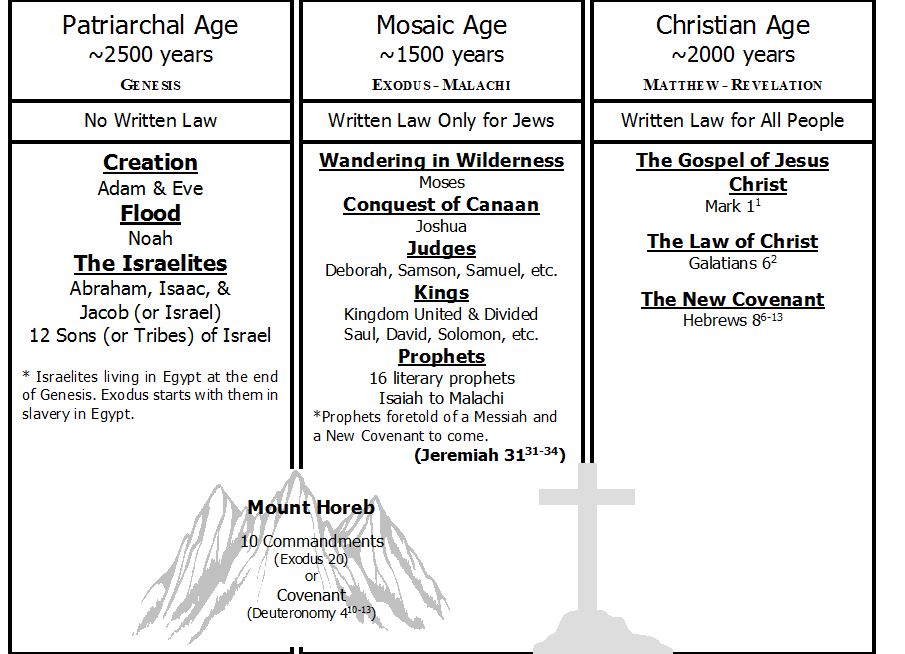
The Outline of the Bible:
overview

Study the chart above. Notice that the three periods of time are divided by how God delivered His laws to mankind. The first was through patriarchs or heads of families. Second was through Moses and the prophets. And finally He delivered His will to man through Jesus.

The Patriarchal Age. This period starts in Genesis 1 at the creation of the world. Adam & Eve disobey God and are made to leave the Garden of Eden. After many years the earth is full of evil and God decides to send a flood to destroy all that will not repent. Noah and 7 of his family are the only ones who are saved. Over 400 years later a man named Abram (later Abraham) is chosen by God to become the father of the Israelite nation (Gen. 12).

From this time on the Bible specifically traces the History of that one nation. Abraham has Isaac, Isaac has Jacob, and after Jacob’s name is changed to Israel he starts the family. The Israelites (also called Hebrews or Jews) begin to grow as a family after Jacob has 12 sons who later become 12 tribes. At the end of Genesis they are a still a small family who have moved to Egypt. They are taken into captivity for a couple hundred years and grow to be a large nation.

The Mosaic Age. God chooses a man named Moses to deliver the people of Israel out of Egyptian bondage. Moses leads the people out of Egypt to a mountain called Horeb (later Sanai). Here God delivers his law for the Israelites.

After the Israelites wander for 40 years in the wilderness, they go into “the Promised Land” (Canaan) under Joshua’s command. Once they settle the land God leads the people by appointing a series of Judges (who were basically military leaders) for around 350 years. After this the people want to be lead by a king like the nations around them. God warns them it’s a bad idea but grants their request by giving them Saul, David, and then Solomon. After Solomon’s reign (925 BC), the nation divides into two groups – Israel in the north and Judah in the south.  The northern kingdom of Israel grows increasingly evil and at God’s decree is taken into captivity by the Assyrians in 721 BC never to return again. Later, the southern kingdom of Judah is punished by being taken into captivity by the Babylonians. After 70 years they returned to their homeland and rebuilt their nation. It is their descendants who are the Jews of today and through whom Christ came.

During the time of these two kingdoms, the Prophets wrote their books. Almost all of them spoke of the coming of a Savior or Messiah. Most of them also spoke of a new covenant that would be enacted when this Savior came.

The Christian Age. This is the final way that God has revealed His will to mankind. We are now living in this age. The Bible teaches that once the Messiah came, so did the new covenant.

According to the Bible people today are to follow the New Testament. This is one reason why there are so many churches today doing so many different things yet all claiming to follow the Bible. There are many religious groups who say they follow the Bible but for some reason have missed this important Bible teaching. Can you think of any religious practices you’ve seen before which are only found in the Old Testament?

Jesus Has All Authority:

The Bible teaches us 4 things that are NOT our authority for religious practice. 1) The Old Testament, 2) Our own initiative to change something God commanded (like Nadab & Abihu), 3) Emotion or good motives (like David & Uzzah), 4) The traditions of men. If none of these can accurately define for us what God wants from us, where must we look?
4 Easy ways to improve your Bible reading

LET’S FACE IT, WE ALL could be doing a better job of reading our Bibles. It’s just that we’re very busy. Although true, it’s still no excuse. After all, we are instructed to study… “Study to shew thyself approved unto God…” 2Timothy 2:15

Instead of trying to keep pace with one of the myriad of Bible reading plans, let’s take an approach that emphasises STUDY over just reading which could work better with your own busy lifestyle.

Study for the Bible classes. The congregation here at Franklin St. church of Christ, has determined to study through the whole Bible during our two weekly Bible class hours. This will take us about 5 years to study (not just read) the entire bible. By preparing for each Bible class, you’re reading the Bible!

Study Topically. So many of us keep a bookmark of “biblical references” in our Bibles. We keep them handy so that we can refer to them when a question arises during our personal work. What’s wrong with taking a few moments each day to study through one of the topics on the bookmark? For example, you could dedicate a week (just a few moments a day) to read all of the scriptures pertaining to baptism or the plan of salvation etc. I have personally used this method to improve my readiness when doing personal work.

But sanctify the Lord God in your hearts: and be ready always to give an answer to every man that asketh you a reason of the hope that is in you with meekness and fear:” 1Peter 3:15

There are other resources you can use to engage in this type of study, topical Bibles which simply list every scripture on a given subject, as well as concordances. Other trusted resources like, “Ready Reference for Growing Christians” or “Nichol’s Pocket Bible Encyclopedia” can be very helpful in your studies. Doing this is called reading your Bible.

Read what you can, when you can. Another strategy you can use is to keep a Bible handy. Download an app on your phone, or keep a pocket Bible in your purse or in your car, so that you always have God’s word with you to read during those many moments of pause. You know those moments of pause, waiting for a doctor’s appointment, or at the orthodontists office etc. Keep a Bible in every room of your house for quick access to His word. A friend of mine keeps her Bible open on the kitchen counter (away from the sink of course) as a constant reminder to take time to read. This too is called reading your Bible.

Make an appointment with yourself and God. Someone once told me, “nothing ever gets done until a deadline is set.” Make an appointment, or set an alarm on your phone, to spend time reading His divine instruction for your life. As an examle, set a goal to read the Gospels in a month. Everyone has time to read the Gospels. Look at these stats….

Matthew:        1 hour, 14 minutes
Mark:              46 minutes
Luke:               1 hour, 18 minutes
John:               1 hour, 3 minutes
The Four Gospels:  4 hours, 21 minutes

Looking at it another way, you could read…

  • Mark in the typical span of 1 or 2 quarters of NFL football.
  • John in the time lost watching commercials in 4 hours of TV.
  • Matthew in the average span of 4 Major League Baseball innings.
  • Luke in the typical length of 1 half of an NBA game.

Please understand, I’m not advocating that you give God the crumbs that are leftover from your day, what I am saying is there are multiple opportunities, during a day, to read the bible if we would just make it a point to take advantage of the time.

Redeeming the time, because the days are evil.”
Ephesians 5:16

This verse from Ephesians should serve as a warning. Let us use the time remaining to protect ourselves from the evil that vexes our souls daily. What better resource do we have to do that than God’s own Word?

Preacher or Pastor What’s the difference?

MOST FOLKS, myself included, have a hard time remembering names. However, many can remember what you do, probably because it’s more tangible than a name.    Let me share with you a conversation that I have nearly every single day;

Them: Hello pastor.
Me: Hello, I’m not a pastor, I’m a preacher.
Them: what’s the difference?
Me: a bunch, would you like to study it?
Them: No, I’m good.

This typical conversation has been condensed for space. I’m never short with them, always jovial and kind, but I do use it as an opportunity to engage in a gospel conversation with folks.

This article is for them. For all of us really. It will be posted online as a tool you can use when they ask you, “what’s your pastor like?”

What’s the difference?

Although all pastors are preachers, not all preachers are pastors.

PREACHERS: These people are “a herald, i.e. of divine truth (especially of the gospel)” WE Vines. Although any one can be a “preacher” when they speak about the Gospel, there is a position in the local congregation which is called “the evangelist.” According to scripture, this is a male who is a herald of the gospel during the preaching portion of the worship. He stands up and preaches the gospel, [2Timothy 4:2; 1Timothy 2:12; 1Corinthians 14:34]. It’s unpopular to say “male only”, but this is the teaching of the New Testament. In no way does this teaching speak to the worth of women, rather it is just a defining of roles. [Galatians 3:28]

In short, a preacher is an evangelist who, in addition to going out to spread the gospel, publicly preaches the gospel during the worship of the local congregation. Paul wrote to the evangelist / preacher Timothy, “But watch thou in all things, endure afflictions, do the work of an evangelist, make full proof of thy ministry.” [2Tim 4:5]

PASTORS: This is a specific position held in the local congregation, the qualifications of which are in 1Timothy 3:1-7 & Titus 1:5-9. There are some additional information about “pastors”, also called “elders” in Acts 20:17-35. Here we find that these men are to watch over the local church and to feed the flock; “Take heed therefore unto yourselves, and to all the flock, over the which the Holy Ghost hath made you overseers, to feed the church of God, which he hath purchased with his own blood.” [Acts 20:28]. From this verse it becomes clear why Elders are also Called Pastors.

An Elder / Pastor can also be an evangelist, laboring as his vocation in the Gospel. “Let the elders that rule well be counted worthy of double honour, especially they who labour in the word and doctrine.” [1Timothy 5:17]

What’s Your Pastor Like?” This is another question that is frequently asked. What they’re trying to determine is his speaking ability and personality. This questions is often asked by a person who’s thinking about visiting a particular church. While there’s nothing wrong in asking about the speaker, it shouldn’t be the FIRST nor ONLY prerequisite for choosing a church. (Other poor qualities for choosing a church are; games, entertainment, cafes of field trips)

One should seek first the truth; “But seek ye first the kingdom of God, and his righteousness; and all these things shall be added unto you” [Mat 6:33]. I’ve written about this in a previous article, “How to start a church” [April 19, 2015]. The basics of which are 3 points:

  • Reliance on God’s word for their only Authority. [1Peter 4:11]
  • Correct Worship in spirit and truth. [John 4:24]
    1. Assembling on the correct day, partaking of the Lord’s Supper [Acts 20:7]. Preaching, praying, singing (without the aid of mechanical music) and giving [Acts 20:7, 8, 36; Eph 5:19; 1Cor 16:1].
  • Doing the work of the church; Spreading the Gospel, Edification of the saints, and benevolence for needy saints. [Mat 28:18-20; Eph 4:12; 1Cor 16:1]

More could be said about this subject, hopefully this article has peaked your interest in confirming for yourself about the truth of all matters. Search the scriptures yourselves to learn all the counsel of God.  [Acts 17:11; 1John 4:1-3].

Prove all things; hold fast that which is good
[1Thess 5:21]

Flood Relief & Divine Pattern

EARLY ON AUGUST 11, torrential downpours dumped rain on the surrounding Baton Rouge and Lafayette areas. Rain fell at a rates up to 2-3 inches per hour and overall totals exceeded nearly 2 feet in some areas as a result of the system remaining stationary. Accumulations reached as high as 31.39 inches in Watson, Louisiana.

The Washington Post noted that the “no-name storm” dumped three times as much rain on Louisiana as Hurricane Katrina. It dropped the equivalent of 7.1 trillion gallons of water or enough to fill Lake Pontchartrain about four times. Hurricane Katrina, by comparison, dumped about 2.3 trillion gallons of rainwater in the state (though more in other states). The flood also dumped more water than Hurricane Isaac. According to the National Weather Service Hydrometeorological Design Studies Center, the amount of rainfall in the hardest-hit locations had a less than 0.1 percent chance of happening or was a (less than) 1-in-1,000-year event.

This flooding has caused heartache and hardship for some in our family of Christ. One congregation in particular, reached out to let brethren know of their plight. They requested help according to the pattern established in the New Testament, not through the institutions of man.

The pattern for aiding brethren in other areas has been established by Acts 11:27-30.Then the disciples, every man according to his ability, determined to send relief unto the brethren which dwelt in Judaea: Which also they did, and sent it to the elders by the hands of Barnabas and Saul.” (emphasis mine seb).

A famine had arisen in the days of Claudius that had severely stricken the Christians in Judea. The Holy Spirit directed Paul on how this relief should be made. Paul wrote about the contribution being sent by the saints in Macedonia; “For it hath pleased them of Macedonia and Achaia to make a certain contribution for the poor saints which are at Jerusalem” [Romans 15:26], so too, the church at Corinth [1Cor 16:1-4].

What we see from this pattern are individual saints (and local congregations) collecting money and sending it directly to the parties affected. No middlemen, no organizations that funnels off money for “operating costs” nor do we see a board of directors who can decide to send the money for a non-scriptural use (as we see with so many “charities”). What we see are saints fulfilling the need directly. The pattern is simple, clean AND EFFECTIVE, because it is the divine pattern from God.

As individuals, we have liberty to be a bit more broad with our benevolence. We’re able to give aid beyond just the saints, unlike the limitations placed upon the church treasury by the Holy Spirit [1Timothy 5:9,16]. If we can, we should be benevolent, being mindful of those times when we ought to refrain [Ga 6:10; 1Thess 3:10-12].

That being said, here is the note from the brethren in Louisiana;

_________________________________

STOP! The need involving Christians in Louisiana has been met.

With several families displaced by floods and facing reconstruction on the inside of their homes, the cost estimate was $500,000 beyond what that local church could do. However, THE NEED HAS BEEN MET.

I just spoke with one of the elders. Their biggest concern is returning the funds beyond what they need. I told him he’ll have to get a roll of stamps. He said, “Wilson, it will take rolls and rolls AND ROLLS of stamps…” He said, “We never dreamed there would be such an outpouring of help for us…”

He went on…

“Please spread the word that the need has been met and that we will do our best to return the monies not needed back to the source.” I am sure they will. But be patient. They have been flooded (sorry!) with overwhelming generosity.

Want Bible? Exodus 36:5: “The people were restrained from bringing any more…” Don’t tell me it doesn’t happen. It just happened in Gonzales, Louisiana…

God is good. And so are His people. Please “Share” the news

___________________________________

Praise God, the need was met for these folks within a few weeks, following God’s pattern of benevolence. I’m sure more can and should be done by individuals, and it can be done following God’s divine pattern for benevolence.

Does the Bible Answer Everything?

DURING A DISCUSSION with a 20 something, the question was raised, “do you really think that the Bible has answers for every situation of man?” I immediately responded with, “YES! In principle.”

What I mean by this is that the Bible contains principles that can aid us in working through any and every situation of life. The Bible is God’s revelation for man and contains His law, i.e. rules of conduct to govern man. (2Peter 1:21; 2Sam. 23:2; 1Cor. 2:7-13, Eph. 3:3-5; Gal. 6:2; James 2:12, etc.).  In fact, all Scriptures given by inspiration of God furnish man completely unto all good works, unto all things that pertain to life and godliness (2 Tim. 3:16-17, 2 Peter 1:3). This tells me that God has made known to mankind His will regarding every situation a person might face.

God, the creator of us all, knows what is best for us. Shall the clay question the potter? Unless we consult with God how shall we direct our own steps [Jeremiah 10:23]? This direction, given in His law, governs our total conduct. Conduct is the meaning of the word “conversation” in Phillippians 1:27; “Only let your conversation be as it becometh the gospel of Christ.” KJV

The total of man’s conduct may be catagorized into five relationship areas: religious, political, economic, domestic, and social.

God reveals His Direction for our conduct regarding our relationship to…

RELIGION in the gospel: John 4:24 ; James 1:27; Romans 12:13; Heb. 13:2; Gal. 6:10.

God is a Spirit: and they that worship him must worship him in spirit and in truth

GOVERNMENT (political: Rom. 13:1-7; 1Peter 2:13-14), to business (economic: Eph. 4:28; 2Thess. 3:10).

Let every soul be subject unto the higher powers. For there is no power but of God: the powers that be are ordained of God.

ECONOMIC (Eph 4:28; 2Thess 3:10;)

Let him that stole steal no more: but rather let him labour, working with his hands the thing which is good, that he may have to give to him that needeth.

FAMILY (domestic: 1 Tim. 5:1-6; Eph. 5:21; 6:4).

But if any provide not for his own, and specially for those of his own house, he hath denied the faith, and is worse than an infidel.

COMMUNITY (social: Matt. 7:12; Luke 10:30-37).

Therefore all things whatsoever ye would that men should do to you, do ye even so to them:

In the Bible, we can study God’s precepts and examples to learn how to direct our own steps. The conduct of many folks, good and bad, are recorded for our learning [1Corinthians 10:6,11; Romans 15:4]. God rejected sinful conduct and demonstrated His approval with conduct that was in harmony with His will. The conduct of their lives, exemplified in the scriptures, are aproved or disapproved according to the dispensation in which they lived.

We have a perfect example in Christ “For even hereunto were ye called: because Christ also suffered for us, leaving us an example, that ye should follow in his steps: who did no sin.” [1Peter 2:21-22]. Never did He violate God’s law [1John 3:4], but in every respect His conduct was in harmony with the Father’s will. This mind that was in Christ we are to imitate [Phil 2:5-11].

With regards to the final judgment, when this world will be dissolved, what manner of person ought we to be? [2Peter 3:11]. “But as he which hath called you is holy, so be ye holy in all manner of conversation; Because it is written, Be ye holy; for I am holy.” [1Pe 1:15-16].

The answer to the question is YES, the Bible does give us directions to face any situation in all of our relationships; Religion, Economic, Political, Family and socially. The Bible is God’s written instructions for mankind, His will for us.

So many people are walking around saying, “I know God has a plan for my life.” He does, yet many never bother to read it. God does have a plan for us, let us study it and do His will [2Timothy 2:15]. Most importantly, let us study His will on how to gain eternal life.

Then Simon Peter answered him, Lord, to whom shall we go? thou hast the words of eternal life. John 6:68