
7 PLAGUES of the mind pt1; Pessimism

Staying Positive in a Negative world.

Negative attitudes have a negative effect on our faith. Life is hard, and it’s even harder with a negative outlook.

The troubles and the sins of this life are troubling for all of us; remember Lot? “For that righteous man dwelling among them, in seeing and hearing, vexed his righteous soul from day to day with their unlawful deeds” (2Peter 2:8). None of us are immune from the constant barrage of evil, but we must not let it infiltrate our minds and hearts to shipwreck our faith.

Negativity is Normal, and is the default setting of our minds, but we must overcome normal. In the absence of light, darkness prevails. Attitude diseases are just as bad as, and contribute to, the physical diseases of the body. Negativity weakens our faith not strengthen it.

Dealing with negative thoughts is like a WAR for keeping our heart and mind. Negative thoughts are like enemy weeds that creep into the beautiful garden. The gardener must be as a vigilant soldier watching on the wall. How far the weeds come in depends on how well he is watching.

EVIL is no match for good, but good must be ACTIVE. We must take action to keep out the negative. We must face it, not ignore it. Facing it doesn’t mean we have to keep it, nor dwell on it, but we do have to handle it. When the gardener sleeps, the tares keep growing. The negative only needs one chance, being positive must be successful continually. Maybe this is why our Lord told us to be mindful of the current day. “Sufficient unto the day is the evil thereof” (Matt 6:34b; see John 11:9). Spiritual warfare requires spiritual weapons (2Cor 10:3-5; Eph 6:11-17). Growing in the Grace and KNOWLEDGE is our strength to ward off these plagues of the mind.

The first of the 7 PLAGUES is PESSIMISM. This is the deadly plague of always looking on the bad side, the difficult side, the listing of all the reasons something can’t be done side. He’s not trying to figure out what is good or right, he’s searching for what’s wrong or how it will go wrong.

The pessimist says, “I can list ten reasons why this is a bad idea.” Why look for ten when one will do? LOL. These folks are on a mission to find fault over virtue. These are the “cup is half empty” people. The “cup is half full” is not the antitheses to this negative idea.

Remembering the overflowing quality of God’s cup is; “Give, and it shall be given unto you; good measure, pressed down, and shaken together, and running over, shall men give into your bosom. For with the same measure that ye mete withal it shall be measured to you again” (Luke 6:38). As the proverb says, “For as he thinketh in his heart, so is he” (Prov 23:7a).

Pessimism, defeatism, and the like are often self-fulfilling prophecies. When the pessimist’s forecast comes true, he seems to find joy. The pessimist can’t enjoy the beauty right outside his house because of the specs on the glass.

While this life may be filled with all kind of reasons to give in, and give up, we need to remember the words of our Lord, “If thou canst believe, all things are possible to him that believeth” (Mark 9:23). The way we think things are affect us more than the way things actually are. “There’s a lion in the street” saith the sluggard, (Prov 22:13; 26:13). Maybe there is, but we won’t know till we try.

Here are four strategies when pessimism attacks:

Instead of listing the reasons something can’t be done, direct your mind to the things that can be done. There is always a way. “but will with the temptation make also the way of escape, that ye may be able to endure it” (1Cor 10:13b).

Redirect pessimism toward appreciation and gratitude. Remembering the great things God has done is how we ward off pessimism. “Many, O LORD my God, are thy wonderful works which thou hast done, and thy thoughts which are to us-ward: they cannot be reckoned up in order unto thee: if I would declare and speak of them, they are more than can be numbered” (Psalm 40:5). “My mouth shall tell of thy righteousness, And of thy salvation all the day; For I know not the numbers thereof” (Psalm 71:15).

Reframing the issue may also help with pessimism. Faced with the problem of those preaching to add to his chains, Paul reframed the issue; “but the other proclaim Christ of faction, not sincerely, thinking to raise up affliction for me in my bonds. What then? only that in every way, whether in pretence or in truth, Christ is proclaimed; and therein I rejoice, yea, and will rejoice” (Phil 1:17-18).

Finally, keeping your eye on the goal is a great way to stave off pessimism. “Brethren, I could not myself yet to have laid hold: but one thing I do, forgetting the things which are behind, and stretching forward to the things which are before, I press on toward the goal unto the prize of the high calling of God in Christ Jesus” (Phil 3:13-14). Regardless of the negative things pressing around us, it won’t change what we ought to do nor where we desire to be, unless we allow it.

The world is a painful place, but “Count it all joy, my brethren, when ye fall into manifold temptations; Knowing that the proving of your faith worketh patience” (James 1:2-3).

Agape,

Spencer

This is part one of a series called the 7 PLAGUES of the heart / mind.

5 Women that met Jesus pt2

You can click here for part 1.

Rebuke not an elder, but intreat him as a father; and the younger men as brethren; The elder women as mothers; the younger as sisters, with all purity” (1Timothy 5:1-2).

In the last article we looked at lessons learned from 3 women who met Jesus.

ONE: The Woman that Washed His feet. A lesson on gratitude for mercy.

TWO: The Woman that anointed His head with Oil. A lesson on preparing for His death. We prepare for His return.

THREE: The Woman named Mary who saw Him first at the resurrection. A lesson about believing the report of the eyewitnesses in scripture.

Now we shall learn from two more women who met Jesus.

The woman who is an Example of Great faith, and the widow woman of Nain.

The fourth example is the woman who is an EXAMPLE of a great faith. (Matthew 15:22-28)

And, behold, a woman of Canaan came out of the same coasts, and cried unto him, saying, Have mercy on me, O Lord, thou Son of David; my daughter is grievously vexed with a devil. But he answered her not a word. And his disciples came and besought him, saying, Send her away; for she crieth after us. But he answered and said, I am not sent but unto the lost sheep of the house of Israel. Then came she and worshipped him, saying, Lord, help me. But he answered and said, It is not meet to take the children’s bread, and to cast it to dogs. And she said, Truth, Lord: yet the dogs eat of the crumbs which fall from their masters’ table. Then Jesus answered and said unto her, O woman, great is thy faith: be it unto thee even as thou wilt. And her daughter was made whole from that very hour.”

What can we learn from her? We learn to continue in faith and be persistent in our prayers despite difficult answers. Jesus wasn’t being insulting, that’s a commentary from so called scholars. He was fulfilling the Law of Moses. His appearance and work fulfill the Seed promise to Abraham. That being said, this woman persisted with her own great answer in recognition of His purpose. For her faith she receives her request and a compliment from the Lord!

Faith does not turn away from the blessings in Christ. Compare her with those of the Jews that turned away after hearing a difficult teaching from Jesus (John 6:66). This woman, one of the few people that Jesus complimented for having faith, was a gentile. (All those Jesus praised for their faith were gentiles).

Do you want to know how to have a great faith?

The fifth example is the widow woman of NAIN. (Luke 7:11-18)

And it came to pass the day after, that he went into a city called Nain; and many of his disciples went with him, and much people. Now when he came nigh to the gate of the city, behold, there was a dead man carried out, the only son of his mother, and she was a widow: and much people of the city was with her. And when the Lord saw her, he had compassion on her, and said unto her, Weep not. And he came and touched the bier: and they that bare him stood still. And he said, Young man, I say unto thee, Arise. And he that was dead sat up, and began to speak. And he delivered him to his mother.”

What can we learn from her story? Without Christ, death is a sad and scary condition. Nobody can do anything about it. Except Jesus.

She was familiar with death having lost her husband some time earlier. She was a widow that only had one son to care for her.  

Notice that He says to her, “Weep not.” Jesus is the only one that can wipe away the tears of mourning. “For the Lamb which is in the midst of the throne shall feed them, and shall lead them unto living fountains of waters: and God shall wipe away all tears from their eyes” (cf Rev 7:17; cf 1Thess 4:13-18).

He stopped the procession and touched the coffin. Only Jesus can stop our appointment with death. “And as it is appointed unto men once to die, but after this the judgment” (Heb 9:27; cf Rom 6:3-11).

He said to the young man “arise.” Jesus is the Only One that can raise us from death; In him is life; and the life is the light of men. “Jesus said unto her, I am the resurrection, and the life: he that believeth in me, though he were dead, yet shall he live” (John 11:25; cf 1:4).

Jesus delivered the young man to his mother. Jesus delivered care back to this widow (cf 1Tim 5:8). It reminds me of one of His last acts before His death, he delivered care to His own mother. “When Jesus therefore saw his mother, and the disciple standing by, whom he loved, he saith unto his mother, Woman, behold thy son! Then saith he to the disciple, Behold thy mother! And from that hour that disciple took her unto his own home” (John 19:26-27).

Look at what happened next. “And there came a fear on all: and they glorified God, saying, That a great prophet is risen up among us; and, That God hath visited his people.”

This story reminds us of our complete lack of control over death. If you have within your ability to raise yourself from the dead, or raise yourself to eternal life, then keep doing what you’re doing. If not, the only One you can turn to is Jesus. When Jesus raised this young man from the dead (and His other works) He shows that He is the Christ, the Son of the living God.

Do you want to know how to be raised from the dead into eternal life?

–Agape,

Spencer

We invite you to come and study with us in Borger, Texas.

5 WOMEN that met Jesus pt1

And Joanna the wife of Chuza Herod’s steward, and Susanna, and many others, which ministered unto him of their substance” (Luke 8:3)

Joanna is just one of several women that met with and learned from Jesus. These women would learn from Him and also minister to Him as seen in the story of Mary & Martha (Luke 10:38-42). Others hosted and served the church in their homes (Acts 12:12; Rom 16).

It’s a worthy study to look into these examples of godly women to find out what we can learn. This and the next article will look at 5 women who met Jesus during His ministry on earth and learn from their faith.

For as many of you as have been baptized into Christ have put on Christ. There is neither Jew nor Greek, there is neither bond nor free, there is neither male nor female: for ye are all one in Christ Jesus.  And if ye be Christ’s, then are ye Abraham’s seed, and heirs according to the promise

(Gal 3:27-29; cf. 1Pet 3:1-6).

The first woman of faith is the woman that WASHED His feet with her hair (Luke 7:37-38).

And, behold, a woman in the city, which was a sinner, when she knew that Jesus sat at meat in the Pharisee’s house, brought an alabaster box of ointment, And stood at his feet behind him weeping, and began to wash his feet with tears, and did wipe them with the hairs of her head, and kissed his feet, and anointed them with the ointment.”

What can we learn from her? Jesus gives us the lesson. It’s a demonstration of love in appreciation for mercy (Luke 7:41-48). He uses the contrast of two debtors in a parable, and then makes this about this faithful and grateful woman and this ungrateful man.

There was a certain creditor which had two debtors: the one owed five hundred pence, and the other fifty. And when they had nothing to pay, he frankly forgave them both. Tell me therefore, which of them will love him most? Simon answered and said, I suppose that he, to whom he forgave most. And he said unto him, Thou hast rightly judged. And he turned to the woman, and said unto Simon, Seest thou this woman? I entered into thine house, thou gavest me no water for my feet: but she hath washed my feet with tears, and wiped them with the hairs of her head. Thou gavest me no kiss: but this woman since the time I came in hath not ceased to kiss my feet. My head with oil thou didst not anoint: but this woman hath anointed my feet with ointment. Wherefore I say unto thee, Her sins, which are many, are forgiven; for she loved much: but to whom little is forgiven, the same loveth little. And he said unto her, Thy sins are forgiven.”

The second example is the woman that anointed His head with OIL just before His death (Matthew 26:7-13).

There came unto him a woman having an alabaster box of very precious ointment, and poured it on his head, as he sat at meat. But when his disciples saw it, they had indignation, saying, To what purpose is this waste? For this ointment might have been sold for much, and given to the poor. When Jesus understood it, he said unto them, Why trouble ye the woman? for she hath wrought a good work upon me. For ye have the poor always with you; but me ye have not always.”

What can we learn from her? Jesus gives us the lesson in this story also. It’s a lesson about looking and preparing for the death of Christ. While she looked forward to His death, we look forward to His return.

For in that she hath poured this ointment on my body, she did it for my burial. Verily I say unto you, Wheresoever this gospel shall be preached in the whole world, there shall also this, that this woman hath done, be told for a memorial of her.”

She did this in anticipation of His death, and she is now a permanent example in the Gospel. Today, we are able to learn from her and prepare for His return.

Know ye not, that so many of us as were baptized into Jesus Christ were baptized into his death? Therefore we are buried with him by baptism into death: that like as Christ was raised up from the dead by the glory of the Father, even so we also should walk in newness of life” (Romans 6:3-4).

The third example are two women named MARY who saw Jesus first after His resurrection (Matthew 28:1, 9-10).

And as they went to tell his disciples, behold, Jesus met them, saying, All hail. And they came and held him by the feet, and worshipped him. Then said Jesus unto them, Be not afraid: go tell my brethren that they go into Galilee, and there shall they see me.”

What can we learn from them? We learn to believe from their eyewitness testimony. Jesus gives us the lesson. They were told by Jesus to go tell His apostles, but (Luke 24:11) “And their words seemed to them as idle tales, and they believed them not.” “Afterward he appeared unto the eleven as they sat at meat, and upbraided them with their unbelief and hardness of heart, because they believed not them which had seen him after he was risen.” (Mark 16:14).

Belief today comes from the eyewitness testimony of those that saw Him in that day. People today expect to hear from Jesus personally, or have God personally call them separate and apart from the word. We will come to believe from the inspired words written by the eyewitnesses of the 1st century. “And many other signs truly did Jesus in the presence of his disciples, which are not written in this book: But these are written, that ye might believe that Jesus is the Christ, the Son of God; and that believing ye might have life through his name” (John 20:30-31; cf. John 17:20).

To expect more miracles, a personal call, or sign is to not believe these women, the Apostles, and opens yourself for the rebuke of Jesus. “…and upbraided them with their unbelief and hardness of heart, because they believed not them which had seen him after he was risen.”

Agape,

Spencer

click here for part 2.

We invite you to come and study with us in Borger, Texas.

8 People to be GRATEFUL

In every thing give thanks: for this is the will of God in Christ Jesus concerning you.

(1Thess 5:18)

In a previous article I listed some things for which I am grateful. (v8 #45 Nov 6, 2022). Today I’d like to make a list of the People to which I am grateful.

Many people claim that they are self-made and in need of help from no one. This couldn’t be further from the truth. The scripture says, “For none of us liveth to himself, and no man dieth to himself.” Everything we have in life will come through or because of others.

We need people. We’re not going to be able to grow all our own food, refine our own gas, nor sow our own clothing. Our needs in life lie at the root of all economies.

Therefore, it is of great necessity that we are grateful to others. Have you taken the time to thank them personally? Do you recognize who they are? Let’s consider who it is that deserves our gratitude.

Certainly, first on our list is GOD. “…He maketh his sun to rise on the evil and on the good, and sendeth rain on the just and on the unjust.” (Matt 5:45b). “Nevertheless he left not himself without witness, in that he did good, and gave us rain from heaven, and fruitful seasons, filling our hearts with food and gladness.” (Acts 14:17). Every good gift comes from above, ought not we give thanks?

Some of the most important people in our lives are often the worst treated of all people, and these are our RELATIVES. We certainly need to show them gratitude. Our parents birthed us and provided for us. Our children bring us a sense of purpose. Our extended families bring us comfort and belonging. Spouses aid one another both physically, emotionally, and spiritually. While this is the ideal, it may have it rough spots. Nevertheless, let us be grateful to those we love the most. “Children, obey your parents in the Lord: for this is right. Honour thy father and mother; (which is the first commandment with promise;) That it may be well with thee, and thou mayest live long on the earth. And, ye fathers, provoke not your children to wrath: but bring them up in the nurture and admonition of the Lord” (Eph 6:1-4).

Another group of people to add to the gratitude list are the AGED. These are those who have been through what we have yet to experience. These can be a source of good knowledge on how to live good lives. Not because they always did it right, but that they sometimes did it wrong and learned from their mistakes. “That the aged men be sober, grave, temperate, sound in faith, in charity, in patience. The aged women likewise, that they be in behaviour as becometh holiness, not false accusers, not given to much wine, teachers of good things; That they may teach the young women to be sober, to love their husbands, to love their children, To be discreet, chaste, keepers at home, good, obedient to their own husbands, that the word of God be not blasphemed” (Titus 2:2-5).

I’m also grateful for those who have educated themselves with those highly TECHNICAL skills that makes civilized life possible. This would include doctors, surgeons, and engineers, but it must also include those with TECHNICAL skills in the blue-collar fields; ie., mechanics, plumbers, and electricians to name just a few. How would life be without these TALENTED people? “For the scripture saith, Thou shalt not muzzle the ox that treadeth out the corn. And, The labourer is worthy of his reward” (1Tim 5:18; cf., Le 19:13; De 24:14-15; 25:4).

Let us also be grateful for those service EMPLOYEES who are often overlooked or looked down upon. These folks prepare our food, make our clothes, and also make civilized life possible. “And, ye masters, do the same things unto them, forbearing threatening: knowing that your Master also is in heaven; neither is there respect of persons with him” (Eph 6:9; cf., Rom 2:11; 1Co 7:22; Col 3:25-4:1).

While we’re making this list of people let us never forget our FRIENDS & Co-Workers. It’s self-evident that we desire FRIENDS. These are people we choose to make a part of our lives because of common values and interests.  “A friend loveth at all times, and a brother is born for adversity” (Prov 17:17). “A man that hath friends must shew himself friendly: and there is a friend that sticketh closer than a brother” (Prov 18:24). Are these not worthy of our gratitude?

An odd one that I put on my list are those that are UNFRIENDLY. We can be grateful even for these. Our savior told us that He loved us while we were enemies, and commands us to love our enemies (Rom 5:8-9; Luke 6:27), but can we also be grateful? I think so. Consider what Paul wrote to the church at Corinth, “For there must be also heresies among you, that they which are approved may be made manifest among you” (1Cor 11:19). The unfriendly, the unkind, the unruly, and the other “uns” become a contrast to help us recognize what is good. I know it sounds weird, but that’s the only way I can understand this verse.

Lastly, would be our LEADERS. It is a direct command to pray for them, and it is clear that God rules in the kingdoms of men, therefore let us give thanks. “I exhort therefore, that, first of all, supplications, prayers, intercessions, and giving of thanks, be made for all men; For kings, and for all that are in authority; that we may lead a quiet and peaceable life in all godliness and honesty. For this is good and acceptable in the sight of God our Saviour; Who will have all men to be saved, and to come unto the knowledge of the truth” (1Tim 2:1-4; cf., Dan 4:17).

One more thing; The above is a general list of the groups of people to whom we could show thanks. I urge you to take it a bit further and to specifically identify individuals in each of these categories that you could recognize with thanksgiving. I began making a list, years ago, of people who have made an impact in my life. Names are constantly being added to it. Then I make a point to thank them in person, or with a note, and I certainly give thanks to God for them.

If you do this, you will be amazed at how much people change when we begin to be grateful for them and show it to them.

Spencer

Paul’s Defense to Agrippa

Paul’s defense to Agrippa is very powerful, and something all Christians should study to understand, and be able to recite.

Acts 24:14 But this I confess unto thee, that after the way which they call heresy, so worship I the God of my fathers, believing all things which are written in the law and in the prophets:

15 And have hope toward God, which they themselves also allow, that there shall be a resurrection of the dead, both of the just and unjust.

16 And herein do I exercise myself, to have always a conscience void of offence toward God, and toward men.

I OPENLY DECLARE

  • I Worship the God of the Bible. John 4:24 God is Spirit: then let his worshippers give him worship in the true way of the spirit.
  • I Believe all things which are written in the Law (of Moses) and the prophets. Luke 24:26 Was it not necessary for the Christ to go through these things, and to come into his glory? 27 And he made clear to them all the things in the Writings, from Moses and from all the prophets, which had to do with himself.
  • I Have Hope toward God. Heb 6:19 And this hope is like a strong band for our souls, fixed and certain, and going in to that which is inside the veil;
  • I Hope in the Resurrection of the dead, (both of the just & unjust). 2Cor 5:10 For we all have to come before Christ to be judged; so that every one of us may get his reward for the things done in the body, good or bad.
  • I Strive to have a conscience without offense toward God. 1Thess 2:4 But as we were allowed of God to be put in trust with the gospel, even so we speak; not as pleasing men, but God, which trieth our hearts.
  • I Strive to have a conscience without offense toward mankind. Acts 23:1 And Paul, earnestly beholding the council, said, Men and brethren, I have lived in all good conscience before God until this day.

None of the above is to be separated from the New Testament to make a creed we recite in a rote manner. These are the words the Apostle Paul came to know and Believe through inspiration of the Holy Spirit as he gave his defense before Agrippa.

Spencer.

30 Days of Thanksgiving pt 2; CONTENTED

30 days of THANKFULNESS

day 10.

I’m grateful for CHILDREN.

Psalm 127:3-5 KJV

Lo, children are an heritage of the Lord : and the fruit of the womb is his reward. [4] As arrows are in the hand of a mighty man; so are children of the youth. [5] Happy is the man that hath his quiver full of them: they shall not be ashamed, but they shall speak with the enemies in the gate.

HERE IS OUR LIST OF GRATITUDE SO FAR.

Grace

Rain

Advocate

Transportation

Invocation

The Temple, the church.

Understandable word of God

Debt paid by Christ

Election

HERE IS OUR LIST FOR BEING CONTENTED.

Children

OPEN doors of Opportunity to preach the Gospel

Col 4:3 Withal praying also for us, that God would open unto us a door of utterance, to speak the mystery of Christ, for which I am also in bonds:

NUPTIALS.

Prov 5:18 Let thy fountain be blessed: and rejoice with the wife of thy youth.

TIME.

Eph 5:16 Redeeming the time, because the days are evil.

EATING & Enjoying company with Family & friends.

Ecc 2:24; 3:13; 1Tim 6:8

1Tim 4:3-4 For every creature of God is good, and nothing to be refused, if it be received with thanksgiving.

NEEDS being MET.

Phil 4:11-13; Ps 37:25 I have been young, and now am old; yet have I not seen the righteous forsaken, nor his seed begging bread.

TALENTs (ability).

Matt 25:15. Each according to his ability.

EFFORTS (wages according to my effort.) Luke 3:14. 1Cor 7:17; Matt 25:15

DOCTRINE of Christ.

2John 1:9 Whosoever transgresseth, and abideth not in the doctrine of Christ, hath not God. He that abideth in the doctrine of Christ, he hath both the Father and the Son.

Why are you GRATEFUL?

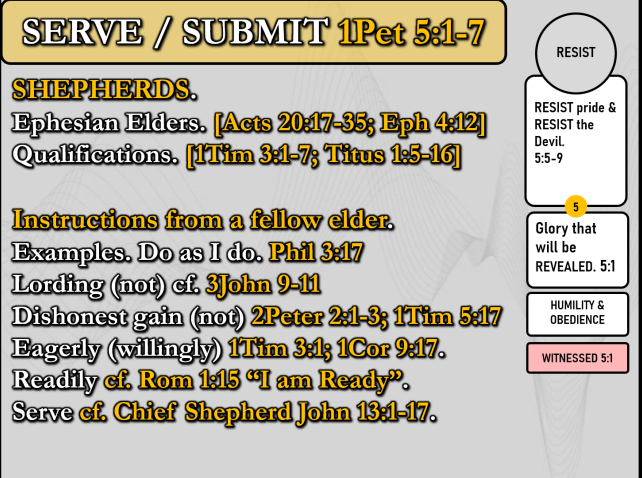
Lessons from 1Peter 5: ELDERS

Instructions from a fellow elder.

be Examples. Do as I do. Phil 3:17

not Lording (not) cf. 3John 9-11

not for Dishonest gain 2Peter 2:1-3; 1Tim 5:17

Eagerly (willingly) 1Tim 3:1; 1Cor 9:17.

Readily cf. Rom 1:15 “I am Ready”.

Serve as a shepherd. cf. Chief Shepherd John 13:1-17.

Spencer is an evangelist for the Franklin & Juniper st church of Christ in Borger Texas.

How to LIVE in this world

Living in the world without becoming part of this world is difficult. Yet, we need to live among them so we can reach them. Paul said,

I wrote unto you in an epistle not to company with fornicators: Yet not altogether with the fornicators of this world, or with the covetous, or extortioners, or with idolaters; for then must ye needs go out of the world” (1Cor 5:9-10).

He also wrote, “If it be possible, as much as lieth in you, live peaceably with all men” (Rom 12:18).

here are 4 ways we can LIVE in the world peacefully:

  1. LOVE Always. (Luke 6:27-36; cf; John 3:16; Rom 5:8-10)
  2. be INDEBTED to them to love, which requires being grateful. “Owe no man any thing, but to love one another: for he that loveth another hath fulfilled the law.” (Rom 13:8)
  3. live VIRTUOUSLY among them. “I will therefore that men pray every where, lifting up holy hands, without wrath and doubting.” (1Tim 2:1-8; cf. 1Peter 3:1-6; 2Pet 1:5-10; Romans 12:14-21)
  4. EXPECT less from people, Except Christ and Him crucified. “For I determined not to know any thing among you, save Jesus Christ, and him crucified.” (1Cor 1:2)

I beseech you therefore, brethren, by the mercies of God, that ye present your bodies a living sacrifice, holy, acceptable unto God, which is your reasonable service. And be not conformed to this world: but be ye transformed by the renewing of your mind, that ye may prove what is that good, and acceptable, and perfect, will of God.” (Romans 12:1-2)

Spencer is an evangelist for the church of Christ in Borger Texas.

Who is TIMOTHY?

TRUE son. 1Tim 1:2; 1Cor 4:17

IMPRISONED. Heb 13:23; w/ Paul Phil 2:19-23

MODEL / EXAMPLE. 1Tim 4:12

OBEDIENT. 1Tim 4:6-16;

TRUSTWORTHY. Phil 2:20 “likeminded, Sincerity”

HOLY SPIRIT gifts. 2Tim 1:6

YOUNG. Not to be despised. 1Tim 4:11; 2Tim 1:5; 3:15