
The Lord give mercy unto the house of Onesiphorus

For he oft refreshed me

The Lord give mercy unto the house of Onesiphorus; for he oft refreshed me, and was not ashamed of my chain,” (2Tim 1:16).  

Who inspires or impresses you? Take a serious moment to think about it.

Is it because they’re successful? Is it because they’re famous? Is it because they’re big shots?

After you think about that, who do you suppose inspires or impresses them? Are they impressed by more successful people, or more famous celebrities? Bigger big shots?

One more question… Who inspires or impresses true big shots? Paul is an Apostle, but he was humble and was able to see the labors of others.

Onesiphorus impressed Paul.

Impressed may not be the right word. He was Grateful, Glad, Invigorated, Renewed, Refreshed. Did Paul release an audible sigh of relief upon being found by him? The scripture is full of lesser known & unknown names of mighty heroes of faith.

Paul was in a Roman prison, (2Tim 1:8). It was about the time that Nero was blaming Christians for the burning of Rome (64AD). This is Paul’s last writing of the New Testament with the purpose to encourage the young evangelist Timothy, (1:6, 2:1, 3:14-15).

Paul was ready to die, and it looked like it was going to happen this time. “For I am now ready to be offered, and the time of my departure is at hand” (2Tim 4:6). It was no sad moment for him, because he had “fought a good fight, I have finished my course, I have kept the faith: Henceforth there is laid up for me a crown of righteousness, which the Lord, the righteous judge, shall give me at that day: and not to me only, but unto all them also that love his appearing” (2Tim 4:7,8).

Even though he had been forsaken by many, he still encouraged Timothy to come to him, for there was still work to be done. “Do thy diligence to come shortly unto me. The cloke that I left at Troas with Carpus, when thou comest, bring with thee, and the books, but especially the parchments” (2Tim 4:9,13).

In this letter we learn about ONESIPHORUS. He was a man of…

UNPARALLELED SUPPORT: “for he oft Refreshed me.” (2Tim 1:16a)

UNABASHED FRIEND: “was not ashamed of my chain.” (2Tim 1:16b)

UNSTOPPABLE EFFORT: “when he was in Rome, he sought me out very diligently, and found me.” (2Tim 1:17)

UNUSUAL SERVICE: “in how many things he ministered unto me at Ephesus, thou knowest very well.” (2Tim 1:18)

UNSURPASSED REWARD: “He that receiveth you receiveth me, and he that receiveth me receiveth him that sent me. He that receiveth a prophet in the name of a prophet shall receive a prophet’s reward; and he that receiveth a righteous man in the name of a righteous man shall receive a righteous man’s reward. And whosoever shall give to drink unto one of these little ones a cup of cold water only in the name of a disciple, verily I say unto you, he shall in no wise lose his reward” (Mat 10:40-42).

The scripture is full of lesser known & unknown names of mighty heroes of faith. God doesn’t waste ink, these examples are there for a reason. “Brethren, be followers together of me, and mark them which walk so as ye have us for an ensample” (Phil 3:17).

 Agape,

Spencer

This article is based on a sermon presented at the Franklin & Juniper st church of Christ in Borger, Texas. We invite you to visit one of our assemblies to learn more about Christ.
What to EXPECT in the New Year

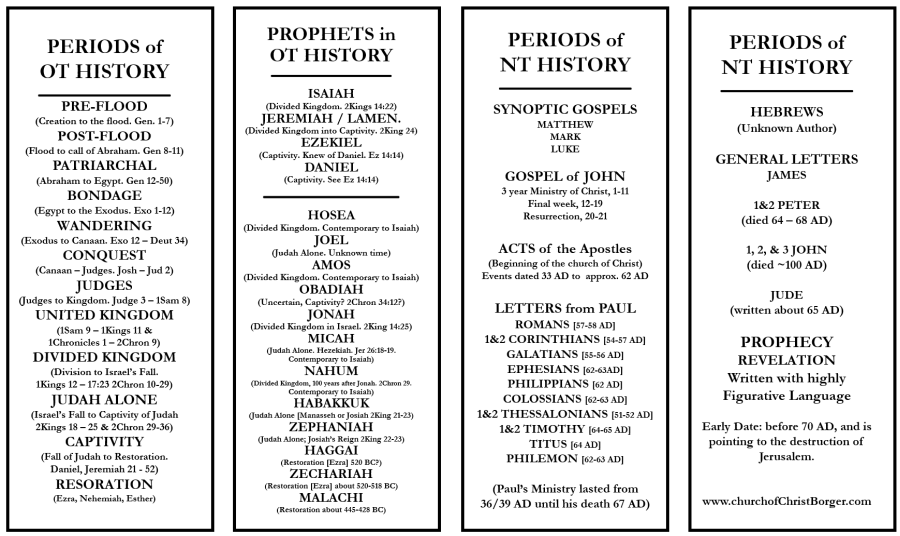
Bible Reading Bookmarks for the Old & New Testament

The thing that hath been, it is that which shall be; and that which is done is that which shall be done: and there is no new thing under the sun.” (Ecclesiastes 1:9).

A large corporation brought in a consultant to give them a forecast about the next 5 years. As they surrounded the conference table awaiting his prognostication, the consultant said, “everything will be about the way it’s always been.”

There will be weather, seasons, traffic, births, deaths, holidays, elections, etc. There will be good times and low ones. That is the record of history. The sad condition of mankind is that many live expecting it always to be different, to always be better, and are unhappy and bitter when it’s not.

The preacher wrote, “there is no new thing under the sun.” We can reasonably predict what life will be like next year.

We will never predict the details, but we can reasonably expect certain things.

We all should be expecting to pile up a TREASURE. We need money & stuff for our earthly needs, and to share with those in need (Eph 4:28). We should expect those things if we’re doing those things God has prescribed in His word. A word of caution, we may become distracted from serving God and will be heaping up treasure against ourselves in judgment. “Your gold and silver is cankered; and the rust of them shall be a witness against you, and shall eat your flesh as it were fire. Ye have heaped treasure together for the last days” (James 5:3; cf. Matt 6:19-21).

We as Christians ought to expect to bear our Cross. “Whosoever will come after me, let him deny himself, and take up his cross, and follow me” (Mark 8:34). This is about commitment to the Cause of Christ and not about some personal pain or shortcoming.

We also ought to expect more wisdom, but we must seek it. Education is one thing nobody can take away from us. Divine wisdom is the most precious of all (Prov 8:1-11).

Christians ought to expect Persecution, but we think it strange even though the Holy Spirit said to expect it (2Tim 3:12).

Everyone ought to expect High & Low eXtremes (Ecc 3:1-10). Sadly, folks expect things to always be better than they are with no pain whatsoever. That condition is in Heaven, and we ought to see the pain in this life as motivation to qualify for the next.

Finally, we all ought to expect Eternity to begin for us. Whether we meet Jesus after our death, or we remain alive when he returns, there is an Eternal hereafter. Where do you want to spend your ETERNITY? “Then we which are alive and remain shall be caught up together with them in the clouds, to meet the Lord in the air: and so shall we ever be with the Lord” (1Thess 4:17).

Agape, Spencer

We invite you to visit one of our services at the Franklin & Juniper st church of Christ in Borger, Texas.

7 Plagues of the mind pt5

The last plague of the mind on our list is vacillation, or being like a See-Saw. This plague can be described as a person that is easily pulled away from one thing to another without being resolute on any one thing. This is a problem when dealing with the truth.

Paul described it this way, “That we henceforth be no more children, tossed to and fro, and carried about with every wind of doctrine, by the sleight of men, and cunning craftiness, whereby they lie in wait to deceive” (Eph 4:14).

Being irresolute is different from being indecisive. A See-Saw person bounces back and forth and appears to be very confident about opposing viewpoints.

Elijah said it this way, “How long go ye limping between the two sides? if the LORD be God, follow him: but if Baal, then follow him. And the people answered him not a word” (1Kings 18:21).

He calls it “limping between two sides” (ASV). Everyone can see it, but seldom in ourselves. Let’s see why this plague of the mind is so dangerous.

Our Lord warned us that it’s impossible to SERVE two masters. “No man can serve two masters; for either he will hate the one, and love the other; or else he will hold to one, and despise the other. Ye cannot serve God and mammon” (Matt 6:24). He then connects it to anxiety in verse 25, “Therefore I say unto you, be not anxious for your life…”

It’s impossible to serve and please everyone. “For am I now seeking the favor of men, or of God? or am I striving to please men? if I were still pleasing men, I should not be a servant of Christ” (Gal 1:10). If we seek to SERVE man, we will not be a SERVANT of Christ! THIS IS WHY IT’S DANGEROUS!

Another illustration of this comes from Paul, “Know ye not that your bodies are members of Christ? shall I then take away the members of Christ, and make them members of a harlot? God forbid” (1Cor 6:15). We cannot be both a member of the body of Christ while still trying to remain in sin.

Paul would give the solution in his 2nd letter to the Corinthians. “Be not unequally yoked with unbelievers: for what fellowship have righteousness and iniquity? or what communion hath light with darkness? And what concord hath Christ with Belial? or what portion hath a believer with an unbeliever? And what agreement hath a temple of God with idols? for we are a temple of the living God; even as God said, I will dwell in them, and walk in them; and I will be their God, and they shall be my people. Wherefore Come ye out from among them, and be ye separate, saith the Lord, And touch no unclean thing; And I will receive you, And will be to you a Father, And ye shall be to me sons and daughters, saith the Lord Almighty” (2Cor 6:14-18).

Our next point on this topic comes from this same warning, (quoting from Luke). “No servant can serve two masters: for either he will hate the one, and love the other; or else he will hold to the one, and despise the other” (Luke 16:13).

To limp between two opinions places us in opposition to Christ. We become ENEMIES to God! “Ye adulterers and adulteresses, know ye not that the friendship of the world is enmity with God? whosoever therefore will be a friend of the world is the enemy of God” (James 4:4). The Apostle John wrote, “Love not the world, neither the things that are in the world. If any man love the world, the love of the Father is not in him” (1John 2:15). THIS IS WHY IT’S DANGEROUS!

Finally, believing that everyone or anyone’s opinion is the truth ie, “your truth, my truth, we all have truth,” is a belief of confusion. “For God is not the AUTHOR of confusion,” (1Cor 14:33). There is only ONE truth. “There is one body, and one Spirit, even as also ye were called in one hope of your calling; one Lord, one faith, one baptism, one God and Father of all, who is over all, and through all, and in all” (Eph 4:4-6).

Recognition of the fact that there is only one truth will move us from duplicity to certainty. It’s here we had our starting place, “that we may be no longer children, tossed to and fro and carried about with every wind of doctrine, by the sleight of men, in craftiness, after the wiles of error.” Error leads to sin and sin leads to death. “For it were better for them not to have known the way of righteousness, than, after knowing it, to turn back from the holy commandment delivered unto them. It has happened unto them according to the true proverb, The dog turning to his own vomit again, and the sow that had washed to wallowing in the mire” (2Peter 2:21-22).

THIS IS WHY IT’S DANGEROUS! To limp, halt, falter between serving mankind or serving the Lord puts us in an impossibility, puts us in the position of being an enemy of God, and makes us confused! Is it any wonder that people are living wandering, hopeless, and worry filled lives?

The solution is a simple one; CHOOSE TO SERVE THE LORD.

This is the solution that Joshua presented to the Israelites after conquering the promised land, “And if it seem evil unto you to serve the LORD, choose you this day whom ye will serve; whether the gods which your fathers served that were on the other side of the flood, or the gods of the Amorites, in whose land ye dwell: but as for me and my house, we will serve the LORD” (Joshua 24:15; emph mine SEB).

Solomon concluded, “Let us hear the conclusion of the whole matter: Fear God, and keep his commandments: for this is the whole duty of man” (Ecc 12:13).

This is the same answer Jesus gives when asked what is the greatest commandment, “Thou shalt love the Lord thy God with all thy heart, and with all thy soul, and with all thy mind. This is the first and great commandment” (Matt 22:37).

When Jesus was being tempted by Satan, this was His answer, “Then saith Jesus unto him, Get thee hence, Satan: for it is written, Thou shalt worship the Lord thy God, and him only shalt thou serve” (Matt 4:10).

Let us be focused, and singular in purpose. Anything else is idolatry.

Agape,

Spencer

This is part of a series on the 7 PLAGUES of the mind.

7 Plagues of the mind pt3. GRUMBLING

(Phil 2:14-15)

The fourth plague of the mind is complaining, or what the bible calls murmuring. I like to call it grumbling, because much of it sounds like we’re growling like hungry dogs.

Generally speaking, God hates it.

How long shall I bear with this evil congregation, that murmur against me? I have heard the murmurings of the children of Israel, which they murmur against me.” (Num 14:27)?

However, before we go running off to condemn everyone that ever has a complaint, let’s make sure we know what we’re talking about.

Some complaints are warranted, and not condemned by God. “Now in these days, when the number of the disciples was multiplying, there arose a murmuring of the Grecian Jews against the Hebrews, because their widows were neglected in the daily ministration” (Acts 6:1).

Here is an example of a “murmur” that was justified and a remedy was sought for the complaint.

There are some complaints that are warranted and should be expressed. Complaints about a health issue needs to be taken up with our doctors. However, when we complain about our health to every stranger, it becomes less about health and more about attention.

The children of Israel had several complaints in the books of Exodus and Numbers after leaving Egypt. Some of the notable complaints include:

These complaints often led to God’s interventions, and sometimes punishments as part of their journey in the wilderness. You’ll notice that they had 3 main categories of complaint that continue to all generations (Food, Conditions, and Leadership). What was the difference between a complaint that was answered and a complaint that invoked God’s wrath?

The main difference is when they were complaining about the blessing, and having no gratitude toward God for His provisions. Note just one example, the complaint about food. At the beginning of their journey, they had no food so they complained and received food (Ex 16:3). Later, they continued to complain about food, but not that it was lacking, but that they were tired of the Miracle Manna from Heaven. “but now our soul is dried away; there is nothing at all save this manna to look upon” (Num 11).

Even so, constant grumbling and complaining is frowned upon by God for at least another reason. It makes the Christian appear hopeless. Paul looked at the pains of life this way, “Wherefore we faint not; but though our outward man is decaying, yet our inward man is renewed day by day. For our light affliction, which is for the moment, worketh for us more and more exceedingly an eternal weight of glory; while we look not at the things which are seen, but at the things which are not seen: for the things which are seen are temporal; but the things which are not seen are eternal” (2Cor 4:16-18; cf. 2Cor 12:7-10; 1Pet 3:14-16).

What can we do when we feel that urge to complain. First, when faced with the THORNS of life, complain with Grace by being thankful for the good. We can show our gratitude by thinking about what is right amidst all that is wrong. “in everything give thanks: for this is the will of God in Christ Jesus to you-ward” (1Thess 5:18).

We can be helpful in the area of complaints about Leadership. Instead of fault finding, we can solution seeking. We can Pray, and we can Participate. Be Helpful instead of Hurtful. “that they may do it with joy, and not with grief: for that is unprofitable for you” (Heb 13:17).

When life appears unfair, instead of lamenting what’s wrong, let’s seek out Opportunities to serve our fellow man. When we are left out, go and include someone else in your plans instead of stewing in complaint. “Do ye not make distinctions among yourselves, and become judges with evil thoughts” (Jas 2:1-4)?

We can also Rejoice, like Paul, knowing that pain produces patience and glorifies God in our continuing hope of His return (2Cor 12:10; Jas 1:2-4).

Never complain to someone who can’t fix it or isn’t responsible for our problem. Much damage has been done against one person when we complain about them to another (James 3:10-15). That’s not to say we can’t share with each other about our pains (James 5:13), but let us be careful about hopeless complaining.

Finally, Seek Solutions that Serve. We can all serve in some manner, whether it be encouraging, ministering, giving, teaching, mercy, or cheerfulness (Romans 12). If there is nothing anyone can do, give it to God, and look forward to His return.

Agape,

Spencer

Based on a series “the 7 PLAGUES of the mind / heart”

7 PLAGUES of the mind pt 2

LEERINESS & APATHY.

Before we can exceed our expectations, we must first face our limitations. Attitudes of the mind that interfere with our faith are some of those limitations.

Awareness is a warning. Just as we watch the weather to prepare for a storm, so too should we be aware of those negative PLAGUES of the mind that contribute to the storms of life.

Last article looked at the first in our list called Pessimism. Today we give warning to the second and third; Leeriness (overcaution) and Apathy.

All of the PLAGUES are natural responses to our experiences in life. They are not sin in and of themselves, except as it weakens our faith, and faithfulness.

And immediately Jesus stretched forth his hand, and took hold of him, and saith unto him, O thou of little faith, wherefore didst thou doubt” (Matt 14:31)?

Overcaution, being overly leery, is being unnecessarily cautious. We are instructed to be cautious; “Look therefore carefully how ye walk, not as unwise, but as wise” (Eph 5:15), but overcautious can hinder us in helping brethren. “Forget not to show love unto strangers: for thereby some have entertained angels unawares” (Heb 13:2).

Jesus spoke about helping strangers, “Then shall the King say unto them on his right hand, Come, ye blessed of my Father, inherit the kingdom prepared for you from the foundation of the world:  for I was hungry, and ye gave me to eat; I was thirsty, and ye gave me drink; I was a stranger, and ye took me in; naked, and ye clothed me; I was sick, and ye visited me; I was in prison, and ye came unto me” (Matt 25:34-36). These two passages talk about the individual responsibility first toward brethren in Christ, and also toward our fellow man (cf Gal 6:10; Luke 10:33-37)

Life is full of risk. It’s risky to do those things needed to take responsibility for the needs of the family. It’s risky to try to improve our health, & mind. We risk appearing foolish as we learn. It’s risky to serve God (Acts 3-8). It’s risky to keep the faith in a faithless world. “And ye shall be hated of all men for my name’s sake: but he that endureth to the end, the same shall be saved” (Matt 10:22).

A few years ago, Overcaution led many away from assembling with the saints. That’s not to say we should take unnecessary risks, being too risky is unwise, but it takes risk to remain faithful. If worshiping together with the saints becomes illegal, will you risk it to worship God? While Paul was ready to risk death (Acts 21:13), he took advantage of an opportunity to avoid dying unnecessarily (Acts 23:11-22). Be ready to die, but avoid it if it doesn’t cause you to lose faith. “For whosoever would save his life shall lose it: and whosoever shall lose his life for my sake shall find it” (Matt 16:25).

To overcome overcaution, we need to remember the instruction to Timothy; “For which cause I put thee in remembrance that thou stir up the gift of God, which is in thee through the laying on of my hands. For God gave us not a spirit of fearfulness; but of power and love and discipline. Be not ashamed therefore of the testimony of our Lord, nor of me his prisoner: but suffer hardship with the gospel according to the power of God” (2Tim 1:6-8)

Apathy is the third in our list of plagues of the mind. The bible describes it as being lukewarm. “I know thy works, that thou art neither cold nor hot: I would thou wert cold or hot. So because thou art lukewarm, and neither hot nor cold, I will spew thee out of my mouth” (Rev 3:15-16). Think about coffee. We like it either piping hot or ice cold, but room temperature coffee is not on any Starbucks menu. Room temperature is the temperature of inactivity.

Apathy takes the “I don’t care” or “It doesn’t matter” approach to service rendered toward God. While there are some things that have no affect on maintaining fellowship, there are other things that are absolute. Baptism, instrumental music in worship, faith in Christ, preaching the gospel, etc are doctrines that cannot be changed.

Paul wrote to Timothy, “Take heed to thyself, and to thy teaching. Continue in these things; for in doing this thou shalt save both thyself and them that hear thee” (1Tim 4:16). There are teachings (doctrines) that are absolute. The ecumenical world takes a casual approach to the doctrine of Christ. “If any one cometh unto you, and bringeth not this teaching, receive him not into your house, and give him no greeting” (2John 10).

Pour it on is the opposite attitude of apathy. Paul found contentment in whatever state he was in; “Not that I speak in respect of want: for I have learned, in whatsoever state I am, therein to be content.” (Phil 4:11). Paul pressed all the buttons, turned all the knobs, and flipped all the switches. “I press toward the mark for the prize of the high calling of God in Christ Jesus” (Phil 3:14).

Paul wrote quite a bit about being on fire for the Lord:

Apathy is the drift approach to faithfulness. “Therefore we ought to give the more earnest heed to the things that were heard, lest haply we drift away from them. For if the word spoken through angels proved stedfast, and every transgression and disobedience received a just recompense of reward; how shall we escape, if we neglect so great a salvation? which having at the first been spoken through the Lord, was confirmed unto us by them that heard;” (Heb 2:1-3; emph mine seb).

The Leeriness and Apathetic approach to faith is no faith at all. These two plagues need to be fought like we fight any physical disease.

Agape,

Spencer

the 7 PLAGUES of the mind is a series of articles about attitudes.

the 7 PLAGUES of the heart.

Staying Positive in a Negative world.

These series of articles are about coming face to face with our doubts, fears, and worries. To combat these, we must be aware they exist and they can come upon us suddenly.

As a continuation, this next series of articles will alert us to the 7 plagues of the mind that can hinder our walk with Christ, and make our evangelism impotent. Negative attitudes can add to doubt. There will be some overlap with the previous series, but there will be some strategies to overcome the doubt that will come from negative thinking.

The seven plagues of the mind are these:

  1. Pessimism, fault finding.
  2. Leeriness, overcautious & fear.
  3. Apathy & Lukewarm.
  4. Grumbling Murmuring & complaining.
  5. Uncertainty.
  6. Exasperation & Anxiety.
  7. Sea Tossed with the waves.

Negative attitudes have a negative effect on our faith. Life is hard, and it’s even harder with a negative outlook.

Agape,

Spencer

7 PLAGUES of the mind pt1; Pessimism

Staying Positive in a Negative world.

Negative attitudes have a negative effect on our faith. Life is hard, and it’s even harder with a negative outlook.

The troubles and the sins of this life are troubling for all of us; remember Lot? “For that righteous man dwelling among them, in seeing and hearing, vexed his righteous soul from day to day with their unlawful deeds” (2Peter 2:8). None of us are immune from the constant barrage of evil, but we must not let it infiltrate our minds and hearts to shipwreck our faith.

Negativity is Normal, and is the default setting of our minds, but we must overcome normal. In the absence of light, darkness prevails. Attitude diseases are just as bad as, and contribute to, the physical diseases of the body. Negativity weakens our faith not strengthen it.

Dealing with negative thoughts is like a WAR for keeping our heart and mind. Negative thoughts are like enemy weeds that creep into the beautiful garden. The gardener must be as a vigilant soldier watching on the wall. How far the weeds come in depends on how well he is watching.

EVIL is no match for good, but good must be ACTIVE. We must take action to keep out the negative. We must face it, not ignore it. Facing it doesn’t mean we have to keep it, nor dwell on it, but we do have to handle it. When the gardener sleeps, the tares keep growing. The negative only needs one chance, being positive must be successful continually. Maybe this is why our Lord told us to be mindful of the current day. “Sufficient unto the day is the evil thereof” (Matt 6:34b; see John 11:9). Spiritual warfare requires spiritual weapons (2Cor 10:3-5; Eph 6:11-17). Growing in the Grace and KNOWLEDGE is our strength to ward off these plagues of the mind.

The first of the 7 PLAGUES is PESSIMISM. This is the deadly plague of always looking on the bad side, the difficult side, the listing of all the reasons something can’t be done side. He’s not trying to figure out what is good or right, he’s searching for what’s wrong or how it will go wrong.

The pessimist says, “I can list ten reasons why this is a bad idea.” Why look for ten when one will do? LOL. These folks are on a mission to find fault over virtue. These are the “cup is half empty” people. The “cup is half full” is not the antitheses to this negative idea.

Remembering the overflowing quality of God’s cup is; “Give, and it shall be given unto you; good measure, pressed down, and shaken together, and running over, shall men give into your bosom. For with the same measure that ye mete withal it shall be measured to you again” (Luke 6:38). As the proverb says, “For as he thinketh in his heart, so is he” (Prov 23:7a).

Pessimism, defeatism, and the like are often self-fulfilling prophecies. When the pessimist’s forecast comes true, he seems to find joy. The pessimist can’t enjoy the beauty right outside his house because of the specs on the glass.

While this life may be filled with all kind of reasons to give in, and give up, we need to remember the words of our Lord, “If thou canst believe, all things are possible to him that believeth” (Mark 9:23). The way we think things are affect us more than the way things actually are. “There’s a lion in the street” saith the sluggard, (Prov 22:13; 26:13). Maybe there is, but we won’t know till we try.

Here are four strategies when pessimism attacks:

Instead of listing the reasons something can’t be done, direct your mind to the things that can be done. There is always a way. “but will with the temptation make also the way of escape, that ye may be able to endure it” (1Cor 10:13b).

Redirect pessimism toward appreciation and gratitude. Remembering the great things God has done is how we ward off pessimism. “Many, O LORD my God, are thy wonderful works which thou hast done, and thy thoughts which are to us-ward: they cannot be reckoned up in order unto thee: if I would declare and speak of them, they are more than can be numbered” (Psalm 40:5). “My mouth shall tell of thy righteousness, And of thy salvation all the day; For I know not the numbers thereof” (Psalm 71:15).

Reframing the issue may also help with pessimism. Faced with the problem of those preaching to add to his chains, Paul reframed the issue; “but the other proclaim Christ of faction, not sincerely, thinking to raise up affliction for me in my bonds. What then? only that in every way, whether in pretence or in truth, Christ is proclaimed; and therein I rejoice, yea, and will rejoice” (Phil 1:17-18).

Finally, keeping your eye on the goal is a great way to stave off pessimism. “Brethren, I could not myself yet to have laid hold: but one thing I do, forgetting the things which are behind, and stretching forward to the things which are before, I press on toward the goal unto the prize of the high calling of God in Christ Jesus” (Phil 3:13-14). Regardless of the negative things pressing around us, it won’t change what we ought to do nor where we desire to be, unless we allow it.

The world is a painful place, but “Count it all joy, my brethren, when ye fall into manifold temptations; Knowing that the proving of your faith worketh patience” (James 1:2-3).

Agape,

Spencer

This is part one of a series called the 7 PLAGUES of the heart / mind.

Overcoming Doubt

Why do we doubt? What is the source of doubt? This series of articles will seek to search the scriptures for the answer, and to learn how to combat, or to Overcome Doubt.

LESSON LINKS.

Why do we DOUBT? Don’t Believe. 09/08/23

Why do we DOUBT? Oppression. 9/14/23

Why do we DOUBT? Uncertainties. 9-22-23

Why do we DOUBT? Backbiting. 09-30-23

Why do we DOUBT? Thorns. 10-07-23

You’re invited to visit our services at the Franklin & Juniper St church of Christ in Borger Texas.

Why do we DOUBT?

Jesus asked this question of Peter when he began to sink after walking on the water.

And in the fourth watch of the night Jesus went unto them, walking on the sea. And when the disciples saw him walking on the sea, they were troubled, saying, It is a spirit; and they cried out for fear. But straightway Jesus spake unto them, saying, Be of good cheer; it is I; be not afraid. And Peter answered him and said, Lord, if it be thou, bid me come unto thee on the water. And he said, Come. And when Peter was come down out of the ship, he walked on the water, to go to Jesus. But when he saw the wind boisterous, he was afraid; and beginning to sink, he cried, saying, Lord, save me. And immediately Jesus stretched forth his hand, and caught him, and said unto him, O thou of little faith, wherefore didst thou doubt? And when they were come into the ship, the wind ceased. Then they that were in the ship came and worshipped him, saying, Of a truth thou art the Son of God

(Matthew 14:25-23).

You may wonder why the Lord was so critical of Peter’s doubt, because walking on water is not normal. But that was not the Lord’s rebuke. Peter was walking on water. Jesus was walking on water. They both walked on water together in the storm.

Do we also doubt in the storms of life?
Why do we doubt? What is the source of doubt? This series of articles will seek to search the scriptures for the answer, and to learn how to combat, or to Overcome Doubt.

The first thing we ought to do is to make certain we know what it means. Jesus asked Peter, “why did you doubt (duplicate, i.e. mentally to waver in opinion) [Strong’s Greek dictionary; distazo]. The dictionary defines doubt as; “to be uncertain about; consider questionable or unlikely; hesitate to believe.” DOUBT is the opposite of BELIEF. Therefore, our first source of DOUBT is DISBELIEF. This will be the ultimate root of all the sources.

DISBELIEF is the target of the Lord’s question to Peter (v31), and is our challenge today. Belief in God is the beginning of our salvation. It’s placed first of all other commands in obeying the gospel. Works without faith is vanity. Faith is a work (John 6:29; 1Thess 1:3; 2Thess 1:11).

But without faith it is impossible to please him: for he that cometh to God must believe that he is, and that he is a rewarder of them that diligently seek him” (Hebrews 11:6).

He that believeth and is baptized shall be saved; but he that believeth not shall be damned” (Mark 16:16).

The type of Belief under consideration is compared to the faith of Abraham when he went to sacrifice the son of promise. “Was not Abraham our father justified by works, when he had offered Isaac his son upon the altar? Seest thou how faith wrought with his works, and by works was faith made perfect? And the scripture was fulfilled which saith, Abraham believed God, and it was imputed unto him for righteousness: and he was called the Friend of God. Ye see then how that by works a man is justified, and not by faith only” (James 2:21-24). His belief was so certain that he supposed God would raise Isaac from the dead (Heb 11:17).

However, faith is not blind. “Now faith is the substance of things hoped for, the evidence of things not seen” (Hebrews 11:1). There’s evidence to believe. Peter’s evidence was the prior miracles of Jesus (which are still evidence for us today John 20:30-31). Peter had participated in the feeding of the 5,000 just preceding his water ambulation. How many steps he made on the water we do not know, but one step out of a boat into the deep stormy waters is sufficient. He had gone out in the limited commission with powers, “against unclean spirits, to cast them out, and to heal all manner of sickness and all manner of disease” (Matthew 10:1).

Well, that was Peter you may say; what about us? We don’t see those miracles today. No, we don’t see biblical miracles today, but that’s okay. The miracles Peter saw, and those in the early church are for our belief. “And many other signs truly did Jesus in the presence of his disciples, which are not written in this book: But these are written, that ye might believe that Jesus is the Christ, the Son of God; and that believing ye might have life through his name” (John 20:30-31). But there’s more…

God’s word says that God’s creation is for belief. “Because that which may be known of God is manifest in them; for God hath shewed it unto them. For the invisible things of him from the creation of the world are clearly seen, being understood by the things that are made, even his eternal power and Godhead; so that they are without excuse” (Romans 1:19-20). God’s creation is enough to begin our belief in Him.

Paul used this same evidence for belief. “Nevertheless he left not himself without witness, in that he did good, and gave us rain from heaven, and fruitful seasons, filling our hearts with food and gladness” (Acts 14:17; 17:27-28). The evidence of creation and human life will point you in the right direction to look further. There are only 2 possibilities about creation: 1) that everything came from a thoughtless nothing, or 2) everything came from a very wise, powerful, and brilliant God.

Belief is not blind. It has evidence and there’s so much evidence inside and outside of scripture. If you doubt, perhaps a study of evidences is for you to combat that doubt. Here are a few areas to study…

I have a few resources in my library. One of my favorites is by a brother in Christ named A.O. Schnabel, “Has God Spoken?” This book references scriptures of nature that science discovered many hundreds and thousands of years later. Some discoveries as recent as the 1960’s!

There’s no need to doubt. We can know and be assured.

(to be continued)

Agape,

Spencer

What can the 7 Sayings of Jesus on the Cross teach us about our pain?

Jesus said, “Take up your cross and follow me” (Matt 16:24). We are to die to self and live for Him.

The Gospels reveal 7 sayings of Jesus when He was on His cross. These sayings have important meaning for themselves, but they also leave an example for us who are suffering on our crosses.

What can the 7 sayings of Jesus on the cross teach us about handling our own pain, suffering, & earthly hurting?

Father, forgive them; for they know not what they do.” (Luke 23:34)

We often suffer at the hands of those close to us. Jesus suffered at the hands of God’s chosen people. We will often complain about what they should do, but didn’t do. Yes, they shoulda, and coulda, but didn’t. This powerful example of Jesus teaches us to be a forgiving people. We need to complain with grace, ready to Forgive, or Forebear, or Forget (release from our heart). Forgive those that are hurting you…

But Stay on the cross.

To day shalt thou be with me in paradise.” (Luke 23:43)

When others fail, remember that God doesn’t fail. There’s hope in the midst of our pain. There’s even hope when our pain is self induced. The thief admitted his guilt, and was a mocker along with the other one, but later he had a change of heart. It’s then he looked to the only one that could help, Jesus. Sometimes our suffering is self induced, but the Lord is faithful to forgive those that are in Him (1John 1:9). Repent…

But Stay on the cross.

Woman, behold, thy son! Behold, thy mother!” (John 19:26-27)

Your friends may have turned their back on you. I hate that. However, If you’ll look, you’ll see that not everyone has left you. Some are nearby unable to take away your pain, But they can take some of your responsibilities. Just ask them for help. Some of us just don’t know what to do, but we’re willing if you’ll let us know.

When you’re overwhelmed with your main priority, let go of some of the other important, but lesser stuff.

But Stay on the cross.

My God, my God, why hast thou forsaken me?” (Mat 27:46)

People will let you down at your lowest point. The disciples left Jesus. It will also APPEAR that God has left you too. He hasn’t. He’s with you. While this saying has prophetic significance, it is a reminder of how lonely we can feel in our darkest moments. We need to remember that Jesus said, “I will never leave thee, nor forsake thee” (Heb 13:5).

But Stay on the cross.

I thirst.” (John 19:28-29)

Life is a dry, and thirsty struggle, metaphorically speaking. Jesus asked the woman at the well for a drink. He received a bit of a rebuke (John 4:7-9). Isn’t that the way it goes sometimes? Jesus said, “I thirst,” and He received sour wine. When we need help we sometimes receive a sour response. Ask anyway…

But Stay on the cross.

It is finished.” (John 19:30)

Jesus stayed on that cross to the very end because He knew that what He was doing was essential for salvation for the world. (cf. Matt 16:21-23; 26:52-55). Keep on pushing through the pain until you complete your duty as a child of God. It’s important that we stay the course of faithfulness. We may not see the benefits until much later (Rev 2:10),

But Stay on the cross.

Father, into thy hands I commend my spirit.” (Luke 23:46)

Even when all others fail you, God never does. Trust God. “For the which cause I also suffer these things: nevertheless I am not ashamed: for I know whom I have believed, and am persuaded that he is able to keep that which I have committed unto him against that day.” (2Tim 1:12). Whatever happens to you…

Stay on the cross.

Agape,

Spencer