
7 things to PROTECT #3, RESOURSES

7 Things we ought to PROTECT pt3. RESOURCES.

O Timothy! keep that which is committed to thy trust,” (1Tim 6:20).

We’ve been taking a closer look at the 7 things we ought to protect.

This next one is about protecting RESOURCES.

Before we begin, it must be understood that we’re not talking about protecting things in this life because we trust them above God. That’s condemned.

Lay not up for yourselves treasures upon earth, where moth and rust doth corrupt, and where thieves break through and steal: But lay up for yourselves treasures in heaven, where neither moth nor rust doth corrupt, and where thieves do not break through nor steal: For where your treasure is, there will your heart be also” (Matt 6:19-21).

What is under consideration in this series is the proper use and the protection of them to guard them from Waste, Abuse, Sin, Trusting, and Exploitation (cf. Luke 15:12-14). “Every good gift and every perfect gift is from above, and cometh down from the Father of lights, with whom is no variableness, neither shadow of turning” (James 1:17).

Now that we understand that material goods are from God for our use and not for trusting in them, we can now see how to use these material blessings for HIS GLORY. Some erroneously believe that Christians (and especially preachers) are to take a vow of poverty.
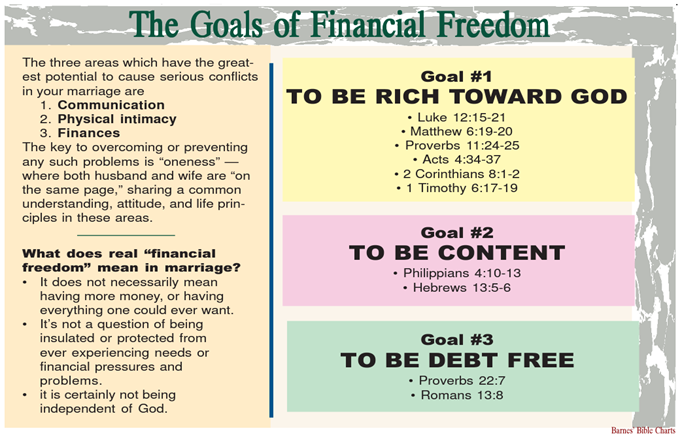
Rom 13:8 Owe no man any thing, but to love one another: for he that loveth another hath fulfilled the law.

We are authorized to use resources for our personal MATERIAL needs. This is a blessing from God He gives to His children. “Now he that ministereth seed to the sower both minister bread for your food, and multiply your seed sown, and increase the fruits of your righteousness;) Being enriched in every thing to all bountifulness, which causeth through us thanksgiving to God” (2Cor 9:10-11). The Psalmist wrote, “I have been young, and now am old; yet have I not seen the righteous forsaken, nor his seed begging bread” (Psalm 37:25). Paul wrote to the church at Thessalonica, “And that ye study to be quiet, and to do your own business, and to work with your own hands, as we commanded you; That ye may walk honestly toward them that are without, and that ye may have lack of nothing” (2Thess 4:11-12; Phil 4:11; Heb 13:5).

Another use of our resources is to care for our OLDER Parents (and by extension our OLDER selves, cf. 2Cor 12:14; cf.  a warning; Luke 12:15-21) “But if any widow have children or nephews, let them learn first to shew piety at home, and to requite their parents: for that is good and acceptable before God. But if any provide not for his own, and specially for those of his own house, he hath denied the faith, and is worse than an infidel” (1Tim 5:4,8). Jesus condemned the Pharisees for their failure in caring for their parents by their erroneous dedication of their wealth for God (cf. Mark 7:9-13).

We ought also to use our resources from God to help NEEDY Saints (and as individuals, our needy NEIGHBORS, cf Luke 10:25-37). “Let him that stole steal no more: but rather let him labour, working with his hands the thing which is good, that he may have to give to him that needeth” (Eph 4:28). What we’re learning is that the Saint is to be working for his income and preserving some for use for those in NEED (cf. Gal 6:10; James 1:27).

Another blessing of the resources from above is for us to personally ENJOY (in a godly way of course). “Charge them that are rich in this world, that they be not highminded, nor trust in uncertain riches, but in the living God, who giveth us richly all things to enjoy” (1Tim 6:17). Another example that these resources are not for saving trust, but for the glory of God.

Rather than preserving resources out of worry or anxiety (cf. Matt 6:20-34), we ought to have a heart that is YEARNING to give. “Now concerning the collection for the saints, as I have given order to the churches of Galatia, even so do ye. Upon the first day of the week let every one of you lay by him in store, as God hath prospered him, that there be no gatherings when I come” (1Cor 16:1-2; cf. 2Cor 8:1-2; Acts 4:32-37 & 5:4). “But this I say, He which soweth sparingly shall reap also sparingly; and he which soweth bountifully shall reap also bountifully. Every man according as he purposeth in his heart, so let him give; not grudgingly, or of necessity: for God loveth a cheerful giver” (2Cor 9:6-7). One implied above is for the spreading of the Gospel through the support of evangelists; “For ye had compassion of me in my bonds, and took joyfully the spoiling of your goods, knowing in yourselves that ye have in heaven a better and an enduring substance” (Heb 10:34; 2Tim 2:4; cf. 1Co 9:9; 1Tim 5:18).

As you may notice, each of these uses of money are often for the helping of others. Before the ability to help another, we must first have enough for ourselves and more than we need, but don’t worry about that. When we have the proper attitude about money, God provides the increase; “And God is able to make all grace abound toward you; that ye, always having all sufficiency in all things, may abound to every good work: (As it is written, He hath dispersed abroad; he hath given to the poor: his righteousness remaineth for ever. Now he that ministereth seed to the sower both minister bread for your food, and multiply your seed sown, and increase the fruits of your righteousness;) Being enriched in every thing to all bountifulness, which causeth through us thanksgiving to God. For the administration of this service not only supplieth the want of the saints, but is abundant also by many thanksgivings unto God” (2Cor 9:8-12).

Spencer

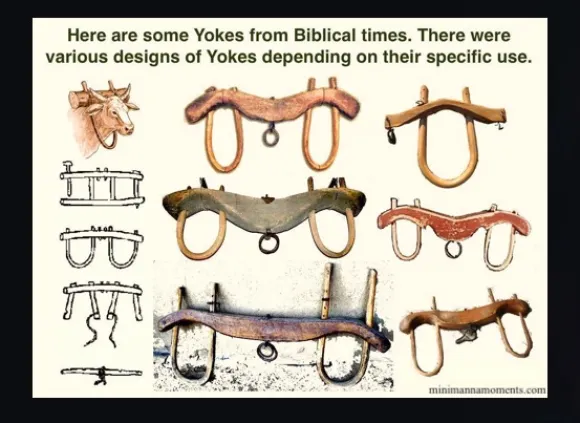
My Yoke is Easy, My BURDEN is light

My yoke is easy and My BURDEN is light.

Matt 11:28-30

28 “Come unto me, all ye that labour and are heavy laden, and I will give you rest. 29 Take my yoke upon you, and learn of me; for I am meek and lowly in heart: and ye shall find rest unto your souls. 30 For my yoke is easy, and my burden is light.”

How is the BURDEN light?

  1. we BELIEVE in the promises. Heb 12:6. 2Tim 4:6-8
  2. because of His UNSURPASSED love. Eph 3:18-21
  3. because of our REDEMPTION through Christ. 1John 1:7-9
  4. his word is DELIGHTFUL and not grievous. 1Cor 10:13. 1John 5:3; Ps 119:24
  5. because His Yoke is EASY. Mat 11:28-30
  6. because He NEVER LEAVES us nor forsakes us. Heb 13:5; Psalm 37:25

The BURDEN of Christ is easy and light.

7 Things we ought to PROTECT pt 1

pt1. Personal Safety.

O Timothy! keep that which is committed to thy trust,” (1Tim 6:20).

Last week we looked at an overview of 7 things we ought to protect. These next 7 articles will dive deeper into each of those items.

The first one is about PERSONAL SAFETY.

Can a child of God protect, preserve, save their life? Is it always necessary to die for the cause of Christ? Yes and no, it depends on the situation.

We have several examples from the life of the Apostle Paul. Let’s learn from his example when his life was under threat of imminent death.

On his way to Jerusalem the Apostle Paul said, “for I am ready not to be bound only, but also to die at Jerusalem for the name of the Lord Jesus” (Acts 21:13). Upon arriving to Jerusalem and entering the Temple he was arrested. Paul was ready to die.

At first, he was going to be scourged by the Roman guard. “The chief captain commanded him to be brought into the castle, and bade that he should be examined by scourging; that he might know wherefore they cried so against him” (Acts 22:24). Paul was ready to die.

But Paul said, “Is it lawful for you to scourge a man that is a Roman, and uncondemned” (v25)? Upon further questioning, they discovered that Paul was a natural born Roman citizen. They became afraid of what they were about to do to him and they backed away. “Then straightway they departed from him which should have examined him: and the chief captain also was afraid, after he knew that he was a Roman, and because he had bound him” (v29). Paul was ready to die.

We conclude that while it is important to be ready to be beaten for the cause of Christ, it’s not necessary if you can lawfully avoid it without denying your faith in Christ. He did not violate Matt 16:25, “For whosoever will save his life shall lose it: and whosoever will lose his life for my sake shall find it.” Paul was ready to die.

Later, during this same arrest event, a plot was discovered to assassinate Paul. “And when it was day, certain of the Jews banded together, and bound themselves under a curse, saying that they would neither eat nor drink till they had killed Paul. And they were more than forty which had made this conspiracy. And they came to the chief priests and elders, and said, We have bound ourselves under a great curse, that we will eat nothing until we have slain Paul. Now therefore ye with the council signify to the chief captain that he bring him down unto you to morrow, as though ye would enquire something more perfectly concerning him: and we, or ever he come near, are ready to kill him. And when Paul’s sister’s son heard of their lying in wait, he went and entered into the castle, and told Paul” (Acts 23:12-16). Paul was ready to die.

Upon learning of the plot Paul did this, “Then Paul called one of the centurions unto him, and said, Bring this young man unto the chief captain: for he hath a certain thing to tell him” (Acts 23:17). The plot was told to the chief captain, “But do not thou yield unto them: for there lie in wait for him of them more than forty men, which have bound themselves with an oath, that they will neither eat nor drink till they have killed him: and now are they ready, looking for a promise from thee” (22:21). The chief captain then sent Paul that night along with two hundred soldiers to go to Caesarea, and horsemen threescore and ten, and spearmen two hundred (v23). Paul was ready to die, but it wasn’t necessary, and he did not deny the Lord in the process.

We conclude that a Christian ought to be ready to be jailed, beaten, and even die for the cause of Christ (Acts 5:4-41). However, if there is a lawful means of protecting your life without denying the Lord that bought you, then do it. We could cite other such examples from Paul’s missionary journeys (Acts 9:25; 2Cor 11:33; Acts 16:35-40), in all Paul was ready to die.

If the means necessary to avoid persecution is to deny the Lord, then we’ve violated the command, denied the faith, and are in jeopardy for our soul. “But whosoever shall deny me before men, him will I also deny before my Father which is in heaven” (Matt 10:33).

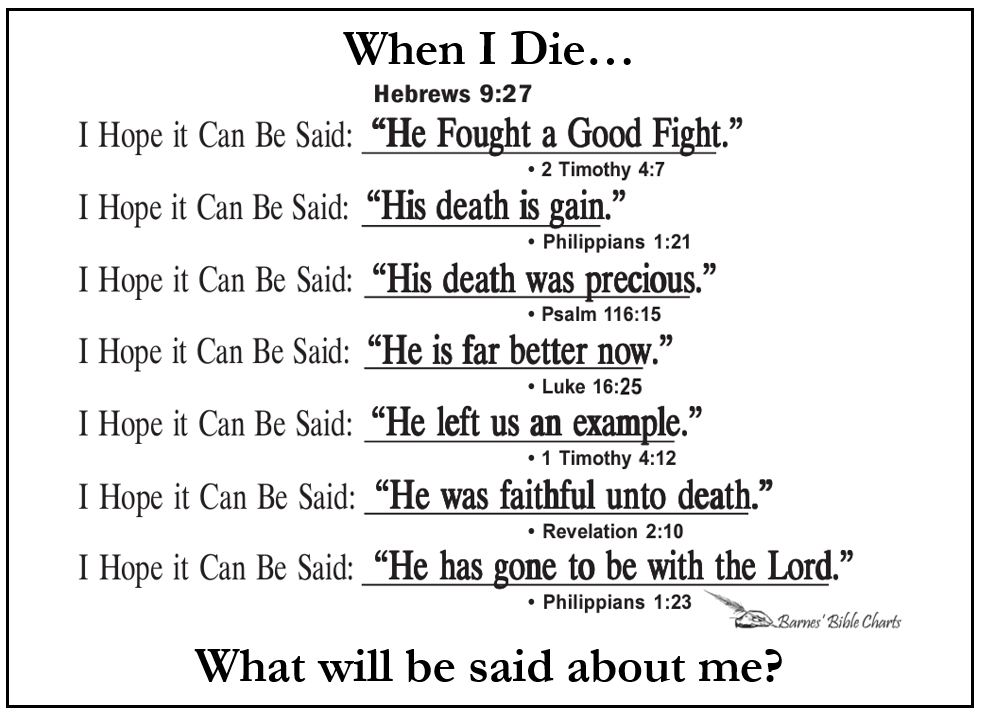
Paul was ready to die, arrest, beatings, and eventually did die. All for the cause of Christ (2Cor 11:23-33; Phil 1:20-22; 2Tim 4:6-7).

Fear none of those things which thou shalt suffer: behold, the devil shall cast some of you into prison, that ye may be tried; and ye shall have tribulation ten days: be thou faithful unto death, and I will give thee a crown of life” (Rev 2:10).

Spencer

MOURNING is better

MOURNING is better?

“It is better to go to the house of mourning, than to go to the house of feasting: for that is the end of all men; and the living will lay it to his heart. Sorrow is better than laughter: for by the sadness of the countenance the heart is made better. The heart of the wise is in the house of mourning; but the heart of fools is in the house of mirth.” (Ecclesiastes 7:2-4)

Why is MOURNING better?

Death is a MOTIVATOR. Loss can move someone to consider their own lives for change, Repentance. Sickness, Sadness, Pain can all do the same thing. (2Sam 12:23; Mark 9:24; John 3:16)

God is an OBJECTIVE judge and is perfectly Just. ( 2Cor 5:10; Re 15:3 Just & True). “The LORD is righteous in all his ways, and holy in all his works.” (Psalm 145:17). As we consider our own lives, we need to look to the ONE that holds life in His hand.

Death is UNAVOIDABLE (Jas 4:14; Ecc 3:2; Heb 9:27; Rom 5:14 death reigned from Adam). We have somehow forgotten that death is certain. It is appointed for man to die and then the judgment.

As we ponder our own mortality, looking to God for guidance, we need to REMEMBER that God has provided a means of RESURRECTION through His Son, Christ Jesus. IN CHRIST we have hope. “For if we believe that Jesus died and rose again, even so them also which sleep in Jesus will God bring with him” (1Thess 4:14; John 11:25-27).

As we think about our loved ones who have died, we will NOT get over it, nor should we. Their death should be a constant reminder of our mortality and our need for God. Becoming a Christian offers the only consolation for death. Jesus used His power of the resurrection as comfort (John 11:25-27). When David’s child died he said, “I shall go to him,” (2Sam 12:23).

Mourning eventually turns in to remembering. IT IS OKAY to talk about our deceased loved ones. Here’s a question for you; what does you deceased loved one want for you on your birthday, anniversary, holidays? What do they want for your salvation?

Consider the motivation of the rich man for his family after his death. We have insight from Jesus about the motivation of those who have gone on before us.

“Then he said, I pray thee therefore, father, that thou wouldest send him to my father’s house: For I have five brethren; that he may testify unto them, lest they also come into this place of torment” (Luke 16:19-31).

As we mourn, let us resolve to NEVER GIVE UP. “Let us hear the conclusion of the whole matter: Fear God, and keep his commandments: for this is the whole duty of man. For God shall bring every work into judgment, with every secret thing, whether it be good, or whether it be evil” (Ecclesiastes 12:13-14). Getting Old is a privilege for in it we have been given opportunity to turn to God.

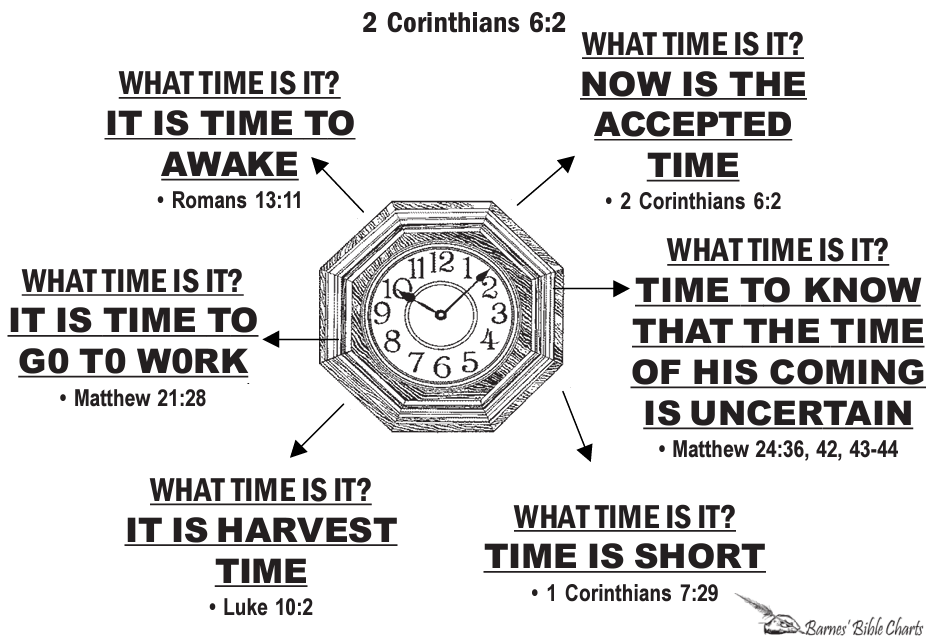
Lastly, mourning can lead us to GO & PREACH to the dying that Jesus saves from death. Life is short, so short that it’s called a vapor that is here and then gone (James 4:14). Because life, even a long life, is so short when compared with eternity, that we need to warn and encourage others to action today.

“For he saith, I have heard thee in a time accepted, and in the day of salvation have I succoured thee: behold, now is the accepted time; behold, now is the day of salvation” (2Cor 6:2; cf Heb 3:7-15).

Spencer

How do you turn away from sin and become a child of God? You must obey the Gospel. (click here)

7 things we ought to PROTECT

O Timothy! keep that which is committed to thy trust,” (1Tim 6:20).

Paul’s letter to Timothy focuses on the work of the young evangelist and his need to remain faithful to God and His word.

At the end of the letter is the command, “KEEP that which is committed to thy trust.” Another word for keep is to ‘guard.’ W.E. Vines defines this word as, to watch, i.e. be on guard (literally or figuratively); by implication, to preserve, obey, avoid: — beware, keep (self), observe, save.

Paul is primarily speaking about the word of God. By implication it would also include whatever else is commanded for us to protect.

This got me searching the scriptures for other things we should protect, keep, guard.

First, we are authorized by command and example to PRESERVE our PERSONAL life. While Paul was ready to die in Jerusalem (Acts 21:13), if it could be avoided without denying the faith, he was authorized to PRESERVE his life. Upon learning of a plot to kill him, Paul was able to thwart that plan (Acts 23:11-30). This led to him to continue to preach as far as Rome (Phil 1:21-26).

Second, we are commanded to use and not to waste our RESOURCES. An example of waste through disuse is with the 1 talent servant. “Thou oughtest therefore to have put my money to the exchangers, and then at my coming I should have received mine own with usury” (Matt 25:24-30). In our passage, Paul told Timothy to command the rich, “that they be not highminded, nor trust in uncertain riches, but in the living God, who giveth us richly all things to enjoy; That they do good, that they be rich in good works, ready to distribute, willing to communicate; Laying up in store for themselves a good foundation against the time to come, that they may lay hold on eternal life” (1Tim 6:17-19).

Third, we are commanded to care for our OLDER relatives who can no longer care for themselves. “But if any provide not for his own, and specially for those of his own house, he hath denied the faith, and is worse than an infidel” (1Tim 5:8-16). Another example is found in the care of Naomi by her daughter-in-law Ruth.

Fourth, we are to protect our TIME in this life. “See then that ye walk circumspectly, not as fools, but as wise, Redeeming the time, because the days are evil” (Eph 5:15-16). TIME is fleeting and precious. “Whereas ye know not what shall be on the morrow. For what is your life? It is even a vapour, that appeareth for a little time, and then vanisheth away” (Jas 4:14). We see this in the example of the urgency to be baptized of those that heard the gospel. “And he took them the same hour of the night, and washed their stripes; and was baptized, he and all his, straightway” (Acts 16:33). “And as they went on their way, they came unto a certain water: and the eunuch said, See, here is water; what doth hinder me to be baptized” (Acts 8:36; cf. Rom 13:11; 2Cor 6:2)?

Fifth, we are to make a covenant with our EYES to protect our heart. “I made a covenant with mine eyes” (Job 31:1). “Keep thy heart with all diligence; for out of it are the issues of life” (Prov 4:23; cf. Mt 12:34; Mar 7:21).

Sixth, we certainly must protect CHILDREN. Jesus Himself warned, “And Jesus called a little child unto him, and set him in the midst of them, And said, Verily I say unto you, Except ye be converted, and become as little children, ye shall not enter into the kingdom of heaven. Whosoever therefore shall humble himself as this little child, the same is greatest in the kingdom of heaven. And whoso shall receive one such little child in my name receiveth me. But whoso shall offend one of these little ones which believe in me, it were better for him that a millstone were hanged about his neck, and that he were drowned in the depth of the sea” (Matt 18:2-6; cf. Mark 4:42-44). Yes, he was inclusive of protecting the child of God, but that only strengthens the point of protecting the innocent life.

Seventh, most important of all, we must protect our TREASURE in Heaven. We have guards, locks, and safes to protect our earthly treasure where “moth and rust doth corrupt, and where thieves break through and steal” (Matt 6:19). This treasure is temporal and temporary and cannot help us in the judgment, but rather witness against us, “Your gold and silver is cankered; and the rust of them shall be a witness against you, and shall eat your flesh as it were fire. Ye have heaped treasure together for the last days” (James 5:3).

Jesus said, “But lay up for yourselves treasures in heaven, where neither moth nor rust doth corrupt, and where thieves do not break through nor steal: For where your treasure is, there will your heart be also” (Matt 6:19-20). We can take our treasure with us to heaven if we’ve laid one there. This is definitely included in the command to Timothy, “KEEP that which is committed to thy trust.”

Spencer is an evangelist for the Franklin and Juniper St church of Christ in Borger, Tx.

They Did Not KNOW

THEY DID NOT KNOW

That phrase stands out to me as I evangelize to a world that knows what isn’t so. “Because thou sayest, I am rich, and increased with goods, and have need of nothing; and KNOWEST NOT that thou art wretched, and miserable, and poor, and blind, and naked” (Rev 3:17; emph mine seb).

While reading Ezekiel recently I was struck by the frequency of another phrase. “Then SHALL THEY KNOW that I am the LORD their God” (emph seb). Seventy-Six times throughout Ezekiel, God makes this statement at the heals of impending judgment, restoration, or prophetic statements about Christ. It’s spoken to people who have rejected, ignored, or otherwise “DO NOT KNOW,” but ought to have known, God.

The problem remains today. Many do not know, but think they know. What they know aint so. That’s why we preach. Here are just a few things we should KNOW.

We need to Know that Christ is KING and is reigning now. “Which in his times he shall shew, who is the blessed and only Potentate, the King of kings, and Lord of lords” (1Tim 6:15; cf Acts 2:34-36).

We need to Know NOT to love the world. “Ye adulterers and adulteresses, know ye not that the friendship of the world is enmity with God” (Jas 4:4)?

We need to Know to OBEY His commandments. “And why call ye me, Lord, Lord, and do not the things which I say” (Luke 6:46-49)? “In flaming fire taking vengeance on them that know not God, and that obey not the gospel of our Lord Jesus Christ” (2Thess 1:8).

We need to Know how to WALK as Jesus WALKED. “He that saith he abideth in him ought himself also so to walk, even as he walked” (1John 2:6).

Knowledge is power, but the right knowledge is the Power of God. “For I am not ashamed of the gospel of Christ: for it is the power of God unto salvation to every one that believeth; to the Jew first, and also to the Greek” (Rom 1:16).

And ye shall know the truth, and the truth shall make you free” (John 8:32).

Spencer

Lesson from 1Peter 2: by your Good WORKS

Having your conversation honest among the Gentiles: that, whereas they speak against you as evildoers, they may by your GOOD WORKS, which they shall behold, glorify God in the day of visitation.

(1Peter 2:12, emph seb)

What are the good works. There are 5 key things to remember about good WORKS.

  • Firstly, they must be according to the WILL of God (authorized through scriptures; 1Pet 4:2; Eph 2:10).
  • They need to be ONGOING in our lives (habitual; cf Titus 2:7; 3:8, 14).
  • Thirdly, we need to be constantly READY & willing from the heart to do them (Titus 2:14; 1Tim 6:18; 2Co 8:12).
  • We can KNOW what they are and be taught them (Heb 10:24; Titus 3:14)
  • Lastly, they are to be SEEN, but not to be seen from pride (1Pet 2:12; 3:1, 16)

The faithful Christian will LEARN, PRACTICE, & MAINTAIN good Works all the days of their life. Here are all the passages in the New Testament that speak about good works.

GOOD WORKS;

Mt 5:16 Let your light so shine before men, that they may see your good works, and glorify your Father which is in heaven.

Joh 10:32 Jesus answered them, Many good works have I shewed you from my Father; for which of those works do ye stone me?

Acts 9:36 Now there was at Joppa a certain disciple named Tabitha, which by interpretation is called Dorcas: this woman was full of good works and almsdeeds which she did.

Rom 13:3 For rulers are not a terror to good works, but to the evil. Wilt thou then not be afraid of the power? do that which is good, and thou shalt have praise of the same:

Eph 2:10 For we are his workmanship, created in Christ Jesus unto good works, which God hath before ordained that we should walk in them.

1Tim 2:10 But (which becometh women professing godliness) with good works.

1Tim 5:10 Well reported of for good works; if she have brought up children, if she have lodged strangers, if she have washed the saints’ feet, if she have relieved the afflicted, if she have diligently followed every good work.

1Tim 5:25 Likewise also the good works of some are manifest beforehand; and they that are otherwise cannot be hid.

1Tim 6:18 That they do good, that they be rich in good works, ready to distribute, willing to communicate;

2Tim 3:17 That the man of God may be perfect, throughly furnished unto all good works.

Titus 2:7 In all things shewing thyself a pattern of good works: in doctrine shewing uncorruptness, gravity, sincerity,

Titus 2:14 Who gave himself for us, that he might redeem us from all iniquity, and purify unto himself a peculiar people, zealous of good works.

Titus 3:8 This is a faithful saying, and these things I will that thou affirm constantly, that they which have believed in God might be careful to maintain good works. These things are good and profitable unto men.

Titus 3:14 And let ours also learn to maintain good works for necessary uses, that they be not unfruitful.

Heb 10:24 And let us consider one another to provoke unto love and to good works:

1Pet 2:12 Having your conversation honest among the Gentiles: that, whereas they speak against you as evildoers, they may by your good works, which they shall behold, glorify God in the day of visitation.

GOOD WORK:

2Cor 9:8 And God is able to make all grace abound toward you; that ye, always having all sufficiency in all things, may abound to every good work:

Php 1:6 Being confident of this very thing, that he which hath begun a good work in you will perform it until the day of Jesus Christ:

Col 1:10 That ye might walk worthy of the Lord unto all pleasing, being fruitful in every good work, and increasing in the knowledge of God;

1Tim 3:1 This is a true saying, If a man desire the office of a bishop, he desireth a good work.

2Tim 2:21 If a man therefore purge himself from these, he shall be a vessel unto honour, sanctified, and meet for the master’s use, and prepared unto every good work.

Titus 1:16 They profess that they know God; but in works they deny him, being abominable, and disobedient, and unto every good work reprobate.

Titus 3:1 Put them in mind to be subject to principalities and powers, to obey magistrates, to be ready to every good work,

Heb 13:21 Make you perfect in every good work to do his will, working in you that which is wellpleasing in his sight, through Jesus Christ; to whom be glory for ever and ever. Amen.

The person that teaches there is nothing for a person to do to become a Christian and to remain faithful has obviously never read the scriptures.

There is a purpose behind good works. Peter says, “which they shall behold, glorify God in the day of visitation.” He is talking about using our good works to win others to Him (cf 1Peter 3:1-2; 15).

Spencer

Lessons from 1Peter 2: Spiritual Sacrifices

We’ve already talked about being living STONES, now we turn our attention to the second half of verse 5:

Ye also, as lively stones, are built up a spiritual house, an holy priesthood, to offer up SPIRITUAL SACRIFICES, acceptable to God by Jesus Christ.”

(1Peter 2:5, emph seb)

What exactly are the SPIRITUAL SACRIFICES we are to offer up to God?

Before we attempt to discern what they are, let’s note four things about them.

Firstly, we are to be ACTIVELY doing them, “Offer up…” Being a Christian is not a passive condition, it’s active. Note that we are “LIVELY” stones.

Secondly, our sacrifices must be “ACCEPTABLE to God.” Paul wrote, “Study to shew thyself approved unto God” (2Tim 2:15a; cf. Rom 12:1).

Thirdly, they we are to AIM them “…to God”. Whatever these sacrifices are, they are to be directed toward God.

Fourthly, they are directed toward God through the AVENUE of Jesus; “…by Jesus Christ.” Jesus Himself said, “Jesus saith unto him, I am the way, the truth, and the life: no man cometh unto the Father, but by me” (John 14:6).

Paul also wrote on spiritual SACRIFICES, “I beseech you therefore, brethren, by the mercies of God, that ye present your bodies a living sacrifice, holy, acceptable unto God, which is your reasonable service” (Rom 12:1). So, what are they? Verse 6 begins a list from Paul, so we shall look at both Peter & Paul’s letters. “Having then gifts differing according to the grace that is given to us, whether…”

We are to SHEW Forth Praises of God. “But ye are a chosen generation, a royal priesthood, an holy nation, a peculiar people; that ye should shew forth the praises of him who hath called you out of darkness into his marvellous light” (1Peter 2:9; cf Heb 13:15-16). It reminds me of when Jesus told the healed man to “Go home to thy friends, and tell them how great things the Lord hath done for thee, and hath had compassion on thee” (Mark 5:16).

ALL of our BODY, our whole being is a living sacrifice to God. “that ye present your bodies a living sacrifice” (Rom 12:1). This clarifies how much of our life is dedicated to God, ALL of it. Christ is our life (Col 3:4).

We are to give a CONTRIBUTION for the helping of needy Saints and for the  work of the Church. “But I have all, and abound: I am full, having received of Epaphroditus the things which were sent from you, an odour of a sweet smell, a sacrifice acceptable, wellpleasing to God” (Phil 4:18; cf. Heb 13:15-16). “He that giveth, let him do it with liberality” (Rom 12:8). God loves a cheerful giver (2Cor 8:2; 9:7).

By him therefore let us offer the sacrifice of praise to God continually, that is, the fruit of our lips giving thanks to his name. But to do good and to communicate forget not: for with such sacrifices God is well pleased” (Heb 13:15-16).

It’s a spiritual sacrifice to submit to Leaders that God has ordained for the local church, and those that RULE are offering up a sacrifice. “He that ruleth, with diligence” (Rom 12:8; cf. 1Tim 3:1-7). This is further supported in Peter’s letter, “Feed the flock of God which is among you, taking the oversight thereof, not by constraint, but willingly; not for filthy lucre, but of a ready mind; Neither as being lords over God’s heritage, but being ensamples to the flock” (1Peter 5:2-3).

Peter’s letter is just as much about how the Saint INFLUENCES the world. “Having your conversation honest among the Gentiles: that, whereas they speak against you as evildoers, they may by your good works, which they shall behold, glorify God in the day of visitation” (1Peter 2:12). This speaks to evildoers converting to Christ through the INFLUENCE of good works done by the saints (cf. 1Pet 3:1).

Paul includes Prophecy or FORETELLING in his letter to the Romans. “Whether prophecy, let us prophesy according to the proportion of faith” (Rom 12:6). While there was a miraculous element in the 1st century, we today can FORETELL through the inspired written word. Peter wrote, “according as each hath received a gift, ministering it among yourselves, as good stewards of the manifold grace of God; if any man speaketh, speaking as it were oracles of God; is any man ministereth, ministering as of the strength which God supplieth: that in all things God may be glorified through Jesus Christ, whose is the glory and the dominion for ever and ever. Amen. (1Peter 4:10-11). The future return of Christ is just one example.

It’s a sacrifice to be an INSTRUCTOR or Teacher of God’s word. “He that teacheth, on teaching” (Rom 12:8; cf. 2Tim 2:2).

It’s certainly a sacrifice to have COMPASSION (Mercy) on our fellow man. “He that sheweth mercy, with cheerfulness” (Rom 12:8). We have obtained mercy through the blood of Jesus. Ought we not show mercy on others?

EXHORTING (to urge one to pursue some course of conduct) is another important sacrifice. “Or he that exhorteth, on exhortation” (Rom 12:8; 2Tim 4:2). Encouraging brethren to better conduct can be a challenge. For example; “Not forsaking the assembling of ourselves together, as the manner of some is; but EXHORTING one another: and so much the more, as ye see the day approaching” (Heb 10:25).

Finally, SERVING (ministering) our brethren is a Spiritual Sacrifice to God. “Or ministry, let us wait on our ministering” (Rom 12:7). When we serve the brethren, we serve Christ. Jesus listed some things, “For I was an hungred, … I was thirsty, … I was a stranger, … Naked, … I was sick, … I was in prison… Then shall the righteous answer him, saying, Lord, when … ? And the King shall answer and say unto them, Verily I say unto you, Inasmuch as ye have done it unto one of the least of these my brethren, ye have done it unto me” (Acts 25:35-40’ cf. Acts 6:1-7).

These are all matters the individual Christian does through their own lives and homes. Some believe we abdicate these to others. These are OUR SPIRITUAL SACRIFICES. May we all offer up spiritual sacrifices, acceptable to God by Jesus Christ.

Spencer

Lessons in 1Peter 2: Follow in His STEPS

1Peter 2:21 For even hereunto were ye called: because Christ also suffered for us, leaving us an example, that ye should follow his steps:

How do we follow in His STEPS?

SUFFERING Innocently. 1Peter 1:20-25

TRUSTING (committing / entrusting). Pet 1:23

ENDURED reviling, threats. 1Pet 2:23; Rev 2:10

PATIENTLY. V20. 2Pet 1:6; 3:15

SERVANT to others. John 13:1-20