
Timothy, a beloved son

Timothy’s Faithful Heart – A Teachable, Ready, and Strong Servant
Timothy’s life offers us an inspiring example of Christian service. He was young, but he was full of wisdom, strength, and dedication. The New Testament paints a picture of a man who was willing to be taught, always ready to serve, and strong in the face of adversity. These qualities made Timothy a powerful servant of God and a true blessing to others.

A Teachable Teacher
One of Timothy’s most admirable traits was his teachability. From childhood, he was taught the Holy Scriptures which are able to save. As Paul wrote, “And that from a child thou hast known the holy scriptures, which are able to make thee wise unto salvation through faith which is in Christ Jesus” (2Timothy 3:15). Timothy shared this knowledge with others, training up faithful believers to teach in turn (2 Timothy 2:2). As Proverbs 1:5 says, “A wise man will hear and will increase learning.”

God wants us to be teachers. As Jesus commanded in the Great Commission, we’re not only to be taught but to teach others, “teaching them to observe all things whatsoever I have commanded you” (Matthew 28:20). Like Timothy, as we grow in wisdom, we can pass it on to those around us (see Hebrews 5:12).

Ready in Season and Out
Timothy was ready to serve at all times. In 2Timothy 4:2, Paul urges him to “preach the word; be instant in season, out of season.” To be instant means being prepared to share the gospel, whether the timing seems favorable or not. Timothy didn’t wait for ideal conditions or worry about convenience. His faithfulness kept him ready, and he served wherever there was need. 1Peter 3:15 reminds us of this same readiness: “But sanctify the Lord God in your hearts: and be ready always to give an answer to every man that asketh you a reason of the hope that is in you.”

When we live in readiness, we are better able to respond to the needs of those around us. Romans 12:11 says, “Not slothful in business; fervent in spirit; serving the Lord.” May we, like Timothy, respond eagerly to God’s work, not allowing any situation to keep us from sharing the gospel.

Strong and Courageous
Timothy’s strength in the face of trials is yet another remarkable example for us. Paul reminds us of his courage in Hebrews 13:23, showing that Timothy was steadfast and faithful despite challenges. the challenges of bondage.

The Bible encourages all believers to be strong. “Watch ye, stand fast in the faith, quit you like men, be strong” (1 Corinthians 16:13). God wants us to face the obstacles in life, just as Timothy did, with confidence and faith. Our strength isn’t in ourselves but in God. We see this echoed in Philippians 4:13: “I can do all things through Christ which strengtheneth me.”

Conclusion
Timothy’s life is an example for us to be teachable, ready, and strong in faith. He shows us that when we’re open to learning, prepared to serve, and firm in our strength from God, we can fulfill our calling and make a difference in others’ lives. His example encourages us to seek wisdom, stay prepared, and find our courage in the Lord.

As we grow in these qualities, we can serve like Timothy did, with a willing spirit and a heart full of faith, trusting that God can use us wherever we are. Just as Timothy’s legacy continues to inspire us, may our lives reflect a commitment to serving the Lord faithfully in all seasons.

Agape

Spencer

The Power of the Tongue

The way we speak to and about each other carries significant weight in shaping our relationships. Scripture offers guidance on this topic.

Speak Truthfully: The foundation of all godly communication is truth. Proverbs 12:22 tells us, “Lying lips are abomination to the Lord: but they that deal truly are his delight.” Truthfulness honors God and fosters trust between people. Ephesians 4:25 reinforces this, saying, “Wherefore putting away lying, speak every man truth with his neighbour: for we are members one of another.” The bond between believers, and even in families or friendships, grows strongest when it is built on honesty.

Truth-telling, however, must go hand in hand with wisdom. We are not to speak everything on our minds recklessly but what is helpful and necessary. Some have excused their rudeness by saying, “I told the truth.” Proverbs 15:28 says, “The heart of the righteous studieth to answer: but the mouth of the wicked poureth out evil things.” Speaking truth without care can do harm, but truth delivered thoughtfully builds others up.

Assume the Best in Others: Too often, we are quick to judge motives, which leads to misunderstanding and division. We ought to give others the benefit of the doubt. Colossians 3:12-13 encourages, “Put on therefore, as the elect of God, holy and beloved, bowels of mercies, kindness, humbleness of mind, meekness, longsuffering; Forbearing one another, and forgiving one another, if any man have a quarrel against any.” Assuming the best about someone promotes unity, while assuming the worst can lead to resentment. Proverbs 18:13 reminds us, “He that answereth a matter before he heareth it, it is folly and shame unto him.” Taking time to understand is a reflection of wisdom and humility.

Speak Lovingly: Speaking the truth without love can damage relationships. Ephesians 4:15 instructs us to be “speaking the truth in love, may grow up into him in all things, which is the head, even Christ.” When we speak lovingly, we are using our words to edify and encourage rather than tear down.

Proverbs 16:24 describes the power of loving words: “Pleasant words are as an honeycomb, sweet to the soul, and health to the bones.” The way we say something can have a profound impact. Loving speech heals, uplifts, and brings peace to those who hear it.

Speak Kindly: Kindness should be evident in the way we communicate. Colossians 4:6 says, “Let your speech be alway with grace, seasoned with salt, that ye may know how ye ought to answer every man.” Graceful speech is kind, considerate, and thoughtful, seeking to bless others rather than cause harm.

Proverbs 15:1 underscores the power of kind words, noting, “A soft answer turneth away wrath: but grievous words stir up anger.” When we speak kindly, we can defuse tension, ease conflict, and promote harmony. It is often through a gentle, kind word that we can turn situations around and make peace where there was previously strife.

The Bible clearly teaches that our speech matters. These principles, when applied, strengthen relationships and reflect our relationship in Christ. In a world where words are often used to divide, we have the opportunity to use ours to build others up, promote unity, and spread the love of God.

Agape,

Spencer

Spencer is an evangelist for the Franklin & Juniper St church of Christ in Borger Texas. We invite you to visit with us to learn about what God wants for our lives.

Duties of Saints, pt4. SERVE

Living the Christian Life:

In Colossians 3:1-4:6, Paul encourages Christians to live in a way that reflects their new identity in Christ. He challenges us to seek things above, focusing on heavenly things while living responsibly here on earth. The principles laid out by Paul guide our daily actions as individuals and members of one another.

These verses remind us that living as Christians involves things we can do, you and I, to embody these teachings.

1) Submit. Submission is a key theme in the Christian life, and it touches various aspects of our relationships and responsibilities. Here are several areas where Paul tells us to SUBMIT To:

a) Spouses (Colossians 3:18-19; Ephesians 5:22; 1 Peter 3:1-7)

The first place where submission begins is in the home. Wives to submit to their husbands, while husbands are to love their wives and not be harsh with them. This mutual submission creates a loving and harmonious household, reflecting Christ’s relationship with the church (Ephesians 5:22-33). If we’re married, you and I are to build marriages that mirror this sacred love and respect.

b) Unity with One Another (Ephesians 5:21; 4:1-6)

Submission doesn’t stop in the home—it extends to the church. There is mutual submission among believers out of reverence for Christ (Ephesians 5:21). Unity requires humility, patience, and bearing with one another in love (Ephesians 4:2). In a world where division often reigns, you and I can stand out as peacemakers, fostering unity and love in our relationships.

c) Children (Ephesians 6:1-2; Colossians 3:20; Matthew 15:4; Mark 7:10)

Children are instructed to obey their parents, honoring them as God has commanded (Ephesians 6:1-2; Colossians 3:20). Parents, on the other hand, should not provoke their children but nurture them in the discipline and instruction of the Lord. As parents, grandparents, or caregivers, you and I have a responsibility to raise the next generation with wisdom, love, and guidance according to God’s word.

d) Masters (Ephesians 6:5; 1 Timothy 6:1; Titus 2:9; Colossians 3:22; 1 Peter 2:18)

In the workplace, Christians are to submit to their employers, working wholeheartedly as if serving the Lord (Colossians 3:22). This principle applies whether you are an employee or in a position of leadership. You and I are to treat those we work with or for with integrity and respect, always reflecting Christ in our actions.

e) In the Church (1 Peter 5:5; Hebrews 13:7, 17)

Within the church, submission to spiritual leaders is essential for maintaining order and spiritual growth. We are to respect and follow those who watch over our souls, submitting to their leadership as they guide us in our walk with Christ (Hebrews 13:7, 17). You and I can contribute to the health of the church by being humble, teachable, and respectful.

f) Territory (Romans 13:1-7)

Submission also extends to governing authorities. Paul reminds us that all authority is established by God, and as Christians, we are to be law-abiding citizens (Romans 13:1-7). Whether we agree with every decision or not, you and I are to respect authority, as long as it doesn’t conflict with God’s commands, knowing that our ultimate allegiance is to Christ.

2) Earn for Our Needs (Ephesians 4:28; 6:5; Colossians 3:22)

Work is a gift from God, and earning an honest living is part of our responsibilities as saints. Paul encourages believers to work hard, not just for themselves but so they can help those in need (Ephesians 4:28). You and I are to be diligent and faithful in our work, providing for our families and contributing to the well-being of others.

3) Relieve the Afflicted (1 Timothy 5:10; 1 Peter 4:9)

Hospitality and care for the afflicted are essential aspects of Christian love. Peter exhorts us to show hospitality without grumbling (1 Peter 4:9). Whether through financial support, emotional encouragement, or practical assistance, you and I can bring comfort to those who are suffering, offering a tangible expression of Christ’s love.

4) Visit the Widows and Orphans in Their Need (James 1:27)

True religion, according to James, is marked by care for the most vulnerable: widows and orphans. Visiting and helping them in their distress is a way to practice our faith in action (James 1:27). You and I can look for opportunities to serve those who are often overlooked, offering them hope and support in their times of need.

5) Edify the Saints (1 Timothy 1:4; Ephesians 4:12, 16, 29; 1 Thessalonians 5:11; Romans 14:19, 15:2)

Finally, Christians are to build one another up. Whether through words of encouragement, teaching, or acts of service, our goal is to strengthen the body of Christ (Ephesians 4:12). You and I can help fellow believers grow in their faith and love for God.

Conclusion

In summary, Paul’s teaching in Colossians 3:1–4:6 provides a clear path for how you and I can live as Christians. By submitting in various relationships, working diligently, caring for the afflicted, and edifying the church, we embody the character of Christ and reflect His love to the world. These are practical actions we can take every day to live out our faith and bring glory to God.

Agape,

spencer

This is part 4 of a series of lessons on the Duties of Saints, pt1

Here is part 2 on the Duties of Saints.

What do you want me to do for you?

(Mark 10:51a)

Do you want what’s different from the bible? You Can’t. In Mark 10:1-12, the Pharisees challenge Jesus about divorce, hoping to trap Him into contradicting Moses’ law. Jesus responds by affirming the unchanging authority of God’s Word, pointing back to the original design of marriage at the beginning of creation (Genesis 2:24). This illustrates the point: you can’t want something different from what the Bible says because God’s Word is eternal and unchanging. People often desire the convenience of twisting scripture to fit modern preferences, but God’s truth stands firm regardless of societal trends. Psalm 119:89 says, “For ever, O Lord, thy word is settled in heaven.” Galatians 1:8 warns, “But though we, or an angel from heaven, preach any other gospel unto you than that which we have preached unto you, let him be accursed.” The Bible is not subject to personal modification or preference. Just like in Mark 10, any attempt to change or soften the Word for comfort or convenience fails, because God’s standards do not shift with the tide.

Do you want acceptance without sacrifice? You Can’t. When the rich young ruler approached Jesus in Mark 10:17-22, he wanted the assurance of eternal life without relinquishing his wealth. He desired acceptance into the Kingdom of God without the cost of giving up what held his heart. Jesus’ response is clear: it’s not possible. True discipleship requires sacrifice. We cannot hold on to worldly attachments and still fully follow Christ, as Luke 14:33 reminds us, “So likewise, whosoever he be of you that forsaketh not all that he hath, he cannot be my disciple.” Jesus didn’t just ask the rich man to part with his wealth; He asked for his full surrender. 1 Samuel 15:22 echoes this: “To obey is better than sacrifice.” There is no path to genuine acceptance by God without the willingness to sacrifice earthly treasures, desires, or comforts. Christ demands full allegiance and obedience, not half-hearted commitment.

Do you want notoriety with the Lord above your brethren? You Can’t. James and John sought glory and prestige above their fellow apostles in Mark 10:35-45. They asked for seats of honor beside Jesus in His Kingdom, not realizing that true greatness in God’s eyes comes through humble service, not self-exaltation. Jesus rebuked their request by explaining that greatness in the Kingdom of God is measured by serving others, not by claiming superior status (Mark 10:43). Philippians 2:3 teaches, “Let nothing be done through strife or vainglory; but in lowliness of mind let each esteem other better than themselves.” Seeking prominence for oneself contradicts Christ’s example of humility. 1 Peter 5:6 instructs, “Humble yourselves therefore under the mighty hand of God, that he may exalt you in due time.” Notoriety is not a competition among believers; it is an outgrowth of genuine servanthood.

We must take up our cross (sacrifice our life to Christ) to be worthy to follow Him. In Mark 10:21, Jesus told the rich young man, “Go thy way, sell whatsoever thou hast, and give to the poor, and thou shalt have treasure in heaven: and come, take up the cross, and follow me.” This call to take up the cross means more than just bearing hardship; it’s a call to die to oneself daily, surrendering our lives entirely to Christ. Jesus made it clear in Luke 9:23, “If any man will come after me, let him deny himself, and take up his cross daily, and follow me.” Taking up our cross is not optional—it’s the only way to be worthy of Christ. Romans 6:6 reminds us, “Knowing this, that our old man is crucified with him, that the body of sin might be destroyed.” To follow Jesus means we must sacrifice our desires, ambitions, and even our comfort for the sake of the gospel. It’s a life of surrender, where the only goal is to glorify God through obedience and faith.

Agape,

Spencer

This article is from a series of sermons on the Gospel of Mark. Click here for the list of available articles on the Gospel of Mark.

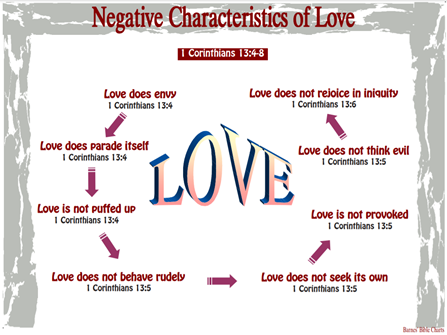
What’s LOVE got to do with it?

Love does not…

EVERYTHING!!

Love is the first & great commandment.

Paul calls love, “a more excellent way” [1Cor 12:31; 13:13].

“And Jesus answered him, The first of all the commandments is, Hear, O Israel; The Lord our God is one Lord: And thou shalt love the Lord thy God with all thy heart, and with all thy soul, and with all thy mind, and with all thy strength: this is the first commandment. And the second is like, namely this, Thou shalt love thy neighbour as thyself. There is none other commandment greater than these.” [Mark 12:29-31]

09-14-23 UPDATE ————————————-

In a world that has reduced love to just a feeling we need to understand Biblical love.

the culture of the day reminds me of the culture found in the book of judges; “In those days there was no king in Israel: every man did that which was right in his own eyes.” (Judges 21:25

Let’s be reminded of biblical love.

——————————————————————————–

The best commentary on Love is found in the Scriptures. Let’s see love from four perspectives.

  1. God’s Love for us
    1. God is Love – 1Jo 4:8 He that loveth not knoweth not God; for God is love. Titus 3:4-6
    2. God Gave His son – 1Jo 4:9, 10 In this was manifested the love of God toward us, because that God sent his only begotten Son into the world, John 3:16, 17; Rom 5:8; Eph 2:4,5
    3. God blesses His children – 1Jo 3:1 Behold, what manner of love the Father hath bestowed upon us, that we should be called the sons of God: Eph 1:3 every spiritual blessings
    4. Every good thing – James 1:17 – comes from above; Acts 17:28
    5. God sends sun & rain – Mt 5:45 for he maketh his sun to rise on the evil and on the good, and sendeth rain on the just and on the unjust.
  • Christ’s Love for us
    • Passes knowledge– Eph 3:19 And to know the love of Christ, which passeth knowledge, that ye might be filled with all the fulness of God.
    • As Father loved Him – Joh 15:9, 10 If ye keep my commandments, ye shall abide in my love; even as I have kept my Father’s commandments, and abide in his love.
    • He gave Himself – Joh 15:13 Greater love hath no man than this, that a man lay down his life for his friends.; Eph 5:2; 1Joh 3:16; Rev 1:5
    • His own– Joh 13:1, 34 A new commandment I give unto you, That ye love one another; as I have loved you, that ye also love one another.
    • Those who obey – Joh 14:21 He that hath my commandments, and keepeth them, he it is that loveth me: and he that loveth me shall be loved of my Father, and I will love him, and will manifest myself to him.
  • Man’s love for God & Christ
    • Great command– 1Jo 4:19 We love him, because he first loved us. Mark 12:28-30; Mt 22:36-40
    • Good thing for those that do – Ro 8:28 And we know that all things work together for good to them that love God, 1Corinthians 2:9 ings which God hath prepared for them that love him.
    • Crown of life / Kingdom – Jas 2:5 Hearken, my beloved brethren, Hath not God chosen the poor of this world rich in faith, and heirs of the kingdom which he hath promised to them that love him? [1:12]
    • Love displayed through obedience – 1Jo 5:3 For this is the love of God, that we keep his commandments:
      • 2Joh 6; John 14:15, 21, 23
    • Love for truth – 2Th 2:10-12 because they received not the love of the truth, that they might be saved.
  • Man’s love for others
    • Brethren – 1Th 4:9; 1Th 3:12 And the Lord make you to increase and abound in love one toward another, and toward all men, even as we do toward you:
      • John 13:34; 15:12; 1Pe 1:22; 2:17;
      • 1Jo 2:10, 3:11, 14, 23; 4:11, 12
      • 2Pe 1:7 And to godliness brotherly kindness; and to brotherly kindness charity.
    • Husbands & Wives – Eph 5:25, 28, 33; Col 3:19; Tit 2:3,4
    • Neighbor – Ro 13:8 Owe no man any thing, but to love one another: for he that loveth another hath fulfilled the law.
      • [Mr 12:31; James 2:8]
    • Enemies – Lu 6:35 But love ye your enemies, and do good, and lend, hoping for nothing again; and your reward shall be great, and ye shall be the children of the Highest:
      • Mt 5:43, 44 But I say unto you, Love your enemies, bless them that curse you, do good to them that hate you, and pray for them which despitefully use you, and persecute you;

Plea for Pure Christianity

“And whatsoever ye do in word or deed, do all in the name of the Lord Jesus, giving thanks to God and the Father by him.” (Colossians 3:17).

(by Jere E. Frost, via “According To The Pattern”, Medina, TN, 04/01/1990)

WE BELIEVE the Bible to be the inspired word of God, a perfect and sufficient guide (2 Timothy 3:16, 17). It does not incidentally contain some things which we teach — it is the alpha and omega of our faith and practice, and we dare not go beyond it (2 John 9).

WE COME to you with no denominational plan seeking your favor, but only in the name of Christ, desiring to help you find the truth, anxious that you obey all of God’s commandments. The obedient have a right to the tree of life and may enter in through the gates into the city (Revelation 22:14). But those who merely cry, “Lord, Lord,” shall not enter into the kingdom of heaven (Matthew 7:21).

WE SUBMIT to the matchless authority of Christ, heeding the faultless message that He and his inspired servants taught (Hebrews 2:3). His word produces faith, and faith in Him as the Son of God is the foundation of hope (Hebrews 11:1; John 8:24). Every person must repent, repentance being required of all and death being held forth as the wage of refusal (Acts 17:30; Luke 13:3). Confession of faith in Christ is unto salvation, and upon such a confession one may be baptized (Romans 10:10; Acts 8:37). Baptism was commanded by Christ Himself (Mark 16:16), puts one into Christ (Galatians 3:27) where all spiritual blessings abound (Ephesians 1:3), and is for the remission of our sins and the salvation of our souls (Acts 2:38; 1 Peter 3:21). Who dares refuse it? Faithfulness unto life’s end is promised a rich heavenly reward (Revelation 2:10).

WE PRAY for unity among all professed believers, for Christ so prayed (John 17:20-23). Paul besought the Corinthians to be “of the same mind” and to “speak the same things.” (1 Corinthians 1:10). Since human wisdom is the cause of (not the cure for) division, we must discard and abandon it in order to be true to any prayer for unity. A perfect and God-given platform for genuine unity is set forth in Ephesians 4:3-6. This is the basis for spiritual harmony and lasting peace with God. Consider: One God (unity in worship), one Lord, Jesus Christ (unity in authority), one Spirit (unity in life), one faith (unity in doctrine), one body, the church (unity in organization), one baptism (unity in practice), and one hope (unity in desire and expectation).

WE REFUSE to sectarianize ourselves by wearing man-made religious names; they are not only unauthorized, but actually foment division. We are to be Christians, nothing more and nothing less, being completely satisfied and humbly grateful to be honored with the privilege of wearing Christ’s name (1 Peter 4:16). God has placed His name above every name, and the disciples wore it (Philippians 2:9; Acts 11:26). The body (church) of Christ also wears His name, preferring none other, and thus the New Testament speaks of “the churches of Christ” (Romans 16:16).

WE ENDEAVOR to speak where the Bible speaks, and to be silent where it is silent. Christians have no creed but Christ, are to uphold no name but the divine, and have no plea but the gospel. We should mutually seek to establish and maintain unity in essentials, liberty in opinions, and love in all things.

WE INVITE you, most sincerely, to come and study the Bible with us – pure Christianity is wonderful! Embrace it! Be just a Christian!

Agape

What is the Value of your Soul?

For what shall it profit a man, if he shall gain the whole world, and lose his own soul? Or what shall a man give in exchange for his soul?” (Mark 8:36-37).

The question of the soul’s worth is one that transcends time and culture, touching the very essence of human existence. Jesus Himself addressed this profound query in Mark 8:34-38 and Matthew 16:24-26, challenging us to consider the eternal value of our souls. Let us explore four pivotal aspects that underscore the immeasurable worth of a soul.

As living souls, we have much greater potential than all others of God’s creation. Technology, Arts, and Mercy are unique to humans. More than these, we have the potential to become like Christ. “So also is the resurrection of the dead. It is sown in corruption; it is raised in incorruption: It is sown in dishonour; it is raised in glory: it is sown in weakness; it is raised in power: It is sown a natural body; it is raised a spiritual body. There is a natural body, and there is a spiritual body” (1Cor 15:42-44). When we obey the gospel, we look forward to eternal life with our Savior and to see Him as He is, (cf. Rev 22:4).

In Matthew 10:28, Jesus admonishes, “And fear not them which kill the body, but are not able to kill the soul: but rather fear him which is able to destroy both soul and body in hell.” This declaration underscores the eternal nature of the soul, distinguishing it from our temporal physical bodies. The body may perish, but the soul endures beyond the grave, facing either eternal life or eternal punishment as stated in Matthew 25:46: “And these shall go away into everlasting punishment: but the righteous into life eternal.”

The everlasting nature of the soul is a solemn reminder of its infinite value. Our earthly concerns often distract us from this reality, yet Jesus calls us to prioritize our spiritual well-being. The choices we make in this life have eternal consequences, emphasizing the need for a life aligned with God’s will.

Jesus highlighted the incomparable worth of a soul by pointing to God’s providence over creation. In Matthew 6:26-30, He illustrates His care for the birds and the flowers, reminding us that we are of far greater value: “Are ye not much better than they?” Jesus also said that “the very hairs of your head are all numbered” (Matt 10:30). These passages underscore the unique and cherished place humanity holds in God’s creation.

I am fearfully and wonderfully made” (Psalm 139:14). This divine craftsmanship reflects the soul’s worth, a masterpiece of God’s creative power. Unlike the rest of creation, the human soul bears a unique value.

The soul’s worth is further magnified by its divine origin. Acts 17:29 declares, “Forasmuch then as we are the offspring of God, we ought not to think that the Godhead is like unto gold, or silver, or stone, graven by art and man’s device.” We are not merely physical beings but spiritual offspring of God, created in His image.

Genesis 1:26-27 records God’s decision to create humanity in His likeness, endowing us with attributes that reflect His nature: “And God said, Let us make man in our image, after our likeness.” The Preacher reminds us that at death, “Then shall the dust return to the earth as it was: and the spirit shall return unto God who gave it” (Ecc 12:7). The soul’s divine origin and destiny underscore its unparalleled worth, calling us to live in a manner that honors our Creator.

The ultimate measure of the soul’s worth is found in the sacrifice of Jesus Christ. John 3:16, perhaps the most well-known verse in the Bible, proclaims, “For God so loved the world, that he gave his only begotten Son, that whosoever believeth in him should not perish, but have everlasting life.” This profound act of love underscores the soul’s value, worthy of the highest price (cf. Rom 5:8-10).

2Peter 3:9 emphasizes God’s desire for our salvation, stating, “The Lord is not slack concerning his promise, as some men count slackness; but is longsuffering to us-ward, not willing that any should perish, but that all should come to repentance.” The sacrificial death of Christ on the cross is the ultimate testament to the worth of our souls, offering us redemption and eternal life.

In contemplating the worth of a soul, we must recognize its eternal nature, its unparalleled value in creation, its divine origin, and the supreme sacrifice made for its salvation. As we reflect on these truths, let us heed Jesus’ call in Mark 8:34-38 and Matthew 16:24-26 to deny ourselves, take up our cross, and follow Him. For in doing so, we affirm the immeasurable worth of our souls and align our lives with God’s eternal purpose.

Agape,
Spencer

This article is from a series of sermons on the Gospel of Mark. Click here for the list of available articles on the Gospel of Mark.

Duties of SAINTS


The letter to the Colossians, penned by the Apostle Paul, serves as a profound guide for Christian living. In Colossians 3:1-4:6, Paul outlines the duties of saints, offering a roadmap for believers to follow. These duties can be encapsulated in six main directives: Seek things above, Abolish sin, Implement virtues, Act in the Name of the Lord, Treat your family well, and Serve with steadfastness.

Seek Things Above
(Colossians 3:1-4)

Paul begins by urging believers to set their minds on things above, where Christ is seated at the right hand of God. This heavenly focus requires a shift from earthly desires to a pursuit of spiritual growth and eternal truths. As Christians, our lives are hidden with Christ in God, and our ultimate hope is in His return and our future glory with Him. This perspective not only shapes our priorities but also transforms our daily actions, aligning them with God’s eternal purposes.

Abolish Sin (Colossians 3:5-9)
The next step is to mortify, or put to death, sinful behaviors. Paul specifically mentions immorality, impurity, passion, evil desire, and greed. These vices are part of the old self, which believers are to shed. Additionally, anger, wrath, malice, slander, and obscene talk must be eradicated from our lives. By abolishing these sins, we break free from their destructive power and align ourselves with God’s holiness (cf 1Pet 1:16).

Implement Virtues
(Colossians 3:10-14)

Having discarded the old self, Paul instructs us to put on the new self, which is being renewed in knowledge after the image of its Creator. This new self is characterized by virtues such as compassion, kindness, humility, meekness, and patience. Forgiveness and love are paramount, with love binding all these virtues together in perfect harmony. These qualities reflect the character of Christ and foster a spirit of unity and peace within the church.

Act in the Name of the Lord
(Colossians 3:15-17)

In every action, whether in word or deed, believers are to do everything in the name of the Lord Jesus, giving thanks to God the Father through Him. This command underscores the importance of living a life that seeks the authority of Christ in all circumstances. The peace of Christ should rule in our hearts, and the word of Christ should dwell richly among us, teaching and admonishing one another with wisdom. Our lives become a model of God’s grace and truth when we consistently act in His name.

Treat Your Family Well
(Colossians 3:18-21)

Paul then addresses family relationships, emphasizing the importance of treating each other well. Wives are called to submit to their husbands as is fitting in the Lord, and husbands are instructed to love their wives and not be harsh with them. Children are to obey their parents in everything, as this pleases the Lord, while fathers are cautioned not to provoke their children, lest they become discouraged. These instructions promote faithfulness to God and love within the home, reflecting God’s design to lead them to heaven.

Serve with Steadfastness
(Colossians 3:22-4:6)

Finally, Paul speaks to servants and masters, urging them to serve and lead with integrity and devotion. Servants are to obey their earthly masters with sincerity of heart, as if serving the Lord, while masters are to treat their servants justly and fairly, knowing they too have a Master in heaven. This principle extends to all areas of life, encouraging believers to serve wholeheartedly, remain steadfast in prayer, and conduct themselves wisely towards outsiders, making the most of every opportunity.

Conclusion
The duties outlined in Colossians 3:1-4:6 provide a comprehensive framework for Christian living. By seeking things above, abolishing sin, implementing virtues, acting in the name of the Lord, treating our families well, and serving with steadfastness, we fulfill our calling as saints. These principles guide us to live lives that are pleasing to God, edifying to the church, and impactful to the world around us. May we, as followers of Christ, diligently pursue these duties, growing in faith and reflecting the glory of our Savior in all we do.

Titus, a fine example of service

To Titus, mine own son after the common faith: Grace, mercy, and peace, from God the Father and the Lord Jesus Christ our Saviour.” (Titus 1:4)

The New Testament offers us many exemplary figures whose lives embody the teachings and values of Christ. One such figure is Titus, a close companion of the Apostle Paul, who stands as a shining example of what it means to be a true child of God. As we strive to live out our faith, examining the life of Titus can provide us with valuable insights and inspiration.

In a world where actions speak louder than words, the life of Titus provides clear evidence of a true follower of Christ. Paul’s confidence in Titus is evident in 2 Corinthians 8:23, where he refers to Titus as “my partner and fellowhelper concerning you.” This statement alone speaks volumes about the character and dedication of Titus. He was not just a believer in name but one whose actions and commitment were evident to all who knew him.

Christians today, must continue to ensure that our lives provide similar evidence of our faith. Are we known as partners and workers for the benefit of the gospel? Do our actions consistently reflect our commitment to Christ?

Titus was entrusted with significant responsibilities within the early church. Paul sent him to various challenging assignments, including dealing with difficult issues in the church at Corinth, and “ordain elders in every city” in Crete. Such trust from Paul indicates Titus’s reliability and dedication to the work of the Lord.

Trust is built over time through consistent and faithful actions. We must also be trustworthy stewards of God. “Moreover it is required in stewards, that a man be found faithful” (1Cor 4:2). Our reliability in carrying out God’s work is a testament to our faith and commitment.

Titus demonstrated unwavering faithfulness in his service to the Lord. He faced numerous challenges and opposition but remained steadfast. “But neither Titus, who was with me, being a Greek, was compelled to be circumcised” (Gal 2:1-3). Unwavering faithfulness means holding fast to the word of God, even when it is difficult. It means standing firm in our faith amid a world that often promotes contrary values. Just as Titus remained faithful despite opposition, we too must be resolute in our commitment to Christ, trusting that our perseverance is pleasing to God.

One of the most admirable qualities of Titus was his sincerity in service. Paul speaks of Titus’s genuine care and concern for the well-being of the believers. “But thanks be to God, which put the same earnest care into the heart of Titus for you” (2Cor 8:16). He genuinely cared for the church.

Sincere service is rooted in love and genuine concern for others. This means serving without seeking personal gain or recognition, serving out of a heartfelt desire to please God, to help and uplift others. Sincere service is a powerful demonstration of God’s love at work within us (cf. 1John 4:7-8).

The example of Titus provides a powerful blueprint for how we should live as true children of God. Our faith should be evident in our actions, as we build trust through our reliability and dedication to God’s work. We must remain unwavering in our faith, standing firm against opposition.

Agape,

Spencer

Lest we DRIFT away, Heb 2:1-3

Therefore we ought to give the more earnest heed to the things that were heard, lest haply we drift away from them. For if the word spoken through angels proved stedfast, and every transgression and disobedience received a just recompense of reward; how shall we escape, if we neglect so great a salvation?” (Heb 2:1-3a ASV)

In the swiftly changing currents of life, it is all too easy to drift away from the secure anchor of hope, “which we have as an anchor of the soul, a hope both sure and stedfast and entering into that which is within the veil” (Heb 6:19).

Let us explore five guiding principles from the book of Hebrews that can help us avoid spiritual drift and ensure our steadfastness in the faith.

The first one is found in Hebrews 6:11, “And we desire that each one of you may show the same diligence unto the fulness of hope even to the end.”

Think of diligence as the steady hand guiding the helm of a ship through treacherous waters. It is not enough to start well; we must persist, with our eyes fixed on the horizon of God’s promises.

Hebrews 4:11 exhorts us, “Let us labour therefore to enter into that rest, lest any man fall after the same example of unbelief.” The necessity of constant effort to avoid spiritual shipwreck is a recurring theme (Hebrews 10:22; 12:1). Are we laboring earnestly, or merely drifting along?

Reading and studying the Bible is the second way we will be able to remain on course, avoiding drift. The writer reminds us, “For the word of God is quick, and powerful, and sharper than any twoedged sword” (Heb 4:12). To avoid drift we must become skilled in the word. Hebrews 5:12-6:8 reveals the peril of spiritual immaturity and the dire consequences of neglecting the deeper teachings of Christ. Is our Bible a well-worn map or an unused artifact?

Another aid in avoiding drift is imitation which calls us to follow the examples of those who have walked the path of faith before us. Hebrews 6:12 instructs us to be “followers of them who through faith and patience inherit the promises.” We should emulate the faithful who have demonstrated unwavering trust in God. Consider the heroes of faith outlined in Hebrews 11. Their lives serve as beacons, illuminating the way for us to follow. By imitating their faith and perseverance, we reinforce our commitment to Christ. Whose shipping lane are we following today? (1Cor 11:1; 3John 11)

A healthy reverence for God is the fourth in our efforts to maintain our spiritual course. Hebrews 4:1 warns, “Let us therefore fear, lest, a promise being left us of entering into his rest, any of you should seem to come short of it.” Godly fear keeps us vigilant. It reminds us of the gravity of our salvation and the importance of living in a manner worthy of our calling. Does our reverence for God inspire vigilance or apathy?

Finally, we ought to take heed. Taking heed requires self-awareness and caution. Hebrews 3:12 cautions, “Take heed, brethren, lest there be in any of you an evil heart of unbelief, in departing from the living God.” The vigilance of the watchman who stands in the crow’s nest of the ship is akin to the spiritual alertness we must maintain to remain on course. By taking heed, we guard against the drift caused by doubt and sin. Are we watchful or wandering?

Let us heed the wisdom of Hebrews and apply these principles diligently. Through our earnest efforts we anchor our souls firmly in Christ, avoiding the perilous drift that leads away from so great a salvation.

Agape,

Spencer