5 WOMEN that met Jesus pt1

And Joanna the wife of Chuza Herod’s steward, and Susanna, and many others, which ministered unto him of their substance” (Luke 8:3)

Joanna is just one of several women that met with and learned from Jesus. These women would learn from Him and also minister to Him as seen in the story of Mary & Martha (Luke 10:38-42). Others hosted and served the church in their homes (Acts 12:12; Rom 16).

It’s a worthy study to look into these examples of godly women to find out what we can learn. This and the next article will look at 5 women who met Jesus during His ministry on earth and learn from their faith.

For as many of you as have been baptized into Christ have put on Christ. There is neither Jew nor Greek, there is neither bond nor free, there is neither male nor female: for ye are all one in Christ Jesus.  And if ye be Christ’s, then are ye Abraham’s seed, and heirs according to the promise

(Gal 3:27-29; cf. 1Pet 3:1-6).

The first woman of faith is the woman that WASHED His feet with her hair (Luke 7:37-38).

And, behold, a woman in the city, which was a sinner, when she knew that Jesus sat at meat in the Pharisee’s house, brought an alabaster box of ointment, And stood at his feet behind him weeping, and began to wash his feet with tears, and did wipe them with the hairs of her head, and kissed his feet, and anointed them with the ointment.”

What can we learn from her? Jesus gives us the lesson. It’s a demonstration of love in appreciation for mercy (Luke 7:41-48). He uses the contrast of two debtors in a parable, and then makes this about this faithful and grateful woman and this ungrateful man.

There was a certain creditor which had two debtors: the one owed five hundred pence, and the other fifty. And when they had nothing to pay, he frankly forgave them both. Tell me therefore, which of them will love him most? Simon answered and said, I suppose that he, to whom he forgave most. And he said unto him, Thou hast rightly judged. And he turned to the woman, and said unto Simon, Seest thou this woman? I entered into thine house, thou gavest me no water for my feet: but she hath washed my feet with tears, and wiped them with the hairs of her head. Thou gavest me no kiss: but this woman since the time I came in hath not ceased to kiss my feet. My head with oil thou didst not anoint: but this woman hath anointed my feet with ointment. Wherefore I say unto thee, Her sins, which are many, are forgiven; for she loved much: but to whom little is forgiven, the same loveth little. And he said unto her, Thy sins are forgiven.”

The second example is the woman that anointed His head with OIL just before His death (Matthew 26:7-13).

There came unto him a woman having an alabaster box of very precious ointment, and poured it on his head, as he sat at meat. But when his disciples saw it, they had indignation, saying, To what purpose is this waste? For this ointment might have been sold for much, and given to the poor. When Jesus understood it, he said unto them, Why trouble ye the woman? for she hath wrought a good work upon me. For ye have the poor always with you; but me ye have not always.”

What can we learn from her? Jesus gives us the lesson in this story also. It’s a lesson about looking and preparing for the death of Christ. While she looked forward to His death, we look forward to His return.

For in that she hath poured this ointment on my body, she did it for my burial. Verily I say unto you, Wheresoever this gospel shall be preached in the whole world, there shall also this, that this woman hath done, be told for a memorial of her.”

She did this in anticipation of His death, and she is now a permanent example in the Gospel. Today, we are able to learn from her and prepare for His return.

Know ye not, that so many of us as were baptized into Jesus Christ were baptized into his death? Therefore we are buried with him by baptism into death: that like as Christ was raised up from the dead by the glory of the Father, even so we also should walk in newness of life” (Romans 6:3-4).

The third example are two women named MARY who saw Jesus first after His resurrection (Matthew 28:1, 9-10).

And as they went to tell his disciples, behold, Jesus met them, saying, All hail. And they came and held him by the feet, and worshipped him. Then said Jesus unto them, Be not afraid: go tell my brethren that they go into Galilee, and there shall they see me.”

What can we learn from them? We learn to believe from their eyewitness testimony. Jesus gives us the lesson. They were told by Jesus to go tell His apostles, but (Luke 24:11) “And their words seemed to them as idle tales, and they believed them not.” “Afterward he appeared unto the eleven as they sat at meat, and upbraided them with their unbelief and hardness of heart, because they believed not them which had seen him after he was risen.” (Mark 16:14).

Belief today comes from the eyewitness testimony of those that saw Him in that day. People today expect to hear from Jesus personally, or have God personally call them separate and apart from the word. We will come to believe from the inspired words written by the eyewitnesses of the 1st century. “And many other signs truly did Jesus in the presence of his disciples, which are not written in this book: But these are written, that ye might believe that Jesus is the Christ, the Son of God; and that believing ye might have life through his name” (John 20:30-31; cf. John 17:20).

To expect more miracles, a personal call, or sign is to not believe these women, the Apostles, and opens yourself for the rebuke of Jesus. “…and upbraided them with their unbelief and hardness of heart, because they believed not them which had seen him after he was risen.”

Agape,

Spencer

click here for part 2.

We invite you to come and study with us in Borger, Texas.
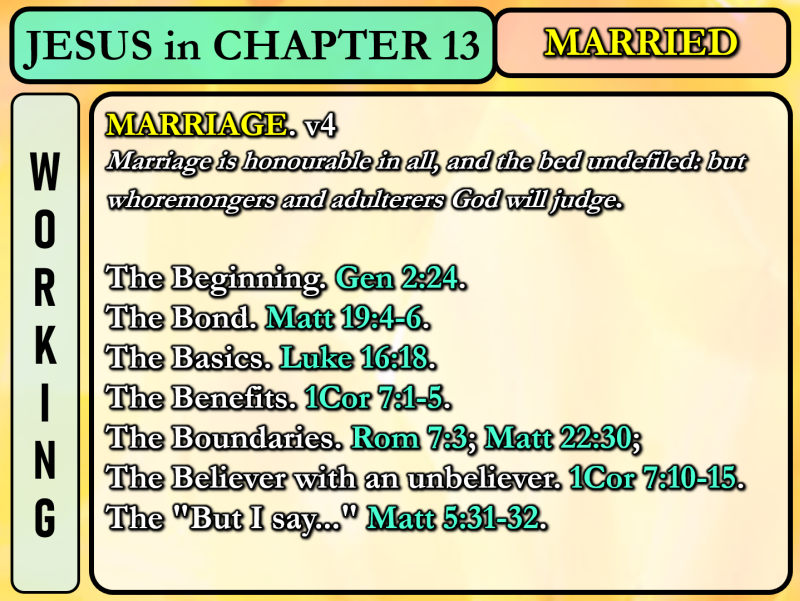
Hebrews 13:4 MARRIAGE

7 topics every couple should talk about before getting MARRIED.

  • MONEY. Prov 22:7; Eph 4:28.
    • Money is the #1 reason given for divorce.
  • AUTHORITY in the home & in life. Eph 5:23; 1Tim 2:12-15
    • Child rearing. Eph 6:1-4;
    • Deu 6:7,20; Prov 13:24
    • 1Cor 11:3 But I would have you know, that the head of every man is Christ; and the head of the woman is the man; and the head of Christ is God.
  • RELIGION. Eph 4:4; 1:22-23; 1Cor 1:10
    • 1Cor 7:39 The wife is bound by the law as long as her husband liveth; but if her husband be dead, she is at liberty to be married to whom she will; only in the Lord.
    • 2Cor 6:14 Be ye not unequally yoked together with unbelievers: for what fellowship hath righteousness with unrighteousness? and what communion hath light with darkness?
  • RELATIONS & RELATIONSHIPS.
    • Intimacy 1Cor 7:1-4.
    • Heb 13:4 Marriage is honourable in all, and the bed undefiled: but whoremongers and adulterers God will judge.
    • Friends. 1Cor 5:6; Gal 5:9.
      • Jas 4:4 Ye adulterers and adulteresses, know ye not that the friendship of the world is enmity with God? whosoever therefore will be a friend of the world is the enemy of God.
  • IN-LAWS. Mat 19:5-6.
    • Gen 2:24 Therefore shall a man leave his father and his mother, and shall cleave unto his wife: and they shall be one flesh.
  • EXPECTATIONS of each other. Goals. Rev 21:1-8; Phil 3:14.
    • Most sorrows come from UNSPOKEN, UNREALIZED, or UNREALISTIC EXPECTATIONS.
  • DISTRACTIONS. Directions.  Mark 4:19 And the cares of this world, and the deceitfulness of riches, and the lusts of other things entering in, choke the word, and it becometh unfruitful.

Spencer is an evangelist for the church of Christ on Franklin and Juniper in Borger Texas.

An overview study of the book of HEBREWS.

Public Conversations

Therefore disputed he in the synagogue with the Jews, and with the devout persons, and in the market daily with them that met with him.”  (Acts 17:17)

For several years it has been my custom to carry my bible into the public and to read privately, but openly. Many folks will comment, or be complimentary. Many more will walk on by. A few will stop to talk about their faith.

This article is a blending of several of those conversations. These two examples are representative of almost all of them. Most of these folks have the identical objections to the Bible. The objections are so common that I’ve actually made a list of the top 10 most common ones along with scriptural answers.

I have not raised my voice, become angry (Jas 1:20), and have avoided any rudeness on my part. I wish it could be said of the other part. Some have been very pleasant and have resulted in a few conversions.

May these be of aid in your efforts. 

A conversation on baptism.

(A blending of several actual conversations)

Person A: You don’t have to be baptized to be saved? You just need to ask Jesus into your heart.

Person B: So, you believe this version of Mark 16:16? “He that believeth and is (NOT) baptized shall be saved.”

Person A: My grandma was a wonderful woman. She never went to church, never had religion, but she was so kind to all.

Person B: So, you believe this version of Mark 16:16? “He that believeth (NOT) and is (NOT) baptized shall be saved.” Are you suggesting a works-based salvation?

Person A: I have a friend whose baby was baptized (sprinkled).

Person B: So, they believe this version of Mark 16:16? “He that believeth (NOT) and is baptized (sprinkled) shall be saved.” Babies are incapable of faith, so they’re safe according to Jesus (Mark 10:13-15).

Person A: I have heard that there’s only heaven and not eternal hell.

Person B: So, you believe this version of Mark 16:16? “He that believeth and is baptized shall (NOT) be saved.” Jesus said, “And these shall go away into everlasting punishment: but the righteous into life eternal.” (Matt 25:46). Jesus uses the same word (aiōnion) to describe both. Jesus said, “He that believeth and is baptized shall be saved; but he that believeth not shall be damned.” It’s so simple, let’s just do what Jesus said.

Person A: you’re going to hell if you believe baptism saves you.

Person B: “The like figure whereunto even baptism doth also now save us (not the putting away of the filth of the flesh, but the answer of a good conscience toward God,) by the resurrection of Jesus Christ:” (1Pet 3:21)

Person A: what about the thief on the cross? Ha! Gotcha.

Person B: The thief received his inheritance before the testator died. (Think about how WILLS work). Now that the Testator (Jesus) has died (and rose again to heaven), we are bound to follow His will. “For where a testament is, there must also of necessity be the death of the testator. [17] For a testament is of force after men are dead: otherwise it is of no strength at all while the testator liveth.” (Heb 9:16-17)

Person A: (screaming) YOU DON’T HAVE TO BE BAPTIZED TO BE SAVED!!!!!

Person B: I see that you’re upset. I’ll not talk to you about it anymore. (Matt 15:14)

Person A: Satan quoted scripture too.

Person B: have a nice day.

“That’s just your opinion”

(Based on an actual conversation)

Person B is handing out religious tracks at the fair.

Person A: (using person B’s personal pocket Bible they used to show scripture) the Bible says; “He that believeth and is baptized shall be saved; but he that believeth not shall be damned.” (Mark 16:16)

Person B: That’s just your opinion.

Person A: wait, what? I just read the scripture directly.

Person B: That’s just your interpretation.

Person A: I didn’t interpret nor did I comment. I just quoted the passage. We could read the whole chapter (Bible) and it wouldn’t change it.

Person B: You’re just a legalist.

Person A: How’s that? I’m reading the words of Jesus. Are you saying Jesus is a legalist too?

Person B: We’re saved by grace alone, through faith alone, in Christ alone.

Person A: Are you interested in reading the only passage in all of the Bible that says “by faith alone?”

Person B: (closes their pocket New Testament & places it in back pocket) “nope.”

Person A: I’m sorry to have bothered you. Have a nice day.

Person B: ☹

Agape,

Spencer is an evangelist for the church of Christ at Franklin & Juniper in Borger Texas.

We Gotta have GRIT

you’re going to Endure You Gotta have Grit.

Behold, we count them happy which endure. Ye have heard of the patience of Job, and have seen the end of the Lord; that the Lord is very pitiful, and of tender mercy.”  (James 5:11)

Endurance is a highly favored quality of mankind. It is most often associated with success despite difficulty or pain. We praise endurance because of the win that usually follows.

Endurance is necessary to our survival, and essential for our salvation. “And ye shall be hated of all men for my name’s sake: but he that endureth to the end shall be saved” (Matt 10:22).

Fear none of those things which thou shalt suffer: behold, the devil shall cast some of you into prison, that ye may be tried; and ye shall have tribulation ten days: be thou faithful unto death, and I will give thee a crown of life” (Rev 3:10; cf Jas 1:12).

GRIT is another description of endurance. It is having a firmness of character; an unconquerable spirit. We gotta have GRIT, but how do we get us some?

The Hebrew writer in chapter 12, a chapter about endurance, gives us 4 keys on how to get GRIT.

[12] Therefore, lift up the hands which hang down and the feeble knees,

[13] and make straight paths for your feet, lest that which is lame be turned out of the way, but let it rather be healed.

[14] Follow peace with all men, and holiness, without which no man shall see the Lord,

[15] looking diligently lest any man fail of the grace of God; lest any root of bitterness spring up to trouble you, and thereby many be defiled;

Key #1 is GET UP AND GO.

Therefore, strengthen the hands which hang down, and the feeble knees” (Heb 12:12). This is a command for us to get busy working on strength building.

When Elijah was facing persecution, God told him to GO. “And there he went into a cave, and spent the night in that place; and behold, the word of the LORD came to him, and He said to him, “What are you doing here, Elijah?” So he said, “I have been very zealous for the LORD God of hosts; for the children of Israel have forsaken Your covenant, torn down Your altars, and killed Your prophets with the sword. I alone am left; and they seek to take my life” (1Kings 19:9). “Go, return on your way to the Wilderness of Damascus; and when you arrive, anoint Hazael as king over Syria” (19:15).

Key #1 is GET UP AND GO.

Key #2 is to READ the Bible with a focus on the New Testament.

“…and make straight paths for your feet, lest that which is lame be turned out of the way, but let it rather be healed” (Heb 12:13). The straight path for our feet is found through the illumination of the word of God, consider Psalm 119:105… “Thy word is a lamp unto my feet, and a light unto my path.”

Key #2 is READ the Bible with a focus on the New Testament.

Key #3 is to be INTERESTED in and pursue peace with people.

Follow peace with all men, and holiness, without which no man shall see the Lord,” (Heb 12:14). We can endure longer when we stop making enemies.

If it be possible, as much as lieth in you, live peaceably with all men” (Rom 12:18). “I exhort therefore, first of all, that supplications, prayers, intercessions, and giving of thanks be made for all men, [2] for kings and for all who are in authority, that we may lead a quiet and peaceable life in all godliness and honesty” (1Tim 2:1-2).

Key #3 is to be INTERESTED in and pursue peace with people.

Key #4 is to look and TEST everything people are teaching.

“…looking diligently lest any man fail of the grace of God; lest any root of bitterness spring up to trouble you, and thereby many be defiled” (Heb 12:15). Looking diligently is about searching out the truth, proving it, and applying it to our lives.

Paul wrote; “Test all things; hold fast to that which is good” (1Thess 5:21). We must be on guard against error and false teachers. “But there were false prophets also among the people, even as there shall be false teachers among you…” (2Pet 2:1a). We’ll gain more endurance as we clear away errors and false teachers.

Key #4 is to look and TEST everything people are teaching.

Summary:

Key #1 is GET UP AND GO. Strengthen the hanging hands.

Key #2 is to READ the Bible to shine a light on your path.

Key #3 is to be INTERESTED in and pursue peace with people.

Key #4 is to look diligently and TEST everything people are teaching.

Agape,

Spencer

Hebrews 12; developing GRIT

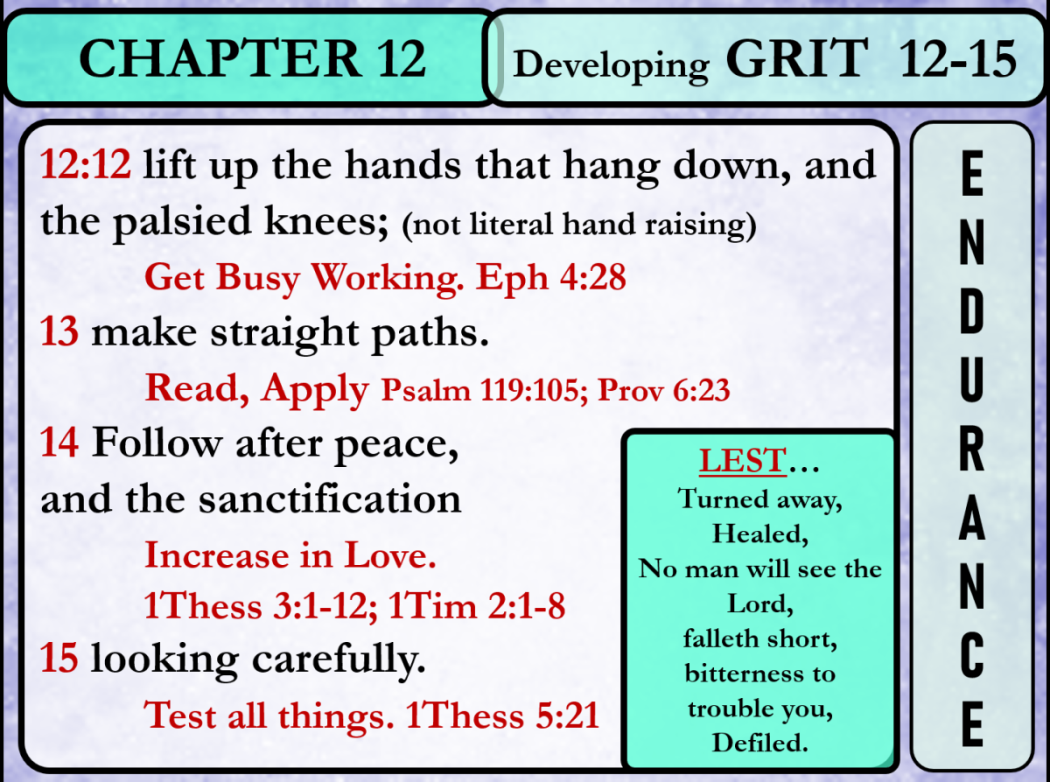
Hebrews 12:12-15 provides a great formula for developing Endurance (GRIT).

Heb 12:12 Wherefore lift up the hands that hang down, and the palsied knees;

Get Busy Working. cf. Eph 4:28

13 and make straight paths for your feet, that that which is lame be not turned out of the way, but rather be healed.

Read, Apply Psalm 119:105; Prov 6:23

14 Follow after peace with all men, and the sanctification without which no man shall see the Lord:

Increase in Love. 1Thess 3:1-12; 1Tim 2:1-8

15 looking carefully lest there be any man that falleth short of the grace of God; lest any root of bitterness springing up trouble you, and thereby the many be defiled;

Test all things. 1Thess 5:21

Along with it the writer provides a warner for lacking endurance.

LEST

Turned away,

Healed,

No man will see the Lord,

falleth short,

bitterness to trouble you,

Defiled.

for an overview of the book of Hebrews.

the Fear of the Lord

Men and brethren, children of the stock of Abraham, and whosoever among you feareth God, to you is the word of this salvation sent.”                  (Acts 13:26)

We don’t talk enough about the Fear of the Lord. Even when we do talk about it, some will complain that we say too much.

We do need to talk about it, and we need to talk about it with understanding. Once you see the phrase in your regular reading, you’ll begin to see it everywhere. One of my favorite Psalms includes a discussion on Fear of the Lord. (Psalm 34)

There are 2 main categories of Fear.

  • Fear that Motivates us into action.
  • Fear that Hibernates (freezes us from action).

The Fear of the Lord that motivates is the right kind of fear. Fear that causes us to turn away from God and away from action is the wrong kind of fear.

To help us define the Fear of the Lord, let’s look at its appearing in Proverbs.

The FEAR of the LORD. (From Proverbs)

Pr 1:7 The fear of the LORD is the beginning of knowledge: but fools despise wisdom and instruction.

Pr 1:29 For that they hated knowledge, and did not choose the fear of the LORD:

Pr 2:4 If thou seekest her as silver, and searchest for her as for hid treasures; 5 Then shalt thou understand the fear of the LORD, and find the knowledge of God.

Pr 3:7 Be not wise in thine own eyes: fear the LORD, and depart from evil.

Pr 8:13 The fear of the LORD is to hate evil: pride, and arrogancy, and the evil way, and the froward mouth, do I hate.

Pr 9:10 The fear of the LORD is the beginning of wisdom: and the knowledge of the holy is understanding.

Pr 10:27 The fear of the LORD prolongeth days: but the years of the wicked shall be shortened.

Pr 14:2 He that walketh in his uprightness feareth the LORD: but he that is perverse in his ways despiseth him.

Pr 14:26 In the fear of the LORD is strong confidence: and his children shall have a place of refuge.

Pr 14:27 The fear of the LORD is a fountain of life, to depart from the snares of death.

Pr 15:16 Better is little with the fear of the LORD than great treasure and trouble therewith.

Pr 15:33 The fear of the LORD is the instruction of wisdom; and before honour is humility.

Pr 16:6 By mercy and truth iniquity is purged: and by the fear of the LORD men depart from evil.

Pr 19:23 The fear of the LORD tendeth to life: and he that hath it shall abide satisfied; he shall not be visited with evil.

Pr 22:4 By humility and the fear of the LORD are riches, and honour, and life.

Pr 23:17 Let not thine heart envy sinners: but be thou in the fear of the LORD all the day long.

Pr 24:21 My son, fear thou the LORD and the king: and meddle not with them that are given to change:

Pr 29:25 The fear of man bringeth a snare: but whoso putteth his trust in the LORD shall be safe.

Pr 31:30 Favour is deceitful, and beauty is vain: but a woman that feareth the LORD, she shall be praised.

As you can see from this reading that the Fear of the Lord is much deeper than being afraid of Him, or afraid of His punishment. There’s a comfort found in the Fear of the Lord. There is a motivation into godly action.

The good FEAR is the fear which an obedient child has for a loving father; the attitude of respect or reverence. It prompts godly action that is pleasing to God. It brings assurance, comfort, confidence, and joy. It produces peace in our minds.

The wrong kind of FEAR is: The painful emotion marked by alarm, dread, or disquiet. It is anxious concern, fright, terror, timidity, and apprehension. It prompts cowardly actions. It produces confused and frantic minds. It results in sleepless, restless nights. It expresses itself in selfishness, thoughtlessness, and greed. It destroys inner unity and peace.

Jesus describes the two types of fear this way: “And fear not them which kill the body, but are not able to kill the soul: but rather fear him which is able to destroy both soul and body in hell” (Matt 10:28). In this context, there is a fear that is wrong; the fear of man. The fear of man prevents us from godly action.

God is able to destroy, but He is also able to save. He saved Noah because of his godly fear. “By faith Noah, being warned of God of things not seen as yet, moved with fear, prepared an ark to the saving of his house; by the which he condemned the world, and became heir of the righteousness which is by faith” (Heb 11:7; Ge 6:13,22).

spencer

Hearing the Voice of Jesus, Pt2

My sheep hear my voice, and I know them, and they follow me” (John 10:27)

Last week we began the discussion about hearing the VOICE of Jesus. The previous article included the first 3 of 5 points.

This article will touch on the next 2 points in this series.

What does it mean to hear the VOICE of Jesus? Some claim He will speak directly, personally, and miraculously to us. What is the truth?

Hearing the VOICE of Jesus.

The voice of Jesus (through the study of His Word) is a source of comfort for us in our pains, sorrows, and hurts. The letters of the New Testament are also the commands of Jesus; “If any man think himself to be a prophet, or spiritual, let him acknowledge that the things that I write unto you are the commandments of the Lord” (1Cor 14:37), The truths contained therein contain comfort. One example is in 1Thess 4.

But I would not have you to be ignorant, brethren, concerning them which are asleep, that ye sorrow not, even as others which have no hope. For if we believe that Jesus died and rose again, even so them also which sleep in Jesus will God bring with him. For this we say unto you by the word of the Lord, that we which are alive and remain unto the coming of the Lord shall not prevent them which are asleep. For the Lord himself shall descend from heaven with a shout, with the voice of the archangel, and with the trump of God: and the dead in Christ shall rise first: Then we which are alive and remain shall be caught up together with them in the clouds, to meet the Lord in the air: and so shall we ever be with the Lord. Wherefore comfort one another with these words” (1Thess 4:13-18).

We can find comfort through the words of Jesus. “Blessed be God, even the Father of our Lord Jesus Christ, the Father of mercies, and the God of all comfort; Who comforteth us in all our tribulation, that we may be able to comfort them which are in any trouble, by the comfort wherewith we ourselves are comforted of God” (2Cor 1:3-4)

Another one of the ways His word comforts us is through the assurance we have from His promises. “That by two immutable things, in which it was impossible for God to lie, we might have a strong consolation, who have fled for refuge to lay hold upon the hope set before us: Which hope we have as an anchor of the soul, both sure and stedfast, and which entereth into that within the veil” (Heb 6:18-19). “But without faith it is impossible to please him: for he that cometh to God must believe that he is, and that he is a rewarder of them that diligently seek him” (Heb 11:6).

Paul wrote; “I have fought a good fight, I have finished my course, I have kept the faith: Henceforth there is laid up for me a crown of righteousness, which the Lord, the righteous judge, shall give me at that day: and not to me only, but unto all them also that love his appearing” (2Tim 4:7-8).

When we seek His voice through the reading & study of His inspired word, and we Obey it, we can have the assurance that He will reward us.

Finally, His voice has the words of ETERNAL Life.

My sheep hear my voice, and I know them, and they follow me: And I give unto them eternal life; and they shall never perish, neither shall any man pluck them out of my hand” (John 10:27-28).

Sadly, some will hear it & turn from it. “From that time many of his disciples went back, and walked no more with him. Then said Jesus unto the twelve, Will ye also go away? Then Simon Peter answered him, Lord, to whom shall we go? thou hast the words of eternal life” (John 6:66-68).

Jesus said, “He that rejecteth me, and receiveth not my words, hath one that judgeth him: the word that I have spoken, the same shall judge him in the last day” (John 12:48). “It is the spirit that quickeneth; the flesh profiteth nothing: the words that I speak unto you, they are spirit, and they are life” (John 6:63).

The writer of Hebrew was inspired to write, “And being made perfect, he became the author of eternal salvation unto all them that obey him” (Heb 5:9). Cornelius was told he needed to hear words, so he sent for Peter who came to tell him words and they were ready to, “hear all things that are commanded thee of God” (Acts 10:6, 22, 33).

When we read, we can believe that we might have life, “But these are written, that ye might believe that Jesus is the Christ, the Son of God; and that believing ye might have life through his name” (John 20:31). When we read, we can understand the mystery, “Whereby, when ye read, ye may understand my knowledge in the mystery of Christ” (Eph 3:4).

The VOICE of Jesus is represented as a sword in the imagery seen by John in Revelation 1:16. The Hebrew writer said, “For the word of God is quick, and powerful, and sharper than any twoedged sword, piercing even to the dividing asunder of soul and spirit, and of the joints and marrow, and is a discerner of the thoughts and intents of the heart” (Heb 4:12).

The sheep will find comfort, peace, assurance, and salvation through the words of the Good Shepherd, Christ Jesus.

–Spencer

Do you love your enemies?

you LOVE your ENEMY?

But I say unto you which hear, Love your enemies, do good to them which hate you, Bless them that curse you, and pray for them which despitefully use you.”    (Luke 6:27-36).

All this month we’ve been talking about LOVE. Here’s a recap.

Love the LORD week 1;

First, GOD IS LOVE. (1John 4:8)

Second, GOD LOVES. (1John 4:9)

Third, HE LOVED US FIRST. (1John 4:19)

Last, GOD DIED FOR US. (1John 3:16)

Love OTHERS week 2:

Love The Brethren. (John 13:34)

Love Others. (1Thess 3:12)

Love to Visit the needy. (Jas 1:27)

Love our Enemies. (Luke 6:27)

Love His Appearing week 3:

We Look for His return. (Luke 12:37)

We Obey Him. (Luke 6:46)

We add Virtue, etc. (2Pet 1:5-11)

We Endure this life. (Matt 10:24)

This week we’ll look at the Lord’s command to Love our Enemy.

It’s unambiguous that we are to love our enemies. Who our enemies are varies. As much as it lies within us, we try to live at peace with all men (Rom 12:18), but there are some that just don’t like us, are rude, mean, or antagonistic to the church. It matters not why; Jesus taught us to LOVE our ENEMIES.

How are we to LOVE an ENEMY?

First, with EMPATHY. We need to have empathy for we were once enemies to the Lord.

For if, when we were enemies, we were reconciled to God by the death of his Son, much more, being reconciled, we shall be saved by his life” (Romans 5:10).

And such were some of you: but ye are washed, but ye are sanctified, but ye are justified in the name of the Lord Jesus, and by the Spirit of our God” (1Cor 6:9-11).

No matter what a person may say to provoke us, we must remain NICE. The anger of man does not produce the righteousness of God (Jas 1:20)

And if ye do good to them which do good to you, what thank have ye? for sinners also do even the same” (Luke 6:33).

This teaching doesn’t mean we put ourselves in harm’s way. Paul avoided many attacks on his life by the Jews, but he still desired they be saved.

Brethren, my heart’s desire and prayer to God for Israel is, that they might be saved” (Rom 10:1).

This next one is difficult, but we need to have a heart to EVANGELIZE.

Some will, some wont, but you’ll never know until you try. We seldom think about, nor even desire to teach an enemy the truth of the gospel.

I ask myself this question whenever interacting with an “enemy;” Could I invite them to worship despite our conflict? Look at this example:

Jesus sent Ananias to Saul of Tarsus to teach him the gospel. “Then Ananias answered, Lord, I have heard by many of this man, how much evil he hath done to thy saints at Jerusalem” (Acts 9:10-16).

Within the command to love our enemy is to be Merciful.

Be ye therefore merciful, as your Father also is merciful” (Luke 6:36).

Merciful means… compassionate, experiencing deep pity (lamentation) as God has for people who look to Him for help in their difficult situations. Consider the example of the stolen servant girl who told Naaman of a cure for leprosy. (2Kings 5:1-3). “Would God my lord were with the prophet that is in Samaria! for he would recover him of his leprosy.”

Finally, and very importantly, YOUR forgiveness depends on it. Let’s read from our passage in Luke:

For if ye love them which love you, what thank have ye? for sinners also love those that love them. And if ye do good to them which do good to you, what thank have ye? for sinners also do even the same. And if ye lend to them of whom ye hope to receive, what thank have ye? for sinners also lend to sinners, to receive as much again. But love ye your enemies, and do good, and lend, hoping for nothing again; and your reward shall be great, and ye shall be the children of the Highest: for he is kind unto the unthankful and to the evil” (Luke 6:32-35). To love only those that love us is no better than the enemies themselves. Look at what Jesus taught:

For if ye forgive men their trespasses, your heavenly Father will also forgive you: But if ye forgive not men their trespasses, neither will your Father forgive your trespasses

(Matt 6:14-15; Mt 18:35; Mr 11:25-26; Eph 4:32; Col 3:13).

People mistake these concepts as having to take abuse, pain, etc. That’s a mistake. We have authority to avoid our enemies attacks, if we do it without sin, and without denying the Lord.

Think about the Apostle Paul in Acts 23:12-31. Some of the very people he was trying to reach with the Gospel had sworn to lie in wait for him so they would have occasion to ambush and kill him. He loved those in Judaism who were persecuting him (Rom 10:1-3), but that didn’t mean he had to be killed if it could be avoided (see, Acts 9:25; 2Cor 11:33).

Dearly beloved, avenge not yourselves, but rather give place unto wrath: for it is written, Vengeance is mine; I will repay, saith the Lord. Therefore if thine enemy hunger, feed him; if he thirst, give him drink: for in so doing thou shalt heap coals of fire on his head. Be not overcome of evil, but overcome evil with good

(Rom 12:19-21).

–Spencer