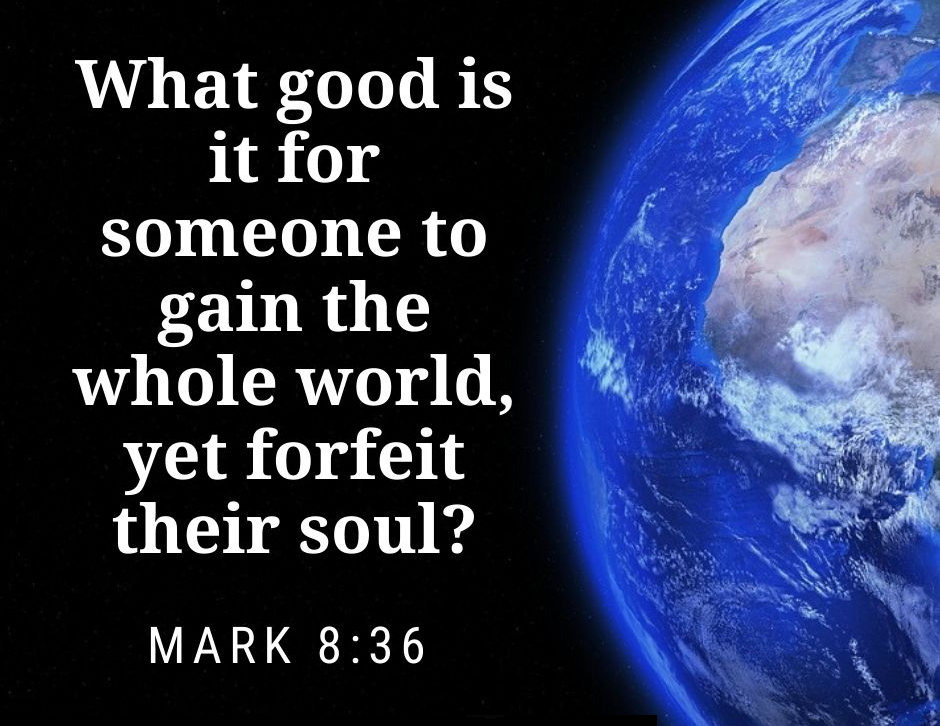
What do we GAIN if we GAIN the whole world?

Matthew 16:26 says, “For what is a man profited, if he shall gain the whole world, and lose his own soul? or what shall a man give in exchange for his soul?”

The world often tells us that success is measured by our wealth, our status, our accomplishments. But Jesus flips this notion on its head. He asks us to consider the value of our soul. What good is it if we gain everything the world offers, but lose the most precious thing we have—our eternal soul?

We Give up our Soul

Our soul is so valuable that God gave His own Son that we have the opportunity to be saved. Jesus died on the cross not to make us rich or famous, but to save our souls. He paid the ultimate price so that we might have eternal life. This is the greatest treasure, far surpassing anything the world can offer. (Rom 5:8-10)

We gain the affection of the World

When we set our affections on worldly gains over our spiritual well-being, we risk losing our soul. We can become so consumed by the pursuit of success, wealth, and approval that we neglect what is pleasing to God. We might find temporary happiness, but it’s fleeting and shallow compared to the deep, abiding joy that comes from knowing Christ. Romans 12:2 tells us, “And be not conformed to this world: but be ye transformed by the renewing of your mind, that ye may prove what is that good, and acceptable, and perfect, will of God.” We are to live differently, to set our minds on things above, not on earthly things.

The Illusion of Worldly Gain

The world tells us to chase after material wealth, to seek power and fame. It tells us that the more we have, the happier we will be. But how often have we seen people who seem to have it all, yet are deeply unhappy, unfulfilled, and lost? They’ve gained the world but lost their soul’s true purpose and joy.

Jesus reminds us that our souls are eternal, while the things of this world are temporary. In 1 Timothy 6:7, we are reminded, “For we brought nothing into this world, and it is certain we can carry nothing out.” No amount of money, fame, or power can accompany us beyond this life. What truly matters is the condition of our soul.

We gain nothing except what we deserve

So, what do we win if we win the world but lose our soul? We gain nothing of true value. But when we seek first the kingdom of God and His righteousness, all these things will be added unto us (Matthew 6:33). When we focus on serving God, we find true peace, joy, and fulfillment.

Revelation 3:21 promises, “To him that overcometh will I grant to sit with me in my throne, even as I also overcame, and am set down with my Father in his throne.” This is the ultimate reward—eternity with Jesus, reigning with Him in glory. This is worth far more than anything the world can offer.

This article is part 1 of a series titled, God’s Moral Law. click here for part one.

You’re invited to attend one of our services at the church of Christ on Franklin and Juniper in Borger Texas.

Do MORALS Matter? Not according to the WORLD.

For the time past of our life may suffice us to have wrought the will of the Gentiles, when we walked in lasciviousness, lusts, excess of wine, revellings, banquetings, and abominable idolatries: Wherein they think it strange that ye run not with them to the same excess of riot, speaking evil of you.” (1Peter 4:3,4).

This passage highlights the contrast between the behaviors of Christians and those of the secular world.

It describes a past life indulged in excesses and immoral activities such as lust, drunkenness, revelry, and idolatry.

Upon turning to a Christian way of life, believers abstain from these practices, leading to a stark difference in conduct.

This transformation often confounds non-believers, who find it strange that Christians no longer join in their excessive and riotous behaviors. As a result, Christians might face criticism or slander for their newfound restraint and moral discipline.

In our secular society, there is a growing trend to sideline morality, with the world often asserting that ethical standards are subjective and unimportant. The Bible warns against this destructive philosophy.

The idea that wrong is relative is exemplified by the biblical account of Pharaoh’s defiance in Exodus 5:2: “And Pharaoh said, Who is the LORD, that I should obey his voice to let Israel go? I know not the LORD, neither will I let Israel go.” Pharaoh’s stance reflects a broader modern sentiment that moral obligations are negotiable based on personal belief systems or the lack thereof. This relativism undermines the concept of an absolute moral authority.

The pursuit of personal gain often overrides moral considerations. In Luke 12:13-21, Jesus tells the parable of the rich fool, who hoards wealth without regard for others or his spiritual well-being. This story highlights how the quest for material success can eclipse ethical responsibilities, leading individuals to prioritize self-interest over faithfulness to God.

Doing what is “right in one’s own eyes” epitomizes the relativistic approach to morality. Judges 21:25 states, “In those days there was no king in Israel: every man did that which was right in his own eyes.” This verse illustrates the chaos and moral decay that arise when subjective judgments replace universal ethical standards.

Contemporary society often masks moral deviations under the guise of love. This rationalization can be seen in the acceptance of various forms of relationships, such as living together, polyamory, and other more controversial issues. By framing these practices as expressions of love, societal norms shift, challenging biblical moral frameworks.

The belief that death is the end and therefore morality is inconsequential is a profound reflection of nihilistic thought. If life has no ultimate purpose beyond physical existence, ethical considerations may seem futile. This outlook fosters a disregard for moral behavior, as the finality of death negates the perceived need for a moral compass.

The world’s dismissal of morality poses significant contrast to sound ethical standards. This is why we must be on guard against such flawed reasoning.

Agape,

Spencer

The Problem of SUGAR

Howdy, brothers and sisters! Today, I want to talk to you about a little thing called “SUGAR.” Now, I know what you’re thinking – sugar is sweet and delightful, a treat for the taste buds. But what if I told you that sugar can be a grave and serious danger to our health?

Sugar is Sneaky

Sugar has a sneaky way of creeping into almost everything we eat. Even when we’re not expecting it, there it is, hidden in plain sight. eating and drinking too many added sugars, which can contribute to health problems such as weight gain and obesity, type 2 diabetes, and heart disease.

We must always be on guard, and watchful, to recognize and resist its sneaky influences.

Sugar is Ubiquitous

Sugar is everywhere. It’s in our breakfast cereals, our sauces, and even our bread. We find it all around us in our daily lives – at work, in our homes, and even in our health food! Sugar often sneaks up on us when we’re not looking. It can be found in the most unexpected places, subtly influencing our health and wellbeing. It’s an omnipresent problem that we must be constantly alert.

Sugar is Gradual

The effects of consuming too much sugar aren’t immediate. It’s a gradual process where we might not notice the damage until it’s too late – the extra pounds, the sluggishness, or the health issues. This gradual erosion, small compromises, and seemingly insignificant choices can lead us far from our intended path over time. We must be diligent and committed, recognizing that small steps lead to poor health and tooth decay.

Sugar is Addictive

Sugar can be highly addictive. The more we consume, the more our bodies crave it. It creates a cycle that’s hard to break. This little treat is harmful to our bodies and we love killing ourselves with it. Some studies have suggested that sugar is as addictive as Cocaine. People often enjoy the dopamine release that sugar brings. But due to the addictive nature of sugar, it’s difficult to quit.

Recognizing this addictive nature is the first step in breaking free from its hold.

Sugar is Ruinous

Over time, excessive sugar can ruin our health, leading to diabetes, heart disease, and other serious conditions. It affects our relationships, our personal well-being, and our ability to interact with others, in particular, our children and grandchildren.

The ultimate ruin comes when we let these challenges dominate our lives, but there’s hope through changing habits, eating real food, and regular activity.

The Sweet Deception of Sin.

Friends, you’ve probably guessed by now that SUGAR is a metaphor for sin. Just as sugar sneaks into our diet, sin sneaks into our lives. It’s ubiquitous, gradual, addictive, and ultimately ruinous. But here’s the good news: we have a Savior who offers us freedom from this cycle.

By recognizing and addressing these issues head-on, we can live a life that truly honors God. Let’s be vigilant, stay rooted in scripture, and support one another in our walk of faith.

Sin is Sneaky

Remember what Jesus said in Matthew 26:41: “Watch and pray so that you will not fall into temptation. The spirit is willing, but the flesh is weak.” We must always be on guard, watchful and prayerful, to recognize and resist these sneaky influences.

Sin is Ubiquitous

In 1Peter 5:8, we are warned, “Be alert and of sober mind. Your enemy the devil prowls around like a roaring lion looking for someone to devour.” Just like sugar is found in the most unexpected places, so are the snares that can lead us astray.

Sin is Gradual

James 1:14-15 explains this well: “But each person is tempted when they are dragged away by their own evil desire and enticed. Then, after desire has conceived, it gives birth to sin; and sin, when it is full-grown, gives birth to death.” We must stay diligent and committed, recognizing that small, faithful steps lead to a righteous life, just as small missteps can lead to spiritual decay.

Sin is Addictive

In Hebrews 11:24-26 we see the powerful pull of sin. “By faith Moses, when he was come to years, refused to be called the son of Pharaoh’s daughter; Choosing rather to suffer affliction with the people of God, than to enjoy the pleasures of sin for a season; Esteeming the reproach of Christ greater riches than the treasures in Egypt: for he had respect unto the recompence of the reward.” Recognizing this addictive nature and having a desire to be with Christ is the first step in breaking free from its hold.

Sin is Ruinous

Romans 6:23 warns us, “For the wages of sin is death, but the gift of God is eternal life in Christ Jesus our Lord.” None are immune, all fall short. The ultimate ruin comes when we let these challenges dominate our lives, but there’s hope and redemption through Christ.

If we say that we have no sin, we deceive ourselves, and the truth is not in us. If we confess our sins, he is faithful and just to forgive us our sins, and to cleanse us from all unrighteousness. If we say that we have not sinned, we make him a liar, and his word is not in us. My little children, these things write I unto you, that ye sin not. And if any man sin, we have an advocate with the Father, Jesus Christ the righteous: And he is the propitiation for our sins: and not for ours only, but also for the sins of the whole world. And hereby we do know that we know him, if we keep his commandments.” (1John 1:8-2:3).

Stay sweet in the spirit, but mindful of the pitfalls, dear ones!

Agape,

spencer is an evangelist for the church of Christ on Franklin and Juniper in Borger Texas. If you’re in the Borger area, stop in a see us at one of our regular services.

Messages of Hope: Insights into the Minor Prophets

In the Old Testament, a collection of writings from twelve individuals collectively forms what is known as the “Minor Prophets.”

These books might be brief, but their messages are profoundly significant, providing lessons, that resonate deeply with the human experience.

As stated in Romans 15:4, “For whatsoever things were written aforetime were written for our learning, that we through patience and comfort of the scriptures might have hope.”

The minor prophets might occupy a small section in the Bible, but their teachings echo through centuries, resonating with timeless truths about justice, repentance, and hope. Through a study of these texts, believers today can deepen their understanding of God’s character and His desires for humanity, leading lives that look to Him for how to live.

The minor prophets consistently call for moral integrity. Amos vehemently condemns the exploitation of the poor and the perversion of justice under the Law of Moses, while Micah famously declares, “He has shown you, O mortal, what is good. And what does the LORD require of you? To act justly and to love mercy and to walk humbly with your God” (Micah 6:8). This push towards Moral Integrity and Justice is as relevant today as it was then, reminding us that God requires a morally upright people under the covenant of Christ (2Pet 1:5-11).

The minor prophets powerfully illustrate the immutability of God’s word—His unchanging truth and unwavering promises. Figures like Hosea and Malachi declared God’s steadfast love and justice amidst Israel’s unfaithfulness, underscoring His consistent character and eternal decrees. In the New Testament, this theme resonates in Matthew 24:35, where Jesus affirms, “Heaven and earth will pass away, but my words will never pass away.”

A significant portion of the prophetic messages involves warnings about impending judgments due to the people’s unfaithfulness and idolatry. Prophets like Hosea and Zephaniah offer vivid descriptions of the consequences that await if the nation does not turn back to God. Yet, even within the stark warnings, there is always a call to repentance—a plea for turning away from wrong and returning to God. This pattern underscores a profound truth about God’s character: His justice is tempered with mercy, and His corrections are aimed at restoration, not destruction. “The Lord is not slack concerning his promise, as some men count slackness; but is longsuffering to us-ward, not willing that any should perish, but that all should come to repentance” (2Peter 3:9).

Despite the frequent messages of doom, the minor prophets are also vehicles of incredible hope. They foretell the coming of a Messiah, and the establishment of a kingdom characterized by peace and mercy. For example, Zechariah speaks of a future King who will rule in righteousness and bring peace to the nations (Zechariah 9:9-10). These prophecies provide evidence that Jesus is the Christ, the Son of the Living God, and that the church He built has always been in the plan of God.

The minor prophets, like Micah and Zechariah, emphasize the righteousness and holiness of God, calling for justice and moral purity among His people. They highlight that God detests sin because it is contrary to His holy nature. In the New Testament, this theme is echoed in 1Peter 1:15-16, where believers are exhorted to be holy in all their conduct because God is holy.

Agape,

Spencer

Sinning against the Holy Spirit

Let the word of Christ dwell in you richly in all wisdom” (Colossians 3:16).

The concept of blasphemy against the Holy Spirit has long intrigued and, at times, perplexed believers. In Mark 3:29, Jesus warns about an unforgiveable sin called blasphemy against the Holy Spirit. Some have said that it’s saying a certain phrase. That view doesn’t fit with the rest of the scriptures on this matter.

It makes sense that this blasphemy involves disobeying the written word of God and remaining unrepentant unto death. It is the Holy Spirit that reveals God’s will to man. This is true for the Old and the New Testaments.

For the prophecy came not in old time by the will of man: but holy men of God spake as they were moved by the Holy Ghost

(2Pet 1:21; Acts 1:16; Heb 9:8; 2Tim 3:16-17).

To better understand this ultimate sin, let’s explore the many ways we sin against the Holy Spirit as revealed in the written word.

Ephesians 4:30 implores believers not to grieve the Holy Spirit. Sorrowing the Spirit occurs when we engage in actions contrary to God’s commands. Look at what Isaiah wrote; “But they rebelled, and vexed his holy Spirit: therefore he was turned to be their enemy, and he fought against them” (Isaiah 63:10). This grief is a result of our disobedience and disregard for His word. When we knowingly choose sin over righteousness, we grieve the Spirit.

In 1 Thessalonians 5:19, we are warned not to quench the Spirit. The Holy Spirit is often symbolized as a flame or fire (Acts 2:3-4). To quench the Spirit is to suppress His influence in our lives through the word. When we ignore His revealed word, or neglect the pursuit of spiritual growth, we extinguish the flame of the Spirit that should cause a burning within us. “Did not our heart burn within us, while he talked with us by the way, and while he opened to us the scriptures?” (cf. Luke 24:32).

Acts 5:1-11 recounts the tragic tale of Ananias and Sapphira, who lied to God the Holy Spirit. Deception never draws us closer to God. They chose to lie to be seen as being more generous than they were. We can fake out men, but we’ll never pull the wool over the all-seeing eyes of God.

In Acts 7:51, Stephen accuses the religious leaders of resisting the Holy Spirit. Resistance involves actively opposing the Spirit’s instructions in the revealed word. When we resist the Holy Spirit, we interfere with the saving power of the Gospel (Romans 1:16).

The account of Simon the sorcerer in Acts 8:17-24 illustrates the danger of insulting the Holy Spirit. Simon sought to purchase the power of the Holy Spirit, demonstrating a profound misunderstanding of the Spirit’s purpose. This sin lies in attempting to commercialize the divine. When we seek to use the Word for personal gain, we insult His sovereignty and it seeks to take advantage (cf. 2Pet 2:3).

Mark 3:22-30 warns against turning away from the Holy Spirit in an unrepentant state. Turning away involves a deliberate rejection of the Spirit’s convicting work and a refusal to acknowledge our need for repentance. If this form of rebellion continues until death, it closes the door to God’s mercy and forgiveness. Unrepentance signifies a hardened heart that resists the transformative power of the Gospel leading to eternal death.

 Agape,

Spencer

Here’s a link for additional reading on how we’re led by the Holy Spirit.

This is part 3 of a series “Preaching through Mark.” Click here for the complete series.

God Gave them Up

Wherefore God also gave them up to uncleanness through the lusts of their own hearts, to dishonour their own bodies between themselves” (Rom 1:24).

People often cite the Letter to the Romans for their erroneous view on election and predestination. While these concepts are here, their view that God preselects individuals to be lost or saved before they were born and without any reason is error.

We can answer this erroneous view beginning with chapter one where we are told why God gave them up to their sin. People are not lost because God randomly chose them to be lost. People are lost because of their disobedience to Him (sin), neither does He cause them to sin.

Note verse 26, “For this cause God gave them up.” Paul is telling us WHY God gave them up, and the reason is not because God just didn’t want them to be saved. There are reasons.

For God to give someone up to sin, there must be some standard by which the guilt is determined.

God gave them up to their sins because they gave Him up. Notice what people had done BEFORE God gave them up.

Because that which may be known of God is manifest in them; for God hath shewed it unto them. For the invisible things of him from the creation of the world are clearly seen, being understood by the things that are made, even his eternal power and Godhead; so that they are without excuse: Because that, when they knew God, they glorified him not as God, neither were thankful; but became vain in their imaginations, and their foolish heart was darkened. Professing themselves to be wise, they became fools, And changed the glory of the uncorruptible God into an image made like to corruptible man, and to birds, and fourfooted beasts, and creeping things. Wherefore God also gave them up to uncleanness through the lusts of their own hearts, to dishonour their own bodies between themselves” (Rom 1:19-24 emphasis mine seb).

God had revealed to mankind His existence through His creation. Instead of glorifying Him, they were ungrateful, turned to their own wisdom, and then to idolatry. They took a piece of creation and worshiped it.

Jeremiah described their foolishness this way; “For the customs of the people are vain: for one cutteth a tree out of the forest, the work of the hands of the workman, with the axe. They deck it with silver and with gold; they fasten it with nails and with hammers, that it move not. They are upright as the palm tree, but speak not: they must needs be borne, because they cannot go. Be not afraid of them; for they cannot do evil, neither also is it in them to do good” (Jer 10:3-5). Jeremiah then warns them, “Every man is brutish in his knowledge: every founder is confounded by the graven image: for his molten image is falsehood, and there is no breath in them. They are vanity, and the work of errors: in the time of their visitation they shall perish” (10:14-15; cf, Isa 44:9-20).

Think about it. Created humans rejected their creator, then created a wooden image to worship, and did not give the God of Heaven thanks nor glory for His great might. Do we see anything different happening today? The only difference is the object of worship.

For many walk, of whom I have told you often, and now tell you even weeping, that they are the enemies of the cross of Christ: Whose end is destruction, whose God is their belly, and whose glory is in their shame, who mind earthly things” (Phil 3:18-19).

Agape,

Spencer

This article is part 1 of a series titled, God’s Moral Law. click here for part two.

You’re invited to attend one of our services at the church of Christ on Franklin and Juniper in Borger Texas.

How to READ the bible pt2

So then faith cometh by hearing, and hearing by the word of God.”  (Rom 10:17)

The New Testament has 260 chapters, 7959 verses, and 181,253 words. For the whole Bible the total is 1189 chapters, 31,173 verses, and 773,746 words.

The size of the Bible intimidates some and is one reason people don’t read it. Others have said they have trouble understanding it. This is talking about application to their lives and not the ability to know the words, because the Bible is written on a high school level.

Two of the excuses given as to why we’re not reading it is size (difficulty) and application. The third, boredom, is related to the first two.

The Bible is written for all; from the PHD to the GED. We can read and we can understand it. “Whereby, when ye read, ye may understand my knowledge in the mystery of Christ)” (Eph 3:4).  

Last week’s tip was for us to RIGHTLY divide the Bible (2Tim 2:15). This meant we need to correctly handle it, and know its parts. This first tip helps to solve the problem of the size and relevance. Today we look at another tip.

Tip #2 of the 4 Tips on how to READ the Bible. We need to make careful EXAMINATION of the bible. There are 4 things we need to EXAMINE as we look into this great book; The Language (defining words as they were originally used), Ourselves whether we’re doers of the word, what Others are teaching, and to Know the love of the Lord Jesus Christ.

First, we need to EXAMINE the text to Learn what is the will of the Lord. “Wherefore be ye not unwise, but understanding what the will of the Lord is” (Eph 5:17). The bible informs us about sin, and educates us about how to avoid the penalty of sin through Christ. “For the wages of sin is death; but the gift of God is eternal life through Jesus Christ our Lord” (Rom 6:23).

The Old Testament is for our Learning, “For whatsoever things were written aforetime were written for our learning, that we through patience and comfort of the scriptures might have hope” (Rom 15:4). In The New Testament we Learn the will of the Lord for all mankind today. “Now to him that is of power to stablish you according to my gospel, and the preaching of Jesus Christ, according to the revelation of the mystery, which was kept secret since the world began, But now is made manifest, and by the scriptures of the prophets, according to the commandment of the everlasting God, made known to all nations for the obedience of faith” (Rom 16:25-26).

The bible is written for understanding, and contains the commandments of the Lord. “If any man think himself to be a prophet, or spiritual, let him acknowledge that the things that I write unto you are the commandments of the Lord” (1Corinthians 14:37). Therefore, after we know what the text says, the next step is to…

EXAMINE OURSELVES to see if we’re doing what the Lord commands. “And why call ye me, Lord, Lord, and do not the things which I say” (Luke 6:46)?

Paul, an Apostle of Jesus Christ wrote, “Examine yourselves, whether ye be in the faith; prove your own selves” (2Cor 13:5a). The bible is to be read so we can learn how to live in a way that is pleasing to God and to be with Him in heaven. When we recognize that God has revealed to us the solution to death, then we instantly realize its relevance.

The theme of the whole bible is about Jesus the Christ. “Search the scriptures; for in them ye think ye have eternal life: and they are they which testify of me. For had ye believed Moses, ye would have believed me: for he wrote of me. But if ye believe not his writings, how shall ye believe my words?” (John 5:39, 46-47). From Genesis to Revelation is about salvation in Christ Jesus. Therefore, we read to learn how to be saved from our sins. “And with many other words did he testify and exhort, saying, Save yourselves from this untoward generation. Then they that gladly received his word were baptized: and the same day there were added unto them about three thousand souls” (Acts 2:40-41).

Therefore, we read to examine ourselves to know how to be saved. Since we can examine our own selves when we read, it also means that we can examine OTHER’S TEACHING to know if it’s true. When Paul preached to those in Berea, they examined the bible to see if what was being taught was accurate. “These were more noble than those in Thessalonica, in that they received the word with all readiness of mind, and searched the scriptures daily, whether those things were so” (Acts 17:11).

There are some denominations that say the average person cannot read the bible themselves and understand it. They claim that only their special clergy can tell you what it means. The Bible says the exact opposite. In addition to what Paul wrote in Ephesians 3, John wrote, “And many other signs truly did Jesus in the presence of his disciples, which are not written in this book: But these are written, that ye might believe that Jesus is the Christ, the Son of God; and that believing ye might have life through his name” (John 20:30-31). Not only can we know what the text means, we can know if we’re in compliance, and we can know if what OTHERS are saying is true.

Lastly, we examine the bible to KNOW the depth of Christ’s love for us. “But grow in grace, and in the knowledge of our Lord and Saviour Jesus Christ. To him be glory both now and for ever. Amen” (2Peter 3:18). Paul’s prayer for the saints in Ephesus, and for us, “For this cause I bow my knees unto the Father of our Lord Jesus Christ, Of whom the whole family in heaven and earth is named, That he would grant you, according to the riches of his glory, to be strengthened with might by his Spirit in the inner man; That Christ may dwell in your hearts by faith; that ye, being rooted and grounded in love, May be able to comprehend with all saints what is the breadth, and length, and depth, and height; And to know the love of Christ, which passeth knowledge, that ye might be filled with all the fulness of God” (Eph 3:14-19).

In conclusion, we read to EXAMINE the Learn the will of the Lord.

We read to EXAMINE Ourselves.

We read to EXAMINE what Others are teaching, and

we read to EXAMINE so we may Know the breadth, and length, and depth, and height of God’s Love in Christ.  

Agape,

Spencer

The Franklin & Juniper st church of Christ in Borger is very much involved in Bible reading and study. You’re invited to attend one of our services to hear the Gospel preached in plainness of speech easy to understand.

You can read part one here.
GRACE is the means to ESCAPE

GRACE gives us the means to escape from the penalty of our sin.

Eph 1:7-9 In whom we have redemption through his blood, the forgiveness of sins, according to the riches of his grace; 8 Wherein he hath abounded toward us in all wisdom and prudence; 9 Having made known unto us the mystery of his will, according to his good pleasure which he hath purposed in himself:


Eph 1:13 In whom ye also trusted, after that ye heard the word of truth, the gospel of your salvation: in whom also after that ye believed, ye were sealed with that holy Spirit of promise,

Without acting on the GRACE that has been given, we shall not escape.

Heb 2:3 How shall we escape, if we neglect so great salvation; which at the first began to be spoken by the Lord, and was confirmed unto us by them that heard him;

Ro 2:4 Or despisest thou the riches of his goodness and forbearance and longsuffering; not knowing that the goodness of God leadeth thee to repentance?

GRACE, FAITH, WORKS is the first part in this five part series.

The Franklin & Juniper st church of Christ invites you to visit during one of their services.

SERMON: 3 things SIN will always do.

3 things SIN will always do.

Sin SEPARATES us from God. Is 59:1-2.

Sin Takes us farther than we wanted to go.

JUDAS went from disciple, to thief, to the betrayer.

Jesus knew Judas was a betrayer. John 6:70
Jesus knew Judas was an Underhanded thief. John 12:6
Judas Delivered Jesus to Die. John 18:2-3
Judas betrayed Jesus with A Kiss. Luke 22:47
Judas was already Satan’s minister. John 13:27;

Then when lust hath conceived, it bringeth forth sin: and sin, when it is finished, bringeth forth death” [Jas 1:15].

2Tim 3:13 Wax worse & worse.

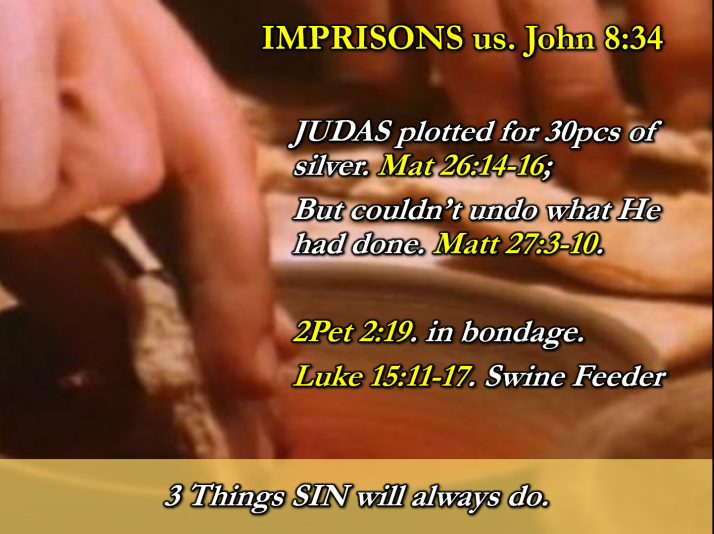
It IMPRISONS us. John 8:34

It Keeps us longer than we INTENDED to stay.

JUDAS plotted for 30pcs of silver. Mat 26:14-16; But couldn’t undo what He had done. Matt 27:3-10.

2Pet 2:19. in bondage. Rom 6:16.

Luke 15:11-17. Swine Feeder

we have NOTHING to repay. Rom 6:23

Sin will cost us more than we wanted to pay.

JUDAS Hangs himself. Giving back the money didn’t fix his sin. He sought his own solution, not God’s. Mt 27:5; Ac 1:18.

For what profit is it to a man if he gains the whole world, and loses his own soul?” Matt 16:26.

For the wages of sin is death; but the gift of God is eternal life through Jesus Christ our Lord.” Romans 6:23

Luke 7:42, Nothing to repay

This sermon was preached Sunday morning at the Franklin and Juniper st church of Christ on July 16, 2023 by spencer blackwelder

Click here to read an article about why we’re different.

Lessons from 1Peter 5; SATAN

unscriptural portrait of Satan; this what people who don’t read the bible think he looks like cf. 2Cor 11:14

1Peter 5:8 Be sober, be vigilant; because your adversary the devil, as a roaring lion, walketh about, seeking whom he may devour:
9 Whom resist stedfast in the faith, knowing that the same afflictions are accomplished in your brethren that are in the world.

Some truths about SATAN.

SUBJECT TO GOD. Mark 5; Job 1

ANGEL OF LIGHT. 2Cor 11:14

TAKES AWAY THE WORD. Mark 4:15; 2Thess 2:11-12; Eph 2:2

ACCUSER. Rev 9:11; Abaddon. Adversary, 1Pet 5:8

NEVER QUITS. 2Cor 11:14; 1Pet 5:8