Gratitude: God expects it

Gratitude; God expects it.

November’s cozy gatherings and pumpkin-spiced moments spark a flicker of gratitude in many of us. Yet, as Black Friday ads flood our screens and holiday shopping takes over, thankfulness often gets trampled under a scramble for deals. God’s Word, however, doesn’t limit gratitude to a single day like Thanksgiving. Scripture reveals that God expects His people to live with thankful hearts every day.

Gratitude refocuses our hearts toward His goodness. In 1 Thessalonians 5:18, Paul writes, “Give thanks in all circumstances; for this is God’s will for you in Christ Jesus.” This is no suggestion; it’s God’s clear expectation.

A compelling example of His displeasure with ingratitude comes from Numbers 11:1-6, where the Israelites grumbled about their wilderness provisions, longing for Egypt’s food instead of praising God for their miraculous deliverance. Their complaints provoked God’s anger, and fire broke out in their camp as a consequence. This stark moment shows that ingratitude dismisses God’s provision, and brings on God’s anger.

Today, when we fixate on what we lack (especially amid our seasonal materialistic rush) we risk echoing the Israelites’ error. Ingratitude is among the conditions that invoke God’s anger, (Romans 1:21). Gratitude, as psychologist Robert Emmons notes in his studies, shifts our focus from scarcity to abundance, helping us see God’s hand in every detail, from daily bread to His unending grace. We don’t need science to tell us what scripture already reveals (Matt 6:25-34).

Gratitude in our worship will deepen our connection to God. Psalm 100:4 says, “enter His gates with thanksgiving and His courts with praise.” God expects gratitude because it acknowledges His sovereignty and faithfulness. When we thank Him daily, whether for an answered prayer or strength in trials, we are acknowledging His blessings in our lives (James 1:17). This counters the fleeting gratitude of social media posts that fade as holiday sales dominate. By making thankfulness a habit, we fulfill God’s desire for a people who recognize His goodness, drawing closer to Him in a world that often pulls us away.

Finally, a grateful heart is essential to being the light of the world that we are showing others, meeting His expectation for us to live as His light. Colossians 3:15-17 urges us to “let the peace of Christ rule in your hearts” and act “with gratitude.” Thankfulness fuels the brightness of our light and allows us to pierce the shadows of darkness, drawing others to Christ. When we’re grateful, we’re less likely to look like the word (in judgment or envy), and more likely to be a blessing to others. Gratitude strengthens our connection to those around us. In a season tempting us to value “things” over people, gratitude keeps us grounded in what matters.

God expects our gratitude every day, not just on Thanksgiving Day. Start now; thank Him for one thing each morning, big or small. Let’s glorify Him, avoiding the Israelites’ mistake, and let a thankful heart shine His love daily.

agape

spencer

Evidence for our Faith: Gratitude

Gratitude and Happiness: Science Catches Up to the Bible

Picture waking up with a heart brimming with thanks, even when life feels like a storm. It’s like a quiet spark of joy, isn’t it? The Bible has long championed gratitude as a way of life, and now science is unveiling its power, showing how this practice transforms our minds, relationships, and faith. Gratitude isn’t just a passing feeling; it’s a powerful attitude that fits God’s design, blending biblical wisdom with modern discoveries in a way that is both timeless and exciting.

Gratitude reshapes our mental health, anchoring us in hope. Research by psychologist Robert Emmons, a leading gratitude scholar, shows that keeping a daily journal of things you’re thankful for can reduce stress and boost well-being. In a 2003 study from the Journal of Personality and Social Psychology, Emmons found that participants who reflected on gratitude reported less depression and greater optimism after just weeks. This resonates with Psalm 40:5 which proclaims, “Many, O Lord my God, are thy wonderful works which thou hast done, and thy thoughts which are to us-ward: they cannot be reckoned up in order unto thee: if I would declare and speak of them, they are more than can be numbered.” The psalmist knew that gratitude expands our perspective on life, filling our hearts with God’s countless blessings. Science confirms this, revealing how gratitude rewires our brains to seek the good, even in tough times.

Gratitude can strengthen relationships, bringing us closer in ways that reflect God’s love. A 2014 study in Emotion by Sara Algoe showed that expressing thanks fosters trust and deepens connections. When we voice gratitude, it sparks a cycle of kindness, making both giver and receiver feel valued. This echoes 1Thessalonians 5:18 in the KJV, where Paul exhorts, “In every thing give thanks: for this is the will of God in Christ Jesus concerning you.” By thanking others, we build connections with others rooted in love. A heartfelt “thank you” can transform a moment into a lasting bond, mirroring the relational heart of the Gospel (see Luke 17:11-19).

Finally, gratitude fuels spiritual growth, drawing us nearer to God. When we practice thankfulness, we train our hearts to remember that He is with us in every moment, deepening our trust. Philippians 4:6 in the KJV urges, “Be careful for nothing; but in every thing by prayer and supplication with thanksgiving let your requests be made known unto God.” This isn’t mere advice; it’s a roadmap for a joy-filled life. Gratitude shifts our focus from what’s missing to trusting in God’s promises. Science supports this: studies show gratitude fosters a sense of purpose and connection to something greater, aligning with the biblical summons to live in awe of God’s goodness.

In a chaotic world, gratitude is a quiet revolution. The Bible, written centuries ago, aligns beautifully with what science now reveals. Researchers like Emmons and Algoe highlight gratitude’s benefits, while scriptures like Psalm 40:5, 1Thessalonians 5:18, and Philippians 4:6 proclaim its already revealed eternal truth. God’s word beckons us to embrace gratitude daily, not as a task, but as a strategy that changes our minds, relationships, and faith. So, let’s begin today: pause, give thanks, and see how God’s wisdom, that science finally realizes, illuminates your life.

agape Sources: Studies by Robert Emmons (Journal of Personality and Social Psychology, 2003) and Sara Algoe (Emotion, 2014). Biblical references from Psalm 40:5, 1 Thessalonians 5:18, and Philippians 4:6 (KJV).

Evidence for our Faith: I ain’t ‘fraid of no demons

Comfort in Christ: The Biblical Truth About Demons: Bound, Limited, and Not Possessing Us Today.

When people think of demons, their minds often race to Hollywood horror flicks (red-eyed creatures, spinning heads, and sinister voices). But the Bible paints a far less theatrical picture. What do the Scriptures actually say about the origin and limitations of demons? The comforting truth is this: demons, as fallen angels, are bound by God’s authority and no longer possess people today. The scary stuff? That’s the theatrical imaginations of entertainers or false teachers creating pictures running wild in our minds.

The Bible reveals that demons are angels who rebelled against God and fell from their heavenly roles. Revelation 12:7-9 describes a war in heaven where Satan, the dragon, and “his angels” fought against Michael and were “cast out into the earth.” Jude 1:6 speaks of angels who “kept not their first estate” and are now “reserved in everlasting chains under darkness unto the judgment of the great day.” Similarly, 2Peter 2:4 says God “cast them down to hell, and delivered them into chains of darkness, to be reserved unto judgment.” These verses point to demons as fallen angels, once glorious but now defeated and restricted, under God’s sovereign control (see Zech 13:2).

What about their power? The Bible shows demons as limited beings, not the all-powerful terrors of pop culture (Job 1:12, 2:6). In the Gospels, demons cause harm (like the Gerasene man’s possession in Mark 5:1-20) but Jesus casts them out with a word, proving His absolute authority (Matthew 8:16). Demons tremble before God (James 2:19), and their activity in the New Testament is tied to a specific time: Jesus’ earthly ministry (to prove Christ’s identity), when spiritual warfare peaked as He confronted Satan head-on (Luke 10:18). After His resurrection, Jesus declared, “All authority in heaven and on earth has been given to me” (Matthew 28:18). This victory binds Satan and his forces, keeping them from possessing people any longer (Colossians 2:15).

Here’s the comforting part: there’s no biblical evidence that demons possess people today as they did in Jesus’ time. The New Testament epistles, written to guide the early church, focus on resisting temptation and standing firm in faith (Ephesians 6:12; James 4:7), not casting out demons. When Paul did have to cast out demons they fulfilled the same purpose, to identify him as an approved messenger of Christ. “These men are the servants of the most high God, which shew unto us the way of salvation” (Acts 16:17; e.g., 19:15). The idea of possession today often stems from theatrical imaginations like movies, books, and spooky campfire stories that amplify fear. While Ephesians 6:12 mentions “spiritual wickedness,” it’s about their influence in the world, not body-snatching. Believers are sealed by the Holy Spirit (Ephesians 1:13), and 1 John 4:4 assures us, “because greater is he that is in you, than he that is in the world.” Demons can’t override God’s boundaries.

Our fascination with demons often comes from cultural exaggerations, not Scripture. The Bible doesn’t describe them with pitchforks or glowing eyes; that’s medieval art and modern cinema talking. Demons are real but restrained, awaiting final judgment (Matthew 25:41). There’s no need to fear demon possession; we need to trust in Christ’s triumph.

So, let’s set aside the horror movie hype. Demons are fallen angels, bound by God, and they’re no longer free to terrorize us (Satan’s teaching is still with us). Fear not; the victory’s already won!

Agape

Related Articles:

Is Demon Possession Possible today?

Is Demon Possession Possible today, pt 2?

Evidence for our Faith: The Bible’s Answers to Life’s Deepest Questions

Generations of people have wrestled with tough questions: Why are we here? Why is there pain in the world? Is there anything after we die? The Bible, trusted by billions, gives clear and meaningful answers to these deep questions. It’s like a guidebook from God, offering wisdom that makes sense and stands the test of time. It is a book for how to understand and navigate through this world, but also guides us to know how to have eternal life beyond this one. It is the word of God.

“And that from a child thou hast known the holy scriptures, which are able to make thee wise unto salvation through faith which is in Christ Jesus. All scripture is given by inspiration of God, and is profitable for doctrine, for reproof, for correction, for instruction in righteousness: That the man of God may be perfect, throughly furnished unto all good works” (2 Timothy 3:15-17).

The Bible declares our purpose. Ecclesiastes 12:13 puts it plainly: “Fear God, and keep his commandments: for this is the whole duty of man.” This means living in a way that puts God first in our lives, rather than chasing our own lusts, desires, and goals. The Bible teaches we were created by God and are made to glorify Him (Genesis 1:26-8; Isaiah 43:7). This provides a clear purpose, a timeless sense of value, and reassurance that we are more than mere animals.

Suffering is real, and the Bible addresses it head on. The story of Job shows a man who faced terrible pain but found God was still with him. Romans 8:28 promises that “God works all things for good for those who love Him.” Pain might come from human mistakes (Genesis 3:16–19) or just life’s challenges, but the Bible never calls it useless. It can shape us, and make us stronger (James 1:2–4). It can also help us to grow closer to God as we recognize our need for His strength (2 Corinthians 12:9-10). Many are hopeless in suffering, but the Bible offers hope that good can come out of suffering for those that love the Lord. The Bible also assures us that suffering is not God messing with us.

The Bible gives a straight answer about life after death. The Bible says, “God loved the world so much that He gave His only Son, so that everyone who believes in Him and follows Him will not be lost but have eternal life” (John 3:16), and “He that believeth and is baptized shall be saved” (Mark 16:16a). The Bible gives us instructions on how to have eternal life with God (e.g. Acts 2:38, Romans 6:17–18). The Bible’s promise of eternal life is backed by Jesus’ resurrection (1 Corinthians 15:20–22), a real event that gives us solid hope for eternity. We can know where we are going and how to get there.

Some people say the Bible’s answers are too rigid for today’s times of enlightenment. Thinkers through the ages have seen how the Bible’s teachings make sense of life’s big questions and remains timeless. It does more than just comfort us, it shows us how to live with purpose, face challenges with hope, and prepare for eternity through obedience to God’s Word. Every generation needs the Bible to discover true enlightenment in God’s timeless wisdom.

The Bible gives more than just answers; it shows us the true God who walks with us through life’s ups and downs. By believing in Jesus and obeying the gospel, we find purpose, hope, and the promise of eternal life. In a confusing world, the Bible is a steady guide for life’s biggest questions.

Agape

Sources:
The Holy Bible (KJV): Ecclesiastes 12:13, Isaiah 43:7, Romans 8:28, John 3:16, etc.

Jesus is the one to follow when we’re HURTING

Hope and Healing in Christ for the Hurting

Life is full of hardship. Suffering, loss, and disappointment are part of the human experience. Some struggle with grief, others with betrayal, loneliness, or physical pain. No one is immune to the trials of life. Yet, in the midst of sorrow, there is One who offers healing, hope, and peace—Jesus Christ.

Jesus understands suffering because He experienced it firsthand. Isaiah 53:3 describes Him as “a man of sorrows, and acquainted with grief.” He knew what it was like to be rejected, betrayed, and physically tormented. He endured humiliation and pain on the cross, bearing the weight of humanity’s sin. Because of this, He is uniquely qualified to comfort those who are hurting. Hebrews 4:15 assures us that we have a Savior who can sympathize with our weaknesses, for He was “tempted like as we are, yet without sin.”

Hope in Christ for the Hurt of This Life

Pain can make life feel unbearable. The world offers temporary distractions, but they cannot bring lasting peace. Only Christ provides true hope. John 16:33 reminds us of this reality: “In the world ye shall have tribulation: but be of good cheer; I have overcome the world.” The suffering of this present life is temporary, but the joy found in Christ is eternal. Paul declares in Romans 8:18, “For I reckon that the sufferings of this present time are not worthy to be compared with the glory which shall be revealed in us.” When we trust in Christ, we gain a perspective that allows us to endure, knowing that something far greater awaits.

Understanding from Christ, Who Endured Suffering

One of the most comforting truths about Jesus is that He understands human suffering. He was betrayed by a close friend (Luke 22:48; Psalm 41:9), falsely accused (Matthew 26:59-60), mocked (Matthew 27:29-31), and crucified (Luke 23:33). He knows what it feels like to be abandoned, rejected, and mistreated. This means that when we pour out our hearts to Him, we are speaking to One who truly understands. Psalm 34:18 assures us, “The Lord is nigh unto them that are of a broken heart.”

Rest and Peace in His Forgiveness and Mercy

Many suffer not only from external circumstances but also from the weight of guilt and shame. Sin leaves scars, and the burden of past mistakes can feel overwhelming. Yet, Jesus offers complete forgiveness. Matthew 11:28 invites us, “Come unto me, all ye that labour and are heavy laden, and I will give you rest.” Through His sacrifice, we are freed from sin’s condemnation. Psalm 103:12 declares, “As far as the east is from the west, so far hath he removed our transgressions from us.” In Christ, we find peace, knowing that our past does not define us.

Truth, Life, and True Joy

Many search for meaning in temporary pleasures, but Jesus alone is the source of true life. He declares in John 14:6, “I am the way, the truth, and the life.” The joy He gives is not dependent on circumstances but is rooted in a relationship with Him. John 15:11 states, “These things have I spoken unto you, that my joy might remain in you, and that your joy might be full.”

Jesus, Our Intercessor

For those who feel distant from God, Jesus bridges the gap. 1 Timothy 2:5 tells us, “For there is one God, and one mediator between God and men, the man Christ Jesus.” He intercedes for us before the Father, offering continual access to God’s grace and help.

He Never Leaves nor Forsakes Us

Loneliness is one of the deepest forms of suffering. Yet, Jesus promises, “I will never leave thee, nor forsake thee” (Hebrews 13:5). Even when we feel abandoned, He is always near.

Good Can Come Despite the Pain

While suffering is hard, God can bring blessings out of trials. Romans 8:28 reassures us, “And we know that all things work together for good to them that love God.” Even when we don’t understand, we can trust that He can bring about good despite the pain and suffering in this life.

Conclusion

No matter what pain or sorrow you carry, Jesus offers hope and healing. Turn to Him, and you will find peace, understanding, and the strength to endure. “Casting all your care upon him; for he careth for you.” (1 Peter 5:7)

Agape

Spencer

There is a way you may know if you have eternal life.

THANKSGIVING JOY

Gratitude isn’t just a seasonal practice—it’s a lifestyle. The Bible teaches us that thanksgiving can shift our perspective and strengthens our faith.

Thanksgiving in Trouble: Jehoshaphat’s Singers
Imagine being in King Jehoshaphat’s position: three armies are marching toward you, and the situation looks hopeless. Instead of panicking, Jehoshaphat sought the Lord, and the strategy God gave him was extraordinary—send singers ahead of the army to praise Him! The singers declared, “Praise the LORD, for His mercy endureth forever” (2 Chronicles 20:21).

When the singers began to praise, God set ambushes against their enemies, causing them to destroy one another. Victory was won, not with weapons, but with thanksgiving and faith.
When we face challenges today, we are called to respond in a similar way. Paul reminds us in Philippians 4:6-7, “Be careful for nothing; but in every thing by prayer and supplication with thanksgiving let your requests be made known unto God. And the peace of God, which passeth all understanding, shall keep your hearts and minds through Christ Jesus.”

Thanksgiving in Loneliness: The Psalmist’s Cry
Loneliness is a reality many of us face, and the psalmist captures this struggle in Psalm 42: “Why art thou cast down, O my soul? And why art thou disquieted in me? Hope thou in God: for I shall yet praise Him for the help of His countenance” (Psalm 42:5).

The psalmist’s honesty about his emotions is relatable, but his decision to praise God despite his feelings is inspiring. Thanksgiving shifts our focus from our emptiness to God’s fullness..

Jesus Himself assures us of His abiding presence in Matthew 28:20: “And, lo, I am with you alway, even unto the end of the world.” Gratitude for God’s unchanging presence can anchor our hearts when we feel alone. Instead of dwelling on what’s missing, we can thank Him for His faithfulness where we’ll find comfort and strength to keep going.

Thanksgiving for Christ’s Goodness: The One Thankful Leper
In Luke 17, ten lepers cried out to Jesus for mercy, and He healed them all. However, only one returned to give thanks. He fell at Jesus’ feet and praised Him, and Jesus said, “Thy faith hath made thee whole” (Luke 17:16-19).

This Samaritan’s gratitude set him apart. While the other nine received physical healing, he recognized and remembered the one from whom all blessings flow. Thanksgiving acknowledges that everything good in our lives comes from above.

This reminder in Colossians helps, “And let the peace of God rule in your hearts, to the which also ye are called in one body; and be ye thankful… And whatsoever ye do in word or deed, do all in the name of the Lord Jesus, giving thanks to God and the Father by Him.” (Col 3:15-17). Thanksgiving is a daily recognition of Christ’s goodness, shaping our actions and attitudes through His word.

A Challenge for Thanksgiving
This week, take time to reflect on your own heart of thanksgiving. Are you thanking God in the midst of your troubles, trusting Him to bring victory? Are you finding reasons to praise Him, even in seasons of loneliness? And are you remembering to give thanks for all the blessings you’ve received through Christ?

As we cultivate a grateful heart, we’ll find that thanksgiving doesn’t just change our circumstances—it changes us. Let our thanksgiving be a reflection of our faith, a reminder of God’s presence, and a response to His abundant goodness.

In every thing give thanks: for this is the will of God in Christ Jesus concerning you” (1 Thessalonians 5:18).

What’s LOVE got to do with it?

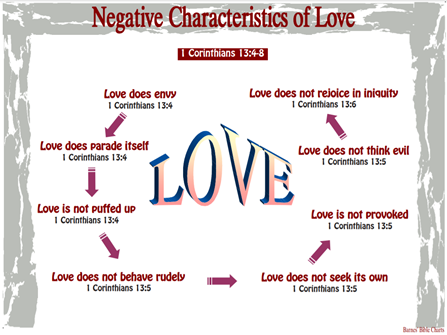
Love does not…

EVERYTHING!!

Love is the first & great commandment.

Paul calls love, “a more excellent way” [1Cor 12:31; 13:13].

“And Jesus answered him, The first of all the commandments is, Hear, O Israel; The Lord our God is one Lord: And thou shalt love the Lord thy God with all thy heart, and with all thy soul, and with all thy mind, and with all thy strength: this is the first commandment. And the second is like, namely this, Thou shalt love thy neighbour as thyself. There is none other commandment greater than these.” [Mark 12:29-31]

09-14-23 UPDATE ————————————-

In a world that has reduced love to just a feeling we need to understand Biblical love.

the culture of the day reminds me of the culture found in the book of judges; “In those days there was no king in Israel: every man did that which was right in his own eyes.” (Judges 21:25

Let’s be reminded of biblical love.

——————————————————————————–

The best commentary on Love is found in the Scriptures. Let’s see love from four perspectives.

  1. God’s Love for us
    1. God is Love – 1Jo 4:8 He that loveth not knoweth not God; for God is love. Titus 3:4-6
    2. God Gave His son – 1Jo 4:9, 10 In this was manifested the love of God toward us, because that God sent his only begotten Son into the world, John 3:16, 17; Rom 5:8; Eph 2:4,5
    3. God blesses His children – 1Jo 3:1 Behold, what manner of love the Father hath bestowed upon us, that we should be called the sons of God: Eph 1:3 every spiritual blessings
    4. Every good thing – James 1:17 – comes from above; Acts 17:28
    5. God sends sun & rain – Mt 5:45 for he maketh his sun to rise on the evil and on the good, and sendeth rain on the just and on the unjust.
  • Christ’s Love for us
    • Passes knowledge– Eph 3:19 And to know the love of Christ, which passeth knowledge, that ye might be filled with all the fulness of God.
    • As Father loved Him – Joh 15:9, 10 If ye keep my commandments, ye shall abide in my love; even as I have kept my Father’s commandments, and abide in his love.
    • He gave Himself – Joh 15:13 Greater love hath no man than this, that a man lay down his life for his friends.; Eph 5:2; 1Joh 3:16; Rev 1:5
    • His own– Joh 13:1, 34 A new commandment I give unto you, That ye love one another; as I have loved you, that ye also love one another.
    • Those who obey – Joh 14:21 He that hath my commandments, and keepeth them, he it is that loveth me: and he that loveth me shall be loved of my Father, and I will love him, and will manifest myself to him.
  • Man’s love for God & Christ
    • Great command– 1Jo 4:19 We love him, because he first loved us. Mark 12:28-30; Mt 22:36-40
    • Good thing for those that do – Ro 8:28 And we know that all things work together for good to them that love God, 1Corinthians 2:9 ings which God hath prepared for them that love him.
    • Crown of life / Kingdom – Jas 2:5 Hearken, my beloved brethren, Hath not God chosen the poor of this world rich in faith, and heirs of the kingdom which he hath promised to them that love him? [1:12]
    • Love displayed through obedience – 1Jo 5:3 For this is the love of God, that we keep his commandments:
      • 2Joh 6; John 14:15, 21, 23
    • Love for truth – 2Th 2:10-12 because they received not the love of the truth, that they might be saved.
  • Man’s love for others
    • Brethren – 1Th 4:9; 1Th 3:12 And the Lord make you to increase and abound in love one toward another, and toward all men, even as we do toward you:
      • John 13:34; 15:12; 1Pe 1:22; 2:17;
      • 1Jo 2:10, 3:11, 14, 23; 4:11, 12
      • 2Pe 1:7 And to godliness brotherly kindness; and to brotherly kindness charity.
    • Husbands & Wives – Eph 5:25, 28, 33; Col 3:19; Tit 2:3,4
    • Neighbor – Ro 13:8 Owe no man any thing, but to love one another: for he that loveth another hath fulfilled the law.
      • [Mr 12:31; James 2:8]
    • Enemies – Lu 6:35 But love ye your enemies, and do good, and lend, hoping for nothing again; and your reward shall be great, and ye shall be the children of the Highest:
      • Mt 5:43, 44 But I say unto you, Love your enemies, bless them that curse you, do good to them that hate you, and pray for them which despitefully use you, and persecute you;

What is the Value of your Soul?

For what shall it profit a man, if he shall gain the whole world, and lose his own soul? Or what shall a man give in exchange for his soul?” (Mark 8:36-37).

The question of the soul’s worth is one that transcends time and culture, touching the very essence of human existence. Jesus Himself addressed this profound query in Mark 8:34-38 and Matthew 16:24-26, challenging us to consider the eternal value of our souls. Let us explore four pivotal aspects that underscore the immeasurable worth of a soul.

As living souls, we have much greater potential than all others of God’s creation. Technology, Arts, and Mercy are unique to humans. More than these, we have the potential to become like Christ. “So also is the resurrection of the dead. It is sown in corruption; it is raised in incorruption: It is sown in dishonour; it is raised in glory: it is sown in weakness; it is raised in power: It is sown a natural body; it is raised a spiritual body. There is a natural body, and there is a spiritual body” (1Cor 15:42-44). When we obey the gospel, we look forward to eternal life with our Savior and to see Him as He is, (cf. Rev 22:4).

In Matthew 10:28, Jesus admonishes, “And fear not them which kill the body, but are not able to kill the soul: but rather fear him which is able to destroy both soul and body in hell.” This declaration underscores the eternal nature of the soul, distinguishing it from our temporal physical bodies. The body may perish, but the soul endures beyond the grave, facing either eternal life or eternal punishment as stated in Matthew 25:46: “And these shall go away into everlasting punishment: but the righteous into life eternal.”

The everlasting nature of the soul is a solemn reminder of its infinite value. Our earthly concerns often distract us from this reality, yet Jesus calls us to prioritize our spiritual well-being. The choices we make in this life have eternal consequences, emphasizing the need for a life aligned with God’s will.

Jesus highlighted the incomparable worth of a soul by pointing to God’s providence over creation. In Matthew 6:26-30, He illustrates His care for the birds and the flowers, reminding us that we are of far greater value: “Are ye not much better than they?” Jesus also said that “the very hairs of your head are all numbered” (Matt 10:30). These passages underscore the unique and cherished place humanity holds in God’s creation.

I am fearfully and wonderfully made” (Psalm 139:14). This divine craftsmanship reflects the soul’s worth, a masterpiece of God’s creative power. Unlike the rest of creation, the human soul bears a unique value.

The soul’s worth is further magnified by its divine origin. Acts 17:29 declares, “Forasmuch then as we are the offspring of God, we ought not to think that the Godhead is like unto gold, or silver, or stone, graven by art and man’s device.” We are not merely physical beings but spiritual offspring of God, created in His image.

Genesis 1:26-27 records God’s decision to create humanity in His likeness, endowing us with attributes that reflect His nature: “And God said, Let us make man in our image, after our likeness.” The Preacher reminds us that at death, “Then shall the dust return to the earth as it was: and the spirit shall return unto God who gave it” (Ecc 12:7). The soul’s divine origin and destiny underscore its unparalleled worth, calling us to live in a manner that honors our Creator.

The ultimate measure of the soul’s worth is found in the sacrifice of Jesus Christ. John 3:16, perhaps the most well-known verse in the Bible, proclaims, “For God so loved the world, that he gave his only begotten Son, that whosoever believeth in him should not perish, but have everlasting life.” This profound act of love underscores the soul’s value, worthy of the highest price (cf. Rom 5:8-10).

2Peter 3:9 emphasizes God’s desire for our salvation, stating, “The Lord is not slack concerning his promise, as some men count slackness; but is longsuffering to us-ward, not willing that any should perish, but that all should come to repentance.” The sacrificial death of Christ on the cross is the ultimate testament to the worth of our souls, offering us redemption and eternal life.

In contemplating the worth of a soul, we must recognize its eternal nature, its unparalleled value in creation, its divine origin, and the supreme sacrifice made for its salvation. As we reflect on these truths, let us heed Jesus’ call in Mark 8:34-38 and Matthew 16:24-26 to deny ourselves, take up our cross, and follow Him. For in doing so, we affirm the immeasurable worth of our souls and align our lives with God’s eternal purpose.

Agape,
Spencer

This article is from a series of sermons on the Gospel of Mark. Click here for the list of available articles on the Gospel of Mark.

Let’s Talk about Jesus the Strength Giver

I can do all things through Christ which strengtheneth me” (Philippians 4:13).

People are talking about Jesus. Let us be ready to talk about Him also, but with purpose and power.

We have seen in the last two articles that Jesus gives JOY, and ETERNAL LIFE, the above verse shows that He also gives us strength.

While this verse doesn’t explicitly tell how He strengthens us, there is scriptural evidence within the New Testament that teach us how and when we can be STRONG in the Lord.

All of us could use a little more strength in this life, but the true strength we need is only in Christ.

In what ways is the Saint made STRONG in the Lord.


Christ makes us SPIRITUALLY STRONG. Eph 3:16 “That he would grant you, according to the riches of his glory, to be strengthened with might by his Spirit in the inner man; That Christ may dwell in your hearts by faith; that ye, being rooted and grounded in love” (Eph 3:16-17). How can we be strong, and how does He dwell in our hearts? If you read the comparable passage in Colossians 3, you’ll see that it’s through scripture. “Let the word of Christ dwell in you richly in all wisdom” (Colossians 3:16a). Paul would continue to reveal to the Ephesians how to be strong; “Finally, my brethren, be strong in the Lord, and in the power of his might, Put on the whole armour of God, that ye may be able to stand against the wiles of the devil. For we wrestle not against flesh and blood, but against principalities, against powers, against the rulers of the darkness of this world, against spiritual wickedness in high places. Wherefore take unto you the whole armour of God, that ye may be able to withstand in the evil day, and having done all, to stand.” (Eph 6:10-12; cf. 13-18).

Jesus gives us strength to TRANSFORM us by the renewing of our mind. I beseech you therefore, brethren, by the mercies of God, that ye present your bodies a living sacrifice, holy, acceptable unto God, which is your reasonable service. And be not conformed to this world: but be ye transformed by the renewing of your mind, that ye may prove what is that good, and acceptable, and perfect, will of God” (Rom 12:1-2). This transformation gives us the strength to change our character as seen in the fruit of the Spirit. “But the fruit of the Spirit is love, joy, peace, longsuffering, gentleness, goodness, faith, Meekness, temperance: against such there is no law” (Gal 5:22-23).

Christ gives us strength to rise up in the face of persecution. “Blessed are they which are persecuted for righteousness’ sake: for theirs is the kingdom of heaven. Blessed are ye, when men shall revile you, and persecute you, and shall say all manner of evil against you falsely, for my sake. Rejoice, and be exceeding glad: for great is your reward in heaven: for so persecuted they the prophets which were before you” (Matt 5:10-12). We can have the Resilience to endure this life knowing that He sees, and that we have a reward in heaven.

This strength gives us Hope and Optimism in the face of death. Paul said, “According to my earnest expectation and my hope, that in nothing I shall be ashamed, but that with all boldness, as always, so now also Christ shall be magnified in my body, whether it be by life, or by death. For to me to live is Christ, and to die is gain” (Philippians 1:20-21). This optimism gives us peace of mind instead of vexation because we know that a better place awaits the faithful in Christ (cf. John 14:27). “Be careful for nothing; but in every thing by prayer and supplication with thanksgiving let your requests be made known unto God. And the peace of God, which passeth all understanding, shall keep your hearts and minds through Christ Jesus” (Philippians 4:6-7). This optimism can be seen in personal contentment with our needs, (Phil 4:11-12).

He gives us the strength to be bold in preaching the gospel of Jesus Christ. The Apostles prayed for this strength of courage when they faced physical violence against their preaching (cf. Acts 4:29). “There is no fear in love; but perfect love casteth out fear: because fear hath torment” (1John 4:18). When we commit to and look to Jesus with our whole heart in love, we shall have the nerve to speak the truth in love to our family, friends, and neighbors.

Ultimately, we have the strength of Christ through His Grace. “And he said unto me, My grace is sufficient for thee: for my strength is made perfect in weakness. Most gladly therefore will I rather glory in my infirmities, that the power of Christ may rest upon me.  Therefore I take pleasure in infirmities, in reproaches, in necessities, in persecutions, in distresses for Christ’s sake: for when I am weak, then am I strong” (2Cor 12:9-10). Paul had an immediate empowerment from a change of perspective of his “thorn in the flesh.” Instead of viewing it as a weakness that hinders, it became a weakness that empowers! The thorn never changed, the pain never lessened, but the Power of Christ was displayed.

Agape,

Spencer

Spencer is an evangelist for the Franklin & Juniper st church of Christ in Borger, Tx.

This is part of a series of articles about reasons to Talk About Jesus.

Let’s Talk about Jesus, the Joy Giver

We have no need of a season to talk about our Lord. Let it be continually on the tip of our tongue. While everyone around us is scurrying to find a reason for the season, we already have reason to rejoice.

Let’s talk about Jesus” will be the theme of the next several articles. It’s not because I desire to put Christ back into Christmas, He never really was part of that holiday. I write about things that are already on people’s minds, and perhaps we can persuade them to look into the True Jesus of the Bible (2Cor 11:4).

Since this is the season of giving and joy, in this first article Let’s talk about Jesus as being the Real Joy Giver. To do that we will look at the JOYS in Jesus from the book of Philippians.

This book is described as the book of Joy. Over and over, we can see the words “Joy” & “rejoice.”  This book is also one of the “prison epistles” of Paul, which makes those words even more astounding.

Let’s talk about the JOYS of Jesus.

JESUS IS PREACHED. While Paul was imprisoned for the cause of Christ (1:13), he found joy because JESUS was being preached. “What then? notwithstanding, every way, whether in pretence, or in truth, Christ is preached; and I therein do rejoice, yea, and will rejoice” (1:18). Some preached Christ out of insincerely, and out of contention, seeking to add to Paul’s bonds. While others preached Jesus out of Love and Good will. Paul rejoiced that Jesus is preached, and that many brethren had grown bolder. They preached boldly the word of Jesus without fear (1:14).

We can rejoice today knowing that Jesus is being preached. Certainly, many preach from error, but I see it as an opportunity to preach boldly the word of Jesus from sincerity and truth. Instead of taking the negative nelly approach, we can ask friendly questions to help folks think accurately about the truth. One was is to ask about the birth story of Christ. Here are a couple of ice-breaker questions to Preach Jesus more accurately (cf. Acts 8:26).

How many wise men are listed in the nativity story (Matt 2:1-12)?

How old was Jesus when the wise men came to Him (Matt 2:11-16)?

Open up your bible and show the answers to these questions. Perhaps a deeper discussion will occur because we were bold to preach Jesus.

ONE MIND IN CHRIST. Paul called for the Joy of having unity, ONE MIND in CHRIST. “If there be therefore any consolation in Christ, if any comfort of love, if any fellowship of the Spirit, if any bowels and mercies, Fulfil ye my joy, that ye be likeminded, having the same love, being of one accord, of one mind. Let nothing be done through strife or vainglory; but in lowliness of mind let each esteem other better than themselves” (Phil 2:1-3). Joy would be made complete when we have the same LOVE, being of one ACCORD (harmony), and of one MIND.

Does it bring you Joy to know that there are others out there who have come to the same conclusions when they read and study the truth for themselves? While the world is on a mission to have contrarian view points on everything, there is Joy in the church when folks from different backgrounds and walks of life come together in Unity having learned the truth and obey it. “Endeavouring to keep the unity of the Spirit in the bond of peace. There is one body, and one Spirit, even as ye are called in one hope of your calling; One Lord, one faith, one baptism, One God and Father of all, who is above all, and through all, and in you all” (Eph 4:2-6).

When we talk with folks about our faith with joy, we might meet someone who is coming to the same conclusions. Part of my evangelism is around seeking seekers. I’ve met several folks (pray for the seed to grow) who have started to question the practices in their religion. 

YOU AND I ARE TO REJOICE IN THE LORD. Paul continued to write about joy even as he gave warning about false teachers. “Finally, my brethren, rejoice in the Lord. To write the same things to you, to me indeed is not grievous, but for you it is safe. Beware of dogs, beware of evil workers, beware of the concision” (Phil 3:1-2). It seems a bit odd to rejoice in the midst of false teachers, but as you read you will see that it makes perfect sense. Because we know the truth, and how to recognize error, we can have Joy and Rejoice knowing that we have a home in heaven! “For our conversation is in heaven; from whence also we look for the Saviour, the Lord Jesus Christ: Who shall change our vile body, that it may be fashioned like unto his glorious body, according to the working whereby he is able even to subdue all things unto himself” (Phil 3:20-21).

While we still have the same problem today, let us rejoice in the fact we have the wisdom to recognize it, and that we have God’s word available to show the truth to others.

STRENGTHENED BY CHRIST. Paul could rejoice in all of these seemingly difficult obstacles to the cause of Christ because he drew his strength from Christ. “I can do all things through Christ which strengtheneth me” (4:13). He wasn’t saying that he could do whatever he wanted through Christ. He was saying that he could be strengthened to endure all the hardships of preaching Jesus as an Apostle and evangelist through Christ.

While we’re surrounded by a vexing world (2Pet 2:7-9), we can have the same joy and strength through the truth of God’s word. We can have joy because we have heard the truth, believed the truth, and obeyed the truth. We can have joy knowing that our names are written above in the Lamb’s book of life.

And I intreat thee also, true yokefellow, help those women which laboured with me in the gospel, with Clement also, and with other my fellowlabourers, whose names are in the book of life. Rejoice in the Lord alway: and again I say, Rejoice (Phil 3:3-4).

Agape,

Spencer is an evangelist for the Franklin & Juniper st church of Christ in Borger, Tx.

This is part of a series of articles about reasons to Talk About Jesus.