Imagine waking up to a day where every thought feels heavy, every interaction strained. Now picture flipping that script by choosing gratitude over resentment. I heard a phrase the other day that resonates well with the teaching of the New Testament, “BE GRATEFUL, NOT HATEFUL.”
Paul’s letters to the early church brim with encouragement to embrace thankfulness, not just as a feel-good habit but as a way of changing our life. Paul knew gratitude could reshape our minds, relationships, and faith.
Gratitude rewires our mental health. Paul urges in Philippians 4:6, “Be careful for nothing; but in every thing by prayer and supplication with thanksgiving let your requests be made known unto God.” He’s not dismissing life’s struggles but pointing to a remedy: pairing prayer with thanks.
Studies, like those from psychologists at the University of California, show gratitude reduces stress and boosts resilience. When we focus on what’s good (God’s provision, a kind word, a new day) our perspective shifts. Instead of spiraling into worry or bitterness, we anchor ourselves in hope. Paul’s wisdom aligns with modern science: thanking God in tough times doesn’t erase pain but builds a mental bridge to peace, because our mind can only focus on one thought at a time.
Gratitude also affects our relationships. In 1 Thessalonians 5:18, Paul writes, “In every thing give thanks: for this is the will of God in Christ Jesus concerning you.” This isn’t about ignoring conflict but choosing to see others through a lens of appreciation. When we’re in the midst of a strained friendship or family tension, gratitude can be a game-changer. When we thank God for the people in our lives, even the challenging ones, we start noticing their value. Science is discovering what the Bible already reveals. Research from the Journal of Social Psychology suggests expressing gratitude strengthens bonds, fostering empathy and reducing hostility. Paul’s urging for thankfulness nudges us to replace grudges with grace, softening hearts and healing divides. If we have a complaint, let us also have grace, reminding ourselves of that person’s good qualities that brought us together in the first place and give thanks to God (James 1:17).
Gratitude can also fuel spiritual growth. In Colossians 3:17, Paul says, “And whatsoever ye do in word or deed, do all in the name of the Lord Jesus, giving thanks to God and the Father by him.” Gratitude isn’t usually automatic; it’s a decision that draws us closer to God. When we thank Him for His faithfulness, as Psalm 100:4-5 encourages, we’re reminded of His goodness and sovereignty, which can deepen our faith. Unlike fleeting emotions, gratitude roots us in God’s eternal promises, making us less swayed by life’s ups and downs. Paul’s exhortation isn’t about denying hardship but about seeing God’s faithfulness giving us hope and purpose.
So, let’s take Paul’s inspired words to heart. Start small: thank God for one thing today; a sunrise, a friend, His promises. Replace a bitter thought with a grateful one. Be grateful, not hateful, and watch how gratitude transforms your heart and world.
Agape
Sources: Insights drawn from biblical texts (Philippians, 1 Thessalonians, Colossians, Psalms) and studies from the University of California and the Journal of Social Psychology.
In a world where choices often weigh heavy with consequence, there are actions so pure, so aligned with the human spirit, that they stand beyond regret or the need for repentance. These are the timeless acts that enrich lives, and those around us, and echo with eternal resonance.
These 4 principles are easy with people we like, it’s much more challenging to hold these qualities with folks who don’t like you.
Speaking EDIFYING Words Words have power to build or break. Choosing to speak words that uplift, encourage, and inspire is a gift that lingers in hearts. Imagine a weary soul, burdened by doubt, lifted by your gentle affirmation. We’ll never regret offering hope through our speech. When we choose words that breathe life, we reflect divine creativity. Ephesians 4:29 urges, “Let no corrupting talk come out of your mouths, but only such as is good for building up.” Our words can be a beacon, guiding others through darkness, and we’ll never wish we’d held them back.
Showing KINDNESS and Forgiveness Kindness is a currency of the soul, and forgiveness its greatest transaction. Extending a hand to someone in need or releasing a grudge can transform lives. Picture the moment you forgave someone who hurt you; their eyes softening, your heart lightening. We’ll never regret choosing compassion over bitterness. Colossians 3:12-13 reminds us to “put on compassionate hearts, kindness, humility… forgiving one another.” These acts free us from resentment’s chains, leaving peace in their wake.
Acting with INTEGRITY Integrity is the compass of a life well-lived. Standing firm in truth, even when it’s costly, brings a quiet confidence that never fades. Consider the employee who refuses to cut corners, earning trust that outlasts fleeting gain. We’ll never regret honoring what’s right. Proverbs 11:3 declares, “The integrity of the upright guides them.” Living with integrity aligns us with our deepest values, ensuring we rest easy, untroubled by guilt. (See 2Peter 1:5-10)
LOVING Others as Yourself To love others as we love ourselves is to mirror the divine (Matt 22:37-39). Loving those who don’t love you is the real challenge. There’s no credit in Loving only those who love you (Luke 6:32). This love, selfless and bold, leaves no room for regret. Imagine the joy of seeing someone flourish because you chose to care. Mark 12:31 commands, “Love your neighbor as yourself.” This love weaves a legacy that endures.
These choices carry no shadow of regret. They are the qualities of living with purpose and peace.
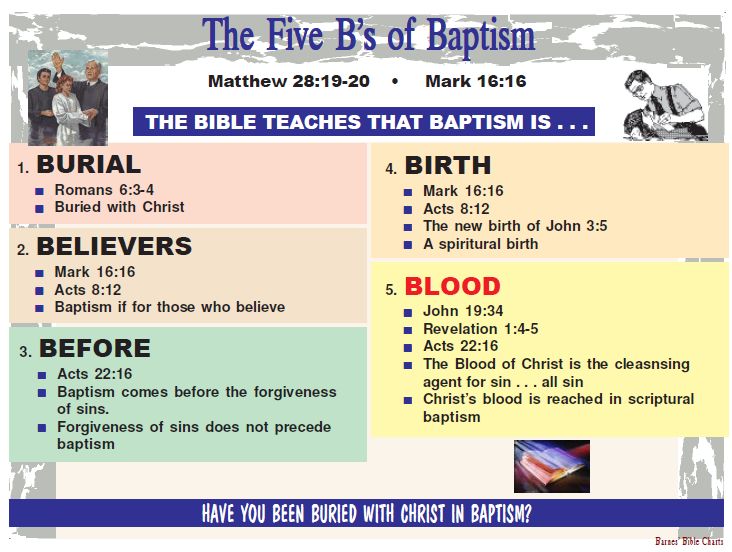
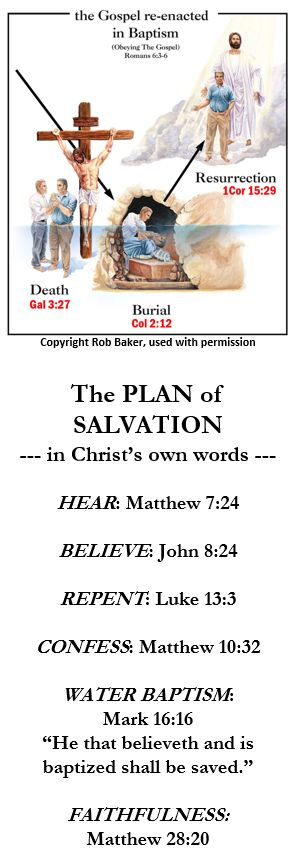
Far from a mere ritual, BAPTISM is a divinely ordained step that aligns believers with Christ’s redemptive work. Through baptism, individuals experience a cleansing of sins, union with Christ’s church, salvation, and an inheritance as heirs of God’s promises.
1. Washing Away Our Sins
Baptism serves as a divine act of cleansing, washing away the stain of sin. In Acts 22:16, Ananias urges Saul, “And now why do you wait? Rise and be baptized and wash away your sins, calling on his name.” This passage emphasizes baptism’s role in cleansing the believer’s conscience before God. Similarly, Acts 2:38 declares, “Repent and be baptized every one of you in the name of Jesus Christ for the forgiveness of your sins, and you will receive the gift of the Holy Spirit.” Here, baptism is linked directly to the remission of sins and the reception of the Holy Spirit. Additionally, Matthew 26:28 connects the concept of forgiveness to Christ’s sacrifice: “For this is my blood of the covenant, which is poured out for many for the forgiveness of sins.” Baptism, therefore, is the moment when a believer appropriates the forgiveness secured by Christ’s blood. Supporting this, Ephesians 5:26 describes Christ sanctifying the church “by the washing of water with the word,” reinforcing baptism’s cleansing power.
2. Added to the Church That Christ Built
Through baptism, believers are united with the body of Christ, the church He established. Acts 2:47 states, “And the Lord added to their number day by day those who were being saved.” This follows the account of 3,000 souls being baptized and added to the church after Peter’s sermon (Acts 2:41). Baptism is the entry point into Christ’s church, as seen in 1 Corinthians 12:13: “For in one Spirit we were all baptized into one body—Jews or Greeks, slaves or free—and all were made to drink of one Spirit.” This passage highlights the unity of believers in the church through baptism. Additionally, Colossians 1:18 affirms Christ as “the head of the body, the church,” underscoring that baptism incorporates individuals into this divine institution, built by Christ Himself (Matthew 16:18).
3. Saved Through Baptism
Baptism is intricately tied to salvation, as it is the moment when a believer’s faith is actualized in obedience to God’s command. 1 Peter 3:21 explicitly states, “Baptism, which corresponds to this, now saves you, not as a removal of dirt from the body but as an appeal to God for a good conscience, through the resurrection of Jesus Christ.” This verse clarifies that baptism is not a mere physical cleansing but a spiritual act that appeals to God for salvation. Mark 16:16 further supports this: “Whoever believes and is baptized will be saved, but whoever does not believe will be condemned.” The connection between baptism and salvation is also evident in Romans 6:3-4, which describes believers being “baptized into his death” and raised to “walk in newness of life,” symbolizing the transformative power of baptism in securing salvation.
4. Becoming Heirs of Abraham
Baptism establishes believers as heirs of the promises made to Abraham, uniting them in God’s covenant family. Galatians 3:27-29 explains, “For as many of you as were baptized into Christ have put on Christ… And if you are Christ’s, then you are Abraham’s offspring, heirs according to promise.” Through baptism, believers become part of the spiritual lineage of Abraham, inheriting the blessings of God’s covenant. Romans 4:16 reinforces this, stating that the promise to Abraham comes “to the one who shares the faith of Abraham, who is the father of us all.” Additionally, Ephesians 3:6 affirms that through the gospel, Gentiles are “fellow heirs” with Israel, a reality actualized in baptism as believers are incorporated into Christ’s body.
5. Putting on Christ
In baptism, believers clothe themselves with Christ, taking on His identity and righteousness. Galatians 3:27 declares, “For as many of you as were baptized into Christ have put on Christ.” This vivid imagery portrays baptism as the moment when a believer is enveloped in Christ’s nature. Romans 13:14 echoes this, urging believers to “put on the Lord Jesus Christ,” a process initiated at baptism. Colossians 3:9-10 further supports this idea, describing believers as having “put off the old self with its practices and… put on the new self,” a transformation that begins with baptism’s symbolic burial and resurrection (Colossians 2:12).
6. Becoming a Disciple of Christ
Baptism marks the beginning of a life of discipleship, as believers commit to following Christ. Matthew 28:19 commands, “Go therefore and make disciples of all nations, baptizing them in the name of the Father and of the Son and of the Holy Spirit.” Baptism is the initiatory step in making disciples, signifying a public commitment to Christ’s teachings. Acts 8:12 illustrates this: “But when they believed Philip as he preached good news… they were baptized, both men and women,” showing that baptism follows belief and marks the start of discipleship. John 3:5 further emphasizes baptism’s role in entering the kingdom of God: “Unless one is born of water and the Spirit, he cannot enter the kingdom of God,” linking baptism to the disciple’s journey of faith.
Baptism is far more than a symbolic act; it is a transformative moment in the believer’s life, rich with spiritual significance. Through baptism, sins are washed away, believers are added to Christ’s church, salvation is received, the promises to Abraham are inherited, Christ is put on, and a lifelong journey of discipleship begins. These truths, grounded in Scripture, underscore baptism’s ESSENTIAL role in the Christian faith.
God Hardened Pharaoh’s Heart For the Scripture says to Pharaoh, “For this very purpose I have raised you up, that I may show My power in you, and that My name may be declared in all the earth.” (Rom 9:17)
This objection sounds like this; Calvinists might say that Pharaoh’s hardening is evidence of predestination separate from free will:
“God hardened Pharaoh’s heart to display His sovereign power, showing that human will is subject to His eternal decree.”
“Pharaoh’s hardening proves that God chooses whom to have mercy on and whom to harden, independent of human action.”
“God raised Pharaoh up to be a vessel of wrath, predestined to resist Him, to magnify divine glory.”
“Pharaoh had no free will to resist God’s hardening, as his rebellion was ordained to serve God’s redemptive plan.”
At the end of the day, this error makes God out to be a monster, and that He is a respecter of persons. “Then Peter opened his mouth, and said, Of a truth I perceive that God is no respecter of persons.” (Acts 9:34)
How can we answer this objection? We Harden Our Own Hearts The Bible repeatedly warns against hardening our hearts, emphasizing that this is a choice we make by disregarding God’s word. Hebrews 3:15 urges, “To day if ye will hear his voice, harden not your hearts, as in the provocation.” Similarly, Hebrews 4:7 echoes, “To day, after so long a time; as it is said, To day if ye will hear his voice, harden not your hearts.” These verses, rooted in Psalm 95:7–8, recall Israel’s rebellion in the wilderness, where they hardened their hearts by refusing to trust God. Proverbs 28:14 warns, “He that hardeneth his heart shall fall into mischief,” while Zechariah 7:12 describes those who “made their hearts as an adamant stone, lest they should hear the law.” When we ignore God, we actively choose to harden our hearts, shutting out God’s truth. The responsibility lies with us, not with God overriding our will.
God Allows Rebellion to Accomplish His Purpose God permitted Pharaoh to exalt himself in pride, using his defiance to demonstrate His power. Exodus 7:3–5 declares, “I will harden Pharaoh’s heart, and multiply my signs… that the Egyptians may know that I am the Lord.” Similarly, Exodus 10:1–2 explains that God hardened Pharaoh’s heart “that ye may tell in the hearing of thy son… what I have wrought in Egypt.” Exodus 14:4 adds, “I will harden Pharaoh’s heart, and he will pursue them, and I will get glory over Pharaoh.” This purpose is echoed in Romans 9:17: “For the scripture saith unto Pharaoh, Even for this same purpose have I raised thee up, that I might shew my power in thee.” Like Judas, chosen yet betraying Jesus (John 6:70–71: “Have not I chosen you twelve, and one of you is a devil?”), Pharaoh’s rebellion serves God’s plan without excusing his guilt. God allows human pride to run its course, turning it to His glory.
Rebellion Is to Harden Our Own Heart Pharaoh’s story vividly illustrates this truth. In Exodus 5:2, he defiantly declares, “Who is the Lord, that I should obey his voice and let Israel go? I do not know the Lord.” This rejection of God’s authority marks the beginning of his heart’s hardening. The Bible shows Pharaoh repeatedly choosing to disregard God’s word through Moses. In Exodus 7:13, after Aaron’s staff becomes a serpent, “Pharaoh’s heart was hardened, and he did not listen to them.” Again, in Exodus 8:15, after the plague of frogs, “he hardened his heart and would not listen to them.” These passages highlight Pharaoh’s active role in hardening his heart by failing to regard God’s signs and commands.
Yet, God’s sovereignty is also at work. Exodus 4:21 states, “I will harden his heart, so that he will not let the people go,” and Exodus 9:12 confirms, “The Lord hardened the heart of Pharaoh.” Does this mean God forced Pharaoh to sin? No. The text consistently shows Pharaoh’s rebellion preceding God’s hardening, as in Exodus 9:27, where Pharaoh admits, “I have sinned this time: the Lord is righteous, and I and my people are in the wrong.” God does not cause Pharaoh’s sin but uses his rebellion to fulfill divine purposes, as Exodus 10:1 explains: “I have hardened his heart… that I may show these signs of mine among them.” Pharaoh remains accountable for his choices, while God sovereignly works through them.
“The Devil Made Me Do It”? Some might claim, like the old saying, “The devil made me do it,” to shift blame for their sin. But Scripture places responsibility squarely on us. Pharaoh’s pride in Exodus 5:2 mirrors the rebellion of Israel in Judges 17:6 and 21:25: “Every man did that which was right in his own eyes.” This self-rule leads to a hardened heart. James 1:14–15 clarifies, “Every man is tempted, when he is drawn away of his own lust… when lust hath conceived, it bringeth forth sin.” Our deceitful hearts (Jeremiah 17:9: “The heart is deceitful above all things”) and evil thoughts (Mark 7:21–22: “From within, out of the heart of men, proceed evil thoughts… pride”) drive rebellion, not God or the devil. Like Pharaoh, we harden our hearts when we prioritize our own desires over God’s truth.
We are to Soften Our Hearts by God’s word. The hardening of Pharaoh’s heart teaches us a profound lesson: We harden our hearts by disregarding God’s word, but God uses even our rebellion to fulfill His purposes. The Bible warns us to choose differently. Hebrews 3:15 pleads, “To day if ye will hear his voice, harden not your hearts.” Unlike Pharaoh, who persisted in pride, we must repent and seek a soft heart, as David prayed in Psalm 51:10: “Create in me a clean heart, O God.” Have you ignored God’s voice through Scripture? Choose to obey, for the responsibility to heed the Gospel call is ours.
“And Jesus said unto him, Verily I say unto thee, To day shalt thou be with me in paradise.” (Luke 23:43)
This Objection sounds like this; “What about The Thief on the cross? He wasn’t baptized.”
You’re right, he wasn’t. He didn’t become a Christian either! You see, the Thief was a Jew (context bears that out) who lived and died under the Law of Moses, the Old Testament system. The New Testament command to be baptized came only after the death of Jesus. (Heb 9:15-17; Luke 23:32-43).
First, The TESTATOR was still alive. A will is not in force while the Testator lives. Jesus is the Testator of the New Covenant. Jesus had power to forgive sins while He was on earth (Mark 2:10). Now that He has died and rose from the dead, we are subject to His Will & Testament. “For where a testament is, there must also of necessity be the death of the testator. For a testament is of force after men are dead: otherwise it is of no strength at all while the testator liveth” (Heb 9:16-17).
The Thief HOPED in the future resurrection of Jesus, whereas we HOPE in a risen Savior’s return. He HOPED that Jesus would finish His prophetic work. We know that it is finished. “When Jesus therefore had received the vinegar, he said, It is finished: and he bowed his head, and gave up the ghost” (John 19:30).
He lived before the completed work of Jesus; we live on this side of the cross. “Moreover, brethren, I declare unto you the gospel which I preached unto you, which also ye have received, and wherein ye stand; By which also ye are saved, if ye keep in memory what I preached unto you, unless ye have believed in vain. For I delivered unto you first of all that which I also received, how that Christ died for our sins according to the scriptures; And that he was buried, and that he rose again the third day according to the scriptures” (1Cor 15:1-4).
Folks that ask about the Thief IGNORE the other times Jesus offered salvation with conditions. I often ask, “why pick the thief, why not be saved in the same way as the rich young ruler?” He asked for eternal life and was told to sell all that he had and give to the poor (Mark 10:17-25). When’s your garage sale? (Matthew 19:16-22, go, sell all, and give away)?
How come nobody asks to be saved like the woman “caught in adultery” (John 8:1-11, GO AND SIN NO MORE)? How come nobody asks to be saved like the laborers in the vineyard (Matthew 20:1-16,)? GO TO WORK. And, in truth, no one could be “saved like the thief,” unless they were crucified with Jesus!
How come folks overlook the multiple EXAMPLES of conversions in the book of Acts? When I ask a denominational person about how to be saved, they appeal to the thief or a verse in Romans. Why not appeal to the EXAMPLES in Acts where preachers went to the lost and baptized them into Christ? We need to ask about everyone that made this same request in the New Testament AFTER the Death, Burial, & Resurrection of Christ, (Acts 2:38; Acts 8:36; Acts 16:30). WHAT DID THEY DO? These were all baptized in water through faith for the remission of sins.
o The first of these conversions were 3,000 Jews on Pentecost to when the church was established. The text (Acts 2:14) shows that they had the Gospel preached to them; they heard (vv. 36-37); they repented of their sins (v. 38); and they were baptized into Christ (v. 38). The result was they had their sins washed away. o In Acts 8:4-5, Phillip preached to the people of Samaria; they heard (v. 6); they believed (v.13); they were baptized (v. 12). o Phillip also preached to Simon (Acts 8:4-5); he heard the Gospel (v. 6); he believed (v.13); and he was baptized (v. 13). o Phillip preached to the Eunuch (Acts 8:35-39); he made the good confession (v. 37); he was baptized (v. 38) and rejoiced in the forgiveness of his sins (v. 39). If a denominational pastor preaches Jesus (as Phillip did) would their audience respond with the same question as the Eunuch? “See, here is water; what doth hinder me to be baptized?”
o Ananias preached to Saul, later called Paul (Acts 9:17); he was baptized (Acts 22:16), and the rest of his life he taught others to do the same (1Cor. 12:13). o Peter preached to Cornelius (Acts 10:34-35); he and his family heard (v. 44); they repented of their sins (Acts 11:18); they were baptized (v. 48). They were saved (Acts 11:14). o Paul preached the saving message to Lydia (Acts 16:13); she heard (v. 14); she was baptized (v. 15). o Paul preached to the Philippian Jailor (Acts 16:32); he repented and he was baptized (v. 33). o Paul preached to and converted souls at Corinth (Acts 18:5); they heard and they were baptized (v. 8). o Paul preached to Crispus (Acts 18:5); when we turn to the letter to the Corinthians, we find that Crispus and others were baptized (1Cor. 1:14). o The Ephesians had the Gospel preached to them (Acts 19:8); they heard the message of salvation (Eph. 1:13). They were baptized (Acts 19:5) and it is in this way that they were saved by grace (Eph. 2:8-10).
Another response to the question, “what about the Thief on the cross” is found in a similar question asked of Jesus by Peter. Jesus indicates to Peter by what death he would glorify Christ (John 21:18-19). Then Peter, gesturing toward John, asks, “what shall this man do?” The Lord’s response to Peter is the same one I give to people who ask about the Thief; “what is that to thee? FOLLOW thou me” (v. 22b emphasis mine seb). The Thief found forgiveness while Jesus lived on earth, but he was not the first one, he is just the last one. There was the man Sick with a palsy (Mark 2:1-12), and the woman that anointed His feet with Oil. (Luke 7:36-50). Christ gave forgiveness during His earthly ministry as a proof that He is God. “Why doth this man thus speak blasphemies? who can forgive sins but God only” (Mark 2:7)?
These received forgiveness before Jesus died (Matt 23:46), before He was buried (Luke 23:53), before He rose again (Luke 24:6), before the command to be baptized for the remission of sins was given (Matt 28:19), and before the church was built (Matt 16:18). Nobody today can be saved like the Thief on the Cross. We live AFTER all these things; therefore, we cannot be saved like the Thief on the cross. Therefore, what’s that to you? you FOLLOW Jesus.
As I grow in faith, I’m learning to make the kingdom of God and His righteousness my highest pursuit, though I often fall short of this priority. Jesus’ words in Matthew 6:33, “Seek first the kingdom of God and His righteousness,” and Luke 12:31 call me to focus on God’s rule and moral standard above all else. This aligns with the righteousness, faith, and godliness in 1 Timothy 6:11 and 2 Timothy 2:22, but I confess it’s a struggle to keep this first in my heart when life’s demands pull me in every direction.
This pursuit is the cornerstone of my faith because it reorients everything else. Jesus promises that when I seek God’s kingdom first, my needs will be met, freeing me from worry. But trusting this promise requires the faith of 1 Timothy 6:11 and 2 Timothy 2:22, believing God’s way is better than my own. Righteousness (living justly and obediently) isn’t just a rule to follow; it’s a reflection of God’s character, as is the godliness in 1 Timothy 6:11. I’m humbled by how often I prioritize my plans over God’s, yet His word directs me back to God’s seeking His way.
Seeking the kingdom means living differently, praying for God’s will, sharing the gospel, and standing for His truth, even when it’s unpopular. I stumble, chasing lesser things, but each time I refocus, through study, and service, I find purpose and peace. As a saint, I’m learning to seek the Kingdom of God and His righteousness above all, trusting Him along the way.
As I seek to grow in faith, the hope of eternal life has become a treasure I hold dear, though I’m still learning to pursue it with the patience it demands. Romans 2:7 speaks of “eternal life to those who by patient continuance in doing good seek for glory, honor, and immortality,” and I see this echoed in the patience and righteousness Paul calls for in 1 Timothy 6:11 and 2 Timothy 2:22. I’m not there yet, my faith wavers, and my endurance falters, but this promise keeps me pressing forward, trusting God’s grace to sustain me.
This pursuit is vital because it anchors my life in something beyond the fleeting moments of this world. Eternal life isn’t just a future hope; it shapes how I live now. The call to “patient continuance” in Romans 2:7 reminds me of the patience in 1 Timothy 6:11, urging me to persevere through trials without giving up. I often grow weary, tempted to chase temporary comforts instead of God’s eternal reward. But when I fix my eyes on eternity, I find strength to choose righteousness, even when it’s costly, like forgiving an offense or staying faithful in difficult times.
Longing for eternal life humbles me. It is God’s gift through Christ to those who obey the gospel. Yet, I’m told to seek it by living uprightly, as 2 Timothy 2:22 encourages in pursuing righteousness. Each step, resisting temptation, serving others, or trusting God in hardship, feels like a deposit toward that eternal hope. It’s a slow, steady journey, and I rely on God’s mercy and His word to keep me faithful. As a saint, this treasure reorients my priorities, reminding me that my true home is with Him, forever.
A Passionate Plea to My Catholic Friends: Turn to the True Gospel
MY DEAR CATHOLIC FRIENDS, I come to you with a heart overflowing with love and urgency, pleading with you to hear the truth about the dangers of the Catholic faith. As your friend, I cannot stay silent when I see you entangled in a system that strays from the pure gospel of Christ. With Scripture as our guide, here are five critical warnings, praying they will open your eyes to the truth and lead you to the freedom found in Jesus alone.
FIRST, Jesus Himself warned us in Matthew 23:9, “Call no man your father on earth, for you have one Father, who is in heaven.” Yet the Catholic Church exalts the Pope, calling him “Holy Father” or “Papa,” a title reserved for God alone. This is no minor mistake—it elevates a man to a position that belongs only to our Heavenly Father. Paul referenced himself “as a father” but never took on the title as “Holy Father.” He often used humbling language and pleaded with people not to bow down to him. “Sirs, why do ye these things? We also are men of like passions with you, and preach unto you that ye should turn from these vanities unto the living God, which made heaven, and earth, and the sea, and all things that are therein:” (Acts 14:15). I implore you to reject this practice and honor God alone as your Father.
SECOND, the organization of the Catholic Church, with its hierarchy of popes, cardinals, and priests, contradicts the biblical model for the church. In 1 Timothy 3:1-10, Paul outlines the qualifications for elders and deacons—humble, local leaders who serve the local body of Christ, not a global institution with supreme rulers. The Catholic structure, centered in the Vatican, adds layers of human authority that Scripture never endorses. The largest organization of the Lord’s church on earth is the local church with autonomy from any other. Please, compare this to God’s Word and see the difference for yourselves!
THIRD, the Catholic religion preaches a perverted gospel, which Paul condemns in Galatians 1:6-10. The Catholic Church distorts the biblical gospel by adding human inventions like infant baptism, the granting of indulgences, an infallible Pope, and purgatory, which obscure the truth of salvation. Scripture teaches that salvation comes through faith in Christ, expressed in obedience to His commands, such as believing and being baptized, as Jesus declared in Mark 16:16: “Whoever believes and is baptized will be saved.” In Acts 19:1-5, Paul taught the Ephesians to believe and be baptized, and they demonstrated repentance by burning their magic books, showing fruits worthy of their faith. While Ephesians 2:8-9 affirms salvation is by grace through faith, not by works of human merit, this faith is active and obedient, not a mere mental assent. By contrast, Catholicism’s reliance on sacraments, human mediators to forgive sins, and man-made doctrines perverts the gospel’s simplicity. Paul warns, “If anyone is preaching to you a gospel contrary to the one you received, let him be accursed!” My friends, this is a matter of eternal life—reject these false teachings and embrace the true gospel of Christ’s grace and obedient faith!
FOURTH, the Catholic Church elevates men above what is proper, violating 1 Corinthians 4:6, which warns us “not to think of men above that which is written.” The veneration of Mary, the canonization of saints, and the authority given to priests and popes place mere humans on pedestals that belong to God alone. Mary was a humble servant, not a co-redeemer; saints are all believers, not an elite class; and no man can stand between you and Christ as your mediator (1 Timothy 2:5). I plead with you to humble yourselves before God and reject these man-made traditions!
FINALLY, the Catholic Church promotes false signs and a misunderstanding of saints, contradicting 1 Corinthians 1:2 and 13:8-11. In 1 Corinthians 1:2, Paul calls all Christians saints, not just those canonized by the Church. The Catholic obsession with miracles, apparitions, and relics often borders on idolatry, and 1 Corinthians 13:8-11 tells us that miraculous signs were temporary, meant to confirm the gospel in the early church, not to be sought after today. Turn away from these deceptive signs and embrace the sufficiency of Christ and His Word!
MY FRIENDS, I know these words may be hard to hear, but they come from a heart that loves you and longs for you to know the freedom of the true gospel. The traditions of Catholicism may feel comforting, but they are a trap, leading you away from the simplicity and purity of Christ. I beg you, search the Scriptures for yourselves, test what I’ve said, and turn to Jesus alone for salvation. He is enough! May God open your eyes and draw you to His truth. With all my love, I pray for you.
The Myth of “God is in Control” That’s shipwrecking Your Faith and what it really means!
GOD IS IN CONTROL, but how?
Is God really behind every move you make? This short article will dive into Scripture and shatter the illusion and unveil a sovereignty you’ll wish you’d known sooner.
The notion that “God is in control” meaning He’s some cosmic puppeteer pulling every string of human thought and action is unscriptural. That idea is a theological shipwreck, and we’re going to sink it with Scripture and logic. (Isa 1:18)
First off, the misunderstanding assumes God micromanages every detail—every fleeting thought, every stubbed toe, every word spoken. It’s as if He’s sitting on a throne with a joystick, forcing people to act like robots. One fellow told me, “I’m thankful to God that there’s no free will.” Who made him say that; is God thanking himself? LoL.
That’s not sovereignty; that’s slavery. The Bible paints a vastly different picture of God’s control. He’s the supreme authority with infinite options, unstoppable in His purpose, yet He doesn’t trample human freedom.
Take Esther 4:14. Mordecai tells Esther, “If you remain silent at this time, relief and deliverance will arise for the Jews from another place, but you and your father’s house will perish.”
Notice the implication: God’s plan to save His people will happen—with or without Esther. He’s not dependent on her choice, but He invites her to participate. If she opts out, He’s got a backup plan. That’s not manipulation; that’s a God with a myriad of ways to achieve His will. He’s not sweating bullets hoping Esther complies—He’s in control because nothing can thwart Him, not because He’s forcing her hand. It shows God’s providential ability not manipulation free will.
Then there’s Luke 3:8, where John the Baptist tells the Pharisees, “God is able from these stones to raise up children for Abraham.” Think about that. God doesn’t need the Pharisees’ cooperation to fulfill His promise to Abraham. He could turn rocks into covenant heirs if He wanted. (Remember that He made a man originally from dust Gen 2:7). This is not hyperbole, God can do it! His control isn’t about puppeteering people; it’s about His limitless power, infinite wisdom and options. The Pharisees could repent or not—free will intact—but God’s plan marches on.
Now, Romans 8:28-39 is the knockout punch. “We know that for those who love God all things work together for good.” Does that mean God orchestrates every sin, every tragedy, every dumb decision? No! It means He’s so sovereign that He can take the mess we make—our free choices, good or bad—and weave it into His redemptive tapestry. Verses 38-39 list every possible obstacle: death, life, angels, rulers, powers, height, depth, anything in creation. None can stop Him. That’s control; not meticulous domination, but unconquerable ability to save. No faithful Saint will be accidentally lost, and no person will be saved against their will.
The Old Testament backs this up. Genesis 12:3 says God will bless all nations through Abraham’s offspring. Fast forward to Galatians 3:13-16, and Paul clarifies this points to Christ. God’s plan was to bring the Messiah and reveal sin and His nature (the Law showing us our need for grace). Did He force Pharaoh to harden his heart? No—Exodus says Pharaoh hardened it first, and God used that rebellion to display His power. Did He make Judas betray Jesus? No—Judas chose greed (John 12:6), and God turned it into the pivot of salvation. The OT isn’t a script God forced on people; it’s a story of Him working through their free actions to unveil Christ.
The New Testament shifts focus: it’s about spreading the gospel until Christ returns. 2 Peter 3:9 says God is “not willing that any should perish, but that all should come to repentance.” If He controlled every thought, why the delay? Why the plea for repentance? Because He’s patient, letting humans choose while His plan—salvation through faith—remains fixed (2 Peter 3:15). Predestination isn’t about God picking who sins or believes; it’s about His unshakeable decision to save through the gospel of Christ. Ephesians 1:3-5 ties it to salvation through obedience to the Gospel (Gal 3:13-27).
Think about it; if God controls every action, free will is a sham, and so is accountability. Why judge sin if God made us do it, or won’t allow us to repent?! That’s nonsense and makes God out to be a monster not a loving savior. Is it any wonder why people reject the gospel after hearing this?
Deuteronomy 30:19 says, “I have set before you life and death… choose life.” Choice is real. God’s control isn’t a straitjacket—it’s His ability to say, “My will stands, no matter what you do.” Think of Joseph’s brothers selling him into slavery (Genesis 50:20): they meant evil, but God meant it for good. He didn’t make them hate Joseph; He used their free will as a step toward His promises.
The “God as micromanager” view is sad because it shrinks Him into a control freak who needs to fiddle with every detail. Tragically, people are being hurt by this error and think it’s God who’s causing their pain for some divine purpose. Not so!
The Bible shows a God so vast, so ingenious, that He doesn’t need to manipulate. He’s got a million roads to His destination, and none of us can block the way. That’s sovereignty worth worshipping—not a petty tyrant, but a King who reigns supreme over chaos without breaking a sweat. Anything less is a caricature, not the God of Scripture.
God does have a plan for you, it’s to trust and obey Him. “I have fought a good fight, I have finished my course, I have kept the faith: Henceforth there is laid up for me a crown of righteousness, which the Lord, the righteous judge, shall give me at that day: and not to me only, but unto all them also that love his appearing.” (2Tim 4:7-8)
“For this is the love of God, that we keep his commandments: and his commandments are not grievous.” (1John 5:3)
God Does Have a PLAN for You…
God’s plan isn’t a cold, cosmic checklist or a tangled web of fate pulling you along. It’s a heartfelt invitation, a steady hand reaching out and guiding you with His word through life’s messiness toward something real and lasting.
PURPOSE: It starts with a tug at your soul—to obey the Gospel, to lean into the quiet rhythms of life and godliness that God’s laid out for us all in His word (2 Pet 3:9; 1:3-10; Gal 6:7; Ecc 12:13). He’s not dangling a secret script; He’s offering a path lit by His love and truth revealed in scripture.
LOVE: Then there’s this ache to love one another, a call that echoes deep within (1 John 4:7; John 14:15). It’s not forced—it’s the warm pulse of obedience, a choice to reflect the One who first loved us.
ABOUND: He stirs you to grow, to stretch beyond where you stand today being equipped by His word (2 Pet 3:18; Heb 5:12; 2 Cor 8; Matt 25:15-30; 2 Tim 3:15-17). There’s a quiet thrill in using what He’s given you—your gifts, your grit—to bloom where you’re planted.
NEVER GIVE UP: And through it all, there’s His constant urging: Never quit. Never give up. Never let go of the hope that’s yours (Heb 2:3; Rev 2:10). It’s a fight worth fighting, a race worth running, because what’s waiting at the end is too precious to abandon.
This isn’t about God puppeteering your every step. It’s His tender, unshakable call to live with purpose, to rise up, and to hold fast—because you’re worth it to Him.
Share this with your neighbors who are being tortured by this false teaching.
“And ye shall know the truth, and the truth shall make you free.” John 8:32 KJV
Not Just another Bible Reading plan you won’t finish.
It’s that time of year again when we encourage folks to find the right Bible reading plan that works for them. If you’ve ever struggled to read the Bible consistently, having a structured plan can make all the difference.
Before we introduce the 2025 plan, let’s take a moment to reflect on why a regular approach to Bible reading is so valuable.
The Word of God is our spiritual nourishment (Matthew 4:4), and regular reading allows us to grow in knowledge, faith, and obedience. A well thought out plan provides consistency and focus, ensuring that we engage with the whole counsel of God (Acts 20:27). It also helps us build a daily habit of spending time in God’s Word, which strengthens our walk with Him and equips us for every good work (2 Timothy 3:16-17).
Following is a simplified version of the Bible Reading Plan I’ve followed for the last few years. This plan is both simple and engaging. By breaking up the reading between the Old and New Testaments it helps to break up any monotony that keeps many folks from finishing.
The Monday Through Friday 5-day Reading Plan This year’s plan has us reading the New Testament twice while incorporating the Old Testament and Poetry/Wisdom books. It is structured to give variety and balance:
• Mondays: Read 4 chapters from the Gospels (Matthew, Mark, Luke, and John – 89 chapters twice).
• Tuesdays: Read 4 chapters from Paul’s letters (Romans through Philemon – 87 chapters twice).
• Wednesdays: Read 4 chapters from the General Letters and Acts (Hebrews through Revelation and Acts – 84 chapters twice).
• Thursdays & Fridays: Read 7 chapters each on these two days from the Old Testament History & prophets (728 chapters total).
• Monday–Friday: Add 1 chapter each morning or evening from the Poetry and Wisdom books (Psalms, Proverbs, Ecclesiastes, Song of Solomon – 201 chapters total). With the 59 days to spare I’ll usually read Proverbs, Ecclesiastes, & Song of Solomon again.
By following this plan, you will read through the entire Bible in a year, with the New Testament covered twice.
Why This Plan Works As New Testament Christians, the focus on the New Covenant is especially meaningful. By reading the New Testament twice in a year—just 4 chapters a day—you’ll gain a deeper understanding of Jesus’ life and teachings, as well as learning about the Lord’s church. In about 15–20 minutes each day, you can reflect on God’s grace and truth revealed through His Word.
The plan also ensures exposure to the Old Testament, grounding us in God’s purpose, and wisdom. With its organized structure, each day brings fresh motivation and variety, helping you stay engaged.
Imagine this time next year, having read about the life of Jesus twice and journeyed through the entire Bible. You’ll gain not just knowledge, but also a richer, deeper relationship with God through His Word. Start your journey today, and see how consistent Bible reading transforms your life in 2025!.


 Borger church of Christ @ Franklin & Juniper