How to know what God wants. Pt1
“God is a Spirit: and they that worship him must worship him in spirit and in truth.” (John 4:24)
God has not at any time authorized gratuitous service be rendered to Him. This means that God requires worship toward Him to be in accordance with His instructions.
From the very beginning we see this principle. In Genesis four, Abel offered an acceptable sacrifice by faith, and Cain did not. “By Faith” is first speaking about divine instruction, followed by our trust in His acceptance when we follow those instructions. “So then faith cometh by hearing, and hearing by the word of God.” (Rom 10:17).
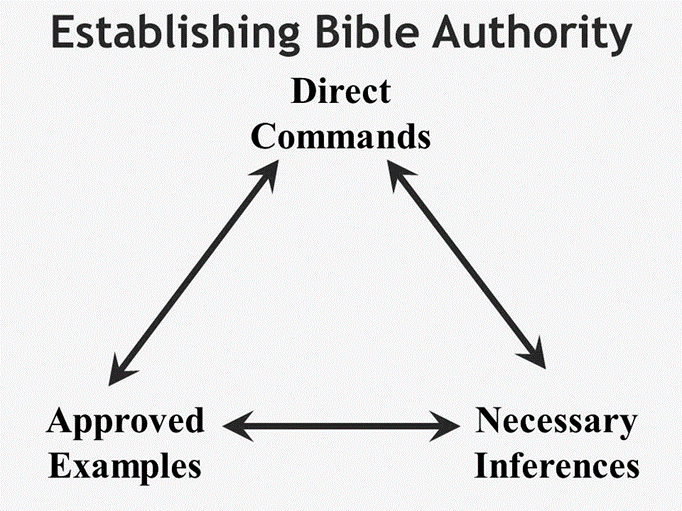
One cannot be walking by faith in Christ while offering strange worship God commanded us not. How do we know what God wants? We can answer that question if we will learn how God communicates. He gives DIRECT commands & statements, He gives EXAMPLES, and He IMPLIES things from which we may infer. He also expects us to respect when He is SILENT on a matter.
I) God communicates through Direct commands & statements.
In the Gospel of Mark, Jesus gives a direct command to his disciples in the Great Commission. He says, “And he said unto them, Go ye into all the world, and preach the gospel to every creature.” (Mark 16:15). These are clear instructions from God on how his followers are to spread the message of salvation.
The Direct commands of God come in 2 forms:
1) SPECIFIC. God tells us exactly what He wants. We cannot add to, nor take away from the specific command. A specific command eliminates all other possibilities.
2) GENERIC. God gives a command but doesn’t tell us how. He leaves those details for us to implement.
The how of a generic command is called an expedient. We need to find the most efficient & effective means to fulfill the command. We cannot bind an expedient on others as being the only way. We have liberty.
II) God communicates using Approved Examples. There are many examples in the bible, but not every one of them is binding, nor authorized. Some examples are incidental like meeting in an upper room (Acts 1:13).
What makes an example an APPROVED EXAMPLE? When the example is in compliance with a Direct command of God. Jesus said “And he said unto them, Go ye into all the world, and preach the gospel to every creature. He that believeth and is baptized shall be saved; but he that believeth not shall be damned.” (Mark 16:15-16). In the Acts one we see exactly that. They preached the Gospel to everyone on Pentecost and baptized for remission of sins.
Another example is found in Acts 8. “Then Philip opened his mouth, and began at the same scripture, and preached unto him Jesus. And as they went on their way, they came unto a certain water: and the eunuch said, See, here is water; what doth hinder me to be baptized? And Philip said, If thou believest with all thine heart, thou mayest. And he answered and said, I believe that Jesus Christ is the Son of God. And he commanded the chariot to stand still: and they went down both into the water, both Philip and the eunuch; and he baptized him.” (Acts 8:35-38). Here we see Philip Going, Preaching, and Baptizing as was commanded by Jesus in the great commission. Philip is one of many APPROVED EXAMPLES.
Without a command an example is just an example. It is not to be bound on others. Examples are only APPROVED (or Apostolic) when there is a command from God. How can we sift the binding from non-binding examples? Here are 4 questions to ask.
- Is there Uniformity in all examples of same event? Baptism was all by immersion, but circumstances around event were different.
- Is there Unity in Harmony? The Example must harmonize with God’s commands. Without a command there is not an approved example.
- Is there Universal application? It must apply and be able for all. Grapes (fruit of the vine) grow everywhere. Water is everywhere man is. Truth is Universal to all mankind.
- Is the example Unnecessary or relevant to the command? The disciples met in an upper room.
People are constantly attempting to worship God according to their own desires (Col 2:23). They have introduced Mechanical Music, plays, interpretive dance, and in one place Roller Skating Praise.
Here are 4 types of False worship.
- Vain. Mark 7; Matt 15:9.
- Against His will. 1Cor 11:17-34; 1Sam 15:22-23
- Ignorant. Acts 17:23
- Narcissistic Self-Willed worship. Col 2:20-23
These should serve as warnings about doing what God FORBIDS, OMISSION of what God commands, or adding EXTRA to the commands of God that He has not commanded.
“Ye shall not add unto the word which I command you, neither shall ye diminish ought from it, that ye may keep the commandments of the LORD your God which I command you”
(Deut 4:2; 12:32; Pr 30:6; Ec 12:13; Re 22:18-19).
Agape,
Spencer
You can read pt 2 of How to know What God wants here.
 Borger church of Christ @ Franklin & Juniper