
Why do we DOUBT?

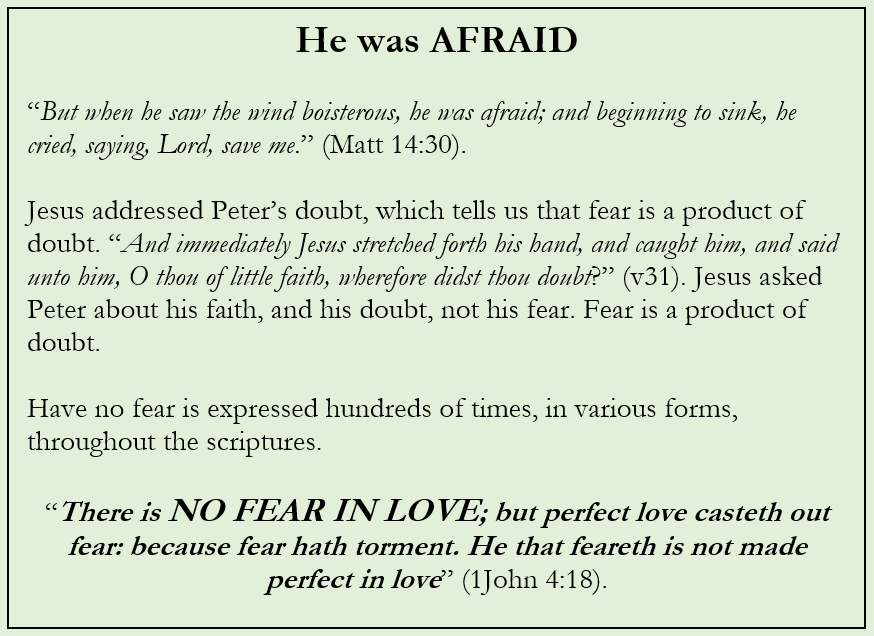
Jesus asked this question of Peter when he began to sink after walking on the water.

And in the fourth watch of the night Jesus went unto them, walking on the sea. And when the disciples saw him walking on the sea, they were troubled, saying, It is a spirit; and they cried out for fear. But straightway Jesus spake unto them, saying, Be of good cheer; it is I; be not afraid. And Peter answered him and said, Lord, if it be thou, bid me come unto thee on the water. And he said, Come. And when Peter was come down out of the ship, he walked on the water, to go to Jesus. But when he saw the wind boisterous, he was afraid; and beginning to sink, he cried, saying, Lord, save me. And immediately Jesus stretched forth his hand, and caught him, and said unto him, O thou of little faith, wherefore didst thou doubt? And when they were come into the ship, the wind ceased. Then they that were in the ship came and worshipped him, saying, Of a truth thou art the Son of God

(Matthew 14:25-23).

You may wonder why the Lord was so critical of Peter’s doubt, because walking on water is not normal. But that was not the Lord’s rebuke. Peter was walking on water. Jesus was walking on water. They both walked on water together in the storm.

Do we also doubt in the storms of life?
Why do we doubt? What is the source of doubt? This series of articles will seek to search the scriptures for the answer, and to learn how to combat, or to Overcome Doubt.

The first thing we ought to do is to make certain we know what it means. Jesus asked Peter, “why did you doubt (duplicate, i.e. mentally to waver in opinion) [Strong’s Greek dictionary; distazo]. The dictionary defines doubt as; “to be uncertain about; consider questionable or unlikely; hesitate to believe.” DOUBT is the opposite of BELIEF. Therefore, our first source of DOUBT is DISBELIEF. This will be the ultimate root of all the sources.

DISBELIEF is the target of the Lord’s question to Peter (v31), and is our challenge today. Belief in God is the beginning of our salvation. It’s placed first of all other commands in obeying the gospel. Works without faith is vanity. Faith is a work (John 6:29; 1Thess 1:3; 2Thess 1:11).

But without faith it is impossible to please him: for he that cometh to God must believe that he is, and that he is a rewarder of them that diligently seek him” (Hebrews 11:6).

He that believeth and is baptized shall be saved; but he that believeth not shall be damned” (Mark 16:16).

The type of Belief under consideration is compared to the faith of Abraham when he went to sacrifice the son of promise. “Was not Abraham our father justified by works, when he had offered Isaac his son upon the altar? Seest thou how faith wrought with his works, and by works was faith made perfect? And the scripture was fulfilled which saith, Abraham believed God, and it was imputed unto him for righteousness: and he was called the Friend of God. Ye see then how that by works a man is justified, and not by faith only” (James 2:21-24). His belief was so certain that he supposed God would raise Isaac from the dead (Heb 11:17).

However, faith is not blind. “Now faith is the substance of things hoped for, the evidence of things not seen” (Hebrews 11:1). There’s evidence to believe. Peter’s evidence was the prior miracles of Jesus (which are still evidence for us today John 20:30-31). Peter had participated in the feeding of the 5,000 just preceding his water ambulation. How many steps he made on the water we do not know, but one step out of a boat into the deep stormy waters is sufficient. He had gone out in the limited commission with powers, “against unclean spirits, to cast them out, and to heal all manner of sickness and all manner of disease” (Matthew 10:1).

Well, that was Peter you may say; what about us? We don’t see those miracles today. No, we don’t see biblical miracles today, but that’s okay. The miracles Peter saw, and those in the early church are for our belief. “And many other signs truly did Jesus in the presence of his disciples, which are not written in this book: But these are written, that ye might believe that Jesus is the Christ, the Son of God; and that believing ye might have life through his name” (John 20:30-31). But there’s more…

God’s word says that God’s creation is for belief. “Because that which may be known of God is manifest in them; for God hath shewed it unto them. For the invisible things of him from the creation of the world are clearly seen, being understood by the things that are made, even his eternal power and Godhead; so that they are without excuse” (Romans 1:19-20). God’s creation is enough to begin our belief in Him.

Paul used this same evidence for belief. “Nevertheless he left not himself without witness, in that he did good, and gave us rain from heaven, and fruitful seasons, filling our hearts with food and gladness” (Acts 14:17; 17:27-28). The evidence of creation and human life will point you in the right direction to look further. There are only 2 possibilities about creation: 1) that everything came from a thoughtless nothing, or 2) everything came from a very wise, powerful, and brilliant God.

Belief is not blind. It has evidence and there’s so much evidence inside and outside of scripture. If you doubt, perhaps a study of evidences is for you to combat that doubt. Here are a few areas to study…

I have a few resources in my library. One of my favorites is by a brother in Christ named A.O. Schnabel, “Has God Spoken?” This book references scriptures of nature that science discovered many hundreds and thousands of years later. Some discoveries as recent as the 1960’s!

There’s no need to doubt. We can know and be assured.

(to be continued)

Agape,

Spencer
Tips to READ through the Bible

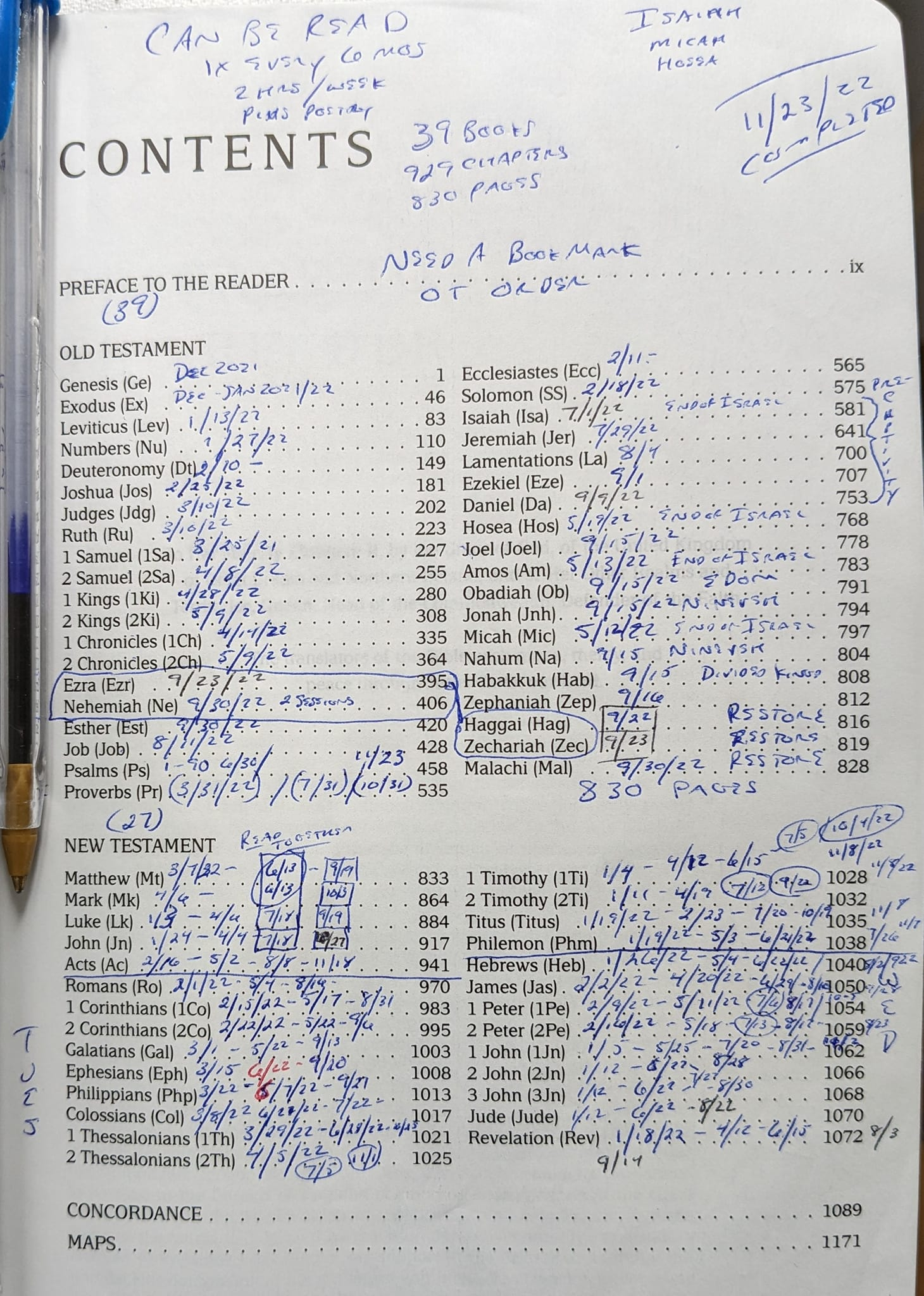
It’s Possible! It’s possible to read through the Bible in one year. The above picture is not for bragging rights, it’s for encouragement. The Pic is my record of when I read each book of the Bible in 2022. As you can see I put an emphasis on reading the New Testament multiple times. I’ll finish up the year reading the Gospel of John and Revelation just one more time.

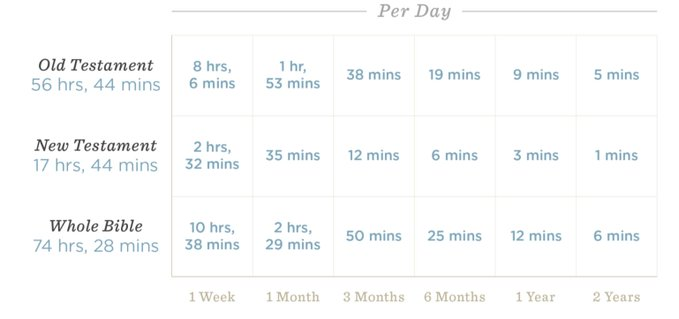
While I have been given the opportunity to read each day for a longer than average time, it’s still possible for the average person to read the bible in one year. Looking at this time chart below, one could read through the Bible in just 12 minutes per day

Crosswalk.org infographic

If you want to read just 5 days a week (Mon-Friday), which is the schedule I’m on, it would only add about 2-3 minutes per day.

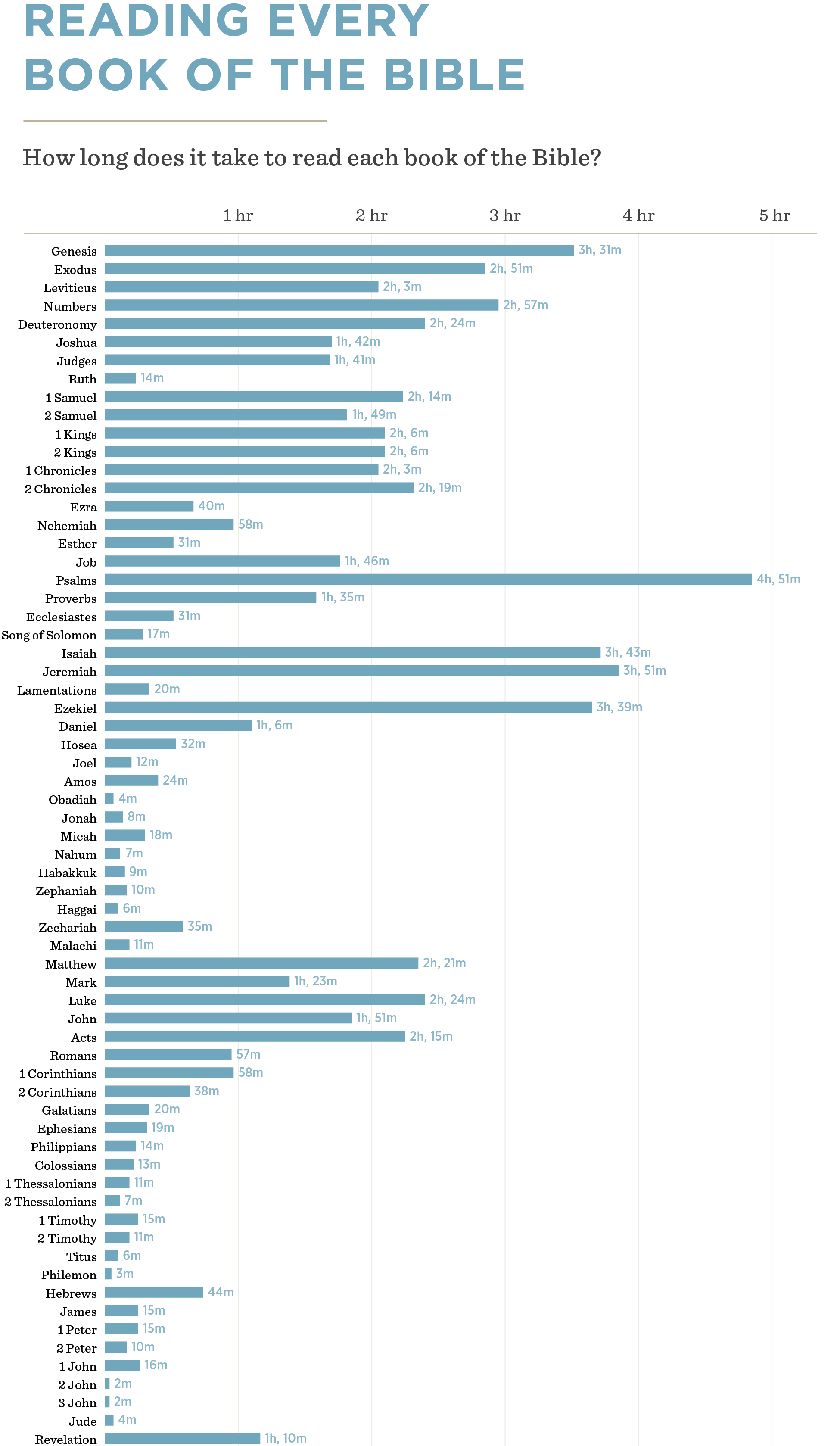
Here is a chart from Crosswalk with the times to read through each book of the Bible.

Here are my 4 Tips to READ through the Bible in one year.

1. Read REGULARLY. Set a time for Bible reading. It only takes 15-17min per day, 5 days a week.

2. Reading is compared to EATING. (Rev 10:9-10; John 6:35-51). We eat every day for physical nourishment. Eat a small portion of the Word for Spiritual nourishment. It doesn’t need to be Eaten in one sitting. How do you ready an elephant? 1 bite at a time.

3. Read prayerfully, ASKING God for wisdom. Jas 1:5-7 The Gospel is the power of God unto salvation. We get faith, belief, Equipping, & understanding when we read. (Rom 20:17; John 20:30-31; Eph 3:3-4; 2Tim 3:15-17)

4. Read with a Desire to become a DOER of the word. James 1:22 but be ye doers of the word and not hearers only, deceiving your own selves. The New Testament is the final word of Christ and is the doctrine we follow today. (2John 1:9)

Here are some words from God’s word to encourage you to read.

John 20:30 And many other signs truly did Jesus in the presence of his disciples, which are not written in this book: 31 But these are written, that ye might believe that Jesus is the Christ, the Son of God; and that believing ye might have life through his name.

Romans 10:17 So then faith cometh by hearing, and hearing by the word of God.

2Timothy 3:15 And that from a child thou hast known the holy scriptures, which are able to make thee wise unto salvation through faith which is in Christ Jesus.16 All scripture is given by inspiration of God, and is profitable for doctrine, for reproof, for correction, for instruction in righteousness:17 That the man of God may be perfect, throughly furnished unto all good works.

Ephesians 3:4 Whereby, when ye read, ye may understand my knowledge in the mystery of Christ)

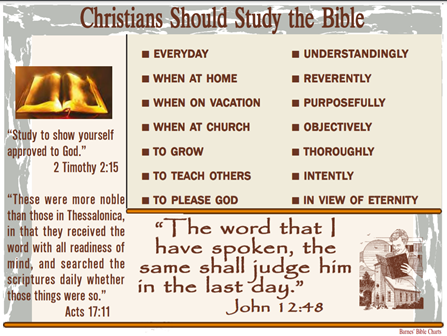
Acts 17:11 These were more noble than those in Thessalonica, in that they received the word with all readiness of mind, and searched the scriptures daily, whether those things were so.

1Thessalonians 5:21 Prove all things; hold fast that which is good.

John 6:48 I am that bread of life. 49 Your fathers did eat manna in the wilderness, and are dead. 50 This is the bread which cometh down from heaven, that a man may eat thereof, and not die. 51 I am the living bread which came down from heaven: if any man eat of this bread, he shall live for ever: and the bread that I will give is my flesh, which I will give for the life of the world.

IT’S POSSIBLE! You can do it. If the scriptures made Timothy wise unto salvation, it will do the same for us too!

spencer

PS here is a link to a printable bookmark to help you keep your place and help you with a little context as you read.

What do you get when you Read the BIBLE?

We believe the Bible is the inspired word of God, that gives us all the information and instruction we need for life and godliness.

For the prophecy came not in old time by the will of man: but holy men of God spake as they were moved by the Holy Ghost.” (2Peter 1:21; cf 1:3-4)

We also believe that we can understand the Bible, and know & do the will of the Lord.

Whereby, when ye read, ye may understand my knowledge in the mystery of Christ)” [Eph 3:4]

And whatsoever ye do in word or deed, do all in the name of the Lord Jesus, giving thanks to God and the Father by him.” [Col 3:17]

What we get when we read the BIBLE?

The Bible reveals an answer to this question.

First, The Bible says we may BELIEVE. “But these are written, that ye might believe that Jesus is the Christ, the Son of God; and that believing ye might have life through his name.” [Jno. 20:30-31] Another word often associated with belief is Faith, which is of the same Greek origin. “So then faith cometh by hearing, and hearing by the word of God.” [Romans 10:17]

We conclude from this evidence and more, that when we read the Bible, God’s inspired revealed word, we may BELIEVE.

How then can we Believe, or have Faith, without reading?

Second, The Bible says we will have INSTRUCTION in righteousness. “All scripture is given by inspiration of God, and is profitable for doctrine, for reproof, for correction, for instruction in righteousness: That the man of God may be perfect, throughly furnished unto all good works.” [2Tim 3:16-17; cf. 2Peter 1:3-4]

We conclude from this evidence and more, that when we read the Bible, God has given us INSTRUCTIONS on how to live, grow, and how to get to heaven.

How then can we speak or act without reading?

Third, The Bible says that we can BE READY to give an answer, or a defense. “But sanctify the Lord God in your hearts: and be ready always to give an answer to every man that asketh you a reason of the hope that is in you with meekness and fear:” [1Pet 3:15]

We conclude from this evidence and more, that when we read the Bible, we can give an answer to any and all who ask us why we have hope.

How can we defend our hope (or our faith) without reading?

Fourth, The Bible says we will know LOVE because He first loved us. “We love him, because he first loved us.” [1John 4:19; cr. Rom 5:6-10]. The Bible also says that we LOVE God by keeping His commandments. “For this is the love of God, that we keep his commandments: and his commandments are not grievous.” [1John 5:3; cr. Jno. 14:15]

We conclude from this evidence and more, that we don’t truly know LOVE or how to LOVE unless we read about the sacrifice of Christ as revealed in the word of God. We also conclude that part of LOVING God is to do His will.

How can we truly know or practice LOVE without reading?

Fifth, The Bible says that Jesus has the words of ETERNAL LIFE. “…thou hast the words of eternal life.” [Jno. 6:68b; Luke 24:27; 2Cor 2:9-12; Eph 3:3-4] Those words have been revealed through the inspired written word of God (Revealed to the Apostles, whom spoke it, then wrote it) [2Th 2:15; 3:14]. These words are researchable and reviewable (Acts 17:11) and have universal application to all.

We conclude from this evidence, and more, that we may only know how to have ETERNAL LIFE through reading (hearing) and obeying the word of God. “And being made perfect, he became the author of eternal salvation unto all them that obey him;” [Heb 5:9].

How can you know we’re saved in hope without reading?

     — spencer

Spencer is an evangelist for the Franklin & Juniper St church of Christ in Borger Texas. If you live in the Borger area and would like a personal bible study, please reach out & let us know how we can help.

Are There Any Bereans Today?

Upon leaving a very difficult evangelism trip through Thessalonica, Luke tells a refreshing story of those he & Paul met in Berea [Acts 17:1-12].

These were more noble than those in Thessalonica, in that they received the word with all readiness of mind, and searched the scriptures daily, whether those things were so. Therefore many of them believed; also of honourable women which were Greeks, and of men, not a few.”

When the word of the Lord was preached to them, they displayed some NOBLE characteristics we all would do well to emulate.

Are there any Bereans today?

Acts chapter 17 relates various reactions to the preaching of God’s word. Some mocked, others got angry even to the point of assault. The Bereans had a proper attitude toward hearing the message of the Gospel. Let’s consider some qualities that would make one NOBLE and ask ourselves if there are any Bereans today?

The Bereans were NOT going to be tossed about with every wind of doctrine NOR be deceived by empty words (cf. Eph 4:14; 5:6). How did they accomplish this? They “searched the scriptures daily, whether those things were so.” The Bereans were NOT gullible people to the extent that they would automatically accept anything taught them.  It’s interesting that Paul would write to the saints in Thessalonica about this very quality; “Prove all things; hold fast that which is good.” (1Thess 5:21; cf 1John 4:1). Are there any Bereans today with a mind to make a proper investigation?

The Bereans appear to be free of bias & preconceived ideas and OPEN to hear the message of the cross. “…in that they received the word with all readiness of mind…” People with prejudice don’t do this. Have you ever wondered how a person can claim to read the Bible yet miss the necessity of baptism? Perhaps it’s overlooked because of bias. Jesus encountered this type of problem with the religious of His day. “For this people’s heart is waxed gross, and their ears are dull of hearing, and their eyes they have closed; lest at any time they should see with their eyes, and hear with their ears, and should understand with their heart, and should be converted, and I should heal them.” (Matt 13:15)

Bias is like the blinders on a horse, seeing nothing that might cause any discomfort. Condemnation before investigation is not what the Bereans practiced. “He that answereth a matter before he heareth it, it is folly and shame unto him.” (Prov 18:13) Bias is the opposite of the love of the truth. Paul gave this warning also to the Thessalonians; “That they all might be damned who believed not the truth, but had pleasure in unrighteousness.” (2Thess 2:11-12) Are there any unbiased Bereans today?

The Bereans BELIEVED the truth. “Therefore many of them believed; also of honourable women which were Greeks, and of men, not a few.” Hearing the truth is how faith & belief comes. “So then faith cometh by hearing, and hearing by the word of God.” and “But these are written, that ye might believe that Jesus is the Christ, the Son of God; and that believing ye might have life through his name.” (Rom 10:17; John 20:31). Are there any Bereans today?

The Bereans LOOKED daily. This speaks to their tenacity & diligence. The scriptures in question of their day were the Old Testament Scriptures. These scriptures were written prior to the days of chapter and verse numbering which would have required considerable effort on their part to search. Undeterred, they searched daily! Are there any Bereans today that would have the energy to undertake this tedious endeavor? In a day when the Scriptures are so conveniently available on our phones, in apps, and when we have concordances and other types of helps to locate various passages. We should be teaming with Bereans!

Lastly, as they “searched the scriptures daily, whether those things were so,” we make note of their attitude of EARNEST attention. An attitude that the writer of Hebrews said we “ought to give the more earnest heed to the things which we have heard, lest at any time we should let them slip.” (Heb 2:1). They had elevated the word of God to the importance it deserves as the word of God (John 17:17). We can’t help but note what Paul wrote to the church at Thessalonica, “ye received it not as the word of men, but as it is in truth, the word of God, which effectually worketh also in you that believe.” (1Thess 2:13; cf 2Tim 3:15-17)

Are there any Bereans today?