A Sower Went Out to Sow

A SOWER WENT OUT TO SOW: and as he sowed, some fell by the way side; and it was trodden down, and the fowls of the air devoured it. And some fell upon a rock; and as soon as it was sprung up, it withered away, because it lacked moisture. And some fell among thorns; and the thorns sprang up with it, and choked it. And other fell on good ground, and sprang up, and bare fruit an hundredfold. And when he had said these things, he cried, He that hath ears to hear, let him hear. And his disciples asked him, saying, What might this parable be? Luke 8:5-9

This parable, as told by our Lord and Master, teaches us about the difficulties of spreading the Gospel. In His explanation [Luke 8:11-15] He shows us that we have good seed, which is the word of God, and that the only failure that occurs in spreading the gospel is on the part of the sower or the receiver, God’s word never fails [Isa 55:11].

There are only 2 reasons why someone rejects the Gospel, you or them. They are responsible for the rejection of the Gospel due to the lack of a good & honest heart [Luke 8:15], or because they do not have a love for the truth.

And with all deceivableness of unrighteousness in them that perish; because they received not the love of the truth, that they might be saved. [2Thess. 2:10]

We fail the master for the same reason, a lack of love for the Word of God. When we obeyed the Gospel, confessing that Jesus was the Christ, we committed ourselves to His service as lights of the world [Mat 5:14]. Therefore, when He said, “go” we said “ok” [Mat 28:18-20]. When we don’t, we become like the son who disobeyed his Father [Mt 21:30].

Here’s where the lack of love comes in, Jesus said, “Thou shalt love the Lord thy God with all thy heart, and with all thy soul, and with all thy mind” [Mat 22:37]. He also said, “if ye love me, keep my commandments” [John 14:15]. Love is exemplified in our obedience toward Him. Which command of God shall we omit? Jesus went on to say, “You shall love your neighbor as yourself.” What better way to demonstrate our love toward a Borger neighbor than to share with them the soul saving Gospel message? There are several ways we can share the Gospel with those closest to us…

ONE, we can show it by acting like Christians every day. This was the case with a woman who had an unbelieving spouse; “Wives, likewise, be submissive to your own husbands, that even if some do not obey the word, they, without a word, may be won by the conduct of their wives, when they observe your chaste conduct accompanied by fear” [1Peter 3:1-2]. When we take an honest look at our behavior and attitudes, will we find that extra special difference from the world? Do we have an above average positive attitude, an above average speech, an above average hope, an above average kindness, an above average show of love, an above average level of service? Rather, and I’m no exception, our daily “conversation” would hardly win anyone.

TWO, we can share the Gospel through our love for each other. “By this all will know that you are My disciples, if you have love for one another” [John 13:35]. We are like any family, we have disagreements from time to time, but that doesn’t mean we stop loving one another or treat each other poorly. Folks are watching us and judging us by the way we treat each other. If we’re having trouble with loving each other, then pray for them. It’s hard to keep hatred in your heart when you pray for them.

THIRD, we can talk about the Gospel with others directly. This requires an intentional mindset toward spreading the Gospel. With enough practice we can turn nearly any conversation toward spiritual things [Acts 8:35]. Of course, not everyone cares for these kinds of conversation, in those cases just remember Matthew 7:6 “Do not give what is holy to the dogs; nor cast your pearls before swine, lest they trample them under their feet, and turn and tear you in pieces.” Do you WANT others to hear the Gospel and obey it? If we want eternal life bad enough, then we can’t help but have the Gospel burst forth from us. “He that believeth on me, as the scripture hath said, out of his belly shall flow rivers of living water.” John 7:38

FOURTH, we can help others in their evangelism efforts. Some folks are really good at starting Bible studies or inviting to services. Your part may be in being the hospitable host or hostess. Perhaps you can help a young mom with her fussy child, allowing her to concentrate on the study. Paul described this kind of evangelism in 1Corinthians 9:19-23. “I have become all things to all men, that I might by all means save some.” As in the previous point, we have to WANT it bad enough.

FIFTH, we can refer interested parties to other members more experienced in leading a study. A new convert friend of mine is really good at generating contacts, but has yet acquired the skills to lead a study. One day he shall, but for now he is invaluable in making contacts. Cornelius, as well as Lydia & the Philippian Jailor, referred their entire families to those who could teach the Gospel. [Acts 10:33; 16:15, 32]. We can give our friends and family study material. We have tracts or books or we can pass out the Ready reference of Bible topics bookmark. You can even pass along the weekly bulletin.

LASTLY, we can evangelize through our own joy in the midst of all our sorrows and pains of life. This is the meaning of 1Peter 3:15; “But sanctify the Lord God in your hearts, and always be ready to give a defense to everyone who asks you a reason for the hope that is in you, with meekness and fear;” As Christians, if Heaven awaits us, we can endure even the most difficult of lives. That’s how Job got through the worst tragedy of life, the loss of a child. When people see our struggles, but at the same time see us remain hopeful, they’re going to ask why. Sorrows are key moments in a person’s life and if we can’t trust in the Lord, why would anyone want to know about Him.


3 step method for Overcoming Discouragement

THERE ARE MANY reasons why we become discouraged.

Life is Difficult. Job faced this more than any other person. Problem after problem after problem just kept coming upon him and he didn’t know why [Job 1-2]. Let’s face it, life is hard and it’s dangerous. We face the loss of jobs, or stuff through things outside of our control. Sometimes tragedy strikes us with the loss of a friend or family in death.

Life’s challenges appear too big. This seems to be the challenge for the Israelites as they came into the promised land, even the people were giants! [Num 13:26-33; 32:9] The Lord knew that the challenge of taking the land would look too big and warned them about becoming discouraged [Deut 1:21]. Do the obstacles you face, money, health & relationships, appear too big to handle?

Other folks get us down. Then there’s the trouble that comes upon us through other folks. Their bad behavior affects us. The sin of David in numbering the people did this [2Sam 24:15]. Often we’re troubled by the sin of another. Whether it is their apathy, carelessness or outright wickedness, we become discouraged.

Consider the many tragedies our brother Paul faced during his life as an Apostle of Jesus Christ;  …in labours … in stripes … in prisons … in deaths …five times …forty stripes … Thrice … beaten with rods, once … stoned, thrice … shipwreck, a night and a day I have been in the deep; … journeyings often, …perils of waters, … robbers… mine own countrymen, … heathen, … city…wilderness… sea,…false brethren; …weariness … painfulness, in watchings often, in hunger and thirst, in fastings often, in cold and nakedness. Beside those things that are without, that which cometh upon me daily, the care of all the churches. [2Co 11:23-28] It would make almost anyone want to give up, but friend, that is not the answer. “But ye, brethren, be not weary in well doing” [2Th 3:13]. What are we to do?

3 STEPS TO OVERCOME DISCOURAGEMENT

STEP 1TAKE COMFORT IN JESUS – REALIZE THE POWER OF CHRIST WHEN WE ARE WEAK… Paul is referring to this when he makes the statement in 2Cor 4:16 “For which cause we faint not; but though our outward man perish, yet the inward man is renewed day by day.” As we have seen, Paul suffered greatly for Christ [2 Co 4:8-9], but he saw it as an opportunity for God’s power through Christ to be shown [2Co 4:7,10-11]. Christ taught Paul this lesson as he struggled with his “thorn in the flesh” [2Co 12:7-10]. When we are weak, that is an opportunity to depend upon the Lord for strength! So infirmities and tribulations can be occasions to rejoice, not despair!

STEP 2LOOK AT THINGS NOT SEEN…FAITH Heb 11:1. Looking at things not seen refers to the “far more exceeding and eternal weight of glory” [2Cor 4:16-17]. This is what renewed Paul inwardly day by day. This attitude makes our AFFLICTION appear light! It’s this mindset that gives us comfort that if our earthly house is destroyed (our bodies) we have…” a building of God, an house not made with hands, eternal in the heavens” [2Co 5:1-5]. If looking to things unseen can renew Paul, it can also do the same for us.

STEP 3TAKE ACTION – DO SOMETHING – FEAR BOREDOM We must keep on keeping on, or as Paul said, “I press toward the mark for the prize of the high calling of God in Christ Jesus” [Php 3:14]. We can all do something. It’s easy to say, “nobody’s there for me, so why should I be there for them?” Friend, this is not Christ’s way. Even though all had forsaken Him, Jesus didn’t stop serving us all the way to the cross! He left us an example in which to follow.

We can all do something; For OTHERS For I was an hungred, and ye gave me meat: I was thirsty, and ye gave me drink: I was a stranger, and ye took me in: Naked, and ye clothed me: I was sick, and ye visited me: I was in prison, and ye came unto me” [Mt 25:35-36]. When we’re serving the brethren, we’re in effect, serving Jesus. I’ve yet to find the passage which states, “Serve thy brethren AFTER they have served you.”

We can also do something for the spreading of the GOSPEL by inviting someone to read the scriptures with you, or inviting them to a worship service. Let me remind you that one of the methods of evangelism is through our HOPE & GODLINESS [1Peter 3:1, 15].

And finally, we can do something for the CHURCH by participating in the worship & in our Bible classes. Colossians 3:16 teaches how we help one another in our songs, “Let the word of Christ dwell in you richly in all wisdom; teaching and admonishing one another in psalms and hymns and spiritual songs, singing with grace in your hearts to the Lord.”

As one of our songs says, “Let us labor for the Master from the dawn til setting sun, let us talk of all His wondrous love and care; Then when all of life is over and our work on earth is done, and the roll is called up yonder I’ll be there.”

You will never hear

WILL YOU EVER hear our Baptist, Presbyterian or any of our denominational friends say, “The most influential men in our history were opposed to the use of instrumental music in Christian assemblies.”? No, you will never hear a Baptist say, “Charles Spurgeon, one of our greatest Baptist preachers, opposed instrumental music.” And you will never hear a Presbyterian admit: “John Calvin, one of the most famous theologians in history, rejected instrumental music in the sacred assembly.” Why? Because most are completely unaware of several facts about church history and may never hear them as their assemblies become more like concerts than a worship.

In the first century, Christians merely sang in their assemblies (Woodson). Hundreds of years passed before instrumental music was ever introduced into the apostate church. In fact, instrumental music was rejected by leading Protestants; and even when introduced into the mainline denominations, there was resistance.

Men who influenced the Protestant landscape were themselves opposed to instrumental music. For example, in his commentary on Psalm 33:2-“Give thanks unto Jehovah with the harp: Sing praises unto him with the psaltery of ten strings”-John Calvin wrote:

For even now, if believers choose to cheer themselves with musical instruments, they should, I think, make it their object not to dissever their cheerfulness from the praises of God. But when they frequent their sacred assemblies, musical instruments in celebrating the praises of God would be no more suitable than the burning of incense, the lighting up of lamps, and the restoration of the other shadows of the law. The Papists, therefore, have foolishly borrowed this, as well as many other things, from the Jews. Men who are fond of outward pomp may delight in that noise; but the simplicity which God recommends to us by the apostle is far more pleasing to him.”

The Methodist scholar Adam Clarke wrote with reference to 2 Chronicles 29:25.

But were it even evident, which it is not, either from this or any other place in the sacred writings, that instruments of music were prescribed by Divine authority under the law, could this be adduced with any semblance of reason, that they ought to be used in Christian worship? No: the whole spirit, soul, and genius of the Christian religion are against this: and those who know the Church of God best, and what constitutes its genuine spiritual state, know that these things have been introduced as a substitute for the life and power of religion; and that where they prevail most, there is least of the power of Christianity. Away with such portentous baubles from the worship of that infinite Spirit who requires his followers to worship him in spirit and in truth, for to no such worship are those instruments friendly.”

In connection with Psalms 42:4, Charles Spurgeon wrote:

Here are the facts. The instrument was not taken out of worship; rather, the instrument was an innovation brought into assemblies. On Christ’s authority, congregational singing of spiritual songs is what belongs in the church.”

John L. Girardeau’s strong opposition among the Presbyterians to the instrument included this statement:

It is almost inconceivable that the majority of the officers and members of the Presbyterian Church can have abandoned the consecrated principle that a divine warrant is needed for every element which enters into the worship of God’s house (197). What a degradation to supplant the intelligent song of the whole congregation by … the blowing off of wind from inanimate bellows and pipes! We might as well pray by machinery as praise by it (272).”

Church history is very clear, the instrument was not taken out of worship; rather, the instrument was BROUGHT IN and it was TAUGHT IN by MEN. Jesus said – and I believe it – that such worship is VAIN. On Christ’s authority, congregational singing of spiritual songs is what belongs in the church.

1Corinthians 14:15; Ephesians 5:18, 19; Colossians 3:16

how do you know?

walk in truth

You say you walk in truth, but how do you know? 3 John 1:4

HAVE YOU ever noticed that when you ask folks about their church they’ll tell you that it teaches the truth? If that were true, then why are there so many denominations teaching different things regarding salvation, worship, godly living and sin? They will also tell me they read their bibles.

If I were to ask someone if they belong to a gym, or own a piece of exercise equipment, there’s a good chance that the answer will be “yes”. Do I need to tell you my thoughts about their answer when I can clearly see the results? LOL. [this coming from a man that owns an elliptical and frequents fast food]

You may think these two questions are unrelated, in fact they have more in common than you may at first realize. The only difference is that with the second question, the person has to admit their failure in “walking in truth” regarding their health. With the first question, they’re often ignorant of their spiritual health.

The Apostle Paul commanded the Corinthian church to “Examine yourselves, whether ye be in the faith; prove your own selves. Know ye not your own selves, how that Jesus Christ is in you, except ye be reprobates?” [2Co 13:5] But how are we to do this “examination”? Let me suggest 3 things we should be examining regarding our faith.

EXAMINE YOURSELVES

We’ve already read the command to examine ourselves, but how and to what? First, let’s never make the mistake of comparing ourselves with others, this is a big problem. Paul had said in the same letter “..we dare not make ourselves of the number, or compare ourselves with some that commend themselves: but they measuring themselves by themselves, and comparing themselves among themselves, are not wise.” [2Co 10:12] Our Lord told a similar story when he told us about the Pharisee that said, “..God, I thank thee, that I am not as other men are, extortioners, unjust, adulterers, or even as this publican.” [Lu 18:11]

No, other men are not the standard. The standard of comparison should always be Christ and His word. Paul also taught the Church at Corinth to, “Imitate me, just as I also imitate Christ.” [1Co 11:1 (NKJV)]. So how does one walk in truth? You become a follower of Christ who said…

Joh 14:15 If ye love me, keep my commandments.
Joh 15:14 Ye are my friends, if ye do whatsoever I command you.
Mt 28:20 Teaching them to observe all things whatsoever I have commanded you:
Mt 22:29 .. Ye do err, not knowing the scriptures, nor the power of God.
Mt 28:19 Go ye therefore, and teach all nations, baptizing them in the name of the Father, and of the Son, and of the Holy Ghost:

EXAMINE YOUR TEACHER

In order to know if you’re walking in truth you must also examine the information you’re receiving. I once had a math teacher that regularly made basic math errors because she wasn’t very good at math. How long do you think my parents kept me in that class? Yet we continually listen to people who are supposed to teach us biblical principles, making grievous errors because they don’t know, or don’t understand what they are teaching. [1Timothy 1:7]

I’ve met “bible teachers” that get upset when I ask questions about the bible, showing them scriptures for my assertions. I’ve met “bible teachers” that actually attempt to tear down the truth of the bible when I show them passages that teach the opposite of their own. A priest of a particular denomination even said, “We’re not encouraged to read the bible.”

The Apostle John himself wrote, “Beloved, do not believe every spirit, but test the spirits, whether they are of God; because many false prophets have gone out into the world. [1Jo 4:1 (NKJV)] Paul was himself subjected to this “examination” by the Bereans in Acts 17:11 when they searched the scriptures daily to see if the things he taught were true.

If it’s good enough for them, it should be good enough for your teacher, preacher or pastor. None of them should ever be afraid of sound doctrine, IF THEY’RE TEACHING IT.

EXAMINE YOUR CHURCH

This third step is just as important as the other two. Scripture teaches that the church is the people, it never refers to the building. [Eph 1:22, 23; 1Co 12:12] Read what our Lord, Jesus said to the churches in Revelation chapter 2 & 3….

Re 2:4 Nevertheless I have somewhat against thee, because thou hast left thy first love.
Re 2:14 But I have a few things against thee,
Re 2:16 Repent; or else I will come unto thee quickly, and will fight against them with the sword of my mouth.
Re 2:20 Notwithstanding I have a few things against thee,
Re 3:1 …I know thy works, that thou hast a name that thou livest, and art dead.
Re 3:16 So then because thou art lukewarm, and neither cold nor hot, I will spue thee out of my mouth.

A teaching in scripture that is often ignored is the teaching about purifying the church. Paul told the church to “purge out”, referring to the man that was a member of the church at Corinth, but was living in unrepentant sin. [1Co 5:7]

When we assemble together, we must assemble IN HIS NAME. [Mt 18:20] To do something in His name means that in order to worship, we must do it by the Lord’s permission. We must worship “in spirit AND TRUTH” and His “word is truth”. [Joh 4:24; Joh 17:17]

CONCLUSION

It’s wonderful to hear that folks want to walk in truth, but desire is only the beginning, we must act upon that desire and obey God. In every case of conversion in the book of Acts, when folks heard the Gospel and had a desire for the salvation it provides, they all REPENTED AND WERE BAPTIZED.

That is the truth.

spencer

Evangelist at the Franklin St. church of Christ in Borger, Texas.

The Force Awakens

star wars

It’s been 32 years since Return of the Jedi, the final episode of the Star Wars trilogy that began in 1977 with episode IV A New Hope. Since the announcement of an episode 7, adults and children alike have endured a 2-year, Christmas like anticipation for the movie to finally arrive in Theaters, of which I am one.

Stories abound of fans scrambling to purchase tickets, pilgrimaging to theaters in droves, to be witness to the first public viewings. Folks have called in sick, one website offered a list of plausible excuses to use when you call off work, so as to be a part of this momentous event. Threats of “unfriending” folks from Facebook if they reveal any spoilers to those of us who have yet to navigate through the sea of people for one of the early showings.

This article shall neither bash those among the masses who make the trek to the early movies, adorned in their Jedi regalia, nor those who couldn’t give a rip that a new Spock movie just opened. (laugh if you got that joke.) No, just a comparison shall I draw. (laugh at that one too.)

I am curious about a few things, have we as a church ever posted online, for any amount of time, displaying our excitement for the coming day to worship our Lord and Savior? Or even better than that, the breathless anticipation of the Return Of The Christ? Oh how I long for the day we could anticipate the 1st day of the week, or His wonderful, triumphant return.

____________________________________________________
Not forsaking the assembling of ourselves together, as the manner of some is; but exhorting one another: and so much the more, as ye see the day approaching. [Hebrews 10:25]
____________________________________________________
I can’t believe you missed it!

Has anyone ever excitedly said to you, “I can’t believe you missed it!”, when referring to the Sunday worship that you had to miss due to illness or work? Have they ever gushed out every single line from the sermon, every emotion and every point drawn? No? Yeah, neither have I. What I HAVE heard was, “Missed you on Sunday”, in that tone as if they were really saying, “what kind of sin kept you from the worship?” Worse than that are those that say, “missed ya on Sunday”, but really saying, “I had to be there, why weren’t you?”

To be sure, If I were given a $200 million budget and 3 years, I may be able to produce a sermon entertaining enough to draw in the numbers comparable to Star Wars. But alas, I do not. I have 6 days to produce 4 lessons (2 sermons & 2 bible Classes). Not counting the myriad of other personal Bible studies, calls and questions I receive. No, my budget is far less.

We have no authority to do anything of the sort. We are to “teach all nations, baptizing them in the name of the Father, and of the Son, and of the Holy Ghost: 20 Teaching them to observe all things whatsoever I have commanded you:” [Matthew 28:19-20] We have no authority to draw anyone by any carnal lust whether it be food, entertainment or money. No, we have the Gospel to draw folks in, drawn in with a “true heart in full assurance of faith” [Hebrews 10:22].

Our Lord warned us about such things. “Jesus answered them and said, Verily, verily, I say unto you, Ye seek me, not because ye saw the miracles, but because ye did eat of the loaves, and were filled. 27 Labour not for the meat which perisheth, but for that meat which endureth unto everlasting life, which the Son of man shall give unto you: for him hath God the Father sealed.” [John 6:26-27]

He was pointing out that some will only come if you feed them with food, but they should be laboring for the spiritual food that brings about everlasting life. A preacher once said to me, “what a person is converted with, they are converted to.”

I have nothing against Star Wars or many other forms of non-sinful entertainment. The question I must ask myself, and you must ask yourself, is this; Do I care as much about the worship of our Lord and Savior Jesus Christ and His Triumphant return as I care about a movie?

Spencer Blackwelder
Evangelist, Borger, Tx

What about the Thief on the Cross?

what about the thief

Folks will use many reasons to take away the command by our Lord to be baptized. The one heard most commonly by me is, “What about the thief on the cross?” This one is offered by those who have a little biblical knowledge, and by those who’ve heard it before, but have never been challenged with scriptural evidence.

THE ARGUMENT goes like this; “If, as you say, baptism is necessary for salvation, then what about the thief on the cross? He was never baptized, yet the Lord said, “To day shalt thou be with me in paradise.” Baptism is not necessary to salvation, because the thief could not obey that command, yet the Lord said he would be in paradise.” [Lu 23:43]

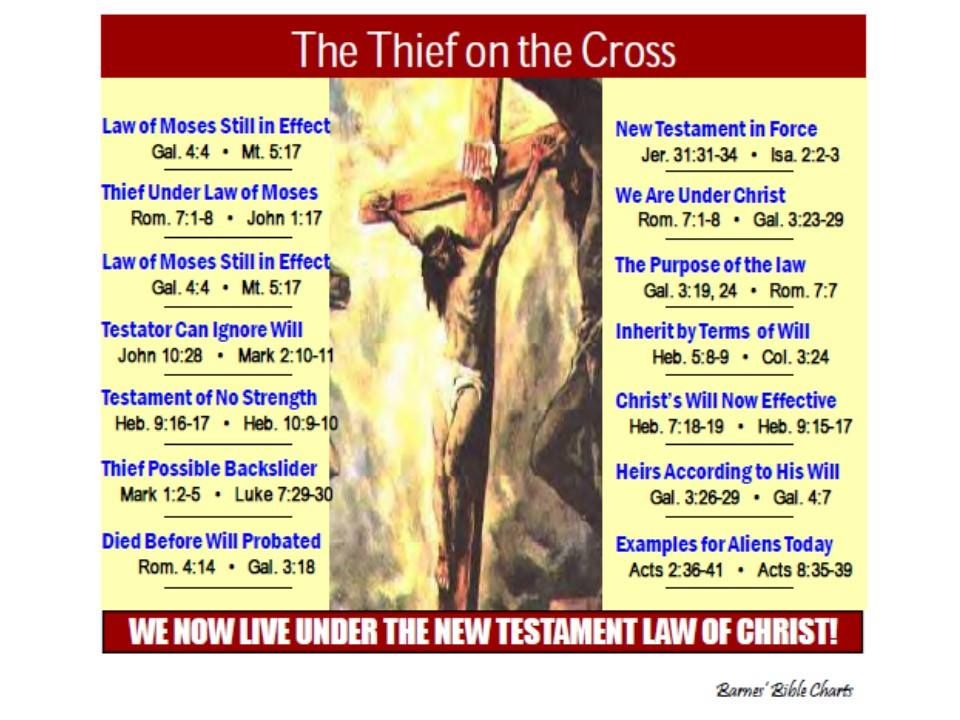
The Scriptures examined: The real issue pertains to a crucial feature of Bible interpretation, are we to take all 66 books of the Bible and take everything that is said and apply it directly and equally to everyone? The Bible is literally filled with commands, instructions, and requirements that were not intended to be duplicated by people living today. People are amenable to the law period under which they lived. [2Timothy 2:15]. There are three dispensations found in the Scriptures:

  • The Patriarchal Dispensation – From creation, everyone was subject to a body of legislation passed down by God through the fathers of family clans (cf. Hebrews 11:1), until the giving of the Law of Moses.
  • The Mosaic Dispensation – At Mt. Sinai, Moses was given a new Law from God and Jews were subject to that body of legal information [Law of Moses] from that time until it also was terminated at the cross of Christ. Consider the following passages:[Matthew 27:51; Romans 2:12-16; Galatians 3:7-29; Ephesians 2:11-22; Colossians 2:11-17]
  • The Christian Dispensation – After Jesus’ death on the Cross, all peoples are now amenable to the Law of Christ. [Galatians 6:2]
Now that we have this background information, let’s examine the reasons which make their argument invalid:

Reason #1– The Law of Moses was still in effect. Many folks are confused when reading the Gospels for it is commonly called, “The New Testament.” However, the majority of the gospel story in Matthew, Mark, Luke & John, take place while Jesus was alive and living as a Jew subject to the Law of Moses.

Jesus was born to a Jewish family under the Law [Mat 1; Luke 3; Ga 4:4], circumcised the 8th day [Lu 2:21], observed the Passover [Lu 2:41, 22:8-20], taught people to follow the Law [Matthew 5:23-24; 8:4], and followed the Law Himself [Matthew 5:17-18].

Under the Law of Moses, never was there a command to be baptized for the remission of sins. Sins were atoned for through the sacrifice of bulls; And he shall do with the bull as he did with the bull as a sin offering; thus he shall do with it. So the priest shall make atonement for them, and it shall be forgiven them. (Leviticus 4:20). The word “atonement” <kaphar> literally means “to cover” and is the same as in Gen 6:14 regarding covering the ark with pitch.

Nowhere in the Old Testament is the teaching that sins were totally removed. As we study our Bibles, we find in Hebrews 10:4 For it is not possible that the blood of bulls and of goats should take away sins. [Heb 10:11 …can never take away sins.] This system pointed to the sacrifice of Jesus on the cross and terminated at the cross [see above scripture references]

The thief on the cross lived during this Mosaic period, therefore was subject to the Law of Moses and it’s system of sacrifice through bulls and goats.

Which brings us to the second reason……

Reason #2 – Since Jesus lived under the Law of Moses, He followed that law. Of course, He would have no reason to offer a sacrifice on His own behalf [Hebrews 4:15] being without sin, He did teach those around Him to do it for themselves [Mt 8:1-4]

As we study, we find out that the sacrifices in the Law of Moses were pointing to the sacrifice that Jesus would offer of Himself. Galatians 3:19-27 teaches that the Law was a teacher to bring us to Christ.

The letter to the HEBREWS teaches us that it was Christ’s death that ended the Law and began the New Covenant. [Hebrews 8-10]. Paul, speaking about the death of Jesus in relationship to the Law of Moses, said “Blotting out the handwriting of ordinances that was against us, which was contrary to us, and took it out of the way, nailing it to his cross;” [Colossians 2:14]

Therefore, the THIEF on the cross never had a command to be baptized for the remission of sins. He died, having repented and placed his trust in the Christ, as EVERYONE UNDER THE LAW OF MOSES did when they obeyed the ordinances under that law.

Reason #3– The command to be baptized “for the remission of sins” was issued AFTER Jesus’ death, burial and resurrection. When Jesus was on the cross, He was fulfilling the Law of Moses, ending it, and bringing in the New Covenant. It was AFTER His death, burial and resurrection that He gave the great commission, “Go ye therefore, and teach all nations, baptizing them in the name of the Father, and of the Son, and of the Holy Ghost:” [Matthew 28:19]

FOR THE REMISSION OF SIN – This phrase is found in connection with baptism. It is particularly important to note how and when it was used;

  • Mt 26:28 For this is my blood of the new testament, which is shed for many for the remission of sins.
  • Ac 2:38 Then Peter said unto them, Repent, and be baptized every one of you in the name of Jesus Christ for the remission of sins, and ye shall receive the gift of the Holy Ghost.

These two verses show the connection between, baptism, Christ’s blood AND the remission of sins.

The other instances of this phrase are connected to the preaching of John “the Baptist”. When we study the scriptures, we find that John’s baptism never remitted any sins, for we read in Acts 19:1-5;

And it came to pass, that, while Apollos was at Corinth, Paul having passed through the upper coasts came to Ephesus: and finding certain disciples, 2 He said unto them, Have ye received the Holy Ghost since ye believed? And they said unto him, We have not so much as heard whether there be any Holy Ghost. 3 And he said unto them, Unto what then were ye baptized? And they said, Unto John’s baptism.  4 Then said Paul, John verily baptized with the baptism of repentance, saying unto the people, that they should believe on him which should come after him, that is, on Christ Jesus. 5 When they heard this, they were baptized in the name of the Lord Jesus.

CONCLUSION:
  • The thief on the cross lived AND DIED under the Law of Moses, as did Jesus our Lord, where there was NO COMMAND to be baptized.
  • The thief, had he been able to obey the command, was not under any obligation to obey it for it DIDN’T APPLY TO HIM at the time of his death, because the Law of Moses was the covenant in force at the time of the statement, “To day shalt thou be with me in paradise.”
  • The command to be baptized was given AFTER his death.

Forgiveness

EVERY ONE of us have failed another and were in dire need of their forgiveness. We also know the pain of another that has failed us. This is all too clear when we look at our close relationships such as with our spouses, children and the like. Without forgiveness, we could never have lasting relationships. It’s only through forgiving others can we ever expect to receive forgiveness [Matthew 6:14-15].

            We learn from this scripture, that forgiveness is an essential aspect of our walk with God, and we desire He forgive us our trespasses against Him. We also urge folks to forgive others, citing this same passage. This is an easy teaching, that is, until we are the ones that need to forgive. Forgiveness is much more difficult to practice than it is to teach.

            God knows us better than we know ourselves. He left us instructions on how to practice forgiveness, even giving us His Son as the perfect example [Ephesians 4:32 …. forgiving one another, just as God in Christ forgave you]. Jesus is incredibly merciful, having given His life while we were ungodly sinners and enemies [Romans 5:6-10].

Let’s consider the Scriptures regarding how to practice forgiveness.

            First, we need to face the facts that even after we’ve forgiven someone, they very likely will need to be forgiven again. We need look no further than our own mirrors to realize this truth. Jesus was asked how many times one should forgive their brother. His answer, “…up to seventy times seven.” [Matthew 18:22]. Before you start counting down to 490, understand that the lesson is that there’s no limit to the number of times we are to extend forgiveness.

­­­­­­­­­­­­­­­­_______________________________________________________________

“I do not say to you, up to seven times, but up to seventy times seven.”

_______________________________________________________________

Praise the Lord that there’s no upper limit on the number of times HE WILL FORGIVE YOU. Look again at the command on forgiveness in Matthew 6, there’s no cap. How often will He forgive you? He is faithful and just to forgive us our sins and to cleanse us from all unrighteousness. [1John 1:9] If forgiveness were a number where then is mercy, grace, compassion and kindness?

            Next, we need to show compassion toward the one seeking our forgiveness. Empathy is a part of forgiveness. Looking again at Matthew 6, we see that The Lord is connecting a reminder of your own sin to that of the one we need to forgive.

            Do you recall your sins against Him? How do you feel, guilty? David wrote that, “my sin is ever before me.” [Psalm 51:2] Did you feel that way? How much did you need God’s forgiveness? How long did you desire to return to Joy, knowing that you were out of fellowship with God?

            When someone is seeking your forgiveness, remind yourself of your own shortcomings toward God. YOU MAY FIND THAT YOU NEED FORGIVENESS FROM THE VERY PERSON SEEKING IT FROM YOU!

            Lastly, we need to let it go. Some folks say they forgive but when they’re sinned against again, they will drudge up the past failings. Why do you suppose sayings like, “Bury the hatchet, but remember where you buried it in case you need it” exist? It’s hard to let go when we’ve been wronged.

            The Lord has shown us through His own forgiveness toward us, how we are to complete the process. “And their sins and iniquities will I remember no more.” [Hebrews 10:17] Without this last step, forgiveness hasn’t really occurred. When we hang onto the memory of the wrong, it will fester in our hearts, hardening us against them, preventing forgiveness.

            If we fail to forgive, fully, we are in jeopardy of losing our own salvation. Our very hope of eternal life is dependent upon God forgiving us our own sins, and His forgiveness is contingent upon US FORGIVING OTHERS.

I said that to say this…….

            As a preacher, I am commanded to preach, “…in season, out of season…” [2Timothy 4:2]. This means that I need to teach whether or not it’s liked by the hearer, preaching the truth in love. [Ephesians 4:15]  Paul continues by saying to, “reprove, rebuke, exhort with all longsuffering and doctrine.” People never like to be rebuked (sharp disapproval), nor do they enjoy being reproved (reprimanded), but that is my charge.

            In the process of doing my duty, I’m placed in a very precarious situation, so I follow the example of the early preachers who prayed for boldness [Acts 4:29]. This boldness I request, may come across as arrogance, the rebuke as closed minded and the reproof as downright meanness. I’ve been accused of preaching too negatively by one and rebuked for not enough fire and brimstone by another.

            I beg you therefore, give me the benefit of the doubt. When I preach, I may touch a touchy subject. I may step on your toes (though I was aiming for your heart). Paul struggled with this as well, “For even if I made you sorry with my letter, I do not regret it; though I did regret it. For I perceive that the same epistle made you sorry, though only for a while.” [2Corintheans 7:8] I may even hurt your feelings. PLEASE, PLEASE, PLEASE forgive me! My brother, please know that I do my job out of a deep love for you, that you and I may go to Heaven.

            As a human being, I may even say something wrong. WHEN I do, please love me and FORGIVE me as I repent of those things. We’ll learn how to do this together, to forgive one another.

spencer            

When Church is Boring 

church is boring

LET’S BE HONEST, sometimes we get bored, even at the worship. What are we to do, change it? But what would we change?

Denominationalism has taken on this problem of boredom head on. In an attempt to keep folks in the buildings (and their money) they have made some changes. I’ve told you about the hip hop church, but I’ve also seen “churches” adding coffee shops, gymnasiums and activity centers with pizza.

            We have, in our own area, churches for cowboys, churches for blacks (I abhor this idea), churches for old, churches for young, all in an attempt to make church more attractive to people. Many have embraced the idea of “churchitainment.” 

            We’ve come to a time where it’s hard to distinguish between a worship service and a concert. Dimmed lights over the audience and flashing colored lights on the stage. Worship leaders have become pop stars for the church. Preachers are becoming famous for proclaiming motivational messages rather than the “…whole counsel of God.” [Acts 20:27].

            Folks have now been trained to seek out churches based on their entertainment value over the spiritual truths it proclaims, unaware that the main work of the church is to teach God’s truth. [Matthew 28:18-20; 1Timothy 3:15]  

            Some of you may never go that far, yet still insist on change. In Recent times we’ve seen churches of our Lord introduce instrumental music into the worship, seeing no wrong with such. No, it didn’t happen overnight, hand clapping & cheering replacing the old-fashioned “AMEN”.

            If I wanted to introduce instrumental music to this congregation I would stop teaching that it’s wrong. Then after some time of never teaching on it, I would begin by speaking positively about the instrument, bringing lessons from the Old Testaments use of the lyre and the harps.

            Next I would suggest that it’s ok. I could even put together a mid-week instrumental service. After that has taken hold I would then move it closer to the first day of the week. Then I would turn the evening Sunday worship into a “contemporary” worship while keeping the “traditional” worship in the morning.

            After everyone was used to that I would then ask, “Why are we divided?” Suggesting that both worships be the same. I would appeal to your emotions and point to the successes of other congregations.

Nothing New Under the Sun

I hope you see, this is exactly how denominations have strayed from the truth. “..There is nothing new under the sun.” [Ecclesiastes 1:9]. Way back in the early history of the nation of Israel, they said, “Make us a king like all the nations.” [1Samuel 8:5] They wanted CHANGE, like the other nations. The problem was that they had REJECTED GOD. “And the LORD said unto Samuel, Hearken unto the voice of the people in all that they say unto thee: for they have not rejected thee, but they have rejected me, that I should not reign over them.” [1Samuel 8:7]

If you would like to reject God, by ignoring His will, we too can become like all the churches. God’s word said to “sing”. [Ephesians 5:19; Colossians 3:16] That which is specifically authorized makes all other choices unauthorized. Singing with the voice is the only authorized form of music for the worship.

“Where is My Honor?” 

            God asked the Israelites this question in Malachi 1:6. He asked because they had found “church” boring, speaking about their worship. He goes on through the prophet to quote what they were saying, “Behold, what a weariness is it!” They had even “snuffed at it”, [Malachi 1:13]. Even back then, folks found the ways of God boring and stopped following His commands for the worship.

            God proposed 2 changes to those that found it boring, turning up their noses at the worship: (1) Shut the doors, stay home and stop worshipping in vain, vs10. (2)He obviously would prefer them to repent, take it to heart and give honor to His name, lest He “will even send a curse upon you, and I will curse your blessings.” [Malachi 2:2]

            Please look closely, He never says to change His commands for the worship to accommodate our tastes, preferences or desires. Has God changed? Is He a new God that has no concern for how we worship? Jesus told the Samaritan woman, “God is a Spirit: and they that worship him must worship him in spirit and in truth.” [John 4:24]. He condemned the Pharisees; “But in vain they do worship me, teaching for doctrines the commandments of men.” [Matthew 15:9]

            I can shorten my sermons, fire them up a bit, making them more like motivational speeches instead of “instruction in righteousness.” [2Timothy 3:16] The song leader can select only upbeat songs and we can say more meaningful prayers. The real answer is not to change what God has authorized for our worship, (prayer 1Corintheans 11:24], vocal singing [Ephesians 5:19; Colossians 3:16], giving cheerfully [2Corintheans 9:7], preaching & the Lord’s Supper [Acts 20:7]), but to change our hearts as worshippers.

            To worship in “spirit and truth” is to worship with our whole hearts, loving Him fully, [Matthew 22:37] and to worship according to His command, according to His revealed word, for His word is truth. [John 17:17] When we read the New Testament, we find some Christians worshipping in error with regard to the Lord’s Supper. Paul said, “What? have ye not houses to eat and to drink in? or despise ye the church of God, and shame them that have not? What shall I say to you? shall I praise you in this? I praise you not.” [1Corintheans 11:22]

            Are we exempt from doing things God’s way? Can we change the worship because we find the “old paths” boring? Can we change the worship to attract more people? If you can find any passage authorizing these changes then let’s do it. The problem with making changes, it requires us to sin by ignoring God’s commands and these errors lead to more changes until we can no longer recognize the church found in the New Testament.

Someone once said, “WHAT PEOPLE ARE CONVERTED WITH, THEY ARE CONVERTED TO.” How about we just stay on the “narrow way”, which is the way that leads to eternal life. [Matthew 7:14]

Spencer Blackwelder
Evangelist for the church of Christ in Borger, Tx

No Absolute Truth?

what is truth

SOMEBODY once said, “There is no absolute truth.” To which we must ask, “Is that absolutely true?”

I find funny the things people assert about the Bible, God and religion. They’re “absolutely certain” about what they claim. When pressed, they never have a logical answer.

We should be ready for these assertions and be able to answer them [1Peter 2:15]. Let’s examine a few things people claim…….

I’M AGAINST ORGANIZED RELIGION: This claim is often used to excuse a person from weekly Sunday worship. They bolster the claim by pointing out the hypocrisy of church goers.

AN ANSWER: We are hypocrites. That’s because we’re people. John said, “If we say that we have no sin, we deceive ourselves, and the truth is not in us.” [1John 1:8] Paul reminded the Corinthian Christians what kind of person they once were, fornicators, idolaters, thieves, drunkards and the list goes on [1Co 6:9-11]. Do you suppose that every Christian stops all sins as soon as they are baptized?

Another answer for this is found in the fallacy of the argument. Why is this discussion only used with religion, but seldom elsewhere? We never criticize the Ford Motor CompanyTM for a few lousy drivers of their cars. We never criticize the grocery store when one of the shoppers is rude to us. Why then do we criticize God’s command to worship? I suppose it’s because of the false notion from the first part, that all Christians must be perfect.

Sometimes we foster that belief when we as Christians act arrogantly, and speak with unbelievers without love. [Ephesians 4:15] Besides, can we ignore the commands of God when others fail to follow them accurately?

I’VE READ THE BIBLE: This one is usually used when a person is attempting to establish their credibility as they preach an opinion. This is hard to contradict because you have no actual proof, (other than they don’t know scriptures), and they get angry when you call them out.

AN ANSWER: One way you can disqualify this assertion, without calling them a liar, is by pointing out that the Bible cannot be learned with ONE reading. It requires continual, daily, reading and study [Acts 17:11]. Ask them this, “Did you go to school? If so, were you able to understand all of your lessons upon reading your textbooks once?”

ALL CHURCHES LEAD TO THE SAME PLACE: Another way this claim is stated is when a preacher says, “Find a church of your choice.” The belief is that, due to the different personalities of people, the Lord has allowed different style of churches, but they’re all leading people to heaven.

AN ANSWER: The Scriptures teach that the church is the body of the Lord, [Ephesians 1:22, 23], therefore, when in chapter 4 it says, “There is one body,” it’s teaching that there is only one church. If there is only one church, then why are there so many different doctrines, even ones that teach a different gospel? [Galatians 1:6-9]

In order for any assembly of Christians to be considered a church of our Lord is if they follow the whole council of God. [Acts 20:27] Our desire here in Borger is to be a true church of Christ. [Matthew 7:21]

THE BIBLE DOESN’T SAY I CAN’T: For me, this is one of the most ridiculous statements I ever hear. What they mean is that there is no specific mention of their sin, therefore, they are free to commit said sin.

I tried this line of reasoning with my parents once. Just once. This method of reasoning NEVER works in other areas of our lives, yet we expect to use this rational with bible study. It is this attitude that causes problems, not just in the church, but in our personal lives. You’ve heard the unverified story of the person that is injured because he used his lawn mower as a hedger. He subsequently sued the mower company using this logic, “you didn’t say in the manual that I couldn’t use it as a hedger.”

AN ANSWER: The Lord has taught us that silence is not authoritative. When King David sought to build God a permanent Temple, he was stopped because God NEVER SAID ANYTHING ABOUT IT.  In 2Samuel 7:7, God asks, “Wherever I have moved about with all the children of Israel, have I ever spoken a word to anyone from the tribes of Israel, whom I commanded to shepherd My people Israel, saying, ‘Why have you not built Me a house of cedar?‘”‘  This is also taught in the book of Hebrews regarding the priesthood of Jesus [Hebrews 7:14], as well as over the issue of circumcision, [Acts 15:24].

These passages teach clearly, silence is prohibitive. If the bible doesn’t say you can, then you can’t. To argue, as do so many denominations, “any practices not expressly forbidden could be considered”, is to argue AGAINST God and His divine word.

There is an absolute truth, it is God’s inspired and divine word [John 17:17]. God delivered this truth to His Apostles and inspired men, and they wrote it down. When we read it, we can know what they knew about the mystery of God. Let us study God’s word and know the truth. [John 16:13; Ephesians 3:3-4; John 8:32]

spencer blackwelder
evangelist – Franklin St Church of Christ, Borger Texas.

Are you Noble?

SOMEBODY asked me one time about a preacher on a certain website to find out if they’re any good. I responded by saying, “Whether they’re on the internet, in a book or preaching from a pulpit in the church of Christ, we are to test every person to determine if their teaching aligns with God’s teachings.

That is the meaning of the verse in 1John 4:1; “Beloved, believe not every spirit, but try the spirits whether they are of God:” Then the writer added; “because many false prophets are gone out into the world.”

The Apostle John was warning that some will teach error, “false prophets.” The Apostle Peter had a similar warning, except that he said some false teachers would come from among the Christians; “But there were false prophets also among the people, even as there shall be false teachers among you, who privily shall bring in damnable heresies, even denying the Lord that bought them, and bring upon themselves swift destruction.” [2Peter 2:1]

Is there a way to determine between a false teacher and a true teacher from God? Yes, there is, and we MUST prove for our own knowledge what is being taught. [1Thessalonians 5:21]

TESTING THE TEACHER

In John’s 1st letter, he gives us two tests…..

TEST ONE – Do they deny that Jesus Christ came in the flesh? A true teacher will say that Jesus Christ has come in the flesh [1John 4:2]. Some folks are denying that Jesus is the Christ, the Son of the living God. [2John 1:7]

TEST TWO – Does the teaching match what the Apostles taught? We perform the test by matching it to what the Apostles taught as they were taught it by the Holy Spirit.

Looking at verse 6 of John’s 1st letter he tells us how to know the difference between truth and error, “We are of God: he that knoweth God heareth us; he that is not of God heareth not us. Hereby know we the spirit of truth, and the spirit of error.”

The Apostles were told what to teach and what to write by the Holy Spirit [John 16:13]. Also in 2Timothy 3:16 Paul wrote, “All scripture is given by inspiration of God…..” He also said, “How that by revelation he made known unto me the mystery; (as I wrote afore in few words,” [Ephesians 3:3].

In Galatians 1, Paul wrote, “But though we, or an angel from heaven, preach any other gospel unto you than that which we have preached unto you, let him be accursed” [Galatians 1:8].

He warned us in the 1st Corinthian letter, not to follow men further than what we can see in the word of God, “….that ye might learn in us not to think of men above that which is written, that no one of you be puffed up for one against another.” [1Corinthians 4:6b]

TWO OTHER TESTS

Though not mentioned by John, we can read about two more tests…..

TEST THREE – Moses answered this question, “How shall we know the word which the LORD hath not spoken?” [Deuteronomy 18:21-22]

            When a prophet makes a statement in the name of the Lord, if what he says does not take place and his words do not come true, then his word is not the word of the Lord. Certain modern denominations have made some predictions that have NOT come to pass. By this test, they are NOT from God.

TEST FOUR – This test is to be used if someone claims to do a wonder (miracle) or a sign [Deuteronomy 13:1-3]. If their teaching, doctrine, contradicts what God has already revealed, they are to be rejected. It matters not whether they were able to perform the sign or to give a wonder. This is very similar to what John taught in the second test. (BTW – signs, wonders & tongues have ceased 1Cor 13:8)

PERFORMING THE TEST

At the beginning of the church, as the inspired men and Apostles taught, folks performed these tests. We read of one such group in Acts 17, the Bereans. The writer notes that these were “more noble (honorable).” Why were they nobler? Simple, because they, “received the word with all readiness of mind, and searched the scriptures daily, whether those things were so.”

Look closely at this passage, the context shows that it was the Apostle Paul, along with Silas, who are teaching. God COMMENDS the Bereans for performing the tests for the Apostle Paul! Compare that to some denominations, even today, who CONDEMN the examination of scripture and tell their members that they are unable to know the truth unless the leadership teaches it.

The title asks if you are noble. We can be noble too, when we search the scriptures, just as they did. A message repeated yesterday and remains today, SEARCH THE SCRIPTURES. [Isaiah 34:16; Luke 16:29; John 5:39; 2Timothy 2:15, 16].

A final word. Let’s note one other thing that the Bereans did. It says that they searched the scriptures DAILY. I was studying with a brother in Christ the other day and he punched me right in the heart when he said, “We would all be better off if we INCREASED to weekly our DAILY STUDY.” Did you catch it? He is suggesting, and I agree, that we’re falling short in our daily reading of God’s word. So, I ask you, nay, I ask myself, Am I more noble?

Spencer Blackwelder