Evidence for our Faith: Natural Law

The Role of Natural Law in Pointing to a Lawgiver

Look at the world around you; the way the stars hang in perfect balance or how a seed knows to become a towering oak. It’s not chaos; it’s order, governed by natural law, the consistent rules that keep the universe humming. These laws, from gravity’s pull to the intricate code in DNA, don’t just happen, they point to a purposeful intelligent design, a Lawgiver who crafted it all with intention. As a believer in the Bible’s account of a six-day creation, I see this order as evidence of God’s deliberate handiwork, not a cosmic accident.

Natural law is the framework of predictable principles that make life possible. The sun rises on schedule (Jeremiah 31:35-36), seasons shift like clockwork, and the laws of physics keep planets spinning. Romans 1:20 says God’s “eternal power and Godhead” are clear in what He made. The universe’s fine-tuning (like the precise gravitational constant that allows stars to form) is no fluke. Scientists estimate the odds of a life-sustaining universe by chance are 1 in 10^229 (Hugh Ross, The Creator and the Cosmos). That’s not luck; it’s design, echoing Genesis 1, where God spoke order into existence over six days.

Then there’s the moral side of natural law. Humans share a sense of justice, love, and truth across cultures. We see this in the oft asked questions about why is there evil in the world. Without God’s moral law, there is no such thing as good nor evil. Ecclesiastes 3:11 says God “set eternity in their heart,” (ASV) hinting at a universal compass. Psalm 19:1-4 adds that the heavens “declare the glory of God,” revealing Him through their silent order. This moral awareness sets us apart from animals. A lion’s instinct drives it to hunt, not to ponder fairness. Animal instincts are about survival (eat, mate, flee) void of elevated human traits like justice, compassion, or self-sacrifice. A dog might show loyalty, but it doesn’t wrestle with ethical dilemmas or seek meaning. This gap points to a Lawgiver who gave humans a unique moral capacity, reflecting His character.

Skeptics might say natural laws are just “there,” needing no explanation. But why do they exist, and why are they so perfectly balanced? Randomness can’t account for a universe where laws align to support life and human consciousness. It’s like expecting a hurricane to build a skyscraper. The Bible’s account of creation (God forming light, land, and life in Genesis 1) shows a purposeful design, not a cosmic roll of the dice.

Natural law, from the orbits of galaxies to the moral stirrings in our souls, is a testament to a Creator’s wisdom. It’s a quiet invitation to see His fingerprints everywhere. Natural law’s order and humanity’s unique moral spark reveal a Lawgiver who designed the universe and us with purpose and love.

agape

Sources:

Ross, Hugh. The Creator and the Cosmos. Reasons to Believe, 2018.
Evidence for our Faith: the 4 Flaws of Evolution

The 4 flaws of Evolution

Evolution, as it’s often taught, leans on four major claims that sound convincing at first but start to wobble when you look closely. These ideas are the backbone of the theory, yet they’ve never been directly observed, no matter how much time passes or how many textbooks repeat them.

First up: the idea that life just popped out of non-living stuff, like some cosmic soup got zapped and poof! life appeared. This is called abiogenesis, but let’s keep it simple: lifeless chemicals somehow turning into living cells. Sounds like a sci-fi movie, right? The problem is, no one has ever seen this happen. Not in a lab, not in nature, nowhere. Scientists have tried mixing chemicals, adding heat, or even throwing in some electricity to mimic lightning, but they’ve never gotten anything close to a living cell. It’s like trying to bake a cake and ending up with a bicycle, it’s just not happening. Life is insanely complex, even at its tiniest level, and the leap from non-life to life is a massive gap that no experiment has bridged.

Next, there’s the claim that all life we see today, every tree, fish, bird, and human, came from a single-celled organism way back when. Picture this: one lonely cell somehow leads to elephants, oak trees, and you and me. The catch? There’s no evidence of any in-between steps. If life really went from one cell to everything else, you’d expect to find fossils or living examples of two-cell, three-cell, or four-cell creatures, right? But we don’t. It’s like the theory skips from a single-celled starting point straight to complex life without any middle ground. No transitional forms, no halfway creatures; just a big, bold story that asks us to take it on faith.

Then we’ve got the idea that time and chance are the magic ingredients driving evolution forward. The story goes that given enough years and a sprinkle of random mutations, simple life turns into complex life. But here’s the thing: time and chance often work against complexity. Mutations, which are like random typos in DNA, usually mess things up rather than improve them. Imagine spilling coffee on a book, does it make the story better? Nope, it just ruins the pages. Most mutations are harmful or neutral, and even the rare “good” ones don’t add the kind of new information needed to turn a fish into a frog. Plus, the more time you add, the more things tend to break down or stay the same, not magically get better. It’s like expecting a rusty old car to turn into a spaceship if you leave it in the garage long enough.

Finally, there’s the idea that microevolution (small tweaks we can actually see, like dogs getting fluffier or bacteria resisting antibiotics) proves macroevolution, the big jumps from one kind of creature to another. This one’s tricky because microevolution is real and observable. Think of it like tweaking a recipe: you can add a bit more sugar or swap cinnamon for nutmeg, and it’s still a cookie. But macroevolution? That’s like saying if you tweak the recipe enough, it’ll turn into a pizza. Small changes within a species don’t show that one species can transform into a totally different one, like a reptile becoming a bird. We’ve never seen that kind of leap, and the fossil record doesn’t show it either, no clear chain of creatures morphing from one kind to another.

These 4 ideas sound neat and tidy, but when you dig in, they’re more like bold guesses than things we’ve actually seen.

Agape

Evidence for our Faith: Why Atheism Fails to Explain the Universe’s Origin

Atheism, as a worldview, suggests that the universe exists without a purposeful intelligent design, relying instead on naturalistic explanations for its origin. Sadly, this perspective struggles to provide a coherent and comprehensive account of the universe’s beginning, leaving critical questions unanswered. In contrast, the Bible offers a logically compelling framework for understanding the universe.

One of atheism’s primary challenges is the question of what caused the beginning of the universe. The universe, according to modern cosmology, began with the Big Bang approximately 13.8 billion years ago (Hawking, 1988). Atheism often leans on theories like quantum fluctuations or multiverse hypotheses to explain this event without invoking a cause. Yet, these explanations falter, only pushing back the question without answering it. Quantum mechanics operates within the framework of space-time, which itself began at the Big Bang. To suggest quantum fluctuations caused the universe requires a pre-existing framework, which doesn’t answer but only blurs the discussion. The multiverse theory, while speculative, lacks any real evidence and merely shifts the question of origin to an unobservable realm (Krauss, 2012). Atheism’s reliance on such theories often feels like an attempt to avoid the question rather than answer it, and requires lots of faith.

In contrast, the Bible presents a clear cause: “In the beginning, God created the heavens and the earth” (Genesis 1:1). This aligns with the philosophical principle of sufficient reason, which argues that everything must have a reason or cause. A transcendent (beyond Time, Space, & Matter), purposeful intelligent design provides a logically consistent explanation for why the universe exists rather than nothing. As Psalm 19:1 states, “The heavens declare the glory of God; and the firmament sheweth his handywork,” suggesting a purposeful order to creation.

Another issue is the fine-tuning of the universe. The physical constants governing gravity, electromagnetism, and nuclear forces are precisely calibrated to allow life (Barrow & Tipler, 1986). Even slight deviations would render the universe inhospitable. Atheism attributes this to chance or necessity, but the odds of such precision arising randomly are astronomically low; it’s like winning a cosmic lottery trillions of times over. Theistic arguments, supported by Romans 1:20, assert that the universe’s order reflects a purposeful design: “For the invisible things of him from the creation of the world are clearly seen, being understood by the things that are made, even his eternal power and Godhead; so that they are without excuse.”

Atheism also struggles with the origin of consciousness and morality. Naturalistic processes like evolution falter in accounting for subjective experiences or objective moral standards as well as biological development. If humans are merely products of matter, why do we possess self-awareness or universal moral intuitions? John 1:3 suggests a divine source for all things: “All things were made by him; and without him was not any thing made that was made.” This implies a purposeful intelligent design behind both the physical and metaphysical aspects of existence.

While atheism offers skepticism, it lacks a robust explanation for the universe’s origin, fine-tuning, and the emergence of consciousness. Theistic arguments, grounded in biblical revelation, provide a coherent narrative that aligns with both reason and observation. Ultimately, atheism’s failure to explain why there is something rather than nothing points to a truth the Bible boldly declares: the universe exists because a purposeful God willed it into being.

The basic question for me is; did everything come from nothing, or did it come from someone who is outside of Time, Space, and Matter? To me, atheism is the least logical belief system (Atheism is the lack of belief in the existence of God). We as humans are currently unable to scan the known universe, let alone the unknown universe, let alone the bottom of our own oceans. How that can one state with confidence, “there is no God.”

AGAPE

Sources:
Barrow, J. D., & Tipler, F. J. (1986). The Anthropic Cosmological Principle. Oxford University Press.
Hawking, S. (1988). A Brief History of Time. Bantam Books.
Krauss, L. M. (2012). A Universe from Nothing. Free Press.
The Bible (KJV): Genesis 1:1, Psalm 19:1, Romans 1:20, John 1:3.

REASONS for a REAL Day

One of my earliest theological questions after becoming a Christian was, “how long were the days in Genesis One?” I suppose that many of you continue to wonder about this question. There are really only two arguments:

  • A Literal 24-hour day
  • Each day could be figurative and include eons of time between the days.

Over the years I’ve come to believe that the days of Genesis one (and all the events of Genesis 1-11) are literal. Here is a list of reasons why I believe in a literal 6-day creation.

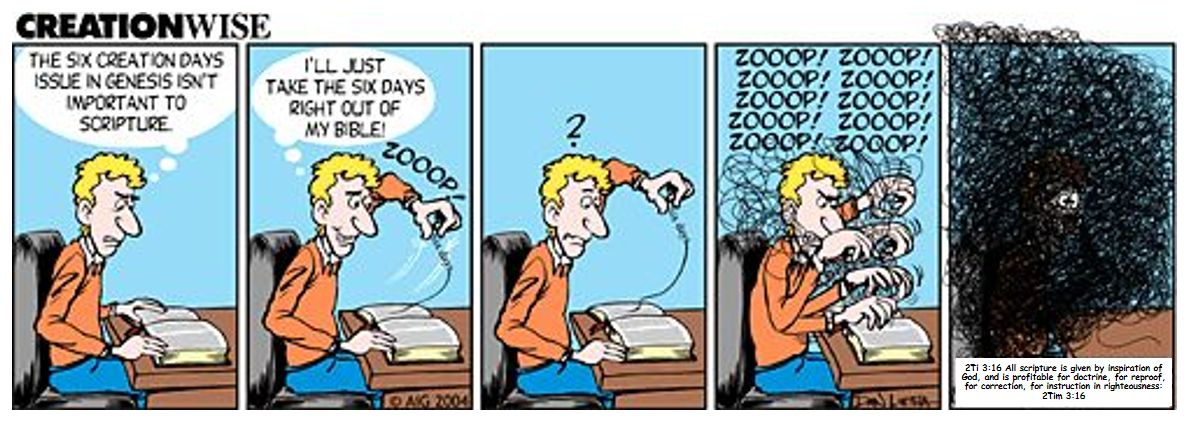
MOSES; the Holy Spirit inspired author of Genesis, was told by God at Mt. Sinai; “For in six days the LORD made heaven and earth, the sea, and all that in them is,” [Ex 20:11] The context is the giving of the weekly Sabbath keeping. Therefore, God is the creation days with the 6 literal days of work in a week.

YOWM; which is the Hebrew word for day, when preceded by a number, is always used as a literal, single revolution of the Earth, day. This word is used in Genesis 1:5, 8, 13, 14, 16,18, 19, 23, 31; Exodus 20:11 as well as the passages related to the keeping of the many feast days.

EVENING & MORNING: Whenever ‘evening’ and ‘morning’ are used in the Old Testament, it always has the meaning of one 24-hour day. If God wanted to tell us that He created everything in 6 24-hour days, what words would He use? The answer – THE SAME words used in Genesis 1.

A WEB OF LIFE PROBLEM: If each ‘day’ represents eons of time, how did plant life survive for millions of years between day 3 & day 5 when insects were created?

JESUS’ TEACHING: He taught that men and women were here from “the beginning of the creation” [Mark 10:6]. If the days are eons, then Jesus was wrong about when man was made, for Genesis has them showing up on day 6, millions or billions of years after the beginning.

DEATH PRECEDED SIN: If the day / age theory is right, then death preceded the fall of man. It was the sin of Adam that brought death into the world. If evolution is true, then death was already a well-established concept. “For since by man came death,” [1Cor 15:21].

GENEALOGIES: Rejecting a literal 24-hour day causes another problem for the Christian. The genealogies in Gen 5 & Luke 11 have a literal man named Adam. If the eon theory is right, which includes the theory of evolution, then you don’t have a literal man named Adam. The Adam of Genesis 1-3 is the same man named in Genesis 5 & Luke 11, an ancestor to our Lord Jesus the Christ.

APPEARANCE OF AGE: Regardless of the theory, both camps believe in an Almighty God. The question then becomes, why does God even need a 24-hour day? Couldn’t all of it have been done in an instant? Another question is, how old did Adam appear when he was formed? Even the atheist Stephen Hawking suggested that if an Almighty God were real, then He could just as easily have created the light between distant stars and the Earth. This would give the appearance of age. We even have a modern-day example of rock & canyon formation within days & months, Lake Shasta near Mt. St. Helens.

These are just a few reasons why I believe in a literal 24-hour 6-day creation. There is even more evidence beyond these. Since none of us were there, we are completely dependent upon the evidence, and for the believer in God, we are totally dependent upon His revealed word as the only eyewitness to these events.

This leaves us with FAITH. “Now faith is the substance of things hoped for, the evidence of things not seen.” [Hebrews 11:1]. Nobody can ‘PROVE’ what happened. Even the atheist must have faith in his theory, for he wasn’t there.

Acceptance of an evolutionary viewpoint is contrary to scripture and is the beginning of a host of other errors when this viewpoint is accepted.

Has God Really Said…?

There is such a thing as a bad question…

In Genesis 3:1, Satan asked Eve, “Has God indeed said, ‘You shall not eat of every tree of the garden’?” This first question in the Bible, and such like it, have been on people’s lips ever since. Has God really said…you must be baptized…you must worship and so many more.

Normally the only bad question is the one not asked, and this wouldn’t be so bad if it was asked by a seeker. Unfortunately, it’s not asked by the seekers, rather, the deniers. Let’s examine this question considering God’s revealed word regarding the creation.

HAS GOD REALLY SAID, ‘HE MADE EVERYTHING IN 6 DAYS?

The short answer is, yes. “For in six days the LORD made heaven and earth, the sea, and all that in them is, and rested the seventh day:” [Exodus 20:11]. If “in six days’ doesn’t mean six literal 24-hour days, then we have a problem. Just as Eve believed the serpent about eating the fruit and lost paradise, if we fail here, we will lose the scriptures, literally! The theory of evolution is at odds with the biblical record. I recently learned that the Catholic church has accepted the possibility of evolution and since 1950, sees no conflict with evolution and the Bible. I see a conflict, and I hope you do as well. If evolution is true, then God has lied, but that’s not possible. God cannot lie [Titus 1:2] and the Bible contains His word [2Timothy 3:16] therefore the Bible is true. I realize this looks like circular reasoning, but God has no reason to lie or He is no God at all.

IF IT’S NOT 6 LITERAL DAYS

THEN…God lied about the thorns. “Because thou hast hearkened unto the voice of thy wife, and hast eaten of the tree…Thorns also and thistles shall it bring forth to thee;” [Gen 3:17,18] Evolutionists tells us that the fossil record reveals both death and thorns for 350-400 million years. Who would know, them or God? Historical science is based entirely on theories, and evolutionists interpret the data through the lens of millions of years. Before they even examine the evidence, they already ‘know’ that whatever they find will be really old. That’s not even good science, for it rejects any evidence that suggest a young earth. God said that thorns came AFTER Adam’s sin, not before as evolutionists suggest.

IF IT’S NOT 6 LITERAL DAYS

THEN…God lied about the reason everyone dies. “But of the tree of the knowledge of good and evil, thou shalt not eat of it: for in the day that thou eatest thereof thou shalt surely die.” [Genesis 2:17] God created everything and at the end of His creative work He said, “…it was very good.” [Gen 2:17] Are you saying that millions of years evolution, which requires death, as being ‘very good?” God never intended for us to die. We see evidence of this in the incredibly long pre-flood lifespans. There is also evidence of arthritis, cancer & disease in dinosaur bones in the fossil record. If dinosaurs truly lived millions of years before humans, then God called death & disease ‘very good.’

THEN…it also makes the Holy Spirit a liar, for He revealed to Paul, “Wherefore, as by one man sin entered into the world, and death by sin;” [Romans 5:12]. If evolution is true, then the Word of the Spirit is false, for He revealed that death came AFTER sin. He also wrote, “For the wages of sin is death; but the gift of God is eternal life through Jesus Christ our Lord.” [Romans 6:23] If evolution is true, and I hope you realize that it is not, then the wages of LIVING is DEATH, a direct contradiction to the Scriptures. Who are you going to believe, God or men?

Scripture teaches that in the beginning there was no death and there will be no more death when Jesus returns. “The last enemy that shall be destroyed is death.” [1Corinthians 15:26]

The Almighty God was there, and like any history, those today only know of historical events through the eyewitness accounts. None of us was there, and therefore must rely on the evidence. For Christians, we have God’s own eyewitness account that tells us death and thorns were brought into the world as the result of Adam’s sin. If we cannot trust His word on a simple thing like thorns, how could we trust Him about what He says about salvation?

IF IT’S NOT 6 LITERAL DAYS

THEN…the redemptive work of Jesus and the defeat of Satan is called into question. “Forasmuch then as the children are partakers of flesh and blood, he also himself likewise took part of the same; that through death he might destroy him that had the power of death, that is, the devil;” [Hebrews 2:14] If the Genesis story is not real, then Satan had nothing to do with death. This line of reasoning also brings the New Testament into question. “He that committeth sin is of the devil; for the devil sinneth from the beginning. For this purpose the Son of God was manifested, that he might destroy the works of the devil.” [1John 3:8].  It was through Satan’s lie to Eve that brought death into the world. God really did say, “in the day that thou eatest thereof thou shalt surely die.”

We need to trust in God’s word and not compromise with the misinterpretation of historical evidence. Early Christians never worried about how to stretch the 6-day creation into millions of years. No, they wondered something completely different.  They asked, “why did God take six days?!”