
Evidence for our faith: Biological similarities

Vertebrate eye

Biological Similarities: Evidence for God in a Six-Day Creation

The remarkable biological similarities between species—too intricate and precise to be explained by evolution—provide powerful scientific evidence for God’s existence as the Creator of all life. These shared features across diverse organisms defy the idea of gradual, naturalistic development, pointing instead to a purposeful design as recounted in the Bible’s six-day creation narrative.

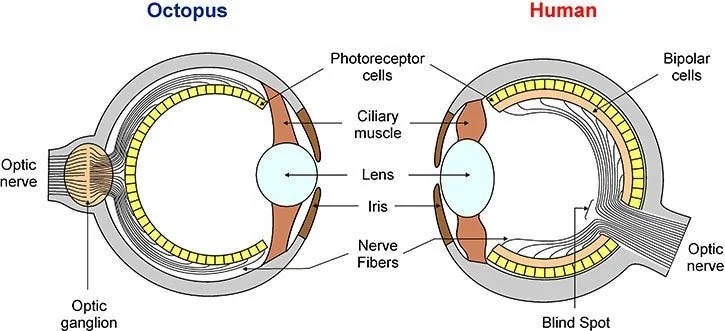
Take the camera-like eye found in both humans and octopuses. Despite no evolutionary link close enough to explain it, both possess retinas, lenses, and optic nerves in stunningly similar arrangements. Evolution suggests these complex structures emerged separately by chance, but the odds of such identical designs arising independently are astronomical.

Biologist Simon Conway Morris notes that these similarities occur too frequently to be random, hinting at a deliberate pattern (Morris, 2015, The Runes of Evolution). Genesis 1:20-21 tells us God created sea creatures and birds on the fifth day, suggesting He crafted these eyes intentionally, not through eons of trial and error.

Then there’s the universal genetic code and protein-building systems—DNA and ribosomes—shared by all life, from bacteria to mankind. Evolution claims this arose once and persisted unchanged, but the complexity of these systems resists explanation as a fluke of nature. Biochemist Michael Denton calls them “primal patterns,” more akin to a master plan than a cosmic accident (Denton, 1986, Evolution: A Theory in Crisis). Genesis 1:26-27 reveals God made man in His image on the sixth day, implying a purposeful design woven into all life from the start.

Enzymes like cytochrome c, vital for energy production, further challenge evolutionary logic. Found in yeast and horses alike, their near-identical structure across vast species gaps suggests a fixed design, not random divergence. Why would such precision hold steady unless crafted by intent? Genesis 1:11-12 describes God creating plants on the third day, each “according to its kind,” hinting at a blueprint for life’s consistency. Psalm 139:14 praises His “wonderful works,” reflecting this meticulous handiwork.

Critics might argue that similarities reflect adaptation or convergence, but this overlooks the sheer complexity and specificity involved. The odds of unrelated organisms independently developing identical genetic and metabolic systems strain credulity without invoking a creator. Psalm 104:24 celebrates this: “How many are your works, Lord! In wisdom you made them all; the earth is full of your creatures.” Biological similarities, then, are not accidents but fingerprints of a Creator who, in six days, crafted a coherent, interconnected world.

Evolution’s tale of chance and time crumbles under these biological marvels. The six-day creation offers a clearer answer: God designed life’s similarities as a signature of His power. From eyes to enzymes, the evidence aligns with Scripture’s bold claim of a purposeful beginning.

Agape,
spencer

Sources:
Denton, M. (1986). Evolution: A Theory in Crisis. Adler & Adler.
Meyer, S. C. (2013). Darwin’s Doubt. HarperOne.
Morris, S. C. (2015). The Runes of Evolution. Templeton Press.
Evidence for our Faith: The Human Eye

The Human Eye

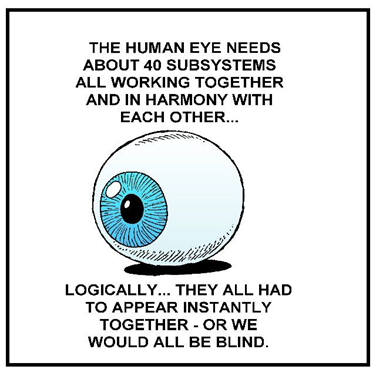
The human eye is one of the most intricate and sophisticated organs in the body, often cited as evidence of intelligent design. Its complexity and functionality defy random chance, pointing instead to purposeful creation. The eye’s ability to perceive light, distinguish colors, and adapt to varying conditions showcases an engineering marvel that naturalistic evolutionary processes struggle to explain.

The eye operates as an integrated system, relying on the coordinated function of numerous components. These include the cornea, lens, retina, optic nerve, and a network of supporting cells and tissues. The retina, for example, contains millions of photoreceptor cells—rods and cones—that convert light into electrical signals. These signals are then processed by the brain, enabling us to perceive the world in vivid detail. The cones are responsible for color vision, while rods excel in low-light conditions, allowing us to adapt to different environments.

A hallmark of the eye’s design is its irreducible complexity. Each part of the eye depends on the others to function properly. For instance, the lens focuses light onto the retina, which converts the light into signals transmitted by the optic nerve to the brain. If any of these components were absent or incomplete, the eye would be nonfunctional. This interdependence challenges the notion of gradual evolution, as intermediate stages would provide no survival advantage.

Darwin himself acknowledged this difficulty, writing in On the Origin of Species: “To suppose that the eye, with all its inimitable contrivances… could have been formed by natural selection, seems, I freely confess, absurd in the highest degree.” (Charles Darwin, On the Origin of Species.)

Biblically, the eye’s intricacy reflects God’s intentional design. Psalm 94:9 asks, “He that planted the ear, shall he not hear? He that formed the eye, shall he not see?” This rhetorical question emphasizes that the Creator, who designed the human eye, possesses perfect knowledge and wisdom. The complexity of the eye aligns with this biblical perspective, affirming a purposeful Designer.

Scientific attempts to explain the evolution of the eye, such as the idea of incremental improvements through natural selection, fail to account for the precise coordination required for its functionality. Mutations alone cannot produce the tightly integrated system observed in the human eye, further supporting the argument for intelligent design.

The human eye stands as a testament to the existence of a Creator. Its complexity, irreducible nature, and unparalleled functionality defy naturalistic explanations, pointing instead to purposeful design. As Romans 1:20 declares, “For the invisible things of him from the creation of the world are clearly seen, being understood by the things that are made.” The human eye, a marvel of engineering, is a clear manifestation of God’s creative power and wisdom.

Agape,

Spencer

GOD is the Genesis, Owner, & Definer

In the beginning, God created the heavens and the earth” (Genesis 1:1).

This statement is a foundational truth that establishes God’s existence and His unparalleled power. As Creator, God brought everything into being out of nothing, speaking life and order into the void. The intricate design of the universe, from the vast galaxies to the smallest particles, testifies to His wisdom and omnipotence. This truth is said also of Jesus, “For by him were all things created, that are in heaven, and that are in earth, visible and invisible, whether they be thrones, or dominions, or principalities, or powers: all things were created by him, and for him” (Col 1:16). But some do not recognize the Creator, “Who is the LORD, that I should obey his voice to let Israel go? I know not the LORD…” (Exo 5:2_

Everything that exists owes its existence to Him. This includes not only the physical universe but also the moral and spiritual dimensions of life. Since He is the source of all life, He possesses an inherent authority over His creation.

Because God is the Creator, He is also the Owner of all that He has made. Psalm 24:1-2 proclaims, “The earth is the Lord’s, and everything in it, the world, and all who live in it; for he founded it on the seas and established it on the waters.” Ownership implies a deep and comprehensive authority. Just as an artist has rights over their masterpiece, God has the ultimate right and claim over His creation.

God’s ownership extends to every aspect of our lives. Our talents, resources, and even our very breath belong to Him. This perspective shifts our focus from self-centered living to a life that honors and glorifies Him. But some would not honor Him, “Because that, when they knew God, they glorified him not as God, neither were thankful” (Rom 1:21a).

Flowing from this truth that God is Creator and Owner, He possesses the sole right to define and decide what is right, just, and necessary for salvation. This divine prerogative is evident throughout Scripture. In Isaiah 45:9, the prophet declares, “Woe to those who quarrel with their Maker… Does the clay say to the potter, ‘What are you making?’” This rhetorical question highlights the absurdity of creation questioning its Creator.

God’s authority encompasses defining moral and ethical standards. In a world rife with moral relativism, God’s Word stands as the absolute standard. His laws and commandments, revealed through Scripture, are not arbitrary rules but reflections of His holy and righteous character.

Moreover, God’s authority extends to the realm of salvation. Throughout the Bible, He has clearly delineated the path to reconciliation with Him. The New Testament emphasizes that salvation is through Jesus Christ alone. In John 14:6, Jesus asserts, “I am the way and the truth and the life. No one comes to the Father except through me.” This exclusivity underscores God’s right to determine the means by which humanity can be saved. But some say that salvation can be found another way, “And when they heard of the resurrection of the dead, some mocked” (Acts 17:32). For some, the gospel is foolishness, (1Cor 1:18).

Understanding God as the ultimate authority challenges us to submit to His will and to obey the gospel (Mark 16:16; Acts 2:38). We trust His wisdom, even when it contradicts our limited understanding or societal norms.

Agape,

Spencer

The Fatherhood of God

FATHER’S DAY is upon us, as we take time out to honor our father’s in the flesh it seems appropriate to look at how Scripture describes God as a Father.

It may surprise you to learn that the Old Testament portrayal of God as Father is quite rare. He is referred to as the Father of the nation of Israel [De 32:6; 1Chron 29:10; Isa 63:16; 64:8; Jeremiah 3:4 Jeremiah 3:19; 31:9; Mal 1:6; 2:10]. “But now, O LORD, thou art our father; we are the clay, and thou our potter; and we all are the work of thy hand” [Isa 64:8]. It speaks of Him as the Father of certain individuals, [2 Sam 7:14; 1 Chron 17:13; 22:10; 28:6; Psalm 68:5; 89:26], and in other places, the idea of Fatherhood is present although the term is not used [Ex 4:22; De 14:1; 32:5, Isa 1:2; 8:18; 9:6; Hos 1:10; 11:1].

As we survey the New Testament, all that changes. The frequency of calling God the Father increases dramatically. Most likely because Jesus said, “Our Father which art in Heaven…” when He taught His disciples to pray, [Mat 6:9]. Jesus, rightfully so, calls God “Father” nearly 200 times in the gospel (over 100 times in the book of John alone). Another word for Father Jesus used was “Abba,” found only 3 times in the New Testament [Mark 14:26; Rom 8:15; Gal 4:6]. In Vine’s Expository Dictionary it says about “Abba”, “It approximates to a personal name, in contrast to ‘Father,’ with which it is always joined in the NT. This is probably due to the fact that, abba having practically become a proper name, Greek-speaking Jews added the Greek word pater, “father,” from the language they used. Abba is the word framed by the lips of infants, and betokens unreasoning trust; ‘father’ expresses an intelligent apprehension of the relationship. The two together express the love and intelligent confidence of the child.” (Vines, W.E., Vines Concise Dictionary of the Bible, Thomas Nelson, Inc. 2005 print page 1)

Should we call God “daddy”?

I’ve noticed a trend among some to refer to God as “daddy” as an attempt to make God sound more familiar to them. They suggest that since the Aramaic word “Abba” is used by children and our nearest English equivalent is “daddy” we have liberty. Their reasoning is flawed since the term is used by older children and adults alike. I’m not a fan of that. Although He is called our Father, we still ought to honor Him with respect, He is still the Almighty God.

God is our Father

There should be no doubt that God is our Father. As the Creator of all things which includes mankind, “So God created man in his own image, in the image of God created he him; male and female created he them” [Gen 1:27], He is our Father. Let us never forget that. Our Father, the Creator, provides for His creation, despite our sin toward Him, in this we ought to be very grateful. “Nevertheless he left not himself without witness, in that he did good, and gave us rain from heaven, and fruitful seasons, filling our hearts with food and gladness” [Acts 14:17]. Because of His goodness over all mankind through His creation, some make the mistake of thinking that this will equate to salvation. For that we need to consider God in another sense, as a Father through adoption.

God, our adopted Father.

Paul tells us in Galatians 4:4-7 that through Christ we may become children of God through adoption, “But when the fulness of the time was come, God sent forth his Son, made of a woman, made under the law, To redeem them that were under the law, that we might receive the adoption of sons. And because ye are sons, God hath sent forth the Spirit of his Son into your hearts, crying, Abba, Father. Wherefore thou art no more a servant, but a son; and if a son, then an heir of God through Christ.” It should be understood that some shall NOT be adopted by God to become their Father, and shall NOT inherit the promises. The question becomes, how do we receive this adoption?

Just a few verses earlier, Paul wrote, “For ye are all the children of God by faith in Christ Jesus. For as many of you as have been baptized into Christ have put on Christ. And if ye be Christ’s, then are ye Abraham’s seed, and heirs according to the promise.” [Galatians 3:26-29]. Friends, don’t miss that. We can all become children of God, He can be our Father by faith when we obey the Gospel of Jesus Christ.