Evidence for our Faith: the Faithful Word

Evidence for Our Bible Today

The Bible we hold today is a treasure, a book that has shaped lives for centuries. But how can we trust it’s the real deal, faithfully passed down through time? The early believers (often called church fathers) from the first few centuries after Christ give us compelling evidence that our Bible is reliable, rooted in their lives, writings, and devotion.

To begin with, people like Ignatius of Antioch and Polycarp, were taught by the apostles or their immediate followers. They didn’t just read about Jesus; they learned from those who walked with Him. Their writings, like Ignatius’ letters (circa 110 AD), echo the New Testament teachings, quoting books like Matthew, John, and Paul’s epistles as Scripture. For example, Ignatius references Jesus’ death and resurrection (Letter to the Smyrnaeans 1:1-2), aligning with 1 Corinthians 15:3-4. This shows the New Testament was already revered as God’s Word within a generation of the apostles, not some later invention.

Also, 2nd century believers defended the Bible’s truth against heresies. Irenaeus, in his Against Heresies (circa 180 AD), argued that the four Gospels (Matthew, Mark, Luke, and John) were uniquely authoritative, handed down through apostolic tradition. He tied their reliability to the Old Testament prophecies fulfilled in Christ, like Isaiah 53:5, which speaks of the Messiah’s suffering. Irenaeus’ work shows the early Church carefully preserved the Scriptures, ensuring no random texts slipped in. Their vigilance gives us confidence that our Bible matches what they held sacred.

Additionally, they sealed their trust in Scripture. Polycarp, martyred around 155 AD, faced death boldly, quoting Jesus’ words from Matthew 10:28: “Do not fear those who kill the body but cannot kill the soul.” His courage, recorded in The Martyrdom of Polycarp, proves he didn’t just believe the Bible, he staked his life on it. Countless others, like Justin Martyr, died for their faith, showing the Scriptures weren’t myths but truths worth everything. Their sacrifices declare to us: this Book is trustworthy. (BTW: their willingness to die wasn’t related in any way to a desire to kill as many folks as possible, as some religions do)

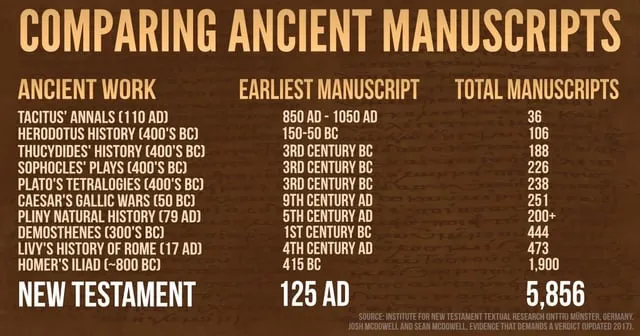
Finally, their meticulous copying and sharing of Scriptures ensured accuracy. Clement of Alexandria (c.150-c.215) and Origen (c.185-c.254) cataloged and taught from texts that match our modern Bible (long before the claims of the catholic church to have brought us the Bible), as seen in surviving manuscripts like the Codex Sinaiticus (4th century). Their efforts preserved God’s Word through persecution and time, a demonstration of faithfulness.

The early believers weren’t perfect, but their writings, lives, and love for Scripture shine as evidence: the Bible we have is the same one they cherished. They bridge the gap between us and the apostles, inviting us to trust God’s Word with the same fire they did.

The Bible stands firm because the early Church Fathers lived and died for it, passing down the truth we hold today.

agape

Sources:

Ignatius, Letter to the Smyrnaeans (Early Christian Writings, http://www.earlychristianwritings.com)

Irenaeus, Against Heresies (Book III, Christian Classics Ethereal Library, http://www.ccel.org)

The Martyrdom of Polycarp (Early Christian Writings) Codex Sinaiticus (www.codexsinaiticus.org) (www.codexsinaiticus.org)

Evidence for our Faith: Why Atheism Fails to Explain the Universe’s Origin

Atheism, as a worldview, suggests that the universe exists without a purposeful intelligent design, relying instead on naturalistic explanations for its origin. Sadly, this perspective struggles to provide a coherent and comprehensive account of the universe’s beginning, leaving critical questions unanswered. In contrast, the Bible offers a logically compelling framework for understanding the universe.

One of atheism’s primary challenges is the question of what caused the beginning of the universe. The universe, according to modern cosmology, began with the Big Bang approximately 13.8 billion years ago (Hawking, 1988). Atheism often leans on theories like quantum fluctuations or multiverse hypotheses to explain this event without invoking a cause. Yet, these explanations falter, only pushing back the question without answering it. Quantum mechanics operates within the framework of space-time, which itself began at the Big Bang. To suggest quantum fluctuations caused the universe requires a pre-existing framework, which doesn’t answer but only blurs the discussion. The multiverse theory, while speculative, lacks any real evidence and merely shifts the question of origin to an unobservable realm (Krauss, 2012). Atheism’s reliance on such theories often feels like an attempt to avoid the question rather than answer it, and requires lots of faith.

In contrast, the Bible presents a clear cause: “In the beginning, God created the heavens and the earth” (Genesis 1:1). This aligns with the philosophical principle of sufficient reason, which argues that everything must have a reason or cause. A transcendent (beyond Time, Space, & Matter), purposeful intelligent design provides a logically consistent explanation for why the universe exists rather than nothing. As Psalm 19:1 states, “The heavens declare the glory of God; and the firmament sheweth his handywork,” suggesting a purposeful order to creation.

Another issue is the fine-tuning of the universe. The physical constants governing gravity, electromagnetism, and nuclear forces are precisely calibrated to allow life (Barrow & Tipler, 1986). Even slight deviations would render the universe inhospitable. Atheism attributes this to chance or necessity, but the odds of such precision arising randomly are astronomically low; it’s like winning a cosmic lottery trillions of times over. Theistic arguments, supported by Romans 1:20, assert that the universe’s order reflects a purposeful design: “For the invisible things of him from the creation of the world are clearly seen, being understood by the things that are made, even his eternal power and Godhead; so that they are without excuse.”

Atheism also struggles with the origin of consciousness and morality. Naturalistic processes like evolution falter in accounting for subjective experiences or objective moral standards as well as biological development. If humans are merely products of matter, why do we possess self-awareness or universal moral intuitions? John 1:3 suggests a divine source for all things: “All things were made by him; and without him was not any thing made that was made.” This implies a purposeful intelligent design behind both the physical and metaphysical aspects of existence.

While atheism offers skepticism, it lacks a robust explanation for the universe’s origin, fine-tuning, and the emergence of consciousness. Theistic arguments, grounded in biblical revelation, provide a coherent narrative that aligns with both reason and observation. Ultimately, atheism’s failure to explain why there is something rather than nothing points to a truth the Bible boldly declares: the universe exists because a purposeful God willed it into being.

The basic question for me is; did everything come from nothing, or did it come from someone who is outside of Time, Space, and Matter? To me, atheism is the least logical belief system (Atheism is the lack of belief in the existence of God). We as humans are currently unable to scan the known universe, let alone the unknown universe, let alone the bottom of our own oceans. How that can one state with confidence, “there is no God.”

AGAPE

Sources:
Barrow, J. D., & Tipler, F. J. (1986). The Anthropic Cosmological Principle. Oxford University Press.
Hawking, S. (1988). A Brief History of Time. Bantam Books.
Krauss, L. M. (2012). A Universe from Nothing. Free Press.
The Bible (KJV): Genesis 1:1, Psalm 19:1, Romans 1:20, John 1:3.

Evidence for our Faith: Bible Prophecy compared to other religious texts

Uniqueness of Biblical Prophecy Compared to Other Religious Texts

Biblical prophecy stands apart from the sacred texts of other mainstream religions due to its specificity, historical fulfillment, and divine coherence across centuries. Unlike the often vague or symbolic predictions found in other religious writings, the Bible’s prophecies offer detailed, verifiable claims that have been demonstrably fulfilled, lending credibility to its divine inspiration.

First, the Bible’s prophecies are remarkably precise. For instance, the prophecy in Isaiah 44:28–45:1 (circa 700 BCE) names Cyrus, a Persian king, as the one who would allow the Jews to return to Jerusalem and rebuild the temple. This prophecy was fulfilled over 150 years later when Cyrus issued the decree in 538 BCE (Ezra 1:1-4). No other religious text matches this level of specificity, naming a future individual and their actions centuries in advance. The Qur’an, for example, lacks detailed predictive prophecies tied to historical events. Similarly, the Bhagavad Gita offers no specific, testable predictions about future rulers or events.

Second, biblical prophecies span centuries and demonstrate consistent fulfillment. The book of Daniel (circa 6th century BCE) predicts the rise and fall of empires (Babylon, Persia, Greece, and Rome) with astonishing accuracy (Daniel 2:31-45; 7:1-28). Historical records, such as those from Herodotus and archaeological findings, confirm these empires’ timelines and transitions. In contrast, texts like the Buddhist Pali Canon or the Vedas focus on cyclical time or spiritual principles without offering verifiable historical predictions. The Bible’s ability to predict geopolitical shifts with precision sets it apart as a text rooted in a divine perspective of history.

Third, the sheer volume and interconnectedness of biblical prophecies create a cohesive narrative. Over 300 prophecies about the Messiah, spanning from Genesis 3:15 to Malachi 3:1, find fulfillment in Jesus’ life, death, and resurrection. For example, Micah 5:2 predicts the Messiah’s birthplace in Bethlehem, fulfilled in Matthew 2:1. Psalm 22:16-18 foretells the crucifixion’s details, including pierced hands and feet and the casting of lots for clothing, fulfilled in John 19:23-24. This intricate web of predictions, written by multiple authors over centuries, demonstrates a unified divine purpose. Other religious texts, such as the Taoist Tao Te Ching, lacks a comparable prophetic framework that ties together historical events and spiritual promises.

Skeptics might argue that these fulfillments are coincidental or retroactively interpreted. However, the Dead Sea Scrolls, dated to the 2nd century BCE, confirm the antiquity of these prophecies, predating their fulfillment. No other religious text provides such a robust, historically verifiable prophetic record.

Biblical prophecy’s unmatched precision and fulfillment reveal a divine hand. No other text dares to predict with such clarity and succeed.

agape

Sources:

  • The Bible (ESV): Isaiah 44:28–45:1, Ezra 1:1-4, Daniel 2:31-45, Micah 5:2, Psalm 22:16-18, Matthew 2:1, John 19:23-24.
  • McDowell, Josh. Evidence That Demands a Verdict. Thomas Nelson, 2017.

Archer, Gleason L. A Survey of Old Testament Introduction. Moody Press, 1994.

Evidence for our Faith: the Moral Argument

The Moral Argument: Why Morality Points to a Creator. God’s Revealed Word as the Source of Objective Morality

The Moral Argument for God’s existence rests on the premise that objective moral values—universal standards of right and wrong—exist and are best explained by a purposeful design from a Creator. While science highlights our innate moral instincts, the Bible provides a unique and compelling case that humanity learns these objective standards through God’s revealed word. This interplay of divine revelation and human conscience offers a profound clue to the existence of a moral lawgiver.

Objective moral values, such as the inherent wrongness of betrayal or the goodness of self-sacrifice, transcend personal opinion or cultural trends. Psychological research, like that of Paul Bloom, shows even infants exhibit rudimentary moral judgments—preferring kindness over cruelty—suggesting an inborn moral sense (Bloom, Just Babies, 2013). Yet, this alone doesn’t explain how we refine and understand these principles. The Bible steps in, asserting that God’s revealed word clarifies and establishes these standards for humanity. Without this guidance, our moral intuitions might remain vague or misdirected.

Scripture presents God as the ultimate source of morality, with His word providing the definitive moral framework. In Exodus 20:1-17, the Ten Commandments are delivered directly from God to Moses, offering unambiguous directives: “You shall not murder,” “You shall not steal.” These laws aren’t mere suggestions but objective truths, reflecting God’s character and intended for all people. This revelation transforms abstract moral instincts into concrete duties, shaping human understanding of right and wrong.

Further, Deuteronomy 6:6-7 instructs, “These commandments that I give you today are to be on your hearts. Impress them on your children.” This emphasizes that morality isn’t left to human guesswork—God’s word is taught, learned, and passed down, refining our natural inclinations. The Psalms reinforce this: Psalm 119:105 declares, “Your word is a lamp to my feet and a light to my path,” portraying divine revelation as the guide that illuminates moral living.

Romans 2:14-15 offers a striking insight: “When Gentiles, who do not have the law, do by nature things required by the law… they show that the requirements of the law are written on their hearts.” This suggests an innate moral awareness, yet the passage implies it aligns with God’s law, revealed fully in Scripture. The Bible bridges the gap between our God-given conscience and the precise standards we’re meant to follow. For instance, Micah 6:8 summarizes divine expectation: “To act justly and to love mercy and to walk humbly with your God”—a standard humanity learns through God’s word, not intuition alone.

Naturalists might argue morality evolves socially, but this fails to explain its objective weight. Cultures differ on specifics, yet core values—like justice—persist universally, echoing biblical principles. God’s revealed word provides the anchor, ensuring morality isn’t arbitrary. As Isaiah 55:8-9 notes, God’s ways are higher than ours, suggesting His revelation elevates human understanding beyond what nature alone could teach.

The Moral Argument, enriched by biblical evidence, posits that objective morality points to a Creator who reveals it through His word. Science hints at our moral wiring, but Scripture—through commandments, teachings, and declarations—grounds it in God’s eternal truth, offering humanity a clear path to righteousness.


Agape,
Spencer

Sources:
o Bloom, Paul. Just Babies: The Origins of Good and Evil. Crown, 2013.
o The Holy Bible, New International Version. Zondervan, 2011 (Exodus 20:1-17, Deuteronomy 6:6-7, Psalm 119:105, Romans 2:14-15, Micah 6:8, Isaiah 55:8-9).

Evidence for our Faith

The Cosmological Argument: Why the Universe Needs a Cause

The cosmological argument, one of the oldest and most compelling proofs for the existence of God, asserts that the universe must have a cause. Its foundation lies in the principle of causality: everything that begins to exist has a cause. Scientific discoveries and philosophical reasoning bolster this argument, making a strong case for a Creator.

The Universe Had a Beginning. One of the most significant discoveries of modern science is that the universe had a beginning. The Big Bang theory, widely accepted among cosmologists, posits that all matter, energy, space, and time originated from a singular event approximately 13.8 billion years ago. Before this point, there was no time, space, or physical reality. This supports the biblical assertion that the universe is not eternal but was created, as described in Genesis 1:1: “In the beginning, God created the heaven and the earth.” (other evidence supports the Biblical narrative for the age of the Earth)

The Second Law of Thermodynamics also supports this conclusion. The universe is moving toward a state of increased entropy, or disorder, which implies that it had an initial highly ordered state. If the universe were eternal, it would have already reached maximum entropy, contradicting observable reality.

Causality and the Need for a Cause. The principle of causality states that everything that begins to exist has a cause. Since the universe began to exist, it must have a cause. However, this cause cannot be part of the physical universe because time, space, and matter only came into existence at the universe’s origin. Therefore, the cause must be timeless, spaceless, and immaterial—qualities that align with the biblical description of God.

Hebrews 11:3 affirms this: “Through faith, we understand that the worlds were framed by the word of God so that things which are seen were not made of things which do appear.” This aligns with the cosmological argument, as it emphasizes that the universe was caused by something outside itself.

The Impossibility of Infinite Regress. An infinite regress of causes—where every cause has a prior cause—leads to logical contradictions. If there were no first cause, the chain of causes could never begin, and the universe could not exist. This necessitates a first, uncaused cause, which philosophers and theologians identify as God.

The cosmological argument is reinforced by scientific evidence that the universe had a beginning, philosophical reasoning on causality, and the impossibility of infinite regress. These findings point to a timeless, spaceless, immaterial, and powerful Creator—attributes consistent with the God of the Bible. As Psalm 33:6 declares, “By the word of the Lord were the heavens made; and all the host of them by the breath of his mouth.”

Sources:
• Craig, W.L. Reasonable Faith: Christian Truth and Apologetics.
• Hawking, S., and Mlodinow, L. The Grand Design.
• Genesis 1:1, Hebrews 11:3, Psalm 33:6 (KJV).

Agape,
Spencer

Why do we DOUBT?

Jesus asked this question of Peter when he began to sink after walking on the water.

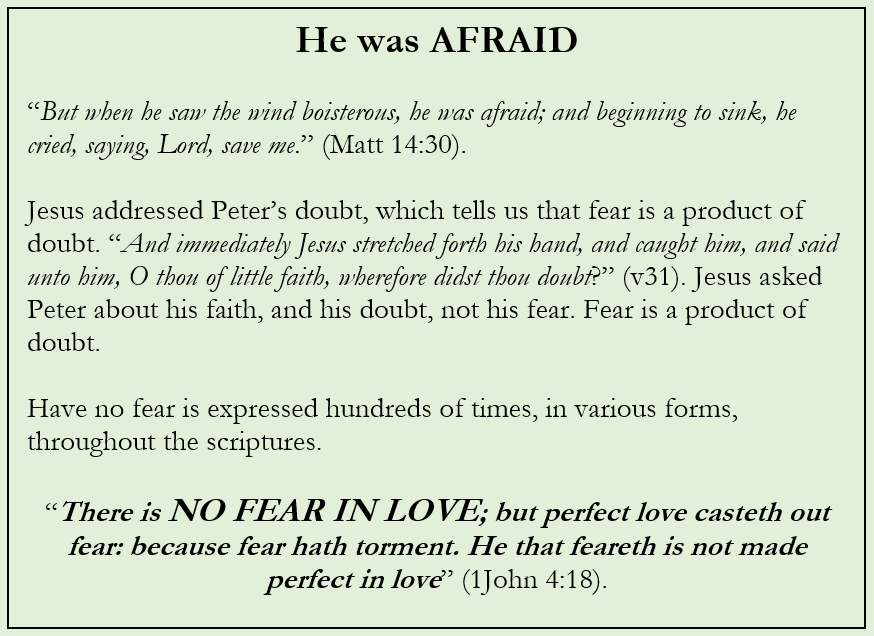
And in the fourth watch of the night Jesus went unto them, walking on the sea. And when the disciples saw him walking on the sea, they were troubled, saying, It is a spirit; and they cried out for fear. But straightway Jesus spake unto them, saying, Be of good cheer; it is I; be not afraid. And Peter answered him and said, Lord, if it be thou, bid me come unto thee on the water. And he said, Come. And when Peter was come down out of the ship, he walked on the water, to go to Jesus. But when he saw the wind boisterous, he was afraid; and beginning to sink, he cried, saying, Lord, save me. And immediately Jesus stretched forth his hand, and caught him, and said unto him, O thou of little faith, wherefore didst thou doubt? And when they were come into the ship, the wind ceased. Then they that were in the ship came and worshipped him, saying, Of a truth thou art the Son of God

(Matthew 14:25-23).

You may wonder why the Lord was so critical of Peter’s doubt, because walking on water is not normal. But that was not the Lord’s rebuke. Peter was walking on water. Jesus was walking on water. They both walked on water together in the storm.

Do we also doubt in the storms of life?
Why do we doubt? What is the source of doubt? This series of articles will seek to search the scriptures for the answer, and to learn how to combat, or to Overcome Doubt.

The first thing we ought to do is to make certain we know what it means. Jesus asked Peter, “why did you doubt (duplicate, i.e. mentally to waver in opinion) [Strong’s Greek dictionary; distazo]. The dictionary defines doubt as; “to be uncertain about; consider questionable or unlikely; hesitate to believe.” DOUBT is the opposite of BELIEF. Therefore, our first source of DOUBT is DISBELIEF. This will be the ultimate root of all the sources.

DISBELIEF is the target of the Lord’s question to Peter (v31), and is our challenge today. Belief in God is the beginning of our salvation. It’s placed first of all other commands in obeying the gospel. Works without faith is vanity. Faith is a work (John 6:29; 1Thess 1:3; 2Thess 1:11).

But without faith it is impossible to please him: for he that cometh to God must believe that he is, and that he is a rewarder of them that diligently seek him” (Hebrews 11:6).

He that believeth and is baptized shall be saved; but he that believeth not shall be damned” (Mark 16:16).

The type of Belief under consideration is compared to the faith of Abraham when he went to sacrifice the son of promise. “Was not Abraham our father justified by works, when he had offered Isaac his son upon the altar? Seest thou how faith wrought with his works, and by works was faith made perfect? And the scripture was fulfilled which saith, Abraham believed God, and it was imputed unto him for righteousness: and he was called the Friend of God. Ye see then how that by works a man is justified, and not by faith only” (James 2:21-24). His belief was so certain that he supposed God would raise Isaac from the dead (Heb 11:17).

However, faith is not blind. “Now faith is the substance of things hoped for, the evidence of things not seen” (Hebrews 11:1). There’s evidence to believe. Peter’s evidence was the prior miracles of Jesus (which are still evidence for us today John 20:30-31). Peter had participated in the feeding of the 5,000 just preceding his water ambulation. How many steps he made on the water we do not know, but one step out of a boat into the deep stormy waters is sufficient. He had gone out in the limited commission with powers, “against unclean spirits, to cast them out, and to heal all manner of sickness and all manner of disease” (Matthew 10:1).

Well, that was Peter you may say; what about us? We don’t see those miracles today. No, we don’t see biblical miracles today, but that’s okay. The miracles Peter saw, and those in the early church are for our belief. “And many other signs truly did Jesus in the presence of his disciples, which are not written in this book: But these are written, that ye might believe that Jesus is the Christ, the Son of God; and that believing ye might have life through his name” (John 20:30-31). But there’s more…

God’s word says that God’s creation is for belief. “Because that which may be known of God is manifest in them; for God hath shewed it unto them. For the invisible things of him from the creation of the world are clearly seen, being understood by the things that are made, even his eternal power and Godhead; so that they are without excuse” (Romans 1:19-20). God’s creation is enough to begin our belief in Him.

Paul used this same evidence for belief. “Nevertheless he left not himself without witness, in that he did good, and gave us rain from heaven, and fruitful seasons, filling our hearts with food and gladness” (Acts 14:17; 17:27-28). The evidence of creation and human life will point you in the right direction to look further. There are only 2 possibilities about creation: 1) that everything came from a thoughtless nothing, or 2) everything came from a very wise, powerful, and brilliant God.

Belief is not blind. It has evidence and there’s so much evidence inside and outside of scripture. If you doubt, perhaps a study of evidences is for you to combat that doubt. Here are a few areas to study…

I have a few resources in my library. One of my favorites is by a brother in Christ named A.O. Schnabel, “Has God Spoken?” This book references scriptures of nature that science discovered many hundreds and thousands of years later. Some discoveries as recent as the 1960’s!

There’s no need to doubt. We can know and be assured.

(to be continued)

Agape,

Spencer