THE GOLDEN CALF: HAVE YOU NOT READ…?
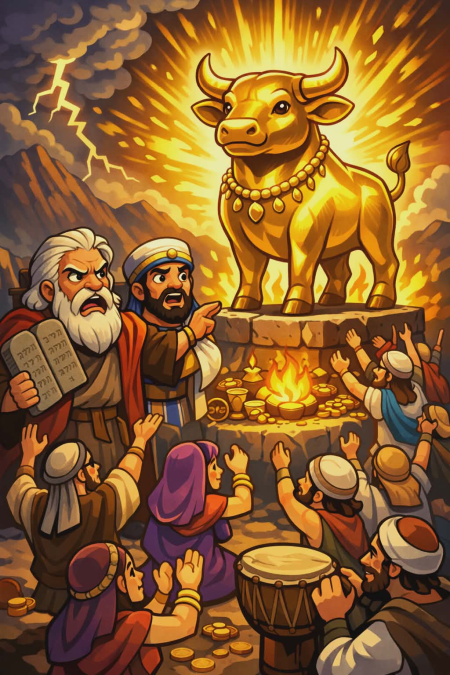
While Moses was on Mount Sinai for forty days receiving God’s law and the stone tablets, the Israelites grew impatient. They gathered around Aaron and demanded, “Come, make us gods who will go before us. As for this fellow Moses who brought us up out of Egypt, we don’t know what has happened to him.
”Aaron told them to bring their gold earrings, which they did. He took the gold, melted it down, and CRAFTED it into the image of a calf. When the people saw it, they exclaimed, “These are your gods, Israel, who brought you up out of Egypt!” Aaron built an ALTAR in front of the calf and announced, “Tomorrow there will be a festival to the Lord.” The next day, the people rose early, offered burnt offerings and peace offerings, then sat down to eat and drink and rose up to revel and play in wild celebration (LET LOOSE).
The Lord told Moses to go down, saying the people had become corrupt and were worshiping an idol, breaking the covenant. God was ready to destroy them and start over with Moses, but Moses interceded, pleading for mercy based on God’s promises to Abraham, Isaac, and Jacob. The Lord relented from total destruction.
Moses descended the mountain with Joshua. Hearing noise, Joshua thought it was battle, but Moses recognized it as singing. When he saw the calf and the dancing, his anger burned. He threw down the tablets, shattering them. He burned the calf, ground it to powder, scattered it on water, and made the people drink it.
Moses confronted Aaron, then called for those on the Lord’s side. The Levites stepped forward and, at Moses’ command, and about three thousand FELL of the guilty that day. Later, a plague struck the people because of their sin with the calf.
This dramatic rebellion showed how quickly the people turned from true worship of the living God to false, man-made worship—even while claiming it honored Him.
He CRAFTED from the people’s earrings (Exodus 32:3-4)
In Exodus 32, while Moses was on Mount Sinai receiving God’s law, the Israelites grew restless. They pressured Aaron: “Come, make us gods who will go before us” (v. 1). Aaron collected their gold earrings, melted them down, and CRAFTED a golden calf. He declared, “These are your gods, Israel, who brought you up out of Egypt!” (v. 4). He BLENDED idol worship with claims of honoring Yahweh. What started as impatience ended in outright idolatry—crafting a god in their own image: visible, portable, controllable, and convenient to their desires.
This is the heart of false worship: people remaking God to fit their preferences rather than submitting to Him as He reveals Himself. They took a kernel of truth—the memory of deliverance from Egypt—and mixed it with massive error: a physical idol violating God’s commands (Ex. 20:4-5). It looked religious, sounded familiar, but it was self-made.
Paul warns of the same danger in Colossians 2:23: “These [regulations] indeed have an appearance of wisdom in promoting self-made religion [or self-imposed worship], false humility and harsh treatment of the body, but they are of no value in stopping the indulgence of the flesh” (ESV/NIV). Today, false worship often follows this pattern—crafting God after our image by blending a little biblical truth with a lot of human invention. We might add entertainment-driven services, self-centered “experiences,” man-made traditions, or watered-down doctrines that prioritize comfort over obedience, all while claiming to honor God. It has the “appearance of wisdom”—it feels spiritual, looks impressive—but it LACKS DIVINE AUTHORITY AND FAILS TO PRODUCE TRUE HOLINESS.
The golden calf teaches us: True worship doesn’t reshape God to suit us; it reshapes us to fit Him. Let’s reject self-made religion and offer God the pure, obedient worship He commands—in spirit and truth (John 4:24).
An ALTAR was also built for it (Exodus 32:5-6)
In Exodus 32, after fashioning the golden calf from the people’s earrings, Aaron took it further. As verse 5 records in the KJV: “And when Aaron saw it, he built an ALTAR before it; and Aaron made proclamation, and said, To morrow is a feast to the LORD.”
Aaron constructed an ALTAR and instituted sacrifices—burnt offerings and peace offerings—typical of legitimate worship to Yahweh. He even called it a “feast to the LORD,” invoking God’s name. Yet this was all directed toward the idol he had made. It appeared devout and sacrificial, but it was corrupt: a man-invented ritual honoring a false god while pretending to serve the true God. God declared the people had “corrupted themselves” (v. 7) and turned aside from His commands.
This pattern persists in false worship today. People build their own “ALTARS”—structures of religious activity—and offer sacrifices that deviate from God’s New Testament pattern. Instead of the living, holy sacrifice God requires, many substitute outward shows: mere attendance, emotional highs, traditions of men, or self-pleasing acts that feel spiritual but lack true submission.
The BIBLE instructs believers in Romans 12:1: “I beseech you therefore, brethren, by the mercies of God, that ye present your bodies a living sacrifice, holy, acceptable unto God, which is your reasonable service.” And in 1 Peter 2:5: “Ye also, as lively stones, are built up a spiritual house, an holy priesthood, to offer up spiritual sacrifices, acceptable to God by Jesus Christ.”
True worship demands our whole selves—living, holy, and spiritual—offered through Christ, not dead rituals or self-made substitutes. The golden calf’s altar reminds us: Any sacrifice not aligned with God’s revealed will is false, no matter how religious it appears. Let us offer only what He accepts: ourselves as living sacrifices in obedient, Spirit-led worship.
They Let LOOSE (Exodus 32:6, 25)
In Exodus 32, after offering sacrifices before the golden calf, the people descended into indulgence. Verse 6 states: “And they rose up early on the morrow, and offered burnt offerings, and brought peace offerings; and the people sat down to eat and to drink, and rose up to play.” The Hebrew term for “play” here implies revelry—LOOSE, immoral behavior, feasting, drinking, and frolic that quickly turned the supposed “feast to the LORD” into carnal excess. What began as religious ritual degenerated into unrestrained partying, idolatry fueling sensuality and self-gratification. God viewed this as corruption (v. 7), and it brought swift judgment.
This “LETTING LOOSE” mirrors false worship today, where assemblies prioritize entertainment over reverence. Many modern “worship centers” resemble concerts—with loud bands, dramatic lighting, smoke machines, and performance-style music that feels more like a rock show than congregational praise. Attendees often observe passively, sipping coffee from on-site cafes, scrolling phones, or enjoying the spectacle rather than actively participating in humble adoration. Some churches even incorporate video games, recreation areas, bowling, or themed play zones—especially for youth—blending social fun with claims of spiritual community. These elements create a casual, consumer-driven atmosphere: eat, drink, play, and feel entertained, all under the guise of worship.
Yet Scripture calls for something different. Romans 14:17 declares: “For the kingdom of God is not meat and drink; but righteousness, and peace, and joy in the Holy Ghost.” True worship produces holiness and spiritual fruit, not worldly indulgence. Paul rebuked the Corinthians for turning the Lord’s Supper into selfish feasting and divisions (1 Corinthians 11:17-34), much like the calf’s revelry.
The golden calf teaches that when worship becomes playtime—food, fun, frolic, concerts, and entertainment hubs—it ceases to honor God. It entertains the flesh instead of transforming the heart. Let us guard against this: Assemble to offer reverent, Spirit-led worship in spirit and truth (John 4:24), not to be amused. Flee the LOOSE LIVING of false worship and pursue the holy joy of true devotion to Christ.
3k People FELL that day (Exodus 32:28)
In Exodus 32, the golden calf incident reached its tragic climax in judgment. After the people had crafted the idol, built the altar, offered false sacrifices, and let loose in revelry, Moses descended the mountain in righteous anger. He confronted Aaron, then called out, “Who is on the LORD’s side?” (v. 26). The Levites stepped forward. Moses commanded them: “Thus saith the LORD God of Israel, Put every man his sword by his side, and go in and out from gate to gate throughout the camp, and slay every man his brother, and every man his companion, and every man his neighbour” (v. 27). Verse 28 in the KJV records the outcome: “And the children of Levi did according to the word of Moses: and there fell of the people that day about three thousand men.”
Three thousand fell by the sword that day because of their idolatry and false worship. Later, verse 35 adds: “And the LORD plagued the people, because they made the calf, which Aaron made.” The sin brought immediate death and ongoing plague—consequences for corrupting true worship.
Paul draws a direct parallel in the New Testament church. In 1 Corinthians 11, he rebukes the Corinthians for mishandling the Lord’s Supper—divisions, selfishness, and unworthy participation that turned a sacred memorial into a selfish meal. He warns in verse 30 (KJV): “For this cause many are weak and sickly among you, and many sleep.” “Sleep” here means death—some had literally died as divine judgment for profaning the Lord’s table. False or irreverent “worship” brought physical weakness, sickness, and even premature death.
Today, false worship carries the same danger. When assemblies prioritize entertainment, man-made traditions, or self over humble obedience—when people approach God casually, divisively, or hypocritically—they risk spiritual and even physical consequences. God is holy; He does not tolerate corrupted worship. The three thousand who fell at Sinai and those who “sleep” in Corinth stand as warnings: False worship is not harmless fun—it can be deadly.
Let us examine ourselves. Are we assembling in truth, offering living sacrifices in reverence? Or are we risking judgment by crafting modern golden calves? Flee false worship. Pursue pure, obedient devotion to Christ, that we may honor Him rightly and escape the falling that comes from dishonoring God.
BE NOBLE & SEARCH THE SCRIPTURES TO FIND OUT IF THESE THINGS ARE SO.
 Borger church of Christ @ Franklin & Juniper