Other scriptural arguments that refute “Eternal Security”
A. The fact the Bible exhorts to faithfulness proves one can be lost be steadfast immovable: 1 Cor 15:58 If these qualities are yours…2 Pe 1:5-11 we will reap if we do not grow weary: Gal 6:9 be faithful unto death and I will give crown of life: Rev 2:10 practice these things and God will be with you: Phil 4:9
B. Man has a free will: Josh 24:15 to argue otherwise is nonsense and is a veiled form of existentialism
C. The Bible clearly prophesied some would fall away: Acts 20:28; 1 Ti 4:1
D. Christians are to restore the fallen: Gal 6:1; Jas 5:19-20
Several of the world’s denominations teach that Christians cannot sin so as to become lost; that is, there is no way that a true convert of Christ he cannot go to hell may sin, and thereby, receive eternal damnation – he cannot go to hell after having once been saved. This is popularly spoken of as the doctrine of “once saved, always saved”.
On one extreme, this doctrine is expressed as, “True Christians will not sin as they lack the desire and the capability to sin, because their allegiance to Christ has changed their nature”. At its other extreme, this doctrine is expressed as, “No matter how grievous, the sins of Christians will not be held against them in the final judgement”. Those who hold this last view believe that Christians can do wrong, but they also believe that Christ will forgive them of any, and every, sin so that they will be blameless on the day of judgement.
You researched this question to find, not what man teaches, but what the Bible teaches about the possibility of Christians falling from the way of truth, and becoming lost.
The most clear treatment of this subject in the New Testament is found in the second chapter of II Peter. Study this entire chapter carefully. I quote now verses 20 and 21, which best summarize its teachings,
“For if after they have escaped the pollution of the world through the knowledge of the Lord and Saviour Jesus Christ, they are again entangled therein, and overcome, the latter end is worse with them than the beginning. For it had been better for them not to have known the way of righteousness, than, after they have known it to turn from the holy commandment delivered unto them“.
Unquestionably the people spoken of here were once Christians, for the writer speaks of them as those who had, “(quote) escaped from the pollution of the world through the knowledge of the Lord Jesus Christ” (unquote). Unquestionably these same people were, again, entangled in worldly pollution, that is, they had fallen from the way of the truth, and had (again) become sinners. Also, unquestionably they are subject to condemnation for these sins, for the verse says that their final state is worse than their initial state, that is, they are worse off than before they were saved. Thus, the doctrine of “once saved, always saved”, is not supported by the scriptures, for the Bible here shows that Christians can sin, and that they may receive punishment for those deeds.
All verses of the Bible agree with all other verses when the subject is the same, and when the rule, or law of God, is the same. Also, when the rule, or law, is consistent, clear verses serve to explain less clear verses about the same subject. Said in a different way, the Bible never contradicts itself, and the Bible is its own best interpreter. Remember, God cannot lie, and God is not the author of confusion. Study Hebrews 6:18, and I Corinthians 14:33. To illustrate this, we can study verses about baptism (for instance) in the New Testament books written by the apostles John, Paul, and James, and expect agreement. But, we cannot necessarily expect agreement between the Old Testament writings of Moses and the New Testament writings of Paul concerning (say) worship; Moses’ laws were in effect until Jesus’ death ended them. See Col. 2:14. Paul’s writings, however, are a part of the will of Christ, His New Testament. The New Testament is our guide today.
In I John 3:9, we read, “Whosoever is born of God doth not commit sin; for his seed remaineth in him: and he cannot sin, because he is born of God“. If this verse teaches, “once saved, always saved”, it is contrary to II Peter 2:20 and 21 (which we read previously). Thus, a contradiction is forced into the scriptures which cannot exist. However, apparent conflict disappears when we see that the writer is stating the obvious fact that Christians cannot sin and remain faithful followers of the Lord. This is verified by the very same writer in the very same letter where the apostle, John, in I John 1:8-10 says, “If we say that we have no sin, we deceive ourselves, and the truth is not in us. If we confess our sins he is faithful and just to forgive us our sins, and to cleanse us from all unrighteousness. If we say that we have not sinned, we make him a liar, and his word is not in us“.
Here, again, we find an inspired writer telling true believers, Christians (including himself) that they can sin, and that they can do unrighteousness. More deeply, John is here instructing Christians how they can find forgiveness for their sins; Christians are to confess their sins and they will be forgiven them. This instruction is not for sinners who have never become Christians. Christians are citizens of God’s kingdom, and must abide by its rules. People who are not citizens in the kingdom must first become so before its laws apply to them. We suggest that you find how to become a citizen of God’s kingdom through study the message, “What Must I Do To Be Saved?” and “Are We Saved By Faith Only?”.
Belief in, “once saved, always saved” may seem justified by John 10:27-29, “My sheep hear my voice, and I know them, and they follow me: And I give unto them eternal life; and they shall never perish, neither shall any man pluck them out of my hand“. If this scripture proves, “once saved, always saved”, the scriptures contradict each other, and this, of course, is an impossibility. To harmonize the scriptures (to make them agree, one with another), we must notice that Jesus did not say that his sheep could not leave of their own accord; He said that no man could pluck them away.
Each Christian may leave Christ, if he chooses; but unless the individual wishes to go, no one else can make him leave. Notice in verse 27, Jesus said that His sheep, “know me and follow me“, and thus, following, and continuing to follow the Savior is a condition that we must fulfill if the promise, “neither shall any man pluck them out of my hand” is to be kept.
And so, in addition to those things necessary to become saved (namely, believing the word of God, believing that Jesus is the Christ, the Son of God, repenting of (or changing away from) a sinful life, and being baptized into Christ for the remission of sins, we have an additional requirement, that of being faithful unto death (Revelation 2:10).
“Once saved, always saved” is a dangerous doctrine: The Christian who does fall away (upon seeing his sinful life) may conclude that he was never saved and become doubtful of the power of God; another may live a sinful life, and become lost, while believing that God is unmindful of the sins being committed. Either way can result in eternal death for the sinner’s soul, and it would be such a useless death, for (as we have seen), the doctrine of “once saved, always saved” is wrong. The Christian who sins must confess those sins to God, who will forgive them.
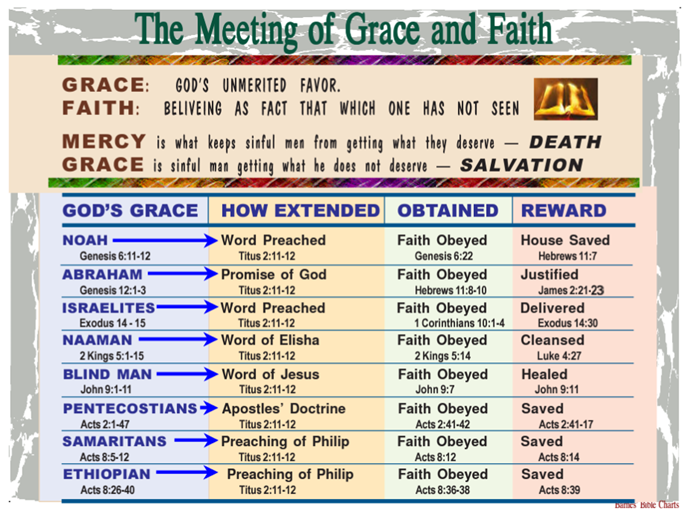
IN the prior article on GRACE, we learned that it is the Gift of God through faith.
the GRACE of God is a gift, and it can either be RECEIVED or REJECTED.
Received…
Titus 2:11-12 For the grace of God that bringeth salvation hath appeared to all men, [12] Teaching us that, denying ungodliness and worldly lusts, we should live soberly, righteously, and godly, in this present world;
Rejected…
Hebrews 12:15 Looking diligently lest any man fail of the grace of God; lest any root of bitterness springing up trouble you, and thereby many be defiled;
Galatians 5:4 Christ is become of no effect unto you, whosoever of you are justified by the law; ye are fallen from grace.
What shall you do with God’s Gift of GRACE?
Are you seeking to better understand God’s Grace and his word?
Send me a message and we can have a home Bible study in person or have one sent to you.
Click here to read part three, by Grace we have ACCESS to salvation.
“For by grace are ye saved through faith; and that not of yourselves: it is the gift of God.”
(Eph 2:8)
There should be no doubt that Grace is a GIFT. Unfortunately, there is so much misunderstanding and confusion about Grace. Not because the scriptures are confusing (1Cor 14:33), but because there are so many opinions about it.
GRACE is a wonderful thing and ought to be understood by the faithful to fully appreciate it and to motivate us for better service to God.
This and the next four articles will be dedicated to some aspect of GRACE so we can “grow in grace and knowledge of the Lord Jesus Christ.” (2Peter 3:18)
This first article examines Grace as the GIFT of God as it is called in the passage above.
“…it is the GIFT of God.”
A gift has 2 parties, a Giver and a receiver. Grace is a Gift Given by God & Christ to the world (Titus 2:11). It is also given without merit on the part of the receiver. There is nothing redeeming about man that generated the gift, it was out of the love of God. “But one in a certain place testified, saying, What is man, that thou art mindful of him? or the son of man, that thou visitest him” (Heb 2:6; cf. Job 7:17; Ps 8:4; 144:3)?
“For the law was given by Moses, but grace and truth came by Jesus Christ.” (John 1:17) “But we believe that through the grace of the Lord Jesus Christ we shall be saved, even as they” (Acts 15:11).
This Gift of Grace is pertaining to Salvation for mankind. “For by Grace you are saved through faith…” Another way of saying this is that the opportunity to be saved, the method, the plan, has been given as a Gift to undeserving people (Rom 5:8-10). As we shall see in the following points, NOT EVERYONE WILL PARTICIPATE IN, NOR ACCEPT THE GIFT OF GRACE.
The Gift of Grace needs to be received (accepted), and it is possible to receive it IN VAIN (which is to try and apply grace on your own terms, without repentance).
“We then, as workers together with him, beseech you also that ye receive not the grace of God in vain” (2Cor 6:1).
Many are confused and deceived because it is taught that the Gift of Grace is given and applied universally. (Universalism is an error that teaches everyone will go to heaven even if it’s against their will, if they’re in unrepentant sins, or even an atheist). While Grace is a Gift for the whole world, not everyone will receive it, or worse, they receive it IN VAIN. To receive it IN VAIN is to make it of none effect.
It must also be noted that the GIFT of Grace may be received, but later one can FALL FROM GRACE.
“Christ is become of no effect unto you, whosoever of you are justified by the law; ye are fallen from grace” (Gal 5:4). And you can make it void; “I do not make void the grace of God: for if righteousness is through the law, then Christ died for nought” (Gal 2:21; ASV)
So you see, while GRACE is a GIFT for all, not everyone will receive (accept) it, nor will everyone remain in it.
Finally, it is THROUGH HIS GRACE & THROUGH OUR FAITH that saves.
“But we believe that through the grace of the Lord Jesus Christ we shall be saved, even as they” (Acts 15:11).
Critics will claim that if there is something a person must do to be saved, even a command from God, then it is no longer a GIFT. What they fail to realize is that God’s Gift of Grace is working THROUGH our faith (trusting belief) in God’s plan, and His Son. To obey God is not earning salvation, it’s trusting in His working THROUGH His Grace.
“In whom also ye are circumcised with the circumcision made without hands, in putting off the body of the sins of the flesh by the circumcision of Christ: Buried with him in baptism, wherein also ye are risen with him through the faith of the operation of God, who hath raised him from the dead” (Col 2:11-12) [emph mine seb].
We see that the Gift of Grace is the opportunity, and the availability of salvation, but it must be received (accepted) in truth, faith, and obedience to God who is giving it and working through it. To believe is to obey as Paul wrote in Romans 10 (often ignored by the faith only crowd). “But they have not all obeyed the gospel. For Esaias saith, Lord, who hath believed our report” (Rom 10:16)? Do you see how “obeyed” and “believed” are used inseparably?
The Ephesians were taught about Grace, and they were taught how to receive it, by being baptized into Christ (Acts 19:1-5). Paul would later write to them and say; “In whom we have redemption through his blood, the forgiveness of sins, according to the riches of his grace” (Eph 1:7). Baptism is a part of God’s Grace in saving mankind, beginning with the Death, Burial, and Resurrection of Christ (cf. Rom 6:3-4).
Jesus Gives the Gift of Grace through His sacrifice, making a way for all of mankind to be saved if they will believe it and obey it. “For by grace we are saved, it is the Gift of God.”
Spencer is an evangelist for the church of Christ at Franklin & Juniper in Borger, Texas.
Did you know that it’s possible for folks to make a false denomination because of a misunderstanding of the Bible?
Matt 22:23-33 The Sadducees made a Jewish denomination because they didn’t take notice of the tense of a verb.
Jesus said to them, “Ye do Err, not knowing the scriptures nor the power of God.” (Matt 22:29)
“Moreover he said, I AM the God of thy father, the God of Abraham, the God of Isaac, and the God of Jacob. And Moses hid his face; for he was afraid to look upon God.” (Exo 3:6)
Jesus is pointing out that God said “I AM,” not “I WAS.”
The Sadducees entire system of belief about salvation was error.
Acts 23:7 “And when he had so said, there arose a dissension between the Pharisees and the Sadducees: and the multitude was divided. 8 For the Sadducees say that there is no resurrection, neither angel, nor spirit: but the Pharisees confess both.”
Are you making an error in your faith not knowing the scriptures?
How would we know?
Some have…
Shipwrecked their faith: 1Tim 1:19 Holding faith, and a good conscience; which some having put away concerning faith have made shipwreck:
Neglected Salvation: Heb 2:3 How shall we escape, if we neglect so great salvation; which at the first began to be spoken by the Lord, and was confirmed unto us by them that heard him;.
Fallen from Grace: Gal 5:4 Christ is become of no effect unto you, whosoever of you are justified by the law; ye are fallen from grace.
Departed from God: Heb 3:12 Beware, brethren, lest there be in any of you an evil heart of unbelief in departing from the living God;
Drawn back to perdition: Heb 10:39 But we are not of them who draw back unto perdition; but of them that believe to the saving of the soul.
>Spencer, Evangelist for the church of Christ at Franklin & Juniper St.




 Borger church of Christ @ Franklin & Juniper