7 PLAGUES of the mind pt 2

LEERINESS & APATHY.

Before we can exceed our expectations, we must first face our limitations. Attitudes of the mind that interfere with our faith are some of those limitations.

Awareness is a warning. Just as we watch the weather to prepare for a storm, so too should we be aware of those negative PLAGUES of the mind that contribute to the storms of life.

Last article looked at the first in our list called Pessimism. Today we give warning to the second and third; Leeriness (overcaution) and Apathy.

All of the PLAGUES are natural responses to our experiences in life. They are not sin in and of themselves, except as it weakens our faith, and faithfulness.

And immediately Jesus stretched forth his hand, and took hold of him, and saith unto him, O thou of little faith, wherefore didst thou doubt” (Matt 14:31)?

Overcaution, being overly leery, is being unnecessarily cautious. We are instructed to be cautious; “Look therefore carefully how ye walk, not as unwise, but as wise” (Eph 5:15), but overcautious can hinder us in helping brethren. “Forget not to show love unto strangers: for thereby some have entertained angels unawares” (Heb 13:2).

Jesus spoke about helping strangers, “Then shall the King say unto them on his right hand, Come, ye blessed of my Father, inherit the kingdom prepared for you from the foundation of the world:  for I was hungry, and ye gave me to eat; I was thirsty, and ye gave me drink; I was a stranger, and ye took me in; naked, and ye clothed me; I was sick, and ye visited me; I was in prison, and ye came unto me” (Matt 25:34-36). These two passages talk about the individual responsibility first toward brethren in Christ, and also toward our fellow man (cf Gal 6:10; Luke 10:33-37)

Life is full of risk. It’s risky to do those things needed to take responsibility for the needs of the family. It’s risky to try to improve our health, & mind. We risk appearing foolish as we learn. It’s risky to serve God (Acts 3-8). It’s risky to keep the faith in a faithless world. “And ye shall be hated of all men for my name’s sake: but he that endureth to the end, the same shall be saved” (Matt 10:22).

A few years ago, Overcaution led many away from assembling with the saints. That’s not to say we should take unnecessary risks, being too risky is unwise, but it takes risk to remain faithful. If worshiping together with the saints becomes illegal, will you risk it to worship God? While Paul was ready to risk death (Acts 21:13), he took advantage of an opportunity to avoid dying unnecessarily (Acts 23:11-22). Be ready to die, but avoid it if it doesn’t cause you to lose faith. “For whosoever would save his life shall lose it: and whosoever shall lose his life for my sake shall find it” (Matt 16:25).

To overcome overcaution, we need to remember the instruction to Timothy; “For which cause I put thee in remembrance that thou stir up the gift of God, which is in thee through the laying on of my hands. For God gave us not a spirit of fearfulness; but of power and love and discipline. Be not ashamed therefore of the testimony of our Lord, nor of me his prisoner: but suffer hardship with the gospel according to the power of God” (2Tim 1:6-8)

Apathy is the third in our list of plagues of the mind. The bible describes it as being lukewarm. “I know thy works, that thou art neither cold nor hot: I would thou wert cold or hot. So because thou art lukewarm, and neither hot nor cold, I will spew thee out of my mouth” (Rev 3:15-16). Think about coffee. We like it either piping hot or ice cold, but room temperature coffee is not on any Starbucks menu. Room temperature is the temperature of inactivity.

Apathy takes the “I don’t care” or “It doesn’t matter” approach to service rendered toward God. While there are some things that have no affect on maintaining fellowship, there are other things that are absolute. Baptism, instrumental music in worship, faith in Christ, preaching the gospel, etc are doctrines that cannot be changed.

Paul wrote to Timothy, “Take heed to thyself, and to thy teaching. Continue in these things; for in doing this thou shalt save both thyself and them that hear thee” (1Tim 4:16). There are teachings (doctrines) that are absolute. The ecumenical world takes a casual approach to the doctrine of Christ. “If any one cometh unto you, and bringeth not this teaching, receive him not into your house, and give him no greeting” (2John 10).

Pour it on is the opposite attitude of apathy. Paul found contentment in whatever state he was in; “Not that I speak in respect of want: for I have learned, in whatsoever state I am, therein to be content.” (Phil 4:11). Paul pressed all the buttons, turned all the knobs, and flipped all the switches. “I press toward the mark for the prize of the high calling of God in Christ Jesus” (Phil 3:14).

Paul wrote quite a bit about being on fire for the Lord:

Apathy is the drift approach to faithfulness. “Therefore we ought to give the more earnest heed to the things that were heard, lest haply we drift away from them. For if the word spoken through angels proved stedfast, and every transgression and disobedience received a just recompense of reward; how shall we escape, if we neglect so great a salvation? which having at the first been spoken through the Lord, was confirmed unto us by them that heard;” (Heb 2:1-3; emph mine seb).

The Leeriness and Apathetic approach to faith is no faith at all. These two plagues need to be fought like we fight any physical disease.

Agape,

Spencer

the 7 PLAGUES of the mind is a series of articles about attitudes.

Why do we DOUBT? Oppression.

When Jesus asked Peter; “why did you doubt?” they were standing in the midst of a storm on tossing seas (Matt 14:24-31).

Isn’t that how it is for us? Our doubts arise in the midst of the storms on the crashing seas of life. We seldom doubt on the calm, and peaceful waters.

This scene with Peter on the sea reminds me of the parable of the Sower. Jesus’ teaching about the rocky soil resembles the fear and doubt that arise during times of trouble.

But he that received the seed into stony places, the same is he that heareth the word, and anon with joy receiveth it; Yet hath he not root in himself, but dureth for a while: for when tribulation or persecution ariseth because of the word, by and by he is offended” (Matt 13:20-21).

Doubt, and falling away, often comes in the face of opposition, or persecution for the word’s sake.

If we can learn to overcome doubt in these situations, perhaps we’ll be able to endure the regular troubles of life.

Why do we doubt? What is the source of doubt? This series of articles will seek to search the scriptures for the answer, and to learn how to combat, or to Overcome Doubt. The first article showed that Doubt is based on Disbelief, and the way to overcome disbelief is through knowledge of the Lord Jesus Christ. This article will attempt to Overcome Doubt that arises from the Oppression of life. 

In the parable of the soils, and in the example of Peter, it becomes clear that trouble reveals our DOUBTS instead of causing them. There are some who teach the error that becoming a Christian relieves us of all pain & suffering. The bible says something completely different.

Yea, and all that will live godly in Christ Jesus shall suffer persecution” (2Tim 3:12).

Confirming the souls of the disciples, and exhorting them to continue in the faith, and that we must through much tribulation enter into the kingdom of God” (Acts 14:22).

Be not thou therefore ashamed of the testimony of our Lord, nor of me his prisoner: but be thou partaker of the afflictions of the gospel according to the power of God” (2Tim 1:8)

Marvel not, my brethren, if the world hate you” (1John 3:13).

These few verses should be sufficient to show that suffering for the faith is a reality for the faithful. Resilience & Endurance is the antidote to DOUBT, but developing these is key. Resilience is the capacity to recover quickly from difficulties; toughness. Endurance is the ability or strength to continue or last, especially despite fatigue, stress, or other adverse conditions.

There is a very good reason why we ought to endure. “You therefore must endure hardship as a good soldier of Jesus Christ” (2Tim 2:3). “If we endure, We shall also reign with Him. If we deny Him, He also will deny us” (2Tim 2:12).

How does one develop endurance? This lesson goes along with the first lesson about faith; remember to remember the Lord and have faith. “Remember that Jesus Christ of the seed of David was raised from the dead according to my gospel: Wherein I suffer trouble, as an evil doer, even unto bonds; but the word of God is not bound. Therefore I endure all things for the elect’s sakes, that they may also obtain the salvation which is in Christ Jesus with eternal glory. It is a faithful saying: For if we be dead with him, we shall also live with him: If we suffer, we shall also reign with him: if we deny him, he also will deny us” (2Timothy 2:8-12).

Have Faith, then after that, the next thing is to stand firm for the faith. The way we can do this is through 5 reminders.

First, Stand back and ask, “is this the worst that can happen?” Before we sink, take time to think. “For our light affliction, which is for the moment, worketh for us more and more exceedingly an eternal weight of glory” (2Cor 4:17). “Fear him that can destroy in Hell” (Mat 10:28; Luke 12:5). “For I reckon that the sufferings of this present time are not worthy to be compared with the glory which shall be revealed to us-ward” (Rom 8:18). We often give up long before our endurance expires. 

Then ask, “How can I endure this?” Before we give up, remember the example of those that faced trials before you. “rejoicing that they were counted worthy to suffer dishonor for the Name” (Acts 5:41; cf. 2Cor 11:22-33). “Behold, we count them happy which endure. Ye have heard of the patience of Job, and have seen the end of the Lord; that the Lord is very pitiful, and of tender mercy” (James 5:11). Can you steel yourself against the pain, can you TOUGHEN up? Paul wrote, “Watch ye, stand fast in the faith, quit you like men, be strong” (1Cor 16:13).

A third question to ask is, “Are there any good things that can come from this?” Paul saw the good of preaching Christ even under false pretenses (Phil 1:12-18). James wrote that the trying of our faith produces patience (Jas 1:3).

Nature itself teaches us that growth comes through enduring difficulties. The writer of Hebrews noted this. “Furthermore we have had fathers of our flesh which corrected us, and we gave them reverence: shall we not much rather be in subjection unto the Father of spirits, and live? For they verily for a few days chastened us after their own pleasure; but he for our profit, that we might be partakers of his holiness. Now no chastening for the present seemeth to be joyous, but grievous: nevertheless afterward it yieldeth the peaceable fruit of righteousness unto them which are exercised thereby. Wherefore lift up the hands which hang down, and the feeble knees(Heb 12:9-13).

Then make a commitment to NEVER, NEVER, NEVER, NEVER, GIVE UP! “And let us not be weary in well doing: for in due season we shall reap, if we faint not” (Gal 6:9; cf. Phil 4:13; Rev 2:10). Make endurance the only option.

Lastly, and most importantly, do all you can do to stand. “Wherefore take unto you the whole armour of God, that ye may be able to withstand in the evil day, and having done all, to stand” (Eph 6:13; cf. 10-18). Be a doer of God’s word and not a hearer only. Do the best you can and when you learn to do better, do better.

I press toward the mark for the prize of the high calling of God in Christ Jesus.” “I can do all things through Christ which strengtheneth me”. (Phil 3:14; 4:13). The troubles of life reveal our doubts, but we can do it, the Lord said so (1Cor 10:13).

Agape,

Spencer

FILED UNDER: Overcoming doubt.

You’re invited to attend one of the services of the Franklin & Juniper st church of Christ in Borger Texas.

Why do we DOUBT?

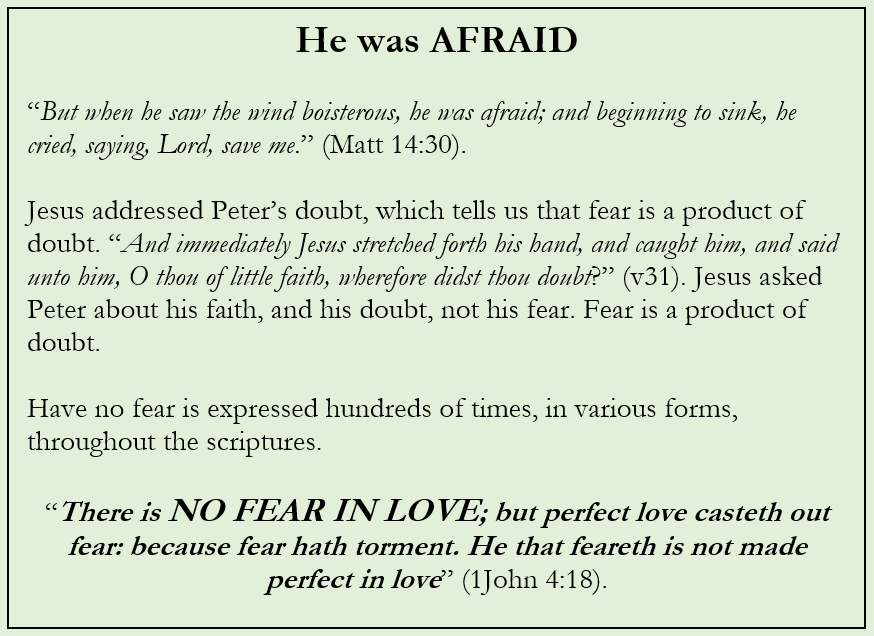
Jesus asked this question of Peter when he began to sink after walking on the water.

And in the fourth watch of the night Jesus went unto them, walking on the sea. And when the disciples saw him walking on the sea, they were troubled, saying, It is a spirit; and they cried out for fear. But straightway Jesus spake unto them, saying, Be of good cheer; it is I; be not afraid. And Peter answered him and said, Lord, if it be thou, bid me come unto thee on the water. And he said, Come. And when Peter was come down out of the ship, he walked on the water, to go to Jesus. But when he saw the wind boisterous, he was afraid; and beginning to sink, he cried, saying, Lord, save me. And immediately Jesus stretched forth his hand, and caught him, and said unto him, O thou of little faith, wherefore didst thou doubt? And when they were come into the ship, the wind ceased. Then they that were in the ship came and worshipped him, saying, Of a truth thou art the Son of God

(Matthew 14:25-23).

You may wonder why the Lord was so critical of Peter’s doubt, because walking on water is not normal. But that was not the Lord’s rebuke. Peter was walking on water. Jesus was walking on water. They both walked on water together in the storm.

Do we also doubt in the storms of life?
Why do we doubt? What is the source of doubt? This series of articles will seek to search the scriptures for the answer, and to learn how to combat, or to Overcome Doubt.

The first thing we ought to do is to make certain we know what it means. Jesus asked Peter, “why did you doubt (duplicate, i.e. mentally to waver in opinion) [Strong’s Greek dictionary; distazo]. The dictionary defines doubt as; “to be uncertain about; consider questionable or unlikely; hesitate to believe.” DOUBT is the opposite of BELIEF. Therefore, our first source of DOUBT is DISBELIEF. This will be the ultimate root of all the sources.

DISBELIEF is the target of the Lord’s question to Peter (v31), and is our challenge today. Belief in God is the beginning of our salvation. It’s placed first of all other commands in obeying the gospel. Works without faith is vanity. Faith is a work (John 6:29; 1Thess 1:3; 2Thess 1:11).

But without faith it is impossible to please him: for he that cometh to God must believe that he is, and that he is a rewarder of them that diligently seek him” (Hebrews 11:6).

He that believeth and is baptized shall be saved; but he that believeth not shall be damned” (Mark 16:16).

The type of Belief under consideration is compared to the faith of Abraham when he went to sacrifice the son of promise. “Was not Abraham our father justified by works, when he had offered Isaac his son upon the altar? Seest thou how faith wrought with his works, and by works was faith made perfect? And the scripture was fulfilled which saith, Abraham believed God, and it was imputed unto him for righteousness: and he was called the Friend of God. Ye see then how that by works a man is justified, and not by faith only” (James 2:21-24). His belief was so certain that he supposed God would raise Isaac from the dead (Heb 11:17).

However, faith is not blind. “Now faith is the substance of things hoped for, the evidence of things not seen” (Hebrews 11:1). There’s evidence to believe. Peter’s evidence was the prior miracles of Jesus (which are still evidence for us today John 20:30-31). Peter had participated in the feeding of the 5,000 just preceding his water ambulation. How many steps he made on the water we do not know, but one step out of a boat into the deep stormy waters is sufficient. He had gone out in the limited commission with powers, “against unclean spirits, to cast them out, and to heal all manner of sickness and all manner of disease” (Matthew 10:1).

Well, that was Peter you may say; what about us? We don’t see those miracles today. No, we don’t see biblical miracles today, but that’s okay. The miracles Peter saw, and those in the early church are for our belief. “And many other signs truly did Jesus in the presence of his disciples, which are not written in this book: But these are written, that ye might believe that Jesus is the Christ, the Son of God; and that believing ye might have life through his name” (John 20:30-31). But there’s more…

God’s word says that God’s creation is for belief. “Because that which may be known of God is manifest in them; for God hath shewed it unto them. For the invisible things of him from the creation of the world are clearly seen, being understood by the things that are made, even his eternal power and Godhead; so that they are without excuse” (Romans 1:19-20). God’s creation is enough to begin our belief in Him.

Paul used this same evidence for belief. “Nevertheless he left not himself without witness, in that he did good, and gave us rain from heaven, and fruitful seasons, filling our hearts with food and gladness” (Acts 14:17; 17:27-28). The evidence of creation and human life will point you in the right direction to look further. There are only 2 possibilities about creation: 1) that everything came from a thoughtless nothing, or 2) everything came from a very wise, powerful, and brilliant God.

Belief is not blind. It has evidence and there’s so much evidence inside and outside of scripture. If you doubt, perhaps a study of evidences is for you to combat that doubt. Here are a few areas to study…

I have a few resources in my library. One of my favorites is by a brother in Christ named A.O. Schnabel, “Has God Spoken?” This book references scriptures of nature that science discovered many hundreds and thousands of years later. Some discoveries as recent as the 1960’s!

There’s no need to doubt. We can know and be assured.

(to be continued)

Agape,

Spencer

the Truth shall set you FREE, from what?

JESUS SAID, “If ye continue in my word, then are ye my disciples indeed; And ye shall know the truth, and the truth shall make you free.” [John 8:31-32]

Jesus orders us to “continue in my word,” and He connects it to the truth. (cr. John 17:17) When we keep His word, the truth, we will be FREE!

FREE from what? From what does obeying the word of God set us FREE?

We’re used to having liberty in our country (free speech, right to assemble etc.), but most fail to realize they’re in bondage.

Let’s search the scriptures to learn from what we’ve been set FREE.

The Truth shall set us FREE from:

The FEAR of death. “O death, where is thy sting? O grave, where is thy victory?” [1Cor. 15:56,57]. “For God hath not given us the spirit of fear; but of power, and of love, and of a sound mind.” [2Tim 1:7]

Being set free from the FEAR of Death is a powerful blessing from obeying Christ. By extension, we are FREE from the FEAR of men. “We ought to obey God rather than men.” [Acts 5:29].

The truth also sets us FREE to pursue RIGHTEOUSNESS. Prior to knowing (& obeying Gal 5:7) the truth we were in bondage to sin and free FROM righteousness. Now we are FREE from sin to pursue RIGHTEOUSNESS. “Being then made free from sin, ye became the servants of righteousness.” [Rom 6:18-20].

This does not mean that we can’t sin [1John 1:8-10], nor does it give us license to sin. Rather, it is teaching that we can have assurance on how to live faithfully, and avoid sin.

Another thing from which we’ve been set FREE is found in the letter to the Galatians. Paul reminded the saints that Christ set them FREE from the ENTAGLEMENT of the Law of Moses. “Stand fast therefore in the liberty wherewith Christ hath made us free, and be not entangled again with the yoke of bondage.” [Gal. 5:1; cr. 2:4; 4:9;]

Returning to the Law of Moses is tantamount to going back into bondage. It’s sad when folks appeal to the OT for NT practices, thereby becoming ENTANGLED in bondage. “Cursed is every one that continueth not in all things which are written in the book of the law to do them.” [Gal 3:10]. “But now we are delivered from the law, that being dead wherein we were held; that we should serve in newness of spirit, and not in the oldness of the letter.” [Rom. 7:6].

Going back to Romans we learn one more thing. Having been set FREE from sin, we may now have EVERLASTING LIFE. “But now being made free from sin, and become servants to God, ye have your fruit unto holiness, and the end everlasting life.” [Rom. 6:22]

None of the above will happen if we are ignorant of the truth. Remember, it is continuing in the TRUTH that sets us FREE. Before we can continue in it, we must first be in it.

WE CAN BE SET FREE IF….

…we become one of His disciples. HOW do I become a disciple of Christ? Remember, Jesus said, “If ye continue in my word, then are ye my disciples indeed; And ye shall know the truth, and the truth shall make you free.” [John 8:31-32] To become His disciple we must obey the Gospel. Before He ascended into heaven He gave this command, “Go ye therefore, and make disciples of all the nations, baptizing them into the name of the Father and of the Son and of the Holy Spirit:” [Matt 28:19 (ASV)]

The Gospel is what calls us [2Thess. 2:14]. By hearing the truth, we can then believe that Jesus is the Christ [John 20:30-31; Rom 10:17].

By hearing and believing the truth, we learn to repent [Luke 13:3], and we learn to confess that Jesus is the Christ [Act 8:37].

By hearing and believing the truth, we learn to be baptized for the remission of sins. [Acts 2:38; 22:16; Mark 16:16].

Being set FREE occurs AFTER obeying the gospel. The Gospel is the Death, Burial, and Resurrection of Jesus [1Cor 15:1-4]. Obeying the Gospel is the Death, Burial, and Resurrection of us through water baptism [Rom 6:3-4].

Obey the Gospel and be set FREE.

— spencer

Spencer is a gospel preacher residing in Borger Texas where he works with the congregation that meets at Franklin & Juniper streets.

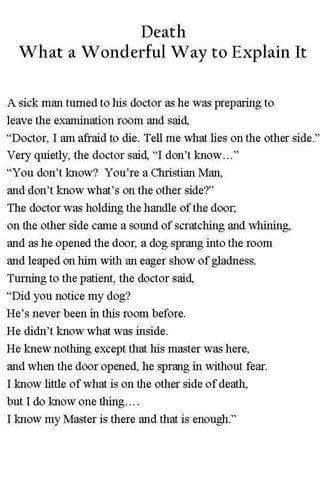
Death Meme explains little


Somethings missing


You’ve likely seen this pic before, the explanation of death. On the surface, it’s an exceptional description. That is, if you’re a Christian. As Christians, we are so much more aware of the other side than a dog. The Word of God tells us so…

There’s a home awaiting us;

In my Father’s house are many mansions: if it were not so, I would have told you. I go to prepare a place for you. [John 14:2]

We’ll be with God;

And if I go and prepare a place for you, I will come again, and receive you unto myself; that where I am, there ye may be also. [John 14:3]

It will last forever;

Keep yourselves in the love of God, looking for the mercy of our Lord Jesus Christ unto eternal life. [Jude 1:21]

The word also tells us what is on the other side IF YOU’RE NOT A CHRISTIAN

There’s a home awaiting you;

Then shall he say also unto them on the left hand, Depart from me, ye cursed, into everlasting fire, prepared for the devil and his angels: [Mat 25:42]

You’ll be withOUT God;

In flaming fire taking vengeance on them that know not God, and that obey not the gospel of our Lord Jesus Christ: Who shall be punished with everlasting destruction from the presence of the Lord, and from the glory of his power; [2 Thessalonians 1:8-9]

It will last forever;

And whosoever was not found written in the book of life was cast into the lake of fire. [Revelation 20:15]

So you see, If you’re IN CHRIST then this little story paints a wonderful picture, but if not, this story gives you a false sense of hope.

The last line is most troubling, for it teaches an idea of “salvation by faith only”. It says, “I know my Master is there, and that’s enough.” No friend, it’s not enough to just know that God is in Heaven. Hear the words of Scripture on this matter…

You believe that there is one God. You do well. Even the demons believe–and tremble! But do you want to know, O foolish man, that faith without works is dead? [James 2:19-20]

The text goes on to reveal the only passage in the entirety of scripture that say, “by faith only”. As you read James 2:24, take careful note of the word preceding that oft used phrase…

You see then that a man is justified by works, and not by faith only. [James 2:24]

So you see then, as Christians, we are looking forward to being with our Master just as the story depicts, but it’s not a blind faith.

Many folks claim to be a Christian, but this claim is often based on dumb little facebook pics such as this one. Truly a blind faith, a faith based only on desire and not according to knowledge.

HOW TO BECOME A CHRISTIAN

To become a child of God, and avoid the eternal flame, one must obey the Gospel [2Thess 1:8]. So here’s a pic worthy of our attention. [Click here for more] [click here]

obey the gospel