“For the word of God is quick, and powerful, and sharper than any twoedged sword, piercing even to the dividing asunder of soul and spirit, and of the joints and marrow, and is a discerner of the thoughts and intents of the heart” (Hebrews 4:12).
I asked a fellow one day if he knew why people read the Bible daily. He said that he didn’t really know why. It got me thinking about why we ought to read the Bible.
In a world filled with confusion, relativism, and aimless wandering, we desperately need to immerse ourselves in the Bible, God’s inspired Word. As Ephesians 5:17 urges, we must not live foolishly but understand the WILL OF THE LORD, which is revealed clearly through Scripture. John 17:17 declares that GOD’S WORD IS TRUTH ITSELF; the objective anchor in an age of shifting sand of public opinions, guarding us from deception. Moreover, 1 Peter 3:15 tells us to always BE READY TO GIVE A DEFENSE FOR THE HOPE WITHIN US, a readiness that comes only from knowing and internalizing biblical truth. Finally, recognizing that it is not in man to direct his own steps (Jeremiah 10:23), we turn to Psalm 119:105, where GOD’S WORD BECOMES A LAMP TO OUR FEET AND A LIGHT TO OUR PATH, illuminating our purpose and guiding us safely through life’s journey. Without regular reading of the Bible, we stumble in darkness; with it, we walk confidently in God’s eternal direction.
Get A Bookmark; it’s the easiest Bible Reading Plan. A simple bookmark can be one of the most powerful tools for staying consistent in Bible reading, even without following a formal plan. Life is unpredictable with busy schedules, unexpected interruptions, and shifting priorities that can easily derail our good intentions to read Scripture daily. But a bookmark quietly solves this problem by marking exactly where we left off, so we know where to go when we pick back up the Bible again. No need to remember the last chapter or verse, no pressure to “catch up” on missed days, and no guilt over abandoning a rigid reading schedule. It allows us to resume right where we stopped, whether that was yesterday, or last week. This simple device keeps the habit alive, allowing steady progress through the Word over months and years. Over time, that humble bookmark becomes a faithful companion helping us build a lifelong rhythm of reading His Word; one verse, one chapter, one bookmark placement at a time.
I have found it most effective to set a time to read each day. In the early years I would read just before bed (a great strategy if you’re trying to avoid screen time at the end of the day). This helped me to go to sleep with God’s word on my heart. Now a days I read in the mornings (Monday – Friday) following a 5-day reading plan to read through the whole bible in one year. May God’s word be a blessing to you as you read in 2026.
Comfort in Christ: I aint ‘fraid of no Ghosts. The Ghost of Jacob Marley vs. the Truth of Luke 16:19-31
Charles Dickens’ “A Christmas Carol” paints a vivid picture of Jacob Marley’s ghost returning from the dead to warn Ebenezer Scrooge of his selfish ways, hoping to spare him a grim afterlife. Marley’s clanking chains and desperate plea grip our imaginations, but how does this fictional tale stack up against the truth of God’s Word in Luke 16:19-31, the story of Lazarus and the rich man? The Bible offers a different, more comforting reality for believers: Neither the faithful nor the lost return as ghosts.
In “A Christmas Carol”, Marley’s ghost is a restless spirit, burdened by chains forged from his greed and indifference in life. He returns to haunt Scrooge, warning him to change his ways to avoid eternal torment. The story suggests the dead can cross back to the living (or never cross over to the realm of the dead), intervening to deliver messages of repentance or hope. This makes for a compelling plot, stirring Scrooge to transform, but it leans on a cultural idea of ghosts lingering to settle unfinished business. Marley’s return implies the afterlife allows such spectral visits, with the dead actively influencing the living. This concept has enriched Hollywood with movies like “Ghost” and “The sixth sense.”
Contrast this with Luke 16:19-31, where Jesus tells of Lazarus, a poor man, and a rich man who die. Lazarus rests in peace at Abraham’s side, while the rich man suffers in torment. The rich man begs Abraham to send Lazarus back to warn his brothers, hoping to save them from his fate. Abraham says, “They have Moses and the prophets; let them hear them” (Luke 16:29). When the rich man insists a return from the dead would convince them, Abraham replies, “If they hear not Moses and the prophets, neither will they be persuaded, though one rose from the dead” (Luke 16:31). Unlike Marley, Lazarus doesn’t haunt the earth (nor does the rich man); he’s at rest, and the rich man’s plea for a ghostly messenger is denied. God’s Word, not supernatural visits, is sufficient for guidance. Ironically, a man named Lazarus did come back from the dead, “But the chief priests consulted that they might put Lazarus also to death; Because that by reason of him many of the Jews went away, and believed on Jesus” (John 12:10-11). So also did ANOTHER come back from the dead and it’s HIS WORD that either warns or haunts us today. “He that rejecteth me, and receiveth not my words, hath one that judgeth him: the word that I have spoken, the same shall judge him in the last day” (John 12:48). The message today is the same; if we hear not Christ, neither will we be persuaded, though one rose from the dead.
Marley’s story fuels the idea that the dead roam to fix past wrongs, reflecting a human longing for second chances or closure. But this clashes with Scripture’s truth: the faithful, like Lazarus, are immediately in comfort, not wandering as spirits. Hebrews 9:27 states, “And as it is appointed unto men once to die, but after this the judgment,” with no provision for ghostly returns. For believers, this is a warm comfort; the faithful in Christ aren’t trapped or restless but safe with God.
Dickens’ tale captivates, but it’s fiction. Luke 16:19-31 grounds us in truth: God’s Word guides the living, and the faithful find eternal rest, not a ghostly mission.
agape
Sources:
Holy Bible KJV.
Dickens, Charles. “A Christmas Carol” (1843).
Final Thought: Marley’s ghost makes a great story, but God’s Word assures us there are no ghosts haunting the earth. I aint ‘fraid of no Ghosts.
Let’s talk about this Calvinist idea of predestination. Basically, that God pulls every string, deciding who’s in and who’s out, with free will just a side note because God’s Sovereignty demands it. Sounds tidy, right? But the Bible keeps pushing back, shouting from the rooftops that we’ve got real choices to make. It’s not some robotic rerun; it’s a dynamic story where God hands us the reins and says, “Your move.”
God repeatedly tells individuals to make choices, implying free will. In Joshua 24:15, Joshua exhorts the Israelites, “Choose this day whom you will serve,” presenting a clear decision between serving God or idols. This command assumes the ability to choose freely, not a predetermined outcome. Similarly, Deuteronomy 30:19 declares, “I have set before you life and death, blessing and curse. Therefore choose life.” The imperative to “choose” underscores human responsibility to respond to God’s call, incompatible with a view where every decision is divinely dictated.
In the New Testament, Jesus’ invitations affirm free will. Matthew 11:28 says, “Come to me, all you who are weary and heavy laden, and I will give you rest.” This open invite requires a voluntary response, suggesting individuals can accept or reject it. Likewise, John 7:17 states, “If any man will do his will, he shall know of the doctrine, whether it be of God, or whether I speak of myself.” Jesus emphasizes choice as central to faith, countering the idea that God irresistibly determines belief.
Calvinists often cite Romans 9:16-18, which highlights God’s sovereignty in showing mercy, to support predestination. However, Paul’s broader argument in Romans emphasizes human responsibility. Romans 10:9 declares, “If you declare with your mouth, ‘Jesus is Lord,’ and believe in your heart… you will be saved.” (Paul will continue on in the text pointing to baptism & faith). The conditional “if” implies that salvation hinges on personal choice, not divine coercion. Furthermore, 2 Peter 3:9 reveals God’s desire that “not willing that any should perish, but that all should come to repentance,” suggesting universal opportunity for salvation through free response, not selective predetermination.
Ephesians 1:4-5, another Calvinist cornerstone, states God chose believers “before the foundation of the world.” Yet, this should be understood corporately; God predestining the church as a body for salvation, while individuals freely choose to obey the Gospel and are added to the church through faith (Ephesians 2:8-9; Acts 2:38,41,47). This harmonizes with passages like Revelation 3:20, where Jesus says, “I stand at the door and knock. If anyone hears my voice and opens the door, I will come in.” The imagery of opening the door underscores human agency in responding to divine initiative.
Moreover, Calvinism’s strict determinism raises concerns about God’s character. If God ordains all actions, including sin, it conflicts with James 1:13, which states, “God cannot be tempted by evil, nor does he tempt anyone.” Free will allows humans to bear responsibility for sin, preserving God’s holiness and justice. Neither the devil nor God made us do it. Scripture consistently portrays God as inviting, not compelling, human response. Scripture paints God as the ultimate pursuer, not puppet-master. Free will aligns with a God who desires genuine relationship over robotic obedience.
The Bible’s Enduring Influence on Western Law and the U.S. Constitution
It is apparent to me that the Bible has profoundly shaped Western civilization and the U.S. Constitution, providing moral and legal principles. Its scriptural teachings influenced the cultural and intellectual society of the West and the American founding, creating a legacy evident in modern legal systems and constitutional governance.
The biblical concept of human dignity, derived from the idea that humans are created in God’s image (Genesis 1:26-27), laid the foundation for Western notions of individual rights. Historian David Landes, in The Wealth and Poverty of Nations, argues that this principle inspired accountability and fairness, influencing documents like the Magna Carta (1215), which echoes Deuteronomy 16:20’s call for justice. This idea can be seen in the Declaration of Independence’s “unalienable rights” and the Constitution’s Bill of Rights, particularly the First Amendment’s protections of speech and religion. James Madison, a key framer, drew on biblical notions of human worth, as noted by Carl Richard in The Founders and the Bible.
The Ten Commandments (Exodus 20:1-17) provided a moral framework for Western jurisprudence, with prohibitions against murder, theft, and perjury shaping legal codes from medieval Europe to colonial America. Legal scholar Harold Berman, in Law and Revolution, highlights how biblical ethics standardized justice in fragmented societies, a legacy reflected in the Constitution’s emphasis on impartiality (Leviticus 19:15). The command to “love your neighbor as yourself” (Leviticus 19:18; Matthew 22:39) further inspired Western social welfare laws and the Constitution’s reliance on civic virtue, as Benjamin Franklin emphasized in his writings.
The Bible’s warnings against unchecked power (1 Samuel 8:10-18; Deuteronomy 17:14-20) influenced the Western concept of the rule of law and the Constitution’s checks and balances. John Locke’s Two Treatises of Government, which cites scripture, argued for limited government, shaping the Constitution’s separation of powers (Articles I-III). Historian Donald Lutz, in The Origins of American Constitutionalism, notes that colonial sermons often referenced Exodus 18:21-22’s decentralized governance, influencing federalism. John Adams, in his Defence of the Constitutions, tied governance to biblical morality (Proverbs 29:2), reinforcing accountability.
The Great Awakening (1730s-1740s) embedded biblical values in colonial culture, shaping the framers’ commitment to liberty, as Daniel Dreisbach details in Reading the Bible with the Founding Fathers. While Enlightenment ideas contributed, the Bible’s influence provided a moral compass for constitutional principles like forgiveness (Colossians 3:13), evident in rehabilitative justice systems. Critics may emphasize secular influences, but the framers’ biblical worldview, as seen in their writings, brought together faith and reason.
agape
Sources: Berman, Harold. Law and Revolution. Harvard University Press, 1983. Dreisbach, Daniel L. Reading the Bible with the Founding Fathers. Oxford University Press, 2017. Landes, David. The Wealth and Poverty of Nations. W.W. Norton, 1998. Lutz, Donald S. The Origins of American Constitutionalism. LSU Press, 1988. Richard, Carl J. The Founders and the Bible. Rowman & Littlefield, 2016. The Bible (KJV): Genesis 1:26-27, Exodus 18:21-22, 20:1-17, Leviticus 19:15, 19:18, Deuteronomy 16:20, 17:14-20, 1 Samuel 8:10-18, Proverbs 29:2, Matthew 22:39, Colossians 3:13.
Knowing the Voice of Jesus: The Written Word as the Sole Means
In John 10:4, Jesus, the Good Shepherd, declares, “And when he putteth forth his own sheep, he goeth before them, and the sheep follow him: for they know his voice.” Believers today do not hear an audible voice nor witness the signs Jesus performed during His earthly ministry, as those signs, per John 20:30-31, were recorded so that we might believe without seeing them firsthand: “And many other signs truly did Jesus in the presence of his disciples, which are not written in this book: But these are written, that ye might believe that Jesus is the Christ, the Son of God; and that believing ye might have life through his name.” The implication is that the signs done then will not be repeated; instead, we know Jesus’ voice through the written word. The apostles’ teaching, the New Testament history of Jesus, and obedience to Christ all converge in the written word as the sole means to know His voice and the truth.
We will know His voice by keeping the apostles’ teaching. The apostles, guided by the Holy Spirit, delivered Jesus’ teachings, preserved in Scripture. John 16:13 promises, “When he, the Spirit of truth, is come, he will guide you into all truth.” Their doctrine, recorded in the written word, allows us to hear Jesus. Later Jesus prays for the apostles in John 17:20, “Neither pray I for these alone, but for them also which shall believe on me through their word;” This shows us that people will believe through their inspired preaching and teaching which is now recorded for all in the New Testament. Acts 2:42 shows early believers “continued stedfastly in the apostles’ doctrine,” while Galatians 1:11-12 clarifies, “The gospel which was preached of me is not after man… but by the revelation of Jesus Christ.” These inspired writings are our access to His voice today.
We will know His voice by the New Testament history of Jesus Christ. The Gospels record Jesus’ life and works, but the signs He performed were for those who saw them personally. John 20:29 reinforces this: “Blessed are they that have not seen, and yet have believed.” We know Him through the written record, as Luke 1:1-4 states: “To set forth in order a declaration… that thou mightest know the certainty of those things.” The written history in Scripture conveys His voice to us. John 20:31a, “But these are written, that ye might believe that Jesus is the Christ, the Son of God;”
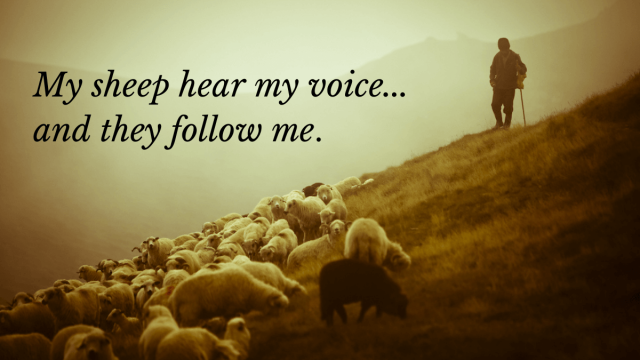
We will know His voice by obedience to Christ. Obeying Jesus’ commands, found in Scripture, confirms we hear His voice. John 10:27 says, “My sheep hear my voice… and they follow me.”1 John 2:4 warns, “He that saith, I know him, and keepeth not his commandments, is a liar, and the truth is not in him.”John 14:23 adds, “If a man love me, he will keep my words: and my Father will love him.” Obedience to the written word ensures we know Him.
The written word is the only means by which we know Jesus’ voice and the truth. The signs Jesus performed, as recorded in John 20:30-31, were for those who saw them, but we believe through what is written. Jesus’ life is in the word (John 5:39: “Search the scriptures… they are they which testify of me”). The apostles’ teachings come from the word (2 Peter 1:21). The Holy Spirit revealed the word (2 Timothy 3:16). While preachers may proclaim the gospel (Romans 10:14), they must teach from the written word. 2 John 1:9 emphasizes, “He that abideth in the doctrine of Christ, he hath both the Father and the Son.” The written word alone enables us to hear and follow the Good Shepherd.
We will know His voice by keeping the apostles’ teaching. The apostles, guided by the Holy Spirit, delivered Jesus’ teachings, preserved in Scripture. John 16:13 promises, “When he, the Spirit of truth, is come, he will guide you into all truth.” Their doctrine, recorded in the written word, allows us to hear Jesus. After Jesus then prays for the apostles, He then prays this in John 17:20, “Neither pray I for these alone, but for them also which shall believe on me through their word;” This shows us that people will believe through their inspired preaching and teaching which is now recorded for all in the New Testament. Acts 2:42 shows early believers “continued stedfastly in the apostles’ doctrine,” while Galatians 1:11-12 clarifies, “The gospel which was preached of me is not after man… but by the revelation of Jesus Christ.” These inspired writings are our access to His voice today.
We will know His voice by the New Testament history of Jesus Christ. The Gospels record Jesus’ life and works, but the signs He performed were for those who saw them personally. John 20:29 reinforces this: “Blessed are they that have not seen, and yet have believed.” We know Him through the written record, as Luke 1:1-4 states: “To set forth in order a declaration… that thou mightest know the certainty of those things.” The written history in Scripture conveys His voice to us.
We will know His voice by obedience to Christ. Obeying Jesus’ commands, found in Scripture, confirms we hear His voice. John 10:27 says, “My sheep hear my voice… and they follow me.”1 John 2:4 warns, “He that saith, I know him, and keepeth not his commandments, is a liar, and the truth is not in him.”John 14:23 adds, “If a man love me, he will keep my words: and my Father will love him.” Obedience to the written word ensures we know Him.
In conclusion, the written word is the only means by which we know Jesus’ voice and the truth. The signs Jesus performed, as recorded in John 20:30-31, were for those who saw them, but we believe through what is written. Jesus’ life is in the word (John 5:39: “Search the scriptures… they are they which testify of me”). The apostles’ teachings come from the word (2 Peter 1:21). The Holy Spirit revealed the word (2 Timothy 3:16). While preachers may proclaim the gospel (Romans 10:14), they must teach from the written word. 2 John 1:9 emphasizes, “He that abideth in the doctrine of Christ, he hath both the Father and the Son.” The written word alone enables us to hear and follow the Good Shepherd.
“But thou, O man of God, flee these things; and follow after righteousness, godliness, faith, love, patience, meekness.” (1Tim 6:11)
“Flee also youthful lusts: but follow righteousness, faith, charity, peace, with them that call on the Lord out of a pure heart.” (2Tim 2:22)
Striving for Selfless Love. As I walk through this life, I’m learning that selfless love is the heartbeat of what it means to follow Christ. The New Testament tells me to pursue love (agape, the kind of love that puts others first) as Paul urges in 1 Corinthians 14:1, “Pursue love,” and 1 Corinthians 10:24, “Let no one seek his own, but each one the other’s well-being.” I see this love woven into the virtues of 1 Timothy 6:11 and 2 Timothy 2:22, where love stands alongside righteousness, faith, and peace. Yet, I confess, loving selflessly doesn’t come naturally to me. It’s a daily choice to set aside my own desires and seek the good of those around me.
This pursuit matters deeply because love is the foundation of God’s kingdom. Paul says in 1 Corinthians 13:13 that love is greater than faith or hope, and I’m beginning to understand why. When I choose to love others (whether through a kind word, a listening ear, or an act of hospitality like Romans 12:13 encourages) I reflect Christ’s heart. Every effort to encourage others flows from this love. But I stumble often. My selfishness creeps in, and I need God’s grace to soften my heart, to help me embody the gentleness of 1 Timothy 6:11 or the peace of 2 Timothy 2:22 in my relationships.
Striving for selfless love changes me. It pushes me to forgive when I’d rather hold a grudge, to serve when I’m tired, and to prioritize others’ needs over my own comfort. It’s humbling to realize how far I fall short, yet I find joy in small steps, like a kind word to a neighbor or praying for a struggling friend. This pursuit brightens the light of Christ in my heart, showing the world a glimpse of Jesus’ love through my imperfect efforts. I keep chasing selflessness to make my love more like God’s.
Seeking God; Aspiring to Excellence (Godliness and Holiness) In my walk with Christ, I’m learning to aspire to excellence through godliness and holiness, though I often feel unworthy of such a high calling. 1 Timothy 6:11 urges me to pursue godliness, a life of devotion to God, while Hebrews 12:14 says to “pursue… holiness, without which no one will see the Lord.” These virtues connect to the righteousness and faith in 1 Timothy 6:11 and 2 Timothy 2:22, and they echo the urging to seek “things above” in Colossians 3:1-2. I’m far from perfect, but I long to reflect God’s character more each day.
This pursuit is crucial because it draws me closer to God Himself. Godliness means living with reverence, seeking His will in every decision, but I often get distracted by worldly concerns. Holiness, too, challenges me to stand apart from sin and selfishness, as Hebrews 12:14 warns that without it, I won’t see God. This sobers me, reminding me that my efforts matter, not to earn salvation but to honor the One who saved me. These virtues shape my heart, teaching me to love what God loves and hate what He hates, aligning with the righteousness of both Timothy passages.
Aspiring to godliness and holiness is a humbling journey. I need the support of other saint, as 2 Timothy 2:22 suggests, pursuing these virtues “with those who call on the Lord.” Through prayer, Scripture, and accountability, I’m slowly growing, learning to forgive quickly, speak truthfully, and serve humbly. Each step feels like a battle, but it’s worth it to become more like Christ. As a saint, I seek this treasure of excellence, trusting God to refine me into His image, one faltering step at a time.
Seeking God; Longing for Eternal Life As I seek to grow in faith, the hope of eternal life has become a treasure I hold dear, though I’m still learning to pursue it with the patience it demands. Romans 2:7 speaks of “eternal life to those who by patient continuance in doing good seek for glory, honor, and immortality,” and I see this echoed in the patience and righteousness Paul pleads for in 1 Timothy 6:11 and 2 Timothy 2:22. I’m not there yet, my faith wavers, and my endurance falters, but I keep pressing forward, trusting God to sustain me.
This pursuit is vital because it anchors my life in something beyond the fleeting moments of this world. Eternal life isn’t just a future hope; it shapes how I live now. The urging to “patient continuance” in Romans 2:7 reminds me of the patience in 1 Timothy 6:11, compelling me to persevere through trials without giving up. I often grow weary, tempted to chase temporary comforts instead of God’s eternal reward. But when I fix my eyes on eternity, I find strength to choose righteousness, even when it’s costly, like forgiving an offense or staying faithful in difficult times.
Longing for eternal life humbles me. It is God’s gift through Christ to those who obey the gospel. Yet, I’m told to seek it by living uprightly, as 2 Timothy 2:22 encourages in pursuing righteousness. Each step, resisting temptation, serving others, or trusting God in hardship, feels like a deposit toward that eternal hope. It’s a slow, steady journey, and I rely on God’s mercy and His word to keep me faithful. This pursuit reminds me that my true home is with Him, forever.
Seeking God; Seeking the Kingdom of God and His Righteousness As I grow in faith, I’m learning to make the kingdom of God and His righteousness my highest pursuit, though I often fall short of this priority. Jesus’ words in Matthew 6:33, “Seek first the kingdom of God and His righteousness,” and Luke 12:31 tell me to focus on God’s rule and moral standard above all else. This aligns with the righteousness, faith, and godliness in 1 Timothy 6:11 and 2 Timothy 2:22, but I confess it’s a struggle to keep this first in my heart when life’s demands pull me in every direction.
This pursuit is the cornerstone of my faith because it reorients everything else. Jesus promises that when I seek God’s kingdom first, my needs will be met, freeing me from worry. But trusting this promise requires the faith of 1 Timothy 6:11 and 2 Timothy 2:22, believing God’s way is better than my own. Righteousness (living justly and obediently) isn’t just a rule to follow; it’s a reflection of God’s character, as is the godliness in 1 Timothy 6:11. I’m humbled by how often I prioritize my plans over God’s, yet His word directs me back to God’s seeking His way.
Seeking the kingdom means living differently, praying for God’s will, sharing the gospel, and standing for His truth, even when it’s unpopular. I stumble, chasing lesser things, but each time I refocus, through study, and service, I find purpose and peace. As a saint, I’m learning to seek the Kingdom of God and His righteousness above all, trusting Him along the way.
The Pitfalls of False Authority: A New Testament Perspective
In a world brimming with voices vying for influence, Christians must discern the true source of authority for faith and practice. The New Testament insists that all authority rests in Jesus Christ, who declared, “All authority in heaven and on earth has been given to me” (Matthew 28:18). Yet, both in Scripture and today, people frequently turn to counterfeit sources. These false authorities—ranging from human tradition to misapplied Scripture—promise guidance but lead astray. Let’s explore ten common wrong sources, grounded in biblical examples and reasoned insight, to sharpen our reliance on Christ alone.
First, human tradition often masquerades as authority. The Pharisees clung to their customs, prompting Jesus to rebuke them: “You leave the commandment of God and hold to the tradition of men” (Mark 7:8-9). Their rituals felt sacred, but without divine sanction, they were hollow. Today, churches may elevate practices—like specific holidays or dress codes—beyond Scripture, clouding God’s clear will.
Second, personal feelings or intuition can deceive. The sons of Sceva, zealous to cast out demons, assumed sincerity sufficed, only to be overpowered (Acts 19:13-16). Emotions sway us, especially in worship or moral choices, but they lack stability apart from God’s Word. A “gut feeling” might feel right yet contradict truth.
Third, religious leaders’ opinions tempt reliance. The Jewish leaders opposed Jesus, leaning on their titles, yet He exposed their hypocrisy (Matthew 23:2-7, 13). Charismatic pastors or scholars may inspire, but their words hold no weight unless tethered to Christ’s authority. Blind trust in human figures risks error.
Fourth, cultural norms exert subtle pressure. The Corinthians mirrored their society’s idolatry, needing Paul’s correction (1 Corinthians 10:14-21). Modern trends—materialism, relativism—shape morality or worship, but culture’s shifting sands lack divine permanence. What’s popular rarely aligns with God’s eternal standard.
Fifth, human reason or philosophy appeals to intellect. The Greeks mocked Paul’s resurrection message, trusting their logic (Acts 17:32). Today, skepticism dismisses miracles or grace when reason reigns alone. Without revelation, philosophy builds on a flawed foundation.
Sixth, false revelations or visions mislead. Paul warned against altered gospels, cursing their preachers (Galatians 1:8-9). False prophets then and now claim divine insight, but if it contradicts Scripture, it’s a lie. Modern “prophecies” must bow to the Bible’s completed authority.
Seventh, majority opinion sways the unwary. The crowd chose Barabbas over Jesus, driven by mob sentiment (Matthew 27:20-23). Polls or social consensus feel authoritative, yet they’re fickle. Truth isn’t a democracy; it stands with Christ, not the masses.
Eighth, wealth or power seduces. Simon the Sorcerer thought money could buy spiritual authority, earning Peter’s condemnation (Acts 8:18-23). Today, influential donors or leaders may dictate doctrine, but earthly clout holds no heavenly warrant.
Ninth, self-appointed authority usurps Christ’s place. Diotrephes craved control, rejecting apostolic guidance (3 John 1:9-10). Cults or lone wolves claim divine calling, but without Christ’s commission, their rule is baseless. True authority is delegated, not seized.
Finally, misapplied Scripture distorts truth. Satan twisted verses to tempt Jesus, who countered with proper context (Matthew 4:5-7). Quoting the Bible out of alignment—like the prosperity gospel—creates a false authority. God’s Word, rightly handled, is the only sure guide.
These false sources recur because they mimic legitimacy, exploiting human weakness. Yet, each fails the test of Christ’s mandate. The New Testament calls us to reject them, anchoring in Him who holds “all authority.”
Which of these do we lean on? How do we confront them? What’s the danger of feelings or crowds over Scripture? How does Satan’s tactic warn us? What steps ensure we follow Christ alone? In a world of counterfeits, only His Word endures.
agape
Spencer
This is the first part of a series of lessons on How to Determine Biblical Authority, or more simply, What does God want?
The Moral Argument: Why Morality Points to a Creator. God’s Revealed Word as the Source of Objective Morality
The Moral Argument for God’s existence rests on the premise that objective moral values—universal standards of right and wrong—exist and are best explained by a purposeful design from a Creator. While science highlights our innate moral instincts, the Bible provides a unique and compelling case that humanity learns these objective standards through God’s revealed word. This interplay of divine revelation and human conscience offers a profound clue to the existence of a moral lawgiver.
Objective moral values, such as the inherent wrongness of betrayal or the goodness of self-sacrifice, transcend personal opinion or cultural trends. Psychological research, like that of Paul Bloom, shows even infants exhibit rudimentary moral judgments—preferring kindness over cruelty—suggesting an inborn moral sense (Bloom, Just Babies, 2013). Yet, this alone doesn’t explain how we refine and understand these principles. The Bible steps in, asserting that God’s revealed word clarifies and establishes these standards for humanity. Without this guidance, our moral intuitions might remain vague or misdirected.
Scripture presents God as the ultimate source of morality, with His word providing the definitive moral framework. In Exodus 20:1-17, the Ten Commandments are delivered directly from God to Moses, offering unambiguous directives: “You shall not murder,” “You shall not steal.” These laws aren’t mere suggestions but objective truths, reflecting God’s character and intended for all people. This revelation transforms abstract moral instincts into concrete duties, shaping human understanding of right and wrong.
Further, Deuteronomy 6:6-7 instructs, “These commandments that I give you today are to be on your hearts. Impress them on your children.” This emphasizes that morality isn’t left to human guesswork—God’s word is taught, learned, and passed down, refining our natural inclinations. The Psalms reinforce this: Psalm 119:105 declares, “Your word is a lamp to my feet and a light to my path,” portraying divine revelation as the guide that illuminates moral living.
Romans 2:14-15 offers a striking insight: “When Gentiles, who do not have the law, do by nature things required by the law… they show that the requirements of the law are written on their hearts.” This suggests an innate moral awareness, yet the passage implies it aligns with God’s law, revealed fully in Scripture. The Bible bridges the gap between our God-given conscience and the precise standards we’re meant to follow. For instance, Micah 6:8 summarizes divine expectation: “To act justly and to love mercy and to walk humbly with your God”—a standard humanity learns through God’s word, not intuition alone.
Naturalists might argue morality evolves socially, but this fails to explain its objective weight. Cultures differ on specifics, yet core values—like justice—persist universally, echoing biblical principles. God’s revealed word provides the anchor, ensuring morality isn’t arbitrary. As Isaiah 55:8-9 notes, God’s ways are higher than ours, suggesting His revelation elevates human understanding beyond what nature alone could teach.
The Moral Argument, enriched by biblical evidence, posits that objective morality points to a Creator who reveals it through His word. Science hints at our moral wiring, but Scripture—through commandments, teachings, and declarations—grounds it in God’s eternal truth, offering humanity a clear path to righteousness.
Agape, Spencer
Sources: o Bloom, Paul. Just Babies: The Origins of Good and Evil. Crown, 2013. o The Holy Bible, New International Version. Zondervan, 2011 (Exodus 20:1-17, Deuteronomy 6:6-7, Psalm 119:105, Romans 2:14-15, Micah 6:8, Isaiah 55:8-9).
The debate over the age of the Earth has been ongoing for centuries, with mainstream science advocating for an age of about 4.5 billion years. However, significant scientific evidence challenges this timeline and supports the view that the Earth is much younger. Below are several compelling arguments, supported by observable data, that point to a young Earth.
1. The Decay of Earth’s Magnetic Field. The Earth’s magnetic field is rapidly decaying, with measurements indicating an exponential decline. Dr. Thomas G. Barnes first analyzed this phenomenon in 1971, showing that the field’s energy has decreased by approximately 50% over the past 1,400 years (Barnes, 1973). If we extrapolate this trend backward, the field would have been so strong just 10,000 years ago that life on Earth would not have been possible due to excessive heat and radiation. This suggests that the Earth’s magnetic field cannot be millions of years old, let alone billions.
2. Soft Tissue in Dinosaur Fossils. One of the most astonishing discoveries in paleontology has been the presence of soft tissues, collagen, and even red blood cells in dinosaur fossils. Dr. Mary Schweitzer first reported these findings in a 1997 study on a T. rex femur (Schweitzer et al., 1997). Subsequent discoveries confirmed that proteins like collagen, which break down relatively quickly, could not survive for the 65+ million years assigned to these fossils. Since such biological materials should degrade completely within a few tens of thousands of years, these discoveries suggest that the fossils are much younger than traditionally believed.
3. Carbon-14 in Ancient Fossils and Diamonds. Carbon-14 (C-14) dating is a method used to determine the age of once-living materials, but it has a fundamental limitation: C-14 decays so quickly that anything older than 100,000 years should have no detectable traces remaining. However, measurable amounts of C-14 have been found in coal, oil, natural gas, and even diamonds—materials supposedly millions to billions of years old (Baumgardner et al., 2003). These findings indicate that these materials are not nearly as old as conventional dating methods suggest.
4. Recession of the Moon. The Moon is slowly moving away from the Earth at a measured rate of approximately 3.8 cm per year (Dickey et al., 1994). If we extrapolate this rate backward, the Moon would have been much closer to the Earth in the past. Just 1.5 billion years ago, the Moon would have been so close that Earth’s tidal forces would have torn it apart. Yet, the standard model suggests the Moon has been receding for over 4 billion years. The current observed recession rate is difficult to reconcile with a billions-of-years-old Earth-Moon system, but it fits well within a young Earth framework.
5. Helium Retention in Zircon Crystals. Zircon crystals, found deep in the Earth’s crust, contain uranium, which decays into lead while simultaneously releasing helium. Since helium is a lightweight, highly diffusive gas, it should escape from these crystals relatively quickly. However, studies have found high concentrations of helium in zircons from Precambrian rock (Gentry et al., 1982). If these rocks were truly over a billion years old, the helium should have long since dissipated. The retention of helium suggests an age of only about 6,000 years, aligning closely with a biblical timeframe.
6. Rapid Formation of Geological Features. The 1980 eruption of Mount St. Helens provided a remarkable case study on how catastrophic events can rapidly shape geological features. Within hours, massive sedimentary layers were deposited, and within days, a new canyon was carved, resembling those believed to have taken millions of years to form (Morris & Austin, 2003). This demonstrates that many geological formations attributed to vast ages could have been formed quickly under the right conditions, such as during a global flood.
7. Biblical Evidence for a Young Earth. The Bible provides a historical framework that aligns with a young Earth. The genealogies in Genesis 5 and 11, when traced chronologically, place the creation of the world at approximately 6,000 years ago. Exodus 20:11 states, “For in six days the Lord made heaven and earth, the sea, and all that in them is, and rested the seventh day.” This passage affirms a literal six-day creation, contradicting the notion of an ancient Earth. Furthermore, Jesus referenced the creation of man “from the beginning of the creation” (Mark 10:6), indicating that humanity was present near the start of Earth’s history, not billions of years after its formation.
The Weight of the Evidence. The conventional billions-of-years model is based on assumptions that increasingly conflict with observable scientific data. The rapid decay of Earth’s magnetic field, the presence of soft tissues in dinosaur fossils, the discovery of C-14 in supposedly ancient materials, the Moon’s recession rate, helium retention in zircons, and the rapid formation of geological features all point to an Earth that is far younger than mainstream science asserts.
If the foundations of an old Earth are shaken by observable data, then the question remains: Why is the conventional narrative so resistant to change? The implications of a young Earth challenge not just scientific paradigms but also philosophical and theological worldviews. If the Earth is young, then biblical history is not just a religious tradition—it is an accurate record of our origins. The evidence speaks for itself, but the willingness to follow that evidence remains a matter of conviction.
Counting the Cost in Love and Relationships: A Biblical Perspective
Love is one of the most profound and beautiful gifts given by God. However, the Bible warns against rushing into love, commitment, or covenant relationships without counting the cost and understanding the lifelong responsibility and sacrifice they require. This principle is seen in Song of Solomon 2:7, where the bride cautions against awakening love before its proper time. While this verse speaks of romantic love, its wisdom applies to marriage, relationships, and most importantly, our commitment to God.
The Weight of Love and Commitment
In a culture that often glorifies love based on emotions, attraction, and fleeting feelings, God’s design for love is rooted in commitment, responsibility, and endurance.
1. Counting the Cost in Marriage
Marriage is not just an emotional connection; it is a lifelong covenant before God (Malachi 2:14-16). Jesus affirmed this in Matthew 19:6, saying, “What therefore God hath joined together, let not man put asunder.”
Before entering into marriage, one must consider:
Spiritual Readiness – Am I prepared to love and lead (if a husband) or submit and support (if a wife) as Scripture commands? (Ephesians 5:22-33)
Shared Faith and Values – Are we both walking in obedience to God? (2 Corinthians 6:14)
Endurance Through Trials – Am I ready to stay committed in sickness, hardships, and challenges? (Ecclesiastes 5:4-5)
Godly Counsel – Have I sought wisdom from Scripture and godly advisors? (Proverbs 11:14)
When love is awakened too soon- without spiritual maturity, wisdom, and a readiness for covenant responsibility – it often leads to heartache. Love should not be rushed, but prepared for with patience and discernment.
2. Counting the Cost in Discipleship
Jesus used the same principle of counting the cost when teaching about discipleship:
“For which of you, intending to build a tower, sitteth not down first, and counteth the cost, whether he have sufficient to finish it?” (Luke 14:28)
Just as marriage requires a lifelong commitment, following Christ demands full devotion and endurance. Many begin their walk with Christ without understanding the depth of obedience and sacrifice required. True discipleship means:
Putting Christ First – Above family, possessions, and personal desires (Luke 14:26).
Carrying the Cross – Willingness to suffer for Christ’s sake (Luke 14:27).
Persevering in Faithfulness – Remaining steadfast even when trials arise (Revelation 2:10).
A relationship with Christ is not based on emotions alone, but on a deliberate choice to obey and follow Him daily (John 14:15).
3. Counting the Cost in Obedience to the Gospel
The greatest love story is God’s love for mankind, demonstrated through Jesus Christ:
“But God commendeth his love toward us, in that, while we were yet sinners, Christ died for us.” (Romans 5:8)
Christ’s love was not merely emotional- it was a sacrificial, obedient love that led Him to give His life so that we could be saved. Because of His love, we are called to respond in obedience to the gospel:
Hearing the Word – Faith comes by hearing (Romans 10:17).
Believing in Christ – Trusting in Jesus as the Son of God (John 8:24).
Repenting of Sin – Turning away from sin and toward God (Acts 17:30).
Confessing Jesus as Lord – Acknowledging Him before others (Romans 10:9-10).
Being Baptized into Christ – For the remission of sins (Acts 2:38; Mark 16:16).
Living Faithfully – Continuing in obedience and holiness (Revelation 2:10).
Many desire the blessings of Christ’s love without counting the cost of obedience. Yet Jesus said:
“Not every one that saith unto me, Lord, Lord, shall enter into the kingdom of heaven; but he that doeth the will of my Father which is in heaven.” (Matthew 7:21)
True love for Christ is not just professed – it is demonstrated through action (John 14:15). Just as one should not enter marriage lightly, one should not enter into a commitment with God without full surrender to His will.
Final Application: The Greatest Love and Commitment
Love, whether in marriage or in faith, requires more than feeling – it requires obedience, sacrifice, and perseverance. Song of Solomon 2:7 reminds us not to rush into commitments without proper preparation.
In earthly love, we must count the cost before making a lifetime vow.
In discipleship, we must understand that following Christ is a lifelong commitment.
In salvation, we must obey the gospel fully, not just emotionally, but with full surrender to God’s commands.
The greatest love story is God’s invitation for us to be united with Him through Christ. Will you count the cost and commit fully to obedience to the gospel?







 Borger church of Christ @ Franklin & Juniper