As I walk this journey of faith, I’m learning that selfless love is the heartbeat of what it means to follow Christ. The New Testament tells me to pursue love (agape, the kind of love that puts others first) as Paul urges in 1 Corinthians 14:1, “Pursue love,” and 1 Corinthians 10:24, “Let no one seek his own, but each one the other’s well-being.” I see this love woven into the virtues of 1 Timothy 6:11 and 2 Timothy 2:22, where love stands alongside righteousness, faith, and peace. Yet, I confess, loving selflessly doesn’t come naturally to me. It’s a daily choice to set aside my own desires and seek the good of those around me.
This pursuit matters deeply because love is the foundation of God’s kingdom. Paul says in 1 Corinthians 13:13 that love is greater than faith or hope, and I’m beginning to understand why. When I choose to love others (whether through a kind word, a listening ear, or an act of hospitality like Romans 12:13 encourages) I reflect Christ’s heart. Every effort to encourage others flows from this love. But I stumble often. My selfishness creeps in, and I need God’s grace to soften my heart, to help me embody the gentleness of 1 Timothy 6:11 or the peace of 2 Timothy 2:22 in my relationships.
Striving for selfless love is transforming me. It pushes me to forgive when I’d rather hold a grudge, to serve when I’m tired, and to prioritize others’ needs over my own comfort. It’s humbling to realize how far I fall short, yet I find joy in small steps, like a kind word to a neighbor or praying for a struggling friend. This pursuit brightens the light of Christ in my heart, showing the world a glimpse of Jesus’ love through my imperfect efforts. As a saint, I am to keep chasing this treasure, trusting God to make my love more like His.
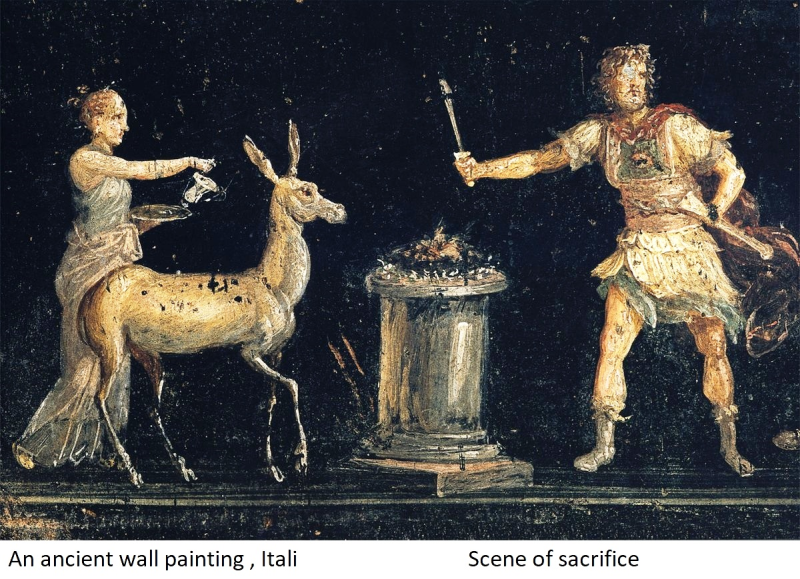
People from all over the world, in different cultures and religions, have practiced some form of sacrifice. Whether it was to please a god, seek forgiveness, or keep some kind of cosmic balance, it’s something humanity has been doing for thousands of years. But when we look at Jesus’ death on the cross, we see something that really stands out from the rest.
What makes it so different? Well, there are three big reasons: it was intentional, it was for everyone, and it was once and for all.
One of the most powerful things about Jesus’ death is that He wasn’t forced into it. In John 10:17-18, He says, “I lay down my life… No one takes it from me, but I lay it down of my own accord.” That’s huge. He didn’t get caught in the wrong place at the wrong time or die just for the sake of being a hero. He chose to die for a purpose.
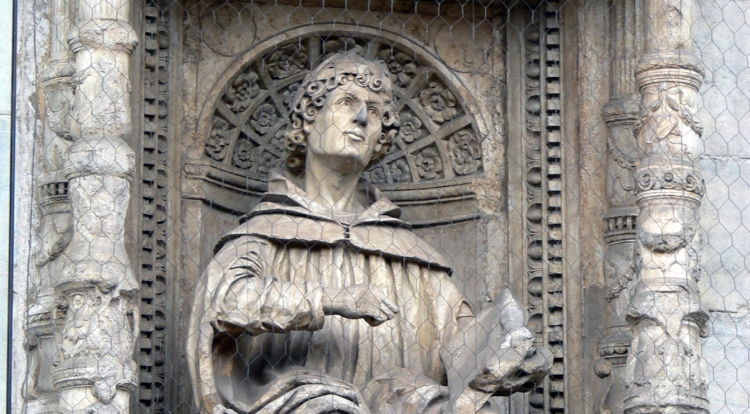
Now, other traditions talk about noble deaths too. Think of Socrates, the Greek philosopher who drank poison rather than run away from what he believed in (Plato, Apology). That’s admirable, but it was more about personal honor. Similarly, in Hinduism, animal sacrifices in Vedic rituals (Rigveda, 10.91) aim to sustain cosmic order, not to personally bridge a gap between humanity and the divine. Jesus’ death, on the other hand, was meant to bring people back to God. He wasn’t just a martyr, He was both the priest and the sacrifice.
Another thing that makes Jesus’ sacrifice unique is that it wasn’t limited to just one group of people. Hebrews 10:10 says, “We have been made holy through the sacrifice of the body of Jesus Christ once for all.” That means it wasn’t just for the Jews, or for a certain tribe, or people from a certain time, it was for all of us.
Other religions had sacrifices too, but they were often done just for a specific community or to honor a local god. For example, the ancient Israelites had the Day of Atonement once a year, and only the high priest could do it, for Israel. And in some cultures like the Aztecs, sacrifices were made to specific gods in hopes of things like rain or victory in battle (Florentine Codex, Book 2). But Jesus’ sacrifice reached across time, culture, and race. It was global.
Most ancient sacrifices had to be repeated year after year, or even more often. It was never-ending. But Jesus’ death was different. Hebrews 9:26 says He “appeared once for all… to do away with sin by the sacrifice of himself.” That means it was complete. Done. No do-overs needed.
This stands in stark contrast to the cyclical sacrifices of ancient pagan religions, such as Rome’s suovetaurilia (Livy, History of Rome, 1.7), or even Buddhism’s karmic atonements, which rely on ongoing personal effort rather than a singular, completed act.
When you step back and look at the big picture, Jesus’ sacrifice isn’t just a church teaching, it’s something totally unique in all of history. Religious scholar Mircea Eliade, who studied sacrifice across many cultures, found sacrifice everywhere, but nothing quite like what Jesus did.
He wasn’t just another teacher or martyr. He was God in the flesh, choosing to give His life, for everyone, forever. And that’s what makes His sacrifice so different, and so deeply personal for each of us.
Life can throw some heavy punches, can’t it? For the believers in Thessalonica, those punches came in the form of persecutions, false teachings, and even some within their own community slacking off and stirring up trouble. Yet, in his second letter to them, Paul points to three timeless virtues (faith, hope, and love) as the keys to standing firm, no matter what others say or do. Rooted in knowing God’s word, these qualities enabled the Thessalonians to rise above their troubles and the “lowness” of their troublers.
Chapter 1: Enduring Through Faith, Hope, and Love
The Thessalonian church was under fire, literally and figuratively. They faced “persecutions and tribulations” (2 Thessalonians 1:4, KJV), likely from hostile neighbors or authorities who opposed their faith. Yet Paul couldn’t stop bragging about them: “We ourselves glory in you in the churches of God for your patience and faith in all your persecutions and tribulations that ye endure” (1:4). Their faith wasn’t just a Sunday morning nod to God; it was a steadfast trust in His promises, even when the world seemed against them. That faith, Paul says, was “growing exceedingly” (1:3), and their love for one another was increasing right alongside it.
But what kept them going? HOPE. Paul paints a vivid picture of hope tied to God’s justice and Christ’s return: “Seeing it is a righteous thing with God to recompense tribulation to them that trouble you; And to you who are troubled rest with us, when the Lord Jesus shall be revealed from heaven with his mighty angels” (1:6-7). The promise that God would deal with their troublers and grant them relief gave them a reason to hold on. This hope wasn’t wishful thinking, it was grounded in God’s word, which assured them that their suffering was “a manifest token of the righteous judgment of God” (1:5). Knowing God’s word fueled their faith to endure, their hope to look forward, and their love to care for one another, even under pressure. Paul prayed for this to continue, asking God to “fulfil all the good pleasure of his goodness, and the work of faith with power” (1:11).
So, what’s the lesson? When trouble comes (whether it’s people attacking your faith or life’s hardships piling up) lean into faith, hope, and love. Trust God’s word, hold fast to the promise of Christ’s return, and keep loving those around you. That’s how you stay faithful, no matter what others do.
Chapter 2: Standing Firm Against Deception
The troubles didn’t stop with persecution. Someone was spreading lies, maybe even claiming Paul’s authority, saying the day of the Lord had already come. This shook the Thessalonians, leaving them “troubled” and “shaken in mind” (2 Thessalonians 2:2). Imagine the confusion, thinking you missed the biggest event in history! But Paul steps in with clarity, urging them not to be “soon shaken in mind, or be troubled, neither by spirit, nor by word, nor by letter as from us” (2:2). He reminds them of God’s word, which he’d already taught: the day of the Lord won’t come until the “man of lawlessness” is revealed (2:3-4) and destroyed by Christ’s return (2:8).
Here’s where faith, hope, and love shine again. Their faith in the truth (God’s word) kept them from falling for deception. Paul calls them “brethren beloved of the Lord” (2:13), chosen for salvation “through sanctification of the Spirit and belief of the truth” (2:13; see John 17:17). That belief anchored them. Hope came from knowing Christ would return to set things right: “The Lord Jesus Christ… shall destroy with the brightness of his coming” (2:8). This hope steadied them against false alarms. And love? Paul prays for their hearts to be comforted and established “in every good word and work” (2:16-17), a call to keep loving and serving each other despite the chaos.
The troublers spreading lies were low, trying to unsettle God’s people. But Paul’s answer is clear: “Therefore, brethren, stand fast, and hold the traditions which ye have been taught, whether by word, or our epistle” (2:15). Stay rooted in God’s word. Let faith keep you grounded, hope keep you looking up, and love keep you moving forward. That’s how you abound, no matter what others say.
Chapter 3: Overcoming Internal Troubles
If external persecution and false teachings weren’t enough, the Thessalonians had trouble within their own ranks. Some believers were “walking disorderly,” refusing to work and meddling as busybodies (2 Thessalonians 3:6, 11). This idleness wasn’t just laziness, it disrupted the work of the church. Paul doesn’t mince words: “If any would not work, neither should he eat” (3:10). Yet even this discipline is rooted in love, as he urges the church to correct the idle “as a brother” (3:15), not an enemy.
Faith shows up in Paul’s confidence that the Thessalonians would stay faithful: “We have confidence in the Lord touching you, that ye both do and will do the things which we command you” (3:4). Their hope was tied to God’s word, which provided clear instructions for living, and to the promise of God’s peace: “Now the Lord of peace himself give you peace always by all means” (3:16). Love guided their response to the troublers within, balancing discipline with care, and Paul prayed that “the Lord direct your hearts into the love of God, and into the patient waiting for Christ” (3:5).
The idle were acting low, causing trouble by neglecting their responsibilities. But Paul calls the church to a higher standard: “Be not weary in well doing” (3:13). By staying faithful to God’s word (working diligently, loving one another, and holding fast to His commands) they could overcome even internal challenges.
Tying It All Together
What do we learn from the Thessalonians? Troubles and troublers come in many forms: persecutors who mock your faith, deceivers who twist the truth, or even fellow believers who let you down. But faith, hope, and love, rooted in knowing God’s word, are your strength. Faith keeps you trusting God’s truth, like the Thessalonians’ belief in the gospel (2:13) and obedience to Paul’s teaching (3:4). Hope lifts your eyes to God’s vengeance (1:6-9, 2:8) and Christ’s return (1:7, 2:8), assuring you that troubles won’t have the last word. Love binds you to your brothers and sisters, growing even in tough times (1:3) and guiding how you correct the wayward (3:15).
Knowing God’s word is the thread that ties it all together. It’s the foundation for faith, the source of hope, and the guide for love. The Thessalonians’ troubles didn’t define them, their faithfulness did. They stayed abounding, growing in faith and love (1:3), standing firm against lies (2:15), and doing good despite setbacks (3:13). So, when others try to drag you down with their words or actions, don’t stoop to their level. Hold fast to God’s word. Let faith, hope, and love keep you faithful and abounding, just as they did for the Thessalonians.
Whether you’re a believer or just curious, the question of whether Jesus of Nazareth really lived is something that gets people talking. While the Bible gives the main story of His life, it’s not the only place we hear about Him. In fact, several ancient Roman and Jewish writers, people who weren’t Christians, also mentioned Jesus. And what they said actually backs up the Bible in some powerful ways.
One of the best-known Roman historians, Tacitus, wrote about Christians in his work Annals around the year 116 AD. In Book 15, Chapter 44, he talks about how Emperor Nero blamed Christians for a fire in Rome and punished them. He even mentions their founder, “Christus” (Christ), who was executed by Pontius Pilate during the reign of Emperor Tiberius. That lines up perfectly with what we read in Matthew 27:2. What’s especially interesting is that Tacitus wasn’t a fan of Christians at all. He was just reporting what he knew, likely from official Roman records. That makes his words a strong, unbiased confirmation that Jesus really was crucified.
Another Roman writer, Pliny the Younger, gives us a peek into what early Christians were up to. Around the year 112 AD, he wrote a letter to the Emperor Trajan asking how to deal with this growing group of Jesus-followers. He said they worshiped Christ “as a god” and were spreading quickly. This matches what we see in Acts 2:41, where thousands started following Jesus shortly after His resurrection. Pliny wasn’t trying to preach, he was just doing his job as a governor, which makes his report even more valuable.
Then there’s Flavius Josephus, a Jewish historian who lived in the first century. In his book Antiquities of the Jews, he refers to Jesus as a wise man who did amazing things, was crucified by Pilate, and had followers who didn’t give up on Him. This section, called the “Testimonium Flavianum,” has sparked debate because it may have been edited by Christian scribes later on. But most scholars believe the basic facts, like Jesus’ crucifixion, are authentic. It’s a fascinating link to what we see in Mark 15:15.
Even the Babylonian Talmud, a collection of Jewish writings compiled later on, has something to say. In Sanhedrin 43a, it talks about a man named Yeshu who was executed on the eve of Passover for leading people astray. It’s a negative take on Jesus, but oddly enough, it lines up with John 19:14 and Matthew 26:65-66. Even though the tone is critical, it still confirms key parts of the story—Jesus’ existence, His influence, and His death.
So, what do all these sources have in common? They come from people who weren’t trying to promote Christianity. In some cases, they were even hostile to it. And yet, they confirm important details from the Gospels, like Jesus being crucified under Pilate and the rapid rise of His followers.
When you put it all together, these outside voices create a strong picture: Jesus wasn’t just a religious figure made up later. He was a real person who made a real impact—so much so that even His critics couldn’t ignore Him.
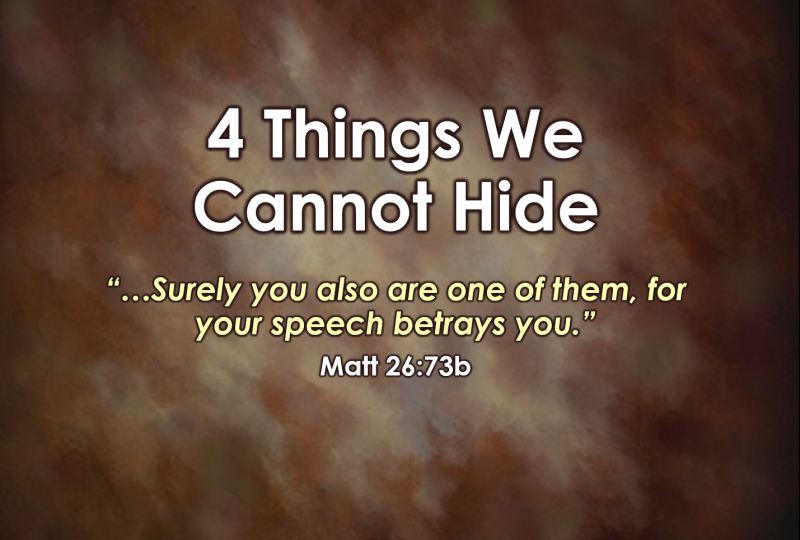
As I navigate life’s winding paths, I often try to present my best self to the world, hoping to mask my flaws. Yet, there are four things I cannot hide: my speech, my assumptions about others, how I let trouble affect me, and my perseverance despite obstacles. These aspects of my character slip through the cracks of my carefully curated facade, revealing my true heart. Through the lens of Scripture, I see both my shortcomings and the path to transformation, as God’s Word guides me to align these areas with His truth.
1. My Speech: The Way I Talk to Others My words betray my heart. Whether I speak with kindness, impatience, or cutting sarcasm, my tone and intent are laid bare for others to see. I cannot hide the impact of my speech, it lingers, shaping how others perceive me. A harsh word can wound, while a gentle one can heal. Proverbs 15:1 offers wisdom: “A soft answer turneth away wrath: but grievous words stir up anger.” When I choose words that uplift and encourage, I reflect God’s will for my life on how to interact with others. “Let no corrupt word proceed out of your mouth, but what is good for necessary edification, that it may impart grace to the hearers.” (Eph 4:29; see Col 4:6) O God, forgive me.
2. My Assumptions: Judging Without Knowing I often catch myself forming quick judgments about others based on their appearance or actions. Someone comically said, “I can tell a judgmental person just by looking at them.” These assumptions (especially in impugning motives) creep out through my body language, a fleeting glance, a hesitant tone, or an unconscious step back. My biases betray me, revealing a heart prone to prejudging. James 2:1-4 (KJV) challenges me: “My brethren, have not the faith of our Lord Jesus Christ, the Lord of glory, with respect of persons… Have ye not then been partial in yourselves, and are become judges of evil thoughts?” By seeking to understand others, I strive to embody humility, countering my tendency to assume. (see Matt 7:1-6 Judge not…) O God, forgive me.
3. The Way I Let Trouble Bother Me When trials come, my response reveals the depth of my faith. Too often, I grumble or slip into pessimism, broadcasting a lack of trust in God. My complaints expose a heart struggling to hold onto hope. Philippians 4:6-7 (KJV) offers a better way: “Be careful for nothing; but in every thing by prayer and supplication with thanksgiving let your requests be made known unto God. And the peace of God, which passeth all understanding, shall keep your hearts and minds through Christ Jesus.” By turning to prayer and gratitude, I can display hope, letting God’s peace shine through my troubles. “Do all things without complaining and disputing, that you may become blameless and harmless, children of God without fault in the midst of a crooked and perverse generation, among whom you shine as lights in the world,” (Phil 2:14-15) O God, Forgive me.
4. The Way I Keep On Despite Obstacles My perseverance (or lack thereof) reveals my resilience (or lack thereof). Do I press forward when others criticize, when obstacles loom, or when doubts creep in? My response is visible to all. Galatians 6:9 (KJV) encourages me: “And let us not be weary in well doing: for in due season we shall reap, if we faint not.” This verse urges me to keep going, trusting God, no matter what stands in my way. My steadfastness displays my Hope in God. “For you have need of endurance, so that after you have done the will of God, you may receive the promise:” (Heb 10:36) O God, Forgive me.
The Problem Exemplified When I fail to guard these areas, my flaws are exposed. Proverbs 21:23 (KJV) warns, “Whoso keepeth his mouth and his tongue keepeth his soul from troubles.” My unguarded words can spark conflict, reflecting a broader truth: when my speech, assumptions, complaints, or lack of perseverance go unchecked, I invite calamity. This verse humbles me, reminding me of the consequences of letting my heart run unrestrained.
Transforming My Life Though I cannot hide these four aspects of myself, I can, by God’s grace, refine them to reflect His character. Proverbs 15:1 teaches me to speak with gentleness. James 2:1-4 calls me to love without prejudice. Philippians 4:6-7 guides me to replace complaints with hope. Galatians 6:9 strengthens me to persevere. Together, these scriptures shape me to live in a better way, letting my words, actions, and attitudes shine as a testimony to the transformative power of God’s word. In a world that sees what I cannot hide, I pray my life reflects Christ.
Scientific Insights in the Bible Before Their Discovery
The Bible, often seen as a spiritual guide, harbors scientific insights that predate their modern discovery, hinting at a wisdom beyond its ancient writers. While not a scientific treatise, its casual mentions of natural phenomena (later validated by research) present a compelling case for its inspired nature. From lightning’s path to Earth’s form, these glimpses into the physical world challenge assumptions of a purely primitive text.
One remarkable example is the Bible’s reference to lightning’s path. Job 28:26 states, “When He made a law for the rain and a path for the thunderstorm,” while Job 38:25 asks, “Who has divided a channel for the overflowing water, or a path for the lightning of thunder?” Written around 2000 BC, these verses suggest lightning follows a guided route, a concept unknown to ancient meteorology. Not until the 1960s, with advancements in high-speed photography and electrical studies, did scientists like Martin Uman confirm that lightning indeed traces a predictable plasma channel. This discovery, detailed in The Lightning Discharge (1987), aligns with Job’s imagery, predating it by nearly 4,000 years. This example is absolutely compelling; it’s a precise, testable phenomenon described millennia before the tools existed to verify it, making it a standout among biblical insights.
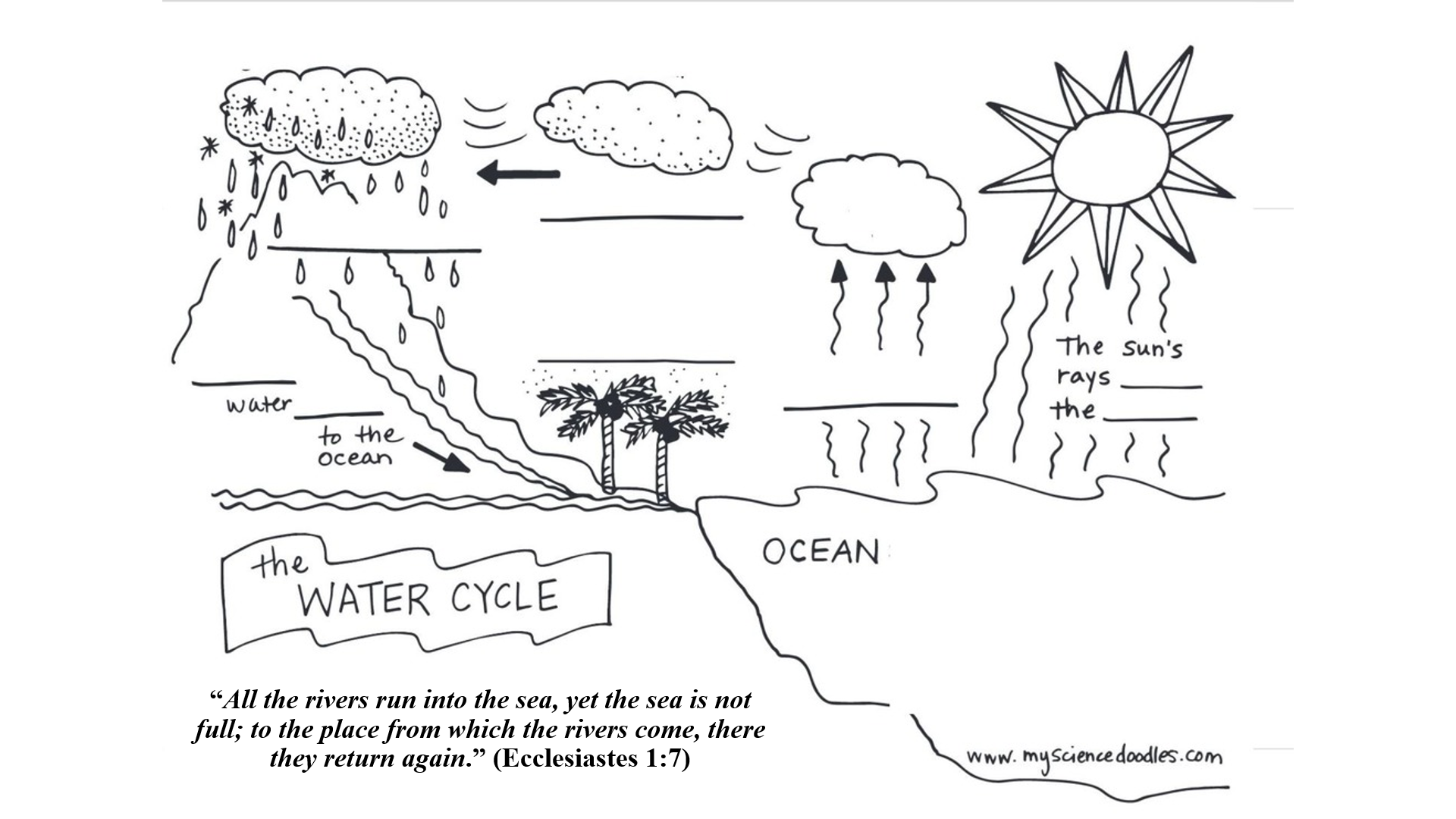
The hydrologic cycle also emerges in Scripture long before its scientific mapping. Ecclesiastes 1:7 observes, “All the rivers run into the sea, yet the sea is not full; to the place from which the rivers come, there they return again.” This encapsulates evaporation and precipitation, a process not formalized until Bernard Palissy’s 16th-century work. Job 36:27-28 reinforces this: “He draws up the drops of water, which distill as rain from the mist,” revealing an understanding absent in contemporary cultures.
Biologically, Leviticus 17:11 declares, “For the life of the flesh is in the blood,” a truth central to modern medicine. Penned circa 1400 BC, it precedes William Harvey’s 1628 circulation discovery by over two millennia. Henry Morris, in The Biblical Basis for Modern Science (1984), argues this reflects knowledge beyond ancient observation, tying blood to vitality in a way science later confirmed.
Cosmologically, Job 26:7 asserts, “He hangs the earth on nothing,” portraying Earth as suspended in space—a view not widely accepted until Copernicus. This contrasts with ancient myths of a supported Earth, aligning with modern astronomy’s findings. John W. Montgomery’s Evidence for Faith (1991) notes such insights suggest a source transcending human limits.
These instances don’t prove divinity but defy coincidence, bridging faith and reason.
Agape
Sources:
Morris, Henry M. The Biblical Basis for Modern Science. Baker Books, 1984.
Montgomery, John W. Evidence for Faith. Probe Books, 1991. Uman, Martin A. The Lightning Discharge. Academic Press, 1987.
The Manuscript Evidence for the Bible’s Preservation
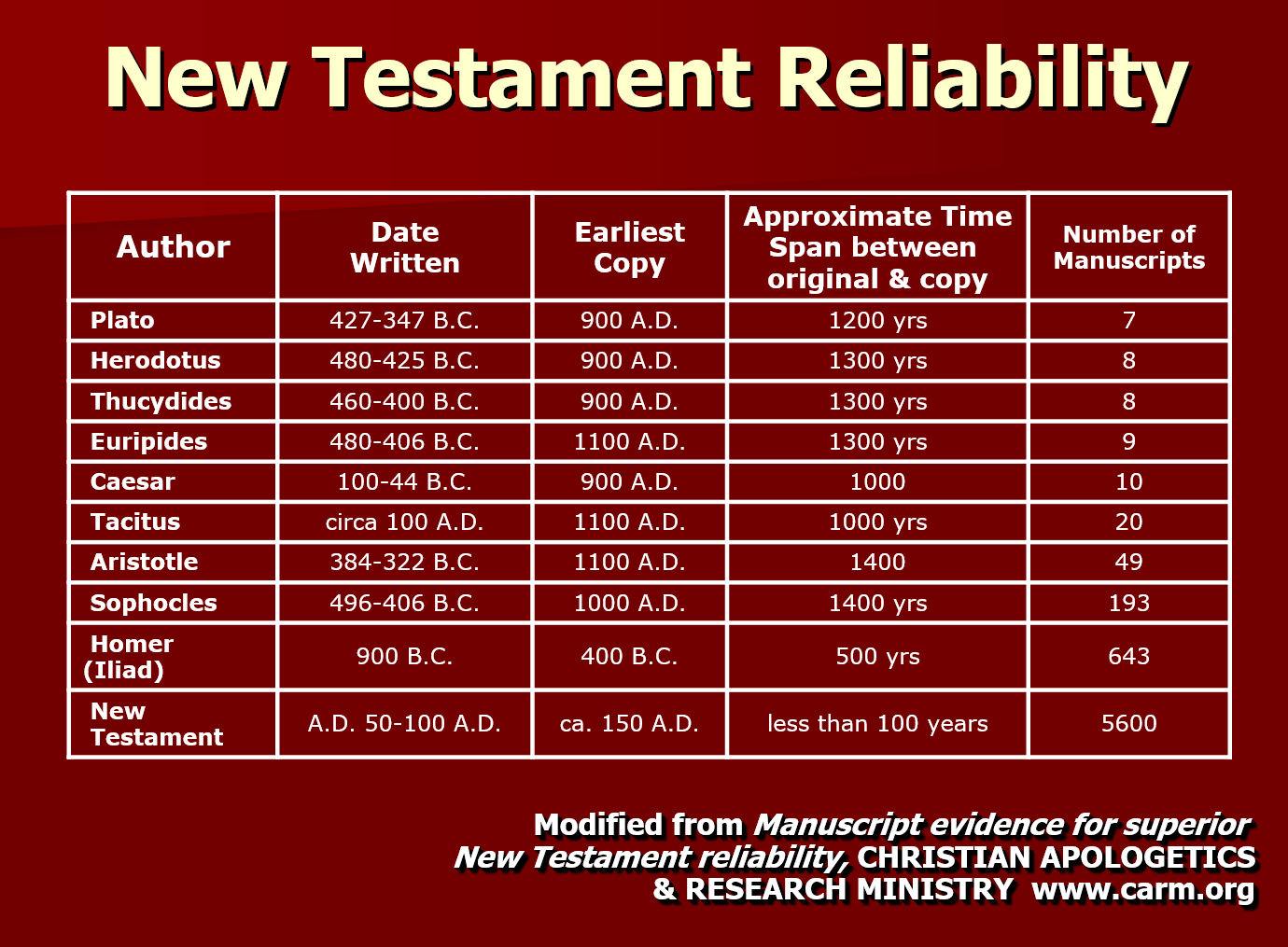
The Bible’s preservation across millennia stands as a testament to its enduring reliability, backed by an unmatched trove of manuscript evidence. With over 5,800 Greek New Testament manuscripts and more than 19,000 in other languages, the Bible dwarfs all other ancient texts in sheer volume. This vast collection, paired with its textual consistency, builds a logical and compelling case that today’s Scriptures faithfully echo their original form.
Take the New Testament: The Rylands Papyrus (P52), dated to around AD 125, preserves John 18:31-33, penned just decades after the Gospel’s origin. Contrast this with Caesar’s Gallic Wars, where the earliest copies lag 900 years behind the original, yet face little skepticism. The Bible’s early manuscripts, hundreds before AD 300, shrink the window for distortion. F.F. Bruce, in The New Testament Documents: Are They Reliable? (1943), asserts this abundance yields a text 99.5% accurate, with variants largely trivial (e.g., spelling in John 1:1).
For the Old Testament, the Dead Sea Scrolls, like the Great Isaiah Scroll (1QIsa^a) from 125 BC, showcase precision. Isaiah 7:14, foretelling a virgin birth, aligns almost perfectly with the 10th-century Masoretic Text across 66 chapters. Minor shifts, like phrasing in Isaiah 40:3, leave meaning intact. Daniel B. Wallace’s Revisiting the Corruption of the New Testament (2011) praises the scribes’ meticulousness, reflecting their obedience to Deuteronomy 4:2’s command against altering God’s Word.
This consistency holds across key doctrines. Christ’s divinity (John 1:14), God’s covenant (Genesis 17:7), and salvation through faith and baptism (Acts 2:38, preserved in Codex Vaticanus, 4th century AD) remain unshaken. In Acts 2:38, Peter’s call to “repent and be baptized… for the remission of your sins” mirrors countless manuscripts, showing no doctrinal drift despite centuries of copying. The volume of texts enables rigorous comparison, a privilege rare among ancient works like Homer’s Iliad (643 copies).
Such preservation stems from deliberate effort, not chance. Jewish scribes counted letters per line, while early Christians, under persecution, shared copies widely—Paul even instructed in 1 Thessalonians 5:27, “I charge you by the Lord that this letter be read to all the brethren,” fostering circulation among congregations. This dedication ensured texts endured, as urged in 2 Timothy 2:15 to handle truth diligently. The Codex Sinaiticus (4th century AD) and later Byzantine manuscripts align closely, bridging continents and eras.
Skeptics may doubt miracles, but the manuscript evidence refutes claims of textual unreliability. From desert caves to medieval scriptoriums, the Bible’s words have weathered time, emerging intact. In a sea of ancient literature, Scripture stands as a rock—its message preserved not by chance, but by a legacy of care that echoes its own call to endure.
Agape
Sources: Bruce, F.F. The New Testament Documents: Are They Reliable? Eerdmans, 1943. Wallace, Daniel B. Revisiting the Corruption of the New Testament. Kregel Academic, 2011.
The discovery of the Dead Sea Scrolls in 1947 ranks among the most significant archaeological finds in history, offering a profound window into the reliability of the Bible. Hidden in caves near Qumran, these ancient manuscripts, dating from the 3rd century BC to the 1st century AD, include fragments of nearly every Old Testament book. Their remarkable preservation and textual consistency with later biblical manuscripts provide compelling evidence that the Scriptures we read today faithfully reflect their ancient origins.
One of the most striking finds is the Great Isaiah Scroll (1QIsa^a), a nearly complete copy of the Book of Isaiah dating to around 125 BC. When compared to the Masoretic Text, the standard Hebrew Bible from the 10th century AD, the scroll shows astonishing fidelity. For instance, Isaiah 53, a messianic prophecy central to both Jewish and Christian theology (Isaiah 53:5-6), differs only in minor spelling or stylistic variations—none altering the meaning. This consistency across a millennium demonstrates that scribes meticulously preserved the text, countering claims of rampant corruption over time.
The scrolls also include fragments of Deuteronomy, such as 4QDeut^j, which preserves Deuteronomy 32:43. This passage, part of Moses’ song, aligns closely with the Septuagint (Greek translation) suggesting a textual tradition predating later standardization. Yet, its core message—God’s covenant with Israel—remains intact, as seen in Deuteronomy 32:8-9. Such findings reveal a diversity of ancient texts but affirm their essential unity, reinforcing the Bible’s reliability as a transmitted document.
Beyond specific books, the scrolls reflect a broader cultural and religious context matching biblical accounts. The Community Rule (1QS) and other sectarian writings echo the ascetic lifestyle of groups like the Essenes, resonating with descriptions of John the Baptist’s wilderness ministry (Matthew 3:1-4). While not direct proof of New Testament events, this alignment anchors the biblical world in historical reality, showing that its narratives were not invented centuries later.
Critics once argued that the Bible’s text evolved significantly over time, but the Dead Sea Scrolls challenge that notion. Scholarly analysis, such as Millar Burrows’ The Dead Sea Scrolls (1955), notes that discrepancies are minimal—often mere scribal errors—while Frank Moore Cross’s The Ancient Library of Qumran (1995) highlights the scrolls’ role in tracing textual transmission. These manuscripts predate the Masoretic Text by over a thousand years, yet their agreement is uncanny, suggesting a disciplined copying tradition rooted in reverence for the Word.
The Dead Sea Scrolls do not prove every biblical claim, but they powerfully affirm the Old Testament’s textual integrity. They bridge centuries, showing that what was written in antiquity endures today with remarkable accuracy. In an age of skepticism, these fragile fragments whisper a timeless truth: the Bible’s words have been guarded through the ages, as if etched in stone and sealed in clay.
Agape
Sources: Burrows, Millar. The Dead Sea Scrolls. Viking Press, 1955. Cross, Frank Moore. The Ancient Library of Qumran. Sheffield Academic Press, 1995.
The Bible’s Historical Accuracy: Archaeology and Scripture
The historical accuracy of the Bible has long been debated, yet archaeological discoveries consistently affirm its reliability as a historical document. Far from being a mere collection of spiritual tales, the Bible contains detailed accounts of people, places, and events that align with evidence unearthed by modern archaeology. This interplay between Scripture and science offers a compelling case for the Bible’s trustworthiness, bridging faith and reason in a unique way.
One striking example is the discovery of the Hittites, a once-obscure people mentioned over 50 times in the Old Testament (e.g., Genesis 15:20, 2 Chronicles 1:17). For centuries, skeptics dismissed the Hittites as fictional, as no evidence of their existence appeared in known ancient records. However, in 1906, German archaeologist Hugo Winckler excavated Hattusa, the Hittite capital, in modern-day Turkey. Tablets and ruins revealed a sophisticated Bronze Age civilization that matched biblical descriptions, including their interactions with Abraham’s descendants (Genesis 23:10). This find silenced doubters and showcased the Bible’s precision in recording historical peoples.
Similarly, the Pool of Bethesda, described in John 5:2 as having “five porches,” was long questioned by critics who argued no such structure existed in Jerusalem. Excavations in the 19th century, however, uncovered a twin-pool complex with five porticoes, precisely as Scripture depicted. This discovery, detailed by archaeologist Conrad Schick, not only confirmed the Gospel’s topographic accuracy but also its cultural context, as the site was linked to healing practices consistent with the narrative of John 5:7-9.
The Tel Dan Stele, unearthed in 1993 in northern Israel, provides another powerful corroboration. This 9th-century BC inscription references the “House of David,” marking the first extra-biblical mention of King David, a central figure in Scripture (2 Samuel 5:11). Critics had previously argued David was a myth, akin to King Arthur, but this basalt fragment, discovered by archaeologist Avraham Biran, aligns with the biblical timeline and dynasty, lending credibility to the historicity of Israel’s monarchy as recorded in 1 and 2 Kings.
Even the New Testament finds support in archaeology. The Pilate Stone, discovered in 1961 at Caesarea Maritima by Italian archaeologist Antonio Frova, bears the name and title of Pontius Pilate, the Roman prefect who sentenced Jesus to death (Matthew 27:24). This limestone block, dated to AD 26-36, matches the biblical timeframe and refutes claims that Pilate was a fabricated character. Such finds anchor the Gospel narratives in verifiable history.
These examples, spanning countries, centuries, and both Testaments, demonstrate a pattern: the Bible’s details, once dismissed as implausible, are repeatedly vindicated by the spade of the archaeologist. While not every verse has been archaeologically confirmed, the cumulative weight of evidence challenges the notion that Scripture is detached from reality. Sources like The Archaeology of the Bible by James K. Hoffmeier (2008) and Biblical Archaeology Review underscore this growing alignment.
The Empty Tomb: Historical Evidence and Explanations
The empty tomb of Jesus Christ stands as one of the most compelling pieces of historical evidence supporting His resurrection, defying naturalistic explanations and aligning with the transformative impact of early Christianity. Recorded in all four Gospels (Matthew 28:1-10, Mark 16:1-8, Luke 24:1-12, John 20:1-18), the tomb’s vacancy is more than a theological claim but a historical puzzle that demands a logical resolution.
First, the empty tomb is a widely attested fact, even by Jesus’ opponents. The Gospel of Matthew notes that the Jewish leaders bribed guards to claim the disciples stole the body (Matthew 28:11-15), implicitly conceding the tomb was empty. This early counter-narrative, preserved in a text dated to within decades of the event, suggests the vacancy was undeniable—otherwise, producing the body would have silenced the resurrection claim. Historian N.T. Wright, in The Resurrection of the Son of God (2003), argues that this admission from hostile sources strengthens the case, as it reflects a historical reality too stubborn to dismiss.
Second, alternative explanations falter under scrutiny. The “stolen body” theory lacks plausibility: the disciples, described as terrified post-crucifixion (John 20:19), were unlikely to overpower Roman guards, risking death for a corpse. The Roman seal and guard presence (Matthew 27:62-66) further complicate this scenario—failure to secure the tomb would have cost the soldiers their lives. The “wrong tomb” hypothesis also fails; the burial site, owned by Joseph of Arimathea, a known figure (Mark 15:43), was no obscure location. Women witnesses, the first to report the empty tomb (Luke 24:1-3), would have ensured accuracy, as their testimony—unexpected in a patriarchal culture—adds credibility, per historian Michael Licona in The Resurrection of Jesus (2010).
Third, the empty tomb’s implications align with historical outcomes. If Jesus’ body remained, the Jewish or Roman authorities, with every motive to crush Christianity, could have displayed it to end the movement. Instead, Christianity exploded, with Paul citing over 500 witnesses to the risen Christ (1 Corinthians 15:3-8), a claim circulated early enough to be verified. The transformation of disciples into bold proclaimers (Acts 2:14-36) and the conversion of skeptics like Paul (Acts 9:1-19) hinge on an event—the resurrection—tied to that empty tomb. Archaeologically, no rival tomb has ever surfaced, despite Jerusalem’s significance.
Finally, the cultural context bolsters the argument. Jewish theology expected a general resurrection at history’s end, not an individual rising (Daniel 12:2). The claim of Jesus’ resurrection, centered on an empty tomb, was radical yet gained traction, suggesting an extraordinary event shifted expectations. As scholar Gary Habermas notes in The Case for the Resurrection of Jesus (2004), the tomb’s emptiness, paired with appearances, best explains this shift. The empty tomb stands as a historical anchor—unrefuted by foes, unexplainable by skeptics, and unshaken by time. No body was found because no body remained; the tomb’s silence screams resurrection.



 Borger church of Christ @ Franklin & Juniper