
5 Things the SAVED do. pt 2

Moreover, brethren, I declare unto you the gospel which I preached unto you, which also ye have received, and wherein ye stand; By which also ye are saved, if ye keep in memory what I preached unto you, unless ye have believed in vain.”  (1Cor 15:1-2)

In part one we noted that those that are SAVED go out SPREADING the Gospel. “Therefore they that were scattered abroad went every where preaching the word” (Acts 8:4). Their changed behavior is just one of the ways they Spread the tidings round (cf. 1Pet 3:1-6).

They also ASSEMBLE with the Saints in person on the first day of the week to worship. “And let us consider one another to provoke unto love and to good works: Not forsaking the assembling of ourselves together, as the manner of some is; but exhorting one another: and so much the more, as ye see the day approaching” (Hebrews 10:24-25; cf. 1Cor 11:17-34; 16:1-2; Acts 2:42).

In part two we will notice 3 more things the SAVED do.

The saved VISIT the Saints. We use VISIT today to mean meeting with each other in a social setting. While Saints do get together socially (Acts 2:46), the word VISIT in the New Testament deals with giving aid to other needy saints or their orphaned children. “Pure religion and undefiled before God and the Father is this, To visit the fatherless and widows in their affliction, and to keep himself unspotted from the world” (James 1:27).

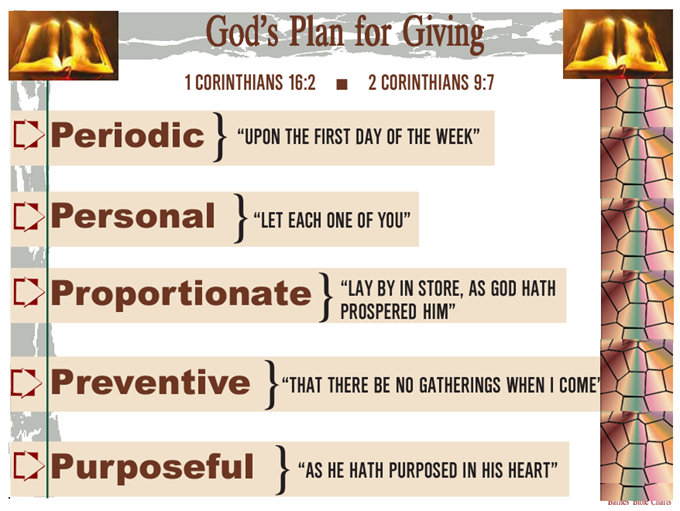
In the beginning of the church, the Saints gave generously to aid the needy Saints. “Neither was there any among them that lacked: for as many as were possessors of lands or houses sold them, and brought the prices of the things that were sold, And laid them down at the apostles’ feet: and distribution was made unto every man according as he had need” (Acts 4:34-35; cf. 11:29; 1Cor 16:1-2).

The SAVED are very generous. They help needy Saints* (individually or through the local church; 1Tim 5:8-10; Matt 25:36), and they, from their own personal treasure, help those outside of the church among their family, friends, and neighbors (cf. Gal 6:10; Eph 4:28). *the funds collected in the local church (1Cor 16:1-2) are limited to Saints only for Making Saints, Teaching Saints, and Helping Saints.

The saved also spend time in self-EXAMINATION. “Examine yourselves, whether ye be in the faith; prove your own selves. Know ye not your own selves, how that Jesus Christ is in you, except ye be reprobates” (2Cor 13:5)? Another way of saying this is we JUDGE ourselves. “For if we would judge ourselves, we should not be judged” (1Cor 11:31). When we are proactive about looking within ourselves first, we will have no worry about those looking at us from outside.

We do this EXAMINATION of ourselves through studying the New Testament. “All scripture is given by inspiration of God, and is profitable for doctrine, for reproof, for correction, for instruction in righteousness: That the man of God may be perfect, throughly furnished unto all good works” (2Tim 3:16-17). It’s this way we find assurance of our salvation (cf 1John 2:12-14). If there is any doubt about ourselves, we will learn from the Bible what to change.

John gave the purpose of the written word, which requires us to read it, and examine ourselves with it to know whether we’re following it. “My little children, these things write I unto you, that ye sin not” (1John 2:1).

Emphasis mine seb.

Lastly (in our list), the saved are DILIGENT to present themselves approved into God. “Be DILIGENT to present yourself approved to God, a worker who does not need to be ashamed, rightly dividing the word of truth” (2Tim 2:15). The word “diligent” (study in the KJV) means that the Saints endeavor, or labor to be well pleasing to God by keeping His commands.

Jesus said, “Therefore whosoever heareth these sayings of mine, and doeth them, I will liken him unto a wise man, which built his house upon a rock: And the rain descended, and the floods came, and the winds blew, and beat upon that house; and it fell not: for it was founded upon a rock” (Matt 7:24-25).

Jesus did the same. “And he that sent me is with me: the Father hath not left me alone; for I do always those things that please him” (John 8:29). He gave us an example in Himself of the thing He commands. At the Judgment, Jesus will ask about our faithfulness, “And why call ye me, Lord, Lord, and do not the things which I say” (Luke 6:46)?

One of the areas that DILIGENCE shows up is when we discover an area of error from which we must repent (see EXAMINATION in the previous point). “For observe this very thing, that you sorrowed in a godly manner: What DILIGENCE it produced in you, what clearing of yourselves, what indignation, what fear, what vehement desire, what zeal, what vindication! In all things you proved yourselves to be clear in this matter” (2Cor 7:11).

Back to John’s writing in 1John 2, we have hope in repentance because we have an Advocate in Christ. “And if any man sin, we have an advocate with the Father, Jesus Christ the righteous: And he is the propitiation for our sins: and not for ours only, but also for the sins of the whole world. And hereby we do know that we know him, if we keep his commandments. He that saith, I know him, and keepeth not his commandments, is a liar, and the truth is not in him. But whoso keepeth his word, in him verily is the love of God perfected: hereby know we that we are in him. He that saith he abideth in him ought himself also so to walk, even as he walked” (1John 2:2-6).

Becoming one of the SAVED in hope is the beginning of our eternal life. It’s no wonder that the saved Spread the word, Assemble with other Saints, Visit the needs of the poor, Examine themselves, and are Diligent to show themselves approved to God. The Saints are saved by grace, and they exemplify salvation by living a life of Grace.

Agape,

Spencer

4 strategies on how to GIVE more.

4 strategies on how to…

GIVE more. Eph 4:28

To give more we can

GET rid of Debt, Get more income. Prov 23:7

Work some OT to have extra money to Give?

Sometimes folks need mentoring and some new

INFORMATION giving. Prov 9:9 give instruction…

It takes no money to

VOLUNTEER giving. Snack Pack, hold a flashlight, hold a hand. Mat 25:31-ff

Take a look at your current spending and

EVALUATE your budget. Expensed vs Extra

You can tell a lot about a person when you look at their monthly spending. I knew a man that spent most of his money on food delivery. It’s no wonder he was also a heavy man.

reverse the direction.

Run out of Money before you run out of month?

Put giving first and EXTRAS last.

Rectangle: Rounded Corners: SUMMARY:

give
We can have and enjoy things. 1Tim 6:10

God want us to give and to have. 2Cor 9:8 Luke 6:38 Give, and it shall be given unto you; good measure, pressed down, and shaken together, and running over, shall men give into your bosom. For with the same measure that ye mete withal it shall be measured to you again.

If we have time, preach the Gospel

THIS IS NOT another article on being busy, or wasting time. Neither is this article going to tell you never to help the needy. No, this article looks at some complicated issues facing the church. Below are two questions that get to the heart of the matter…

  • Why did Jesus come to Earth?
  • What is the work of His church?

Answering these questions incorrectly can lead to a misunderstanding of the work of the church. We must know the answer, we’ve got to get it right. To do otherwise will cause a lot of us to be lost.

Recently, a brother in Christ stated, “In my Bible, Jesus spent His life helping poor and the needy.” It is statements like this that have led to a complete departure from the God given work of the church. Many denominations have deprecated the work of the church and turned it into a benevolent organization. If that is what God wants us to do, we had better do it. However, what if He gave the church, that He built, a different task?

To find out what our work is, we need to answer those two questions.

Why did Jesus come to Earth?

Looking to what Jesus Himself said on the matter, we find a few passages…

And he said unto them, How is it that ye sought me? wist ye not that I must be about my Father’s business? [Luke 2:49] Did Jesus say this as the carpenter’s son or as the Son of God? Clearly, He spoke as Emmanuel, God with us.

And he said unto them, I must preach the kingdom of God to other cities also: for therefore am I sent. [Luke 4:43] In this passage, Jesus is plainly saying why He came to earth, TO PREACH THE KINGDOM OF GOD.

When people came to Jesus in John 6, He perceived that they only came for the physical food. What He says to them speaks volumes about why He was here. Jesus answered them and said, Verily, verily, I say unto you, Ye seek me, not because ye saw the miracles, but because ye did eat of the loaves, and were filled. Labour not for the meat which perisheth, but for that meat which endureth unto everlasting life, which the Son of man shall give unto you: for him hath God the Father sealed. [John 6:26-27] If Jesus’ job was to provide for the physical needs of the poor, why didn’t He feed them again? If you didn’t get it, read vs 29; Jesus answered and said unto them, This is the work of God, that ye believe on him whom he hath sent. The work of God, the job Jesus came to do, was to teach people about the Kingdom of God, to pay the penalty for sin so that we could be reconciled back with God. He did the miracles of feeding and healing to CONFIRM that this message, which was alluded to in the OT, was from God [John 20:30-31].

When we look at other passages, we learn what others thought of Our Lord’s work. The next day John seeth Jesus coming unto him, and saith, Behold the Lamb of God, which taketh away the sin of the world. [John 1:29, 36] John the baptizer knew why Jesus had come, it was to reconcile man back to God.

At the circumcision of Jesus, Zacharias said, “And thou, child, shalt be called the prophet of the Highest: for thou shalt go before the face of the Lord to prepare his ways; To give knowledge of salvation unto his people by the remission of their sins,” [Luke 1:76-77]. We are separated because of sin and need a Savior. If we understand the principles of sacrifice from the scripture, then we will have a better understanding of why Jesus came to earth. He came to bring salvation from sin.

Lastly, when we look at the last command He gave while still on this earth, we learn the answer to question two.

What is the work of His church?

What was the last command Jesus gave while still on earth? He gave it after His DEATH, BURIAL & RESURRECTION.

And Jesus came and spake unto them, saying, All power is given unto me in heaven and in earth. Go ye therefore, and teach all nations, baptizing them in the name of the Father, and of the Son, and of the Holy Ghost: Teaching them to observe all things whatsoever I have commanded you: and, lo, I am with you alway, even unto the end of the world. Amen. [Mat 28:18-20; cr. Mark 16:15-16]

Jesus, the founder and builder of the church which bears His name, gave very clear instructions; PREACH THE GOSPEL, MAKE DISCIPLES (through hearing, believing, confession, repentance & baptism) and to TEACH those disciples to obey His commandments. THIS IS THE WORK OF THE CHURCH! Can people feed the poor, YES. Should people feed the poor, once again, YES. And the bible gives us instruction on how and who. It also limits the church collective to needy saints [1Tim 5:16]. We need to focus on preaching the Gospel, to do anything less is to place salvation as a secondary activity to physical concerns, something we do IF WE GET TIME.

Making Preachers Rich

An Excerpt of a sermon BY Moses E. Lard

EDITOR’S NOTE: In 1863, Moses E. Lard, one of the “second generation” Restoration Leaders wrote a tribute at the death of Allen Wright, another preacher of that era. Lard said “the Churches always managed to keep Brother Wright poor, very poor.” From this point Lard gave a “sermon” to the readers of his Quarterly. Speaking of the brotherhood he said,

” . . . (they) tell me they do not believe in making preachers rich. Neither do I. But, brethren, I do believe in making them comfortable, in supporting them this side of want, and in affording these faithful men the means of schooling their children well.

Is this right? But why, pray, do you not believe in making preachers rich? Do you think it would hurt them? You cannot say it would; for you have never made one rich, to know. Suppose before you longer preach your doctrine with so much confidence in its truth, you test it by making at least one preacher rich.

Hitherto you have kept them all poor; let us now have at least one exception to your rule. You are satisfied that it works well both ways. Preachers are not at all satisfied that you are right in what you say, neither will they be until, by making at least one of them rich you convince them that you are so.

Do you think it would hurt you to be rich, or hurt your children to educate them well, and thereby enable them to move in genteel circles? Of course you do not. How then can you imagine that it would your preacher, or injure his children to make him rich?

You tell me it would cause him to neglect his calling. But how do you know this? You have never made one rich, to have the point tested. Would making you rich cause you to neglect your calling? Why then should you think it would cause the preacher to neglect his? The closer you stick to your calling the richer you grow. Think you not, if the preacher, too, could grow daily richer by sticking to his calling, that he would not stick to it close indeed. But the difference is, that the closer you stick to your calling the richer you grow, while the closer he sticks to his the poorer he grows. Is there not something wrong?

But tell me truly, faithful brother, do you preach this doctrine really believing it. Is it really so that you do not believe in making preachers rich, and that, too, because it would hurt them and cause them to neglect their calling? Or is not this a mere plea to shield your own purse? Beware” (Lard’s Quarterly, September. 1863, Volume One, pp. 37, 38).