God Hardened Pharaoh’s Heart
For the Scripture says to Pharaoh, “For this very purpose I have raised you up, that I may show My power in you, and that My name may be declared in all the earth.” (Rom 9:17)
This objection sounds like this; Calvinists might say that Pharaoh’s hardening is evidence of predestination separate from free will:
“God hardened Pharaoh’s heart to display His sovereign power, showing that human will is subject to His eternal decree.”
“Pharaoh’s hardening proves that God chooses whom to have mercy on and whom to harden, independent of human action.”
“God raised Pharaoh up to be a vessel of wrath, predestined to resist Him, to magnify divine glory.”
“Pharaoh had no free will to resist God’s hardening, as his rebellion was ordained to serve God’s redemptive plan.”
At the end of the day, this error makes God out to be a monster, and that He is a respecter of persons. “Then Peter opened his mouth, and said, Of a truth I perceive that God is no respecter of persons.” (Acts 9:34)
How can we answer this objection?
We Harden Our Own Hearts
The Bible repeatedly warns against hardening our hearts, emphasizing that this is a choice we make by disregarding God’s word. Hebrews 3:15 urges, “To day if ye will hear his voice, harden not your hearts, as in the provocation.” Similarly, Hebrews 4:7 echoes, “To day, after so long a time; as it is said, To day if ye will hear his voice, harden not your hearts.” These verses, rooted in Psalm 95:7–8, recall Israel’s rebellion in the wilderness, where they hardened their hearts by refusing to trust God. Proverbs 28:14 warns, “He that hardeneth his heart shall fall into mischief,” while Zechariah 7:12 describes those who “made their hearts as an adamant stone, lest they should hear the law.” When we ignore God, we actively choose to harden our hearts, shutting out God’s truth. The responsibility lies with us, not with God overriding our will.
God Allows Rebellion to Accomplish His Purpose
God permitted Pharaoh to exalt himself in pride, using his defiance to demonstrate His power. Exodus 7:3–5 declares, “I will harden Pharaoh’s heart, and multiply my signs… that the Egyptians may know that I am the Lord.” Similarly, Exodus 10:1–2 explains that God hardened Pharaoh’s heart “that ye may tell in the hearing of thy son… what I have wrought in Egypt.” Exodus 14:4 adds, “I will harden Pharaoh’s heart, and he will pursue them, and I will get glory over Pharaoh.” This purpose is echoed in Romans 9:17: “For the scripture saith unto Pharaoh, Even for this same purpose have I raised thee up, that I might shew my power in thee.” Like Judas, chosen yet betraying Jesus (John 6:70–71: “Have not I chosen you twelve, and one of you is a devil?”), Pharaoh’s rebellion serves God’s plan without excusing his guilt. God allows human pride to run its course, turning it to His glory.
Rebellion Is to Harden Our Own Heart
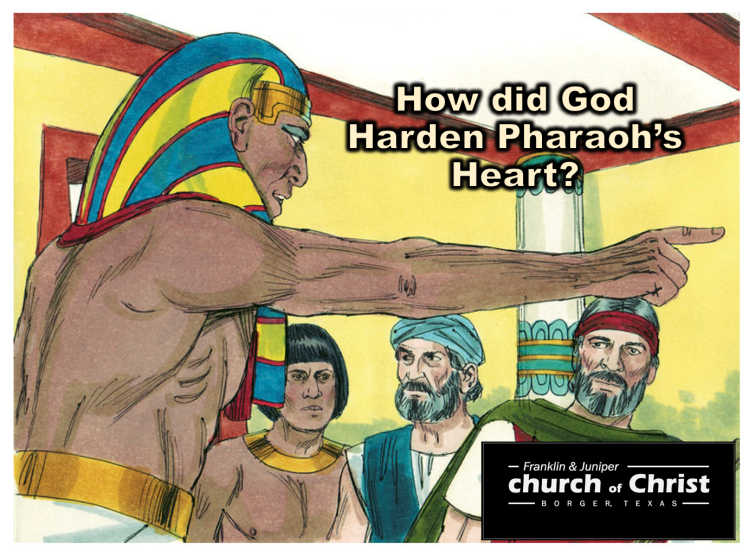
Pharaoh’s story vividly illustrates this truth. In Exodus 5:2, he defiantly declares, “Who is the Lord, that I should obey his voice and let Israel go? I do not know the Lord.” This rejection of God’s authority marks the beginning of his heart’s hardening. The Bible shows Pharaoh repeatedly choosing to disregard God’s word through Moses. In Exodus 7:13, after Aaron’s staff becomes a serpent, “Pharaoh’s heart was hardened, and he did not listen to them.” Again, in Exodus 8:15, after the plague of frogs, “he hardened his heart and would not listen to them.” These passages highlight Pharaoh’s active role in hardening his heart by failing to regard God’s signs and commands.
Yet, God’s sovereignty is also at work. Exodus 4:21 states, “I will harden his heart, so that he will not let the people go,” and Exodus 9:12 confirms, “The Lord hardened the heart of Pharaoh.” Does this mean God forced Pharaoh to sin? No. The text consistently shows Pharaoh’s rebellion preceding God’s hardening, as in Exodus 9:27, where Pharaoh admits, “I have sinned this time: the Lord is righteous, and I and my people are in the wrong.” God does not cause Pharaoh’s sin but uses his rebellion to fulfill divine purposes, as Exodus 10:1 explains: “I have hardened his heart… that I may show these signs of mine among them.” Pharaoh remains accountable for his choices, while God sovereignly works through them.
“The Devil Made Me Do It”?
Some might claim, like the old saying, “The devil made me do it,” to shift blame for their sin. But Scripture places responsibility squarely on us. Pharaoh’s pride in Exodus 5:2 mirrors the rebellion of Israel in Judges 17:6 and 21:25: “Every man did that which was right in his own eyes.” This self-rule leads to a hardened heart. James 1:14–15 clarifies, “Every man is tempted, when he is drawn away of his own lust… when lust hath conceived, it bringeth forth sin.” Our deceitful hearts (Jeremiah 17:9: “The heart is deceitful above all things”) and evil thoughts (Mark 7:21–22: “From within, out of the heart of men, proceed evil thoughts… pride”) drive rebellion, not God or the devil. Like Pharaoh, we harden our hearts when we prioritize our own desires over God’s truth.
We are to Soften Our Hearts by God’s word.
The hardening of Pharaoh’s heart teaches us a profound lesson: We harden our hearts by disregarding God’s word, but God uses even our rebellion to fulfill His purposes. The Bible warns us to choose differently. Hebrews 3:15 pleads, “To day if ye will hear his voice, harden not your hearts.” Unlike Pharaoh, who persisted in pride, we must repent and seek a soft heart, as David prayed in Psalm 51:10: “Create in me a clean heart, O God.” Have you ignored God’s voice through Scripture? Choose to obey, for the responsibility to heed the Gospel call is ours.
Agape
 Borger church of Christ @ Franklin & Juniper