Let’s talk Legalism

Do not ADD to God’s Word.

The principles governing the handling of God’s Word can be framed through three pairs of terms: add (legalism), diminish (Illegal-ism), and distort (Perversion-ism).

Ye shall not add unto the word which I command you, neither shall ye diminish ought from it, that ye may keep the commandments of the LORD your God which I command you.” (Deuteronomy 4:2)

Add thou not unto his words, lest he reprove thee, and thou be found a liar.” (Proverbs 30:6)

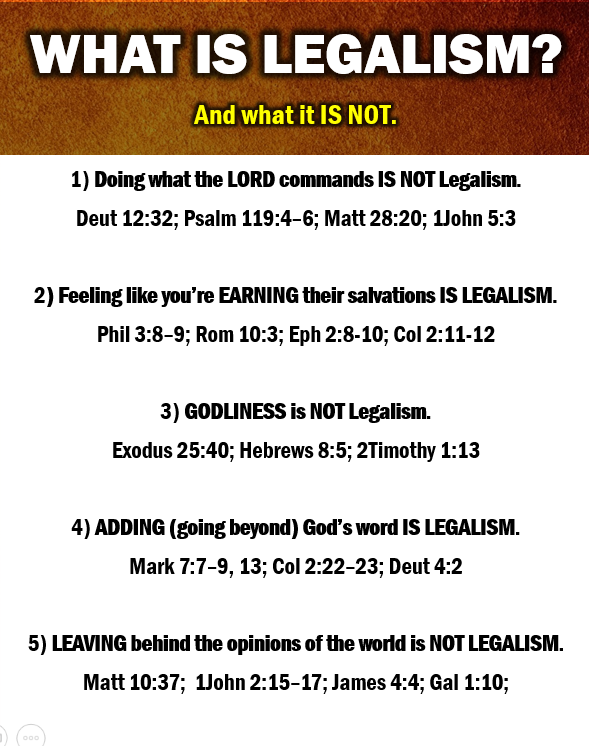
Add (Legalism) To add to God’s Word, known as legalism, involves imposing human rules or traditions as divine mandates, distorting Scripture’s intent (Deuteronomy 4:2, Proverbs 30:6). Legalism burdens believers with extra-biblical requirements, as seen in the Pharisees’ elevation of oral traditions, which Jesus rebuked (Mark 7:8-13). This practice fosters self-righteousness, shifting focus from God’s grace to man-made standards.

Legalism risks idolatry by prioritizing human additions over divine authority, creating confusion and division. Believers must discern between God’s commands and cultural preferences, ensuring worship remains rooted in Scripture’s sufficiency. Adding to God’s Word undermines its purity, leading to a faith that exalts human effort over divine truth. The antidote is humility, trusting Scripture’s completeness without supplementation. By avoiding legalism, believers honor God’s Word as the sole guide, fostering genuine faith free from the weight of unnecessary rules. Doing what God commands by faith is never legalism.

Diminish (Illegal-ism) To diminish God’s Word, termed Illegal-ism, involves selectively ignoring or downplaying Scripture to suit personal or cultural preferences (Deuteronomy 4:2, Revelation 22:19). Illegal-ism manifests when believers dismiss challenging teachings, such as those on baptism, to avoid obedience. This practice dilutes faith, creating a superficial spirituality that lacks trust in God. Scripture declares all its contents inspired and profitable (2 Timothy 3:16), demanding adherence to its entirety. Illegal-ism risks spiritual malnourishment, as believers miss God’s full counsel, and opens the door to moral relativism, where truth bends to human desires. Unlike legalism’s excess, Illegal-ism subtracts from divine revelation, equally undermining its authority. Faithfulness requires embracing both comforting and convicting passages, trusting God’s wisdom. By rejecting Illegal-ism, believers uphold the whole counsel of God (acts 20:27), ensuring a balanced faith that honors God’s perfect Word without selective omission.

Distort (Perversion-ism) To distort God’s Word, I call Perversion-ism, means twisting or misrepresenting its intended meaning to align with human agendas, cultural trends, or personal biases (Galatians 1:7, 2 Peter 3:16). “…in which are some things hard to be understood, which they that are unlearned and unstable wrest, as they do also the other scriptures, unto their own destruction.” Perversion-ism occurs when Scripture is reinterpreted to justify sin or compromise, as when Israel blended idolatry with worship (1 Kings 12:28-33). Unlike legalism’s additions or illegal-ism’s subtractions, Perversion-ism corrupts the text’s essence, altering its truth. This distortion undermines God’s authority, leading believers astray into false teachings or worldly conformity. Combatting Perversion-ism requires discernment to preserve Scripture’s intended message and courage to resist pressures to conform. It’s a subtle yet grave error, as it masquerades as faithfulness while perverting divine truth. By rejecting perversion-ism, believers stay aligned with God’s unchanging Word, ensuring obedience reflects His heart. This principle completes the framework: legalism adds, illegal-ism diminishes, and Perversion-ism distorts, guiding believers to honor Scripture faithfully.

AGAPE

SPENCER

LEGALISM

One of the most manipulative criticisms of the members of the Lord’s church is that they’re ‘legalists.’

Legalism is defined as “strict, literal or excessive conformity to the law or to a religious or moral code” (Webster’s Dictionary). Another way of saying it is, “one who follows the rules.”

What is unique about the definition of legalism is that it’s subjective. What does “excessive conformity” mean, who decides what is excessive and by what standard are they determining what constitutes excessive.

If you were to poll the denominations in a local area about what is a legalist, and pit their views on sin against one another, you’ll find that they would each think the other were legalists.

It’s really a made-up sin for people who want to continue in it. Paul addressed this in Romans chapter 6…

What shall we say then? Shall we continue in sin, that grace may abound? God forbid. How shall we, that are dead to sin, live any longer therein?” Romans 6:1-2

Here’s the rub, the workers of the devil have convinced people that NOT COMMITTING SIN IS A SIN! If you were to suggest that a legalist is a person who places their trust in the rule keeping ONLY, then of course that’s wrong. God clearly teaches an obedience through faith. Jesus condemned the Pharisee’s, not for keeping the law, rather for keeping it without their heart. I’ve met no one in the churches of Christ who believes or teaches salvation by works alone.

Woe unto you, scribes and Pharisees, hypocrites! for ye pay tithe of mint and anise and cummin, and have omitted the weightier matters of the law, judgment, mercy, and faith: these OUGHT YE TO HAVE DONE, AND NOT TO LEAVE THE OTHER UNDONE.” [Mat 23:23] emphasis mine.

A careful reading of the New Testament will find commands like…

  • Teaching them to observe all things whatsoever I have commanded you: Mat 28:18
  • By whom we have received grace and apostleship, for obedience to the faith among all nations, for his name: Romans 1:5
  • …according to the commandment of the everlasting God, made known to all nations for the obedience of faith: Romans 16:26
  • For to this end also did I write, that I might know the proof of you, whether ye be obedient in all things. 2Cor 2:9
  • If ye love me, keep my commandments. John 14:15
  • For this is the love of God, that we keep his commandments: and his commandments are not grievous. 1John 5:3

I believe the confusion comes from a misunderstanding of passages that teach the keeping of the Law could not bring life [ie Gal 3:11; 5:1-4]. The context of these passages is speaking about the Law of Moses, not the Law of Christ. Later in Galatians 3:27 Paul wrote, “For as many of you as have been baptized into Christ have put on Christ.” In many places, the Inspired Writers and Apostles of Christ warned those, that still clung to the fulfilled Law of Moses, that it would lead to death. And nowhere will you find any similar condemnation of strictly following the commands of our Lord. Instead, they commend it.

Now, based on a poor understanding of Scripture, millions are being led astray believing that strict obedience to God is a sin called legalism. They’re being told that a faithful Christian is one who is not overly concerned with knowing or keeping God’s commandments. They will often cite 2Corinthians 3:6 as a proof text. However, when you examine the context (v7) you’ll find that what is under consideration is once again, the Law of Moses as it refers to “tablets of stone.”

Listen up, those who love God will keep His commandments [John 14:15]. What does it mean then if you refuse to keep His commandments? In his letters, John also wrote…

And hereby we do know that we know him, if we keep his commandments. He that saith, I know him, and keepeth not his commandments, is a liar, and the truth is not in him.” [1John 2:3]

To love God, to truly know God, is to keep His commandments THROUGH FAITH for it also says in His divine word…


But without faith it is impossible to please him: for he that cometh to God must believe that he is, and that he is a rewarder of them that diligently seek him.” [Hebrews 11:6]