What Do I Say When They Say; God Hardened Pharaoh’s Heart?

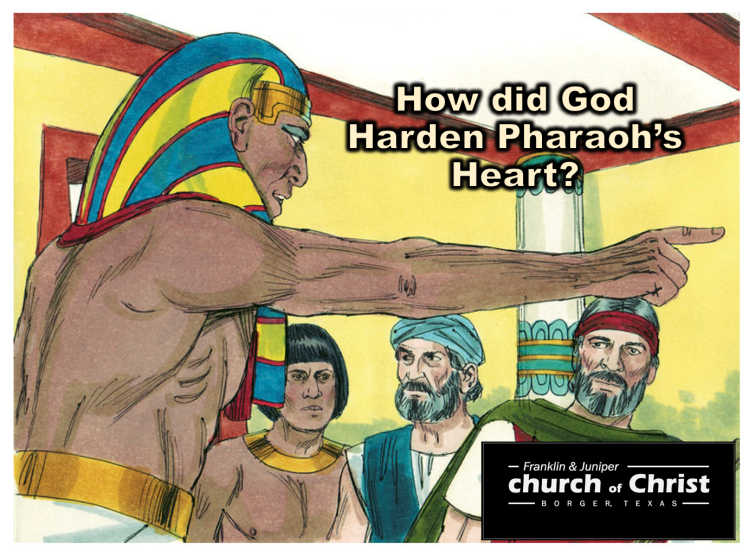
God Hardened Pharaoh’s Heart
For the Scripture says to Pharaoh, “For this very purpose I have raised you up, that I may show My power in you, and that My name may be declared in all the earth.” (Rom 9:17)

This objection sounds like this; Calvinists might say that Pharaoh’s hardening is evidence of predestination separate from free will:

“God hardened Pharaoh’s heart to display His sovereign power, showing that human will is subject to His eternal decree.”

“Pharaoh’s hardening proves that God chooses whom to have mercy on and whom to harden, independent of human action.”

“God raised Pharaoh up to be a vessel of wrath, predestined to resist Him, to magnify divine glory.”

“Pharaoh had no free will to resist God’s hardening, as his rebellion was ordained to serve God’s redemptive plan.”

At the end of the day, this error makes God out to be a monster, and that He is a respecter of persons. “Then Peter opened his mouth, and said, Of a truth I perceive that God is no respecter of persons.” (Acts 9:34)

How can we answer this objection?
We Harden Our Own Hearts

The Bible repeatedly warns against hardening our hearts, emphasizing that this is a choice we make by disregarding God’s word. Hebrews 3:15 urges, “To day if ye will hear his voice, harden not your hearts, as in the provocation.” Similarly, Hebrews 4:7 echoes, “To day, after so long a time; as it is said, To day if ye will hear his voice, harden not your hearts.” These verses, rooted in Psalm 95:7–8, recall Israel’s rebellion in the wilderness, where they hardened their hearts by refusing to trust God. Proverbs 28:14 warns, “He that hardeneth his heart shall fall into mischief,” while Zechariah 7:12 describes those who “made their hearts as an adamant stone, lest they should hear the law.” When we ignore God, we actively choose to harden our hearts, shutting out God’s truth. The responsibility lies with us, not with God overriding our will.

God Allows Rebellion to Accomplish His Purpose
God permitted Pharaoh to exalt himself in pride, using his defiance to demonstrate His power. Exodus 7:3–5 declares, “I will harden Pharaoh’s heart, and multiply my signs… that the Egyptians may know that I am the Lord.” Similarly, Exodus 10:1–2 explains that God hardened Pharaoh’s heart “that ye may tell in the hearing of thy son… what I have wrought in Egypt.” Exodus 14:4 adds, “I will harden Pharaoh’s heart, and he will pursue them, and I will get glory over Pharaoh.” This purpose is echoed in Romans 9:17: “For the scripture saith unto Pharaoh, Even for this same purpose have I raised thee up, that I might shew my power in thee.” Like Judas, chosen yet betraying Jesus (John 6:70–71: “Have not I chosen you twelve, and one of you is a devil?”), Pharaoh’s rebellion serves God’s plan without excusing his guilt. God allows human pride to run its course, turning it to His glory.

Rebellion Is to Harden Our Own Heart
Pharaoh’s story vividly illustrates this truth. In Exodus 5:2, he defiantly declares, “Who is the Lord, that I should obey his voice and let Israel go? I do not know the Lord.” This rejection of God’s authority marks the beginning of his heart’s hardening. The Bible shows Pharaoh repeatedly choosing to disregard God’s word through Moses. In Exodus 7:13, after Aaron’s staff becomes a serpent, “Pharaoh’s heart was hardened, and he did not listen to them.” Again, in Exodus 8:15, after the plague of frogs, “he hardened his heart and would not listen to them.” These passages highlight Pharaoh’s active role in hardening his heart by failing to regard God’s signs and commands.

Yet, God’s sovereignty is also at work. Exodus 4:21 states, “I will harden his heart, so that he will not let the people go,” and Exodus 9:12 confirms, “The Lord hardened the heart of Pharaoh.” Does this mean God forced Pharaoh to sin? No. The text consistently shows Pharaoh’s rebellion preceding God’s hardening, as in Exodus 9:27, where Pharaoh admits, “I have sinned this time: the Lord is righteous, and I and my people are in the wrong.” God does not cause Pharaoh’s sin but uses his rebellion to fulfill divine purposes, as Exodus 10:1 explains: “I have hardened his heart… that I may show these signs of mine among them.” Pharaoh remains accountable for his choices, while God sovereignly works through them.

“The Devil Made Me Do It”?
Some might claim, like the old saying, “The devil made me do it,” to shift blame for their sin. But Scripture places responsibility squarely on us. Pharaoh’s pride in Exodus 5:2 mirrors the rebellion of Israel in Judges 17:6 and 21:25: “Every man did that which was right in his own eyes.” This self-rule leads to a hardened heart. James 1:14–15 clarifies, “Every man is tempted, when he is drawn away of his own lust… when lust hath conceived, it bringeth forth sin.” Our deceitful hearts (Jeremiah 17:9: “The heart is deceitful above all things”) and evil thoughts (Mark 7:21–22: “From within, out of the heart of men, proceed evil thoughts… pride”) drive rebellion, not God or the devil. Like Pharaoh, we harden our hearts when we prioritize our own desires over God’s truth.

We are to Soften Our Hearts by God’s word.
The hardening of Pharaoh’s heart teaches us a profound lesson: We harden our hearts by disregarding God’s word, but God uses even our rebellion to fulfill His purposes. The Bible warns us to choose differently. Hebrews 3:15 pleads, “To day if ye will hear his voice, harden not your hearts.” Unlike Pharaoh, who persisted in pride, we must repent and seek a soft heart, as David prayed in Psalm 51:10: “Create in me a clean heart, O God.” Have you ignored God’s voice through Scripture? Choose to obey, for the responsibility to heed the Gospel call is ours.

Agape

Moses Chose

When we look back at Moses, we see a man standing at the crossroads of history, faith, and destiny. He didn’t just stumble into leadership or into God’s favor. No sir, he made some mighty choices—five monumental ones that shaped the course of Israel’s future. It’s worth asking ourselves: What motivated Moses to choose the harder road? What lessons can we glean from his resolve?

1. The Motivation of Moses

Acts 7:25 tells us Moses had a sense of destiny, that he “supposed his brethren would have understood how that God by his hand would deliver them.” Hebrews 11:24-25 sheds more light on this by saying, “By faith Moses, when he was come to years, refused to be called the son of Pharaoh’s daughter; choosing rather to suffer affliction with the people of God, than to enjoy the pleasures of sin for a season.”

Moses wasn’t motivated by the luxury and ease that the Egyptian palace offered. No, he had a fire burning within him that Pharaoh’s wealth and influence couldn’t extinguish. Moses saw his people suffering, and rather than turning a blind eye, he chose to embrace their pain as his own. There’s something noble in that, isn’t there? Like a wise man once said, “It’s not what you stand on that defines you, but what you stand for.”

2. Oppression: Choosing Affliction Over Comfort

Hebrews 11:25 continues by showing that Moses chose “to suffer affliction with the people of God.” Think about that for a moment. This man had it all—prestige, power, privilege—but he willingly stepped away from the trappings of luxury to join the oppressed. Imagine leaving behind the Egyptian courts, not because you had to, but because you chose to.

Now, that’s the kind of conviction that echoes through history. We know that when oppression knocks at the door, it’s not always convenient to answer. But Moses didn’t care about convenience. He knew his place was with God’s people, not lounging in the pleasures of the palace.

3. Stood Against Pharaoh: Not a Slave, But a Servant of the Most High

When Moses went before Pharaoh, he wasn’t some lowly slave groveling for mercy. No, he stood tall as a servant of the God Most High, with the authority of heaven behind him. Exodus 5:20-23 tells us how the elders of Israel turned against Moses after Pharaoh made their labor even harder. Imagine that! He’s trying to lead his people to freedom, and the very folks he’s trying to help turn on him. If that ain’t a leadership test, I don’t know what is.

But Moses pressed on. He knew that he wasn’t doing this for himself or for the approval of man. He was on God’s mission, and that’s a lesson for us all. When the road gets rough, and even those closest to us lose faith, we’ve got to stand firm and remember who we serve.

4. Exposed as Exodus Leader: Challenges on Every Side

Leadership exposed Moses. Exodus 14:11-14 shows the people complaining when they saw no way out as Pharaoh’s army bore down on them at the Red Sea. Then, in Exodus 15:24, they grumbled again, this time over a lack of water. And if that wasn’t enough, they complained in Exodus 16:1-3 when there was no bread.

Now, it’s easy to criticize when you’re on the sidelines, but Moses was in the thick of it. No one said leading God’s people was going to be easy. It’s like that old saying: “Everybody wants to be a leader until it’s time to make decisions.” Moses made tough decisions, and though the people grumbled, God delivered—again and again.

5. Stood With Christ

Moses’ ultimate vindication came long after his earthly life ended. Mark 9:4 tells us that Moses stood with Christ on the Mount of Transfiguration. Think about that! After all the struggles, complaints, and hardships, Moses stood in glory with the Savior of the world.

And when Moses died, God Himself buried him (Deuteronomy 34:5-6). Now, if you ask me, there’s no better way to go than to have God take care of your final resting place.

What Do You Think of His Choice Now?

Looking back, I’d say Moses made the right choice, wouldn’t you? He didn’t choose comfort, wealth, or the easy road. He chose faith, suffering, and ultimately, the eternal reward of standing with Christ. Moses showed us that it’s not the temporary pleasures of this world that define our legacy, but the eternal decisions we make in the service of God.

So, when we face our own crossroads, let’s remember Moses.

Agape,

Spencer

The one oar Christian

THERE’S A STORY TOLD OF an old wise man of God who was continually criticized for his motto, “pray and work.” A young pupil, struggling with the mounting problems of life, asked the wise man, “If God is so powerful, why then do you teach us also to work?” The wise man of God invited this youth to go fishing. As they entered the boat, the youth noticed that the old man only used one oar and said, “If you don’t use both, we’ll just go around in circles and you won’t get anywhere.” “That’s right, my son,” the elder man replied. “One oar is called prayer and the other is called work. Unless you use both at the same time, you just go in circles and you don’t get anywhere.”

Over the years I’ve learned that prayer alone, or work alone, is just like trying to row a boat using only one oar. All you ever seem to do is just go around in circles.

There is no doubt that prayer ought to be a part of every Christians day. Jesus taught this on several occasion, exemplifying it in His own life [Mat 14:23; 26:36,39; Mark 1:35; Luke 9:18,29].

_____________________________

And he spake a parable unto them to this end, that men ought always to pray, and not to faint;
Luke 18:1

_____________________________

Unfortunately, that is where many of us stop. We pray and pray and pray, wondering why nothing ever changes. What we forget is that God has also required us to act. Let us consider two Godly men Abraham, and Moses, men who are noted for how God spoke to them as a friend [Gen 18:17; Ex 33:11].

In reading Hebrews 11, we see that these two men had a great faith. Was their faith only seen in their prayer life? Are these men remembered for their inactive faith only? Do you recall reading about these men sitting in their easy chair, lifting up praise and prayers to God and softly drifting off to sleep comforted with the thought that God would take care of their troubles? No, never. What we DO READ is that these men of faith prayed and worked.

_____________________________

By faith Abraham, when he was called to go out into a place which he should after receive for an inheritance, obeyed; and he went out, not knowing whither he went. Heb 11:8

By faith Abraham, when he was tried, offered up Isaac: and he that had received the promises offered up his only begotten son, Heb 11:7

_____________________________

When Abraham heard God, he acted upon those commands. In the case of offering up Isaac, it is said that he “rose early” that morning to fulfill the commands of God [Gen 22:3].

Moses also acted upon the commands of God.

_____________________________

By faith Moses, when he was come to years, refused to be called the son of Pharaoh’s daughter; Choosing rather to suffer affliction with the people of God, than to enjoy the pleasures of sin for a season; Esteeming the reproach of Christ greater riches than the treasures in Egypt: for he had respect unto the recompence of the reward. Heb 11:24-26

_____________________________

Did either of these men think that they were accomplishing anything out of their own power? No, they had placed their trust in God, but this trust was manifested by a remarkable demonstration of action.

When we pray according to God’s will, we’re praying having sought to know His will through the study of His word [2Tim 2:15]. Then after we pray, we get up and apply that knowledge to our lives. We act, not because we think highly about ourselves, rather, because we are trusting God to bless our godly activities.

_____________________________

But be ye doers of the word, and not hearers only, deceiving your own selves. James 1:22

_____________________________

For if any be a hearer of the word, and not a doer, he is like unto a man beholding his natural face in a glass: 24 For he beholdeth himself, and goeth his way, and straightway forgetteth what manner of man he was. But whoso looketh into the perfect law of liberty, and continueth therein, he being not a forgetful hearer, but a doer of the work, this man shall be blessed in his deed.”  (KJV) [Jam 1:23-25]

The Faith Formula

The disciples of Christ asked Him to increase their faith. (Luke 17:5-10) His answer is very strange to me. First He tells them that true faith has no size, but then He teaches them about a servant that serves his master. At the end He says, “Does he thank that servant because he did the things that were commanded him? I think not.”

How does this increase our faith?

I looked into faith to learn more and found this passage about Moses in Heb 11:24-29

24 By faith Moses, when he was come to years, refused to be called the son of Pharaoh’s daughter; 25 Choosing rather to suffer affliction with the people of God, than to enjoy the pleasures of sin for a season; 26 Esteeming the reproach of Christ greater riches than the treasures in Egypt: for he had respect unto the recompence of the reward. 27 By faith he forsook Egypt, not fearing the wrath of the king: for he endured, as seeing him who is invisible. 28 Through faith he kept the passover, and the sprinkling of blood, lest he that destroyed the firstborn should touch them. 29 By faith they passed through the Red sea as by dry land: which the Egyptians assaying to do were drowned.

As I read this passage, I noticed a formula of faith and it relates perfectly to our Luke passage. The faith formula is this……

F=(R+ C + E) – (F, F) + (S + K + P)

FAITH = (REFUSING + CHOOSING + ESTEEMING) – (FORSAKING, FEARING) + (SEEING + KEEPING + PASSING)

Using Moses as our example, let’s see how his story line is very similar to our own…….By faith, Moses……

Refused to be called son of the devil?
Ye are of your father the devil, and the lusts of your father ye will do. (Joh 8:44)
He that committeth sin is of the devil;(1Jo 3:8)
“My sheep hear My voice, and I know them, and they follow Me.”( Joh 10:27)

Choosing to suffer for a time than enjoy the passing pleasures of sin?
For our light affliction, which is but for a moment, is working for us a far more exceeding and eternal weight of glory,(2Co 4:17)

Esteeming the reproach of Christ as greater riches. The reproach that Christ had to bear in his own person and also in the person of every true believer.
Are they ministers of Christ? (I speak as a fool) I am more; in labours more abundant, in stripes above measure, in prisons more frequent, in deaths oft.(2Co 11:23)
Be not thou therefore ashamed of the testimony of our Lord, nor of me his prisoner: but be thou partaker of the afflictions of the gospel according to the power of God; (2Ti 1:8)

Forsaking our lives of ease and waste. Not Fearing the culture around us
the popular opinions.
In regard to these, they think it strange that you do not run with them in the same flood of dissipation, speaking evil of you.(1Pe 4:4)

Seeing Jesus, with our eyes of faith. Knowing that He will come to get us.
Jesus said to him, “Thomas, because you have seen Me, you have believed. Blessed are those who have not seen and yet have believed.”(Joh 20:29)

Keeping the faith
But without faith it is impossible to please Him.(Heb 11:6)
“For we cannot but speak the things which we have seen and heard.”(Ac 4:20)

Passing through the trials set before us
Beloved, do not think it strange concerning the fiery trial which is to try you, as though some strange thing happened to you;(1Pe 4:12)
Therefore I endure all things for the elect’s sakes, that they may also obtain the salvation which is in Christ Jesus with eternal glory.(2Ti 2:10)

Do you see how this can help you endure, can increase your faith? Let me say it this way……

Is your faith low? Is your faith weak? Are you sad? Is your faith in man gone? Then let the formula of faith help you…

Serve God
Refuse sin
Choose Christ
Esteem Christ
Forsake this world
Fear God
Look to Christ
Keep the faith
Pass through this life and Endure til the end

Let’s remember one more thing about Moses…….
…having obtained a good testimony through faith, did not receive the promise, God having provided something better for us, that they should not be made perfect apart from us.(Heb 11:39-40)

spencer

Borger, Tx
806/274-5021

Ask me how to make your calling and election sure. 2Pet 1:10