
How to know what God Wants pt2

God is a Spirit: and they that worship him must worship him in spirit and in truth.”  (John 4:24)

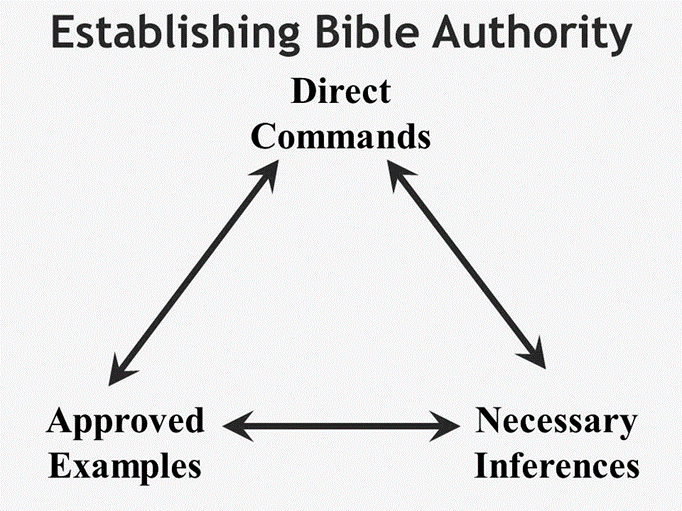
One cannot be walking by faith in Christ while offering strange worship God commanded us not. How do we know what God wants? We can answer that question if we will learn how God communicates. He gives DIRECT commands & statements, He gives EXAMPLES, and He IMPLIES things from which we may infer. He also expects us to respect when He is SILENT on a matter.

Last week we looked at the first 2 ways to discover what God wants,

  1. Direct commands & statements.
  2. Approved Examples.

Today we will look at 2 more,

  1. Implications & Necessary Inferences.
  2. Silence, when God gives no command.

Since we’re not to ADD nor TAKE AWAY from His word, we need to understand how He communicates.

III) Implications & Necessary Inferences. (Inescapable conclusions)

One of the ways we communicate is by implying something and we infer from it. Here’s a simple example. When our parents gave us $20 to go to the store to buy bread and milk, it is necessarily inferred that they want the change brought back and we’re not to spend the rest of the money on candy & video games. A lesson my older brother learned quickly.

We all communicate this way. God does too. In Acts 10, Peter saw a vision Acts 10:12, “Wherein were all manner of fourfooted beasts of the earth, and wild beasts, and creeping things, and fowls of the air.” The Lord told him to rise, kill, and eat.

After Peter’s refusal because they were unclean, the Lord said, “What God hath cleansed, that call not thou common.” Peter would eventually understand the implication, that God had included gentiles as candidates for the gospel. Peter made a necessary inference based on what the Lord had implied through the vision, the events that followed, and His command to preach the gospel to every nation. (Read Acts 10-11; Mark 16:15-16).

Another example of necessary inference is in Acts 8:35-36. “Then Philip opened his mouth, and began at the same scripture, and preached unto him Jesus. And as they went on their way, they came unto a certain water: and the eunuch said, See, here is water; what doth hinder me to be baptized?” All that we read is that Philip preached Jesus, and the Eunuch concludes baptism is commanded. We Necessarily Infer that baptism is included in the preaching of Jesus.

Without a command from God, we do not make any inferences about what God wants.

IV) God commands us not (no command). Silence is not permissive.

This is an answer to the objection, “it doesn’t say not to.” In regard to service rendered to God, human wisdom must not do what God has FORBIDDEN, OMIT what He’s commanded, nor add EXTRA which He has not commanded. To do otherwise is to walk by our own judgment, and not by faith.

Here are several examples which show that where there is no command there is no permission. GOD GAVE NO COMMAND.

  1. Lev 10:1 And Nadab and Abihu, the sons of Aaron, took either of them his censer, and put fire therein, and put incense thereon, and offered strange fire before the LORD, which he commanded them not.
  2. Deut 17:3 And hath gone and served other gods, and worshipped them, either the sun, or moon, or any of the host of heaven, which I have not commanded;
  3. Deut 18:20 But the prophet, which shall presume to speak a word in my name, which I have not commanded him to speak, or that shall speak in the name of other gods, even that prophet shall die.
  4. Jer 7:22 For I spake not unto your fathers, nor commanded them in the day that I brought them out of the land of Egypt, concerning burnt offerings or sacrifices:
  5. Jer 29:23 Because they have committed villany in Israel, and have committed adultery with their neighbours’ wives, and have spoken lying words in my name, which I have not commanded them; even I know, and am a witness, saith the LORD.
  6. Jer 32:35 And they built the high places of Baal, which are in the valley of the son of Hinnom, to cause their sons and their daughters to pass through the fire unto Molech; which I commanded them not, neither came it into my mind, that they should do this abomination, to cause Judah to sin.
  7. Acts 15:24 Because we have knowledge that some who went from us have been troubling you with their words, putting your souls in doubt; to whom we gave no such order; (BBE). KJV. we gave no such commandment:

In two other instances we find the same lesson.

  1. 2Sam 7:1-7. David’s desire to build a temple. God asks him where He ever asked for it. 2Sa 7:7 In all the places wherein I have walked with all the children of Israel spake I a word with any of the tribes of Israel, whom I commanded to feed my people Israel, saying, Why build ye not me an house of cedar?
  2. Heb 7:11-14 In explaining the Priesthood of Christ, the writer points out that God never spoke anything about Priests from Judah.
    1. Heb 7:14 For it is evident that our Lord arose from Judah, of which tribe Moses spoke nothing concerning priesthood.

When you say, “God never said not to.” I reply, “God doesn’t need to tell you not to do something when He’s told you specifically what He wants. Where did He ever give the command for it?” If it’s a good enough explanation for God, it’s a good principle for us to use today.

Men are not divided over what the Bible says but what it doesn’t say. We must respect His Silence.

Agape,

Spencer

You can read pt 1 of How to know What God wants here.
How to know what God wants pt1

How to know what God wants. Pt1

God is a Spirit: and they that worship him must worship him in spirit and in truth.”  (John 4:24)

God has not at any time authorized gratuitous service be rendered to Him. This means that God requires worship toward Him to be in accordance with His instructions.

From the very beginning we see this principle. In Genesis four, Abel offered an acceptable sacrifice by faith, and Cain did not. “By Faith” is first speaking about divine instruction, followed by our trust in His acceptance when we follow those instructions. “So then faith cometh by hearing, and hearing by the word of God.” (Rom 10:17).

One cannot be walking by faith in Christ while offering strange worship God commanded us not. How do we know what God wants? We can answer that question if we will learn how God communicates. He gives DIRECT commands & statements, He gives EXAMPLES, and He IMPLIES things from which we may infer. He also expects us to respect when He is SILENT on a matter.

I) God communicates through Direct commands & statements.

In the Gospel of Mark, Jesus gives a direct command to his disciples in the Great Commission. He says, “And he said unto them, Go ye into all the world, and preach the gospel to every creature.” (Mark 16:15). These are clear instructions from God on how his followers are to spread the message of salvation.

The Direct commands of God come in 2 forms:

1) SPECIFIC. God tells us exactly what He wants. We cannot add to, nor take away from the specific command. A specific command eliminates all other possibilities.

2) GENERIC. God gives a command but doesn’t tell us how. He leaves those details for us to implement.

The how of a generic command is called an expedient. We need to find the most efficient & effective means to fulfill the command. We cannot bind an expedient on others as being the only way. We have liberty.

II) God communicates using Approved Examples. There are many examples in the bible, but not every one of them is binding, nor authorized. Some examples are incidental like meeting in an upper room (Acts 1:13).

What makes an example an APPROVED EXAMPLE? When the example is in compliance with a Direct command of God. Jesus said “And he said unto them, Go ye into all the world, and preach the gospel to every creature. He that believeth and is baptized shall be saved; but he that believeth not shall be damned.” (Mark 16:15-16). In the Acts one we see exactly that. They preached the Gospel to everyone on Pentecost and baptized for remission of sins.

Another example is found in Acts 8. “Then Philip opened his mouth, and began at the same scripture, and preached unto him Jesus. And as they went on their way, they came unto a certain water: and the eunuch said, See, here is water; what doth hinder me to be baptized? And Philip said, If thou believest with all thine heart, thou mayest. And he answered and said, I believe that Jesus Christ is the Son of God. And he commanded the chariot to stand still: and they went down both into the water, both Philip and the eunuch; and he baptized him.” (Acts 8:35-38). Here we see Philip Going, Preaching, and Baptizing as was commanded by Jesus in the great commission. Philip is one of many APPROVED EXAMPLES.

Without a command an example is just an example. It is not to be bound on others. Examples are only APPROVED (or Apostolic) when there is a command from God. How can we sift the binding from non-binding examples? Here are 4 questions to ask.

  1. Is there Uniformity in all examples of same event? Baptism was all by immersion, but circumstances around event were different.
  2. Is there Unity in Harmony? The Example must harmonize with God’s commands. Without a command there is not an approved example.
  3. Is there Universal application? It must apply and be able for all. Grapes (fruit of the vine) grow everywhere. Water is everywhere man is. Truth is Universal to all mankind.
  4. Is the example Unnecessary or relevant to the command? The disciples met in an upper room.

People are constantly attempting to worship God according to their own desires (Col 2:23). They have introduced Mechanical Music, plays, interpretive dance, and in one place Roller Skating Praise.

Here are 4 types of False worship.

  1. Vain. Mark 7; Matt 15:9.
  2. Against His will. 1Cor 11:17-34; 1Sam 15:22-23
  3. Ignorant. Acts 17:23
  4. Narcissistic Self-Willed worship. Col 2:20-23

These should serve as warnings about doing what God FORBIDS, OMISSION of what God commands, or adding EXTRA to the commands of God that He has not commanded.

Ye shall not add unto the word which I command you, neither shall ye diminish ought from it, that ye may keep the commandments of the LORD your God which I command you

(Deut 4:2; 12:32; Pr 30:6; Ec 12:13; Re 22:18-19).

Agape,

Spencer

You can read pt 2 of How to know What God wants here.

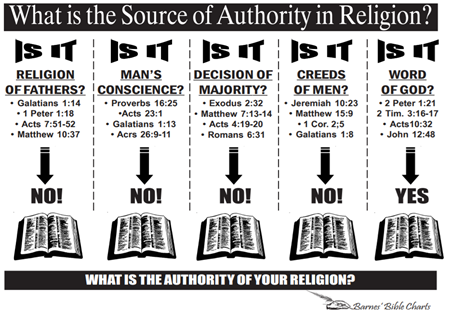
All AUTHORITY is in Christ

The

MANIFOLD wisdom of God pt 2

All AUTHORITY is in Christ, and His commands are written in the New Testament.

[Mat 28:18; Luke 6:46; 1Cor 14:37].

This single subject is actually the KEY subject on how to answer every question, objection and error you will face. A firm understanding of how to determine Scriptural Authority will arm you against all the fiery darts of the devil. [Eph 6:10-17]

There are two fundamental differences that separate truth from error.

ERROR: “We are at liberty to do anything not specifically forbidden.” This is the approach liberals and modernists use towards the Bible that leads to death.

TRUTH: “Ye shall not add unto the word which I command you, neither shall ye diminish ought from it, that ye may keep the commandments of the LORD your God which I command you.” [Deut 4:2; 12:32; Jos 1:7; Pr 30:6; Ec 12:13; Re 22:18-19]

As you can see, God limits our actions to what is contained in the scriptures. We cannot go beyond the word of the Lord. This is easily understood in our everyday communication. The easiest example is seen when one places an ORDER for a pizza.

We communicate our wishes when we place an ORDER, by Telling, Showing or Implying. If you can communicate your wishes without Telling, Showing or Implying, please explain it to me without Telling, Showing or Implying. [Luke 6:46; Col 3:17]

It is understood by our specific request that no REPLACEMENTS or alterations are allowed. If one orders a pizza, chicken wings would not be acceptable. If you wanted wings you would have Ordered them. [1Sam 15:22-23; Acts 15]

The person receiving our order understands they may only DELIVER what is Specifically requested, Shown or Implied. To add or remove any item is to go beyond the permission (authority) given. To say, “you didn’t say I couldn’t add black olives;” would be unacceptable to any logical thinking person. [2Sam 7:7; Heb 7:11-17]

It matters not what the server ENJOYS, likes, or otherwise wants. It’s not about them, it’s about the one placing the Order. They may say “But I really ENJOY black olives on my pizza,” or, “The majority of people ENJOY smoked oysters and pineapple.” None of these are legitimate reasons to alter the order. They are limited to the specific request.

The following words from Jesus should make it plain.

Not every one that saith unto me, Lord, Lord, shall enter into the kingdom of heaven; but he that doeth the will of my Father which is in heaven. Many will say to me in that day, Lord, Lord, have we not prophesied in thy name? and in thy name have cast out devils? and in thy name done many wonderful works? And then will I profess unto them, I never knew you: depart from me, ye that work iniquity.” [Matthew 7:21-23]

Any alteration to the given command under specific authority is to be REJECTED regardless of how good it may feel, what good we think it may do, or how popular it may be.

[Matt 7:13-14; Luke 13:24; Acts 26:9]

How do we use this? “Let the word of Christ dwell in you richly in all wisdom; teaching and admonishing one another in psalms and hymns and spiritual songs, singing with grace in your hearts to the Lord.” [Col 3:16; Eph 5:19] Instrumental music is an addition because it is not commanded nor is it necessary to complete the command. Song books (or other scriptural source material) are accepted under GENERIC AUTHORITY because we need something from which we could all sing. Generic authority is the liberty given to us to choose the means by which we complete a specific command. ie. Noah was commanded to build an ark, under generic authority he had liberty to choose the necessary tools. “Let all things be done decently and in order.” [1Cor 14:40]

To say that instrumental music makes things better, or more enjoyable is irrelevant. It’s not in the command. To say David used instruments is also irrelevant because he lived under the Law of Moses (more about that in Lesson 6). David also used incense and sacrificed bulls; would you suggest we do those too? [Gal 5:1-4]

Understanding what God Wants

Scriptural Authority in Acts.

One of the biggest questions of life is, What Does God Want? Along those lines comes the question, how do we find out?

Acts fifteen contains an event that will show us how God communicates, whereby we can know today what it is that God wants.

As we begin this study, we must recognize a few facts.

  • The New Testament was not yet written.
  • Miraculous gifts were to confirm what God wants. Heb 2:4; cf. Deut 18:21-22; 13:1-5.
  • Once the Written Word was completed, the signs and miracles were no longer needed. John 20:30-31; 1Cor 13:10; Eph 3:3-4; 2Tim 3:15-17.

These facts being established, we can learn how to determine what God wants by examining this passage.

God communicates in the same manner as we do with one another. We communicate our desires by TELLING, SHOWING, & IMPLYING. We also trust that our SILENCE on a matter is prohibitive. We can easily see these four concepts being utilized in Acts fifteen. The question the disciples wanted answered was, Are Gentiles candidates for the Gospel of Christ?

And certain men came down from Judaea and taught the brethren, saying, Except ye be circumcised after the custom of Moses, ye cannot be saved.” [Acts 15:1]

Some claim that this was a council to vote on the question. This is wrong. The Apostles already knew the answer, as will be shown by their looking at God’s method of communication (Telling, Showing, Implying & Silence).

FIRST, Peter rose up and reminded them about the first Gentile converts (Acts 10 & 11). How the Holy Spirit fell upon them as He had them “at the beginning.” [Acts 11:15]. Peter Necessarily Infers (inescapably concluded) that God had implied, both through a vision and the falling of the Holy Spirit upon them, that God is accepting Gentiles. He closes by saying, “Now therefore why tempt ye God, to put a yoke upon the neck of the disciples…” [Acts 15:10] “But we believe that through the grace of the Lord Jesus Christ we shall be saved, even as they.” [15:11]

NEXT, Paul and Barnabas “declaring what miracles and wonders God had wrought among the Gentiles by them.” [15:12] This is God communicating through SHOWING. Another way this is stated is Approved Apostolic Example. This testimony agrees with Peter, and with what was said about miracles. (see opening statements). “God also bearing them witness, both with signs and wonders, and with divers miracles, and gifts of the Holy Ghost, according to his own will?” [Heb 2:4]

THEN, James answered. His appeal is to the revealed written word from God. He quotes from Amos nine, verses eleven and twelve. His appeal is to the DIRECT STATEMENTS of God. From this command of God, he concludes that God had already planned and authorized for Gentiles to be included in the Gospel of Jesus Christ.

James connects the testimony of Peter with these verses in Amos. Who are we to fight against God? He begins by saying, “as it is written.” [15:15] We know from both Old and New Testaments not to go beyond that which is written. [1Cor 4:6; Deut 4:2; 12:32; Rev 22:18; Prov 30:6]

LASTLY, a letter is written and from it we find this statement about the prohibitive nature of SILENCE. “Forasmuch as we have heard, that certain which went out from us have troubled you with words, subverting your souls, saying, Ye must be circumcised, and keep the law: to whom we gave no such commandment:” [Acts 15:24. emph mine seb]

From this we learn that if there is no command, there is no permission. It is to speak presumptuously, something God has already condemned. [De 18:22; 13:2; 18:20; Jer 28:9] Silence is prohibitive is logically understood and demonstrated in at least two other places. Read & Study 2Samuel 7:1-7; Hebrews 7]

In conclusion, we see that the Apostles already knew what the Lord had commanded. They were guided into all truth [John 14:17,26; 15:26; 16:13]. They then declared to those in error the truth of the matter by appealing to God’s Direct Statements, Approved Examples, Inescapable conclusions along with the prohibitive nature of Silence.

We can do the same today utilizing “the holy scriptures, which are able to make thee wise unto salvation through faith which is in Christ Jesus. All scripture is given by inspiration of God, and is profitable for doctrine, for reproof, for correction, for instruction in righteousness: That the man of God may be perfect, throughly furnished unto all good works.” [2Tim 3:15-17]

Here are some questions to ask ourselves and of any who still believe that miracles are happening, revelation is still being received.

  • We know that Gentiles that obey the Gospel are accepted by God. What further evidence beyond the scriptures do we need to prove this?
  • We know that Baptism is commanded by God, what further miracle do we need to show this?
  • We know what moral behaviors are accepted and which behaviors God abhors, what further miracle do we need to show this?
  • We know that there will be a judgment day, what additional miracle do we need to show this?
  • We know that Jesus is the Christ the Son of the Living God and that we are to do whatever He commands [Luke 6:46], what additional miracle do we need to show this?