Who are God’s Chosen People today?

WHO ARE GOD’S CHOSEN PEOPLE TODAY?

The Bible presents the children of Abraham, specifically the twelve tribes of Israel, as God’s chosen people, selected for a divine purpose: to bring forth the Messiah, Jesus Christ, through whom all nations would be blessed. This narrative weaves through the Old and New Testaments, showing the progression from the Law of Moses to the New Covenant in Christ, culminating in the universal call to become God’s chosen through faith and obedience to the Gospel.

The Chosen People and the Promise.
God’s covenant with Abraham (Genesis 12:1-3) established his descendants as the vehicle for His redemptive plan. Through Abraham’s seed—ultimately Christ (Galatians 3:16)—all nations would be blessed. The twelve tribes of Israel, descending from Abraham through Isaac and Jacob (Genesis 17:19; 35:10-12), were chosen to preserve God’s covenant, carry His oracles, and prepare the world for the Messiah. Deuteronomy 7:6-8 emphasizes that Israel’s election was not due to their merit but God’s love and faithfulness to His promise.

The Purpose of the Law of Moses.
The Law of Moses, given to Israel at Sinai (Exodus 19-20), served as a tutor to lead humanity to Christ (Galatians 3:24-25). It revealed God’s holiness, exposed human sinfulness (Romans 3:20), and provided a framework for Israel’s covenant relationship with God. The Law included moral, ceremonial, and civil commands, pointing to Christ through types and shadows (Hebrews 10:1). For example, the Passover lamb (Exodus 12) prefigured Christ’s sacrificial death (1 Corinthians 5:7). However, the Law was temporary, unable to justify or remove sin permanently (Hebrews 7:19; 10:4). Its purpose was to prepare Israel—and the world—for the coming of the Messiah.

Fulfillment in Christ and the New Covenant.
With Christ’s death, burial, and resurrection—the Gospel (1 Corinthians 15:1-4)—the Law of Moses was fulfilled and abrogated (Colossians 2:14; Hebrews 8:6-13). Jesus, as the promised seed of Abraham (Galatians 3:16), accomplished what the Law could not: justification and reconciliation with God (Romans 5:1-2). The New Covenant, established through His blood (Matthew 26:28), replaced the Old Covenant, making salvation accessible to all—Jew and Gentile—through faith in Christ (Romans 10:12-13). The Great Commission (Matthew 28:18-20) commands the spread of this Gospel to all nations, inviting everyone to obey Christ’s doctrine (2 John 1:9).

Paul expresses his heart for Israel’s salvation in Romans 10:1, noting their zeal for God but lack of knowledge about the righteousness that comes through faith in Christ (Romans 10:3-4). The Law’s purpose was fulfilled in Christ, and now all who believe—whether Jew or Gentile—are justified by faith (Galatians 3:26-29).

The Saints as the Chosen People.
Under the New Covenant, the “chosen people” are no longer defined by ethnicity but by faith and obedience to the Gospel. 1 Peter 2:9 describes believers—Jew & Gentile—as a “chosen generation, a royal priesthood, a holy nation,” echoing Israel’s calling in Exodus 19:5-6 but now applied universally to the church. Anyone who obeys the Gospel by faith (Romans 1:16; Acts 2:38) becomes part of this spiritual Israel, grafted into God’s family (Romans 11:17-24). The saints, through Christ, inherit the promises made to Abraham (Galatians 3:29).


The twelve tribes of Israel were chosen to bring Christ into the world, with the Law of Moses guiding them toward this purpose while exposing humanity’s need for a Savior. Christ’s Gospel fulfilled and replaced the Law, opening salvation to all who obey Him by faith. The saints, as God’s new chosen people, reflect His redemptive plan: a universal call to become His own through the New Covenant, demonstrating His grace and power to save.

HOW IS ISRAEL SAVED TODAY?

Israel (and everyone else) is saved not by the Law of Moses but by the Law of Christ under the New Covenant. The fulfillment of Jeremiah 31:31-34, as affirmed in Hebrews 8, establishes that salvation for Israel—and all people—comes through faith and obedience to the Gospel of Christ.

Salvation Through the Law of Christ.

Since Pentecost, when the New Covenant was inaugurated with the outpouring of the Holy Spirit (Acts 2:1-4), salvation for Israel (and all nations) is through the Law of Christ, which is the Gospel—the message of His death, burial, and resurrection (1 Corinthians 15:1-4).

The Bible is clear:

  • Faith and Obedience to the Gospel: Romans 10:9-13 states that salvation comes by confessing Jesus as Lord and believing in His resurrection, with “no distinction between Jew and Greek, for the same Lord over all is rich to all who call upon Him.” Acts 2:38, preached to Jews on Pentecost, commands repentance and baptism in Jesus’ name for the forgiveness of sins, resulting in 3,000 Jews being saved (Acts 2:41). This marks the beginning of salvation under the Law of Christ.
  • The New Covenant Fulfilled: Jeremiah 31:31-34 promised a new covenant with Israel, where God would write His law on their hearts and forgive their sins. Hebrews 8:6-13 declares this fulfilled in Christ, who is the “mediator of a better covenant.” His sacrifice replaced the Old Covenant (Hebrews 8:13), making the Gospel the means of salvation for all, including Israel.
  • The Law of Christ: Galatians 6:2 refers to “the law of Christ” as the guiding principle for believers. This involves faith working through love (Galatians 5:6), obedience to Christ’s commands (John 14:15), and adherence to His doctrine (2 John 1:9). For Israel, this means accepting Jesus as the Messiah and obeying His Gospel, as seen in the Jewish believers of the early church (Acts 2:41; 6:7).

The Law of Moses Abrogated.

(Abrogated: To annul by an authoritative act; to abolish by the authority of the maker or his successor; To put an end to; to do away with.)

The Law of Moses, given to Israel at Sinai (Exodus 19-20), is no longer the means of salvation:

  • Fulfilled and Replaced: Jesus fulfilled the Law (Matthew 5:17-18), and His death on the cross abolished it as a system of justification (Colossians 2:14; Ephesians 2:15). Hebrews 10:9 states that Christ “takes away the first [covenant] that He may establish the second.” The Law’s sacrifices and ordinances could not perfect or justify (Hebrews 10:1-4; Galatians 3:10-13).
  • A Tutor to Christ: Galatians 3:24-25 explains that the Law was a “tutor to bring us to Christ,” but “after faith has come, we are no longer under a tutor.” For Israel, the Law pointed to the Messiah, but since His coming, salvation is through faith in Him, not the Law’s works (Romans 10:4).
  • Inability to Save: Acts 15:10-11, in the context of Jewish believers, affirms that neither Jews nor Gentiles are saved by the Law, which was a “yoke” they could not bear. Instead, “through the grace of the Lord Jesus Christ we shall be saved.”

Israel’s Salvation Today.

Since Pentecost, Jews (Israel) are saved by:

  • Hearing and Believing the Gospel: Romans 10:17 says faith comes by hearing the word of Christ. Jews must believe Jesus is the Messiah, as Peter proclaimed to Israel (Acts 2:36).
  • Repentance and Baptism: Acts 2:38 applies to Jews, as seen in the mass conversions at Pentecost. Baptism in Jesus’ name unites Jews and Gentiles with Christ (Galatians 3:27-29).
  • Ongoing Faithfulness: Like all believers, Jews must abide in Christ’s doctrine (2 John 1:9) and remain faithful (Hebrews 3:14). The remnant of Israel saved today includes Jews who obey the Gospel, such as the apostles and early disciples (Romans 11:5).

The Remnant and Future Hope.

Romans 11:5 speaks of a “remnant according to the election of grace” among Israel, saved by faith in Christ, as exemplified by Jewish believers in the New Testament (e.g., Acts 21:20). While Romans 11:26 anticipates a future time when “all Israel will be saved,” this does not imply salvation apart from the Gospel. The context (Romans 11:23-27) suggests Israel’s salvation comes through faith in Christ, aligning with the New Covenant promise of Jeremiah 31:31-34, fulfilled in Christ’s blood (Hebrews 8:8-12; Matthew 26:28).

Conclusion.

Since Pentecost, Israel is saved through the Law of Christ—the Gospel—not the Law of Moses, which was fulfilled and abrogated (Hebrews 8:13; Colossians 2:14). The New Covenant, promised in Jeremiah 31:31-34 and established through Christ (Hebrews 8:6), requires Jews to believe in Jesus as Messiah, repent, and be baptized (Acts 2:38; Romans 10:9-13). The remnant of Israel today, like all believers, enters God’s chosen people (1 Peter 2:9) by faith and obedience to the Gospel, fulfilling God’s redemptive plan through the eternal covenant of Christ.

agape

What’s at Stake for missing out on the Gospel?

What’s at Stake if We Miss the Gospel?

Missing the gospel isn’t just a minor misstep, it’s a choice with eternal consequences. The New Testament lays out what’s on the line when we turn away from God’s call to follow Jesus. It’s not about fear-mongering or guilt-tripping anyone; it’s about understanding the weight of our decisions. What’s really at risk for missing out on the Gospel of Christ?

First, salvation itself hangs in the balance. Hebrews 5:8 tells us Jesus learned obedience through suffering, becoming the source of eternal salvation for those who obey Him. Disobeying the gospel means rejecting the only path to being made right with God. Look at John 3:36 “He that believeth on the Son hath everlasting life: and he that believeth not the Son shall not see life; but the wrath of God abideth on him.” Acts 4:12 hammers it home: there’s no other name under heaven by which we can be saved. And Romans 10:16 ties belief and obedience together, showing that refusing to obey the gospel is like shutting the door on God’s grace. Salvation isn’t a free pass; it’s a response to Jesus’ sacrifice.

Next, there’s treasure in heaven. Matthew 6:19-20 urges us to store up treasures in heaven, not on earth, where moth and rust destroy. Disobeying the gospel means chasing fleeting, earthly rewards instead of eternal ones. Colossians 3:2 pushes us to set our minds on things above, not earthly things. And 1 Timothy 6:17 encourages us not to place our trust in uncertain riches, but in the living God, who giveth us richly all things to enjoy. Ignoring the Gospel risks a life spent on what fades away.

Then there’s the danger of apostasy; falling away from faith. Galatians 4:11 shows Paul’s fear that his work among the Galatians might be in vain if they turn from the gospel. Hebrews 6:4-6 warns of the impossibility of renewing repentance in those who fall away after receiving the truth. 2 Peter 2:20-21 paints a grim picture of those who know Jesus but return to the world, saying it’s worse than never knowing at all. And 1Timothy 4:1 speaks of some abandoning faith in later times. Ignoring the gospel can lead to a slow drift or outright rejection of the truth we once held.

Kingdom citizenship is also at stake. Colossians 1:13 says God has rescued us from darkness and brought us into His Son’s kingdom. Disobeying the gospel means missing out on that transfer. Ephesians 2:19 calls believers fellow citizens with God’s people, no longer strangers. Philippians 3:20 declares our citizenship is in heaven, where we await Jesus. And Luke 22:29-30 promises a place in God’s kingdom for those who follow Him. Rejecting the gospel keeps us outside this family, this home God offers.

Finally, eternal life itself is on the line. Matthew 7:13-14 describes the narrow gate leading to life and the wide road to destruction. Disobedience chooses the latter. John 5:28-29 warns that those who’ve done evil face a resurrection to judgment. Romans 6:23 contrasts the wages of sin, death, with the gift of eternal life through Jesus. And 1 John 5:11-12 makes it clear: eternal life is in the Son, and without Him, we don’t have it. Missing the gospel risks an eternity apart from God.

So, what’s at stake? Everything—our salvation, our eternal reward, our steadfastness, our place in God’s kingdom, and life itself. The gospel isn’t just good news; it’s a call to choose wisely, to live for what lasts.

can one be saved without water BAPTISM?


People often ask questions about what happens if a person is not water baptized. “What if you’re on the way to the baptistry and you’re killed on the way?”

For the answer we appeal solely to the word of God. We can know nothing about it except that it was revealed by God.

Without water BAPTISM.


Was not BURIED with Him, Col 2:11-12

In whom also ye are circumcised with the circumcision made without hands, in putting off the body of the sins of the flesh by the circumcision of Christ: Buried with him in baptism, wherein also ye are risen with him through the faith of the operation of God, who hath raised him from the dead.


Not ADDED to the church. Acts 2:38-47

Then they that gladly received his word were baptized: and the same day there were added unto them about three thousand souls.

Praising God, and having favour with all the people. And the Lord added to the church daily such as should be saved.


Did not PUT on Christ. Gal 3:27

For as many of you as have been baptized into Christ have put on Christ.


TRANSGRESSED the command of Christ, (& Apostles) Luke 6:46; Mark 16:16; 1Cor 14:37; 2Thess 1:7-9

Mr 16:16 He that believeth and is baptized shall be saved; but he that believeth not shall be damned.

2Th 1:8 In flaming fire taking vengeance on them that know not God, and that obey not the gospel of our Lord Jesus Christ:

1Co 14:37 If any man think himself to be a prophet, or spiritual, let him acknowledge that the things that I write unto you are the commandments of the Lord.


Did not follow Christ INTO the likeness of His death. Rom 6:3-6

Ro 6:3 Know ye not, that so many of us as were baptized into Jesus Christ were baptized into his death?
4 Therefore we are buried with him by baptism into death: that like as Christ was raised up from the dead by the glory of the Father, even so we also should walk in newness of life.
5 For if we have been planted together in the likeness of his death, we shall be also in the likeness of his resurrection:
6 Knowing this, that our old man is crucified with him, that the body of sin might be destroyed, that henceforth we should not serve sin.


Did not wash away SINS. Acts 22:16; Is not SAVED. 1Pet 3:21

Ac 22:16 And now why tarriest thou? arise, and be baptized, and wash away thy sins, calling on the name of the Lord.

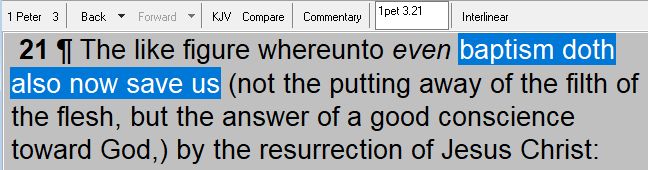
1Pe 3:21 The like figure whereunto even baptism doth also now save us (not the putting away of the filth of the flesh, but the answer of a good conscience toward God,) by the resurrection of Jesus Christ:


We MUST be baptized into Christ to be saved by Grace. Acts 19:1-5; Eph 2:8-10

Ac 19:1 And it came to pass, that, while Apollos was at Corinth, Paul having passed through the upper coasts came to Ephesus: and finding certain disciples,
2 He said unto them, Have ye received the Holy Ghost since ye believed? And they said unto him, We have not so much as heard whether there be any Holy Ghost.
3 And he said unto them, Unto what then were ye baptized? And they said, Unto John’s baptism.
4 Then said Paul, John verily baptized with the baptism of repentance, saying unto the people, that they should believe on him which should come after him, that is, on Christ Jesus.
5 When they heard this, they were baptized in the name of the Lord Jesus.

spencer is an evangelist for the Franklin & Juniper st church of Christ in Borger Texas

the Truth shall set you FREE, from what?

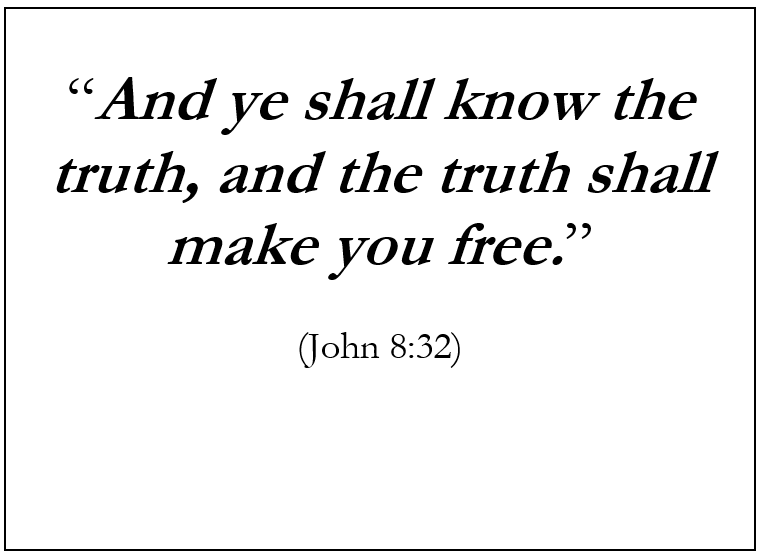
JESUS SAID, “If ye continue in my word, then are ye my disciples indeed; And ye shall know the truth, and the truth shall make you free.” [John 8:31-32]

Jesus orders us to “continue in my word,” and He connects it to the truth. (cr. John 17:17) When we keep His word, the truth, we will be FREE!

FREE from what? From what does obeying the word of God set us FREE?

We’re used to having liberty in our country (free speech, right to assemble etc.), but most fail to realize they’re in bondage.

Let’s search the scriptures to learn from what we’ve been set FREE.

The Truth shall set us FREE from:

The FEAR of death. “O death, where is thy sting? O grave, where is thy victory?” [1Cor. 15:56,57]. “For God hath not given us the spirit of fear; but of power, and of love, and of a sound mind.” [2Tim 1:7]

Being set free from the FEAR of Death is a powerful blessing from obeying Christ. By extension, we are FREE from the FEAR of men. “We ought to obey God rather than men.” [Acts 5:29].

The truth also sets us FREE to pursue RIGHTEOUSNESS. Prior to knowing (& obeying Gal 5:7) the truth we were in bondage to sin and free FROM righteousness. Now we are FREE from sin to pursue RIGHTEOUSNESS. “Being then made free from sin, ye became the servants of righteousness.” [Rom 6:18-20].

This does not mean that we can’t sin [1John 1:8-10], nor does it give us license to sin. Rather, it is teaching that we can have assurance on how to live faithfully, and avoid sin.

Another thing from which we’ve been set FREE is found in the letter to the Galatians. Paul reminded the saints that Christ set them FREE from the ENTAGLEMENT of the Law of Moses. “Stand fast therefore in the liberty wherewith Christ hath made us free, and be not entangled again with the yoke of bondage.” [Gal. 5:1; cr. 2:4; 4:9;]

Returning to the Law of Moses is tantamount to going back into bondage. It’s sad when folks appeal to the OT for NT practices, thereby becoming ENTANGLED in bondage. “Cursed is every one that continueth not in all things which are written in the book of the law to do them.” [Gal 3:10]. “But now we are delivered from the law, that being dead wherein we were held; that we should serve in newness of spirit, and not in the oldness of the letter.” [Rom. 7:6].

Going back to Romans we learn one more thing. Having been set FREE from sin, we may now have EVERLASTING LIFE. “But now being made free from sin, and become servants to God, ye have your fruit unto holiness, and the end everlasting life.” [Rom. 6:22]

None of the above will happen if we are ignorant of the truth. Remember, it is continuing in the TRUTH that sets us FREE. Before we can continue in it, we must first be in it.

WE CAN BE SET FREE IF….

…we become one of His disciples. HOW do I become a disciple of Christ? Remember, Jesus said, “If ye continue in my word, then are ye my disciples indeed; And ye shall know the truth, and the truth shall make you free.” [John 8:31-32] To become His disciple we must obey the Gospel. Before He ascended into heaven He gave this command, “Go ye therefore, and make disciples of all the nations, baptizing them into the name of the Father and of the Son and of the Holy Spirit:” [Matt 28:19 (ASV)]

The Gospel is what calls us [2Thess. 2:14]. By hearing the truth, we can then believe that Jesus is the Christ [John 20:30-31; Rom 10:17].

By hearing and believing the truth, we learn to repent [Luke 13:3], and we learn to confess that Jesus is the Christ [Act 8:37].

By hearing and believing the truth, we learn to be baptized for the remission of sins. [Acts 2:38; 22:16; Mark 16:16].

Being set FREE occurs AFTER obeying the gospel. The Gospel is the Death, Burial, and Resurrection of Jesus [1Cor 15:1-4]. Obeying the Gospel is the Death, Burial, and Resurrection of us through water baptism [Rom 6:3-4].

Obey the Gospel and be set FREE.

— spencer

Spencer is a gospel preacher residing in Borger Texas where he works with the congregation that meets at Franklin & Juniper streets.

Why We Left the World

It was a dark and stormy night that frigid evening in November of 1997. It was dark, and the storm was within our hearts, because we had just learned some things about our condition toward God.

By that time my wife and I had been engaged for a few weeks in some simple bible studies with Uncle Charlie.  

The study had just ended having studied what God required of us to receive His grace. We didn’t answer at that moment. Uncle Charlie said, “Ok then, I guess I’ll be going.” I knew he wanted an answer, but none came.

After he left, we talked. We talked for an hour.

WHY WE LEFT THE WORLD.

We weren’t terrible people; we were just a young couple with 3 children trying our best to take care of ourselves. We both believed in God but never really knew about our responsibility toward Him. Until that night.

That night we realized the LOVE that God had toward us and the whole world. “For God so loved the world, that he gave his only begotten Son, that whosoever believeth in him should not perish, but have everlasting life.” (John 3:16) We realized that this LOVE was demonstrated through the death of Christ on a cross. “But God commendeth his love toward us, in that, while we were yet sinners, Christ died for us.” (Romans 5:8) We realized that to LOVE God we must keep His commandments. “If ye love me, keep my commandments.” (John 14:15; 1John 5:3; Luke 6:46)

That night we heard a very clear EXPLANATION from the scriptures about our sin condition and the sin solution. There were no words without a passage to support them. The passages themselves are very EASY to understand.

  • I said therefore unto you, that ye shall die in your sins: for if ye believe not that I am he, ye shall die in your sins.” (John 8:24)
  • I tell you, Nay: but, except ye repent, ye shall all likewise perish.” (Luke 13:3)
  • Whosoever therefore shall confess me before men, him will I confess also before my Father which is in heaven.” (Matt 10:32-33)
  • Repent, and be baptized every one of you in the name of Jesus Christ for the remission of sins, and ye shall receive the gift of the Holy Ghost.” (Acts 2:38)
  • But he that shall endure unto the end, the same shall be saved.” (Matt 24:13)

We knew that it was an all or nothing decision. Before we would do anything, we agreed that this was an all or nothing endeavor.

God would not take a half-hearted lip service. “The fear of the LORD is the beginning of knowledge: but fools despise wisdom and instruction.” (Prov 1:7) We had a godly FEAR of the Lord. A mix of Reverence, Awe and Terror. “It is a fearful thing to fall into the hands of the living God.” (Heb 10:31)

We agreed together, but when? “Now,” we said. “TONIGHT.” To delay may mean death. It was well after 10:00pm when I called Uncle Charlie to tell him we desired to obey the gospel in water baptism. He asked, “when?” I answered, “TONIGHT.” He joyfully replied, “LET’S GO!” Had he tried to put us off, or schedule a TIME to be baptized we would likely never have done it. We knew that the TIME was right now, as soon as possible. “For he saith, I have heard thee in a time accepted, and in the day of salvation have I succoured thee: behold, now is the accepted time; behold, now is the day of salvation.” (2Cor 6:2)

What is the biblical TIMING for baptism? Immediately upon understanding your condition toward God and understanding what HE requires of thee. “And he took them the same hour of the night, and washed their stripes; and was baptized, he and all his, straightway.” (Acts 16:33)

That night we put on Christ through baptism. That night we obeyed the Gospel. That night we began our newness of life.

We slept peacefully that night knowing that we had done what the Lord had commanded to be done. We rejoiced and continue to rejoice giving thanks to God for His indescribable gift.

Thanks be unto God for his unspeakable gift.” (2Cor 9:15)

— spencer

What about those who never heard?

Romans 10 tells us that a person cannot confess Christ unless they have heard of Him.

How then shall they call on him in whom they have not believed? and how shall they believe in him of whom they have not heard? and how shall they hear without a preacher?” [Rom 10:14]

Many antagonists of the Gospel, this includes denominational believers, will often challenge obedience to the Gospel in Baptism by asking this question. This is one of the most challenging questions, but not unanswerable. As with all questions we turn to scriptures for the solution.

Before we answer, we must establish some undeniable facts about Christ. Here are 3 absolutes about Jesus:

1: JESUS is the ONLY WAY to the Father. “Jesus saith unto him, I am the way, the truth, and the life: no man cometh unto the Father, but by me.” [John 14:6]

If reconciliation to God could be done by good works of man, Mohammed, philosophy, ignorance or any other way, then what was the need of sending Jesus to provide a sacrifice? No one will get to heaven without coming to Jesus the Christ.

2: JESUS is the author of salvation for all that obey Him. All of the saved are obedient to Christ [Luke 6:46]. This is exactly the meaning of Hebrews 5:9: “And being made perfect, he became the author of eternal salvation unto all them that obey him;

There is no salvation by accident, ignorance nor faith alone.

3: OBEDIENCE to the Gospel is required. The knowledge of God and obedience in Baptism are essential to salvation. One is not saved by faith only [Jas 2:24], is not saved then baptized. We are saved when we are baptized (buried) in water through faith.

The like figure whereunto even baptism doth also now save us (not the putting away of the filth of the flesh, but the answer of a good conscience toward God,) by the resurrection of Jesus Christ:” [1Peter 3:21]

There’s more that could be said, but this is sufficient to prove the point, “Neither is there salvation in any other: for there is none other name under heaven given among men, whereby we must be saved.” [Acts 4:12]

WHAT ABOUT THOSE WHO HAVE NEVER HEARD?

We answer this with the bible and just a little bit of reasoning.

Allow me to offer 2 possibilities:

EVERYONE WHO IS SEEKING THE TRUTH, GOD WILL ENSURE THAT THEY HEAR IT. We have a few examples of this in the New Testament. The first is the house of Cornelius. He was a devout believer in God and had been praying about this very thing. God sent him Peter to, “who will tell you words by which you and all your household will be saved.” [Acts 11:14]. We can also see this when Philip was urged to go down toward Gaza and encountered the seeking Eunuch. [Acts 8:26-39]. All the more reason we need to keep preaching to the whole world. [Mat 28:18-20; cr. Lu 10:2]

GOD KNOWS WHO WON’T ACCEPT THE GOSPEL EVEN IF THEY HEARD IT. The rich man in Luke 16 wanted Lazarus to go back from the dead to warn his brothers about the torment they were facing. The answer was, nope, if they’re not listening to the revelation they already have, they won’t hear even if someone were raised from the dead. [Luke 16:19-31]

Romans 1:20 tells us people are without excuse in light of creation. We all know that many reject God and they use His creation to do it. We could all think of a person that is NOT SEEKING the truth, rather they’re seeking THEIR TRUTH. [2Thess 2:8-10].

If they wouldn’t accept the basic light of creation declaring the existence of God, they won’t accept any more light. Jesus acknowledged this when He said, “Let them alone: they be blind leaders of the blind. And if the blind lead the blind, both shall fall into the ditch.” [Mat 15:14].

He also warned, “Give not that which is holy unto the dogs, neither cast ye your pearls before swine, lest they trample them under their feet, and turn again and rend you.” [Mat 7:6]

There are those who just won’t believe regardless the effort, even if someone comes back from the dead. That’s what Jesus did, and many still won’t believe.

But I’m Not Legalistic About it

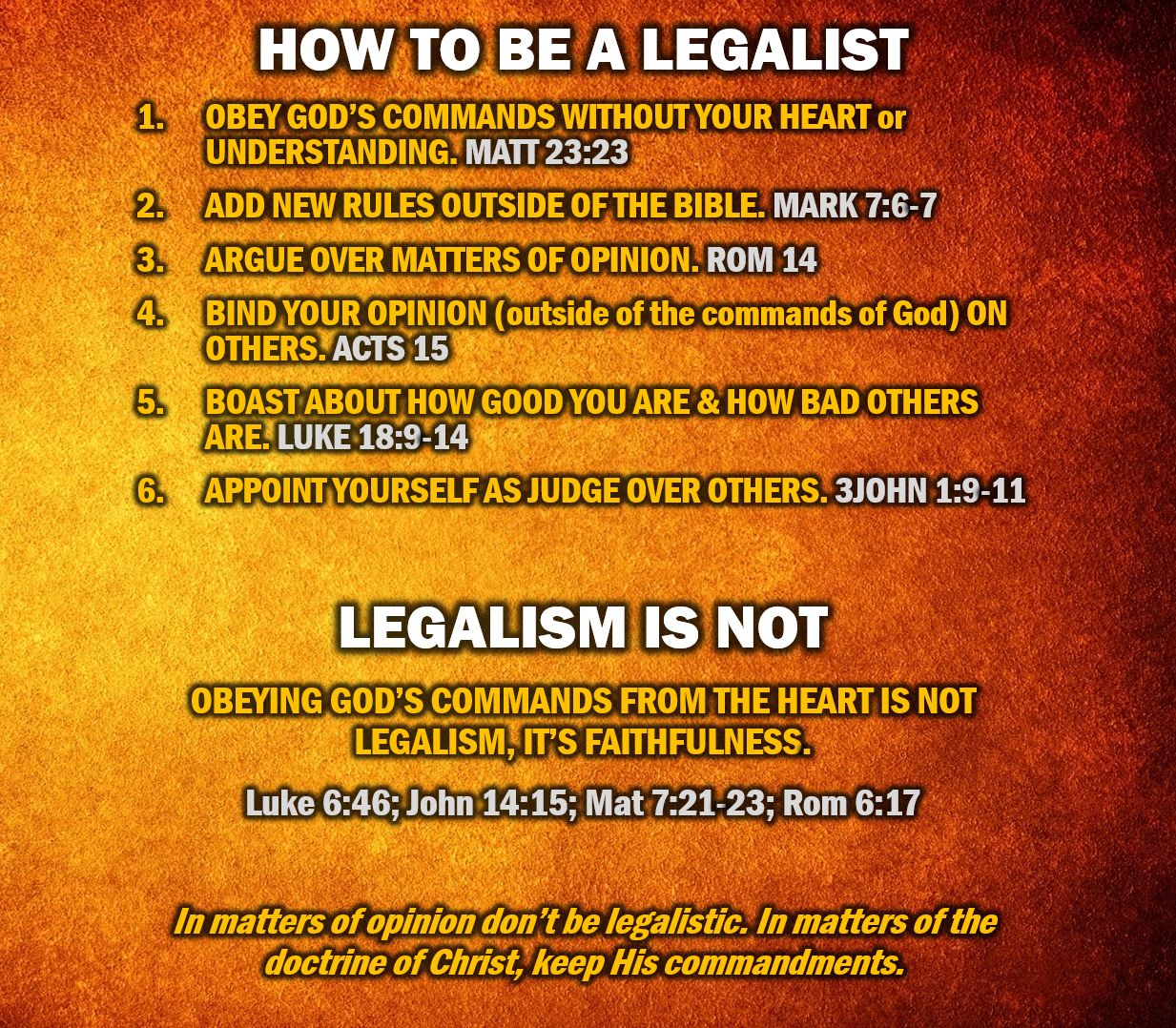
Yes, another bulletin on the meaning of ‘LEGALISM’ because it’s the standard argument used by those who refuse to repent.

The discussion goes like this;

  • Believer: Jesus commands us to keep His commandments [Luke 6:46; Mat 7:21-29].
  • Non-Believer: Yeah, but I’m not LEGALISTIC about it.

End of discussion.

To understand their argument as to why they believe that God is giving them license to sin (if not fully, at least partially) let’s look at how the reasoning goes.

THE RATIONALE GOES LIKE THIS:

  • Since nobody’s perfect [1John 1:10],
  • And since God is full of grace & mercy [Heb 4:16],
  • Then God doesn’t expect us to be perfect, So, we don’t have to try. “I’m not going to be LEGALISTIC about it.”

That’s not very good bible study. Paul addressed a similar question in his time. In Romans 6:1 he answers a rhetorical question, “shall we continue in sin that grace may abound?” His answer, “certainly not!” This may be why we have thousands of denominations with a nearly equal number of doctrines about how to live. It’s like they’re saying that since there’s a little room to sin regarding salvation, then we can intentionally be mediocre. That’s fine for unimportant things like dieting or quilting, but not a very good way to handle salvation.

Is GRACE & MERCY license to sin willfully? That’s just another way of saying “I’m not legalistic about it.” God is full of GRACE & He is MERCIFUL, but that’s no license to sin. The accurate way to look at it is that He has provided GRACE & MERCY to an imperfect people. This is the right way to understand Ephesians 2:8-9 and 1John 1:7-10. God sent His Son as a sacrifice for a sinful people that didn’t deserve it [Rom 5:8-10]. We obey the Gospel upon recognition of our need for the atoning blood of Jesus [2Thess 1:8-9; Acts 2:38; Heb 5:9]. Obeying the gospel & keeping His commandments [Mat 28:18-20] is not being legalistic, it’s being faithful.

WHEN NOT TO BE LEGALISTIC

There are 2 chapters in the New Testament that are telling folks not to be legalistic. They are, Romans 14 & 1Cor 8. These are dealing with issues that are NOT MATTERS OF DOCTRINE but matters of OPINION. If that’s what you mean by ‘I’m not going to be legalistic about it’ then we both agree with God and His word. If, however, you aren’t going to be legalistic with the doctrine of Christ, then you’re going to find yourself fighting against God.

“But I’m Not Legalistic About it”

People who say they’re not legalistic about the doctrine of Christ would never say the same thing in other areas of their lives. Below are just a few examples of how ridiculous this sounds.

  • I’m a VEGAN, but I’m not legalistic about it.
  • I love my wife, but I’m not legalistic about it.
  • I always do my job at work, but I’m not legalistic about it.
  • I want a great brain surgeon, but I’m not legalistic about it.
  • I take insulin to keep from dying, but I’m not legalistic about it.
  • I stop at red lights, but I’m not legalistic about it.
  • I watch over my kids when they swim, but I’m not legalistic about it.
  • I’m a bank teller, but I’m not legalistic about it.
  • I’m a judge, but I’m not legalistic about it.
  • I practice food safety at the restaurant I work, but I’m not legalistic about it.
  • I work with the nuclear warheads at Pantex, but I’m not legalistic about it.

So you see, we all can understand that in matters of importance we must stand firm. “Watch, stand fast in the faith, be brave, be strong.” [1Cor 16:13] Regarding the matters of style or opinion, don’t be legalistic about it, but with matters of the doctrine of Christ, be LEGALISTIC.

THROWING OUT THE TRUTH WITH THE BATHWATER

Most of you understand the expression, “THROW OUT THE BABY WITH THE BATHWATER” because you lived it. Back in the days of old, before the days of indoor plumbing, the family would take their baths in a large metal wash tub. After everyone was done, the last usually being the youngest, the bathwater was tossed out into the yard.

The idiom reminds us not to discard the precious as we attempt to rid ourselves of the despised.

I bring this to your attention because there is a movement among many to “toss out the bathwater” of baptism.

They’re TOSSING out the TRUTH of salvation as they seek to rid themselves of the baptismal waters. In their zeal to remove the ‘bathwater’ they have missed the simple truth about the Gospel.

Ye blind guides, which strain at a gnat, and swallow a camel. [Mat 23:24]

Those who are now working to rid the church of the ‘bathwater’ are repeating the mistakes of those in the past and tossing out the precious truth about salvation & baptism.

One fellow said that the baptism spoken of in Acts 2:38 is ‘spiritual immersion.’ What he’s done is thrown out SALVATION with the baptism water. Look at 1Peter 3:21; what is being taught?

The like figure whereunto even baptism doth also now save us (not the putting away of the filth of the flesh, but the answer of a good conscience toward God,) by the resurrection of Jesus Christ:” [1Peter 3:21]

The Apostle Peter makes a specific reference to water when he says, “not the putting away of the filth of the flesh.” Why would he bring up ‘the filth of the flesh’ unless saving baptism involves water? If salvation was ‘faith only’ then this addition is completely pointless. He brought it up because he was talking about WATER BAPTISM. He was teaching us not to confuse the water baptism obeyed through faith with a physical cleansing. WATER BAPTISM, submitted through faith, provides a SPIRITUAL CLEANSING.

Paul was told, “arise, and be baptized, and WASH AWAY THY SINS, calling on the name of the Lord.” [Acts 22:16] Upon hearing the preaching of Jesus by Phillip, the Ethiopian Eunuch asked, “See, here is WATER; what doth hinder me to be baptized?” [Acts 8:36] (emphasis mine, seb) These verses harmonize BECAUSE they are teaching WATER BAPTISM. They make no sense if salvation occurs BEFORE water baptism.

No one is teaching a ‘works’ salvation, for no one, submitting to the simple command of God in Christ, is able to do anything of themselves while under the water. Christ is doing the spiritual cleansing [Rev 1:5]. Christ is doing the saving [Matt 1:21]. Christ is adding to the church those that are being saved [Acts 2:47].

If you believe

  • You were saved before you were water baptized,
  • That baptism is not immersion in water,
  • That baptism doesn’t save you,
  • Were baptized in or into a denomination,
  • You were saved by being baptized as a baby,

Then you are guilty of ‘THROWING OUT THE TRUTH WITH THE BATHWATER’ and remain in your sin.

Saving Baptism in the bible is

  • Commanded by Christ, Matt 28:19; Mark 16:16
  • For the remission of sins, Acts 2:38; Mat 26:28
  • What washes away sin, Acts 22:16
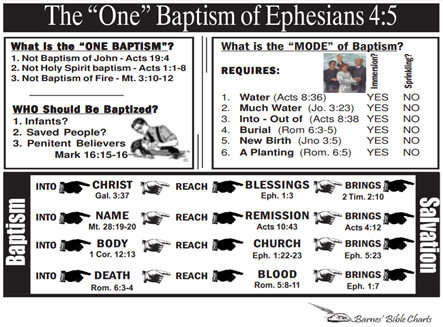
  • Death to sin, Romans 6:1-4
  • A Burial, Colossians 2:12
  • Immersion in water, 1Peter 3:21; Acts 8:36
  • What saves you, by faith, 1Peter 3:21; Heb 11:7
  • Taught by Peter, Paul, & others Acts 2:38; 19:5; 22:16;
  • The Putting on of Christ, Galatians 3:27
  • AFTER Hearing, Believing, Repenting & Confessing, Mark 16:15, 16

3 Ways the Lost RID themselves of Christ.

If you haven’t noticed, many of these articles are written for 2 purposes. First, to strengthen the Christian in their hope of salvation. Second, to empower the Christian with information that could be used to reach the lost. The titles are designed to evoke some emotion that makes someone want to see what it’s about.

Today’s article does both because we know the lost world needs Christ, and it’s possible for the Christian to drift away [Heb 2:2-3].

HOW DOES THE LOST RID THEMSELVES OF CHRIST?

Whether a person does it intentionally or by neglect, the results are the same, they’re lost. So, here’s what scripture tells us how a person RIDs himself of Christ.

REJECTING CHRIST:

One of the ways to get Christ out of your life is to reject Him, reject His commands and totally reject His will for your life. This is what the Jews did during His personal ministry. “And have ye not read this scripture; The stone which the builders rejected is become the head of the corner:” [Mark 12:10].

Jesus warned, “He that rejecteth me, and receiveth not my words, hath one that judgeth him: the word that I have spoken, the same shall judge him in the last day.” [John 12:48]

The result of rejecting Christ is found in the example of Esau, “For ye know how that afterward, when he would have inherited the blessing, he was rejected:” [Heb 12:17] The same fate awaits those who reject Christ, that is, to be rejected by God.

IGNORING CHRIST:

Probably the most common way to RID yourself of Christ is to IGNORE Him. We see this in most folks as they take zero consideration for their eternity. These may say they believe in God & Christ, may even attend a church service somewhere, but they make no effort to know what His will is about godly living, worship or even His commands about baptism.

Paul faced this attitude when he spoke with Agrippa. “Then Agrippa said unto Paul, Almost thou persuadest me to be a Christian.” [Acts 26:28] To ignore Christ is just as fatal as to reject Him.

Our Lord spoke about those who ignored His commands when He said, “Not every one that saith unto me, Lord, Lord, shall enter into the kingdom of heaven; but he that doeth the will of my Father which is in heaven.” [Mat 7:21]

Some say that doctrine is not important. But the Holy Spirit says that there is a ‘sound doctrine’ which means that some would be following unsound doctrine ignoring the Doctrine of Christ. [2Tim 4:3; 2John 1:9]

DELAYING OBEDIENCE TO CHRIST:

The last one will RID Christ from your life just as effectively even though the person in this position may say they want to obey the Gospel. Saying you want to do something has zero effect on one’s salvation. Christ said, “And why call ye me, Lord, Lord, and do not the things which I say?” [Luke 6:46]

There is something you must do. Saul (later called Paul) knew this, “Lord, what wilt thou have me to do?” Jesus then sent him to a Christian to tell him what to do. Nobody accesses salvation without actively doing what the Lord requires. The Jailor, upon hearing about Jesus, obeyed the gospel “the same hour of the night’ without delay. [Acts 16:33]

Don’t be like Felix; “And as he reasoned of righteousness, temperance, and judgment to come, Felix trembled, and answered, Go thy way for this time; when I have a convenient season, I will call for thee.” [Acts 24:25] He delayed, and we have no idea if he ever responded to the gospel. How sad.

All 3 of these can be applied to those outside of Christ as well as those who are in Christ. You see, we can lose our salvation when we REJECT, IGNORE or DELAY in doing the commands of the Lord. Please, Salvation has appeared to all men [Titus 2:11], don’t RID yourselves of that Grace.

Just Preach Jesus

I met a fellow this week who during his conversation with me said, “instead of looking at what we’re doing differently, we ought to be celebrating what the denominations are doing right.” He then cited the example of a denomination’s sound finances. As the conversation went on, he repeated this sentiment, the idea of “celebrating what’s right and ignoring what’s wrong. This has mass appeal in our ecumenical society.

When shown the passage; “Now I beseech you, brethren, by the name of our Lord Jesus Christ, that ye all speak the SAME thing, and that there be no divisions among you; but that ye be perfectly joined together in the SAME mind and in the SAME judgment.” 1 Corinthians 1:10 (emphasis mine), he swept it away as just a request Paul had and not a requirement of the Lord. [cf. 1Cor 14:37]. He said, “I’m not about logic and reasoning.” Then the conversation was over.

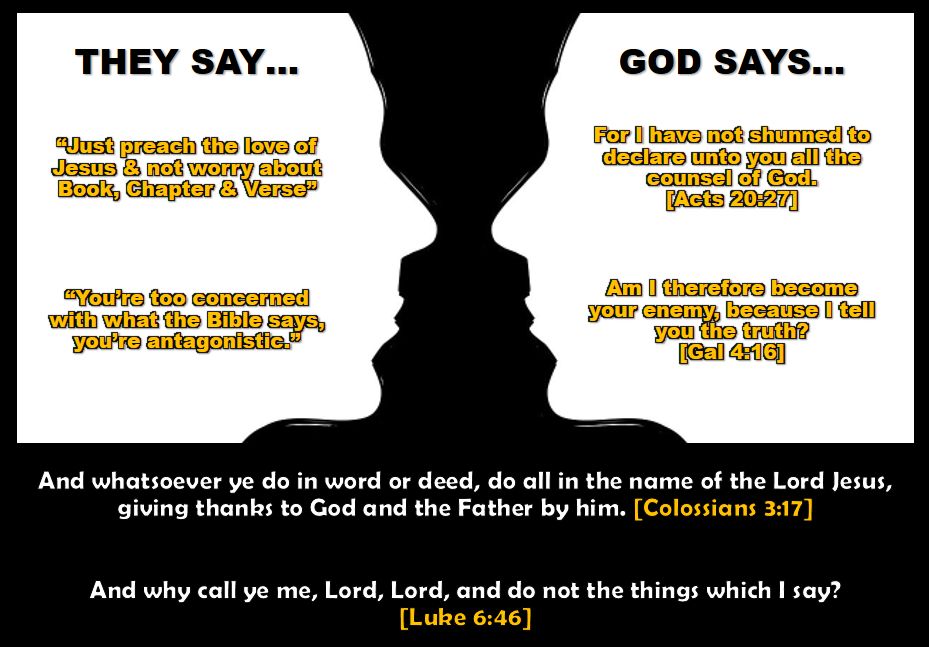
They tell us to JUST preach Jesus, His love and His grace. The thing is…we are preaching Jesus, His love and His grace, we’re just including the parts that they have left out. Leaving out key parts of the information is not to tell the truth, the whole truth and nothing but the truth.

Abram’s HALF TRUTH

Before we go on, let’s take a small detour back to the time when Abram (later changed to Abraham) was in Egypt [Genesis 12:10-20] when he was afraid the Egyptians would kill him to take his wife. He told the Egyptians the truth, that Sarai (later changed to Sarah) was his sister. Scripture tells us that she is the “daughter of my father, but not the daughter of my mother; and she became my wife” [Genesis 20:12]. Abraham and his brother had married sisters. This made Sarah both Abraham’s wife AND his sister in law. So technically, he didn’t lie. However, we all know that the whole truth wasn’t conveyed. He told a story to protect his life but didn’t identify her as his wife. With that before us, let’s return to the main point.

JUST PREACH JESUS

When they say, “JUST preach Jesus,” they are saying to focus ONLY on His love and His grace which is to preach ONLY half of the truth. Just as Abraham told the partial truth about his wife Sarah, to preach JUST Jesus love, is to preach a partial truth about Jesus, that is, to preach faith only. James, using another example of Abraham, points out that no justification is by ‘faith only’. “Ye see then how that by works a man is justified, and not by faith only.” [James 2:24]

God IS love, and we are saved by grace, but that’s only half of the story. [cr. John 3:16; Ephesians 2:8] There should be no doubt in anyone’s mind that Salvation is a gift of God, something none of us can earn. [cr. Romans 5:8-10] But we are not allowed to declare only half the truth, we must declare the “whole counsel of God.”

For I have not shunned to declare unto you all the counsel of God. [Acts 20:27]

PREACHING JESUS

What does it mean to “preach Jesus?” To learn that answer we turn to Acts 8:26-40, the story of Philip and the Ethiopian eunuch. Philip approached the eunuch who was reading Isaiah while returning from Jerusalem. Philip asked him, “Do you understand what you are reading?” The eunuch invited Philip up into the chariot to guide him in the text. Philip then, beginning at the same scripture, opened his mouth and “preached unto him Jesus.”  [v35]

This next part is extremely important, please pay close attention and notice who speaks in the very next verse. “And as they went on their way, they came unto a certain water: and the eunuch said, See, here is water; what doth hinder me to be baptized?” [Acts 8:36] The eunuch spoke and asked about BEING BAPTIZED!!! How did he learn about baptism? How did he learn about water being the type of baptism? How did he learn that baptism was immersion? How did he learn that it was a requirement of salvation? Where did he learn the answer to each of these questions? The answer is simple, and we already read it in verse 35, Philip “preached unto him Jesus.” To preach Jesus it to “declare the whole counsel of God.”

To preach the Love of Christ is to talk about how to love Him…

If ye love me, keep my commandments.

John 14:15; cf. 1John 5:3

To preach the Gospel is to tell about obeying the Gospel…

In flaming fire taking vengeance on them that know not God, and that obey not the gospel of our Lord Jesus Christ:

2Thessalonians 1:8; cf. 1Cor 15:1-4; Rom 6:1-4

To preach the Grace of God is to include how one can fall from it…

Christ is become of no effect unto you, whosoever of you are justified by the law; ye are fallen from grace.

Galatians 5:4

Preaching anything less is to come short of salvation. Let us speak the truth about Jesus, His love and His grace and let’s do it with LOVE.

But speaking the truth in love, may grow up into him in all things, which is the head, even Christ: Ephesians 4:15