
Responding to PAIN

Responding to Pain with Faith: A Biblical Perspective

Pain is an inevitable part of the human experience, whether it stems from physical suffering, emotional turmoil, or spiritual trials. The Bible offers timeless guidance on how to navigate pain with faith, resilience, and trust in God. Four key principles emerge from Scripture to guide believers in responding to pain: never forsaking God, maintaining integrity, acting on God’s will, and praying without ceasing. These principles, rooted in the Word, provide a framework for enduring suffering while remaining anchored in faith.

First, irrespective of our trials, we ought never forsake God, trusting that He never forsakes His people. Deuteronomy 31:6 declares, “Be strong and courageous. Do not be afraid… for the Lord your God goes with you; he will never leave you nor forsake you.” This promise assures us that God’s presence is constant, even in our darkest moments. Similarly, Hebrews 13:5 reinforces this truth: “…Never will I leave you; never will I forsake you.” When pain threatens to overwhelm, these verses remind us that God is our refuge. Clinging to Him, rather than turning away in bitterness, strengthens our faith and provides hope. Pain may obscure our view of God, but His faithfulness remains unwavering, a steady anchor through life’s storms. God is not the source of our pain, but He can use it for our growth (Rom 8:28).

Second, maintaining integrity in the face of pain is essential. Persecution, betrayal, or injustice can tempt us to retaliate or compromise our values, but Scripture teaches us to maintain a higher standard. Romans 12:17-19 instructs, “Do not repay anyone evil for evil… Do not take revenge, my dear friends, but leave room for God’s wrath.” Likewise, 1 Peter 3:9 urges, “Do not repay evil with evil… but with blessing.” Integrity means reflecting God’s character, even when wronged. By refusing to curse our enemies or seek vengeance, we demonstrate trust in God’s justice and exemplify His love. Proverbs 20:22 echoes this: “Do not say, ‘I’ll pay you back for this wrong!’ Wait for the Lord, and he will avenge you.” Integrity in pain glorifies God and guards our hearts against resentment. Christ could have called 12 legions of angels (Matt 26:53; 1Pet 2:23)

Third, acting on God’s will by doing good is a powerful response to suffering. Pain can lead to self-focus, but Scripture calls us to persevere in righteousness. Galatians 6:9 encourages, “Let us not become weary in doing good, for at the proper time we will reap a harvest if we do not give up.” James 4:17 adds, “If anyone, then, knows the good they ought to do and doesn’t do it, it is sin for them.” Doing good (whether through kindness, service, or forgiveness) aligns us with God’s purposes and transforms pain into opportunities for service. By acting in obedience, we reflect Christ’s example, who endured suffering to accomplish God’s redemptive plan.

Finally, prayer is the lifeline of a believer in pain. 1 Thessalonians 5:17 commands, “Pray continually.” Philippians 4:6 further instructs, “Do not be anxious about anything, but in every situation, by prayer and petition, with thanksgiving, present your requests to God.” Colossians 4:2 adds, “Devote yourselves to prayer, being watchful and thankful.” Prayer connects us to God’s strength, aligns our hearts with His will, and brings peace that surpasses understanding. In pain, persistent prayer becomes a conduit for God’s comfort.

Responding to pain with faith involves trusting God’s presence, upholding integrity, doing good, and praying without ceasing. These biblical principles anchor us in God’s truth, enabling us to endure suffering with hope and purpose. By clinging to Scripture, we find the strength to navigate pain while glorifying God.

agape

What can the 7 Sayings of Jesus on the Cross teach us about our pain?

Jesus said, “Take up your cross and follow me” (Matt 16:24). We are to die to self and live for Him.

The Gospels reveal 7 sayings of Jesus when He was on His cross. These sayings have important meaning for themselves, but they also leave an example for us who are suffering on our crosses.

What can the 7 sayings of Jesus on the cross teach us about handling our own pain, suffering, & earthly hurting?

Father, forgive them; for they know not what they do.” (Luke 23:34)

We often suffer at the hands of those close to us. Jesus suffered at the hands of God’s chosen people. We will often complain about what they should do, but didn’t do. Yes, they shoulda, and coulda, but didn’t. This powerful example of Jesus teaches us to be a forgiving people. We need to complain with grace, ready to Forgive, or Forebear, or Forget (release from our heart). Forgive those that are hurting you…

But Stay on the cross.

To day shalt thou be with me in paradise.” (Luke 23:43)

When others fail, remember that God doesn’t fail. There’s hope in the midst of our pain. There’s even hope when our pain is self induced. The thief admitted his guilt, and was a mocker along with the other one, but later he had a change of heart. It’s then he looked to the only one that could help, Jesus. Sometimes our suffering is self induced, but the Lord is faithful to forgive those that are in Him (1John 1:9). Repent…

But Stay on the cross.

Woman, behold, thy son! Behold, thy mother!” (John 19:26-27)

Your friends may have turned their back on you. I hate that. However, If you’ll look, you’ll see that not everyone has left you. Some are nearby unable to take away your pain, But they can take some of your responsibilities. Just ask them for help. Some of us just don’t know what to do, but we’re willing if you’ll let us know.

When you’re overwhelmed with your main priority, let go of some of the other important, but lesser stuff.

But Stay on the cross.

My God, my God, why hast thou forsaken me?” (Mat 27:46)

People will let you down at your lowest point. The disciples left Jesus. It will also APPEAR that God has left you too. He hasn’t. He’s with you. While this saying has prophetic significance, it is a reminder of how lonely we can feel in our darkest moments. We need to remember that Jesus said, “I will never leave thee, nor forsake thee” (Heb 13:5).

But Stay on the cross.

I thirst.” (John 19:28-29)

Life is a dry, and thirsty struggle, metaphorically speaking. Jesus asked the woman at the well for a drink. He received a bit of a rebuke (John 4:7-9). Isn’t that the way it goes sometimes? Jesus said, “I thirst,” and He received sour wine. When we need help we sometimes receive a sour response. Ask anyway…

But Stay on the cross.

It is finished.” (John 19:30)

Jesus stayed on that cross to the very end because He knew that what He was doing was essential for salvation for the world. (cf. Matt 16:21-23; 26:52-55). Keep on pushing through the pain until you complete your duty as a child of God. It’s important that we stay the course of faithfulness. We may not see the benefits until much later (Rev 2:10),

But Stay on the cross.

Father, into thy hands I commend my spirit.” (Luke 23:46)

Even when all others fail you, God never does. Trust God. “For the which cause I also suffer these things: nevertheless I am not ashamed: for I know whom I have believed, and am persuaded that he is able to keep that which I have committed unto him against that day.” (2Tim 1:12). Whatever happens to you…

Stay on the cross.

Agape,

Spencer

5 Strategies to Endure GRIEF

Nobody is immune to sorrow, loss, and pain. Sometimes we add in guilt for feeling joy during times of celebration.

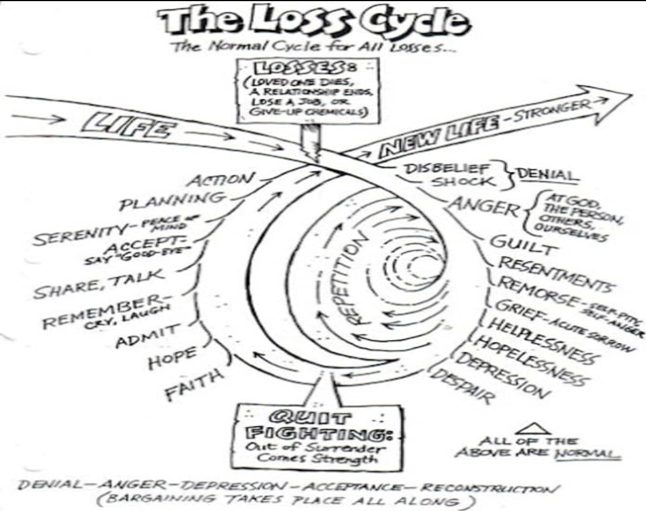
It is possible to be happy and to experience Joy without guilt. While I’m no expert, I have experienced GRIEF and have gone through its seven stages.

I’m no expert; I’m just a student of the Bible and have found some strategies that have helped me. Perhaps they can help someone else who may be struggling with the weight of GRIEF.

It may help to know that after every winter there is a spring.

A time to weep, and a time to laugh; a time to mourn, and a time to dance;”

[Ecc 3:4]

5 Strategies for Living through GRIEF, (from my own experience).

1) You never get over death, nor should you, but you may GROW through it. That hole in our hearts never gets smaller, but our hearts can GROW larger with time. If we will Look up, we can GET UP. [1King 19; Col 3:1-4]

My brethren, count it all joy when ye fall into divers temptations; Knowing this, that the trying of your faith worketh patience.” [Jas 1:2-3]

2) It’s OK to REMEMBER our loved one that sleeps. If you mention my mother’s name you might make us cry. If you don’t, you’ll break our hearts. Talk about your loved one who sleeps. A word of warning; it’s possible to steal another’s joy. You can end every conversation by REQUIRING others to REMEMBER your pain. This may be difficult to understand right now while you’re engulfed in sorrow, but be aware of other’s joy or pain and that it’s unfair to steal another’s joy. There’s a time for every season. [Ecc 3:1-13].

RECOGNIZING other’s Pain or Joy gives one perspective. Perspective is powerful, but it’s up to you to RECEIVE it. Perspective is a self-soothing tool. It’s no real comfort to say that somebody else has it worse than you. How would you comfort that person with the most pain? (REMEMBER Job? Jas 5:11). But there is Someone who feels what you feel.

For we have not an high priest which cannot be touched with the feeling of our infirmities; but was in all points tempted like as we are, yet without sin.” [Heb 4:15]

3) Don’t IGNORE your feelings, nor your physical health. It’s easy to let GRIEF permeate every part of our life and destroy it. Don’t IGNORE your emotions, but also don’t IGNORE the rest of your life. Get up & move, take a shower, and do what needs to be done. Keep doing those IMPORTANT things. Also, don’t ISOLATE yourself from others. You’ll be surprised by how many people are grieving something. You can grieve & still do what is IMPORTANT. Go to worship [2Sam 12:20-23], celebrate birthdays, and do your work. You’ll discover an INCREASE in strength you never thought possible.

And, behold, there came a voice unto him, and said, What doest thou here, Elijah?” [1Kings 19]

4) Ecclesiastes 7 talks about the “house of mourning.” It’s better because it’s there that we will consider our own END and take it to heart. The end of the book concludes with this lesson; “fear God & keep keep His commandments.” Life is frail & short [Jas 4:14]. Think on ETERNAL life. The hope of being resurrected unto ETERNAL life is our only true comfort. [1Thess 4:13-18]

But I would not have you to be ignorant, brethren, concerning them which are asleep, that ye sorrow not, even as others which have no hope.” [1Thess 4:13]

5) Prevent the repetitious spiraling FALL into darkness. GRIEF doesn’t have to define you & become your identity. Instead, FOCUS on the FUTURE and the FRUITFUL things you can do. There are people you can help, like those that have helped you. It’s possible to FEEL joy again. Ask yourself this, “What would your loved one want for you?” Do they want you to give up or to FEEL joy again? We know, through scripture, what they truly want for you. [Php 3:13; Luke 16:27-28]

Brethren, I count not myself to have apprehended: but this one thing I do, forgetting those things which are behind, and reaching forth unto those things which are before, I press toward the mark for the prize of the high calling of God in Christ Jesus.” [Phil 3:13-14]

It may not feel like comfort at this moment, but you’re not alone. One thing I noticed during my two plus years of trial & loss was how many others needed help. There were others who were just beginning their grief as I was working through mine. Your pain now can become another’s lifeline later. We’re all in this together.

— spencer

Spencer is an evangelist for the church of Christ that meets at Franklin & Juniper Street in Borger, Texas.

Do you remember when you were without hope?

You may be thinking that this title refers to that time in your life when you had great financial distress, but it doesn’t. Or you may suppose that it refers to that time when you may have been in fear for your life at the threat of a thief or a maniac, but it doesn’t. Or you may be thinking it’s referring to the loss of a parent or a spouse, but it doesn’t.

It’s referring to Ephesians chapter 2: “Wherefore remember, that ye being in time past Gentiles in the flesh,… That at that time ye were without Christ, being aliens from the commonwealth of Israel, and strangers from the covenants of promise, having no hope, and without God in the world.”

Too many people are hopeless, and far too many Christians are displaying hopelessness as well. It’s very easy to get caught up in the concerns for this life and to forget that there’s an eternity awaiting us. Paul is saying that without Christ this life is hopeless. Without Christ this life holds no promises.

The writer of Ecclesiastes makes the same point in a very powerful way. He writes about seeking success, wealth, joy and meaningful work, but at the end of the day it’s vanity, “grasping after the wind.” He’s not suggesting that these pursuits are worthless. His conclusion is the same as Paul’s, without God in your life all these things are hopeless. His conclusion of the whole matter is, “Fear God, and keep his commandments: for this is the whole duty of man.” [Ecc 12:13]

Have you ever met someone that appeared to have nothing, no money, had physical disabilities or otherwise devoid of many of this world’s goods but was happy? I have, many times. I met a man, whom I’ve told you about, who had a disease called Fibrodysplasia ossificans progressiva (FOP). It is a disorder in which muscle tissue and connective tissue are gradually replaced by bone (ossified), forming bone outside the skeleton. He was one of the happiest guys I knew. I loved being around him because he brightened every room he entered.

How can anyone in a condition like that be happy? It was by no cause of his own, it happened to him beginning from his youth up. He experienced daily pain because of his disease but brought joy to those around him. How did he do it, what’s the key? I’ll tell you, he looked forward to being with God. In other words, he had purpose. This is true of nearly everyone who, despite the difficulties of life, are happy. They have found purpose, meaning and a direction.

THE KEY TO TRUE JOY…PURPOSE

People with purpose are some of the happiest people on the planet. They will endure great pain & struggle because of purpose.

I read about a study where scientists tossed lab rats into a jar of water that had been placed in total darkness to see how long they would swim to survive. In total darkness it took 3 minutes before they gave up. Then they took the rats and placed them in the same conditions, but this time with a small ray of light at the top. How long did the rats struggle this time? 36 hours! When they had a light, a possibility of escape, they were able to endure.

Think about how strong we can be when we have hope, true hope that is in Christ. We can face tomorrow when we know that we’ve been reconciled to God in Christ. Paul finishes his command to remember by saying, “But now in Christ Jesus ye who sometimes were far off are made nigh by the blood of Christ.”

So, let us be reminded that without Christ we are without hope, without the promise of heaven, but IN CHRIST we have both the promise of heaven and hope that He will return to take us there. [Gal 3:27 put on Christ in baptism]

The next time life gets you down, and it will, look up and be reminded that God loves you, and that He sent His Son to provide you a way of escape.

Behold, we count them happy which endure. Ye have heard of the patience of Job, and have seen the end of the Lord; that the Lord is very pitiful (compassionate), and of tender mercy.” [James 5:11]

Rock Bottom

Everyone has some trouble in their life, some more than others. It may be self-caused, natural causes or externally caused. Regardless of the source, living on this planet can be rough.

Another interesting fact about living on this planet; nothing stops when trouble comes. Bills keep arriving in the mail, landlords still want their rent and don’t get me started about what the grocery store wants when you load up a buggy full of food.

Just because the world keeps moving doesn’t mean that we’re not weeping with you in your sorrow, neither does it mean there’s no compassion.

Rejoice with them that do rejoice, and weep with them that weep.

[Romans 1:15]

Take, for example, Naomi. She was a young widow who was living with her widowed daughter-in-law Ruth. Back in those days it was very difficult for a woman without a husband. I can’t imagine that kind of sorrow, but we can study it and learn from it.

You see, Naomi was down, very down. You might say that she had hit rock bottom. We know she was down because of what she said to those back in Bethlehem;

“Call me not Naomi, call me Mara: for the Almighty hath dealt very bitterly with me. I went out full, and the LORD hath brought me home again empty: why then call ye me Naomi, seeing the LORD hath testified against me, and the Almighty hath afflicted me?” [Ruth 1:20-21]

Her sadness was so deep that she wanted to be called ‘bitter’ which is also translated as ‘grieved’ in verse 13. “for it grieveth me much for your sakes that the hand of the LORD is gone out against me.” Can you imagine the depth of hurt that you would rather people call you bitter, grief or sadness? Her words conveyed no sense of hope. Is it any wonder she wanted her daughters-in-law to return to their father’s home? [1:8-14]

FACE THE FACTS

Naomi just presented them with the facts of the matter. That’s a good place to start I suppose. Many folks try to hide from the reality of their pain.

In another story, Joshua had to face the facts when Moses died. The Lord spoke to him and said, “Moses my servant is dead.” Yeah, Joshua knew that, they had mourned the death of Moses for 30 days [Deut 34:8]. So why did God tell him again? To face the facts. God had something for Joshua to do and it was time for him to get after it. God follows up His restating of the facts by saying to Joshua;

“now therefore arise, go over this Jordan, thou, and all this people, unto the land which I do give to them, even to the children of Israel.” [Joshua 1:2]

Naomi, Ruth and Joshua were in mourning, but life was still moving forward. No one expected them to forget their loved ones, nor was anyone telling them to ‘get over it’ not even God does that. However, what He does expect from all of us, in particular those that are in sorrow, is to keep moving forward. He wants us to keep moving toward Him.

It’s when we understand this that we can have a better understanding of Matthew 6:27; “Which of you by taking thought can add one cubit unto his stature?” Christ then goes onto say;

“But seek ye first the kingdom of God, and his righteousness; and all these things shall be added unto you.” [Mat 6:33]

He is saying, keep moving forward toward Him, and you will have the strength to discover joy again. This is what Paul learned with the trouble he faced while spreading the Gospel. He wrote to the Philippians;

Not that I speak in respect of want: for I have learned, in whatsoever state I am, therewith to be content. I know both how to be abased, and I know how to abound: every where and in all things I am instructed both to be full and to be hungry, both to abound and to suffer need. I can do all things through Christ which strengtheneth me.”

[Phil 4:11-13]

With the help of Ruth, Naomi was able to face the facts and move forward. God retold the promise of Abraham & Moses to Joshua as motivation to keep him moving, and Paul found peace and contentment when he heeded the Word of God.

“Be careful for nothing; but in every thing by prayer and supplication with thanksgiving let your requests be made known unto God. And the peace of God, which passeth all understanding, shall keep your hearts and minds through Christ Jesus.” [Phil 4:6-7]

Keep moving forward.

We Ought to pray

THE LORD TAUGHT US that we ought always to pray and to not lose heart [Luke 18:1]. This parable tells the story of a woman who pleaded with an unjust judge to avenge her of her adversaries, which he eventually did due to her persistance in her requests. The lesson is explained in vs 7, 8; “And shall not God avenge his own elect, which cry day and night unto him, though he bear long with them? I tell you that he will avenge them speedily. Nevertheless when the Son of man cometh, shall he find faith on the earth?”

Life is full of sorrow, said the preacher [Ecc 1:18]. If you’ve ever experienced the ocean waves, you may understand what I mean. The pains and troubles of this life sometimes overtake us, and keep on overtaking us as wave after wave of sorrow washes over us, preventing us from standing, oftentimes, suffocating us of all hope. Life on Earth is like that. We all have pain which makes it all the more imperitive that we ought to pray.

Lest we add sorrow upon sorrow, we need to stop and pray to the only one that can provide help. Let us remember the lesson, “men ought always to pray, and not to faint.”

The Lord has taught us to pray. Go to a quiet place [Mat 6:6], and pray to the Father who sees in secret. When we study the comforting word [2Cor 1:3] we learn how to pray and for what to pray in difficult times.

It’s in these times that I pray….

Most gracious heavenly Father, my great master and most righteous friend. I know that you are full of all goodness, mercy and grace.
[John 15:14; James 1:17; 2Cor 1:3; John 1:14]

I Thank You Father for what has gone right in the midst of what is wrong. Thank you for the breath that I have, the food you’ve provided and the salvation given through Christ Jesus.
[1Thess 5:17-18]

You’ve commanded me to cast my cares upon you, for you care for me. Therefore, I bring to you my sorrow and worries, seeking your guidance and help, according to your will.
[1Peter 5:7; Luke 11:2].

I pray for wisdom and remembrance of Your godly instructions of what to do in difficult times. Knowing that You Father, give with all liberality. Help me to remember all that you’ve taught through your word that I may know how to proceed.
[James 1:5; John 14:15-24; 16:13]

May your peace come upon me as I think upon the good things of life helping me to think clearly that I may endure what has befallen me.
[Phil 4:6-9]

May a blessing be upon those that are fighting against me. Help me to do good to them that hate me and to love them and forgive them as you’ve forgiven me. Please forgive me of all unrighteousness.
[Mat 5:44; Mark 11:25; 1John 1:9]

May You grant unto me boldness that I may endure the difficulties of life and to take purposeful action knowing that as a child of Yours, You are always beside me.
[Acts 4:29; Hebrews 13:5]

Finally, I pray knowing that today will be a great day. Though every day is filled with some sorrow, it’s even more so filled with your goodness. Because You live, I can face the day! May my light shine through this darkness and into the darkness of this sinful place.
[Phil 3:1; John 14:19; 1Peter 2:15; Mat 5:16]

That’s what I would do. Then I get busy, for I fear boredom. It is the enemy to my thoughts. I get up and go do something of service. What can you do? According to the scriptures, there are many things you can do. God has given us a talent to serve Him, each according to our own ability [Mat 25:15].

We serve Him through…

Diligence in our vocations. Ephesians 6:5-8
Diligence in the raising of our children. Ephesians 4:1-4
Diligence in service for our brethren. Mat 25:31-46
Diligence in our display of hope during trouble, knowing that salvation is upon the true believer. 1Peter 2:15
And Diligence in our sowing the seeds of the kingdom. Mat 28:18-20

— Spencer