
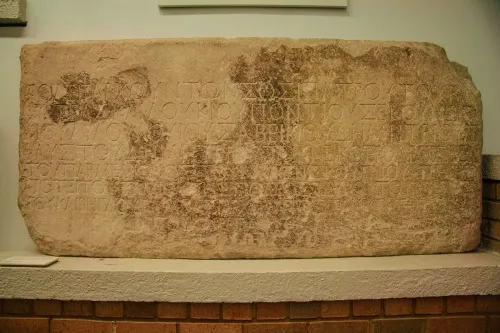
The Politarch Inscription
For years, critics of the Bible pointed to the Greek word politarch, used in Acts 17:6-8 to describe Thessalonian city officials, as evidence of scriptural inaccuracy. This term, unique to Luke’s account and absent from classical Greek literature, led some 19th-century scholars to argue that Luke fabricated details, casting doubt on the New Testament’s historical reliability. They claimed politarch was an anachronism or error, undermining Luke’s credibility as a historian.
However, the discovery of the Thessalonian Politarch Inscription1 in the 19th century, which explicitly lists “politarchs” as civic leaders in Thessaloniki, silenced these objections. As noted by historians like F.F. Bruce, this archaeological find confirmed Luke’s precision, showing that politarch was a legitimate title in first-century Macedonia. This turnaround highlights how critics’ challenges, when met with evidence, can strengthen faith in the Bible’s trustworthiness, echoing Psalm 119:160’s assurance that God’s Word is true.
Thessaloniki was a bustling Roman city, and the politarchs were civic leaders navigating the tensions of a diverse, often skeptical society. Acts 17:4-5 tells of locals and converts stirred by Paul’s preaching, clashing with those loyal to Roman order. The inscription, studied by scholars like N.T. Wright, reveals a city governed by these politarchs, who faced real pressures from crowds opposing the gospel. This context makes Paul’s courage, and the Thessalonians’ faith, more vivid. It reminds us that the Gospel continued to spread in a complex, real-world setting, encouraging us to live boldly for Christ today, as Paul urged in 1 Thessalonians 5:16-18, to “rejoice always” despite challenges.
The Politarch Inscription strengthens our confidence in scripture’s reliability. If Luke accurately recorded a minor detail like a local title (which was for centuries thought to be inaccurate until archaeological discovery), we can trust his accounts of greater events (like Jesus’ resurrection or Paul’s missionary journeys). Archaeological finds consistently show the Bible’s alignment with history. This harmony between faith and evidence invites us to approach scripture with confidence, not blind belief, knowing it withstands scrutiny. As John 17:17 reminds us, God’s Word is truth, a foundation that discovery affirms rather than contradicts.
The Thessalonian Politarch Inscription is more than a dusty relic; it’s a testament to the Bible’s trustworthiness. It encourages us to dig deeper into scripture, marvel at its accuracy, and live out our faith with boldness. Let this ancient stone inspire you to trust God’s Word, knowing it stands firm both then and now.
agape
1. The Thessalonian Politarch Inscription, discovered in Thessaloniki, Greece, in the 19th century, is a fragmented stone artifact from the first century AD, likely part of a public monument or building. This stone tablet discovered in Thessalonica (modern-day Thessaloniki, Greece) that dates to the second century A.D. lists six officials known as “politarchs,”.
The Inscription on the Politarch as much as is possible due to its fragmented condition.
“In the time of [name of a Roman official or emperor, possibly missing], the politarchs of Thessaloniki, [names such as Sosipatros, Lucius, Sextus, Gaius, Secundus, as typical in Macedonian inscriptions], [served or dedicated this] to [a deity, civic institution, or event, possibly Zeus or the city], in the year [specific dating, often tied to a Roman or local calendar].”
INTERESTING NAMES ON THE STONE
Sosipater: A common Greek name, possibly linked to the biblical Sosipater in Romans 16:21.
C. (Gaius): another name that echoes biblical figures like the Gaius mentioned in Acts 20:4.
Secundus: A Roman name, similar to the Thessalonian Secundus in Acts 20:4.
 Borger church of Christ @ Franklin & Juniper