Responding to PAIN

Responding to Pain with Faith: A Biblical Perspective

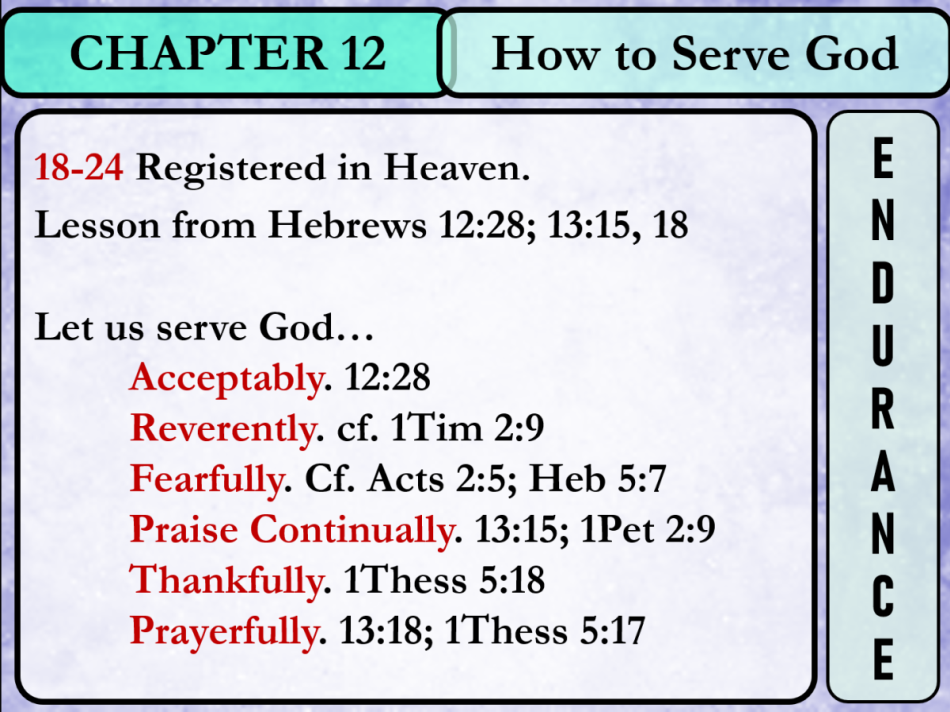
Pain is an inevitable part of the human experience, whether it stems from physical suffering, emotional turmoil, or spiritual trials. The Bible offers timeless guidance on how to navigate pain with faith, resilience, and trust in God. Four key principles emerge from Scripture to guide believers in responding to pain: never forsaking God, maintaining integrity, acting on God’s will, and praying without ceasing. These principles, rooted in the Word, provide a framework for enduring suffering while remaining anchored in faith.

First, irrespective of our trials, we ought never forsake God, trusting that He never forsakes His people. Deuteronomy 31:6 declares, “Be strong and courageous. Do not be afraid… for the Lord your God goes with you; he will never leave you nor forsake you.” This promise assures us that God’s presence is constant, even in our darkest moments. Similarly, Hebrews 13:5 reinforces this truth: “…Never will I leave you; never will I forsake you.” When pain threatens to overwhelm, these verses remind us that God is our refuge. Clinging to Him, rather than turning away in bitterness, strengthens our faith and provides hope. Pain may obscure our view of God, but His faithfulness remains unwavering, a steady anchor through life’s storms. God is not the source of our pain, but He can use it for our growth (Rom 8:28).

Second, maintaining integrity in the face of pain is essential. Persecution, betrayal, or injustice can tempt us to retaliate or compromise our values, but Scripture teaches us to maintain a higher standard. Romans 12:17-19 instructs, “Do not repay anyone evil for evil… Do not take revenge, my dear friends, but leave room for God’s wrath.” Likewise, 1 Peter 3:9 urges, “Do not repay evil with evil… but with blessing.” Integrity means reflecting God’s character, even when wronged. By refusing to curse our enemies or seek vengeance, we demonstrate trust in God’s justice and exemplify His love. Proverbs 20:22 echoes this: “Do not say, ‘I’ll pay you back for this wrong!’ Wait for the Lord, and he will avenge you.” Integrity in pain glorifies God and guards our hearts against resentment. Christ could have called 12 legions of angels (Matt 26:53; 1Pet 2:23)

Third, acting on God’s will by doing good is a powerful response to suffering. Pain can lead to self-focus, but Scripture calls us to persevere in righteousness. Galatians 6:9 encourages, “Let us not become weary in doing good, for at the proper time we will reap a harvest if we do not give up.” James 4:17 adds, “If anyone, then, knows the good they ought to do and doesn’t do it, it is sin for them.” Doing good (whether through kindness, service, or forgiveness) aligns us with God’s purposes and transforms pain into opportunities for service. By acting in obedience, we reflect Christ’s example, who endured suffering to accomplish God’s redemptive plan.

Finally, prayer is the lifeline of a believer in pain. 1 Thessalonians 5:17 commands, “Pray continually.” Philippians 4:6 further instructs, “Do not be anxious about anything, but in every situation, by prayer and petition, with thanksgiving, present your requests to God.” Colossians 4:2 adds, “Devote yourselves to prayer, being watchful and thankful.” Prayer connects us to God’s strength, aligns our hearts with His will, and brings peace that surpasses understanding. In pain, persistent prayer becomes a conduit for God’s comfort.

Responding to pain with faith involves trusting God’s presence, upholding integrity, doing good, and praying without ceasing. These biblical principles anchor us in God’s truth, enabling us to endure suffering with hope and purpose. By clinging to Scripture, we find the strength to navigate pain while glorifying God.

agape

Daily Bible Bite; Prayer

Psalm 54

This is David’s prayer when the Ziphites revealed to king Saul his location (1Sam 26).

As a matter of fact, many of the Psalms of David are his personal written prayers.

This got me thinking about how helpful it might be to us if we made a habit of writing out our prayers.

David’s Psalms are examples of

Praise.

Requests for forgiveness.

Asking God to fight for him.

Yearning to worship God.

Prayer is a spiritual blessing for the Saints.

Let us use this privilege without neglect.

1 Thessalonians 5:17 “PRAY without ceasing.”

Can we know too much Bible? pt2

Can we know too much Bible? 2/4

We need to know enough to be able to speak the SAME things.

Now I beseech you, brethren, by the name of our Lord Jesus Christ, that ye all speak the SAME thing, and that there be no divisions among you; but that ye be perfectly joined together in the SAME mind and in the SAME judgment. (1Cor1:10)

Can you know too much about…

How to ASSEMBLE with the saints?

What does the bible say about what we do when we come together as a CHURCH?

1) we COMMUNE at the Lord’s table. 1Cor 11:17-34. Not a common meal.

2) we HEAR a message from the word. Acts 20:7.

3) we sing with UNDERSTANDING. 1Cor 14:15; Eph 5:19; Col 3:16. Singing is specified which eliminates all other friends of music.

4) we make REQUESTS known unto God. Phil 4:6; Acts 2:42

5) we CHEERFULLY CONTRIBUTE to the work of the church. Free will, as we purposed and prospered. 1Cor 16:1-2; 2Cor 9:1-7

6) we meet together in person with our HEARTS to PROVOKE one another to Love and good works. Heb 10:24-25

This is a lesson on AUTHORITY, about how to know what God wants.

Which can you add, change, or remove and still be speaking the SAME thing as Jesus, Peter, Philip, Paul & the rest of the NT?

Agape,

Spencer

click here to access more Bible studies.

Lessons from 1Peter 2: Spiritual Sacrifices

We’ve already talked about being living STONES, now we turn our attention to the second half of verse 5:

Ye also, as lively stones, are built up a spiritual house, an holy priesthood, to offer up SPIRITUAL SACRIFICES, acceptable to God by Jesus Christ.”

(1Peter 2:5, emph seb)

What exactly are the SPIRITUAL SACRIFICES we are to offer up to God?

Before we attempt to discern what they are, let’s note four things about them.

Firstly, we are to be ACTIVELY doing them, “Offer up…” Being a Christian is not a passive condition, it’s active. Note that we are “LIVELY” stones.

Secondly, our sacrifices must be “ACCEPTABLE to God.” Paul wrote, “Study to shew thyself approved unto God” (2Tim 2:15a; cf. Rom 12:1).

Thirdly, they we are to AIM them “…to God”. Whatever these sacrifices are, they are to be directed toward God.

Fourthly, they are directed toward God through the AVENUE of Jesus; “…by Jesus Christ.” Jesus Himself said, “Jesus saith unto him, I am the way, the truth, and the life: no man cometh unto the Father, but by me” (John 14:6).

Paul also wrote on spiritual SACRIFICES, “I beseech you therefore, brethren, by the mercies of God, that ye present your bodies a living sacrifice, holy, acceptable unto God, which is your reasonable service” (Rom 12:1). So, what are they? Verse 6 begins a list from Paul, so we shall look at both Peter & Paul’s letters. “Having then gifts differing according to the grace that is given to us, whether…”

We are to SHEW Forth Praises of God. “But ye are a chosen generation, a royal priesthood, an holy nation, a peculiar people; that ye should shew forth the praises of him who hath called you out of darkness into his marvellous light” (1Peter 2:9; cf Heb 13:15-16). It reminds me of when Jesus told the healed man to “Go home to thy friends, and tell them how great things the Lord hath done for thee, and hath had compassion on thee” (Mark 5:16).

ALL of our BODY, our whole being is a living sacrifice to God. “that ye present your bodies a living sacrifice” (Rom 12:1). This clarifies how much of our life is dedicated to God, ALL of it. Christ is our life (Col 3:4).

We are to give a CONTRIBUTION for the helping of needy Saints and for the  work of the Church. “But I have all, and abound: I am full, having received of Epaphroditus the things which were sent from you, an odour of a sweet smell, a sacrifice acceptable, wellpleasing to God” (Phil 4:18; cf. Heb 13:15-16). “He that giveth, let him do it with liberality” (Rom 12:8). God loves a cheerful giver (2Cor 8:2; 9:7).

By him therefore let us offer the sacrifice of praise to God continually, that is, the fruit of our lips giving thanks to his name. But to do good and to communicate forget not: for with such sacrifices God is well pleased” (Heb 13:15-16).

It’s a spiritual sacrifice to submit to Leaders that God has ordained for the local church, and those that RULE are offering up a sacrifice. “He that ruleth, with diligence” (Rom 12:8; cf. 1Tim 3:1-7). This is further supported in Peter’s letter, “Feed the flock of God which is among you, taking the oversight thereof, not by constraint, but willingly; not for filthy lucre, but of a ready mind; Neither as being lords over God’s heritage, but being ensamples to the flock” (1Peter 5:2-3).

Peter’s letter is just as much about how the Saint INFLUENCES the world. “Having your conversation honest among the Gentiles: that, whereas they speak against you as evildoers, they may by your good works, which they shall behold, glorify God in the day of visitation” (1Peter 2:12). This speaks to evildoers converting to Christ through the INFLUENCE of good works done by the saints (cf. 1Pet 3:1).

Paul includes Prophecy or FORETELLING in his letter to the Romans. “Whether prophecy, let us prophesy according to the proportion of faith” (Rom 12:6). While there was a miraculous element in the 1st century, we today can FORETELL through the inspired written word. Peter wrote, “according as each hath received a gift, ministering it among yourselves, as good stewards of the manifold grace of God; if any man speaketh, speaking as it were oracles of God; is any man ministereth, ministering as of the strength which God supplieth: that in all things God may be glorified through Jesus Christ, whose is the glory and the dominion for ever and ever. Amen. (1Peter 4:10-11). The future return of Christ is just one example.

It’s a sacrifice to be an INSTRUCTOR or Teacher of God’s word. “He that teacheth, on teaching” (Rom 12:8; cf. 2Tim 2:2).

It’s certainly a sacrifice to have COMPASSION (Mercy) on our fellow man. “He that sheweth mercy, with cheerfulness” (Rom 12:8). We have obtained mercy through the blood of Jesus. Ought we not show mercy on others?

EXHORTING (to urge one to pursue some course of conduct) is another important sacrifice. “Or he that exhorteth, on exhortation” (Rom 12:8; 2Tim 4:2). Encouraging brethren to better conduct can be a challenge. For example; “Not forsaking the assembling of ourselves together, as the manner of some is; but EXHORTING one another: and so much the more, as ye see the day approaching” (Heb 10:25).

Finally, SERVING (ministering) our brethren is a Spiritual Sacrifice to God. “Or ministry, let us wait on our ministering” (Rom 12:7). When we serve the brethren, we serve Christ. Jesus listed some things, “For I was an hungred, … I was thirsty, … I was a stranger, … Naked, … I was sick, … I was in prison… Then shall the righteous answer him, saying, Lord, when … ? And the King shall answer and say unto them, Verily I say unto you, Inasmuch as ye have done it unto one of the least of these my brethren, ye have done it unto me” (Acts 25:35-40’ cf. Acts 6:1-7).

These are all matters the individual Christian does through their own lives and homes. Some believe we abdicate these to others. These are OUR SPIRITUAL SACRIFICES. May we all offer up spiritual sacrifices, acceptable to God by Jesus Christ.

Spencer

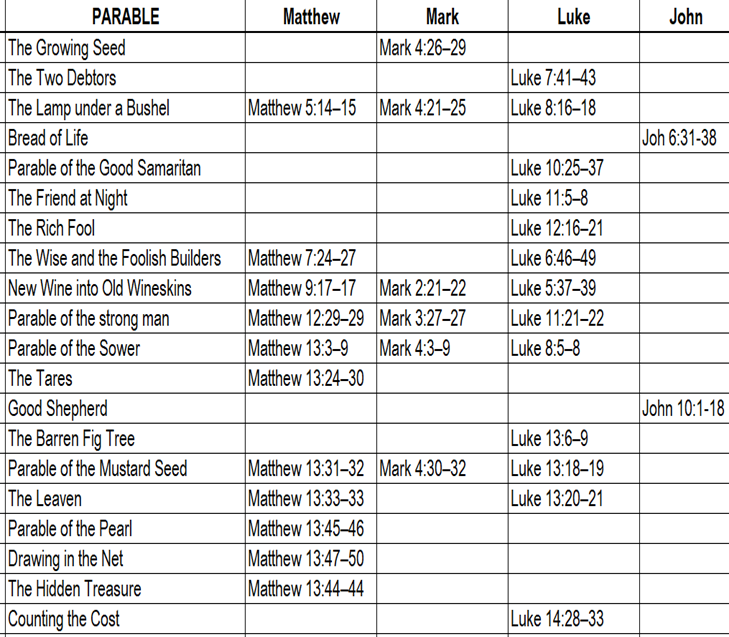
the PARABLES of Jesus

Just about everyone knows that Jesus taught with parables. If you were to say the world parable, folks would automatically think of Jesus.

The PURPOSE of the parables is explained in scripture.

And the disciples came, and said unto him, Why speakest thou unto them in parables? He answered and said unto them, Because it is given unto you to know the mysteries of the kingdom of heaven, but to them it is not given. For whosoever hath, to him shall be given, and he shall have more abundance: but whosoever hath not, from him shall be taken away even that he hath. Therefore speak I to them in parables: because they seeing see not; and hearing they hear not, neither do they understand. And in them is fulfilled the prophecy of Esaias, which saith, By hearing ye shall hear, and shall not understand; and seeing ye shall see, and shall not perceive:” (Matt 13:10-14).

We will notice that parables were part of PROPHECY which contributed to identifying Jesus as the Christ. “I will open my mouth in a parable:” (Psalm 78:2)

We will also notice that parables ASSIST people in understanding the lessons from Christ. We can easily identify the example in the parable to discover His teaching.

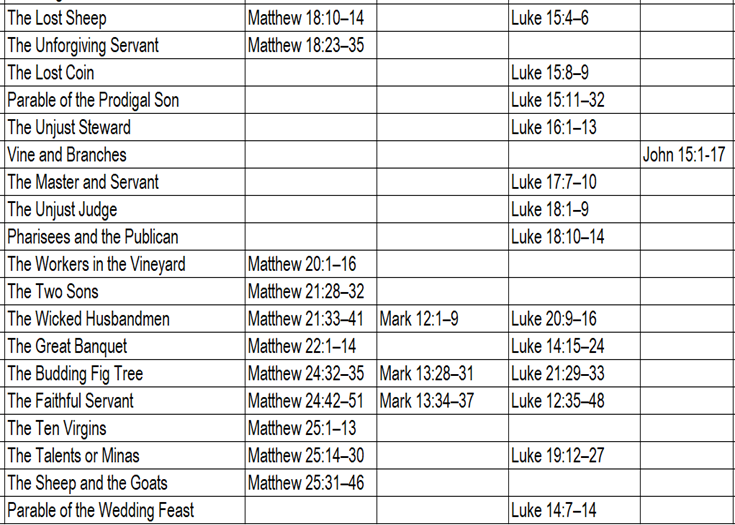
If you’ll look at the list of the parables you notice that Christ uses REAL life scenarios to explain His teachings. (ie. a sower)

Parables will ALLOW the seekers to see, but the BLIND not to see. Christ never keeps life saving truth from anyone, but some just don’t want it, hence they’re BLIND.

The meaning of the word parable is; to LAY along side. (cf. W.E. Vines). “And he said, Whereunto shall we liken the kingdom of God? or with what comparison shall we compare it?” (Mark 4:30)

Another way to describe a parable is as an EXTENDED metaphor or simile. It’s not intended to be mysterious, concealing, nor prevent the truth seeker from understanding.

Ultimately, a parable is a SPIRITUAL lesson using an understood physical scenario. Jesus uses a known thing to explain SPIRITUAL things.

And he said unto them, Know ye not this parable? and how then will ye know all parables?” (Mark 4:13)

On the following page is a list of all the parables (I think). Luke carries the most parables. While many people categorize them in different ways, I’ve identified seven. Prayer Parables, Kingdom Parables, Forgiveness Parables, Christ Parables, Parables of the Lost, Readiness Parables, and Stewardship Parables.

7 MYTHS about Prayer

Image result for praying hands


The misunderstanding of prayer is hurting people. It’s leading them astray into frustration and faithlessness. It’s not uncommon to hear of people’s exasperation at ‘unanswered’ prayer. Still others are ‘on the outs with God’ because their prayers are unfulfilled.

Not only that, but mockers are using it against the faithful when they see evil in the world. They say things like, “your thoughts and prayers are meaningless.” In one sense they’re right because they’re attacking the MYTHS about prayer that many believers are telling!

We must understand prayer. We need to teach it to people. To this end, here are the top 5 MYTHS about prayer.


The first MYTH is that MONEY & prosperity shows up without effort. I’ve heard people say, “if God had meant for me to be rich, I would be rich.”

He does want us to be financially secure and has given us laws about money that we can follow to become financially secure. Laws like…

Debt: “…borrower is servant to the lender.” [Prov 22:7]

Work: “Let him that stole steal no more: but rather let him labour, working with his hands the thing which is good, that he may have to give to him that needeth.” [Eph 4:28]

People pray for financial prosperity while simultaneously break the rules of God about finances.

The 2nd MYTH is that God will say YES to every petition. Experience should show them this is wrong and scripture says it directly.

If you doubt, “For let not that man think that he shall receive any thing of the Lord.” [Jas 1:7]

And, “Ye ask, and receive not, because ye ask amiss, that ye may consume it upon your lusts.” [Jas 4:3]

God gives no guarantee when we ask amiss.

A 3rd MYTH is that God will TAKE away all pain & evil. Where did you get that? This is the one the MOCKERS cite in their criticism of God. “Since there’s so much evil in the world God is either powerless, unkind or non-existent.”

This myth assumes that heaven is on earth. It’s never taught that way in scripture. Heaven is a place prepared for the obedient faithful (but I repeat myself) after the destruction of the world & it’s evil. [2Pet 39-10; Rev 21:4]

The 4th MYTH about prayer is that God will HEAL everyone everywhere of everything. That’s absurd. This myth misses the teaching about the purpose of miraculous healing done by Christ and the Apostles in the first century.

Miraculous healing (1 of 9 spiritual gifts) were for the express purpose of showing God’s confirmation of those who were teaching the Gospel and the New Covenant of Christ. In one instance, Jesus said, “Whether is it easier to say to the sick of the palsy, Thy sins be forgiven thee; or to say, Arise, and take up thy bed, and walk? But that ye may know that the Son of man hath power on earth to forgive sins, (he saith to the sick of the palsy,) I say unto thee, Arise, and take up thy bed, and go thy way into thine house. And immediately he arose, took up the bed, and went forth before them all; insomuch that they were all amazed, and glorified God, saying, We never saw it on this fashion.” [Mark 2:9-11, emph mine seb]

This is just one of many proofs to show that the miraculous healing of that day was for the purpose of confirming the word of God.

Does God want good health for us today? I believe so because the bible teaches it, but not in the way MYTH tellers say. We need to learn about this and teach it accurately.

The last MYTH about prayer is that God will just beam SCRIPTURE into their mind without study. It’s true that God gave inspiration to some for the purpose of revealing His will and they wrote it down for us today [Eph 3:3-4]. It IS NOT TRUE that you should expect that same inspiration today. When you read what is written you can;

BELIEVE, UNDERSTAND, PROFIT, PLEASE GOD, & KNOW GOD’S WILL.

[John 20:30-31; 2Tim 2:15; 3:16-17; 2Pet 3:15-16]

Misunderstanding prayer is making spiritually weak and lazy believers. God wants us to pray to Him, but He also commands it be done “according to His will” [1John 5:14] which means we must know what He wants and be obedient to His will.

This morning’s sermon will cover this and more about Godly prayer.

—Spencer

GIVING THANKS

One winter, while a junior in high school in Fairbanks, a friend of mine invited me to have dinner with his family (we called the evening meal ‘dinner’ in Alaska). As his dad was plating the food and delivering it to the table one at a time, his mom began eating having been served first. As my plate was set before me, I refrained from eating as a courtesy toward the host. Mr. LaPerierre noticed me waiting and asked, “Spencer, are you waiting because you’re wanting to say grace?” At that moment, his wife, fork in mouth, looked at me with wide mortified eyes, filled with the realization that she may have committed a grievous faux pas.

Has something like that ever happened to you, folks begin shoveling food in their mouths before everyone even has a chance to sit down, much worse, discovering mid bite that a prayer of thanksgiving was going to be offered? Perhaps you’ve been the one with the fork in your mouth.

It’s called different things in different places. Some call it, ‘giving thanks’, ‘saying grace’ ‘asking a blessing’ or simply, ‘the blessing.’ As families come together this week to celebrate the national holiday of Thanksgiving, the above scenario will likely repeat as folks stumble through an awkward and unprepared prayer, while the rest choke down a premature mouthful or pause mid chew.

Is it your habit to ‘say grace’ for your food?

It may not, and not just for Thanksgiving. According to a recent poll, only about 43% of Americans pray before a meal. Of those that pray, the researchers discovered they only pray 2-3 times per week. When they examined denominational backgrounds, 52% of Catholics, 60% of Protestants and 74% of Evangelicals prayed before taking a meal. Interestingly, 80% of African American families prayed, regardless of religious affiliation.

It was surprising to learn so many folks were actually praying in America. However, surprise gave way to disgust as the pollsters found that it wasn’t necessarily God being thanked. Eleven percent who claimed to be atheist, agnostic or irreligious said a prayer. An atheist man, cited in a news article about the poll, said that he and his wife give thanks to the spirits of his food. When they eat beef, they thank the four-legged spirits, and the winged ones whenever they eat chicken. When eating veggies, he thanks the veggie spirits. Sounds like a veggie tale to me.

What does the Bible say?

Many who are reading this article already have a good handle on this subject, and I hope that had we been asked, we would have skewed the polling higher. Prayer is as much a subject of scripture as God Himself. We all know that it says, “Pray without ceasing” in 1Thessalonians 5:17, but did you know that verse 18 says “in everything give thanks?”

Among the “everything”, food is a daily opportunity to “give thanks.” We ought to be thankful for our daily food, “which God created to be received with thanksgiving by them that believe and know the truth” [1Timothy 4:3b].

Our Lord and Savior, Christ Jesus, lived an example of praying before eating. In John 6:11 He, “took the loaves; and having given thanks, he distributed to them that were set down; likewise also of the fishes as much as they would.” Then, during His final meal with His disciples, “he took bread, and when he had given thanks, he brake it, and gave to them, saying, This is my body which is given for you: this do in remembrance of me” [Luke 22:19]. On the very night that he would be betrayed, Jesus knowing all things, was thankful. How simple a thing it is, and so worthwhile, to pause and to pray.


Our most Holy and Righteous Father,

Thank you for this beautiful day

For we know Father, only you can make our day.

Thank You for this food,

Which You created

And for the nourishment within it.

May it provide us the strength

For continued service in Thy Kingdom.

Please forgive us our trespasses,

For they have been many,

And we have been weak.

Your mercy, O Lord, endures forever.

Amen.

School, Money and Nuclear war

ANOTHER SCHOOL YEAR has arrived for our young ones. Parents are scrambling for last minute school supplies, a panic that will be repeated for another reason the day after Thanksgiving. Excitement (or anxiety) is building up in the little hearts as the 1st day of school approaches. Their minds wondering, will the teachers be nice, will their friends be in the same class, will the lessons be difficult, all in anticipation of the chiming bell that brings school into session.

Moms are asking themselves, “will my little baby have friends, play nice and excel in all that he does?” Dads have worries too, “will my kid have the courage to face the perils of the playground, will he stand up for the weak, or will he be one of them, or worse, will he be one of the bullies?”

Let us remember the teachers who are under pressure to teach to a test instead of helping our children to fully understand the 3 R’s in favor of political correctness. The struggles of maintaining order in the classroom as more children enter the school from broken and dysfunctional homes. Just one question…

Did you think to pray?

Humble yourselves therefore under the mighty hand of God, that he may exalt you in due time: Casting all your care upon him; for he careth for you. [1Peter 5:6-7]

In many homes, the worries about money loom large as the accounts dwindle under the mounting pressures of debt and doubt. Moms & dads hoping their jobs will still be there tomorrow, fearing what new program the government will roll out to “help.”

Did you think to pray?

But lay up for yourselves treasures in heaven, where neither moth nor rust doth corrupt, and where thieves do not break through nor steal: For where your treasure is, there will your heart be also. [Matthew 6:20-21]

Then there’s the constant worry about food, water and health. Is our food GMO’d into poison, has our drinking water been contaminated, and when will cancer affect me? All of it seems so impossible to control, what are we to do?

Did you think to pray?

Therefore I say unto you, Take no thought for your life, what ye shall eat, or what ye shall drink; nor yet for your body, what ye shall put on. Is not the life more than meat, and the body than raiment? [Matthew 6:25]

Did I mention North Korea? The threat of war, the rattling of sabers, by a despot in a foreign country that many of us will never see. A dictator who appears to be channeling the likes of Hitler, Mussolini or Mao. The uncertainties of our own leaders who appear to be more concerned for the next election rather than the current conditions. What are we to do?

Did you think to pray?

I exhort therefore, that, first of all, supplications, prayers, intercessions, and giving of thanks, be made for all men; For kings, and for all that are in authority; that we may lead a quiet and peaceable life in all godliness and honesty. [1Timothy 2:1-2]

There are plenty of things to worry about in this world. It’s easy to become overwhelmed by the chaos we call life. But there’s comfort in the scriptures. It tells of a man named Lot whose soul was ‘vexed (tormented) daily’ by the lawless deeds of those around him. [2Peter 2:7-8] The comforting part is in vs 9, “The Lord knoweth how to deliver the godly out of temptations, and to reserve the unjust unto the day of judgment to be punished:”

Our world is beset with Sweat, Sorrow & Sin and our Souls are tormented every day to the point we don’t know what to do. Remember, “God is faithful who will not suffer you to be tempted above that ye are able; but will with the temptation also make a way to escape, that ye may be able to bear it,” but we’ve got to remember to pray!

Be careful for nothing; but in every thing by prayer and supplication with thanksgiving let your requests be made known unto God. And the peace of God, which passeth all understanding, shall keep your hearts and minds through Christ Jesus.” [Philippians 4:6]

Lastly, we don’t serve a God who doesn’t understand. Our Savior lived on this earth and faced the very same things we face, and He prayed.

For we have not an high priest which cannot be touched with the feeling of our infirmities; but was in all points tempted like as we are, yet without sin. Let us therefore come boldly unto the throne of grace, that we may obtain mercy, and find grace to help in time of need.” [Hebrews 4:15-16]

What do I do now?

The Franklin St church of Christ in Borger, Tx

IT IS WITH GREAT joy that we announce a new sister in Christ, Margie. Just as there is joy in the heart of the one who obeys the gospel, there is also much joy in heaven and we are also full of joy for her [Luke 15:7, 10].

After a person obeys the gospel, the most oft asked question is, “what do I do now?” However, this question is asked by both the new convert AND the members of the local congregation. The new convert, full of joy and gratitude, has a desire to serve and to do what is right. The older members want to help them, but where do you begin?

For the answer, let us turn to Acts 2, the place where the church of Christ began.

41 Then they that gladly received his word were baptized: and the same day there were added unto them about three thousand souls. That’s where we are with Margie, and all others who obeyed the gospel recently (a young man was also baptized into Christ on the same day.) Nobody joins the church; the Lord adds to the church [47].

42 And they continued stedfastly in the apostles’ doctrine and fellowship, and in breaking of bread, and in prayers. Here’s where we find our answer to the question, “what do I do next?”

Continue in the apostles’ doctrine. The Apostles’ doctrine is Christ’s doctrine. Jesus said to the Apostles, that in addition to making disciples, as one who has all authority, teach them “to observe all things whatsoever I have commanded you” [Mat 28:19-20]. Paul said about his letters, “let him acknowledge that the things that I write unto you are the commandments of the Lord.” [1Cor 14:37]

So, the first thing we need to do is to continue to learn through study of the Scriptures what Jesus expects from us. The most effective way to do this is for the new convert and the “old” members to get together and study the scriptures. We need to note that “continue” means to do them. It’s not enough to learn what Jesus wants, we must obey Him [John 14:15]. We can also learn when we gather to worship on the first day of the week.

And Fellowship and in breaking of bread, and in prayers. The new Christians worshiped together. They had fellowship, which means that they were in partnership with one another. This partnership begins when we, “all speak the same thing, and that there be no divisions among you; but that ye be perfectly joined together in the same mind and in the same judgment” [1Cor 1:10]. The partnership also includes the collection of money for the work of the church. (As you continue to study, you’ll begin to understand the work God has given the church is to spread the Gospel, Teach the saints and practice limited benevolence). The Philippians gave money to spread the gospel, and were in fellowship in the gospel [Phil 1:3-7].

One of the parts of worship (there are 5 activities in sound worship) the disciples ‘broke bread’ which is to remember the death of our Lord and Savior, Christ Jesus. Commonly referred to as “The Lord’s Supper” the first Christians met on the 1st day of the week, Sunday, where they would take unleavened bread and fruit of the vine to commemorate His death. The Apostle Paul wrote the early Christians how to properly observe this important part of our worship [1Cor 11:23-34].

They also prayed. Prayer is the privilege of the saints. Christians are called saint in the Scriptures [Rom 1:7; Eph 1:1; Phil 1:1; Col 1:1]. In obeying the gospel through baptism, we have “put on Christ” [Gal 3:27] and have been given access through Him to the “throne of grace” [Heb 4:16]. Prayer is an incredible part of becoming a child of God. We know that God does not listen to sinners [John 9:31] but He hears us!

God is not our “genie in a bottle,” to gift us with everything we want like a spoiled child. Rather, He wants to help us in our time of need. It says in Hebrews 4:16; “that we may obtain mercy, and find grace to help in time of need.” Temptation doesn’t stop when we become Christians, neither do troubles & pains, “but God is faithful, who will not suffer you to be tempted above that ye are able; but will with the temptation also make a way to escape, that ye may be able to bear it” [1Cor 10:13]. So, all Christians need to pray.

Finally, let us note one more thing from Acts 2…

47 Praising God, and having favour with all the people. As you begin your journey as a new Christian, and every Christian, let us never forget from whom we received the gift of grace. We received it from God through Christ Jesus [Eph 2:8-10]. May we never forget, may it never grow old and may we never grow tired of praising God for His indescribable gift.

Thanks be unto God for his indescribable gift.

2 Corinthians 9:15