
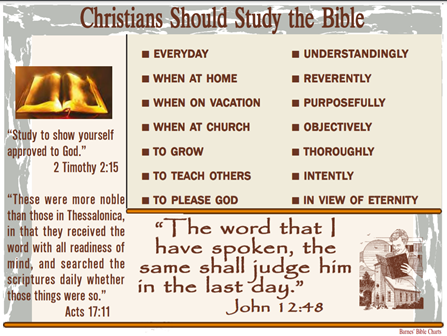
Each New Year I write to encourage us all to read the Word of God. “New Year, New Me” is the mantra of most of us at the beginning of a New Year.
“For the word of God is quick, and powerful, and sharper than any twoedged sword, piercing even to the dividing asunder of soul and spirit, and of the joints and marrow, and is a discerner of the thoughts and intents of the heart. Neither is there any creature that is not manifest in his sight: but all things are naked and opened unto the eyes of him with whom we have to do” (Heb 4:12-13).
Usually someone would say, “It’s not enough to just read it, you’ve got to STUDY it.” To this I would whole heartedly agree. (The basis of any study is of course reading).
That being said, people struggle to study the bible as it appears overwhelming at first. To allay those fears, this article is titled…
5 Tips for Effective Bible STUDY.
These tips will have a foundation of scripture along with a tip on how to be more effective in our study of the Word of God.
#1 SEARCH the word. “These were more noble than those in Thessalonica, in that they received the word with all readiness of mind, and searched the scriptures daily, whether those things were so” (Acts 17:11). “Search the scriptures; for in them ye think ye have eternal life: and they are they which testify of me” (John 5:39). “And beginning at Moses and all the prophets, he expounded unto them in all the scriptures the things concerning himself” (Luke 24:27).
From these scriptures we find the first tip, SEARCH the scriptures. There are a few resources available to just about everyone to help us in our SEARCH through God’s word. First, I use “Nave’s Topical Bible.” This is a type of Bible concordance with over 20,000 topics and subtopics. Plus, there’s an app for that!
Other online resources I use are either “Bible Hub” or the “Blue Letter Bible.” Both of these sites & apps have within them “Strong’s Exhaustive Concordance of the Bible.” A concordance can help you SEARCH for any word, phrase, or verse in the Bible. Because all of these are compilations of humans, care & discernment needs to be taken by the Bible Student.
We can SEARCH the Scriptures and be “more noble minded.”
#2 TEACH it to others. “And the things that thou hast heard of me among many witnesses, the same teach thou to faithful men, who shall be able to teach others also” (2Tim 2:2). “Till I come, give attendance to reading, to exhortation, to doctrine” (1Tim 4:13). “That they may teach the young women to be sober, to love their husbands, to love their children,” (Titus 2:4).
From these passages we can’t help but notice the need to TEACH the things we STUDY to others in the faith. This is separate from evangelism which is also important. In the church there are those that need a boost from the more mature members (cf. Heb 5:12). It is often said by the one that teaches that they learn even more from their studies than they teach to others.
We can TEACH sound doctrine to other faithful Christians.
#3 Seek to UNDERSTAND because you can. “How that by revelation he made known unto me the mystery; (as I wrote afore in few words, [4] Whereby, when ye read, ye may understand my knowledge in the mystery of Christ” (Eph 3:3-4). “In the first year of his reign I Daniel understood by books the number of the years, whereof the word of the Lord came to Jeremiah the prophet, that he would accomplish seventy years in the desolations of Jerusalem” (Dan 9:2).
While some will claim that you are unable to understand the Bible without their personal guidance, these scriptures show otherwise. While it is helpful to call on another for help with your study of more difficult passages (see Acts 8:30-31), it’s still possible to UNDERSTAND the word of God yourself through your own studies.
The resources listed above also give you access to Bible Dictionaries like; “Smith’s Bible Dictionary” “W.E. Vine’s” and “Strong’s Dictionary of Hebrew and Greek words” to look up the meanings of words as used in the original languages. Along with the concordances, a student can discover the meaning of a text through understanding the words, and examining similar passages allowing the Bible to explain itself through less difficult passages.
We can UNDERSTAND the Bible through reading and STUDY.
#4 Develop a DELIGHT to study the Bible. “Be diligent to present yourself approved to God, a worker who does not need to be ashamed, rightly dividing the word of truth” (2Tim 2:15). “I will delight myself in thy statutes: I will not forget thy word.” (Psalm 119:24,161).
When we see that we can be approved to God, and that His word has so many valuable truths, it becomes possible to enjoy reading, to DELIGHT in His word. The Psalmist tells us that God’s word is, righteous, pure, perfect, and that they provide comfort. These are just a few attributes of God’s word listed in the 176 verses in the Psalm, each of which is about the word of God. Is it any wonder that he found DELIGHT in His word?
We can DELIGHT in studying the Bible.
#5 We can find rest when we put on the YOKE of Christ and YEARN to LEARN of Him. “Come unto me, all ye that labour and are heavy laden, and I will give you rest. Take my yoke upon you, and learn of me; for I am meek and lowly in heart: and ye shall find rest unto your souls. For my yoke is easy, and my burden is light” (Matt 11:28-30).
When citing this verse, we often overlook the LEARNING part. We desire the rest, but we never really ask how. We learn through reading and study.
We can find rest when we put on the YOKE to learn of Him.
Spencer is an evangelist working with the Franklin & Juniper St church of Christ in Borger Texas.
Click Here if you would like to hear this online.
 Borger church of Christ @ Franklin & Juniper