How to know what God wants pt3. Walking by Faith

God is a Spirit: and they that worship him must worship him in spirit and in truth.”  (John 4:24)

So far, we’ve learned how to know what God wants,

  1. Direct commands & statements.
  2. Approved Examples.
  3. Implications & Necessary Inferences.
  4. Silence, when God gives no command.

Today, let’s talk about walking by FAITH and not by sight. “For we walk by faith, not by sight” (2Cor 5:7).

I’ve written about FAITH before in the article “Lord, Increase our Faith” Sept 04, 2022. To summarize…

Faith is the FULL BODY of God’s revelation. Jude 1:3 “The faith once delivered.”

Faith is ACTION based on the information. James 2:14-24 “justified by works and not by faith only.”

Faith is INSISTENT on standing firm. Hebrews 11:24-25

By faith Moses, when he was come to years, refused to be called the son of Pharaoh’s daughter; [25] Choosing rather to suffer affliction with the people of God, than to enjoy the pleasures of sin for a season;”

Faith is Believing and TRUSTING in the results from keeping God’s word. Colossians 2:12. “Buried with him in baptism, wherein also ye are risen with him through the faith of the operation of God, who hath raised him from the dead.”

Faith is HOPE that the Lord will reward those that keep His word.

Hebrews 11:1, 6 “Now faith is the substance of things hoped for, the evidence of things not seen. But without faith it is impossible to please him: for he that cometh to God must believe that he is, and that he is a rewarder of them that diligently seek him.”

Faith is listed among the 9 spiritual gifts early saints could receive during the writing of the New Testament (1Cor 12:8-9; 13:2; Matt 17:20).

These several senses above all combine to mean FAITH. Where there is no word of God there can be no faith in God. This is an unquestioned teaching of God’s word. (See also John 20:30-31; Rom 10:17: Eph 3:1-4) If therefore, God says nothing concerning a given course, there can be no faith. Since we are to walk by faith, it follows that in any matter whatsoever in which we are not directed by the word of God, we are neither walking by faith nor pleasing God.

To walk by FAITH is to act upon God’s revealed word, the faith, and not by opinion. If people are seekers of God, they will seek His will before acting, rather than acting and hoping God will sanctify the actions.

One man said it this way about a particular religious action he had taken. “I don’t know if it’s right or wrong. I just do my best and ask God for mercy.” If you don’t know if it’s right, then DON’T DO IT. There’s a principle that speaks directly to this; “And he that doubteth is damned if he eat, because he eateth not of faith: for whatsoever is not of faith is sin” (Rom 14:23).

Let’s state it another way. God accepts no gratuitous service in matters to be rendered exclusively to Him. Man possesses an undeniable right to exercise his own judgment in the management of his personal affairs, as long as he does not violate any principles of moral correctness or righteousness. Man is guided in his personal life by God’s moral law and is given liberty to make individual choices under generic authority live, prosper and enjoy (1Thess 4:1-12; 1Tim 6:17; 3John 2).

However, In the service to be rendered exclusively to God, He has legislated. He has ordained the worship to be rendered to Him, and human wisdom must neither add to, take from, nor in any way modify what he has prescribed, otherwise those who do so are walking by their own judgment, and not by faith. Let’s review a few examples…

Water Baptism has been commanded by Christ (Mark 16:16; Acts 2:38; 8:35-36; 22:16; 1Pet 3:21). Who are we to alter it or even hint that one can be saved without it? Note the urgency of Baptism in the book of Acts. “And he took them the same hour of the night, and washed their stripes; and was baptized, he and all his, straightway” (Acts 16:33).

Adoration in vocal song (Eph 5:19; Col 3:16). Who are we to do what God has commanded not by introducing instrumental music? “Let the word of Christ dwell in you richly in all wisdom; teaching and admonishing one another in psalms and hymns and spiritual songs, singing with grace in your hearts to the Lord.”

The Lord’s Supper is given to be observed by the assembled local church (Matt 26:26-30; Luke 22:15-20; Acts 2:42; 20:7; 1Cor 11:17-34). Who are we to move it to a digital venue, or a cruise ship vacation, or to any other place of convenience where there is no local church assembled? The idea that any group of Christians is a church is false. (see Matt 18:16, a distinction is made between a 2-3 individuals and the church)

We are commanded to Keep the faith “I have fought a good fight, I have finished my course, I have kept the faith” (2Tim 4:7), and to Keep God’s commands (1John 5:3). Who are we to tell anyone that they may be saved without obedience to the faith, or that they can never fall from grace? “Looking diligently lest any man fail of the grace of God; lest any root of bitterness springing up trouble you, and thereby many be defiled” (Heb 12:15).

By whom we have received grace and apostleship, for obedience to the faith among all nations, for his name” (Rom 1:5).

We must walk by FAITH, not by the sight of our own opinions.

Agape,

Spencer

But David used Instruments

Praise ye the LORD. Praise God in his sanctuary: praise him in the firmament of his power. Praise him for his mighty acts: praise him according to his excellent greatness. Praise him with the sound of the trumpet: praise him with the psaltery and harp. Praise him with the timbrel and dance: praise him with stringed instruments and organs. Praise him upon the loud cymbals: praise him upon the high sounding cymbals. Let every thing that hath breath praise the LORD. Praise ye the LORD.”  (Psalm 150)

An appeal is often made to Psalm 150 as justification for the use of instru-mental music in the assembly of the saints. The argument goes like this;

“David used instruments in worship, and he is a man after God’s own heart. Therefore, we are authorized to use instruments today in worship.”

At first this may sound reasonable, but is it sound doctrine for the New Testament church?

Let’s examine some things David did.

I will offer unto thee burnt sacrifices of fatlings, with the incense of rams; I will offer bullocks with goats. Selah. Come and hear, all ye that fear God, and I will declare what he hath done for my soul.” (Psalm 66:15-16).

After reading this passage, Let’s Imagine this conversation…

Person A: Walking into the assembly carrying a lamb, a man asks, “can I bring a lamb to worship and sacrifice it to the Lord? David did it.”

Person B: No. That is part of the OT system. Jesus is the Lamb of God and it’s His blood that takes away sin (Heb 10:1-12). “Behold the Lamb of God, which taketh away the sin of the world” (John 1:29).

Person A: Walking into the assembly carrying a burning lamp of incense, a man asks, “can I burn incense of rams in the worship today? David did it.”

Person B: No, that is not authorized in the New Testament. Jesus is the sweet-smelling savor. “And walk in love, as Christ also hath loved us, and hath given himself for us an offering and a sacrifice to God for a sweetsmelling savour” (Eph 5:2).

Person A: Walking into the assembly carrying a guitar, or some other mechanical instrument, a man asks, “can I bring this into the assembly to worship using my God given talent to play an instrument? David did it.”

Person B: YES! David did, so we can too! Come on in!!

Do you see the ridiculousness of the above conversation? Let’s imagine an alternative ending to this conversation.

Person A: Walking into the assembly carrying a guitar, or some other mechanical instrument, a man asks, “can I bring this into the assembly to worship using my God given talent to play an instrument? David did it.”

Person B: Hold on a moment. Just because David did something doesn’t necessarily mean it’s authorized for us in the New Testament. As I’ve shown at other times, we need to look at the teachings and guidelines given in the New Testament for worship practices. Regarding music in the worship, we are given specific instructions.

Speaking to yourselves in psalms and hymns and spiritual songs, singing and making melody in your heart to the Lord” (Eph 5:19).

Let the word of Christ dwell in you richly in all wisdom; teaching and admonishing one another in psalms and hymns and spiritual songs, singing with grace in your hearts to the Lord” (Col 3:16). Note the specifics of the command which eliminates all other items. Sing, Speak, Teaching, Admonishing, Melody & Grace in your hearts; instruments can do none of that.

Person A: But if David did it, shouldn’t it be acceptable for us to do the same? After all, he was a man after God’s own heart.

Person B: While David was a significant figure in the Old Testament and had commands for worship in his age, the New Testament provides specific instructions and teachings for believers. It’s important to follow those guidelines rather than solely relying on David’s actions.

Person A: I see your point. So, if the New Testament hasn’t commanded bringing a lamb, burning incense, nor instruments, God has not authorized those practices in our worship. But there’s no command not to have it.

Person B: That’s correct, and we don’t need one. We should seek to worship in spirit and truth according to the teachings given in the New Testament. When God specifies what He wants, it cancels all other possibilities. We have no need of a passage to condemn it. The specific command automatically eliminates any additions.

Person A: That makes sense. We should prioritize aligning our worship practices with the teachings of the New Testament rather than simply imitating the actions of individuals from the Old Testament.

Person B: Exactly. It’s essential to have a solid foundation in the New Testament and understand the principles it teaches to ensure our worship is pleasing to God and in line with His will. “For do I now persuade men, or God? or do I seek to please men? for if I yet pleased men, I should not be the servant of Christ” (Gal 1:10).

Person A: I appreciate your insight. I’ll take the time to study the New Testament further and seek a thus saith the Lord to ensure our worship practices are in accordance with God’s Word.

Person B: That’s a wise approach. Let’s strive to worship in a way that honors God and reflects the truths revealed in the New Testament. Jesus says, “And why call ye me, Lord, Lord, and do not the things which I say?” And Paul wrote by the command of the Lord, “And whatsoever ye do in word or deed, do all in the name of the Lord Jesus, giving thanks to God and the Father by him” (Col 3:17).

Agape,

Spencer

Every NT Scripture authorizing Instrumental Music in the Worship

Years ago, as we were beginning our walk as children of God, we had a few ‘why’ questions. Why don’t we have crosses on the building? Why does everyone correct us when we say, “going to church?” One of the why questions was, “why do we sing Acapella music without instrumental accompaniment during worship?”

The gospel preacher at this congregation would always give us a bible answer to all our questions, but this time, the bible answer was so different than all the other answers he had given. He said, “I’m going to read to you every single passage in the Bible authorizing instrumental music in New Testament worship.” And he did.

The lesson was so powerful that I have used it myself when others have asked this question and I want to share it with you. The chart below lists every single passage in the Bible authorizing instrumental music in New Testament worship.

New Testament Scriptures Authorizing Instrumental Music in the Worship


(this page left blank intentionally)


That’s it, every single passage. You may be saying, “but the chart is blank” and I would say, “yup, because that is what God has said about instrumental music in New Testament worship, NOTHING.”

Speak when the Bible speaks, and remain silent when it’s silent

There can be no clear instructions, no command keeping if we don’t have a respect for silence. “The bible doesn’t say I can’t” is NOT a valid reason to play an instrument during worship of God. If silence doesn’t restrict our actions, then we can’t get upset when Mcd’s gets our order wrong. All they need to say is, “you didn’t say we couldn’t.”

God The Holy Spirit told us what He wants in our worship regarding music, VOCAL. “Speaking to yourselves in psalms and hymns and spiritual songs, singing and making melody in your heart to the Lord;” “Let the word of Christ dwell in you richly in all wisdom; teaching and admonishing one another in psalms and hymns and spiritual songs, singing with grace in your hearts to the Lord.” [Ephesians 5:19; Colossians 3:16]

When you tell your child to make his bed, and later you find out he made it and painted it, are you going to accept, “you didn’t say I couldn’t?” Certainly not! Why? Because what is expressly stated eliminates all other options and additions. Imaging trying to give instructions if you also must include all the things you DON’T WANT.

Some will say, “Well David used instruments to worship God.” Really, you’re going to follow an OT example? [Colossians 2:14] Are you going to also slaughter bulls and goats, because that’s what David did? Here’s a question for you, did God authorize David’s use of the instrument? David also had multiple wives, can I do that? What did God think of David’s use of the instrument? God rebuked His people in Amos 6:5 saying, “Who sing idly to the sound of stringed instruments, And invent for yourselves musical instruments like David;” It seems God was no more happy with David’s instrumental music than He was with the multiplying of wives [Acts 17:30], and you want to use that for permission? Let’s just do this, respect what God has commanded, and leave what He hasn’t said where He left it…SILENT.

You will never hear

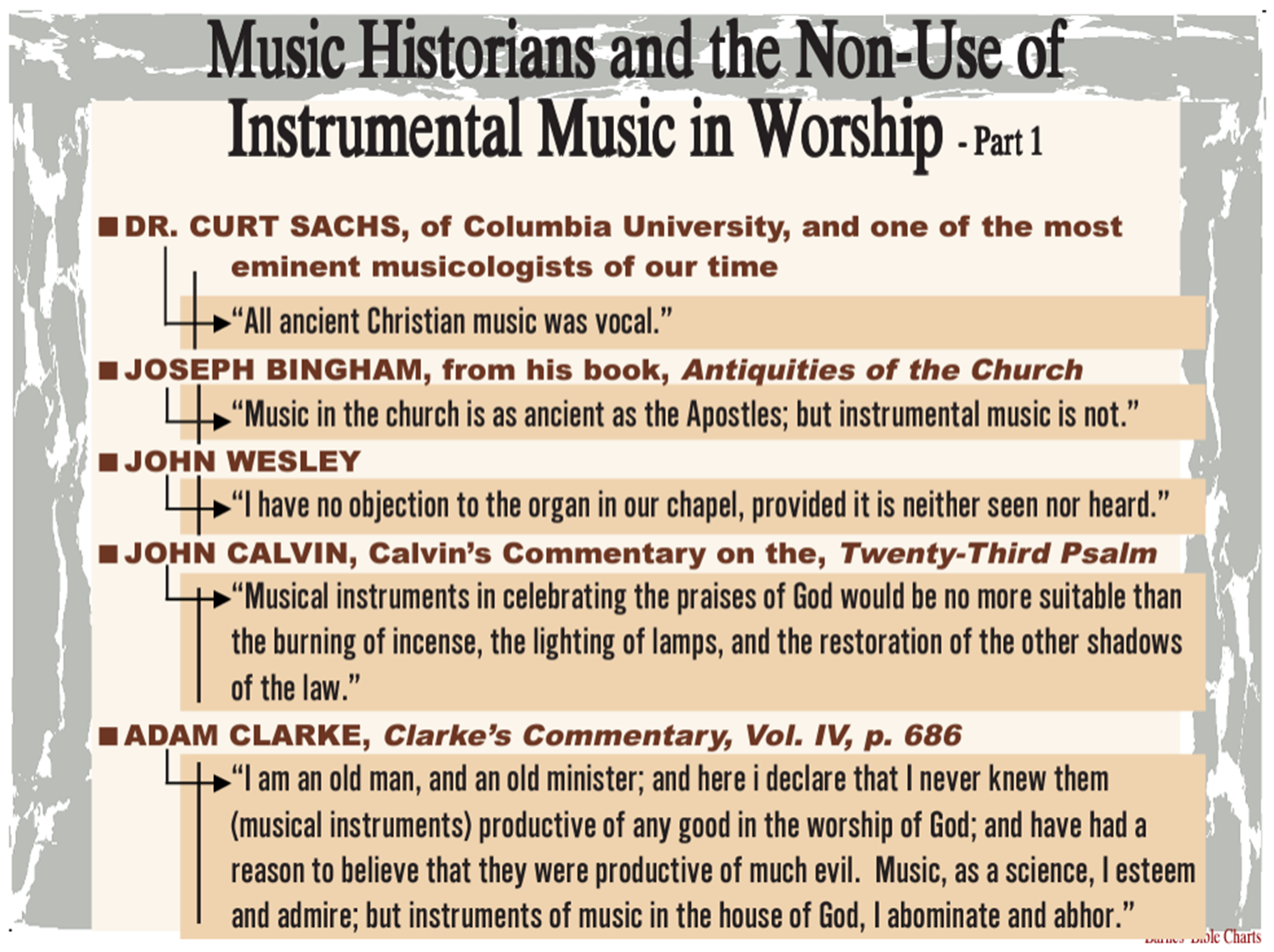
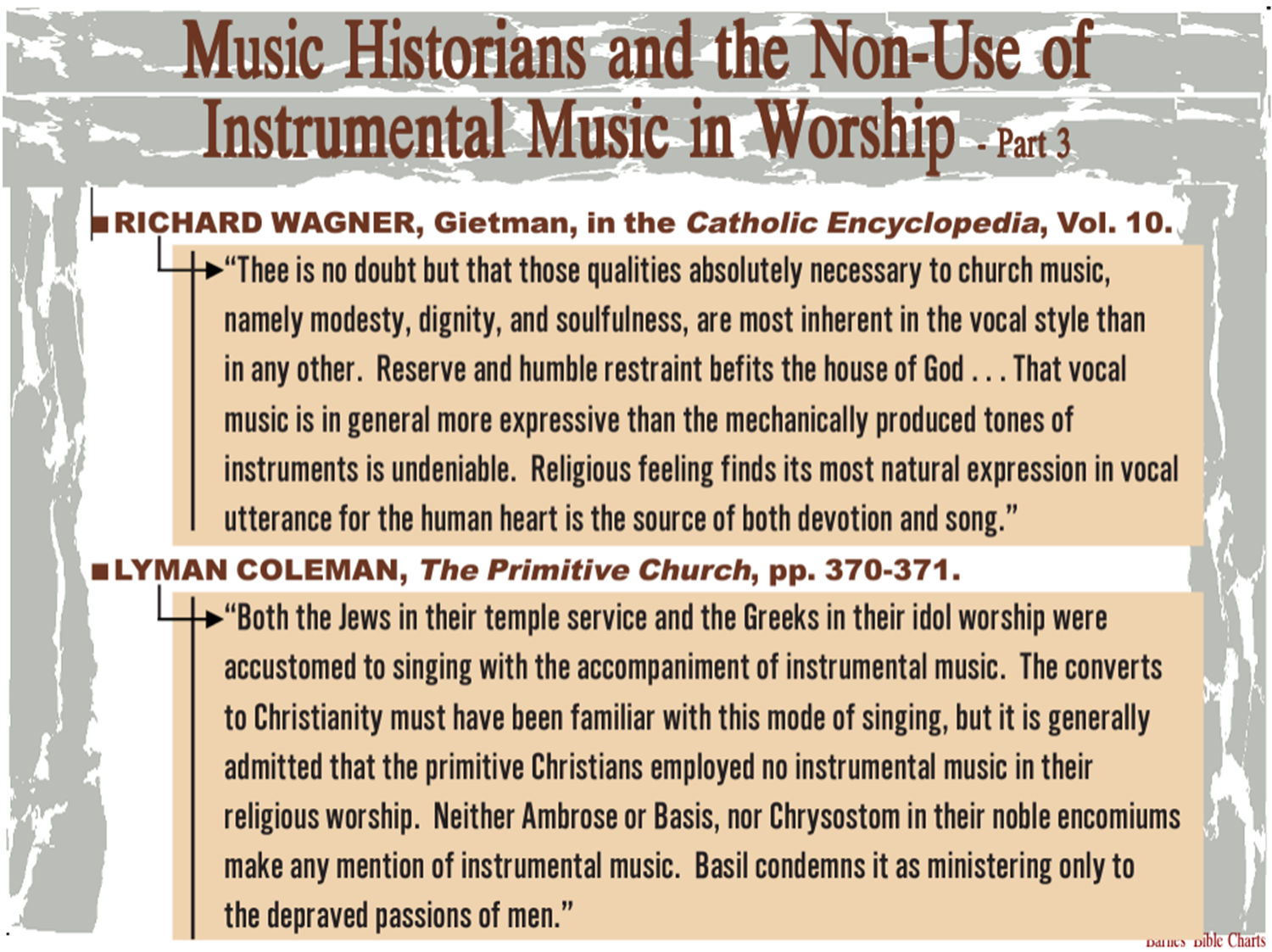
WILL YOU EVER hear our Baptist, Presbyterian or any of our denominational friends say, “The most influential men in our history were opposed to the use of instrumental music in Christian assemblies.”? No, you will never hear a Baptist say, “Charles Spurgeon, one of our greatest Baptist preachers, opposed instrumental music.” And you will never hear a Presbyterian admit: “John Calvin, one of the most famous theologians in history, rejected instrumental music in the sacred assembly.” Why? Because most are completely unaware of several facts about church history and may never hear them as their assemblies become more like concerts than a worship.

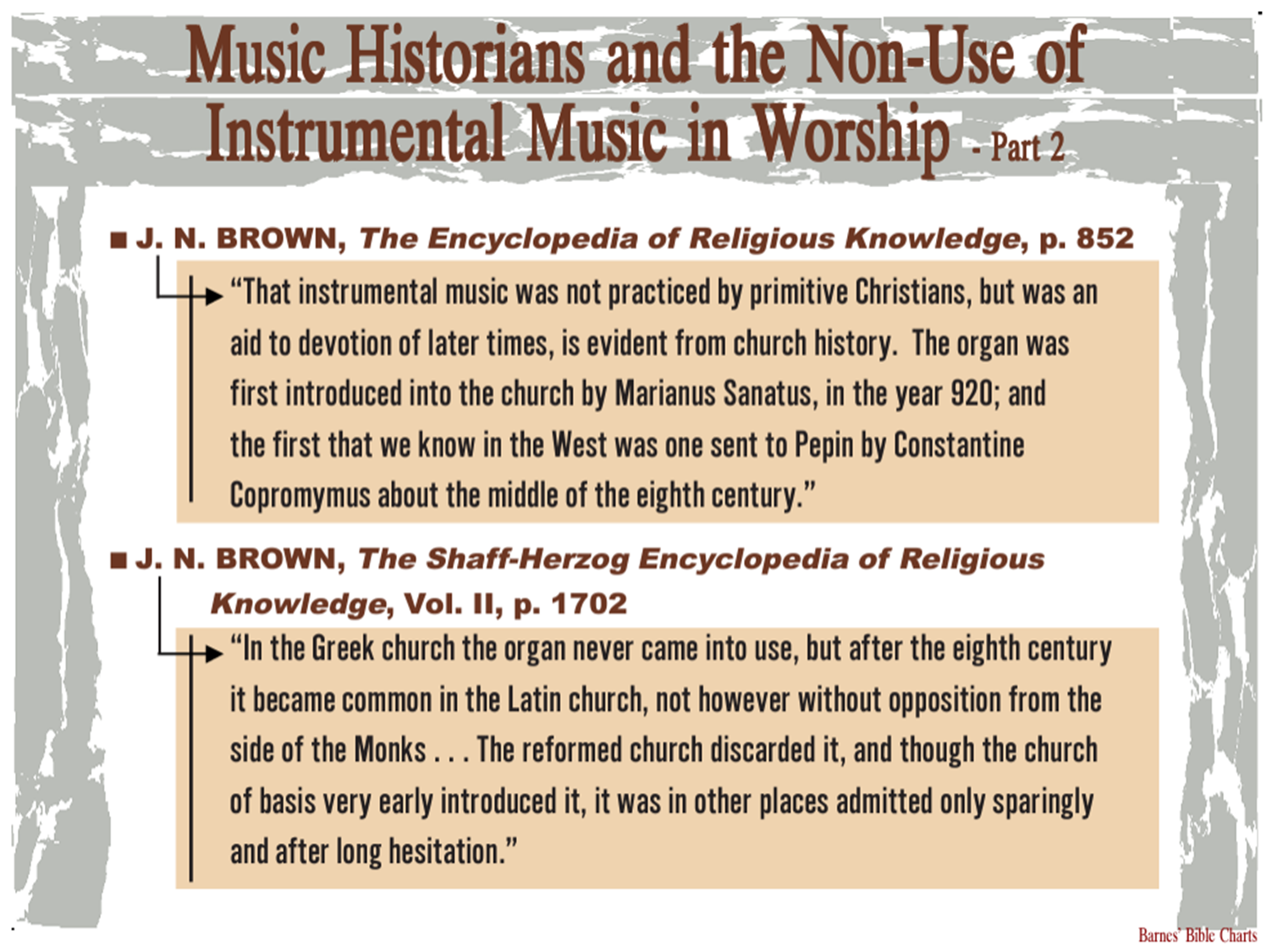
In the first century, Christians merely sang in their assemblies (Woodson). Hundreds of years passed before instrumental music was ever introduced into the apostate church. In fact, instrumental music was rejected by leading Protestants; and even when introduced into the mainline denominations, there was resistance.

Men who influenced the Protestant landscape were themselves opposed to instrumental music. For example, in his commentary on Psalm 33:2-“Give thanks unto Jehovah with the harp: Sing praises unto him with the psaltery of ten strings”-John Calvin wrote:

For even now, if believers choose to cheer themselves with musical instruments, they should, I think, make it their object not to dissever their cheerfulness from the praises of God. But when they frequent their sacred assemblies, musical instruments in celebrating the praises of God would be no more suitable than the burning of incense, the lighting up of lamps, and the restoration of the other shadows of the law. The Papists, therefore, have foolishly borrowed this, as well as many other things, from the Jews. Men who are fond of outward pomp may delight in that noise; but the simplicity which God recommends to us by the apostle is far more pleasing to him.”

The Methodist scholar Adam Clarke wrote with reference to 2 Chronicles 29:25.

But were it even evident, which it is not, either from this or any other place in the sacred writings, that instruments of music were prescribed by Divine authority under the law, could this be adduced with any semblance of reason, that they ought to be used in Christian worship? No: the whole spirit, soul, and genius of the Christian religion are against this: and those who know the Church of God best, and what constitutes its genuine spiritual state, know that these things have been introduced as a substitute for the life and power of religion; and that where they prevail most, there is least of the power of Christianity. Away with such portentous baubles from the worship of that infinite Spirit who requires his followers to worship him in spirit and in truth, for to no such worship are those instruments friendly.”

In connection with Psalms 42:4, Charles Spurgeon wrote:

Here are the facts. The instrument was not taken out of worship; rather, the instrument was an innovation brought into assemblies. On Christ’s authority, congregational singing of spiritual songs is what belongs in the church.”

John L. Girardeau’s strong opposition among the Presbyterians to the instrument included this statement:

It is almost inconceivable that the majority of the officers and members of the Presbyterian Church can have abandoned the consecrated principle that a divine warrant is needed for every element which enters into the worship of God’s house (197). What a degradation to supplant the intelligent song of the whole congregation by … the blowing off of wind from inanimate bellows and pipes! We might as well pray by machinery as praise by it (272).”

Church history is very clear, the instrument was not taken out of worship; rather, the instrument was BROUGHT IN and it was TAUGHT IN by MEN. Jesus said – and I believe it – that such worship is VAIN. On Christ’s authority, congregational singing of spiritual songs is what belongs in the church.

1Corinthians 14:15; Ephesians 5:18, 19; Colossians 3:16