
Responding to PAIN

Responding to Pain with Faith: A Biblical Perspective

Pain is an inevitable part of the human experience, whether it stems from physical suffering, emotional turmoil, or spiritual trials. The Bible offers timeless guidance on how to navigate pain with faith, resilience, and trust in God. Four key principles emerge from Scripture to guide believers in responding to pain: never forsaking God, maintaining integrity, acting on God’s will, and praying without ceasing. These principles, rooted in the Word, provide a framework for enduring suffering while remaining anchored in faith.

First, irrespective of our trials, we ought never forsake God, trusting that He never forsakes His people. Deuteronomy 31:6 declares, “Be strong and courageous. Do not be afraid… for the Lord your God goes with you; he will never leave you nor forsake you.” This promise assures us that God’s presence is constant, even in our darkest moments. Similarly, Hebrews 13:5 reinforces this truth: “…Never will I leave you; never will I forsake you.” When pain threatens to overwhelm, these verses remind us that God is our refuge. Clinging to Him, rather than turning away in bitterness, strengthens our faith and provides hope. Pain may obscure our view of God, but His faithfulness remains unwavering, a steady anchor through life’s storms. God is not the source of our pain, but He can use it for our growth (Rom 8:28).

Second, maintaining integrity in the face of pain is essential. Persecution, betrayal, or injustice can tempt us to retaliate or compromise our values, but Scripture teaches us to maintain a higher standard. Romans 12:17-19 instructs, “Do not repay anyone evil for evil… Do not take revenge, my dear friends, but leave room for God’s wrath.” Likewise, 1 Peter 3:9 urges, “Do not repay evil with evil… but with blessing.” Integrity means reflecting God’s character, even when wronged. By refusing to curse our enemies or seek vengeance, we demonstrate trust in God’s justice and exemplify His love. Proverbs 20:22 echoes this: “Do not say, ‘I’ll pay you back for this wrong!’ Wait for the Lord, and he will avenge you.” Integrity in pain glorifies God and guards our hearts against resentment. Christ could have called 12 legions of angels (Matt 26:53; 1Pet 2:23)

Third, acting on God’s will by doing good is a powerful response to suffering. Pain can lead to self-focus, but Scripture calls us to persevere in righteousness. Galatians 6:9 encourages, “Let us not become weary in doing good, for at the proper time we will reap a harvest if we do not give up.” James 4:17 adds, “If anyone, then, knows the good they ought to do and doesn’t do it, it is sin for them.” Doing good (whether through kindness, service, or forgiveness) aligns us with God’s purposes and transforms pain into opportunities for service. By acting in obedience, we reflect Christ’s example, who endured suffering to accomplish God’s redemptive plan.

Finally, prayer is the lifeline of a believer in pain. 1 Thessalonians 5:17 commands, “Pray continually.” Philippians 4:6 further instructs, “Do not be anxious about anything, but in every situation, by prayer and petition, with thanksgiving, present your requests to God.” Colossians 4:2 adds, “Devote yourselves to prayer, being watchful and thankful.” Prayer connects us to God’s strength, aligns our hearts with His will, and brings peace that surpasses understanding. In pain, persistent prayer becomes a conduit for God’s comfort.

Responding to pain with faith involves trusting God’s presence, upholding integrity, doing good, and praying without ceasing. These biblical principles anchor us in God’s truth, enabling us to endure suffering with hope and purpose. By clinging to Scripture, we find the strength to navigate pain while glorifying God.

agape

Jesus is the one to follow when we’re HURTING

Hope and Healing in Christ for the Hurting

Life is full of hardship. Suffering, loss, and disappointment are part of the human experience. Some struggle with grief, others with betrayal, loneliness, or physical pain. No one is immune to the trials of life. Yet, in the midst of sorrow, there is One who offers healing, hope, and peace—Jesus Christ.

Jesus understands suffering because He experienced it firsthand. Isaiah 53:3 describes Him as “a man of sorrows, and acquainted with grief.” He knew what it was like to be rejected, betrayed, and physically tormented. He endured humiliation and pain on the cross, bearing the weight of humanity’s sin. Because of this, He is uniquely qualified to comfort those who are hurting. Hebrews 4:15 assures us that we have a Savior who can sympathize with our weaknesses, for He was “tempted like as we are, yet without sin.”

Hope in Christ for the Hurt of This Life

Pain can make life feel unbearable. The world offers temporary distractions, but they cannot bring lasting peace. Only Christ provides true hope. John 16:33 reminds us of this reality: “In the world ye shall have tribulation: but be of good cheer; I have overcome the world.” The suffering of this present life is temporary, but the joy found in Christ is eternal. Paul declares in Romans 8:18, “For I reckon that the sufferings of this present time are not worthy to be compared with the glory which shall be revealed in us.” When we trust in Christ, we gain a perspective that allows us to endure, knowing that something far greater awaits.

Understanding from Christ, Who Endured Suffering

One of the most comforting truths about Jesus is that He understands human suffering. He was betrayed by a close friend (Luke 22:48; Psalm 41:9), falsely accused (Matthew 26:59-60), mocked (Matthew 27:29-31), and crucified (Luke 23:33). He knows what it feels like to be abandoned, rejected, and mistreated. This means that when we pour out our hearts to Him, we are speaking to One who truly understands. Psalm 34:18 assures us, “The Lord is nigh unto them that are of a broken heart.”

Rest and Peace in His Forgiveness and Mercy

Many suffer not only from external circumstances but also from the weight of guilt and shame. Sin leaves scars, and the burden of past mistakes can feel overwhelming. Yet, Jesus offers complete forgiveness. Matthew 11:28 invites us, “Come unto me, all ye that labour and are heavy laden, and I will give you rest.” Through His sacrifice, we are freed from sin’s condemnation. Psalm 103:12 declares, “As far as the east is from the west, so far hath he removed our transgressions from us.” In Christ, we find peace, knowing that our past does not define us.

Truth, Life, and True Joy

Many search for meaning in temporary pleasures, but Jesus alone is the source of true life. He declares in John 14:6, “I am the way, the truth, and the life.” The joy He gives is not dependent on circumstances but is rooted in a relationship with Him. John 15:11 states, “These things have I spoken unto you, that my joy might remain in you, and that your joy might be full.”

Jesus, Our Intercessor

For those who feel distant from God, Jesus bridges the gap. 1 Timothy 2:5 tells us, “For there is one God, and one mediator between God and men, the man Christ Jesus.” He intercedes for us before the Father, offering continual access to God’s grace and help.

He Never Leaves nor Forsakes Us

Loneliness is one of the deepest forms of suffering. Yet, Jesus promises, “I will never leave thee, nor forsake thee” (Hebrews 13:5). Even when we feel abandoned, He is always near.

Good Can Come Despite the Pain

While suffering is hard, God can bring blessings out of trials. Romans 8:28 reassures us, “And we know that all things work together for good to them that love God.” Even when we don’t understand, we can trust that He can bring about good despite the pain and suffering in this life.

Conclusion

No matter what pain or sorrow you carry, Jesus offers hope and healing. Turn to Him, and you will find peace, understanding, and the strength to endure. “Casting all your care upon him; for he careth for you.” (1 Peter 5:7)

Agape

Spencer

There is a way you may know if you have eternal life.

What can the 7 Sayings of Jesus on the Cross teach us about our pain?

Jesus said, “Take up your cross and follow me” (Matt 16:24). We are to die to self and live for Him.

The Gospels reveal 7 sayings of Jesus when He was on His cross. These sayings have important meaning for themselves, but they also leave an example for us who are suffering on our crosses.

What can the 7 sayings of Jesus on the cross teach us about handling our own pain, suffering, & earthly hurting?

Father, forgive them; for they know not what they do.” (Luke 23:34)

We often suffer at the hands of those close to us. Jesus suffered at the hands of God’s chosen people. We will often complain about what they should do, but didn’t do. Yes, they shoulda, and coulda, but didn’t. This powerful example of Jesus teaches us to be a forgiving people. We need to complain with grace, ready to Forgive, or Forebear, or Forget (release from our heart). Forgive those that are hurting you…

But Stay on the cross.

To day shalt thou be with me in paradise.” (Luke 23:43)

When others fail, remember that God doesn’t fail. There’s hope in the midst of our pain. There’s even hope when our pain is self induced. The thief admitted his guilt, and was a mocker along with the other one, but later he had a change of heart. It’s then he looked to the only one that could help, Jesus. Sometimes our suffering is self induced, but the Lord is faithful to forgive those that are in Him (1John 1:9). Repent…

But Stay on the cross.

Woman, behold, thy son! Behold, thy mother!” (John 19:26-27)

Your friends may have turned their back on you. I hate that. However, If you’ll look, you’ll see that not everyone has left you. Some are nearby unable to take away your pain, But they can take some of your responsibilities. Just ask them for help. Some of us just don’t know what to do, but we’re willing if you’ll let us know.

When you’re overwhelmed with your main priority, let go of some of the other important, but lesser stuff.

But Stay on the cross.

My God, my God, why hast thou forsaken me?” (Mat 27:46)

People will let you down at your lowest point. The disciples left Jesus. It will also APPEAR that God has left you too. He hasn’t. He’s with you. While this saying has prophetic significance, it is a reminder of how lonely we can feel in our darkest moments. We need to remember that Jesus said, “I will never leave thee, nor forsake thee” (Heb 13:5).

But Stay on the cross.

I thirst.” (John 19:28-29)

Life is a dry, and thirsty struggle, metaphorically speaking. Jesus asked the woman at the well for a drink. He received a bit of a rebuke (John 4:7-9). Isn’t that the way it goes sometimes? Jesus said, “I thirst,” and He received sour wine. When we need help we sometimes receive a sour response. Ask anyway…

But Stay on the cross.

It is finished.” (John 19:30)

Jesus stayed on that cross to the very end because He knew that what He was doing was essential for salvation for the world. (cf. Matt 16:21-23; 26:52-55). Keep on pushing through the pain until you complete your duty as a child of God. It’s important that we stay the course of faithfulness. We may not see the benefits until much later (Rev 2:10),

But Stay on the cross.

Father, into thy hands I commend my spirit.” (Luke 23:46)

Even when all others fail you, God never does. Trust God. “For the which cause I also suffer these things: nevertheless I am not ashamed: for I know whom I have believed, and am persuaded that he is able to keep that which I have committed unto him against that day.” (2Tim 1:12). Whatever happens to you…

Stay on the cross.

Agape,

Spencer

Lessons from 1 Peter: the POWER of Christ

POWER of The SUFFERING Christ in 1 PETER.

Every chapter of 1Peter has a reference to the suffering of Christ. By looking at these we can see the POWER of His suffering as we face similar difficulties in the Christian’s life.

  1. P-PRECIOUS. 1:19 Precious Blood Shed.
    1. Type Passover Ex 12:5; Joh 1:29,36; 1Co 5:7;
    1. Purchased with Acts 20:28;
    1. forgiveness, redemption Eph 1:7;
    1. His own blood Heb 9:12,14;
  2. O-OBSERVE (follow) His Example. 2:21 Example to follow.
    1. deny self, take up cross Mt 16:24;
    1. leaving an example Joh 13:15;
    1. this mind Php 2:5;
    1. living godly in Christ 2Ti 3:12;
    1. walk as He walked. 1Jo 2:6
  3. W-WATER. 3:18-22 Through Christ’s DBR, through Water.
    1. DEATH. Ro 5:6 in due time Christ died for the ungodly.
    1. BURIAL. 1Co 15:4 And that he was buried,
    1. ROSE AGAIN, 1Cor 15:4; Ac 2:32 This Jesus hath God raised up, whereof we all are witnesses.
    1. ANTITYPE. Noah’s Ark. saved by water.
  4. E-EXCEEDING JOY. 4:12-16 Exceeding Joy when Glory revealed after suffering.
    1. Ac 5:41 And they departed from the presence of the council, rejoicing that they were counted worthy to suffer shame for his name.
    1. 2Tim 2:12 If we suffer, we shall also reign with him:
    1. Mat 5:11 Blessed are ye, when men shall revile you, and persecute you, and shall say all manner of evil against you falsely, for my sake. 12 Rejoice, and be exceeding glad: for great is your reward in heaven: for so persecuted they the prophets which were before you.
  5. R-REVEALED. 5:1-4 Returning, Revealed, Really Happened.
    1. v1; Glory that shall be REVEALED
    1. v2; but of a ready mind;
    1. v3; responsibility, ensample; entrusted with.
    1. v4; ye shall receive a crown of glory that fadeth not away.

The CROSS of Christ

One of the saddest days in history, while simultaneously being the greatest day, was the day that Jesus died on an ancient Roman cross of execution.

While this is the time of year many are talking about His birth, can we remember and be ready to talk about His death?

What does the CROSS of Christ mean to us? While books can and have been written on this subject, this article will look at just a few aspects of the Cross of Christ.

We have no instructions on how nor when to celebrate His birth, but we do have instructions on how & when to remember His death… His death on a CROSS.

Behold, we go up to Jerusalem; and the Son of man shall be betrayed unto the chief priests and unto the scribes, and they shall condemn him to death,And shall deliver him to the Gentiles to mock, and to scourge, and to crucify him: and the thir d day he shall rise again.” [Matt 20:18-19]

Jesus lived a perfect life free of sin [Heb 4:15; 1Pet 2:21-22]. Yet, His short life on earth ended as if He were the vilest of sinners by being executed on a Cross.

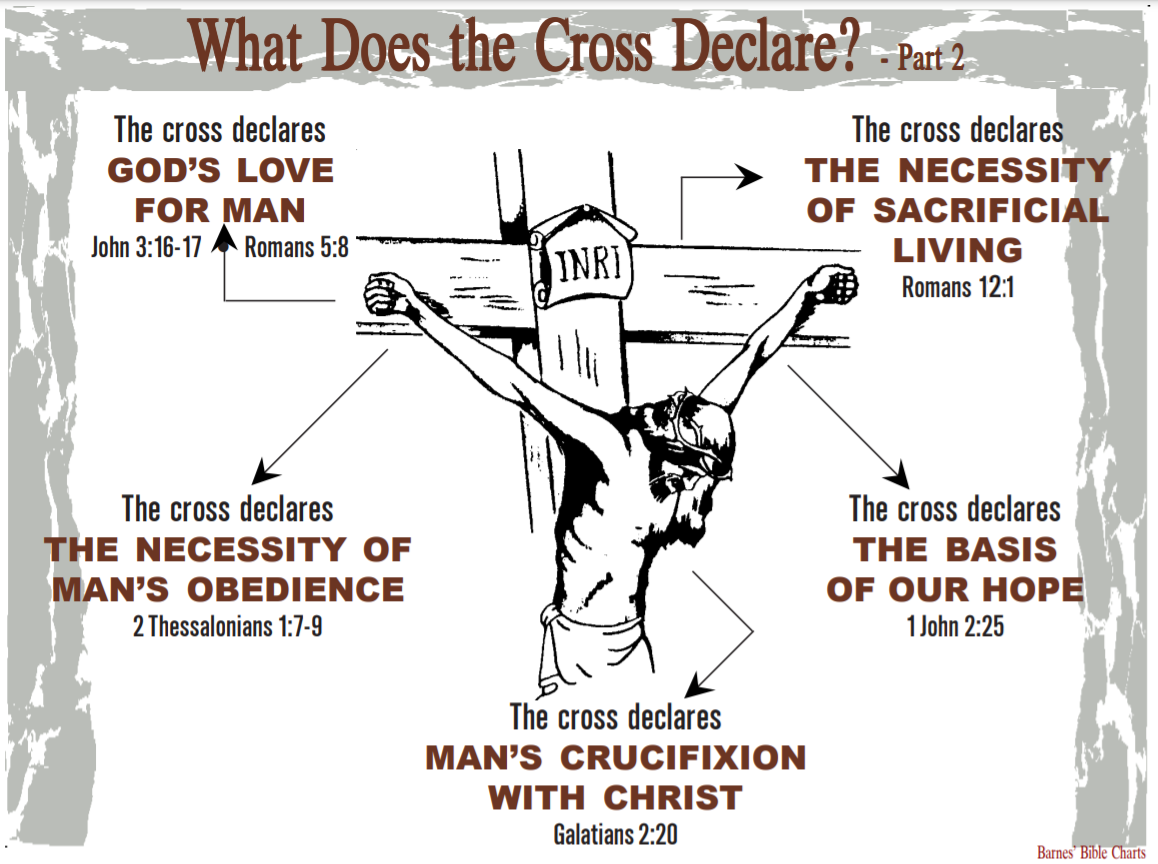
The Cross of Christ means death by CRUCIFIXION. It is the execution of a person by nailing them to a post with their arms outstretched on a cross member lifting the person up on full display to all. Our Savior knew all of this. He told His disciples about it [Mat 16:21; Joh 3:14], and He did it anyway. The Cross of Christ represents CRUCIFIXION still [Rom 6:6; Gal 2:20; 5:24; 6:14].

The Cross of Christ represents REJECTION by His own. The prophet Isaiah foretold this, “He is despised and rejected of men; a man of sorrows, and acquainted with grief: and we hid as it were our faces from him; he was despised, and we esteemed him not.” [Isa 53:3] During His last hours on earth, the ones who cried “Hosanna: Blessed is the King of Israel that cometh in the name of the Lord” [John 12:13], just days earlier, were calling out for His death. This despite the evidence of scripture, and His own works and words, the Jews REJECTED Him. The Cross of Christ represents REJECTION still. [John 15:18]

The Cross of Christ represents His OBEDIENCE to God the Father. “And he said, Abba, Father, all things are possible unto thee; take away this cup from me: nevertheless not what I will, but what thou wilt.” [Mar 14:36; Joh 8:29; Heb 5:7] It amazes me how fervent some will fight against our need for OBEDIENCE to Christ while claiming to follow the example of Jesus. “Though he were a Son, yet learned he obedience by the things which he suffered; And being made perfect, he became the author of eternal salvation unto all them that obey him;” [Heb 5:8-9]. The Cross of Christ represents OBEDIENCE still. [2Thess 1:8-9]

The Cross of Christ represents SUFFERING. Jesus suffered even before reaching the cross. “Then Pilate therefore took Jesus, and scourged him.” [John 19:1; Mark 15:15-20]. The Cross of Christ represents SUFFERING still today; “Forasmuch then as Christ hath suffered for us in the flesh, arm yourselves likewise with the same mind: for he that hath suffered in the flesh hath ceased from sin;” [1Pet 4:1-2]. “For even hereunto were ye called: because Christ also suffered for us, leaving us an example, that ye should follow his steps:” [2:21].

The Cross of Christ represents SACRIFICE. Jesus died because He was the only acceptable Sacrifice for our sin. The blood of animals can never take away sin, “For it is not possible that the blood of bulls and of goats should take away sins.” [Heb 10:4], and without the shedding of blood there is no remission of sin, “…and without shedding of blood is no remission.” [Heb 9:22]. Christ shed His own blood, becoming, “the Lamb of God, which taketh away the sin of the world.” [John 1:29, 36]. The Gospel we obey, by which we may be saved, is the Death (on a Cross), Burial, and resurrection of Jesus [1Cor 15:1-4]. The death of Christ is God’s grace toward us who deserve nothing from Him. He provided the Lamb, the SACRIFICE [cf. Gen 22:8].

The Cross of Christ represents SACRIFICE still. “I beseech you therefore, brethren, by the mercies of God, that ye present your bodies a living sacrifice, holy, acceptable unto God, which is your reasonable service.” [Rom 12:1; cf. Phil 4:18]

So you see, the Cross of Christ represents so much more than an object to be viewed. What happened on that Cross, and our response to it is what truly matters. May God bless us all.

     — spencer

Like a Hurricane

For over 2 weeks, hurricane news has dominated this countries attention. It began when Harvey struck S.E. Texas, and the relief efforts, then all eyes quickly turned to watch hurricane Irma.

For many, prayer has been the only thing that gives them comfort, while others are using these storms as evidence that God doesn’t exist, for if He did, then why does He allow such suffering?

One editorial cartoon mocks those who praise God for being rescued.

Many of us became very angry when we saw this cartoon, but when your blood stops boiling, the question about how to answer those who mock us, comes into view. How are we to address those who use natural catastrophe as proof that God is not real? They will pose these 3 problems…
1) “If God is real, why does He allow suffering?”
2) “If God is all powerful, then He must not be all good, because of suffering.”
3) “If God is all good, then He must not be all powerful to allow suffering.”

FIRST, the problem of suffering from natural disasters is not automatic proof that God is not real or uncaring. On the contrary, it offers proof that GOD IS REAL! When someone attempts to disprove God by pointing at suffering, their idea of suffering can only be true if there is a standard of good, and there is someone who sets that standard. That someone is GOD.

If God were not real, there can be no standard by which to determine if something is wrong. For there to be a wrong, there must be a right. For those who reject God in favor of evolution, then every natural disaster is just the result of the continual process of evolution. Therefore, your subjective feelings are the only standard by which you object to natural suffering. You may not like it, but without God, you cannot say that it is bad. It’s just nature doing it’s job.

SECOND, we should ask the skeptic how they would put one of these things (the earth) together. How would they run the world? How would they deal with free will and the problem of sin? How would they create a planet where gravity only works when we place something down, but never breaks bones when a person trips? How would they get heat to cook food and to keep us warm without the possibility of forest fires?

Would they interfere every time something bad was about to happen? If they prevented every injustice, would there be free will? If they stepped in to prevent every death due to natural catastrophe, would the people simply regard that as just the way nature works and be atheists anyway? How would they feel, if they could put one of these together, when their creation considered their benevolent activity as just nature doing what nature does?

LAST, If God were not real, the atheist has no answer for how wrongs are eventually made right. For the Christian, we believe that all wrongs will be righted and that all evil will be dealt with. The word from our Lord says; “Vengeance is mine; I will repay,” [Romans 12:19]. We believe that we all must appear before Him and; “…that every one may receive the things done in his body, according to that he hath done, whether it be good or bad” [2Corinthians 5:10].

Here’s another thing, if God is not real, then there is no resurrection from the dead, then Christ has not risen, and if Christ has not risen then we are still in our sins and we are a pitiful people. I thank God daily for the blessings in Christ Jesus. I may not understand all suffering, but I do believe in God and…

For the which cause I also suffer these things: nevertheless I am not ashamed: for I know whom I have believed, and am persuaded that he is able to keep that which I have committed unto him against that day. [2Timothy 1:12]