
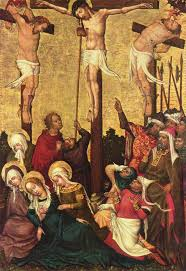
What about the Thief on the cross. #3

“And Jesus said unto him, Verily I say unto thee, To day shalt thou be with me in paradise.” (Luke 23:43)

This Objection sounds like this; “What about The Thief on the cross? He wasn’t baptized.”

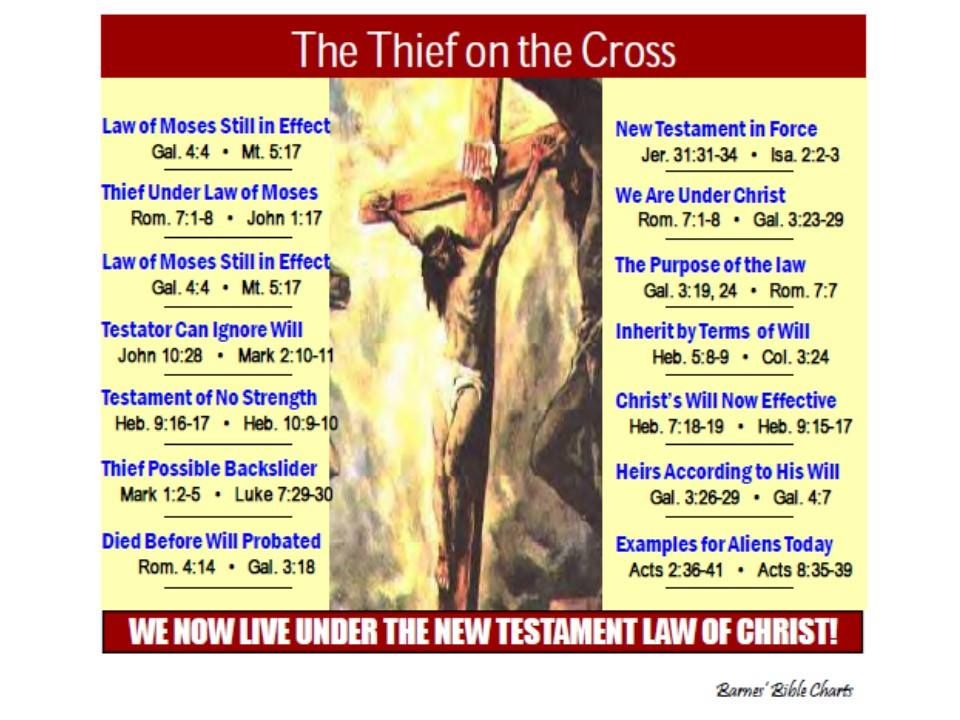
You’re right, he wasn’t. He didn’t become a Christian either! You see, the Thief was a Jew (context bears that out) who lived and died under the Law of Moses, the Old Testament system. The New Testament command to be baptized came only after the death of Jesus. (Heb 9:15-17; Luke 23:32-43).

First, The TESTATOR was still alive. A will is not in force while the Testator lives. Jesus is the Testator of the New Covenant. Jesus had power to forgive sins while He was on earth (Mark 2:10). Now that He has died and rose from the dead, we are subject to His Will & Testament. “For where a testament is, there must also of necessity be the death of the testator. For a testament is of force after men are dead: otherwise it is of no strength at all while the testator liveth” (Heb 9:16-17).

The Thief HOPED in the future resurrection of Jesus, whereas we HOPE in a risen Savior’s return. He HOPED that Jesus would finish His prophetic work. We know that it is finished. “When Jesus therefore had received the vinegar, he said, It is finished: and he bowed his head, and gave up the ghost” (John 19:30).

He lived before the completed work of Jesus; we live on this side of the cross. “Moreover, brethren, I declare unto you the gospel which I preached unto you, which also ye have received, and wherein ye stand; By which also ye are saved, if ye keep in memory what I preached unto you, unless ye have believed in vain. For I delivered unto you first of all that which I also received, how that Christ died for our sins according to the scriptures; And that he was buried, and that he rose again the third day according to the scriptures” (1Cor 15:1-4).

Folks that ask about the Thief IGNORE the other times Jesus offered salvation with conditions. I often ask, “why pick the thief, why not be saved in the same way as the rich young ruler?” He asked for eternal life and was told to sell all that he had and give to the poor (Mark 10:17-25). When’s your garage sale? (Matthew 19:16-22, go, sell all, and give away)?

How come nobody asks to be saved like the woman “caught in adultery” (John 8:1-11, GO AND SIN NO MORE)? How come nobody asks to be saved like the laborers in the vineyard (Matthew 20:1-16,)? GO TO WORK. And, in truth, no one could be “saved like the thief,” unless they were crucified with Jesus!

How come folks overlook the multiple EXAMPLES of conversions in the book of Acts? When I ask a denominational person about how to be saved, they appeal to the thief or a verse in Romans. Why not appeal to the EXAMPLES in Acts where preachers went to the lost and baptized them into Christ? We need to ask about everyone that made this same request in the New Testament AFTER the Death, Burial, & Resurrection of Christ, (Acts 2:38; Acts 8:36; Acts 16:30). WHAT DID THEY DO? These were all baptized in water through faith for the remission of sins.

o The first of these conversions were 3,000 Jews on Pentecost to when the church was established. The text (Acts 2:14) shows that they had the Gospel preached to them; they heard (vv. 36-37); they repented of their sins (v. 38); and they were baptized into Christ (v. 38). The result was they had their sins washed away.
o In Acts 8:4-5, Phillip preached to the people of Samaria; they heard (v. 6); they believed (v.13); they were baptized (v. 12).
o Phillip also preached to Simon (Acts 8:4-5); he heard the Gospel (v. 6); he believed (v.13); and he was baptized (v. 13).
o Phillip preached to the Eunuch (Acts 8:35-39); he made the good confession (v. 37); he was baptized (v. 38) and rejoiced in the forgiveness of his sins (v. 39). If a denominational pastor preaches Jesus (as Phillip did) would their audience respond with the same question as the Eunuch? “See, here is water; what doth hinder me to be baptized?”

o Ananias preached to Saul, later called Paul (Acts 9:17); he was baptized (Acts 22:16), and the rest of his life he taught others to do the same (1Cor. 12:13).
o Peter preached to Cornelius (Acts 10:34-35); he and his family heard (v. 44); they repented of their sins (Acts 11:18); they were baptized (v. 48). They were saved (Acts 11:14).
o Paul preached the saving message to Lydia (Acts 16:13); she heard (v. 14); she was baptized (v. 15).
o Paul preached to the Philippian Jailor (Acts 16:32); he repented and he was baptized (v. 33).
o Paul preached to and converted souls at Corinth (Acts 18:5); they heard and they were baptized (v. 8).
o Paul preached to Crispus (Acts 18:5); when we turn to the letter to the Corinthians, we find that Crispus and others were baptized (1Cor. 1:14).
o The Ephesians had the Gospel preached to them (Acts 19:8); they heard the message of salvation (Eph. 1:13). They were baptized (Acts 19:5) and it is in this way that they were saved by grace (Eph. 2:8-10).

Another response to the question, “what about the Thief on the cross” is found in a similar question asked of Jesus by Peter. Jesus indicates to Peter by what death he would glorify Christ (John 21:18-19). Then Peter, gesturing toward John, asks, “what shall this man do?” The Lord’s response to Peter is the same one I give to people who ask about the Thief; “what is that to thee? FOLLOW thou me” (v. 22b emphasis mine seb). The Thief found forgiveness while Jesus lived on earth, but he was not the first one, he is just the last one. There was the man Sick with a palsy (Mark 2:1-12), and the woman that anointed His feet with Oil. (Luke 7:36-50). Christ gave forgiveness during His earthly ministry as a proof that He is God. “Why doth this man thus speak blasphemies? who can forgive sins but God only” (Mark 2:7)?

These received forgiveness before Jesus died (Matt 23:46), before He was buried (Luke 23:53), before He rose again (Luke 24:6), before the command to be baptized for the remission of sins was given (Matt 28:19), and before the church was built (Matt 16:18). Nobody today can be saved like the Thief on the Cross. We live AFTER all these things; therefore, we cannot be saved like the Thief on the cross. Therefore, what’s that to you? you FOLLOW Jesus.

OBJECTIONS to the Gospel pt3

TLC_026: OBJECTIONS and SIDEBARS | Trial Lawyer Confidential


OBJECTIONS #5; You CAN’T lose your salvation. Once Saved Always Saved.

This Objection comes up as you discuss continued faithfulness after obeying the gospel and the possibility of apostacy. The key verse they use is, Romans 8:35-39. Nothing, they say, can separate us from the Love of God. What they fail to see is us, can we reject Him?

We can LOSE our salvation. We can stop LOVING God through our willing disobedience. “For this is the love of God, that we keep his commandments: and his commandments are not grievous.” [1John 5:3]

Can we escape through willful disobedience? “In flaming fire taking vengeance on them that know not God, and that OBEY not the gospel of our Lord Jesus Christ:” [2Thess 1:8; cf Luke 6:46; Mat 7:21-19, emph mine Seb]

Paul saw a connection between his SERVICE toward God as a Christian and the possibility of being disqualified. If Paul thought he could become disqualified, why do you think differently? [1Cor 9:27]

Paul wrote Timothy about those who have a shipwrecked faith. [1Tim 1:19]. The parable of the sower shows that we need to ESTABLISH ourselves in the faith, to grow roots in faithfulness and produce good fruit. [Mark 4:13-20; cf John 15:1-6]

Do you need further evidence? Galatians 5:4.

OBJECTIONS #6; The Thief on the cross wasn’t baptized.

You’re right, he wasn’t. He didn’t become a Christian either! You see, the Thief was a Jew (context bears that out) who lived and died under the Law of Moses, the Old Testament system. The New Testament didn’t come into play until after the death of Jesus. [Heb 9:15-17; Luke 23:32-43].

Therefore, the Thief HAD NO COMMAND to be BAPTIZED. That command came after the resurrection of Christ. [Mat 28:18-20; Mark 16:16; Acts 2:38]

I often ask, “why pick the thief, why not be saved IN THE SAME WAY AS the rich young ruler?” [Mat 19:16-22] He asked for eternal life and was told to sell all that he had and give to the poor. When’s your garage sale?

An appeal to the Thief will not help you to ESCAPE God’s wrath [Heb 2:1-3; 2Thess 1:8-9]. ESCAPE only comes through obedience to the Gospel. [1Cor 15:1-4; Rom 6:3-4]

the Thief found FORGIVENESS before the removal of the Law of Moses, before the command to be baptized, before the New Testaments covenant of Christ, before the church was built, and before Christ died. Nobody today can meet those criteria to be saved like the Thief on the Cross.


–Spencer

What about the Thief on the Cross?

what about the thief

Folks will use many reasons to take away the command by our Lord to be baptized. The one heard most commonly by me is, “What about the thief on the cross?” This one is offered by those who have a little biblical knowledge, and by those who’ve heard it before, but have never been challenged with scriptural evidence.

THE ARGUMENT goes like this; “If, as you say, baptism is necessary for salvation, then what about the thief on the cross? He was never baptized, yet the Lord said, “To day shalt thou be with me in paradise.” Baptism is not necessary to salvation, because the thief could not obey that command, yet the Lord said he would be in paradise.” [Lu 23:43]

The Scriptures examined: The real issue pertains to a crucial feature of Bible interpretation, are we to take all 66 books of the Bible and take everything that is said and apply it directly and equally to everyone? The Bible is literally filled with commands, instructions, and requirements that were not intended to be duplicated by people living today. People are amenable to the law period under which they lived. [2Timothy 2:15]. There are three dispensations found in the Scriptures:

  • The Patriarchal Dispensation – From creation, everyone was subject to a body of legislation passed down by God through the fathers of family clans (cf. Hebrews 11:1), until the giving of the Law of Moses.
  • The Mosaic Dispensation – At Mt. Sinai, Moses was given a new Law from God and Jews were subject to that body of legal information [Law of Moses] from that time until it also was terminated at the cross of Christ. Consider the following passages:[Matthew 27:51; Romans 2:12-16; Galatians 3:7-29; Ephesians 2:11-22; Colossians 2:11-17]
  • The Christian Dispensation – After Jesus’ death on the Cross, all peoples are now amenable to the Law of Christ. [Galatians 6:2]
Now that we have this background information, let’s examine the reasons which make their argument invalid:

Reason #1– The Law of Moses was still in effect. Many folks are confused when reading the Gospels for it is commonly called, “The New Testament.” However, the majority of the gospel story in Matthew, Mark, Luke & John, take place while Jesus was alive and living as a Jew subject to the Law of Moses.

Jesus was born to a Jewish family under the Law [Mat 1; Luke 3; Ga 4:4], circumcised the 8th day [Lu 2:21], observed the Passover [Lu 2:41, 22:8-20], taught people to follow the Law [Matthew 5:23-24; 8:4], and followed the Law Himself [Matthew 5:17-18].

Under the Law of Moses, never was there a command to be baptized for the remission of sins. Sins were atoned for through the sacrifice of bulls; And he shall do with the bull as he did with the bull as a sin offering; thus he shall do with it. So the priest shall make atonement for them, and it shall be forgiven them. (Leviticus 4:20). The word “atonement” <kaphar> literally means “to cover” and is the same as in Gen 6:14 regarding covering the ark with pitch.

Nowhere in the Old Testament is the teaching that sins were totally removed. As we study our Bibles, we find in Hebrews 10:4 For it is not possible that the blood of bulls and of goats should take away sins. [Heb 10:11 …can never take away sins.] This system pointed to the sacrifice of Jesus on the cross and terminated at the cross [see above scripture references]

The thief on the cross lived during this Mosaic period, therefore was subject to the Law of Moses and it’s system of sacrifice through bulls and goats.

Which brings us to the second reason……

Reason #2 – Since Jesus lived under the Law of Moses, He followed that law. Of course, He would have no reason to offer a sacrifice on His own behalf [Hebrews 4:15] being without sin, He did teach those around Him to do it for themselves [Mt 8:1-4]

As we study, we find out that the sacrifices in the Law of Moses were pointing to the sacrifice that Jesus would offer of Himself. Galatians 3:19-27 teaches that the Law was a teacher to bring us to Christ.

The letter to the HEBREWS teaches us that it was Christ’s death that ended the Law and began the New Covenant. [Hebrews 8-10]. Paul, speaking about the death of Jesus in relationship to the Law of Moses, said “Blotting out the handwriting of ordinances that was against us, which was contrary to us, and took it out of the way, nailing it to his cross;” [Colossians 2:14]

Therefore, the THIEF on the cross never had a command to be baptized for the remission of sins. He died, having repented and placed his trust in the Christ, as EVERYONE UNDER THE LAW OF MOSES did when they obeyed the ordinances under that law.

Reason #3– The command to be baptized “for the remission of sins” was issued AFTER Jesus’ death, burial and resurrection. When Jesus was on the cross, He was fulfilling the Law of Moses, ending it, and bringing in the New Covenant. It was AFTER His death, burial and resurrection that He gave the great commission, “Go ye therefore, and teach all nations, baptizing them in the name of the Father, and of the Son, and of the Holy Ghost:” [Matthew 28:19]

FOR THE REMISSION OF SIN – This phrase is found in connection with baptism. It is particularly important to note how and when it was used;

  • Mt 26:28 For this is my blood of the new testament, which is shed for many for the remission of sins.
  • Ac 2:38 Then Peter said unto them, Repent, and be baptized every one of you in the name of Jesus Christ for the remission of sins, and ye shall receive the gift of the Holy Ghost.

These two verses show the connection between, baptism, Christ’s blood AND the remission of sins.

The other instances of this phrase are connected to the preaching of John “the Baptist”. When we study the scriptures, we find that John’s baptism never remitted any sins, for we read in Acts 19:1-5;

And it came to pass, that, while Apollos was at Corinth, Paul having passed through the upper coasts came to Ephesus: and finding certain disciples, 2 He said unto them, Have ye received the Holy Ghost since ye believed? And they said unto him, We have not so much as heard whether there be any Holy Ghost. 3 And he said unto them, Unto what then were ye baptized? And they said, Unto John’s baptism.  4 Then said Paul, John verily baptized with the baptism of repentance, saying unto the people, that they should believe on him which should come after him, that is, on Christ Jesus. 5 When they heard this, they were baptized in the name of the Lord Jesus.

CONCLUSION:
  • The thief on the cross lived AND DIED under the Law of Moses, as did Jesus our Lord, where there was NO COMMAND to be baptized.
  • The thief, had he been able to obey the command, was not under any obligation to obey it for it DIDN’T APPLY TO HIM at the time of his death, because the Law of Moses was the covenant in force at the time of the statement, “To day shalt thou be with me in paradise.”
  • The command to be baptized was given AFTER his death.

What about the thief on the cross?

How Would You Answer?

Imagine you’re speaking to someone about Jesus and you bring up the subject of baptism. Just as Philip did in Acts 8. You say something like, “The Bible says that one must be baptized in order to be saved.” They immediately shake their head and say, “What about the thief on the cross?” [Luke 23:43 And Jesus said unto him, Verily I say unto thee, To day shalt thou be with me in paradise.]

It’s not really that hard to imagine. This exchange occurs nearly every single time I speak with a person about Jesus, salvation or the bible. I’m sure you’ve had the same experience.

Before you respond, let me remind you of a proper attitude you must maintain while giving an answer; Ephesians 4:15 But speaking the truth in love, may grow up into him in all things, which is the head, even Christ:

This verse needs to be memorized by every Christian.

We need to give an answer with love and compassion. If they get upset let it be with God’s word rather than your attitude.

So, HOW WOULD YOU ANSWER THEM? In order to provide the answer, I need to point out a few things that are wrong with their questions.

FIRST, their question is steeped in a misunderstanding on how to determine scriptural authority. [Invite them to the “Are you certain?” Classes.]

Most denominations have no concept of how to determine God’s will. They think that if it’s in the Bible, that makes it scriptural. They misunderstand that in order for something to be scriptural, it must be determined by context, audience and speaker. There are some clear “rules” for determining scriptural authority. Not difficult ones, nor are they unique to Bible interpretation only. These rules are shown to us in scripture, but we use them automatically in our secular lives. One answer I use is to introduce them to this concept and invite them to study with me about How to determine Scriptural Authority [Permissions].

SECOND, your prospect is giving a proof text without context. One way to correct their error is by asking them, “Under what system of Law were Jesus and the thief living?”

Now that you understand where their error lies, we can look at several answers, all of which are united with each other in Truth…

ONE – While on earth, Jesus had the authority to forgive sins. We see this with the paralytic Luke 5:18-26, and the sinful woman in Luke 7:36-50. With the thief, Jesus clearly offered him salvation.

TWO – This thief was saved BEFORE the command to be baptized was given. Matthew 28:18-20 shows the command to be baptized was given AFTER Christ had risen from the dead. Additionally, we are baptized into His death, Romans 6:3-4.

The thief was never subject to baptism for it was commanded after his death. Just like Abraham, Noah, Moses etc. The thief never had a baptism command to obey. There was John’s baptism, but we can read the answer to that in Acts 19:4-5.

THREE – The thief lived, died and was saved BEFORE the new covenant began. Deuteronomy 5:2-3 shows the Old Covenant, which came to an end when Jesus died on the cross. [Ephesians 2:14-16; Colossians 2:14] Then in Hebrews 8:6-7, 13 we see that the first covenant was done away, and we now live under a New Covenant.

I hope this helps you as you to give answer for the hope that is in you. 1Peter 3:15

Spencer

Click here for an updated 5 part answer to this objection.