Why do we doubt? pt5

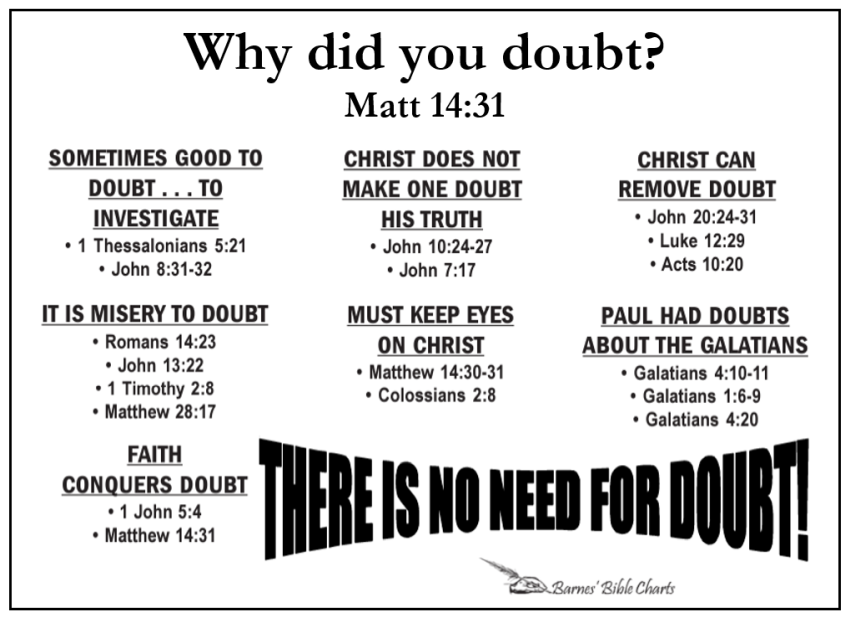
We have seen in this series of articles that doubt can develop from several places. Our job is to recognize the triggers for doubt and to avoid them.

So far we’ve learned about disbelief, opposition, uncertainty, and division. Today we talk about one more, distractions, or as Jesus put it, THORNS.

 “And these are they which are sown among thorns; such as hear the word, And the cares of this world, and the deceitfulness of riches, and the lusts of other things entering in, choke the word, and it becometh unfruitful

(Mark 4:18-19).

Distractions lead to doubt by taking our eyes off the goal, or diverting our time. When we focus on the vanities of life (see Ecclesiastes), we lose sight of hope and then doubt. Distractions give us less time for the study we need to strengthen our faith.

While there are many distractions, most of them can be grouped together into a few categories. 

One of the main categories of thorns leading to doubt is from family TRADITIONS. “Howbeit in vain do they worship me, teaching for doctrines the commandments of men” (Mark 7:7). Family traditions (religious or other), can lead to doubt especially as the word of God conflict with their religious practices or family time. When I first became a Christian, the tradition of our Sunday morning brunch interfered with worship. There is often pressure from the family for the Christian to forego worship, bible study, or even beliefs. This is especially difficult for the new in the faith, as they lack the biblical knowledge to defend themselves. (see Matt 10:37; Luke 14:26).

Another areas of distraction that keep us from study, meditation, and serving the Lord (Rom 12:6-8) are HOBBIES, Social-Media, and entertainment that consumes a significant amount of time. While these are non-sinful activities (sinful activities are always to be avoided), they can become distractions when the time & resources needed for them leave little of the same for God. Some have led to neglect of the family and job that can lead to financial strain. Hobbies and such like can be used for godly service. I know of one family that intentionally plans their activities as a tool for meeting people for an opportunity to share the gospel. Some use Social-Media for advancing the kingdom. “He who tills his land will be satisfied with bread, But he who follows frivolity is devoid of understanding” (Prov 12:11; 28:19 NKJV).

Lust for OTHER THINGS is another area that affects us (Mark 4:19). “Ye ask, and receive not, because ye ask amiss, that ye may spend it in your pleasures” (James 4:3). We begin to doubt when our prayers seem to go unanswered not recognizing that we’re praying amiss. Prayer is very personal as we pour out our heart to God. Sometimes we pray for things that go against the will of God. When our desires and God’s will conflict, we need to align our will with His, or doubt will creep in (cf. Jas 1:13-15).

The parable in Mark 4 also warns about the deceitfulness of RICHES. Money is a tool we use to ease trade. Sadly, many of us begin to trust in wealth above trusting in God. “But they that are minded to be rich fall into a temptation and a snare and many foolish and hurtful lusts, such as drown men in destruction and perdition” (1Tim 6:9-17). It’s very easy to think that money solves all our problems and leads to an easier life. That’s what one rich man thought (Luke 12:15-21). If we have problems that can be solved with money, we don’t have a problem. Then, when a real problem comes (one not solved by money), our faith may begin to waver. Our treasure in heaven is far more valuable than any earthly treasure, let’s focus on that (Matt 13:44-45; 16:26).

Related to riches is our concern for the NEEDS of this world. We need what we need and stress about them may lead to doubt. Because they’re needs, they can quickly and easily distract us and cause doubt especially if we lack any need. “Therefore I say unto you, be not anxious for your life, what ye shall eat, or what ye shall drink; nor yet for your body, what ye shall put on. Is not the life more than the food, and the body than the raiment” (Matt 6:25-34)? The command of Christ is to seek first the kingdom of God and His righteousness.

The final category of thorns is found in SICKNESS, Sadness or Sorrows. The physical and emotional pains of life can quickly overwhelm our faith and become the focus of every conversation. When we’re asked how we’re doing, do we give an organ recital (listing all our ailments) or do we talk about our hope? “For our light affliction, which is but for a moment, worketh for us a far more exceeding and eternal weight of glory” (2Cor 4:17). Unhealed pain is a source of doubt for many of our brethren, and certainly for the world.

For me this is one of the most difficult thorns. Pain, Loss, Sickness, and Sorrows can drive our identity. A friend of mine noticed after the loss of his infant son that he could end any joyful moment for himself and others. Some pains can be healed, but the death of a loved one lives with us forever. This and other Sorrows can be a constant source of doubt.

Paul faced a physical thorn that he appealed to the Lord three times in prayer. However, the Lord’s answer changed his perception about the pain. “Concerning this thing I besought the Lord thrice, that it might depart from me. And he hath said unto me, My grace is sufficient for thee: for my power is made perfect in weakness. Most gladly therefore will I rather glory in my weaknesses, that the power of Christ may rest upon me. Wherefore I take pleasure in weaknesses, in injuries, in necessities, in persecutions, in distresses, for Christ’s sake: for when I am weak, then am I strong.” (2Cor 12:8-10). Instead of letting his thorn in the flesh become his identity, it became a motivation and a source of strength through faith in Jesus Christ.

Friends, we all have our fears and doubts, but we must never let it have a foothold in our hearts. When we are aware of how doubt develops, we’ll be better able to stave it off. The tried-and-true way to combat doubt is by keeping our eyes on Jesus. We do this by reading His word, encouraging and assembling with the saints, and being diligent to show ourselves approved unto God.

Agape,

Spencer

This is part 5 of a series on Overcoming Doubt.

The Parable of the TARES.

Kingdom Parables of Jesus in Matthew

The Parable of the TARES.

24 Another parable put he forth unto them, saying, The kingdom of heaven is likened unto a man which sowed good seed in his field: 25 But while men slept, his enemy came and sowed tares among the wheat, and went his way. 26 But when the blade was sprung up, and brought forth fruit, then appeared the tares also. 27 So the servants of the householder came and said unto him, Sir, didst not thou sow good seed in thy field? from whence then hath it tares? 28 He said unto them, An enemy hath done this. The servants said unto him, Wilt thou then that we go and gather them up 29 But he said, Nay; lest while ye gather up the tares, ye root up also the wheat with them. 30 Let both grow together until the harvest: and in the time of harvest I will say to the reapers, Gather ye together first the tares, and bind them in bundles to burn them: but gather the wheat into my barn.” (Matt 13:24-30).

Jesus spoke in parables. Some were very plain, some a bit more difficult, and still others He gives the meaning as He does in this parable (36-40).

Let us understand and apply the parable of the TARES.

TARES appear to look like wheat, but are really a kind of undesirable grass, a weed. It is TOXIC to man and to most herbivore animals. “The kingdom of heaven is likened unto a man which sowed good seed in his field: But while men slept, his enemy came and sowed tares among the wheat, and went his way.” In the explanation, Jesus said, “The field is the world; the good seed are the children of the kingdom; but the tares are the children of the wicked one;” (38). All men look the same on the outside. We will only know them by their fruits. Jesus said in another parable, “Beware of false prophets, which come to you in sheep’s clothing, but inwardly they are ravening wolves. Ye shall know them by their fruits. Do men gather grapes of thorns, or figs of thistles? Even so every good tree bringeth forth good fruit; but a corrupt tree bringeth forth evil fruit. A good tree cannot bring forth evil fruit, neither can a corrupt tree bring forth good fruit” (Matt 7:15-18).

False teachers are TOXIC to sound doctrine. It is a poison that can destroy the soul of the righteous if we’re not careful. This is the world we live in.

They are sown and intermixed AMONG the wheat. Therefore, they grow up together and their proximity to the wheat makes it very difficult to remove without also harming the good plants. “But when the blade was sprung up, and brought forth fruit, then appeared the tares also.”

We live in a dangerous world full of false teachers that appear and live among us. Peter wrote, “But there were false prophets also among the people, even as there shall be false teachers among you, who privily shall bring in damnable heresies, even denying the Lord that bought them, and bring upon themselves swift destruction” (2Pet 1:1). We need to heed the warning lest we fall. “And many shall follow their pernicious ways; by reason of whom the way of truth shall be evil spoken of.”

Our gut reaction is to ROOT them up now and get RID of them so the wheat doesn’t suffer, or get choked out (cf. Matt 13:7). We want them out now! “But he said, Nay; lest while ye gather up the tares, ye root up also the wheat with them.” Why does the Lord allow this to go on? I don’t know all the reasons of the Lord, but here we’re given a clue. It’s to spare the good plant. The fact that He allows them to remain is evidence that it is wise to do so. Allowing something to exist is not approval.

The Tares are the ENEMIES teachings of the wicked one who is the Devil. This can be compared to the seed, in the parable of the Sower in an earlier parable (vs 13:18), which is the word of God. The seed in that parable produces Saints. It stands to reason that the tares are the teachings of the Devil that produces false teachers. “The field is the world; the good seed are the children of the kingdom; but the tares are the children of the wicked one; The enemy that sowed them is the devil; the harvest is the end of the world; and the reapers are the angels.” (38-39).

Jesus warned of false teachers Matt 7:15-20. Paul warned of false teachers (Rom 16:17-18). Peter warned of false teachers (2Peter 2). John warned of false teachers (2John 9). Jude warns of them also. “For there are certain men crept in unawares, who were before of old ordained to this condemnation, ungodly men, turning the grace of our God into lasciviousness, and denying the only Lord God, and our Lord Jesus Christ” (Jude 1:4). Perhaps there’s something to this?

The Lord’s response implies that we are to Keep SUPPORTING the good plants. “Let both grow together until the harvest: and in the time of harvest I will say to the reapers, Gather ye together first the tares, and bind them in bundles to burn them: but gather the wheat into my barn.”

In the harvest, which is the end of the world, God will take care of the GOOD and the BAD. “The enemy that sowed them is the devil; the harvest is the end of the world; and the reapers are the angels. As therefore the tares are gathered and burned in the fire; so shall it be in the end of this world. The Son of man shall send forth his angels, and they shall gather out of his kingdom all things that offend, and them which do iniquity; And shall cast them into a furnace of fire: there shall be wailing and gnashing of teeth.” (Matt 13:39-42).

The lesson of the TARES is plain. Beware of the TOXIC Teaching of false teachers. They live AMONG us, and appear to look like us. We will know them by their fruit. REMAIN faithful till the end when the Lord’s REAPERS will take care of the problem once and for all. The ENEMY can’t hurt us while we remain faithful (cf. Jas 4:7-8). Continue to SPEAK the things which are proper for sound doctrine (Titus 2:1).

With the Lord’s help, His word, and our prayers, we can endure this. We’re all in this together. “Then the righteous will shine forth as the sun in the kingdom of their Father. He who has ears to hear, let him hear!” (43).

–Agape,

Spencer

At the Franklin & Juniper st church of Christ, we do not claim to be perfect people, but we strive to be a local church of Christ sound in its teaching, sound in its actions, and united in the bond of peace.

Here we believe the Bible is the inspired Word of God. Thus, we insist upon Bible authority for everything that we teach and practice (Col 3:17).

We teach what people in the first century were taught, believe what they were taught to believe, and do what they were taught to do.  

We want you to feel welcomed. We will not ask you to believe anything unless we can give you Bible authority for it.

The churches of Christ salute you!  [Rom 16:16]

Has God Really Said…?

There is such a thing as a bad question…

In Genesis 3:1, Satan asked Eve, “Has God indeed said, ‘You shall not eat of every tree of the garden’?” This first question in the Bible, and such like it, have been on people’s lips ever since. Has God really said…you must be baptized…you must worship and so many more.

Normally the only bad question is the one not asked, and this wouldn’t be so bad if it was asked by a seeker. Unfortunately, it’s not asked by the seekers, rather, the deniers. Let’s examine this question considering God’s revealed word regarding the creation.

HAS GOD REALLY SAID, ‘HE MADE EVERYTHING IN 6 DAYS?

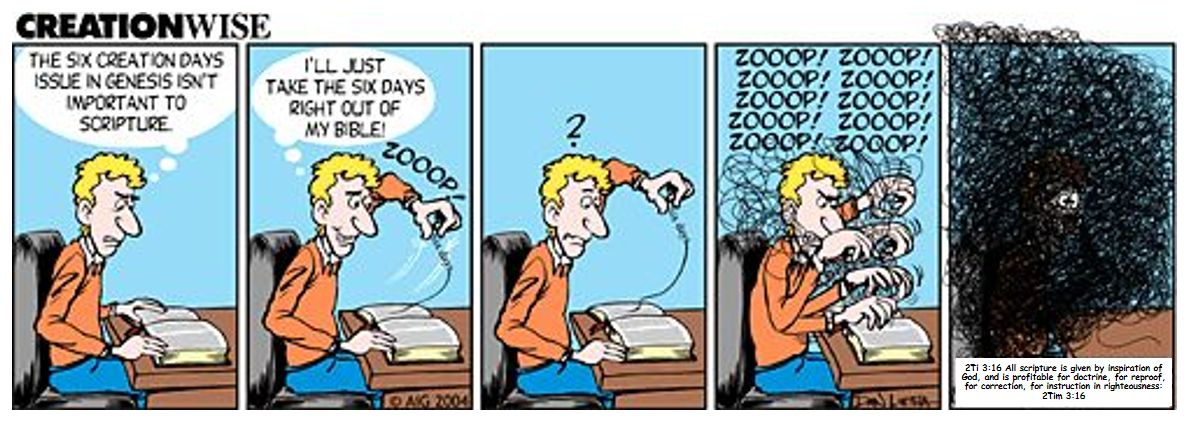
The short answer is, yes. “For in six days the LORD made heaven and earth, the sea, and all that in them is, and rested the seventh day:” [Exodus 20:11]. If “in six days’ doesn’t mean six literal 24-hour days, then we have a problem. Just as Eve believed the serpent about eating the fruit and lost paradise, if we fail here, we will lose the scriptures, literally! The theory of evolution is at odds with the biblical record. I recently learned that the Catholic church has accepted the possibility of evolution and since 1950, sees no conflict with evolution and the Bible. I see a conflict, and I hope you do as well. If evolution is true, then God has lied, but that’s not possible. God cannot lie [Titus 1:2] and the Bible contains His word [2Timothy 3:16] therefore the Bible is true. I realize this looks like circular reasoning, but God has no reason to lie or He is no God at all.

IF IT’S NOT 6 LITERAL DAYS

THEN…God lied about the thorns. “Because thou hast hearkened unto the voice of thy wife, and hast eaten of the tree…Thorns also and thistles shall it bring forth to thee;” [Gen 3:17,18] Evolutionists tells us that the fossil record reveals both death and thorns for 350-400 million years. Who would know, them or God? Historical science is based entirely on theories, and evolutionists interpret the data through the lens of millions of years. Before they even examine the evidence, they already ‘know’ that whatever they find will be really old. That’s not even good science, for it rejects any evidence that suggest a young earth. God said that thorns came AFTER Adam’s sin, not before as evolutionists suggest.

IF IT’S NOT 6 LITERAL DAYS

THEN…God lied about the reason everyone dies. “But of the tree of the knowledge of good and evil, thou shalt not eat of it: for in the day that thou eatest thereof thou shalt surely die.” [Genesis 2:17] God created everything and at the end of His creative work He said, “…it was very good.” [Gen 2:17] Are you saying that millions of years evolution, which requires death, as being ‘very good?” God never intended for us to die. We see evidence of this in the incredibly long pre-flood lifespans. There is also evidence of arthritis, cancer & disease in dinosaur bones in the fossil record. If dinosaurs truly lived millions of years before humans, then God called death & disease ‘very good.’

THEN…it also makes the Holy Spirit a liar, for He revealed to Paul, “Wherefore, as by one man sin entered into the world, and death by sin;” [Romans 5:12]. If evolution is true, then the Word of the Spirit is false, for He revealed that death came AFTER sin. He also wrote, “For the wages of sin is death; but the gift of God is eternal life through Jesus Christ our Lord.” [Romans 6:23] If evolution is true, and I hope you realize that it is not, then the wages of LIVING is DEATH, a direct contradiction to the Scriptures. Who are you going to believe, God or men?

Scripture teaches that in the beginning there was no death and there will be no more death when Jesus returns. “The last enemy that shall be destroyed is death.” [1Corinthians 15:26]

The Almighty God was there, and like any history, those today only know of historical events through the eyewitness accounts. None of us was there, and therefore must rely on the evidence. For Christians, we have God’s own eyewitness account that tells us death and thorns were brought into the world as the result of Adam’s sin. If we cannot trust His word on a simple thing like thorns, how could we trust Him about what He says about salvation?

IF IT’S NOT 6 LITERAL DAYS

THEN…the redemptive work of Jesus and the defeat of Satan is called into question. “Forasmuch then as the children are partakers of flesh and blood, he also himself likewise took part of the same; that through death he might destroy him that had the power of death, that is, the devil;” [Hebrews 2:14] If the Genesis story is not real, then Satan had nothing to do with death. This line of reasoning also brings the New Testament into question. “He that committeth sin is of the devil; for the devil sinneth from the beginning. For this purpose the Son of God was manifested, that he might destroy the works of the devil.” [1John 3:8].  It was through Satan’s lie to Eve that brought death into the world. God really did say, “in the day that thou eatest thereof thou shalt surely die.”

We need to trust in God’s word and not compromise with the misinterpretation of historical evidence. Early Christians never worried about how to stretch the 6-day creation into millions of years. No, they wondered something completely different.  They asked, “why did God take six days?!”