Conversing at the Lord’s Table

We all know, that on the night of Jesus betrayal, He implemented what is commonly called the Lord’s supper: “He said unto them, With desire I have desired to eat this passover with you before I suffer: For I say unto you, I will not any more eat thereof, until it be fulfilled in the kingdom of God. And he took the cup, and gave thanks, and said, Take this, and divide it among yourselves: For I say unto you, I will not drink of the fruit of the vine, until the kingdom of God shall come. And he took bread, and gave thanks, and brake it, and gave unto them, saying, This is my body which is given for you: this do in remembrance of me. 20 Likewise also the cup after supper, saying, This cup is the new testament in my blood, which is shed for you.” [Luke 22:15-20; cr. Matthew 26:26-29]

A most important topic but, have you ever considered what ELSE He taught at that last supper? When we read all the gospel accounts regarding the supper, we find 5 other topics of discussion.

1 – The Hurt of Betrayal Among them. [Matthew 26:20-25] As they sat down for supper, Jesus said, “Verily I say unto you, that one of you shall betray me.” They all wondered aloud, “is it I?” Jesus goes on to say, “woe unto that man by whom the Son of man is betrayed! it had been good for that man if he had not been born.” So many lessons could be drawn, but one question keeps haunting me, “Is it I?” Could we betray our Lord? The Hebrew writer expresses this idea when he wrote about “crucifying afresh” the Son of God when we fall away. [Hebrews 6:6]

2 – The Value of Service. [John 13:3-17] While the twelve are all still there, Jesus humbles Himself and washes each of the disciple’s feet, INCLUDING JUDAS. Jesus tells them, “For I have given you an example, that ye should do as I have done to you.” He is not commanding us to perform a ritual of foot washing, (that was a custom of that day), rather He is demonstrating service toward one another. To love one another. After this example He said, “By this shall all men know that ye are my disciples, if ye have love one to another.” [John 13:36]. The lesson is clear, have we such a love for each other?

3 – The Promise of Comfort. [John 14:26; 15:26; 16:13] At this supper He was telling them about His coming departure. As they wondered where He would be going, and how they might follow Him, He said, “I will not leave you comfortless: I will come to you.” He then spoke about a Comforter who would come to “guide them into all truth.” He was speaking about the revelation of the New Testament scriptures, brought to them through the guidance of the Holy Spirit. Today, we have the complete word of God. Can we still find comfort in them, just as the Apostles? I’d say we can.

4 – The Need to Bear Fruit. [John 15:1-8] As He was telling them of the Comforter, He also gave an illustration about being profitable disciples. He spoke of “bearing much fruit.” Connected with His word, and the words the Holy Spirit shall speak, the disciple can abide in Jesus, and He in us. Just as a branch bears fruit when attached to the vine, we too can bear fruit when attached to Jesus through His word. But there was also a warning, “If a man abide not in me, he is cast forth as a branch, and is withered; and men gather them, and cast them into the fire, and they are burned.” What a terrible thought, to be cast away and burned for failing to bear fruit. We can only bear fruit through obedience to His word. [cr. Matthew 7:21-29]

5 – The Power of Spiritual Unity. [John 17:11-23] Prior to their departure to the garden of Gethsemane, Jesus prayed to the Father in their presence. He prayed, “Holy Father, keep through thine own name those whom thou hast given me, that they may be one, as we are.” Some today have the false notion that unity is found in just getting along and overlooking sin. This can never be right. Spiritual Unity is also called “fellowship.” Scriptural fellowship with God is achieved through heartfelt obedience to the Word of God. Jesus said it this way, “He that hath my commandments, and keepeth them, he it is that loveth me: and he that loveth me shall be loved of my Father, and I will love him, and will manifest myself to him.” [John 14:21].  Do you and I love Jesus? Then we shall keep His commandments and have spiritual fellowship.

But if we walk in the light, as he is in the light, we have fellowship one with another, and the blood of Jesus Christ his Son cleanseth us from all sin. [1John 1:7]

What an amazing supper that must have been. These are the final words of the Master to His disciples before He is betrayed and crucified. They are important words with valuable lessons. Let us study them, learn from them and apply them into our lives.
An open letter to “Prayer over Borger”

August 22, 2017

This open letter, to the organizers & participants of the “Prayer over Borger” event scheduled for September 23, 2017, is written as an appeal for Biblical Unity. This open letter does not seek to divide us further, rather it’s an appeal out of an earnest love for people to know the Lord, Christ Jesus. Neither is it to criticize the desire to pray over Borger. God’s word teaches us to pray for those who are in authority; “I exhort therefore, that, first of all, supplications, prayers, intercessions, and giving of thanks, be made for all men; For kings, and for all that are in authority; that we may lead a quiet and peaceable life in all godliness and honesty. For this is good and acceptable in the sight of God our Saviour;” [1Timothy 2:1] It’s truly refreshing to hear about folks who have a desire for the wellness of our community.

However, we must admit, that part of the problem we face in our community is the DISUNITY that exists among us. As the letter sent out states, “Borger only has ONE church but we meet in many buildings with various names.” How can we consider ourselves to be of “ONE church” when we are separated by so many doctrines of men? We are divided over…

  • God’s plan of salvation; Mark 16:15-16
  • Faith only James; 2:14, 17, 24
  • Baptism; Acts 22:16
  • Sin; Rom 3:23
  • Fornication; 1Cor 6:18
  • Worship; John 4:24
  • Names; Romans 16:16
  • Clergy / Laity; 1Peter 2:9
  • Which day we worship; Acts 20:7, 1Cor 16:1-2
  • Instrumental music; Eph 5:19, Col 3:16
  • Operation of the Holy Spirit; 1Cor 13:10
  • Repentance; Acts 17:30
  • And more…

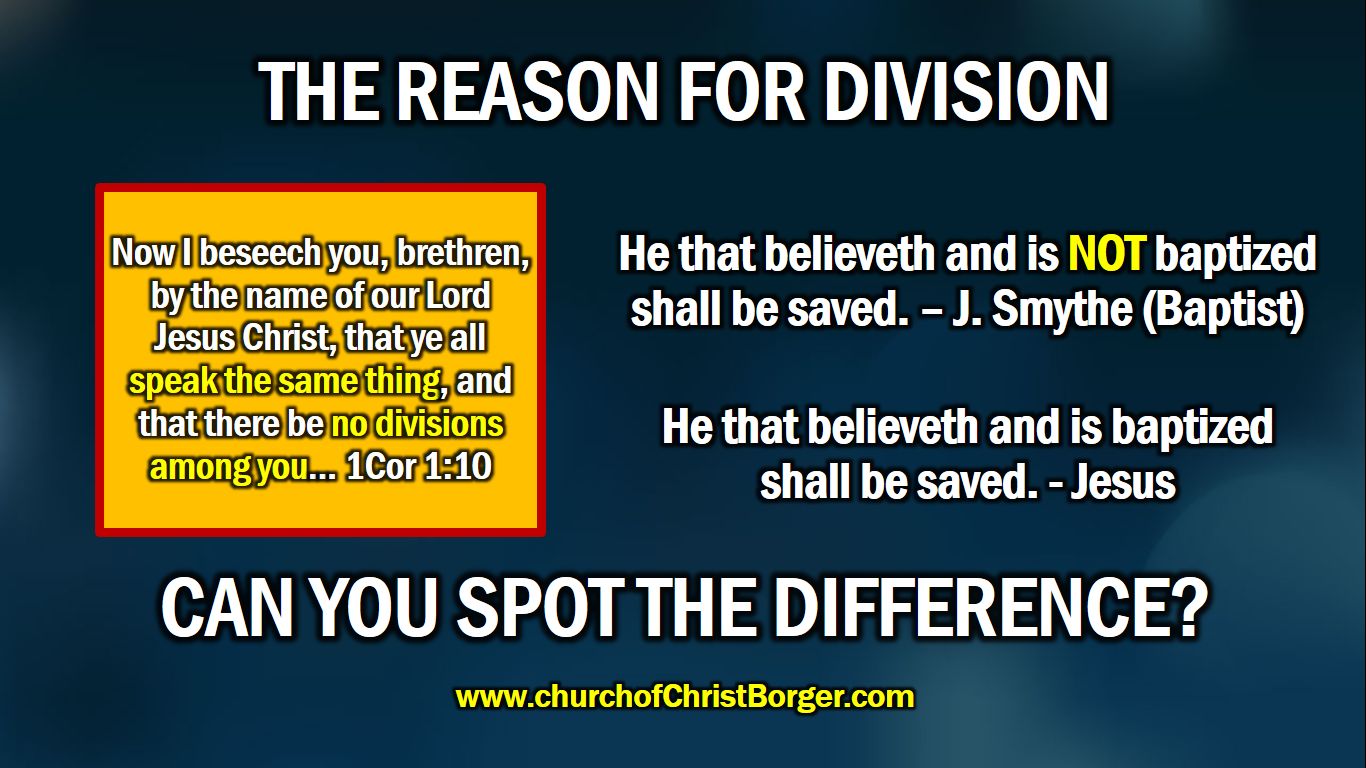
How can we be called “ONE church” when these things divide us? The Holy Spirit, writing through Paul, said, “Now I beseech you, brethren, by the name of our Lord Jesus Christ, that ye all speak the same thing, and that there be no divisions among you; but that ye be perfectly joined together in the same mind and in the same judgment.” [1Corinthians 1:10] It is clear from God’s divine word that divisions (denominations) are a sin and will affect our salvation. We are NOT speaking the same thing, nor of the same mind, nor of the same judgement.

Some may say, “We only differ in style” or “we’re all going to the same harbor on different ships.” This cannot be true. When you examine the list, you will notice that many of these do impact whether or not one is saved. Jesus said, “But in vain they do worship me, teaching for doctrines the commandments of men.” [Matthew 15:19] We didn’t say that, the Lord Jesus did. Jesus is in complete authority over EVERYTHING (Mat 28:18), both in Heaven and upon earth. If it is possible to worship in vain, and Jesus is Supreme authority on all matters, can we truly say that we’re “ONE church” and differ on things pertaining to salvation and worship? Read Matthew 7:21-29.

I will continue to pray for our community (as I often do), but my prayer will be the same as the one Jesus prayed in the Garden on the night of His betrayal; “That they all may be one; as thou, Father, art in me, and I in thee, that they also may be one in us: that the world may believe that thou hast sent me.” [John 17:21]. In that beautiful prayer, the Lord Jesus also said, “Sanctify them through thy truth: thy word is truth.” [v17]. If God’s word is truth, and I know you believe that it is, then why aren’t our words the same?

With all lowliness and meekness, with longsuffering, forbearing one another in love; Endeavouring to keep the unity of the Spirit in the bond of peace. There is one body, and one Spirit, even as ye are called in one hope of your calling; One Lord, one faith, one baptism, One God and Father of all, who is above all, and through all, and in you all.” [Ephesians 4:2-6]

Is God Speaking to you?

MANY FOLKS I MEET say that God is speaking to them (separate and apart from the written word of God). It’s obvious to me that God is not in fact speaking with them. You can see it as well, because these folks are…

  • worshiping differently from the word,
  • acting (often with sin) different from the word
  • speaking differently from the word.

Ironically, these folks are lousy at quoting scripture, correctly referring to scripture and generally ignorant about scripture. If God is speaking to you then why are they so ignorant about scripture? Only 2 conclusions can be drawn, either they aren’t being spoken to by God (my belief) or God is an author of confusion. “For God is NOT the author of confusion, but of peace, as in all churches of the saints” [1Co 14:33]. (emphasis mine)

There are 4 major problems with this position. Not only is it ERROR but it has a problem with AUTHENTICITY, a problem of REPEATED REVIEW by others and a problem with ACCESS to others. The written word of God solves every one of these problems. Let’s look at the first 2; ERROR & AUTHENTICITY.

The 1st Problem of A Personal Revelation, ERROR.

God speaks to us through His divine written word. Jesus said that “All power is given unto me in heaven and in earth” [Matt 28:18]. He also said that the Holy Spirit would come to guide the Apostles into all truth [John 16:13]. This is exactly what happened, and as the Holy Spirit guided them, He provided signs & wonders as a confirmation that what they spoke was from God [Mark 16:20; Acts 5:12; 14:3; 1Cor 2:4-5; Heb 2:4]. These men both spoke AND wrote what they received from God [2Peter 1:21; Eph 3:3; John 20:30-31]. Finally, after the revelation from God was completed, the signs & wonders also ceased [1Cor 13:8-10].

Therefore, when we read, we can understand and believe what they understood and believed about Jesus the Christ [Eph 3:4]. A person that studies God’s revealed, written word, can know EVERYTHING he needs to know regarding life, godliness and salvation [2Tim 3:16-17]. To suppose that God is speaking directly to you today (separate and apart from His written word) is to say that God is doing something that scripture shows to be a very RARE occurrence and that you’re somehow more special than everyone else making God out to be a respecter of persons [Acts 10:34].

Of a truth I perceive that God is no respecter of persons.”

The 2nd Problem of A Personal Revelation, AUTHENTICITY.

How do you know that what you’re “hearing” is from God and not due to a feeling, desire or lust? James wrote that we are drawn by our own lusts, “But every man is tempted, when he is drawn away of his own lust, and enticed. Then when lust hath conceived, it bringeth forth sin: and sin, when it is finished, bringeth forth death” [Jas 1:14-15]. How do you know that the “voice” you’re hearing is not a Mental health problem? You may hear voices if you experience psychosis, schizophrenia, bipolar disorder or severe depression.

IF you’re being spoken to by God, how do WE know? In the Bible, the person who received instructions from God also had signs to CONFIRM that what they said was from God. He even gave us tests to know the difference between someone speaking from God from one who was not.

4 TESTS of a PROPHET;

First, do they deny that Jesus Christ came in the flesh [1John 4:2]? Second, does what they’re saying match the written word [1John 4:6; Gal 1:8, 9]? Third, does what they predict or affirm come true, or if they say a miracle will happen, does it [Deuteronomy 18:21-22]? Last, even if by some chance their sign does comes to pass, do their teachings contradict the teachings that have already been written [Deuteronomy 13:1-3]? If they’re able to perform a wonder, the accompanying teaching still must match the written word! Each of these tests has one thing in common, it must be consistent with what has already been revealed and written.

Conclusion:

To believe that God is speaking to you today (separate and apart from the written word) contradicts scripture and creates a huge problem of AUTHENTICITY. The next article will address the problem of REPEATED REVIEW by others. The only way to know what God’s will is for your life is through a diligent study of His divine word, rightly divided.

“Study to shew thyself approved unto God, a workman that needeth not to be ashamed, rightly dividing the word of truth.”   2Timothy 2:15

Arguments I can (not) answer

THERE ARE THINGS people say to me that are so very easy to answer, yet impossible to answer. Sounds confusing? Allow me to explain…

Recently, a man I was sharing the gospel with told me that God speaks to him directly. I asked, “how do you know that the voice in your head is God and not something else?” He emphatically replied, “you can’t tell me that God isn’t talking to me!”

No, I can’t…tell him. Oh, I could give him a sound, Biblical answer like, “And for this cause God shall send them strong delusion, that they should believe a lie” [2Thess 2:11]. I could show him the example of Jacob believing a lie about his son Joseph being dead, then NOT believing the truth when he was told that Joseph was alive [Gen 37:12-33; 45:26]. I could show you passage after passage directing us to the WRITTEN WORD OF GOD for our communication from Him. I could show you that the written word of God…

  • Must be Read – Eph 3:3;
  • Is Complete – 2Tim 3:16-17
  • Devine – 1Thess 2:13
  • Final – Jude 3; Gal 1:6-9
  • Causes Belief – John 20:31
  • Calls – 2Th 2:14

…but he already told me I can’t tell him, therefore I can’t.

It’s sad really. Folks are so convinced of lies (I blame the false teachers in denominationalism [Mat 24:5,11]) that it’s near about impossible to convince them of the truth. In another instance, I showed a “faith only” fellow 1Peter 3:21 [The like figure whereunto even baptism doth also now save us] and asked him what it meant. He said, “I know what it doesn’t mean, it doesn’t mean you need to be baptized!” He was already convinced of what it DOESN’T mean, that he couldn’t read the words and learn the truth.

_________________________

It’s easier to convince a person of a lie than it is to convince them that they’ve been lied to.

_________________________

Rather than become discouraged, the Scriptures from God teaches us that the real problem is a lack of love for the truth. “And with all deceivableness of unrighteousness in them that perish; because they received not the love of the truth, that they might be saved” [2Thess 210]. Once the moral compass of truth is gone, then all we have left is our own lusts and desires.

_________________________

Wherefore God also gave them up to uncleanness through the lusts of their own hearts. Rom 1:24

_________________________

When the moral compass of God’s true written word [John 17:17] is ignored, is it any wonder why people are all over the map with their beliefs, worship, methods for salvation and so many other erroneous ideas? Without the truth of God’s written word, it becomes easy to be tossed about with every wind of doctrine.

_________________________

That we henceforth be no more children, tossed to and fro, and carried about with every wind of doctrine, by the sleight of men, and cunning craftiness, whereby they lie in wait to deceive. Eph 4:14

_________________________

Friend, if you’re one of those people who believe that God is “CALLING YOU” or The HOLY SPIRIT is leading you separate and apart from God’s written word, then you’re just being led by your own personal thoughts, lusts and desires. [Mat 22:29]

_________________________

Let no man say when he is tempted, I am tempted of God: for God cannot be tempted with evil, neither tempteth he any man: But every man is tempted, when he is drawn away of his own lust, and enticed. Then when lust hath conceived, it bringeth forth sin: and sin, when it is finished, bringeth forth death. James 1:13-15

_________________________

Let’s look at it one more way…

If God is telling men what to do, separate and apart from God’s word, then why are there over 30,000 different Christian denominations? Is God an author of confusion, does He mind that we’re all saying different things?

_________________________

For God is not the author of confusion.

1Corinthians 14:33 

Now I beseech you, brethren, by the name of our Lord Jesus Christ, that ye all speak the same thing, and that there be no divisions among you; but that ye be perfectly joined together in the same mind and in the same judgment. 1Corinthians 1:10

_________________________

Please everyone Lose everything

donkey

THERE WAS AN OLD MAN, a boy and a donkey. They were going to town and the boy was riding the donkey, with the old man walking alongside.

As they rambled along, they passed some old women sitting in the shade. One of the women called out, ”Shame on you, a great lump of a boy, riding while your old father is walking.” The man and boy decided that maybe the critics were right so they changed positions.

Later they ambled by a group of mothers watching their young children play by the river. One cried out in protest, “How could you make your little boy walk in the hot sun while you ride?!” The two travelers decided that maybe they both should walk.

Next, they met some young men out for a stroll. “How stupid you are to walk when you have a perfectly good donkey to ride!” one yelled derisively. So, both father and son clambered onto the donkey, deciding they both should ride.

They were soon settled and underway again. They next encountered some children who were on their way home from school. One girl shouted, “How mean to put such a load on a poor little animal.” The old man and the boy saw no alternative. Maybe the critics were right. They now struggled to carry the donkey. As they crossed a bridge, they lost their grip on the confused animal and he fell to his death in the river.

You know the moral of the story, if you try to please everyone you will never know what to do, it will be hard to get anywhere, you will please no-one, not even yourself, and you will probably lose everything. We can say it another way, DON’T SET YOURSELF ON FIRE TRYING TO KEEP OTHERS WARM.

We spend a lot of time worrying about what other people think about us. We are continually perplexed because we can never please everybody. The English poet, John Lydgate once said, “You can please some of the people all of the time, you can please all of the people some of the time, but you can’t please all of the people all of the time”. Another problem that arises from seeking others approval, is when we find out that they weren’t thinking about us at all. STOP TRYING!

We ought rather, to strive to please God and do unto others as we would have them do unto us [Mat 7:12], instead of worrying about someone thinking us foolish. There is a lesson here for all of us. We will be happier if we learn it.

The Apostle Paul wrote to the Corinthian church: “But with me it is a very small thing that I should be judged by you or by a human court. In fact, I do not even judge myself. For I know nothing against myself, yet I am not justified by this; but He who judges me is the Lord.” [1Cor 4:3-4]

There comes a point when you must realize that you’ll never be good enough for some people. That’s their problem. The only One from whom we need any approval is God and He always knows what is right and what is in your heart. [Heb 4:12; cr. John 8:29; Rom 8:8; 1Cor 7:32, 10:33; Gal 1:10; Php 4:18; 1Thess 2:15; 4:1; 2Tim 2:4; Hebrews 11:6; 13:21]

“Therefore we make it our aim, whether present or absent, to be well pleasing to Him. For we must all appear before the judgment seat of Christ; that every one may receive the things done in his body, according to that he hath done, whether it be good or bad.” [2Corinthians 5:9-10]

How Liberalism wins.

BEFORE WE BEGIN, for the purpose of this article, we shall use the simple definitions of liberal & conservative. Liberal means; “not opposed to new ideas or ways of behaving that are not traditional or widely accepted.”1 Conservative means; “the tendency to prefer an existing or traditional situation to change.”2

As it relates to religion, a conservative is one who wants to hold fast to the word of God. “If any man speak, let him speak as the oracles of God” [1Pe 4:11], means that we do not go beyond the text of the scriptures. We’re told to “Prove all things; hold fast that which is good” [1Thess 5:21], and “not to think beyond what is written” [1Cor 4:6]. [cr. 2Peter 1:19-21; John 12:48; 2Thess 2:15]. This is what the Christians here at Franklin & Juniper church of Christ in Borger Texas want to do, hold fast to the Word of God.

A liberal, therefore, is the one who believes that we have freedom to move from tradition and authority, and have the ability to adjust religious beliefs and practices for the culture. They believe that strict adherance to the word of God is legalistic and unloving.

Many folks will apply labels of “liberal” or “conservative” but those terms mean different things according to where you’re standing at the time. As for me, I start with the undefiled Word of God [John 12:48] and want to CONSERVE that purity in my life and the church. “Every word of God is pure: he is a shield unto them that put their trust in him” [Pr 30:5 (cr. Psalm 119)].

Have you ever wondered why folks with strong conservative values allow error to creep in and pledge support for these errors? How do the “grievous wolves” that Paul spoke about, appear and how do they lead astray so many, even causing division in the church? Paul warned the Ephesian elders; “For I know this, that after my departure savage wolves will come in among you, not sparing the flock. Also from among yourselves men will rise up, speaking perverse things, to draw away the disciples after themselves” [Ac 20:29-30]. He also warned that Satan himself would appear as an “angel of light” and his ministers would appear as “ministers of righteousness” [2Cor 11:14-15].

I’ve noticed 3 arguments that are most often used in support of error. They are EMOTIONALIZE, DEMONIZE & CRITICIZE. Remember also, that change agents appear as “angels of light” [2Cor 11:14]. Let’s examine how this works, not with hate toward others, rather as a warning to all of us as we strive to do God’s will.

The 3 Arguments in support of error

EMOTIONALIZE: “It’s for the children” is the most oft used emotional argument to promote error. The users of these arguments seldom use scripture and when they do they “wrest the scriptures” [2Pe 3:16]. We saw it when denominations pushed for infant baptism. Truth teaches that babies are safe in the Lord [2Sam 12:23; Mat 19:13-14]. This argument continues to be utilized to go around the clear commands of God. We have to resist the urge to break God’s word when our emotions begin to burn. “Whether it is pleasing or displeasing, we will obey the voice of the LORD our God to whom we send you, that it may be well with us when we obey the voice of the LORD our God” [Jer 42:6]. Remember, our hearts can be (and often are) deceived [2Thess 2:10-11; 2Cor 11:14; Gal 1:8-9; Gal 6:7].

If there’s no success with this, they move onto…

DEMONIZE; The promoters of error demonize those that oppose them. While hanging onto the emotional argument, they malign the opposition. Paul faced this himself, “Have I therefore become your enemy because I tell you the truth?” [Ga 4:16] They’ll say we hate children, or are unloving, calling us “anti’s” & “legalists” because we say “I could not go beyond the word of the LORD, to do good or bad of my own will. What the LORD says, that I must speak‘?” [Num 24:13]

Then they will….

CRITICIZE; the opposition for doing things that they themselves are doing. The Apostles faced this very thing. They were criticized for preaching for gain, or for being arrogant, while the critics themselves were doing the very things they spoke against. “I wrote to the church, but Diotrephes, who loves to have the preeminence among them, does not receive us. Therefore, if I come, I will call to mind his deeds which he does, prating against us with malicious words. And not content with that, he himself does not receive the brethren, and forbids those who wish to, putting them out of the church.” [3John 1:9-10 (cr 2Cor 11 & 12)].

Many errors begin due to a lack of understanding on how to determine scriptural authority (or permissions). They also come due to a misunderstanding of the true work of the church. The work of the church is found in “the Great commission”; “Go ye therefore, and teach all nations, baptizing them in the name of the Father, and of the Son, and of the Holy Ghost: Teaching them to observe all things whatsoever I have commanded you: and, lo, I am with you alway, even unto the end of the world. Amen [Mat 28:19-20]. It’s to TEACH the gospel and TEACH the new disciples to observe WHATSOEVER our Lord has commanded.

Please understand, I’m not against helping children, or being benevolent to strangers. I just want to do it God’s way. “And whatever you do in word or deed, do all in the name of the Lord Jesus, giving thanks to God the Father through Him” [Col 3:17].

1 – http://www.merriam-webster.com/dictionary/liberal

2 – http://www.merriam-webster.com/dictionary/conservate

Are we A Strong Congregation?

3-09-15 Eph 6_6

What do you look for in a strong congregation? The scriptures teach that a congregation is made up Christians in a local area who assemble to worship and to work together. Revelations 3:1 calls the church in Laodicea dead and in 3:16 is lukewarm. None of us want to be in dead or lukewarm congregations, so what sets apart a strong congregation from a dead one? 

They Love God

The first and foremost characteristic of a strong congregation is when it’s composed of Christians who, “…love the Lord thy God with all thy heart, and with all thy soul, and with all thy mind, and with all thy strength: this is the first commandment.” [Mark 12:30]

The most powerful and effective motivation to obey God’s word is a sincere and deep love of God.

They Love God’s Word

A strong congregation loves God, therefore also loves His word. When I speak to “religious” people, one thing I notice is the lack of knowledge of God’s word and His patterns.

Weak congregations are short on giving; “…attendance to reading, to exhortation, to doctrine.” [1Timothy 4:13] Strong congregations consider FIRST what the will of the Lord is from His divine Word, for it is the truth; [John 17:17]. This enables them to worship in truth [John 4:24], Teach the truth [1Timothy 1:3] and do His work according to the divine pattern [Ephesians 4:12]. 

They Rejoice in the Lord

When a strong congregation loves God and His word, they will rejoice despite the difficulties that come from living on this side of the Judgement.

Paul warned the early Christians that life was tough, and not many others had a more difficult time than he. The Lord teaches, through Paul, to be content regardless of circumstance. [Philippians 4:11-13] The Lord also taught us to be prepared for trials that every Christian will face and to rejoice. [James 1:2; 1Peter 4:12] 

It is Growing and Working

Every congregation has folks that are at varying levels of their maturity. There are new converts, babes in Christ, some more mature, some struggling and overcoming sins and still others that are strong in their faith. [1Corintheans 8:12-31]

All of them, doing their own part in the body [Ephesians 4:11-12], are growing in grace and knowledge of the Lord [2Peter 3:18], so that the body grows [Ephesians 4:16], always abounding in the work of the Lord. [1Corintheans 15:58] 

It Follows the New Testament Pattern of organization

A strong congregation is striving to attain and to follow the New Testament pattern for its organization. [Philippians 1:1]

They have or are qualifying men to oversee as elders [Acts 20:17; 1Timothy 3:1-7; 1Peter 5:1-2], doing the same regarding deacons to serve under elders, [1Timothy 3:8-13]. In whichever state, the strong congregation has faithful men to see that the work of the Lord is accomplished never losing sight of the ideal. 

They’re Proactive

The strong congregation never waits. It continues to be zealous for good works [Titus 2:14; Revelations 3:19]. They want to be found doing and increasing in the Lord’s work [Matthew 25:14-30], never burying their talents or content with just getting themselves to heaven, because they want to others to be saved also [2Timothy 2:2].

What About the Church in Borger?

I bet, that as you read this article, you were also thinking about our congregation. I believe that we have a strong congregation. Perhaps not like the church in Smyrna which the Lord had nothing negative to say [Rev 2:8], but one that has the ability to overcome what is lacking [Revelations 2:7].

I feel that we are strong because we love God and His word, we rejoice and help each other during difficult times. We all desire for the truth to grow in Borger and that folks respond to the Gospel. I am grateful to you and to God for this local congregation.

That’s just my opinion, but what do you think? If you were to rate our congregation on a scale of 1-10, what number would you give us? If it’s not a 10 for being the best, why not? More importantly, what are you doing to change it?

A church worth investigating

A member recently brought me a bulletin for the Franklin St church of Christ from April 1959. It held a timeless message that I wanted to share with you all.

A church worth investigating

The church of Christ was not established on a sudden whim of the Lord, nor was its establishment merely an afterthought. It had been God’s intention throughout the entire history of the world to build the church. All of the many centuries were spent in preparation for the establishment of the church. The church and its work is “According to the eternal purpose which He purposed in Christ Jesus our Lord.” –Eph. 3:10

About 800 years before Christ came to this earth the prophet Isaiah foretold that the government of the Lord’s house should be established at Jerusalem, and all nations should flow unto it. –Isa. 2:2. This could not have referred to the house of Israel, for that had already been established and it was not for all nations. What then is the Lord’s house of which the prophet wrote? Turning to 1Timothy 3:15, we read, “But if I tarry long, that thou mayest know how thou oughtest to behave thyself in the house of God, which is the church of the living God, the pillar and ground of the truth.” So we see that the house of God is the church, and of this house Isaiah wrote hundreds of years before Christ. What more is required to show the importance which God has placed upon the church of Christ?

Why the church of Christ is important

This brings us to the following question: WHY IS THE CHURCH OF CHRIST IMPORTANT? The church is important because God’s wisdom is seen in it: “To the intent that now unto the principalities and powers in heavenly places might be known by the church the manifold wisdom of God,” — Eph 3:10. Is it important to know the wisdom of God?

Again, there is glory to God in the church: “Unto him be glory in the church by Christ Jesus throughout all ages, world without end. Amen.” — Eph 3:21. Is it important to glorify God?

Also the church is important because its purchase price was the blood of Christ: “…feed the church of God, which he hath purchased with his own blood.” — Ac 20:28. Do you believe the church is worth the purchase price: The church of Christ is important because Jesus “loved the church, and gave himself for it.” –Eph. 5:25. Would you give yourself for something that is not important to you?

Finally, we shall mention that the church is important because all of the saved are added to it: “And the Lord added to the church daily such as should be saved.” — Ac 2:47. It is surely regrettable that denominationalists preach that the church is not important.

Not a denomination

The church of Christ is not, and cannot be, a human denomination because the church does not wear a denominational name. All denominations wear names which distinguish them from “other Christians”, as they say. But the church of Christ does not seek to distinguish itself from others who are Christians, since we firmly believe that ALL Christians are members of the church of Christ. There is nothing denominational about the name which we wear, for it only honors Christ, and is worn by His command. –Acts 4:12, Rom. 16:16.

The church is not a denomination, furthermore, because we do not subscribe to a creed written by men. We believe in Jesus Christ as he is revealed in the New Testament, but we refuse to accept human interpretations of the New Testament. It is sectarian to make any book of human origin the standard of fellowship and communion. We extend our fellowship to any who follow only God’s word.

The church is not a denomination because we have no earthly headquarters. Christ is the only head of the church, Col. 1:18, Eph. 1:22-23, Matt. 28:18, and His is in heaven. Thus our headquarters is in heaven. Instead of all of the churches of Christ being tied into one central unit, each church is directly, and independently, responsible to Christ.

Almost all religious people are in agreement on one important point; that is, that the church we read about in the Bible is the right church. Most folks will also agree when asked that the Bible mentions only one church. Where, then, does the idea come from that one church is just as good as another? If the Bible only mentions one church, ad this is the right church, it follows that all other churches are wrong. This is the case whether we wish to accept it or not. By this position we are not trying to consign all of the members of the other churches to hell, but rather we are trying to teach them the truth so that they can be saved.

Nor is the idea true that all denominations are simply branches of the Bible church, for all denominations contradict one another in points of faith, doctrine, name, and practice. The Bible does not contradict itself, so all of the many churches could not be parts of the Bible church. For a church to be the right church, it must be identical with the church that we read about in the New Testament. This is true of no religious body save the church of Christ. We do not need to make a labored attempt to distort history, and trace an unbroken chan of churches all the way back to Bible times, because we can prove by the Bible itself that everything we teach, and everything we do, was taught and practiced by the church under the direction of the apostles. This makes it the right church, and nothing else can make a church right. We invite you to attend the services of the church of Christ and to investigate it. We believe that it is a church that is worth investigating.

–Gordon Wilson, Sacramento, CA 1959

God Wants Unity Too

The other day a man said, “All us protestants need to get together.” Yes, unity would be great. I just have 1 question, How would that look? This is no new issue, men of old have been discussing this for years. So, I turn to a gospel preacher from a number of years ago…….

by Robert F. Turner

There seems to be two general philosophies for attaining unity in religion. One school urges men to find their own middle ground — something on which all can agree — making whatever compromise is necessary on the part of each human faction. The other recognizes Gods truth as the only proper basis for unity; but they find it difficult to agree on what constitutes this truth, so they put their hopes in unity in diversity — seeking a level of understanding acceptable to all human parties, and expecting God to be satisfied with this level.

In each case men seem determined to whittle on Gods end of the stick. All agree that unity demands a common ground, and since we are thinking of unity in religion (before God) it follows that God and man are the ultimate parties to be reconciled. God must be taken into consideration; a ground found that is acceptable to God as well as man. Mans free agency gives him the power of choice, to accept or reject, but when men begin to judge the law and declare this part of Gods law essential, that part non-essential, they are whittling on Gods end of the stick. They act as though God had done nothing — made no sacrifice — to unite men among themselves, and to Himself.

Note: God was in Christ, reconciling the world unto himself, not imputing their trespasses unto them; and hath committed unto us the word of reconciliation. (2 Cor. 5:19) Jesus said, sanctify them through thy truth: thy word is truth. (Jn. 17:17) And Jesus prayer for unity among men was a prayer for those who believe on me through their (Apostles, rt) word. (Jn. 17:20) Gods end of the stick includes the means (Christ) and the instructions (inspired word) for unity acceptable to God.

To contend that men can not come to a common understanding of Gods word (of reconciliation) is to argue that Gods part is imperfectly done. To require more, or less, or a substitution for Gods word, is to reject the completeness of divinity. God wants men united — apparently far more than we want to be united. Have we no faith in Gods desire and plan?

When two men understand and act upon a single step of Gods truth, they are united upon that step. It doesnt make them fellow-Christians. but it makes them fellow-learners. If one stops there, while the other continues to learn and obey, they are separated — cease to be fellow -learners.  They can become fellow -Christians by continuing to learn and obey Gods truth (remember God determines this level, not man. This discussed p. ii.) or they can be further separated by the difference in their willingness to trust in God. (Matt. 10:32-f) In all cases God furnishes the means of unity, but it is up to man to use these means.

A divided church is a monument to the shameful fact that men have been and are unwilling to use Gods means of unity. Some may be over—scrupulous (Rom. 14:) (see p. 7) and both sides may err in understanding and practice but THE FAULT lays with those who refuse to continue joint Bible study.

This was from the September 1969 issue of “Plain Talk


spencer
Borger, Tx
806/274-5021

Ask me how to make your calling and election sure. 2Pet 1:10