
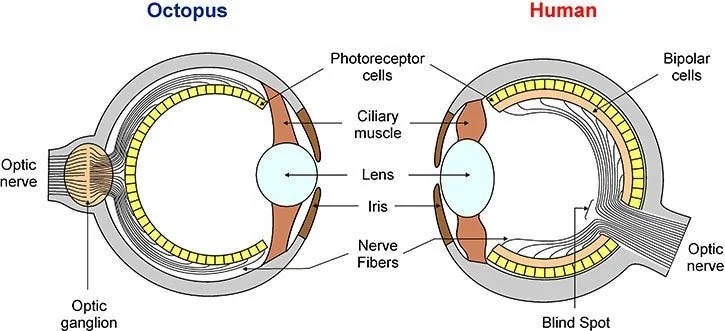
Vertebrate eye
In the same article De Beer goes on to describe in detail an interesting case which illustrates that even actual developmental mechanisms, by which apparently homologous structures are formed during embryogenesis, may not be homologous at all: “It was a problem to know why the lens of the vertebrate eye, which develops from the epidermis overlying the optic cup, should develop exactly in the “right” place, and fit into the optic cup so perfectly, until it was discovered that the optic cup is itself an organizer which induces the epidermis to differentiate into a tailor-made lens. At least, this is what it does in the common frog, Rana fusca, in the embyro of which, if the optic cup is cut out, no lens develops at all. But in the closely related edible frog, Rana esculents, the optic cup can be cut out from the embryo, and the lens develops all the same. It cannot be doubted that the lenses of these two species of frog are homologous, yet they differ completely in the mechanism by which determination and differentiation are brought about. This is no isolated example. In true vertebrates the spinal cord and brain develop as a result of induction by the underlying organizer; but in the “tadpole larva” of the tunicates, which has a “spinal cord” like the vertebrates, it differentiates without any underlying organizer at all. All this shows that homologous structures can owe their origin and stimulus to differentiate to different organizer- induction processes without forfeiting their homology. [emphasis added]” (Evolution: A Theory in Crisis, Michael Denton, 1985, p 147, citing: Homology: An Unsolved Problem, G. De Beer, 1971) (bible.ca)
Biological Similarities: Evidence for God in a Six-Day Creation
The remarkable biological similarities between species—too intricate and precise to be explained by evolution—provide powerful scientific evidence for God’s existence as the Creator of all life. These shared features across diverse organisms defy the idea of gradual, naturalistic development, pointing instead to a purposeful design as recounted in the Bible’s six-day creation narrative.
Take the camera-like eye found in both humans and octopuses. Despite no evolutionary link close enough to explain it, both possess retinas, lenses, and optic nerves in stunningly similar arrangements. Evolution suggests these complex structures emerged separately by chance, but the odds of such identical designs arising independently are astronomical.
Biologist Simon Conway Morris notes that these similarities occur too frequently to be random, hinting at a deliberate pattern (Morris, 2015, The Runes of Evolution). Genesis 1:20-21 tells us God created sea creatures and birds on the fifth day, suggesting He crafted these eyes intentionally, not through eons of trial and error.
Then there’s the universal genetic code and protein-building systems—DNA and ribosomes—shared by all life, from bacteria to mankind. Evolution claims this arose once and persisted unchanged, but the complexity of these systems resists explanation as a fluke of nature. Biochemist Michael Denton calls them “primal patterns,” more akin to a master plan than a cosmic accident (Denton, 1986, Evolution: A Theory in Crisis). Genesis 1:26-27 reveals God made man in His image on the sixth day, implying a purposeful design woven into all life from the start.
Enzymes like cytochrome c, vital for energy production, further challenge evolutionary logic. Found in yeast and horses alike, their near-identical structure across vast species gaps suggests a fixed design, not random divergence. Why would such precision hold steady unless crafted by intent? Genesis 1:11-12 describes God creating plants on the third day, each “according to its kind,” hinting at a blueprint for life’s consistency. Psalm 139:14 praises His “wonderful works,” reflecting this meticulous handiwork.
Critics might argue that similarities reflect adaptation or convergence, but this overlooks the sheer complexity and specificity involved. The odds of unrelated organisms independently developing identical genetic and metabolic systems strain credulity without invoking a creator. Psalm 104:24 celebrates this: “How many are your works, Lord! In wisdom you made them all; the earth is full of your creatures.” Biological similarities, then, are not accidents but fingerprints of a Creator who, in six days, crafted a coherent, interconnected world.
Evolution’s tale of chance and time crumbles under these biological marvels. The six-day creation offers a clearer answer: God designed life’s similarities as a signature of His power. From eyes to enzymes, the evidence aligns with Scripture’s bold claim of a purposeful beginning.
Agape,
spencer
Sources:
Denton, M. (1986). Evolution: A Theory in Crisis. Adler & Adler.
Meyer, S. C. (2013). Darwin’s Doubt. HarperOne.
Morris, S. C. (2015). The Runes of Evolution. Templeton Press.
 Borger church of Christ @ Franklin & Juniper