
Scientific Insights in the Bible Before Their Discovery
The Bible, often seen as a spiritual guide, harbors scientific insights that predate their modern discovery, hinting at a wisdom beyond its ancient writers. While not a scientific treatise, its casual mentions of natural phenomena (later validated by research) present a compelling case for its inspired nature. From lightning’s path to Earth’s form, these glimpses into the physical world challenge assumptions of a purely primitive text.
One remarkable example is the Bible’s reference to lightning’s path. Job 28:26 states, “When He made a law for the rain and a path for the thunderstorm,” while Job 38:25 asks, “Who has divided a channel for the overflowing water, or a path for the lightning of thunder?” Written around 2000 BC, these verses suggest lightning follows a guided route, a concept unknown to ancient meteorology. Not until the 1960s, with advancements in high-speed photography and electrical studies, did scientists like Martin Uman confirm that lightning indeed traces a predictable plasma channel. This discovery, detailed in The Lightning Discharge (1987), aligns with Job’s imagery, predating it by nearly 4,000 years. This example is absolutely compelling; it’s a precise, testable phenomenon described millennia before the tools existed to verify it, making it a standout among biblical insights.
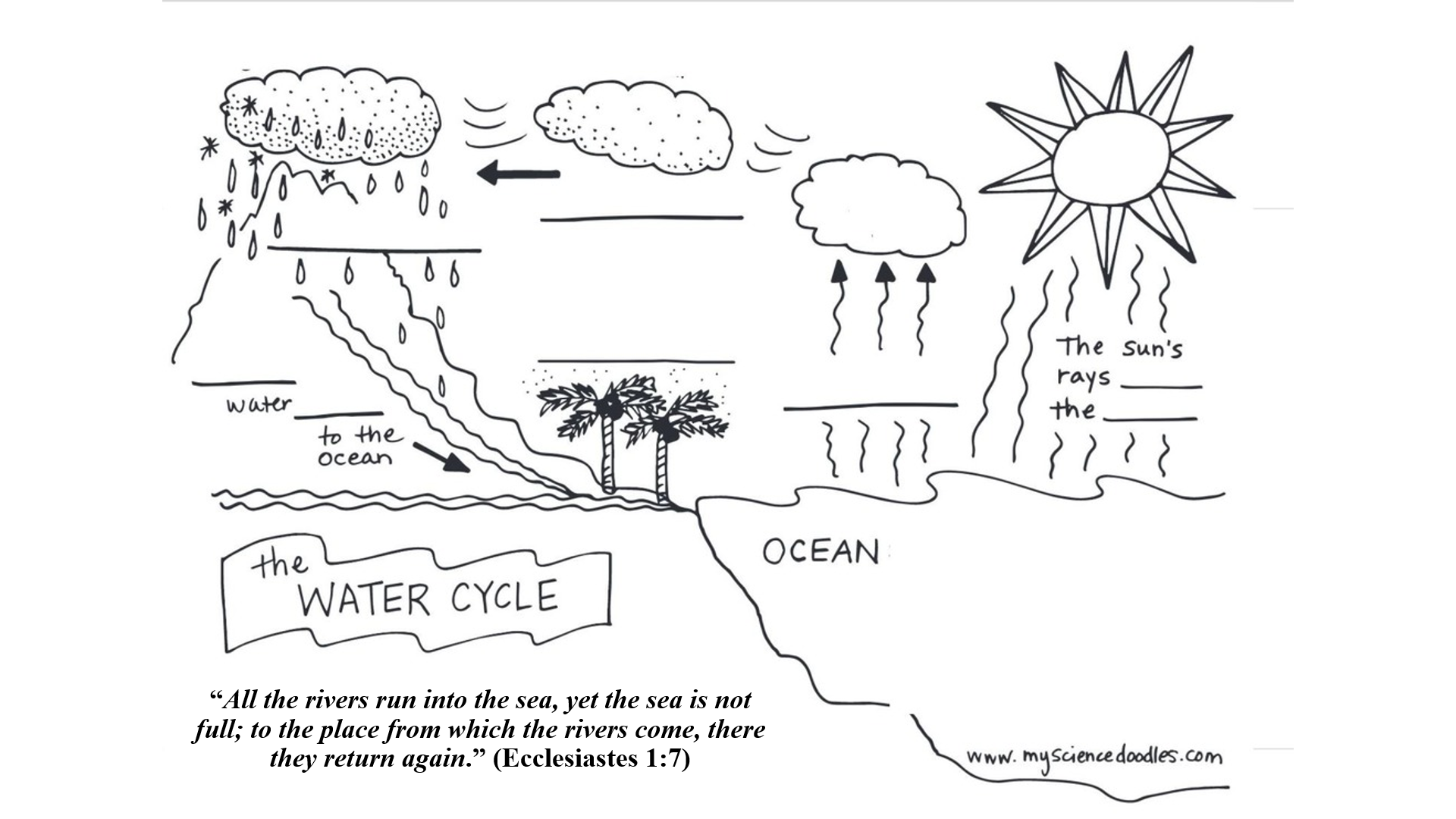
The hydrologic cycle also emerges in Scripture long before its scientific mapping. Ecclesiastes 1:7 observes, “All the rivers run into the sea, yet the sea is not full; to the place from which the rivers come, there they return again.” This encapsulates evaporation and precipitation, a process not formalized until Bernard Palissy’s 16th-century work. Job 36:27-28 reinforces this: “He draws up the drops of water, which distill as rain from the mist,” revealing an understanding absent in contemporary cultures.
Biologically, Leviticus 17:11 declares, “For the life of the flesh is in the blood,” a truth central to modern medicine. Penned circa 1400 BC, it precedes William Harvey’s 1628 circulation discovery by over two millennia. Henry Morris, in The Biblical Basis for Modern Science (1984), argues this reflects knowledge beyond ancient observation, tying blood to vitality in a way science later confirmed.
Cosmologically, Job 26:7 asserts, “He hangs the earth on nothing,” portraying Earth as suspended in space—a view not widely accepted until Copernicus. This contrasts with ancient myths of a supported Earth, aligning with modern astronomy’s findings. John W. Montgomery’s Evidence for Faith (1991) notes such insights suggest a source transcending human limits.
These instances don’t prove divinity but defy coincidence, bridging faith and reason.
Agape
Sources:
Morris, Henry M. The Biblical Basis for Modern Science. Baker Books, 1984.
Montgomery, John W. Evidence for Faith. Probe Books, 1991. Uman, Martin A. The Lightning Discharge. Academic Press, 1987.
 Borger church of Christ @ Franklin & Juniper