Why some don’t Read the Bible

Why don’t people read the Bible?

They DON’T like to read.

they’re APATHETIC & have unbelief

Not ENOUGH time to read.

They Reject it because it’s too REPULSIVE.

For a book that has shaped history, guided nations, and transformed lives, the Bible often sits unopened. The reasons are not always complex—but they are revealing.

First, some simply don’t like to read. In a fast-paced world driven by screens and short attention spans, reading itself feels like a chore. The Bible, with its length and depth, can seem especially intimidating. For those who already avoid reading, opening Scripture rarely becomes a priority.

Jesus answered and said unto them, Ye do err, not knowing the scriptures, nor the power of God. (Matthew 22:29)

Others struggle with apathy and unbelief. If someone doubts the Bible’s relevance or truth, motivation quickly fades. It becomes easy to think, “It doesn’t apply to me,” or “I don’t believe it anyway.” This quiet indifference can be more powerful than outright rejection, because it removes any urgency to explore what the Bible actually says.

He that rejecteth me, and receiveth not my words, hath one that judgeth him: the word that I have spoken, the same shall judge him in the last day.” (John 12:48)

A common excuse is lack of time. Life fills up with work, responsibilities, family, and constant distractions. Yet this reason often reveals more about priorities than availability. People tend to make time for what they value. When the Bible is seen as optional, it is often the first thing pushed aside.

And these are they which are sown among thorns; such as hear the word,
And the cares of this world, and the deceitfulness of riches, and the lusts of other things entering in, choke the word, and it becometh unfruitful
.” (Mark 4:18)

Finally, some reject the Bible because they find it repulsive. Certain passages challenge modern values, confront personal behavior, present difficult truths, and in some cases are gruesome to them. Rather than wrestle with these tensions, some choose to dismiss the message entirely. Conviction can feel uncomfortable, and avoidance becomes the easier path.

For whatsoever things were written aforetime were written for our learning, that we through patience and comfort of the scriptures might have hope.” (Romans 15:4)

These reasons—dislike of reading, apathy, busyness, and rejection—may differ on the surface, but they share a common thread: they keep people from engaging with something that has the power to shape their lives. Understanding these barriers is the first step toward overcoming them.

My people are destroyed for lack of knowledge: because thou hast rejected knowledge, I will also reject thee, that thou shalt be no priest to me: seeing thou hast forgotten the law of thy God, I will also forget thy children.” (Hosea 4:6)

What’s your reason?

agape

spencer

Bearing Fruit: Members

Herein is my Father glorified, that ye bear much fruit; so shall ye be my disciples.” (John 15:8)

When we talk about being fruit bearers, we recognize that there is One vine (Christ) and One way of defining fruit (the word). What we may overlook is how different each of the branches are. While we are all part of the One vine, and bear fruit, we are still unique individuals. For this we look at another metaphor, the parts of the body.

“For the body is not one member, but many. If the foot shall say, Because I am not the hand, I am not of the body; is it therefore not of the body? And if the ear shall say, Because I am not the eye, I am not of the body; is it therefore not of the body? If the whole body were an eye, where were the hearing? If the whole were hearing, where were the smelling? But now hath God set the members every one of them in the body, as it hath pleased him. And if they were all one member, where were the body? But now are they many members, yet but one body. And the eye cannot say unto the hand, I have no need of thee: nor again the head to the feet, I have no need of you. Nay, much more those members of the body, which seem to be more feeble, are necessary: And those members of the body, which we think to be less honourable, upon these we bestow more abundant honour; and our uncomely parts have more abundant comeliness. For our comely parts have no need: but God hath tempered the body together, having given more abundant honour to that part which lacked: That there should be no schism in the body; but that the members should have the same care one for another. And whether one member suffer, all the members suffer with it; or one member be honoured, all the members rejoice with it” (1Cor 12:14-26). Another passage on this topic is in Romans 12:4-8, “For as we have many members in one body, and all members have not the same office.”

From these two passages we learn that each of us is individual fruit bearers attached to the One vine, who is Christ. He is the source of our nourishment and growth, and we each have differing abilities from which we bear fruit (cf. Matt 25:14-30). We have differing roles, functions, and abilities for “…the perfecting of the saints, for the work of the ministry, for the edifying of the body of Christ: Till we all come in the unity of the faith, and of the knowledge of the Son of God, unto a perfect man, unto the measure of the stature of the fulness of Christ” (Eph 4:12-13). These differences work together for the building up of the body.

One of the ways we can bear fruit is through personal evangelism. Our differences (not in the political sense of unity in diversity–which celebrates plurality itself, with less insistence on a single unifying purpose) give the church the greatest ability to reach the most people. Because of our differing interests, abilities, and spheres of influence, we are able to reach people with the gospel that others in the congregation may never meet. From my experience, some folks respond better to those who have similar backgrounds than to those who come from different ones.

Being one in Christ fuses many hearts into one purpose.

Agape
spencer

Leadership without Humility

Nebuchadnezzar & Agrippa I: Leadership Without Humility

The Bible does not shy away from showing the consequences when leaders forget their place before God. Two striking accounts—one from the Old Testament and one from the New—illustrate a timeless warning: when earthly rulers exalt themselves or accept the exaltation of others, the outcome is always ruinous. These stories serve as sober reminders for any generation about the perils of pride in positions of power.

King Nebuchadnezzar of Babylon stands as a vivid example of self-aggrandizement. After great military victories, he erected a massive golden image and commanded all his subjects to bow down and worship it under penalty of death (Daniel 3). His pride reached its peak when he boasted of his own achievements while surveying his magnificent city: “Is not this the great Babylon I have built as the royal residence, by my mighty power and for the glory of my majesty?” (Daniel 4:30). A divine warning had come in a dream, urging him to acknowledge that “the Most High is sovereign over all kingdoms on earth and gives them to anyone he wishes” (Daniel 4:17). Yet he refused to humble himself. As judgment, he was driven away from people, lived like a wild animal, eating grass, with his body drenched by the dew of heaven, until seven times passed over him. Only after he lifted his eyes to heaven and praised the Most High God was his sanity and kingdom restored (Daniel 4:34-37). The lesson is clear: God opposes the proud, and no leader, no matter how powerful, can claim glory that belongs to God alone.

A different but equally sobering example appears in the New Testament with King Herod Agrippa I. After a period of persecution against the early church, Herod delivered a public address in Caesarea. The people, seeking his favor, shouted, “This is the voice of a god, not of a man!” (Acts 12:22). Herod did not rebuke the flattery or redirect the praise to the living God. Instead, he accepted it in silence. Immediately, “an angel of the Lord struck him down, because he did not give God the glory, and he was eaten by worms and died” (Acts 12:23). His end was swift, painful, and public. The contrast is striking: where Nebuchadnezzar actively demanded worship, Herod passively allowed it. In both cases, the failure to humble oneself before God brought severe judgment.

These two accounts reveal a common pattern. Leadership without humility inevitably leads to idolatry—either self-imposed or encouraged by followers. Whether a ruler builds his own monument to greatness or simply fails to correct those who offer divine honors, the result is the same: divine opposition. Scripture repeatedly emphasizes that “God opposes the proud but shows favor to the humble” (James 4:6; 1 Peter 5:5). Pride in high places does not merely affect the individual leader; it corrupts those under authority, distorts truth, and invites disorder and decay.

The Bible’s warning is therefore general and enduring. Any leader—whether in government, business, religion, or any sphere of influence—who forgets that all authority comes from God and who fails to give Him the glory due His name risks the same tragic trajectory. Nebuchadnezzar’s madness and Herod’s gruesome death stand as monuments to the truth that exaltation of self, whether bold or subtle, always precedes a fall. True leadership begins with the fear of the Lord and the recognition that “the Most High rules over the kingdom of men” (Daniel 4:17). Without such humility, even the mightiest throne becomes a path to humiliation.

May every person in authority—and every citizen who supports them—heed this ancient scriptural counsel: give glory to God alone, walk in humility, and reject every form of self-deification. For in the end, only God is worthy of worship, and He will not share His glory with another (Isaiah 42:8).

agape

spencer

Blood in God’s plan

Blessed be the God and Father of our Lord Jesus Christ, who hath blessed us with all spiritual blessings in heavenly places in Christ” (Eph 1:3)

As we continue to count our spiritual blessings in Christ, today is a fitting time to talk about the blessings we have in Christ through His blood. For us to appreciate the full impact of this blessing, we need to go back and see the impact of blood in the Old Testament.

The first implied reference to blood appears in Genesis 3, when God took animal skins to cover Adam and Eve after their sin. “Unto Adam also and to his wife did the LORD God make coats of skins, and clothed them” (Gen 3:21).

The next reference we find in the scene with Cain and Abel. Abel made an offering to the Lord from the firstlings of his flock. It says, “And the LORD had respect unto Abel and to his offering” (Gen 4:4; cf. Heb 11:4). Three things stand out: first, that Abel gave the ‘firstling’; second, that it was the shedding of blood; and third, he offered it by faith (Heb 11:4).

We see animal sacrifices continue throughout Genesis, often involving the building of an altar and the offering of clean animals as burnt offerings. They emphasize faith, obedience, thanksgiving, or covenant relationship. When we get to Abraham we see another important element. Initially, his son Isaac was to be offered as a burnt offering, but God provided a ram caught in a thicket, which Abraham sacrificed in his son’s place. This event is seen as a foreshadowing of substitutionary sacrifice. “And Abraham lifted up his eyes, and looked, and behold behind him a ram caught in a thicket by his horns: and Abraham went and took the ram, and offered him up for a burnt offering in the stead of his son. And Abraham called the name of that place Jehovahjireh (the LORD will see to it [will provide]): as it is said to this day, In the mount of the LORD it shall be seen” (Gen 22:13-14).

In Exodus God turned the waters of the Nile to blood and commanded the Israelites to apply blood to the doorposts and lintel during the final plague. This Passover event powerfully foreshadows the sacrifice of Christ. Jesus Himself used the elements of the Passover meal as symbols of His body and blood: “And as they were eating, Jesus took bread… this is my body… For this is my blood of the new testament, which is shed for many for the remission of sins” (Matt 26:26-28).

Another notable instance of the use of blood is at the dedication of the tabernacle. Blood was used—along with oil—to consecrate both the tabernacle and the priests setting them apart as holy for God’s service. Moses applied blood to the horns of the altar to purify it (Lev. 8:15), and he placed blood on the right ear, thumb, and big toe of Aaron and his sons before sprinkling them and their garments with a mixture of blood and oil (Lev. 8:23–24, 30; see also Ex. 29:12, 20-21, 36–37).

Blood plays a central role in God’s plan of redemption.

Agape
spencer

BLOOD

And almost all things are by the law purged with blood; and without shedding of blood is no remission.

(Hebrews 9:22)

For the life of the flesh is in the blood: and I have given it to you upon the altar to make an atonement for your souls: for it is the blood that maketh an atonement for the soul. (Leviticus 17:11)

WALKING WORTHY

I therefore, the prisoner of the Lord, beseech you that ye walk worthy of the vocation wherewith ye are called, With all lowliness and meekness, with longsuffering, forbearing one another in love; Endeavouring to keep the unity of the Spirit in the bond of peace.” (Eph 4:1-3)

The Holy Spirit wants us to keep the unity of His Spirit in the bond of peace. In this passage He gives 3 avenues through which we are to “walk worthy of the vocation you are called.” To understand this passage, we need to understand the words.

Walk: To conduct one’s life, behave, or live in a habitual manner; the ongoing pattern of daily conduct and lifestyle as a believer (Colossians 1:10; Ephesians 5:2)

Worthy: Suitably, appropriately, or in a manner that matches or balances the value of something; living in congruence with the dignity and nature of what has been received. Philippians 1:27 — “Let your conversation be as it becometh the gospel of Christ” (worthy manner);

Vocation: The divine calling, invitation, or summons to salvation and service in Christ; the position or role to which God has invited believers. 1Corinthians 7:20 — “Let every man abide in the same calling wherein he was called”;

Called: To be summoned, invited, or effectually drawn by God into relationship with Him through the gospel. 2Thessalonians 2:14 — “Whereunto he called you by our gospel.”

Lowliness: Humility of mind, lowliness of thought about oneself; thinking soberly of self in light of God’s grace, without pride or self-exaltation. Colossians 3:12 — “Put on… humbleness of mind.”

Meekness: Gentleness, mildness, or controlled strength; a disposition that is patient and considerate, not harsh or self-assertive, even under provocation. It’s Restrained power, not weakness. Matthew 11:29 — “For I am meek and lowly in heart.”

Longsuffering: Patience, forbearance, or endurance in bearing wrongs; slow to anger and long to endure provocation or hardship. Colossians 3:12 — “Putting on… longsuffering.”

Unity: Oneness, harmony, or unanimity; the state of being one in spirit and purpose, produced by the Holy Spirit among believers. The term appears only here and in Ephesians 4:13.

Peace: Harmony, tranquility, and reconciliation; the state of concord and absence of strife, especially the bond that holds believers together. Ephesians 2:14 — “For he is our peace, who hath made both one.”

These words reveal that walking worthy involves humble, gentle, patient conduct that preserves the Spirit-given oneness among believers.

Agape
spencer

Bearing Fruit: 100 fold

Herein is my Father glorified, that ye bear much fruit; so shall ye be my disciples.” (John 15:8)

Bearing fruit is more than a positive affirmation, it has substance. In God’s law of sowing and reaping, the physical act of planting seed mirrors the spiritual work of evangelism. Jesus taught in the Parable of the Sower, “But he that received seed into the good ground is he that heareth the word, and understandeth it; which also beareth fruit, and bringeth forth, some an hundredfold, some sixty, some thirty” (Matthew 13:8, 23). When we scatter the seed of the Gospel, four powerful incentives assure us that our labor is never in vain.

First, we receive personal benefit—FOOD for ourselves. Just as the farmer’s harvest supplies daily bread, God promises the same in the spiritual realm: “Now he that ministereth seed to the sower both minister bread for your food, and multiply your seed sown, and increase the fruits of your righteousness” (2Corinthians 9:10). Every time we share the Gospel, our own faith is nourished. You’ve heard that the teacher gets more than the student. Evangelism also feeds the sower. Are you sowing the seeds of the kingdom, brother?

Second, we can expect a harvest OVER and ABOVE what we can imagine—30, 60, or 100-fold—but it may come well after us. Paul declares, “Now unto him that is able to do exceeding abundantly above all that we ask or think, according to the power that worketh in us” (Ephesians 3:20). A single conversion to Christ can ripple across decades and continents. The person you teach to obey the Gospel today may win others tomorrow, producing fruit far beyond your lifetime (2Timothy 2:2). The surplus benefits into future generations, and praise that glorifies God. While we can expect an overabundance, there is a caveat, “He which soweth sparingly shall reap also sparingly; and he which soweth bountifully shall reap also bountifully” (2Corinthians 9:6). Are you sowing the seeds of the kingdom, brother?

Third, we benefit from the LABORS of others, and others will benefit from ours. Jesus reminded His disciples, “One soweth, and another reapeth… I sent you to reap that whereon ye bestowed no labour: other men laboured, and ye are entered into their labours” (John 4:37-38). Every believer is the fruit of someone else’s faithful sowing—parents, teachers, friends, or even strangers who planted the seed of the kingdom years earlier. We in this place are beneficiaries of the labors of others. Are you sowing the seeds of the kingdom, brother?

Finally, we are to sow DILIGENTLY—while remaining wholly DEPENDENT on God. Even in paradise, Adam was commanded to cultivate the garden. The same command echoes in the Great Commission: go and sow the Gospel. Diligent Duty is the record of history; we cannot sit idle. Yet growth is never by our power alone. God sends the sunshine, the rain, and He gives the increase. All glory belongs to Him. Are you sowing the seeds of the kingdom, brother?

This goes beyond evangelism. These lessons can be applied to all fruit bearing. The fruit is felt first by the individual Saint, then there’s an overabundance of fruit, followed by lasting benefits for others. Finally, there’s a reminder to remain faithful and thankful to Christ, the Vine.

Agape,

spencer

the Providence of God

How does it work?

Since the end of the age of the miraculous gifts of the Holy Spirit (1Cor 13:8-10) folks have wondered how God works in our lives. Many have gone the way of Calvinism that portrays God as a cosmic puppet master, but the scriptures teach something completely different and so much better. The bible teaches that God continues to work in our lives PROVIDENTIALLY.

There is a big difference between the MIRACULOUS and PROVIDENCE.

MIRACLES: God works directly, supernaturally, and immediately, suspending, overriding, or working outside the ordinary laws of nature He established (eg; John 11:43-44).

PROVIDENCE (or divine providence): God cares for man through the ordinary laws of nature, (“natural” processes). The word itself is rooted in the Greek word meaning to look out for beforehand actively, by way of maintenance for others.1 It’s used in 1 Timothy 5:8, “if any provide not for his own…” We understand DIVINE PROVIDENCE to mean God makes available what is needed to accomplish a purpose.

Since the age of Miracles, God works in our lives through PROVIDENCE providing what is needed to accomplish a purpose. There are 5 elements we can draw from scripture that God PROVIDES to the Saints to accomplish His purposes through the church (1Tim 3:15; Eph 3:10; Matt 28:19-20). These PROVISIONS are;

INSTRUCTIONS: God has provided with us His will with instructions about what He wants through His word. “All scripture is given by inspiration of God, and is profitable for doctrine, for reproof, for correction, for instruction in righteousness: That the man of God may be perfect, throughly furnished unto all good works” (2Tim 3:16-17). The Bible contains instructions on how to live, and commands to obey.

RESOURCES:* God provides us with all necessary resources to do His will, both spiritually (for saints) & physically. “According as his divine power hath given unto us all things that pertain unto life and godliness, through the knowledge of him that hath called us to glory and virtue” (2Peter 1:3). These resources are found in His creation through constant natural laws, and other provisions that help us to do His will. “Nevertheless he left not himself without witness, in that he did good, and gave us rain from heaven, and fruitful seasons, filling our hearts with food and gladness” (Acts 14:17; eg 2Cor 9:10-15). The framework of creation, PROVIDED by God, contains all that we need to do His will.

OPPORTUNITY FOR GROWTH: Within God’s word, we also have the provisions for growth. “But speaking the truth in love, may grow up into him in all things, which is the head, even Christ” (Eph 4:15). The scriptures contain principles that develop us in all areas of our lives (Relationships, Industry, Community, Child rearing etc.).

INCENTIVES (PROMISES):* God has also provided us incentives contained in promises that motivate us. “…he is a rewarder of them that diligently seek him.” (Hebrews 11:6). We can know WHY God wants things because He has revealed it to us. We know from His word that there is hope beyond this present world. “For our light affliction, which is but for a moment, worketh for us a far more exceeding and eternal weight of glory” (2Corinthians 4:16).

PRAYER FOR HELP:* God provides aid through prayer for those in Christ (“all spiritual blessings are in Christ Jesus” Eph 1:3). “Let us therefore come boldly unto the throne of grace, that we may obtain mercy, and find grace to help in time of need” (Heb 4:16). He hasn’t walked away from us and left us to fend for ourselves, but when we pray “according to His will” He continues to work through the ordinary laws of nature. He tells us, “Casting all your care upon him; for he careth for you” (1Peter 5:7). The very fact that He commands us to pray (Matthew 6:9-15) shows that He continues to help us. “The effectual fervent prayer of a righteous man availeth much” (James 5:16b). The record of scripture shows that He answers our righteous prayers through the agency of divine providence. To pray for things outside of His will is to “ask amiss” (James 4:3).

Here is where we get into trouble. We want to know HOW, WHAT, WHERE, & WHEN God helps us. That’s the thing about PROVIDENCE, we don’t know. Mordecai could only say, “Who knows” (Esther 4:14)?

Error automatically runs to claims such as, ‘God has a plan for me.’ As if God hasn’t revealed anything about what He wants. When they say, “God is in control” they mean that He is moving every atom & person separate from our own free will. They speak as if God has an unrevealed individualized divine plan for everyone. This leads to frustration.

The truth is, God has created a system (Instruction, creation, natural laws, growth, incentives, & prayer) in which man has freedom to direct his own life and will be judged according to his deeds (2Corinthians 5:10; Mt 25:31-32; Ro 2:6; 14:10; Ga 6:7; Eph 6:8; Col 3:24-25; Re 22:12). God has revealed His will for man and He has PROVIDED all we need for life & godliness.

It’s all in His word.

Agape
Spencer

  1. Strongs Concordance.

* Spiritual Blessings are only for those who are “in Christ” (Eph 1:3)

Heroes of Faith: Onesiphorus

ONESIPHORUS, AN UNUSUAL FRIEND

Few figures shine as quietly yet powerfully as ONESIPHORUS, a faithful believer from Ephesus mentioned in Paul’s final letter, 2 Timothy. Paul, imprisoned in Rome and facing execution, contrasts the desertion of many (2 Timothy 1:15) with Onesiphorus’s steadfast loyalty. In 2 Timothy 1:16-18, Paul prays, “The Lord give mercy unto the house of Onesiphorus; for he oft refreshed me, and was not ashamed of my chain: But, when he was in Rome, he sought me out very diligently, and found me. The Lord grant unto him that he may find mercy of the Lord in that day: and in how many things he ministered unto me at Ephesus, thou knowest very well.” Later, in 2 Timothy 4:19, Paul greets “the household of Onesiphorus,” underscoring the lasting impact of this man’s life. His name, meaning “bringing profit” or “help-bringer,” perfectly captures his character. Onesiphorus stands as a model for Christians to emulate in an age of fleeting commitments, (Phil 3:17).


Let’s note first of all his UNPARALLELED SUPPORT: Onesiphorus “often refreshed” Paul, a term implying revival and cooling relief amid suffering. This shows that Onesiphorus gave aid frequently to Paul and his efforts—which Timothy was well acquainted with, “and in how many things he ministered unto me at Ephesus, thou knowest very well.” This kind of commendation tells me that his work was done quietly without fanfare, but noticed, especially by those who are helped (see Prov 27:2).

Then there’s his UNABASHED EFFORTS: Paul highlights that Onesiphorus “was not ashamed of my chains.” In 2 Timothy 1:8, 12, 16, Paul urges Timothy not to be ashamed of the gospel or of Paul’s imprisonment. A Roman prison would discourage lesser men, but not ONESIPHORUS. Paul was not suffering because of his own faults, but was suffering wrongfully for the sake of the Gospel (e.g., 1Peter 4:14-16). Paul was confined in the bowels of Rome’s ancient Mamertine Prison—a place nearly devoid of light, which make modern-day prisons feel like a cheap motel room by comparison. Unlike his confinement in the final chapters of Acts, this one treated him as a condemned “evil doer” (2 Timothy 2:9), with no privileges. Roman prisons did not reliably provide sustenance; prisoners relied on external support—Paul needed help.

Then there’s his UNSTOPPABLE EFFORT: When in Rome, Onesiphorus “sought me out very diligently, and found me” (2 Timothy 1:17). In a time without cell phones, nor GPS, no obstacle deterred him; he persevered until he located and delivered the aid Paul desperately needed in the deep, dark, and dank prison.

Finally, there’s his UNSURPASSED REWARD: Paul prays, “The Lord grant unto him that he may find mercy of the Lord in that day” (2 Timothy 1:18), pointing to eternal reward. Jesus promises in Matthew 10:40-42 that whoever receives His servants receives Him, and even a cup of cold water given in His name will not lose its reward (see Matt 25:31-46).

O to have more like Onesiphorus.

Agape
spencer

How to get All The Spiritual Blessings that are in Christ

“Blessed be the God and Father of our Lord Jesus Christ, who hath blessed us with all spiritual blessings in heavenly places in Christ” (Eph 1:3)

Last month we saw how all spiritual blessings are IN CHRIST, and none are for those OUTSIDE of Christ. This month we shall answer the all-important question, “How to be in Christ?”

Continuing in the first chapter of Ephesians, all spiritual blessings (such as election, adoption, redemption, forgiveness, inheritance, and sealing with the Holy Spirit) belong exclusively to those who are “IN CHRIST” (Ephesians 1:3–14).

To be “IN CHRIST” means to be united with Him in His death, burial, and resurrection, then His righteousness, and blessings become yours (Romans 6:3–11; 2Cor 5:17, 21; Col 2:12; Gal 2:20).

The New Testament describes this union as happening through faith in Christ, through FAITH, REPENTANCE and BAPTISM:

Faith is the means: “Ye are all sons of God by faith in Christ Jesus” (Galatians 3:26). Believing the gospel of Jesus Christ begins our unity to Christ (Romans 10:9–10; Ephesians 2:8–9).

Repentance is inseparable from faith: Repentance was preached by Jesus at the beginning when Jesus said, “The time is fulfilled, and the kingdom of God is at hand: repent ye, and believe the gospel” (Mark 1:15). And continued to be preached after His death, burial, & resurrection, “Testifying both to the Jews, and also to the Greeks, repentance toward God, and faith toward our Lord Jesus Christ” (Acts 20:21; cf Acts 2:38).

Baptism in water is the point of inclusion: “Then they that gladly received his word were baptized: and the same day there were added unto them about three thousand souls” (Acts 2:42, 47). “For as many of you as have been baptized into Christ have put on Christ” (Galatians 3:27). “Know ye not, that so many of us as were baptized into Jesus Christ were baptized into his death” (Romans 6:3). “Buried with him in baptism, wherein also ye are risen with him through the faith of the operation of God, who hath raised him from the dead” (Colossians 2:12). Note that it is faith in God’s work as we obey the Gospel.

Thus, one becomes “IN CHRIST” by Hearing, Believing the gospel of Christ, Repentance, Confession (Romans 10:9), then being Baptized into Him (immersion in water in His name, Acts 2:38). It’s only then that a person is a new creation (2Corinthians 5:17), reconciled to God, and receives every spiritual blessing in Him.

Agape
Spencer

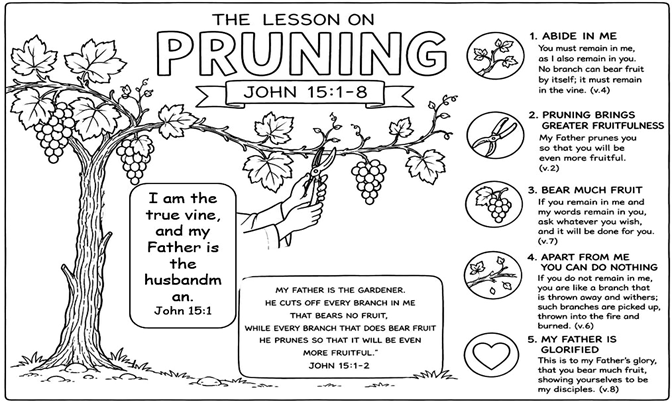
Bearing Fruit by Abiding in Christ

“Herein is my Father glorified, that ye bear much fruit; so shall ye be my disciples.” (John 15:8)

Last month we learned who defines good fruit, this month we find out that Jesus expects fruit bearing, and He tells us how to bear MUCH fruit. “Abide in me, and I in you. As the branch cannot bear fruit of itself, except it abide in the vine; no more can ye, except ye abide in me. I am the vine, ye are the branches: He that abideth in me, and I in him, the same bringeth forth much fruit: for without me ye can do nothing” (John 15:4-5).

People let their imaginations run wild with ideas about what it means to “ABIDE” in Christ. Anything from emotional claims, miraculous personal indwelling, to hearing of still small voices. The trouble with these is there’s no way to distinguish from what a person already desires from that which God desires.

What needs to be observed from the passage in John 15 is that Jesus is giving a directive to us. When He gives a command, or a directive, then it is something WE MUST DO. Another example is the command to “repent and be baptized” (Acts 2:38). When we’re told to do something, it stands to reason that it involves action on our part. The command to ABIDE IN ME, is a directive that we must ACT upon. We can do things to abide in Christ. The question then becomes, ‘what things?’

First, John also wrote, “Therefore let that abide in you which you heard from the beginning. If what you heard from the beginning abides in you, you also will abide in the Son and in the Father.” (1John 2:24) We today hear & know what they heard when we read the Bible. Note these passages in the Letter of 1John:


• 1John 1:4 And these things write we unto you…
• 1John 2:1 My little children, these things write I unto you…
• 1John 2:7 Brethren, I write no new commandment unto you…
• 1John 2:8 Again, a new commandment I write unto you…
• 1John 2:12 I write unto you…
• 1John 2:13 I write unto you…
• 1John 2:14 I have written unto you…
• 1John 2:21 I have not written unto you…
• 1John 2:26 These things have I written unto you…
• 1John 5:13 These things have I written unto you…

We abide in Christ when we study & keep His word so that it DWELLS IN us. “If you continue [same Greek word: abide/remain] in My word, you are truly My disciple.” (John 8:31 cf. Col 3:16).

We abide in Christ when we DO HIS WILL. “Whoever transgresses and does not abide in the doctrine of Christ does not have God. He who abides in the doctrine of Christ has both the Father and the Son” (2John 9). “Whoever says he abides in Him ought himself also to walk just as He walked” (1John 2:6).

Repeatedly the scriptures connect ABIDING IN CHRIST with scripture. To abide in Christ is to keep His commands and to bear fruit. Paul wrote to Timothy, “All scripture is given by inspiration of God, and is profitable for doctrine, for reproof, for correction, for instruction in righteousness: That the man of God may be perfect, throughly furnished unto all good works.” (2Tim 3:16-17). It stands to reason then, that knowing the scriptures EQUIPS us to bear fruit (good works). This includes avoiding sin. “No one who abides in Him keeps on sinning; no one who keeps on sinning has either seen Him or known Him” (1John 3:6).

We can ABIDE IN CHRIST. He has shown us and told us how.

Agape
spencer