Evidence for our Faith: the Politarch

The Politarch Inscription

For years, critics of the Bible pointed to the Greek word politarch, used in Acts 17:6-8 to describe Thessalonian city officials, as evidence of scriptural inaccuracy. This term, unique to Luke’s account and absent from classical Greek literature, led some 19th-century scholars to argue that Luke fabricated details, casting doubt on the New Testament’s historical reliability. They claimed politarch was an anachronism or error, undermining Luke’s credibility as a historian.

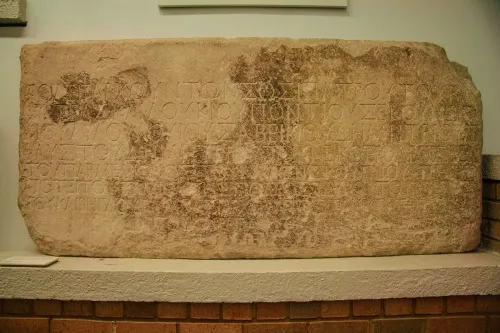
However, the discovery of the Thessalonian Politarch Inscription1 in the 19th century, which explicitly lists “politarchs” as civic leaders in Thessaloniki, silenced these objections. As noted by historians like F.F. Bruce, this archaeological find confirmed Luke’s precision, showing that politarch was a legitimate title in first-century Macedonia. This turnaround highlights how critics’ challenges, when met with evidence, can strengthen faith in the Bible’s trustworthiness, echoing Psalm 119:160’s assurance that God’s Word is true.

Thessaloniki was a bustling Roman city, and the politarchs were civic leaders navigating the tensions of a diverse, often skeptical society. Acts 17:4-5 tells of locals and converts stirred by Paul’s preaching, clashing with those loyal to Roman order. The inscription, studied by scholars like N.T. Wright, reveals a city governed by these politarchs, who faced real pressures from crowds opposing the gospel. This context makes Paul’s courage, and the Thessalonians’ faith, more vivid. It reminds us that the Gospel continued to spread in a complex, real-world setting, encouraging us to live boldly for Christ today, as Paul urged in 1 Thessalonians 5:16-18, to “rejoice always” despite challenges.

The Politarch Inscription strengthens our confidence in scripture’s reliability. If Luke accurately recorded a minor detail like a local title (which was for centuries thought to be inaccurate until archaeological discovery), we can trust his accounts of greater events (like Jesus’ resurrection or Paul’s missionary journeys). Archaeological finds consistently show the Bible’s alignment with history. This harmony between faith and evidence invites us to approach scripture with confidence, not blind belief, knowing it withstands scrutiny. As John 17:17 reminds us, God’s Word is truth, a foundation that discovery affirms rather than contradicts.

The Thessalonian Politarch Inscription is more than a dusty relic; it’s a testament to the Bible’s trustworthiness. It encourages us to dig deeper into scripture, marvel at its accuracy, and live out our faith with boldness. Let this ancient stone inspire you to trust God’s Word, knowing it stands firm both then and now.

agape

1. The Thessalonian Politarch Inscription, discovered in Thessaloniki, Greece, in the 19th century, is a fragmented stone artifact from the first century AD, likely part of a public monument or building. This stone tablet discovered in Thessalonica (modern-day Thessaloniki, Greece) that dates to the second century A.D.  lists six officials known as “politarchs,”.

The Inscription on the Politarch as much as is possible due to its fragmented condition.

“In the time of [name of a Roman official or emperor, possibly missing], the politarchs of Thessaloniki, [names such as Sosipatros, Lucius, Sextus, Gaius, Secundus, as typical in Macedonian inscriptions], [served or dedicated this] to [a deity, civic institution, or event, possibly Zeus or the city], in the year [specific dating, often tied to a Roman or local calendar].”

INTERESTING NAMES ON THE STONE

Sosipater: A common Greek name, possibly linked to the biblical Sosipater in Romans 16:21.

C. (Gaius): another name that echoes biblical figures like the Gaius mentioned in Acts 20:4.

Secundus: A Roman name, similar to the Thessalonian Secundus in Acts 20:4.

Evidence for our Faith: Free Will

Let’s talk about this Calvinist idea of predestination. Basically, that God pulls every string, deciding who’s in and who’s out, with free will just a side note because God’s Sovereignty demands it. Sounds tidy, right? But the Bible keeps pushing back, shouting from the rooftops that we’ve got real choices to make. It’s not some robotic rerun; it’s a dynamic story where God hands us the reins and says, “Your move.”

God repeatedly tells individuals to make choices, implying free will. In Joshua 24:15, Joshua exhorts the Israelites, “Choose this day whom you will serve,” presenting a clear decision between serving God or idols. This command assumes the ability to choose freely, not a predetermined outcome. Similarly, Deuteronomy 30:19 declares, “I have set before you life and death, blessing and curse. Therefore choose life.” The imperative to “choose” underscores human responsibility to respond to God’s call, incompatible with a view where every decision is divinely dictated.

In the New Testament, Jesus’ invitations affirm free will. Matthew 11:28 says, “Come to me, all you who are weary and heavy laden, and I will give you rest.” This open invite requires a voluntary response, suggesting individuals can accept or reject it. Likewise, John 7:17 states, “If any man will do his will, he shall know of the doctrine, whether it be of God, or whether I speak of myself.” Jesus emphasizes choice as central to faith, countering the idea that God irresistibly determines belief.

Calvinists often cite Romans 9:16-18, which highlights God’s sovereignty in showing mercy, to support predestination. However, Paul’s broader argument in Romans emphasizes human responsibility. Romans 10:9 declares, “If you declare with your mouth, ‘Jesus is Lord,’ and believe in your heart… you will be saved.” (Paul will continue on in the text pointing to baptism & faith). The conditional “if” implies that salvation hinges on personal choice, not divine coercion. Furthermore, 2 Peter 3:9 reveals God’s desire that “not willing that any should perish, but that all should come to repentance,” suggesting universal opportunity for salvation through free response, not selective predetermination.

Ephesians 1:4-5, another Calvinist cornerstone, states God chose believers “before the foundation of the world.” Yet, this should be understood corporately; God predestining the church as a body for salvation, while individuals freely choose to obey the Gospel and are added to the church through faith (Ephesians 2:8-9; Acts 2:38,41,47). This harmonizes with passages like Revelation 3:20, where Jesus says, “I stand at the door and knock. If anyone hears my voice and opens the door, I will come in.” The imagery of opening the door underscores human agency in responding to divine initiative.

Moreover, Calvinism’s strict determinism raises concerns about God’s character. If God ordains all actions, including sin, it conflicts with James 1:13, which states, “God cannot be tempted by evil, nor does he tempt anyone.” Free will allows humans to bear responsibility for sin, preserving God’s holiness and justice. Neither the devil nor God made us do it. Scripture consistently portrays God as inviting, not compelling, human response. Scripture paints God as the ultimate pursuer, not puppet-master. Free will aligns with a God who desires genuine relationship over robotic obedience.

agape

spencer

Evidence for our Faith: the Faithful Word

Evidence for Our Bible Today

The Bible we hold today is a treasure, a book that has shaped lives for centuries. But how can we trust it’s the real deal, faithfully passed down through time? The early believers (often called church fathers) from the first few centuries after Christ give us compelling evidence that our Bible is reliable, rooted in their lives, writings, and devotion.

To begin with, people like Ignatius of Antioch and Polycarp, were taught by the apostles or their immediate followers. They didn’t just read about Jesus; they learned from those who walked with Him. Their writings, like Ignatius’ letters (circa 110 AD), echo the New Testament teachings, quoting books like Matthew, John, and Paul’s epistles as Scripture. For example, Ignatius references Jesus’ death and resurrection (Letter to the Smyrnaeans 1:1-2), aligning with 1 Corinthians 15:3-4. This shows the New Testament was already revered as God’s Word within a generation of the apostles, not some later invention.

Also, 2nd century believers defended the Bible’s truth against heresies. Irenaeus, in his Against Heresies (circa 180 AD), argued that the four Gospels (Matthew, Mark, Luke, and John) were uniquely authoritative, handed down through apostolic tradition. He tied their reliability to the Old Testament prophecies fulfilled in Christ, like Isaiah 53:5, which speaks of the Messiah’s suffering. Irenaeus’ work shows the early Church carefully preserved the Scriptures, ensuring no random texts slipped in. Their vigilance gives us confidence that our Bible matches what they held sacred.

Additionally, they sealed their trust in Scripture. Polycarp, martyred around 155 AD, faced death boldly, quoting Jesus’ words from Matthew 10:28: “Do not fear those who kill the body but cannot kill the soul.” His courage, recorded in The Martyrdom of Polycarp, proves he didn’t just believe the Bible, he staked his life on it. Countless others, like Justin Martyr, died for their faith, showing the Scriptures weren’t myths but truths worth everything. Their sacrifices declare to us: this Book is trustworthy. (BTW: their willingness to die wasn’t related in any way to a desire to kill as many folks as possible, as some religions do)

Finally, their meticulous copying and sharing of Scriptures ensured accuracy. Clement of Alexandria (c.150-c.215) and Origen (c.185-c.254) cataloged and taught from texts that match our modern Bible (long before the claims of the catholic church to have brought us the Bible), as seen in surviving manuscripts like the Codex Sinaiticus (4th century). Their efforts preserved God’s Word through persecution and time, a demonstration of faithfulness.

The early believers weren’t perfect, but their writings, lives, and love for Scripture shine as evidence: the Bible we have is the same one they cherished. They bridge the gap between us and the apostles, inviting us to trust God’s Word with the same fire they did.

The Bible stands firm because the early Church Fathers lived and died for it, passing down the truth we hold today.

agape

Sources:

Ignatius, Letter to the Smyrnaeans (Early Christian Writings, http://www.earlychristianwritings.com)

Irenaeus, Against Heresies (Book III, Christian Classics Ethereal Library, http://www.ccel.org)

The Martyrdom of Polycarp (Early Christian Writings) Codex Sinaiticus (www.codexsinaiticus.org) (www.codexsinaiticus.org)

the Amazing WORD

The Amazing Power of God’s Word

You know, the Word of God is like a hidden gem for all of us believers. It’s more than just pages filled with text; it’s our go-to guide, a wellspring of truth, and an incredible tool for our spiritual journey. Seriously, if you really pay attention to its teachings, you’ll uncover so many benefits! When we dig into the scriptures, we see how God shows us His will, gives us solid truth, helps us stand strong in our faith, and lights up our paths. How cool is that?

Knowing the Will of the Lord (Ephesians 5:17)

Ephesians 5:17 exhorts, “Wherefore be ye not unwise, but understanding what the will of the Lord is.” In a world clouded by confusion, the Bible unveils God’s will for humanity. It reveals His universal desires, such as salvation for all (2 Peter 3:9, KJV: “not willing that any should perish, but that all should come to repentance”) and holy living (1 Thessalonians 4:3). By meditating on Scripture, as Psalm 119:11 (KJV) states, “Thy word have I hid in mine heart, that I might not sin against thee,” believers align their lives with God’s purposes. The Word acts as a divine compass, guiding us to avoid folly and live according to His eternal plan.

Objective Truth in a Deceptive World (John 17:17)

In John 17:17, Jesus prays, “Sanctify them through thy truth: thy word is truth.” The Bible stands as the unchanging standard of truth in an age of shifting values. As 2 Timothy 3:16 (KJV) declares, “All scripture is given by inspiration of God,” it is a reliable foundation for faith and practice. This truth sanctifies believers, setting them apart for God’s service by renewing their minds (Romans 12:2). It also guards against deception, as Jesus used Scripture to defeat Satan’s lies (Matthew 4:4-10). In a world prone to error, the Word anchors us in divine truth, enabling us to live with understanding.

A Ready Answer for Our Faith (1 Peter 3:15)

The Word equips believers to share their hope in Christ. 1 Peter 3:15 instructs, “Be ready always to give an answer to every man that asketh you a reason of the hope that is in you with meekness and fear.” Scripture strengthens our faith (Romans 10:17, KJV: “faith cometh by hearing, and hearing by the word of God”) and prepares us to share the gospel with humility and reverence. Whether answering skeptics or encouraging seekers, the Bible provides the foundation for our testimony, ensuring our words reflect God’s truth and grace (Colossians 4:6).

Direction for Our Lives (Jeremiah 10:23; Psalm 119:105)

Jeremiah 10:23 acknowledges, “The way of man is not in himself: it is not in man that walketh to direct his steps.” Paired with Psalm 119:105, “Thy word is a lamp unto my feet, and a light unto my path,” this reveals the Bible’s role as a guide. Human wisdom falters (Proverbs 16:9), but Scripture illuminates both immediate decisions and long-term goals. Whether facing trials or choices, the Word offers wisdom (Joshua 1:8) and warnings (Proverbs 14:12). By following it, believers walk confidently in God’s purposes.

The Word is “quick, and powerful” (Hebrews 4:12, KJV), transforming hearts, comforting in affliction (Psalm 119:92), and fostering intimacy with God (John 15:7). It equips us for every good work (2 Timothy 3:17), enabling us to live with purpose, anchored in the truth and guidance of God’s Word.

agape

spencer

Evidence for our Faith: the 4 Flaws of Evolution

The 4 flaws of Evolution

Evolution, as it’s often taught, leans on four major claims that sound convincing at first but start to wobble when you look closely. These ideas are the backbone of the theory, yet they’ve never been directly observed, no matter how much time passes or how many textbooks repeat them.

First up: the idea that life just popped out of non-living stuff, like some cosmic soup got zapped and poof! life appeared. This is called abiogenesis, but let’s keep it simple: lifeless chemicals somehow turning into living cells. Sounds like a sci-fi movie, right? The problem is, no one has ever seen this happen. Not in a lab, not in nature, nowhere. Scientists have tried mixing chemicals, adding heat, or even throwing in some electricity to mimic lightning, but they’ve never gotten anything close to a living cell. It’s like trying to bake a cake and ending up with a bicycle, it’s just not happening. Life is insanely complex, even at its tiniest level, and the leap from non-life to life is a massive gap that no experiment has bridged.

Next, there’s the claim that all life we see today, every tree, fish, bird, and human, came from a single-celled organism way back when. Picture this: one lonely cell somehow leads to elephants, oak trees, and you and me. The catch? There’s no evidence of any in-between steps. If life really went from one cell to everything else, you’d expect to find fossils or living examples of two-cell, three-cell, or four-cell creatures, right? But we don’t. It’s like the theory skips from a single-celled starting point straight to complex life without any middle ground. No transitional forms, no halfway creatures; just a big, bold story that asks us to take it on faith.

Then we’ve got the idea that time and chance are the magic ingredients driving evolution forward. The story goes that given enough years and a sprinkle of random mutations, simple life turns into complex life. But here’s the thing: time and chance often work against complexity. Mutations, which are like random typos in DNA, usually mess things up rather than improve them. Imagine spilling coffee on a book, does it make the story better? Nope, it just ruins the pages. Most mutations are harmful or neutral, and even the rare “good” ones don’t add the kind of new information needed to turn a fish into a frog. Plus, the more time you add, the more things tend to break down or stay the same, not magically get better. It’s like expecting a rusty old car to turn into a spaceship if you leave it in the garage long enough.

Finally, there’s the idea that microevolution (small tweaks we can actually see, like dogs getting fluffier or bacteria resisting antibiotics) proves macroevolution, the big jumps from one kind of creature to another. This one’s tricky because microevolution is real and observable. Think of it like tweaking a recipe: you can add a bit more sugar or swap cinnamon for nutmeg, and it’s still a cookie. But macroevolution? That’s like saying if you tweak the recipe enough, it’ll turn into a pizza. Small changes within a species don’t show that one species can transform into a totally different one, like a reptile becoming a bird. We’ve never seen that kind of leap, and the fossil record doesn’t show it either, no clear chain of creatures morphing from one kind to another.

These 4 ideas sound neat and tidy, but when you dig in, they’re more like bold guesses than things we’ve actually seen.

Agape

What’s at Stake for missing out on the Gospel?

What’s at Stake if We Miss the Gospel?

Missing the gospel isn’t just a minor misstep, it’s a choice with eternal consequences. The New Testament lays out what’s on the line when we turn away from God’s call to follow Jesus. It’s not about fear-mongering or guilt-tripping anyone; it’s about understanding the weight of our decisions. What’s really at risk for missing out on the Gospel of Christ?

First, salvation itself hangs in the balance. Hebrews 5:8 tells us Jesus learned obedience through suffering, becoming the source of eternal salvation for those who obey Him. Disobeying the gospel means rejecting the only path to being made right with God. Look at John 3:36 “He that believeth on the Son hath everlasting life: and he that believeth not the Son shall not see life; but the wrath of God abideth on him.” Acts 4:12 hammers it home: there’s no other name under heaven by which we can be saved. And Romans 10:16 ties belief and obedience together, showing that refusing to obey the gospel is like shutting the door on God’s grace. Salvation isn’t a free pass; it’s a response to Jesus’ sacrifice.

Next, there’s treasure in heaven. Matthew 6:19-20 urges us to store up treasures in heaven, not on earth, where moth and rust destroy. Disobeying the gospel means chasing fleeting, earthly rewards instead of eternal ones. Colossians 3:2 pushes us to set our minds on things above, not earthly things. And 1 Timothy 6:17 encourages us not to place our trust in uncertain riches, but in the living God, who giveth us richly all things to enjoy. Ignoring the Gospel risks a life spent on what fades away.

Then there’s the danger of apostasy; falling away from faith. Galatians 4:11 shows Paul’s fear that his work among the Galatians might be in vain if they turn from the gospel. Hebrews 6:4-6 warns of the impossibility of renewing repentance in those who fall away after receiving the truth. 2 Peter 2:20-21 paints a grim picture of those who know Jesus but return to the world, saying it’s worse than never knowing at all. And 1Timothy 4:1 speaks of some abandoning faith in later times. Ignoring the gospel can lead to a slow drift or outright rejection of the truth we once held.

Kingdom citizenship is also at stake. Colossians 1:13 says God has rescued us from darkness and brought us into His Son’s kingdom. Disobeying the gospel means missing out on that transfer. Ephesians 2:19 calls believers fellow citizens with God’s people, no longer strangers. Philippians 3:20 declares our citizenship is in heaven, where we await Jesus. And Luke 22:29-30 promises a place in God’s kingdom for those who follow Him. Rejecting the gospel keeps us outside this family, this home God offers.

Finally, eternal life itself is on the line. Matthew 7:13-14 describes the narrow gate leading to life and the wide road to destruction. Disobedience chooses the latter. John 5:28-29 warns that those who’ve done evil face a resurrection to judgment. Romans 6:23 contrasts the wages of sin, death, with the gift of eternal life through Jesus. And 1 John 5:11-12 makes it clear: eternal life is in the Son, and without Him, we don’t have it. Missing the gospel risks an eternity apart from God.

So, what’s at stake? Everything—our salvation, our eternal reward, our steadfastness, our place in God’s kingdom, and life itself. The gospel isn’t just good news; it’s a call to choose wisely, to live for what lasts.

Evidence for our Faith: Faith comes by hearing

How Long Would It Take to Teach the Whole Bible Three Times a Week?

While planning the Bible studies for this congregation, I wondered how long it would take to teach the entire Bible in depth in only our 3 sessions per week?

The schedule in question was familiar: two Bible classes each week, each about 45 minutes long but with an introduction, prayer, discussion, and summary that left roughly 30 minutes for actual material. The third session would be a sermon (possibly as long as 45 minutes) but in reality, I only have about 30 minutes. That gave me three half-hour teaching slots per week to teach.

There are several common methods of teaching Scripture, each has its own pace. The first and perhaps most obvious is the EXPOSITORY method; going chapter-by-chapter in order. At first glance, this seems easy to measure: 1,189 chapters, one per session, for 1,189 classes; about 7.6 years at three sessions per week. But here’s the reality: many chapters require a minimum of two or even three sessions to capture the fullness of their meaning. You could go chapter-per-session if you only did an overview, but true depth would extend the timeline significantly. Recognizing this reality, a book-by-book overview may pick up the pace, but no real depth will be accomplished.

Other methods would take different amounts of time. A topical study, covering 100 major subjects like baptism, love, faith, or the church and giving each three sessions, would total 300 lessons; just under 2 years. Character studies (looking at lives like Abraham, David, Peter, and Paul) might only take around 100 sessions if you covered about 50 people with two classes each. That’s less than a year. Thematic or doctrinal studies, following threads like covenant, kingdom, or grace from Genesis to Revelation, would run about 120 sessions, taking nine months. A chronological narrative, telling the Bible’s story in the order events happened, would be more ambitious: about 250 sessions, or 1.6 years.

If you stacked all these methods back-to-back without repeating material, the grand total would be 2,105 sessions. That’s about 13½ years of steady teaching (three times a week, every week). Start now and finish somewhere in the late 2030s. But here’s the twist: this assumes each important doctrine, like salvation in Christ, IS GIVEN ONLY ONCE. That would be like a wilderness wandering of teaching and never helping anyone actually enter the Promised Land. If salvation (and many other vital subjects) is left as a single stop along the way, we risk people hearing the gospel once every few years.

The truth is, many of these methods overlap, and rightly so. Some themes, especially the gospel of Christ, must resurface again and again no matter which teaching plan is in use. Whether chapter-by-chapter, book-by-book, or topic-by-topic, there must be repeated lessons on repentance, faith, and obedience. Yes, we could make a plan that takes a decade or more to cover everything, but if we’re truly guiding people toward salvation in Christ, we won’t wait until year seven to bring up the cross again.

Agape

Speaking the truth in Love

Demonstrating Love Through Our Speech

The way we speak reveals the condition of our hearts and serves as a powerful expression of love. Scripture, particularly Ephesians, provides a blueprint for how our words can reflect Christ’s love, fostering unity, encouragement, and grace. By aligning our speech with biblical principles, we demonstrate love that honors God and uplifts others.

Seasoned with Salt; Colossians 4:6 urges believers to let their speech be “always full of grace, seasoned with salt,” so that they know how to answer everyone (“seasoned with salt” suggesting speech that is gracious, wise, and impactful, enhancing conversations like salt enhances food). Similarly, James 3:17 describes wisdom from above as pure, peace-loving, and gentle. Words seasoned with salt are purposeful, preserving truth and adding value to conversations. They avoid blandness or harshness, striking a balance that reflects thoughtfulness and care. When our speech is seasoned with grace, it becomes a tool to point others to Christ, making our interactions meaningful and impactful.

Pleasant, Not Profane; Ephesians 5:4 warns against “filthiness, foolish talk, or crude joking,” which are out of place for those who follow Christ. Instead, our words should be pleasant, reflecting gratitude and reverence. Filthy or foolish speech tears down, while pleasant words build up and create an atmosphere of love. Avoiding foul language doesn’t mean stifling humor or joy but choosing words that align with God’s holiness. Pleasant speech invites others into a space of dignity and respect, mirroring the love Christ shows us.

Edifying, Empathetic, & Encouraging; Ephesians 4:29 instructs, “Let no corrupting talk come out of your mouths, but only such as is good for building up, as fits the occasion, that it may give grace to those who hear” (Edifying means Building up or strengthening others spiritually). Romans 14:19 tells us to pursue peace and mutual edification, while Colossians 3:16 encourages teaching and admonishing one another with wisdom. Hebrews 10:24-25 emphasizes spurring one another toward love and good works. Empathetic and encouraging speech listens deeply, validates feelings, and inspires growth. It puts others’ needs above our own, fostering community and reflecting Christ’s sacrificial love.

Speaking Truth in Love; Ephesians 4:15 and 4:25 highlight the importance of speaking truth in love, rooted in agape type (love selfless, unconditional love). Truth without love can wound, while love without truth can enable. Speaking truth in love requires humility and courage, ensuring our words are honest yet delivered with kindness. This balance builds trust and strengthens relationships, as we lovingly correct or guide others toward God’s truth. Loving speech prioritizes the other person’s spiritual growth, even when it’s uncomfortable, because it seeks their ultimate good.

Kindness in Speech; Ephesians 4:32 tells us to be kind and compassionate, forgiving one another as God forgave us. James 1:26 warns that those who fail to bridle their tongues deceive themselves, and Colossians 3:12-13 emphasizes clothing ourselves with kindness and patience. Kind words diffuse conflict, heal wounds, and demonstrate grace. They reflect a heart transformed by Christ, choosing gentleness over harshness and forgiveness over bitterness. Kindness in speech is a daily practice of love, creating a ripple effect of grace in our interactions.

agape

Evidence for our Faith: Why Atheism Fails to Explain the Universe’s Origin

Atheism, as a worldview, suggests that the universe exists without a purposeful intelligent design, relying instead on naturalistic explanations for its origin. Sadly, this perspective struggles to provide a coherent and comprehensive account of the universe’s beginning, leaving critical questions unanswered. In contrast, the Bible offers a logically compelling framework for understanding the universe.

One of atheism’s primary challenges is the question of what caused the beginning of the universe. The universe, according to modern cosmology, began with the Big Bang approximately 13.8 billion years ago (Hawking, 1988). Atheism often leans on theories like quantum fluctuations or multiverse hypotheses to explain this event without invoking a cause. Yet, these explanations falter, only pushing back the question without answering it. Quantum mechanics operates within the framework of space-time, which itself began at the Big Bang. To suggest quantum fluctuations caused the universe requires a pre-existing framework, which doesn’t answer but only blurs the discussion. The multiverse theory, while speculative, lacks any real evidence and merely shifts the question of origin to an unobservable realm (Krauss, 2012). Atheism’s reliance on such theories often feels like an attempt to avoid the question rather than answer it, and requires lots of faith.

In contrast, the Bible presents a clear cause: “In the beginning, God created the heavens and the earth” (Genesis 1:1). This aligns with the philosophical principle of sufficient reason, which argues that everything must have a reason or cause. A transcendent (beyond Time, Space, & Matter), purposeful intelligent design provides a logically consistent explanation for why the universe exists rather than nothing. As Psalm 19:1 states, “The heavens declare the glory of God; and the firmament sheweth his handywork,” suggesting a purposeful order to creation.

Another issue is the fine-tuning of the universe. The physical constants governing gravity, electromagnetism, and nuclear forces are precisely calibrated to allow life (Barrow & Tipler, 1986). Even slight deviations would render the universe inhospitable. Atheism attributes this to chance or necessity, but the odds of such precision arising randomly are astronomically low; it’s like winning a cosmic lottery trillions of times over. Theistic arguments, supported by Romans 1:20, assert that the universe’s order reflects a purposeful design: “For the invisible things of him from the creation of the world are clearly seen, being understood by the things that are made, even his eternal power and Godhead; so that they are without excuse.”

Atheism also struggles with the origin of consciousness and morality. Naturalistic processes like evolution falter in accounting for subjective experiences or objective moral standards as well as biological development. If humans are merely products of matter, why do we possess self-awareness or universal moral intuitions? John 1:3 suggests a divine source for all things: “All things were made by him; and without him was not any thing made that was made.” This implies a purposeful intelligent design behind both the physical and metaphysical aspects of existence.

While atheism offers skepticism, it lacks a robust explanation for the universe’s origin, fine-tuning, and the emergence of consciousness. Theistic arguments, grounded in biblical revelation, provide a coherent narrative that aligns with both reason and observation. Ultimately, atheism’s failure to explain why there is something rather than nothing points to a truth the Bible boldly declares: the universe exists because a purposeful God willed it into being.

The basic question for me is; did everything come from nothing, or did it come from someone who is outside of Time, Space, and Matter? To me, atheism is the least logical belief system (Atheism is the lack of belief in the existence of God). We as humans are currently unable to scan the known universe, let alone the unknown universe, let alone the bottom of our own oceans. How that can one state with confidence, “there is no God.”

AGAPE

Sources:
Barrow, J. D., & Tipler, F. J. (1986). The Anthropic Cosmological Principle. Oxford University Press.
Hawking, S. (1988). A Brief History of Time. Bantam Books.
Krauss, L. M. (2012). A Universe from Nothing. Free Press.
The Bible (KJV): Genesis 1:1, Psalm 19:1, Romans 1:20, John 1:3.

Evidence for our Faith: The Bible’s Answers to Life’s Deepest Questions

Generations of people have wrestled with tough questions: Why are we here? Why is there pain in the world? Is there anything after we die? The Bible, trusted by billions, gives clear and meaningful answers to these deep questions. It’s like a guidebook from God, offering wisdom that makes sense and stands the test of time. It is a book for how to understand and navigate through this world, but also guides us to know how to have eternal life beyond this one. It is the word of God.

“And that from a child thou hast known the holy scriptures, which are able to make thee wise unto salvation through faith which is in Christ Jesus. All scripture is given by inspiration of God, and is profitable for doctrine, for reproof, for correction, for instruction in righteousness: That the man of God may be perfect, throughly furnished unto all good works” (2 Timothy 3:15-17).

The Bible declares our purpose. Ecclesiastes 12:13 puts it plainly: “Fear God, and keep his commandments: for this is the whole duty of man.” This means living in a way that puts God first in our lives, rather than chasing our own lusts, desires, and goals. The Bible teaches we were created by God and are made to glorify Him (Genesis 1:26-8; Isaiah 43:7). This provides a clear purpose, a timeless sense of value, and reassurance that we are more than mere animals.

Suffering is real, and the Bible addresses it head on. The story of Job shows a man who faced terrible pain but found God was still with him. Romans 8:28 promises that “God works all things for good for those who love Him.” Pain might come from human mistakes (Genesis 3:16–19) or just life’s challenges, but the Bible never calls it useless. It can shape us, and make us stronger (James 1:2–4). It can also help us to grow closer to God as we recognize our need for His strength (2 Corinthians 12:9-10). Many are hopeless in suffering, but the Bible offers hope that good can come out of suffering for those that love the Lord. The Bible also assures us that suffering is not God messing with us.

The Bible gives a straight answer about life after death. The Bible says, “God loved the world so much that He gave His only Son, so that everyone who believes in Him and follows Him will not be lost but have eternal life” (John 3:16), and “He that believeth and is baptized shall be saved” (Mark 16:16a). The Bible gives us instructions on how to have eternal life with God (e.g. Acts 2:38, Romans 6:17–18). The Bible’s promise of eternal life is backed by Jesus’ resurrection (1 Corinthians 15:20–22), a real event that gives us solid hope for eternity. We can know where we are going and how to get there.

Some people say the Bible’s answers are too rigid for today’s times of enlightenment. Thinkers through the ages have seen how the Bible’s teachings make sense of life’s big questions and remains timeless. It does more than just comfort us, it shows us how to live with purpose, face challenges with hope, and prepare for eternity through obedience to God’s Word. Every generation needs the Bible to discover true enlightenment in God’s timeless wisdom.

The Bible gives more than just answers; it shows us the true God who walks with us through life’s ups and downs. By believing in Jesus and obeying the gospel, we find purpose, hope, and the promise of eternal life. In a confusing world, the Bible is a steady guide for life’s biggest questions.

Agape

Sources:
The Holy Bible (KJV): Ecclesiastes 12:13, Isaiah 43:7, Romans 8:28, John 3:16, etc.