The Cosmological Argument: Why the Universe Needs a Cause
The cosmological argument, one of the oldest and most compelling proofs for the existence of God, asserts that the universe must have a cause. Its foundation lies in the principle of causality: everything that begins to exist has a cause. Scientific discoveries and philosophical reasoning bolster this argument, making a strong case for a Creator.
The Universe Had a Beginning. One of the most significant discoveries of modern science is that the universe had a beginning. The Big Bang theory, widely accepted among cosmologists, posits that all matter, energy, space, and time originated from a singular event approximately 13.8 billion years ago. Before this point, there was no time, space, or physical reality. This supports the biblical assertion that the universe is not eternal but was created, as described in Genesis 1:1: “In the beginning, God created the heaven and the earth.” (other evidence supports the Biblical narrative for the age of the Earth)
The Second Law of Thermodynamics also supports this conclusion. The universe is moving toward a state of increased entropy, or disorder, which implies that it had an initial highly ordered state. If the universe were eternal, it would have already reached maximum entropy, contradicting observable reality.
Causality and the Need for a Cause. The principle of causality states that everything that begins to exist has a cause. Since the universe began to exist, it must have a cause. However, this cause cannot be part of the physical universe because time, space, and matter only came into existence at the universe’s origin. Therefore, the cause must be timeless, spaceless, and immaterial—qualities that align with the biblical description of God.
Hebrews 11:3 affirms this: “Through faith, we understand that the worlds were framed by the word of God so that things which are seen were not made of things which do appear.” This aligns with the cosmological argument, as it emphasizes that the universe was caused by something outside itself.
The Impossibility of Infinite Regress. An infinite regress of causes—where every cause has a prior cause—leads to logical contradictions. If there were no first cause, the chain of causes could never begin, and the universe could not exist. This necessitates a first, uncaused cause, which philosophers and theologians identify as God.
The cosmological argument is reinforced by scientific evidence that the universe had a beginning, philosophical reasoning on causality, and the impossibility of infinite regress. These findings point to a timeless, spaceless, immaterial, and powerful Creator—attributes consistent with the God of the Bible. As Psalm 33:6 declares, “By the word of the Lord were the heavens made; and all the host of them by the breath of his mouth.”
Sources: • Craig, W.L. Reasonable Faith: Christian Truth and Apologetics. • Hawking, S., and Mlodinow, L. The Grand Design. • Genesis 1:1, Hebrews 11:3, Psalm 33:6 (KJV).
The existence of beauty in the world presents a profound question: why does beauty exist at all, and why are humans uniquely capable of perceiving and appreciating it? From awe-inspiring sunsets to masterful works of art, beauty seems unnecessary for survival, challenging purely naturalistic explanations and pointing to a Creator who values aesthetics.
Beauty in Nature Nature abounds with intricate and breathtaking beauty. The symmetry of snowflakes, the vibrant colors of a coral reef, and the majesty of mountain ranges go far beyond what is required for survival. Evolutionary theory might explain functional traits aiding survival and reproduction, but beauty often serves no such purpose. For example, the iridescence of a butterfly’s wing or the intricate design of a seashell does not directly contribute to the organism’s fitness. These examples suggest an artist behind the canvas of creation.
The Human Appreciation of Beauty Human beings uniquely recognize and create beauty. Unlike animals, which may engage in utilitarian behaviors related to survival, humans produce art, music, and poetry with no direct survival benefit. Neuroscientists have identified regions of the brain that respond to beauty, regardless of its form—visual, auditory, or conceptual. This capacity for aesthetic appreciation suggests that humans are made in the image of a Creator who delights in beauty. The Bible affirms this in Genesis 1:27, where it states, “God created man in his own image.”
Universality of Beauty Across cultures and times, humans have consistently found certain patterns, colors, and sounds beautiful. The golden ratio, found in natural phenomena and human art, is a prime example. This universality suggests an objective standard of beauty woven into the fabric of creation. Ecclesiastes 3:11 notes, “He hath made every thing beautiful in his time,” affirming that beauty reflects the order and intention of God.
Beauty and Purpose If the universe were purely a product of random chance, beauty would be an inexplicable anomaly. However, the Bible reveals that creation declares the glory of God: “The heavens declare the glory of God; and the firmament sheweth his handywork” (Psalm 19:1). Beauty serves a purpose in pointing humanity to its Creator, inspiring wonder and gratitude.
Conclusion The existence and appreciation of beauty challenge naturalistic explanations and align with the biblical worldview of a Creator who delights in aesthetics. Beauty is not accidental but purposeful, reflecting God’s nature and inviting us to seek Him. As Romans 1:20 states, “For the invisible things of him from the creation of the world are clearly seen, being understood by the things that are made.” Beauty, in all its forms, is a testament to the divine Artist behind the universe.
Sources: • D’Souza, D. What’s So Great About Christianity? • Lennox, J. God’s Undertaker: Has Science Buried God? • Genesis 1:27, Psalm 19:1, Ecclesiastes 3:11, Romans 1:20 (KJV).
The biblical account of a global flood is detailed in Genesis 6–9, describing Noah’s ark, the catastrophic deluge, and the repopulation of the earth. This narrative has parallels in ancient cultures worldwide, suggesting a shared memory of a catastrophic event. Scientific evidence also lends credibility to this account, providing compelling data that aligns with the possibility of a global flood.
Sedimentary Layers and Fossil Evidence
Sedimentary rock layers, found across the earth, contain fossils of marine and land organisms, often in unexpected locations. For instance, marine fossils have been discovered atop the Himalayas and other high-altitude regions. This suggests that these areas were once submerged under water. Rapid burial of organisms during a massive flood could explain the fossilization of soft-bodied creatures and the preservation of delicate features, such as jellyfish imprints, which would decay under normal conditions.
Polystrate Fossils
Polystrate fossils, or fossils that extend vertically through multiple sedimentary layers, challenge the standard geological timeline that attributes these layers to slow accumulation over millions of years. A rapid deposition of sediment, such as during a global flood, provides a more plausible explanation for how these fossils formed without significant decay.
Large-Scale Erosion and Canyon Formation
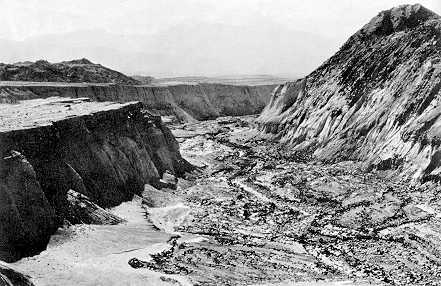
The formation of canyons, such as the Grand Canyon, shows evidence of rapid water erosion rather than slow geological processes. Experiments following events like the eruption of Mount St. Helens in 1980 showed how massive volumes of water can carve canyons in a short period, mirroring what a global flood might accomplish on a larger scale.
Flood Legends Across Cultures
Over 200 flood legends exist among ancient cultures worldwide, including those of the Sumerians, Babylonians, and Native Americans. Many of these accounts include a large vessel, a remnant of humanity and animals, and a divine reason for the flood. Such widespread narratives suggest a historical basis for the biblical account of Noah’s flood.
Biblical Consistency with Science
Genesis describes “the fountains of the great deep” breaking open and “the windows of heaven” releasing water (Genesis 7:11). Modern geology acknowledges subterranean water reserves and their role in catastrophic events. Furthermore, the ark’s dimensions (Genesis 6:15) align with the proportions needed for stability and capacity, as confirmed by naval architects.
Conclusion
While interpretations of evidence vary, the sedimentary layers, polystrate fossils, rapid erosion patterns, and global flood legends align with the Genesis narrative. These findings challenge the notion of slow geological processes and suggest that a catastrophic event, consistent with the biblical flood, is plausible.
Agape,
Spencer
Sources:
Morris, J. “The Global Flood.” Institute for Creation Research.
Snelling, A. “Flood Evidences.” Answers in Genesis.
Several of the world’s denominations teach that Christians cannot sin so as to become lost; that is, there is no way that a true convert of Christ he cannot go to hell may sin, and thereby, receive eternal damnation – he cannot go to hell after having once been saved. This is popularly spoken of as the doctrine of “once saved, always saved”.
On one extreme, this doctrine is expressed as, “True Christians will not sin as they lack the desire and the capability to sin, because their allegiance to Christ has changed their nature”. At its other extreme, this doctrine is expressed as, “No matter how grievous, the sins of Christians will not be held against them in the final judgement”. Those who hold this last view believe that Christians can do wrong, but they also believe that Christ will forgive them of any, and every, sin so that they will be blameless on the day of judgement.
You researched this question to find, not what man teaches, but what the Bible teaches about the possibility of Christians falling from the way of truth, and becoming lost.
The most clear treatment of this subject in the New Testament is found in the second chapter of II Peter. Study this entire chapter carefully. I quote now verses 20 and 21, which best summarize its teachings,
“For if after they have escaped the pollution of the world through the knowledge of the Lord and Saviour Jesus Christ, they are again entangled therein, and overcome, the latter end is worse with them than the beginning. For it had been better for them not to have known the way of righteousness, than, after they have known it to turn from the holy commandment delivered unto them“.
Unquestionably the people spoken of here were once Christians, for the writer speaks of them as those who had, “(quote) escaped from the pollution of the world through the knowledge of the Lord Jesus Christ” (unquote). Unquestionably these same people were, again, entangled in worldly pollution, that is, they had fallen from the way of the truth, and had (again) become sinners. Also, unquestionably they are subject to condemnation for these sins, for the verse says that their final state is worse than their initial state, that is, they are worse off than before they were saved. Thus, the doctrine of “once saved, always saved”, is not supported by the scriptures, for the Bible here shows that Christians can sin, and that they may receive punishment for those deeds.
All verses of the Bible agree with all other verses when the subject is the same, and when the rule, or law of God, is the same. Also, when the rule, or law, is consistent, clear verses serve to explain less clear verses about the same subject. Said in a different way, the Bible never contradicts itself, and the Bible is its own best interpreter. Remember, God cannot lie, and God is not the author of confusion. Study Hebrews 6:18, and I Corinthians 14:33. To illustrate this, we can study verses about baptism (for instance) in the New Testament books written by the apostles John, Paul, and James, and expect agreement. But, we cannot necessarily expect agreement between the Old Testament writings of Moses and the New Testament writings of Paul concerning (say) worship; Moses’ laws were in effect until Jesus’ death ended them. See Col. 2:14. Paul’s writings, however, are a part of the will of Christ, His New Testament. The New Testament is our guide today.
In I John 3:9, we read, “Whosoever is born of God doth not commit sin; for his seed remaineth in him: and he cannot sin, because he is born of God“. If this verse teaches, “once saved, always saved”, it is contrary to II Peter 2:20 and 21 (which we read previously). Thus, a contradiction is forced into the scriptures which cannot exist. However, apparent conflict disappears when we see that the writer is stating the obvious fact that Christians cannot sin and remain faithful followers of the Lord. This is verified by the very same writer in the very same letter where the apostle, John, in I John 1:8-10 says, “If we say that we have no sin, we deceive ourselves, and the truth is not in us. If we confess our sins he is faithful and just to forgive us our sins, and to cleanse us from all unrighteousness. If we say that we have not sinned, we make him a liar, and his word is not in us“.
Here, again, we find an inspired writer telling true believers, Christians (including himself) that they can sin, and that they can do unrighteousness. More deeply, John is here instructing Christians how they can find forgiveness for their sins; Christians are to confess their sins and they will be forgiven them. This instruction is not for sinners who have never become Christians. Christians are citizens of God’s kingdom, and must abide by its rules. People who are not citizens in the kingdom must first become so before its laws apply to them. We suggest that you find how to become a citizen of God’s kingdom through study the message, “What Must I Do To Be Saved?” and “Are We Saved By Faith Only?”.
Belief in, “once saved, always saved” may seem justified by John 10:27-29, “My sheep hear my voice, and I know them, and they follow me: And I give unto them eternal life; and they shall never perish, neither shall any man pluck them out of my hand“. If this scripture proves, “once saved, always saved”, the scriptures contradict each other, and this, of course, is an impossibility. To harmonize the scriptures (to make them agree, one with another), we must notice that Jesus did not say that his sheep could not leave of their own accord; He said that no man could pluck them away.
Each Christian may leave Christ, if he chooses; but unless the individual wishes to go, no one else can make him leave. Notice in verse 27, Jesus said that His sheep, “know me and follow me“, and thus, following, and continuing to follow the Savior is a condition that we must fulfill if the promise, “neither shall any man pluck them out of my hand” is to be kept.
And so, in addition to those things necessary to become saved (namely, believing the word of God, believing that Jesus is the Christ, the Son of God, repenting of (or changing away from) a sinful life, and being baptized into Christ for the remission of sins, we have an additional requirement, that of being faithful unto death (Revelation 2:10).
“Once saved, always saved” is a dangerous doctrine: The Christian who does fall away (upon seeing his sinful life) may conclude that he was never saved and become doubtful of the power of God; another may live a sinful life, and become lost, while believing that God is unmindful of the sins being committed. Either way can result in eternal death for the sinner’s soul, and it would be such a useless death, for (as we have seen), the doctrine of “once saved, always saved” is wrong. The Christian who sins must confess those sins to God, who will forgive them.
“And if it seem evil unto you to serve the LORD, choose you this day whom ye will serve; whether the gods which your fathers served that were on the other side of the flood, or the gods of the Amorites, in whose land ye dwell: but as for me and my house, we will serve the LORD.” (Joshua 24:15).
Being a personal worker is hard. Not only does the personal worker need to be able to present the truth with love, we must also combat error. I’ll admit it, I’ve often taken the “you’re wrong here’s why” approach to evangelism.
Almost on a daily basis, especially Since I started preaching in Borger, I am told fantastic stories of how folks claim to have been saved. At no point is there ever a “thus saith the Lord” with a bible book, chapter, verse reference.
What do we say after those kinds of tales? It’s too easy to shake your head and close off the conversation because we don’t know how to respond.
I’ve discovered a better way, and I want to share it with you. Instead of running away, I see it as an opportunity to share the true Gospel, (Romans 1:16).
It’s called the “As for me…” principle as found in Joshua 24:15. The Apostle Paul used a similar tactic on Mars Hill. “Then Paul stood in the midst of Mars’ hill, and said, Ye men of Athens, I perceive that in all things ye are too superstitious. For as I passed by, and beheld your devotions, I found an altar with this inscription, TO THE UNKNOWN GOD. Whom therefore ye ignorantly worship, him declare I unto you. God that made the world and all things therein, seeing that he is Lord of heaven and earth, dwelleth not in temples made with hands” (Acts 17:22-24).
Here’s how it works. First, I ASK if I can open up to them about my own salvation. I then tell them how I was SAVED according to the commands of God. I had to Hear the gospel (Matt 7:23-29). I Believe that Jesus is the Christ (John 8:24). I Repented and continue to live a penitent life (Luke 13:3). I have Confessed and continue to Confess Jesus before all (Matt 10:32). I was Baptized in Water, just as the Lord commands to have my sins washed away (Mar 16:16; Acts 2:38), and I strive to be Faithful to the Lord all the days of my life even if doing so causes me hurt (Mat 28:20; Rev 2:10). “I know whom I have believed, and am persuaded that he is able to keep that which I have committed unto him against that day” (2Tim 1:12).
Sometimes there are questions about what I’ve said. I answer by saying, “I’ve FOUND that there are many discrepancies between what people say and what God teaches in His word. This next part is important. I ask if I can show them what I did. Then OPEN an actual printed bible for them to see and read for themselves.
I READ to them, (or let them read) those passages that I saw when I first learned the truth. Sometimes I need a few MARGIN notes to remind me where they are. I let the gospel be the power of God unto salvation and not myself for the converting of the soul. Whenever I’ve relied on my own ability to quote scripture, I’ve been met with resistance. One person said, “Satan quoted scripture too.” That push back was helpful because it revealed to me what people are thinking whenever I have quoted verses (even if accurately). It’s hard for people to argue against the Word. They’ll try, but they’ll fail.
Finally, I have no EXPECTATIONS of them. Certainly, my desire is that they come to the knowledge of the truth and be saved, but that’s God’s work. My job is to scatter the seed on the ground of the heart (see Mark 4:14-20). “I have planted, Apollos watered; but God gave the increase” (1Cor 3:6).
Agape,
Spencer
Go here For some helps with scripture when sharing the gospel.
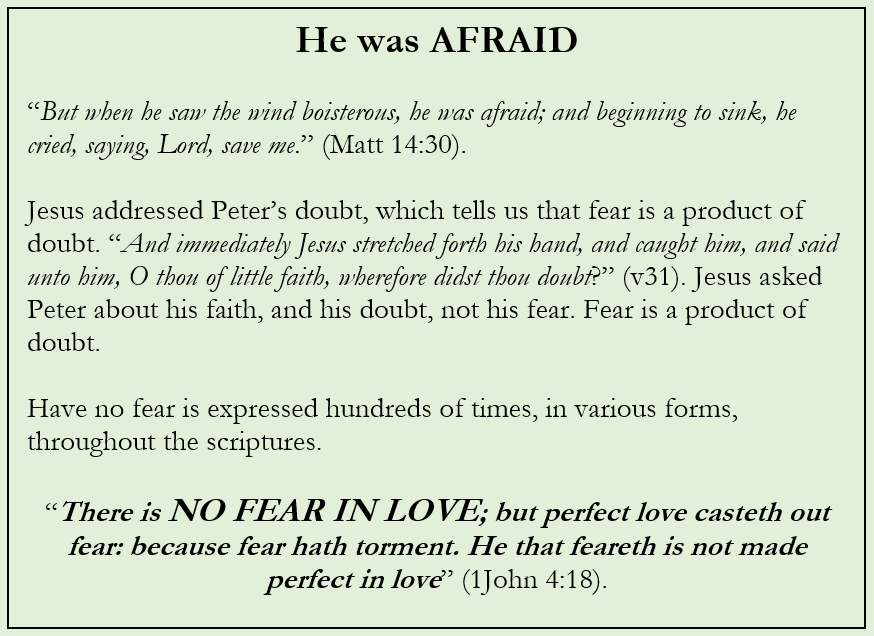
Jesus asked this question of Peter when he began to sink after walking on the water.
“And in the fourth watch of the night Jesus went unto them, walking on the sea. And when the disciples saw him walking on the sea, they were troubled, saying, It is a spirit; and they cried out for fear. But straightway Jesus spake unto them, saying, Be of good cheer; it is I; be not afraid. And Peter answered him and said, Lord, if it be thou, bid me come unto thee on the water. And he said, Come. And when Peter was come down out of the ship, he walked on the water, to go to Jesus. But when he saw the wind boisterous, he was afraid; and beginning to sink, he cried, saying, Lord, save me. And immediately Jesus stretched forth his hand, and caught him, and said unto him, O thou of little faith, wherefore didst thou doubt? And when they were come into the ship, the wind ceased. Then they that were in the ship came and worshipped him, saying, Of a truth thou art the Son of God”
(Matthew 14:25-23).
You may wonder why the Lord was so critical of Peter’s doubt, because walking on water is not normal. But that was not the Lord’s rebuke. Peter was walking on water. Jesus was walking on water. They both walked on water together in the storm.
Do we also doubt in the storms of life? Why do we doubt? What is the source of doubt? This series of articles will seek to search the scriptures for the answer, and to learn how to combat, or to Overcome Doubt.
The first thing we ought to do is to make certain we know what it means. Jesus asked Peter, “why did you doubt (duplicate, i.e. mentally to waver in opinion) [Strong’s Greek dictionary; distazo]. The dictionary defines doubt as; “to be uncertain about; consider questionable or unlikely; hesitate to believe.” DOUBT is the opposite of BELIEF. Therefore, our first source of DOUBT is DISBELIEF. This will be the ultimate root of all the sources.
DISBELIEF is the target of the Lord’s question to Peter (v31), and is our challenge today. Belief in God is the beginning of our salvation. It’s placed first of all other commands in obeying the gospel. Works without faith is vanity. Faith is a work (John 6:29; 1Thess 1:3; 2Thess 1:11).
“But without faith it is impossible to please him: for he that cometh to God must believe that he is, and that he is a rewarder of them that diligently seek him” (Hebrews 11:6).
“He that believeth and is baptized shall be saved; but he that believeth not shall be damned” (Mark 16:16).
The type of Belief under consideration is compared to the faith of Abraham when he went to sacrifice the son of promise. “Was not Abraham our father justified by works, when he had offered Isaac his son upon the altar? Seest thou how faith wrought with his works, and by works was faith made perfect? And the scripture was fulfilled which saith, Abraham believed God, and it was imputed unto him for righteousness: and he was called the Friend of God. Ye see then how that by works a man is justified, and not by faith only” (James 2:21-24). His belief was so certain that he supposed God would raise Isaac from the dead (Heb 11:17).
However, faith is not blind. “Now faith is the substance of things hoped for, the evidence of things not seen” (Hebrews 11:1). There’s evidence to believe. Peter’s evidence was the prior miracles of Jesus (which are still evidence for us today John 20:30-31). Peter had participated in the feeding of the 5,000 just preceding his water ambulation. How many steps he made on the water we do not know, but one step out of a boat into the deep stormy waters is sufficient. He had gone out in the limited commission with powers, “against unclean spirits, to cast them out, and to heal all manner of sickness and all manner of disease” (Matthew 10:1).
Well, that was Peter you may say; what about us? We don’t see those miracles today. No, we don’t see biblical miracles today, but that’s okay. The miracles Peter saw, and those in the early church are for our belief. “And many other signs truly did Jesus in the presence of his disciples, which are not written in this book: But these are written, that ye might believe that Jesus is the Christ, the Son of God; and that believing ye might have life through his name” (John 20:30-31). But there’s more…
God’s word says that God’s creation is for belief. “Because that which may be known of God is manifest in them; for God hath shewed it unto them. For the invisible things of him from the creation of the world are clearly seen, being understood by the things that are made, even his eternal power and Godhead; so that they are without excuse” (Romans 1:19-20). God’s creation is enough to begin our belief in Him.
Paul used this same evidence for belief. “Nevertheless he left not himself without witness, in that he did good, and gave us rain from heaven, and fruitful seasons, filling our hearts with food and gladness” (Acts 14:17; 17:27-28). The evidence of creation and human life will point you in the right direction to look further. There are only 2 possibilities about creation: 1) that everything came from a thoughtless nothing, or 2) everything came from a very wise, powerful, and brilliant God.
Belief is not blind. It has evidence and there’s so much evidence inside and outside of scripture. If you doubt, perhaps a study of evidences is for you to combat that doubt. Here are a few areas to study…
I have a few resources in my library. One of my favorites is by a brother in Christ named A.O. Schnabel, “Has God Spoken?” This book references scriptures of nature that science discovered many hundreds and thousands of years later. Some discoveries as recent as the 1960’s!
There’s no need to doubt. We can know and be assured.
We need to know enough to be able to speak the SAME things.
Now I beseech you, brethren, by the name of our Lord Jesus Christ, that ye all speak the SAME thing, and that there be no divisions among you; but that ye be perfectly joined together in the SAME mind and in the SAME judgment. (1Cor1:10)
Can you know too much about SALVATION? Are all churches teaching the SAME thing as The Bible? Are we teaching the SAME thing as Jesus.
What did Jesus say about SALVATION?
Matthew 7:24 KJV
Therefore whosoever HEARS these sayings of mine, and doeth them, I will liken him unto a wise man, which built his house upon a rock:
John 8:24 KJV
I said therefore unto you, that ye shall die in your sins: for if ye BELIEVE not that I am he, ye shall die in your sins.
Luke 13:3,5 KJV
I tell you, Nay: but, except ye REPENT, ye shall all likewise perish. [5] I tell you, Nay: but, except ye REPENT, ye shall all likewise perish.
Matthew 10:32-33 KJV
Whosoever therefore shall CONFESS me before men, him will I CONFESS also before my Father which is in heaven. [33] But whosoever shall deny me before men, him will I also deny before my Father which is in heaven.
Mark 16:16 KJV
He that believeth and is BAPTIZED shall be saved; but he that believeth not shall be damned.
It’s water baptism. Notice what the first Christian evangelists taught.
Acts 8:35-36 KJV
Then Philip opened his mouth, and began at the same scripture, and preached unto him JESUS. [36] And as they went on their way, they came unto a certain WATER: and the eunuch said, See, here is WATER; what doth hinder me to be BAPTIZED?
Baptism is a burial in water.
Colossians 2:12 KJV
BURIED with him in BAPTISM, wherein also ye are risen with him through the faith of the operation of God, who hath raised him from the dead.
Matthew 28:20 KJV
Teaching them to OBSERVE ALL THINGS whatsoever I have COMMANDED you: and, lo, I am with you alway, even unto the end of the world. Amen.
Does your church teach the SAME as Jesus about how to be saved? Does it teach the SAME purpose?
Hear, Believe, Repent, Confess, water Baptism, & Faithfulness.
Which can you add, change, or remove and still be speaking the SAME thing as Jesus, Peter, Philip, Paul & the rest of the NT?
Recently, someone asked me why I got into preaching. I gave an answer that had two main motivations. Afterward, I got to thinking about why we preach at all. From this study I came up with 4 more reasons why we preach.
Why do we PREACH?
HEARING requires preaching. Rom 10:14) How then shall they call on him in whom they have not believed? and how shall they believe in him of whom they have not heard? and how shall they hear without a preacher? Hearing is the first step in God’s plan to save mankind. There will be no “zapping” of the Holy Spirit to save us. We must Seek Him through a study of His word.
CHRIST commanded preaching. Mark 16:15) And he said unto them, Go ye into all the world, and preach the gospel to every creature. Before He ascended into heaven, Christ commanded that the Gospel be preached. Who am I to go against a command of Christ?
Luke 6:46) And why call ye me, Lord, Lord, and do not the things which I say?
ANGELS are looking into it. 1Pet 1:10-2) Of which salvation the prophets have enquired and searched diligently, who prophesied of the grace that should come unto you: 11 Searching what, or what manner of time the Spirit of Christ which was in them did signify, when it testified beforehand the sufferings of Christ, and the glory that should follow. 12 Unto whom it was revealed, that not unto themselves, but unto us they did minister the things, which are now reported unto you by them that have preached the gospel unto you with the Holy Ghost sent down from heaven; which things the angels desire to look into. The gospel that was preached by the Apostles, then recorded for us in the written word, was searched out by Angels. That’s amazing to me. Yet we often don’t read it, much less to search through it diligently.
EVERYONE I know needs it. Matt 28:19; Col 1:27-28) To whom God would make known what is the riches of the glory of this mystery among the Gentiles; which is Christ in you, the hope of glory: 28 Whom we preach, warning every man, and teaching every man in all wisdom; that we may present every man perfect in Christ Jesus: Every person needs Christ and to obey His gospel. The gospel is about the death, burial, and resurrection of Jesus. (cf 2Thess 1:7-8; 2Pet 3:9)
I’m REQUIRED to preach. 1Cor 9:16) For though I preach the gospel, I have nothing to glory of: for necessity is laid upon me; yea, woe is unto me, if I preach not the gospel! Now it gets a little more personal. Since I’ve become an evangelist, one who’s main work is to preach the gospel, woe unto me if I don’t. This is what I do, spread the gospel. I’ve become that guy who needs to talk about Jesus anytime I’m in the presence of another person.
PERSONAL REASONS Luke 16:19-31) And it came to pass, that the beggar died, and was carried by the angels into Abraham’s bosom: the rich man also died, and was buried; 23 And in hell he lift up his eyes, being in torments, and seeth Abraham afar off, and Lazarus in his bosom. The last reason, and maybe the most emotional reason, is that those that I love the most are dying OUTSIDE of Christ. They have not all obeyed the Gospel and are in jeopardy of their souls. All of us need to take this seriously. In the story of the Rich man & Lazarus, the Rich man became very evangelistic upon discovery of his fate. This motivates me to be evangelistic in life!!
This is why I PREACH the Gospel.
Agape,
Spencer
Spencer is a gospel preacher for the church of Christ at Franklin & Juniper in Borger, Texas.
The phrase “God has a plan for you” is one of the most Disheartening, Destructive, and Dangerous false Doctrines taught today. It’s based on an abuse of the context of Jeremiah’s prophecy. God does have a plan for you. It’s the same plan for everyone. Ecclesiastes 12:13 KJV Let us hear the conclusion of the whole matter: Fear God, and keep his commandments: for this is the whole duty of man. 2 Peter 3:9 KJV The Lord is not slack concerning his promise, as some men count slackness; but is longsuffering to us-ward, not willing that any should perish, but that all should come to repentance. Mark 16:15-16 KJV And he said unto them, Go ye into all the world, and preach the gospel to every creature. [16] He that believeth and is baptized shall be saved; but he that believeth not shall be damned. 1 Thessalonians 4:11-12 KJV And that ye study to be quiet, and to do your own business, and to work with your own hands, as we commanded you; [12] That ye may walk honestly toward them that are without, and that ye may have lack of nothing.
God’s PLAN for you and me. God is no respect of persons. Acts 10:34. He has the same PLAN for the whole world. SADLY, MOST WON’T FOLLOW IT. 1) PUT on Christ. Galatians 3:27 KJV For as many of you as have been baptized into Christ have put on Christ. Mark 16:15-16 KJV And he said unto them, Go ye into all the world, and preach the gospel to every creature. [16] He that believeth and is baptized shall be saved; but he that believeth not shall be damned. 2) LOVE the Lord, His commands, His children, and everyone. Matthew 22:37,39 KJV Jesus said unto him, Thou shalt love the Lord thy God with all thy heart, and with all thy soul, and with all thy mind. [39] And the second is like unto it, Thou shalt love thy neighbour as thyself. 1 John 5:3 KJV For this is the love of God, that we keep his commandments: and his commandments are not grievous. 3) ASPIRE to live a quiet and peaceful life. 1 Thessalonians 4:11-12 KJV And that ye study to be quiet, and to do your own business, and to work with your own hands, as we commanded you; [12] That ye may walk honestly toward them that are without, and that ye may have lack of nothing. 1 Timothy 2:2-4 KJV For kings, and for all that are in authority; that we may lead a quiet and peaceable life in all godliness and honesty. [3] For this is good and acceptable in the sight of God our Saviour; [4] Who will have all men to be saved, and to come unto the knowledge of the truth. 4) NEVER quit being faithful even in the face of pain, persecution, and personal struggles. Revelation 2:10 KJV Fear none of those things which thou shalt suffer: behold, the devil shall cast some of you into prison, that ye may be tried; and ye shall have tribulation ten days: be thou faithful unto death, and I will give thee a crown of life. Matthew 10:22 KJV And ye shall be hated of all men for my name’s sake: but he that endureth to the end shall be saved.
For several years it has been my custom to carry my bible into the public and to read privately, but openly. Many folks will comment, or be complimentary. Many more will walk on by. A few will stop to talk about their faith.
This article is a blending of several of those conversations. These two examples are representative of almost all of them. Most of these folks have the identical objections to the Bible. The objections are so common that I’ve actually made a list of the top 10 most common ones along with scriptural answers.
I have not raised my voice, become angry (Jas 1:20), and have avoided any rudeness on my part. I wish it could be said of the other part. Some have been very pleasant and have resulted in a few conversions.
Person A: You don’t have to be baptized to be saved? You just need to ask Jesus into your heart.
Person B: So, you believe this version of Mark 16:16? “He that believeth and is (NOT) baptized shall be saved.”
Person A: My grandma was a wonderful woman. She never went to church, never had religion, but she was so kind to all.
Person B: So, you believe this version of Mark 16:16? “He that believeth (NOT) and is (NOT) baptized shall be saved.” Are you suggesting a works-based salvation?
Person A: I have a friend whose baby was baptized (sprinkled).
Person B: So, they believe this version of Mark 16:16? “He that believeth (NOT) and is baptized (sprinkled) shall be saved.” Babies are incapable of faith, so they’re safe according to Jesus (Mark 10:13-15).
Person A: I have heard that there’s only heaven and not eternal hell.
Person B: So, you believe this version of Mark 16:16? “He that believeth and is baptized shall (NOT) be saved.” Jesus said, “And these shall go away into everlasting punishment: but the righteous into life eternal.” (Matt 25:46). Jesus uses the same word (aiōnion) to describe both. Jesus said, “He that believeth and is baptized shall be saved; but he that believeth not shall be damned.” It’s so simple, let’s just do what Jesus said.
Person A: you’re going to hell if you believe baptism saves you.
Person B: “The like figure whereunto even baptism doth also now save us (not the putting away of the filth of the flesh, but the answer of a good conscience toward God,) by the resurrection of Jesus Christ:” (1Pet 3:21)
Person A: what about the thief on the cross? Ha! Gotcha.
Person B: The thief received his inheritance before the testator died. (Think about how WILLS work). Now that the Testator (Jesus) has died (and rose again to heaven), we are bound to follow His will. “For where a testament is, there must also of necessity be the death of the testator. [17] For a testament is of force after men are dead: otherwise it is of no strength at all while the testator liveth.” (Heb 9:16-17)
Person A: (screaming) YOU DON’T HAVE TO BE BAPTIZED TO BE SAVED!!!!!
Person B: I see that you’re upset. I’ll not talk to you about it anymore. (Matt 15:14)
Person A: Satan quoted scripture too.
Person B: have a nice day.
“That’s just your opinion”
(Based on an actual conversation)
Person B is handing out religious tracks at the fair.
Person A: (using person B’s personal pocket Bible they used to show scripture) the Bible says; “He that believeth and is baptized shall be saved; but he that believeth not shall be damned.” (Mark 16:16)
Person B: That’s just your opinion.
Person A: wait, what? I just read the scripture directly.
Person B: That’s just your interpretation.
Person A: I didn’t interpret nor did I comment. I just quoted the passage. We could read the whole chapter (Bible) and it wouldn’t change it.
Person B: You’re just a legalist.
Person A: How’s that? I’m reading the words of Jesus. Are you saying Jesus is a legalist too?
Person B: We’re saved by grace alone, through faith alone, in Christ alone.
Person A: Are you interested in reading the only passage in all of the Bible that says “by faith alone?”
Person B: (closes their pocket New Testament & places it in back pocket) “nope.”
Person A: I’m sorry to have bothered you. Have a nice day.
Person B: ☹
Agape,
Spencer is an evangelist for the church of Christ at Franklin & Juniper in Borger Texas.









 Borger church of Christ @ Franklin & Juniper