the Truth about GRACE

A Bible-Only Perspective

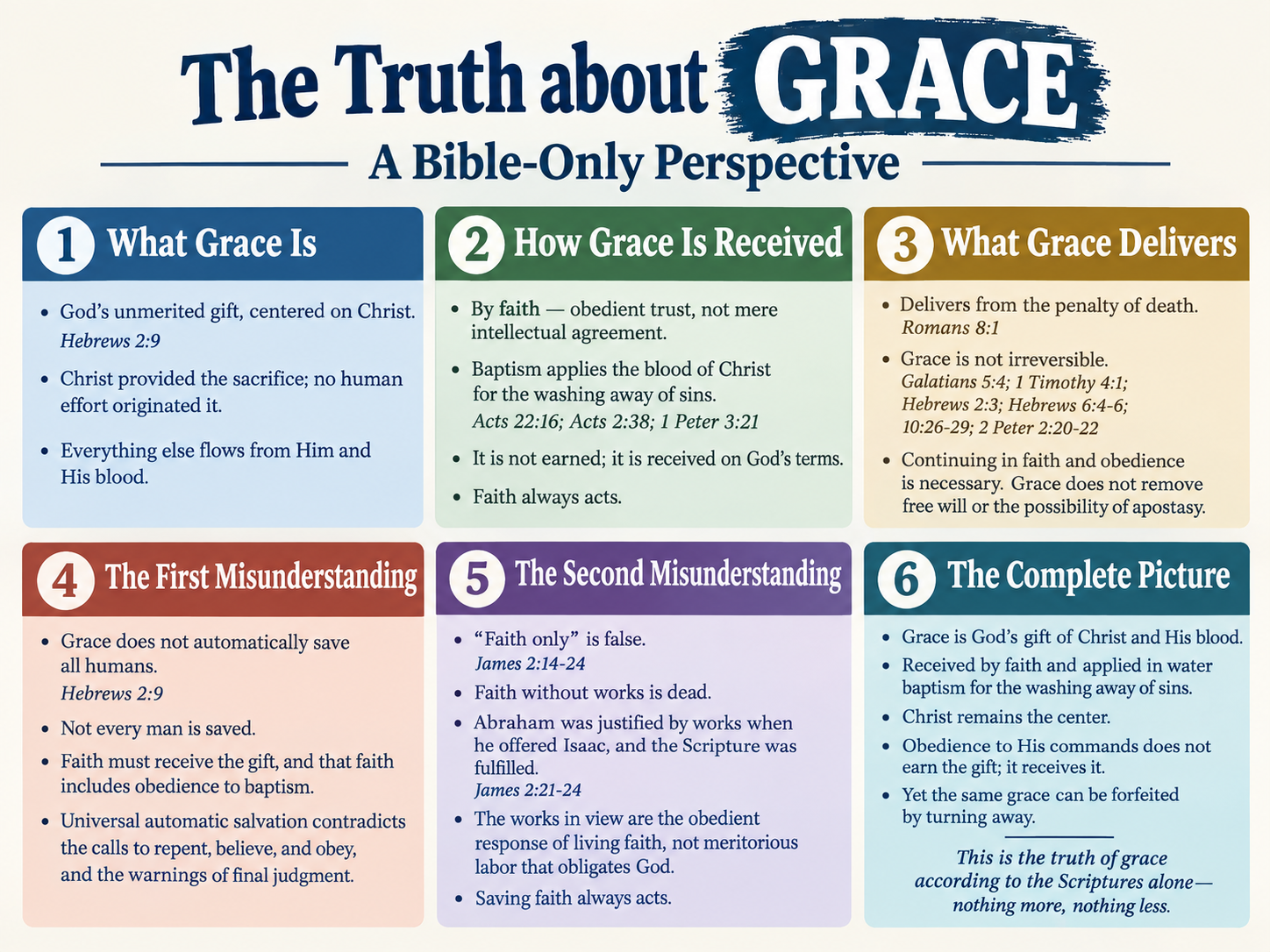
The religious world remains deeply confused about the grace of God. Many treat it as an automatic covering for every person regardless of response, or reduce it to a mental assent called “faith only.” Scripture alone presents a clear, consistent picture centered on Christ.

Grace is God’s unmerited GIFT expressed supremely in the sending of His Son to taste death for every man. Hebrews 2:9 declares that Jesus “by the grace of God should taste death for every man.” This is the heart of grace: God provided the sacrifice. No human effort originated it. Christ is the focus of the grace of God. Everything else flows from Him and His blood.

On man’s side, this grace is RECEIVED by faith. Faith is the obedient trust that takes hold of what God has freely offered. It is never mere intellectual agreement. The blood of God’s grace—the blood that cleanses from sin—is APPLIED when a believing person is baptized in water. At that point sins are washed away by His blood. Acts 22:16 records the command, “Arise, and be baptized, and wash away thy sins, calling on the name of the Lord.” Acts 2:38 links repentance and baptism “for the remission of sins.” First Peter 3:21 states that baptism “doth also now save us.” The power is not in the water itself but in the blood of Christ applied through the obedient act God appointed. COMPLYING with the Lord’s COMMAND is not earning salvation; it is receiving the gift on the terms God set. No one works his way into grace by obeying; one simply submits so that the blood can cleanse.

Grace delivers from the penalty of death. Through Christ we ESCAPE condemnation. Yet Scripture nowhere presents grace as irreversible once received. A person can be EJECTED from grace by turning away from God. Galatians 5:4 warns those who seek justification by law that “ye are fallen from grace.” 1Timothy 4:1 speaks of some who “shall depart from the faith.” Hebrews 2:3 asks how we shall escape if we neglect so great salvation. These and similar passages (Hebrews 6:4-6; 10:26-29; 2 Peter 2:20-22) show that continuing in faith and obedience is necessary. Grace does not cancel free will or remove the possibility of apostasy.

Two common misunderstandings distort this biblical picture. The first is the idea that grace automatically saves all humans. Hebrews 2:9 shows Christ died for every man, yet not every man is saved. Faith must receive the gift, and that faith includes the obedience of baptism for the washing away of sins. Universal automatic salvation contradicts the many calls to believe, repent, and obey, as well as the warnings of final judgment.

The second error is “faith only.” James 2:14-24 addresses it directly. Faith without works is dead. Abraham was justified by works when he offered Isaac, and the Scripture was fulfilled that “Abraham believed God, and it was imputed unto him for righteousness.” James concludes, “Ye see then how that by works a man is justified, and not by faith only.” The works in view are not meritorious labor that obligates God; they are the obedient response of living faith. Saving faith always acts. Separating faith from the obedience God requires empties faith of its biblical meaning and leaves a person still in sin.

Thus, the Bible’s teaching is straightforward. Grace is God’s gift of Christ and His blood. That grace is received by faith and applied in water baptism for the washing away of sins. Christ remains the center. Obedience to His commands does not earn the gift; it receives it. Yet the same grace can be forfeited by turning away. This is the truth of grace according to the Scriptures alone—nothing more, nothing less.

A New and Living Way; Hebrews 10:20

The New and Living Way

“By a new and living way, which he hath consecrated for us, through the veil, that is to say, his flesh.” Hebrews 10:20

There is something striking about the way the Bible describes what God has done through Jesus Christ. It repeatedly uses the word new.

God promised a new covenant. Christ established it. Those who come to Christ receive new life. They become new creatures. They put off the old man and put on the new man. They receive a new identity and are called by a new name. They are taught to live differently.

This is more than an updated version of an old religion. Jesus opened “a new and living way.

A NEW COVENANT

The coming of something new was not a surprise. God had promised it hundreds of years before Christ came.

Jeremiah wrote: “Behold, the days come, saith the LORD, that I will make a new covenant…” Jeremiah 31:31

God promised a covenant in which He would forgive iniquity and write His law upon the hearts of His people.

The prophets also spoke of an everlasting covenant and a covenant of peace. Isaiah spoke of God’s Servant being given “for a covenant of the people” (Isaiah 42:6). Ezekiel spoke of an “everlasting covenant” (Ezekiel 37:26).

Then Jesus came. When He instituted the Lord’s Supper, He said: “For this is my blood of the new testament, which is shed for many for the remission of sins…” Matt 26:28

Hebrews explains exactly what happened: “In that he saith, A new covenant, he hath made the first old.” Hebrews 8:13

Christ did not simply repair the first covenant. He established a new one. (see Heb 7:12-14)

And that new covenant is the covenant under which we live today.

A New LIFE and a New Creation

The new covenant calls for a new kind of life.

Paul wrote: “Therefore if any man be in Christ, he is a new creature.” 2Cor 5:17

That is personal. If I am in Christ, I am not supposed to remain the same person I was before.

Galatians 6:15 says that what matters is being “a new creature.”

The prophets had already pointed toward this kind of change. Isaiah recorded God’s promise: “Behold, I will do a new thing…” Isaiah 43:19

The New Testament shows us that this new work begins in those who obey the gospel of Christ.

God does not simply give us a new set of beliefs. He calls us to a new life.

Buried (IMMERSED in baptism) and Raised to Newness of Life

Romans 6 makes the connection even clearer. Paul says: “Therefore we are buried with him by baptism into death: that like as Christ was raised up from the dead… even so we also should walk in newness of life.” Romans 6:4

Notice the progression.

We are buried with Christ. We are raised with Christ. THEN we walk in newness of life.

Colossians 2:12 describes us as being “buried with him in baptism” and raised with Him.

Galatians 3:27 says: “For as many of you as have been baptized into Christ have put on Christ.”

What baptism is Paul talking about?

He is talking about immersion in water.

The word baptism means immersion, and the Bible repeatedly connects baptism with water. The Ethiopian eunuch went down into the water with Philip, and they came up out of the water (Acts 8:36-39). Peter commanded baptism with water (Acts 10:47-48). Ananias told Saul to arise and be baptized and wash away his sins (Acts 22:16).

This is not something man invented. Jesus commanded it.

Jesus said: “Go ye therefore, and teach all nations, baptizing them…” Matthew 28:19

Mark records: “He that believeth and is baptized shall be saved…” Mark 16:16

Water baptism is therefore not a work that replaces faith. It is an act of obedient faith.

The question is not whether baptism is a human work that earns salvation. It does not.

The question is whether a person who believes Jesus should obey what Jesus commanded.

  • Jesus commanded baptism.
  • The apostles commanded baptism.
  • And when people believed the gospel, they were baptized.

Acts 2:41 says those who gladly received the word were baptized.

Acts 8:12 says men and women believed and were baptized.

Acts 18:8 says many Corinthians hearing, believed, and were baptized.

Faith does not make obedience unnecessary.

Faith obeys.

That is why Romans 6 connects baptism with being buried and raised with Christ and then walking in newness of life.

Baptism is not presented as an empty ceremony. It is connected with entering Christ, being raised with Him, and beginning a new life.

The Christian life is supposed to look different because the Christian has become different.

New Wine and New VESSELS

Jesus used another picture to describe what He was bringing.

“New wine must be put into new bottles.” Mark 2:22

The point is simple. The new work Christ was doing called for something new.

We cannot claim the new life Christ gives us while continuing to live according to the old life we left behind.

The gospel is not just something we add to our lives.

It changes our lives.

A New Man in a New IMAGE

Paul gives us another powerful picture in Ephesians 4.

He tells Christians to put away the old manner of life and: “put on the new man, which after God is created in righteousness and true holiness.” Ephesians 4:24

Colossians 3:9-10 says: “Ye have put off the old man with his deeds; And have put on the new man…”

Then Paul explains that the new man is: “renewed in knowledge after the image of him that created him.”

That is what Christ is doing in us.

We put off the old man. We put on the new man. We become more like Christ.

Christianity is not about becoming a slightly improved version of the old me. It is about becoming a new man in Christ.

A New NAME

God also promised that His people would receive a new name.

Isaiah wrote: “thou shalt be called by a new name, which the mouth of the LORD shall name.” Isaiah 62:2

Isaiah 65:15 speaks of God calling His servants “by another name.”

Then we come to the New Testament.

Acts 11:26 tells us: “And the disciples were called Christians first in Antioch.”

James refers to “that worthy name by the which ye are called” (James 2:7).

Peter says: “if any man suffer as a Christian, let him not be ashamed.” 1 Peter 4:16

Revelation also speaks of a “new name” given to those who belong to Christ (Rev 2:17; 3:12).

God gives His people a new identity.

We are not defined by who we used to be. We belong to Christ.

New GARMENTS

The Bible also describes this new identity as putting on new clothing.

Isaiah wrote: “he hath clothed me with the garments of salvation, he hath covered me with the robe of righteousness.” Isaiah 61:10

Paul uses the same kind of language when he says: “put ye on the Lord Jesus Christ.” Romans 13:14

And again: “put on the new man.” Eph 4:24

Colossians 3 tells us what these new garments look like. We put on mercy, kindness, humility, meekness, patience, forgiveness, and love.

This is what the new life should look like.

We take off the old behavior and put on Christ.

The New and Living Way

Put all of this together and the message becomes clear.

God promised a new covenant.

Christ established it through His blood.

Those who come to Christ receive new life.

Through baptism, we are buried and raised to newness of life.

We become a new creation at baptism.

We put off the old man and put on the new man.

We receive a new identity and name.

We put on new garments of righteousness, holiness, and love. Galatians 3:27

And all of it points us back to Hebrews 10:20:

“A new and living way.”

Jesus did not merely make the old way easier. He opened a new way to God.

The question is not simply whether we believe that Jesus opened that way.

The question is whether we are walking in it.

If I have entered the new covenant, I should live a new life.

If I have been raised to newness of life, I should not keep living like the old man.

If I have put on Christ, people should be able to see Christ in the way I live.

That is the challenge of the new and living way.

Christ made all things new. He calls us to live as new people.

agape

spencer

Cornelius was such a great guy

Blessed is the man that walketh not in the counsel of the ungodly, nor standeth in the way of sinners, nor sitteth in the seat of the scornful. But his delight is in the law of the LORD; and in his law doth he meditate day and night. And he shall be like a tree planted by the rivers of water, that bringeth forth his fruit in his season; his leaf also shall not wither; and whatsoever he doeth shall prosper.” (Psalms 1:1-3)

We all know someone who seems to meet every standard of goodness that human opinion can invent.

I can recall a person in my life who left an impression of goodness, kindness, generosity, and made me feel special just for being me. Some things I recall about them is that they were believers in God, prayerful, and had a good reputation among all. This kind person lit up every room they entered, and nearly everyone smiled and was glad to see them.

If you were to ask my opinion back then I would say these folks exemplified someone bound for heaven. If anyone was ready for heaven it would be them.

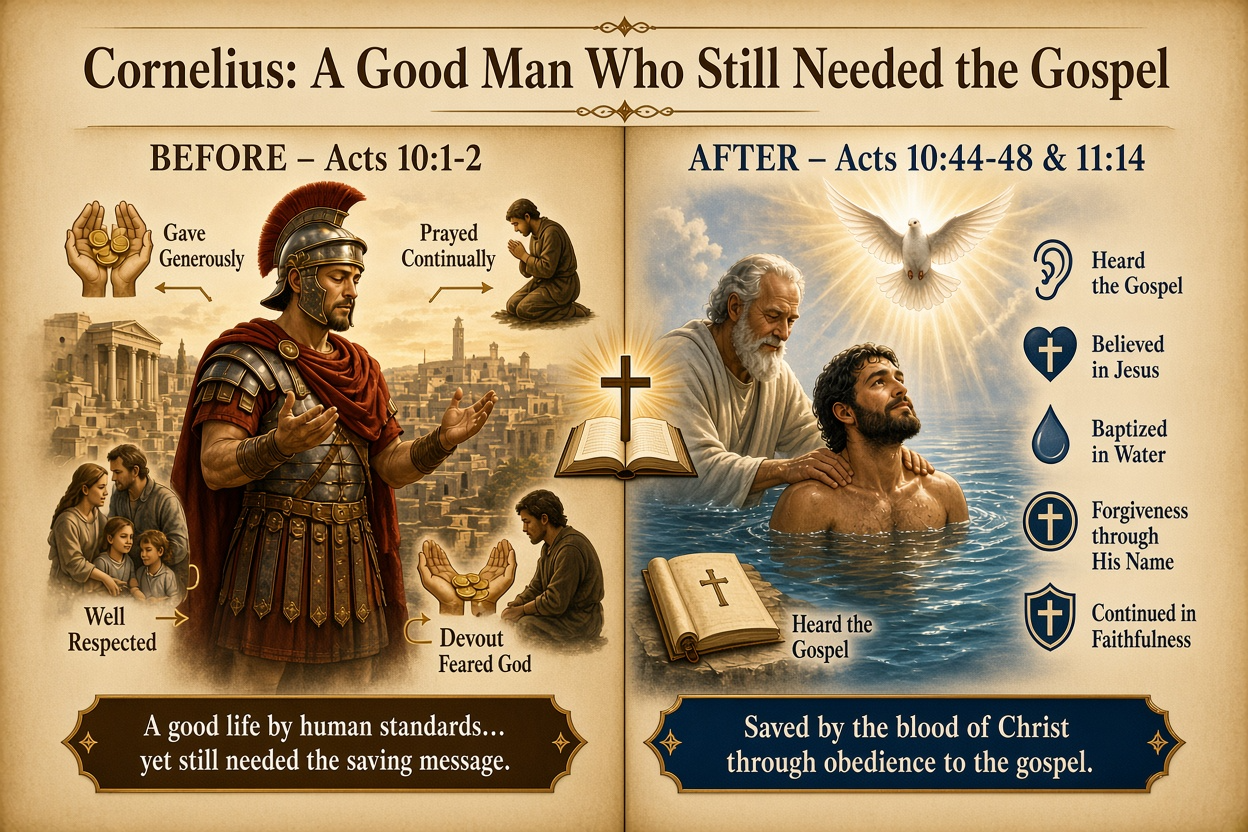
A similar real person appears in the pages of Scripture. Acts 10 and 11 tell us of a man named Cornelius, a centurion of the Italian cohort stationed in Caesarea. The text states that he was a devout man who feared God with all his household, gave alms generously to the people, and prayed continually to God. The report about him among men was, “a just man, and one that feareth God, and of good report among all the nation of the Jews…” (Acts 10:22). Left to us that would be the whole of the story. That would be our eulogy at his funeral had he died before the rest of the events in Acts 10 & 11.

An angel of God appeared to him and said that his prayers and alms had ascended as a memorial before God. The angel directed him to send men to Joppa for Simon who is called Peter. Cornelius obeyed at once. When Peter arrived, Cornelius gathered his relatives and close friends to hear the message. Peter would relate later what Cornelius told him, “how he had seen an angel standing in his house, who said to him, ‘Send men to Joppa, and call for Simon whose surname is Peter, who will tell you words by which you and all your household will be saved’” (Acts 11:13-14). You see, the angel told him he needed to hear words to be SAVED.

Peter proclaimed Jesus of Nazareth: how God anointed Him with the Holy Spirit and with power, how He went about doing good and healing, how He was put to death and raised on the third day, and how God appointed Him to be judge of the living and the dead. Peter declared that to Him all the prophets bear witness that everyone who believes in Him receives forgiveness of sins through His name. He preached the Gospel (v38-43).

While Peter was still speaking these words, the Holy Spirit fell on all who heard the message. The circumcised believers who had come with Peter were amazed because the gift of the Holy Spirit had been poured out even on the Gentiles. They heard them speaking in tongues and extolling God. “And as I began to speak, the Holy Spirit fell upon them, as upon us at the beginning” (Acts 11:15-16). This outpouring served as clear evidence that God was accepting the Gentiles.

Peter then asked “Can any man forbid water, that these should not be baptized,” (Acts 10:47). He commanded them, “to be baptized in the name of the Lord” (v48). Cornelius heard that message, believed in Jesus, and was baptized in water. He and his household continued thereafter in the way of the Lord.

The account leaves no room for doubt. Despite the genuine devotion, generous alms, continual prayer, and godly fear that marked Cornelius’s life, he still needed to hear the words by which he would be saved. Human reasoning might have concluded that such a person already stood accepted. Scripture records otherwise. The gospel required hearing about Jesus, believing in Him for the forgiveness of sins, and being baptized in water. The Holy Spirit’s descent confirmed God’s acceptance of the Gentiles, yet water baptism still followed as the commanded completion of faith.

We must not confuse a good life with having earned or owed salvation. A life filled with generosity, prayer, and respect may impress others, yet it cannot purchase forgiveness. We all need the blood of Christ. Nobody is saved outside of Christ, no matter how good we think they are. The same truth applies to the kind person I talked about at the beginning.

No matter how generous, prayerful, respected, or devout that individual may seem, the same need remains. Romans 3:23 states that “all have sinned and fall short of the glory of God.” Character that impresses people does not remove the requirement to hear the gospel of Jesus Christ, believe in Him, be baptized in water, and continue in faithfulness.

Cornelius’s story stands as a clear demonstration that even the most admirable life by human standards still requires obedience to the message that saves through the blood of Christ.

Agape
spencer

GO, TEACH, BAPTIZE… Who Does what?


“Go ye therefore, and teach all nations, baptizing them in the name of the Father, and of the Son, and of the Holy Ghost:” (Matt 28:19).

Who does what?
This may appear like a simple question to you, but some are making it difficult and are opposing Jesus’ commands on how to be saved. Here’s how the objection sounds; “Water is not stated in that verse therefore it’s Holy Spirit baptism.” They will make this claim in all the places that baptism is commanded, (see Acts 2:38; 8:12; 9:1-18; 22:16; 16:15; 25-34).

There are several ways to answer this objection but let’s just look at a simple and logical one; Answer the question: Who is being commanded to do what?

In every case that a command is given, the one receiving the command is the one expected to perform it. This includes both inward actions (faith, believing, repentance, loving) and outward actions (going, teaching, baptizing, praying, singing, giving). Scripture never presents a command that is fulfilled by another person performing the commanded action in the place of the one commanded. In other words, the command is being given to people to do, therefore people comply with the action being commanded.

Faith is not excluded from this principle simply because it is inward.
• Jesus commanded: “Believe the gospel.” (Mark 1:15);
• Paul told the jailer: “Believe on the Lord Jesus Christ.” (Acts 16:31);
• John writes: “This is his commandment, That we should believe on the name of his Son Jesus Christ.” (1 John 3:23);

Believing is therefore something the hearer is commanded to do. Likewise:
• Repent (Acts 17:30);
• Confess (Romans 10:9-10);
• Continue in the faith (Colossians 1:23).

These are personal responses. Although invisible to others, they are nevertheless actions of the person commanded. (this same reasoning answers other similar objections).

Back to Matthew 28:19; what kind of baptism can a person administer who is commanded to “go…baptizing them”? A human being cannot administer: the baptism of the Holy Spirit, nor the baptism of fire. John the Baptist distinguished these. “I indeed baptize you with water unto repentance… he shall baptize you with the Holy Ghost, and with fire” (Matthew 3:11). Notice the distinction. John administered water baptism. Christ administers Holy Spirit baptism. The administrator identifies the baptism. Only Jesus is ever said to baptize with the Holy Spirit. No apostle is ever commanded to baptize anyone with the Holy Spirit. But the apostles are commanded to baptize. Therefore, the baptism they administer must be one that men can administer. That baptism is water baptism.

Matthew 28 does not have to mention water explicitly. It identifies the administrator. Once Scripture identifies that men are to administer the baptism, the only baptism men are ever shown administering is water baptism.

Necessary inference. When Scripture gives a command:
• The person commanded is responsible for performing the commanded action.
• Matthew 28:19 commands people to baptize.
• People can administer only water baptism.
• Therefore, the baptism commanded in Matthew 28:19 is water baptism administered by one person to another.

Agape
Spencer

BONUS ANSWER: Acts 8:34-39
“And the eunuch answered Philip, and said, I pray thee, of whom speaketh the prophet this? of himself, or of some other man?
35 Then Philip opened his mouth, and began at the same scripture, and preached unto him Jesus.
36 And as they went on their way, they came unto a certain water: and the eunuch said, See, here is water; what doth hinder me to be baptized?
37 And Philip said, If thou believest with all thine heart, thou mayest. And he answered and said, I believe that Jesus Christ is the Son of God.
38 And he commanded the chariot to stand still: and they went down both into the water, both Philip and the eunuch; and he baptized him.
39 And when they were come up out of the water, the Spirit of the Lord caught away Philip, that the eunuch saw him no more: and he went on his way rejoicing.”

What Inescapable conclusions do you draw from this passage?

The Scheme of Redemption

THE SCHEME (PLAN) OF REDEMPTION:

Creation and the Entrance of Sin

  1. Genesis 1:27 God created man in His own image.
  2. Ecclesiastes 7:29 Man sought to sin
  3. Romans 3:9, 10, 23 All stand as sinners before God.

The Nature and Definition of Sin

  1. 1 John 1:8 If one says he has no sin he is not truthful. What is sin?
  2. 1 John 5:17 Sin is unrighteousness.
  3. Romans 1:16 Righteousness is revealed in the Bible.
  4. 1 John 3:4 Sin is lawlessness (acting without law). What law?
  5. James 1:25 Authority is found in the perfect law of liberty, the gospel of Christ.
  6. Romans 14:23 Whatever is not of faith is sin. How does one get faith?
  7. Romans 10:17 Faith comes by hearing the word of God.
  8. James 4:17 Not doing good is sin. How does one know what is good?
  9. Micah 6:8 What is good is shown by God to man in the Bible.

The Tragic Consequences of Sin
1) Isaiah 59:1-2 Sin is tragic. It separates man from God. (Separates; Injures; Never lets go)
2) Romans 6:23 Without God’s help, sin will separate man from God eternally.

God’s Love and Provision for Salvation
1) John 3:16 God’s love made it possible for man not to die because of his sin.
2) Matthew 1:21 Jesus came to save man from sin.
3) Jeremiah 10:23 God knew man needed help to deal with sin.
4) Proverbs 14:12 The end of the ways of man is death.
5) 2 Peter 1:3 God, in His word, has given man what he needs for life and godliness.
6) Romans 1:16 The gospel, God’s word, is His power unto salvation given through Jesus.

The Necessity of Hearing and Believing
1) Matthew 7:24-27 People must hear the words of Christ.
2) John 12:48 We will be judged by the words of Christ, therefore, we must live by them.
3) John 6:68 We must hear Christ’s words because they are the words of eternal life.
4) Romans 10:17 We must hear Christ’s words in order to believe (have faith. see John 20:30-31).
5) Hebrews 11:6 We must believe in order to come to God and be pleasing to Him.
6) John 8:24 We must believe in Jesus to keep from dying in sin.

Faith Must Lead to Obedience
1) Matthew 7:21 We must act on our belief (faith) with obedience.
2) Hebrews 5:8-9 Jesus will only save those who obey Him.
3) John 14:15 If you love Jesus, you will keep His commandments. What are they?

The Commands of the Gospel
1) Luke 13:3 Jesus commands all to repent.
2) Acts 17:30 All people are required to repent.
3) Matthew 10:32 All are required to confess Jesus as Lord.
4) Romans 10:10 Confession is essential to salvation.
5) Mark 16:16 Jesus commands baptism.
6) 1 Peter 3:21 Baptism now saves us.
7) Acts 22:16 Baptism washes away sin.

The Blessings of Being in Christ and His Church
1) Galatians 3:27 In baptism one puts on Christ.
2) Ephesians 1:3 All spiritual blessings are in Christ.
3) 1 Corinthians 12:13 Baptism puts one in the body of the saved.
4) Colossians 1:18 That body is Christ’s church.
5) Acts 2:47 God adds the saved to His church.
6) Ephesians 5:23 Christ is the Savior of the body, the church. (Eph 1:22-23)

The Urgency of Obedience
1) 2 Thessalonians 1:7-9 Those who do not know God and those who do not obey Him will perish.
2) 2 Corinthians 6:2 Now is the time to obey.
3) James 4:13-14 There is no guarantee of a tomorrow.

Commencement Address 2026

Dear class of 2026,

In my nearly 58 years of life, I’ve learned there are two ways to live: one that most people follow, and another that very few find.

When I was young, as you are today, I had the expectation that life would be nothing but FOOD, FUN, and FROLIC. I found those things, but in between came FEAR, FRUSTRATION, and FAILURE. My expectations about life, myself, and others were unrealistic. While this life offers love, laughter, and lucre, it also brings lovelessness, lows, and loss. It surprised me, disappointed me, and often depressed me. I learned this was the wide way.

Then I discovered an ancient book that taught me a better way—a way to find true joy and meaning even in the midst of pain. It showed me that focusing primarily on me, myself, and I (Jeremiah 17:9) led only to dissatisfaction, disappointment, and depression. It revealed there is more to life than what we see under the sun. It pointed me to SOMEONE who is the source of true meaning, purpose, and value—things I could never find on my own. This book taught me about LIGHT, LOVE, and LIFE. It introduced me to Jesus, “the new and living way” (Hebrews 10:20).

“In the beginning was the Word, and the Word was with God, and the Word was God. The same was in the beginning with God. All things were made by him; and without him was not any thing made that was made. In him was life; and the life was the light of men. And the Word was made flesh, and dwelt among us, (and we beheld his glory, the glory as of the only begotten of the Father,) full of grace and truth” (John 1:1-4, 14).

Jesus is the way, the truth, and the life (John 14:6). When we learn of Him, and take His yoke upon us (Matt 11:29-30; see Romans 10:17), we find rest. For those who obey His gospel, Jesus becomes their life, their purpose, their meaning, their joy, and their peace. “If ye then be risen with Christ, seek those things which are above, where Christ sitteth on the right hand of God. Set your affection on things above, not on things on the earth. For ye are dead, and your life is hid with Christ in God. When Christ, who is our life, shall appear, then shall ye also appear with him in glory” (Colossians 3:1-4; see Colossians 2:11-12; Acts 2:38; Romans 6:3-4).

After putting on Christ (Gal 3:27), my expectations shifted from this temporary life to true hope and eternal life. This instantly gave meaning to my daily efforts, because now I do all things for Him. “And whatsoever ye do in word or deed, do all in the name of the Lord Jesus, giving thanks to God and the Father by him. And whatsoever ye do, do it heartily, as to the Lord, and not unto men; Knowing that of the Lord ye shall receive the reward of the inheritance: for ye serve the Lord Christ” (Colossians 3:17, 23).

Welcome to life. Two ways lie before you: the wide and normal way that many follow, which ends in destruction (Matthew 7:13; 2 Thess. 1:8-9), or the narrow, new and living way that leads to eternal joy, eternal life, and inexpressible love. Choose wisely.

Agape
Spencer

How to get All The Spiritual Blessings that are in Christ

“Blessed be the God and Father of our Lord Jesus Christ, who hath blessed us with all spiritual blessings in heavenly places in Christ” (Eph 1:3)

Last month we saw how all spiritual blessings are IN CHRIST, and none are for those OUTSIDE of Christ. This month we shall answer the all-important question, “How to be in Christ?”

Continuing in the first chapter of Ephesians, all spiritual blessings (such as election, adoption, redemption, forgiveness, inheritance, and sealing with the Holy Spirit) belong exclusively to those who are “IN CHRIST” (Ephesians 1:3–14).

To be “IN CHRIST” means to be united with Him in His death, burial, and resurrection, then His righteousness, and blessings become yours (Romans 6:3–11; 2Cor 5:17, 21; Col 2:12; Gal 2:20).

The New Testament describes this union as happening through faith in Christ, through FAITH, REPENTANCE and BAPTISM:

Faith is the means: “Ye are all sons of God by faith in Christ Jesus” (Galatians 3:26). Believing the gospel of Jesus Christ begins our unity to Christ (Romans 10:9–10; Ephesians 2:8–9).

Repentance is inseparable from faith: Repentance was preached by Jesus at the beginning when Jesus said, “The time is fulfilled, and the kingdom of God is at hand: repent ye, and believe the gospel” (Mark 1:15). And continued to be preached after His death, burial, & resurrection, “Testifying both to the Jews, and also to the Greeks, repentance toward God, and faith toward our Lord Jesus Christ” (Acts 20:21; cf Acts 2:38).

Baptism in water is the point of inclusion: “Then they that gladly received his word were baptized: and the same day there were added unto them about three thousand souls” (Acts 2:42, 47). “For as many of you as have been baptized into Christ have put on Christ” (Galatians 3:27). “Know ye not, that so many of us as were baptized into Jesus Christ were baptized into his death” (Romans 6:3). “Buried with him in baptism, wherein also ye are risen with him through the faith of the operation of God, who hath raised him from the dead” (Colossians 2:12). Note that it is faith in God’s work as we obey the Gospel.

Thus, one becomes “IN CHRIST” by Hearing, Believing the gospel of Christ, Repentance, Confession (Romans 10:9), then being Baptized into Him (immersion in water in His name, Acts 2:38). It’s only then that a person is a new creation (2Corinthians 5:17), reconciled to God, and receives every spiritual blessing in Him.

Agape
Spencer

Who are God’s Chosen People today?

WHO ARE GOD’S CHOSEN PEOPLE TODAY?

The Bible presents the children of Abraham, specifically the twelve tribes of Israel, as God’s chosen people, selected for a divine purpose: to bring forth the Messiah, Jesus Christ, through whom all nations would be blessed. This narrative weaves through the Old and New Testaments, showing the progression from the Law of Moses to the New Covenant in Christ, culminating in the universal call to become God’s chosen through faith and obedience to the Gospel.

The Chosen People and the Promise.
God’s covenant with Abraham (Genesis 12:1-3) established his descendants as the vehicle for His redemptive plan. Through Abraham’s seed—ultimately Christ (Galatians 3:16)—all nations would be blessed. The twelve tribes of Israel, descending from Abraham through Isaac and Jacob (Genesis 17:19; 35:10-12), were chosen to preserve God’s covenant, carry His oracles, and prepare the world for the Messiah. Deuteronomy 7:6-8 emphasizes that Israel’s election was not due to their merit but God’s love and faithfulness to His promise.

The Purpose of the Law of Moses.
The Law of Moses, given to Israel at Sinai (Exodus 19-20), served as a tutor to lead humanity to Christ (Galatians 3:24-25). It revealed God’s holiness, exposed human sinfulness (Romans 3:20), and provided a framework for Israel’s covenant relationship with God. The Law included moral, ceremonial, and civil commands, pointing to Christ through types and shadows (Hebrews 10:1). For example, the Passover lamb (Exodus 12) prefigured Christ’s sacrificial death (1 Corinthians 5:7). However, the Law was temporary, unable to justify or remove sin permanently (Hebrews 7:19; 10:4). Its purpose was to prepare Israel—and the world—for the coming of the Messiah.

Fulfillment in Christ and the New Covenant.
With Christ’s death, burial, and resurrection—the Gospel (1 Corinthians 15:1-4)—the Law of Moses was fulfilled and abrogated (Colossians 2:14; Hebrews 8:6-13). Jesus, as the promised seed of Abraham (Galatians 3:16), accomplished what the Law could not: justification and reconciliation with God (Romans 5:1-2). The New Covenant, established through His blood (Matthew 26:28), replaced the Old Covenant, making salvation accessible to all—Jew and Gentile—through faith in Christ (Romans 10:12-13). The Great Commission (Matthew 28:18-20) commands the spread of this Gospel to all nations, inviting everyone to obey Christ’s doctrine (2 John 1:9).

Paul expresses his heart for Israel’s salvation in Romans 10:1, noting their zeal for God but lack of knowledge about the righteousness that comes through faith in Christ (Romans 10:3-4). The Law’s purpose was fulfilled in Christ, and now all who believe—whether Jew or Gentile—are justified by faith (Galatians 3:26-29).

The Saints as the Chosen People.
Under the New Covenant, the “chosen people” are no longer defined by ethnicity but by faith and obedience to the Gospel. 1 Peter 2:9 describes believers—Jew & Gentile—as a “chosen generation, a royal priesthood, a holy nation,” echoing Israel’s calling in Exodus 19:5-6 but now applied universally to the church. Anyone who obeys the Gospel by faith (Romans 1:16; Acts 2:38) becomes part of this spiritual Israel, grafted into God’s family (Romans 11:17-24). The saints, through Christ, inherit the promises made to Abraham (Galatians 3:29).


The twelve tribes of Israel were chosen to bring Christ into the world, with the Law of Moses guiding them toward this purpose while exposing humanity’s need for a Savior. Christ’s Gospel fulfilled and replaced the Law, opening salvation to all who obey Him by faith. The saints, as God’s new chosen people, reflect His redemptive plan: a universal call to become His own through the New Covenant, demonstrating His grace and power to save.

HOW IS ISRAEL SAVED TODAY?

Israel (and everyone else) is saved not by the Law of Moses but by the Law of Christ under the New Covenant. The fulfillment of Jeremiah 31:31-34, as affirmed in Hebrews 8, establishes that salvation for Israel—and all people—comes through faith and obedience to the Gospel of Christ.

Salvation Through the Law of Christ.

Since Pentecost, when the New Covenant was inaugurated with the outpouring of the Holy Spirit (Acts 2:1-4), salvation for Israel (and all nations) is through the Law of Christ, which is the Gospel—the message of His death, burial, and resurrection (1 Corinthians 15:1-4).

The Bible is clear:

  • Faith and Obedience to the Gospel: Romans 10:9-13 states that salvation comes by confessing Jesus as Lord and believing in His resurrection, with “no distinction between Jew and Greek, for the same Lord over all is rich to all who call upon Him.” Acts 2:38, preached to Jews on Pentecost, commands repentance and baptism in Jesus’ name for the forgiveness of sins, resulting in 3,000 Jews being saved (Acts 2:41). This marks the beginning of salvation under the Law of Christ.
  • The New Covenant Fulfilled: Jeremiah 31:31-34 promised a new covenant with Israel, where God would write His law on their hearts and forgive their sins. Hebrews 8:6-13 declares this fulfilled in Christ, who is the “mediator of a better covenant.” His sacrifice replaced the Old Covenant (Hebrews 8:13), making the Gospel the means of salvation for all, including Israel.
  • The Law of Christ: Galatians 6:2 refers to “the law of Christ” as the guiding principle for believers. This involves faith working through love (Galatians 5:6), obedience to Christ’s commands (John 14:15), and adherence to His doctrine (2 John 1:9). For Israel, this means accepting Jesus as the Messiah and obeying His Gospel, as seen in the Jewish believers of the early church (Acts 2:41; 6:7).

The Law of Moses Abrogated.

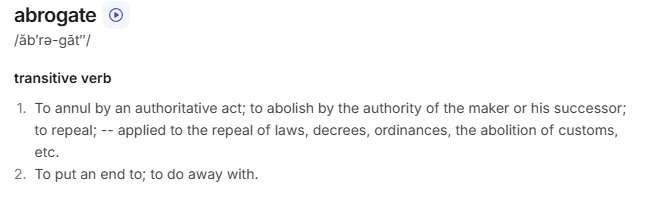
(Abrogated: To annul by an authoritative act; to abolish by the authority of the maker or his successor; To put an end to; to do away with.)

The Law of Moses, given to Israel at Sinai (Exodus 19-20), is no longer the means of salvation:

  • Fulfilled and Replaced: Jesus fulfilled the Law (Matthew 5:17-18), and His death on the cross abolished it as a system of justification (Colossians 2:14; Ephesians 2:15). Hebrews 10:9 states that Christ “takes away the first [covenant] that He may establish the second.” The Law’s sacrifices and ordinances could not perfect or justify (Hebrews 10:1-4; Galatians 3:10-13).
  • A Tutor to Christ: Galatians 3:24-25 explains that the Law was a “tutor to bring us to Christ,” but “after faith has come, we are no longer under a tutor.” For Israel, the Law pointed to the Messiah, but since His coming, salvation is through faith in Him, not the Law’s works (Romans 10:4).
  • Inability to Save: Acts 15:10-11, in the context of Jewish believers, affirms that neither Jews nor Gentiles are saved by the Law, which was a “yoke” they could not bear. Instead, “through the grace of the Lord Jesus Christ we shall be saved.”

Israel’s Salvation Today.

Since Pentecost, Jews (Israel) are saved by:

  • Hearing and Believing the Gospel: Romans 10:17 says faith comes by hearing the word of Christ. Jews must believe Jesus is the Messiah, as Peter proclaimed to Israel (Acts 2:36).
  • Repentance and Baptism: Acts 2:38 applies to Jews, as seen in the mass conversions at Pentecost. Baptism in Jesus’ name unites Jews and Gentiles with Christ (Galatians 3:27-29).
  • Ongoing Faithfulness: Like all believers, Jews must abide in Christ’s doctrine (2 John 1:9) and remain faithful (Hebrews 3:14). The remnant of Israel saved today includes Jews who obey the Gospel, such as the apostles and early disciples (Romans 11:5).

The Remnant and Future Hope.

Romans 11:5 speaks of a “remnant according to the election of grace” among Israel, saved by faith in Christ, as exemplified by Jewish believers in the New Testament (e.g., Acts 21:20). While Romans 11:26 anticipates a future time when “all Israel will be saved,” this does not imply salvation apart from the Gospel. The context (Romans 11:23-27) suggests Israel’s salvation comes through faith in Christ, aligning with the New Covenant promise of Jeremiah 31:31-34, fulfilled in Christ’s blood (Hebrews 8:8-12; Matthew 26:28).

Conclusion.

Since Pentecost, Israel is saved through the Law of Christ—the Gospel—not the Law of Moses, which was fulfilled and abrogated (Hebrews 8:13; Colossians 2:14). The New Covenant, promised in Jeremiah 31:31-34 and established through Christ (Hebrews 8:6), requires Jews to believe in Jesus as Messiah, repent, and be baptized (Acts 2:38; Romans 10:9-13). The remnant of Israel today, like all believers, enters God’s chosen people (1 Peter 2:9) by faith and obedience to the Gospel, fulfilling God’s redemptive plan through the eternal covenant of Christ.

agape

Are you WASHED?

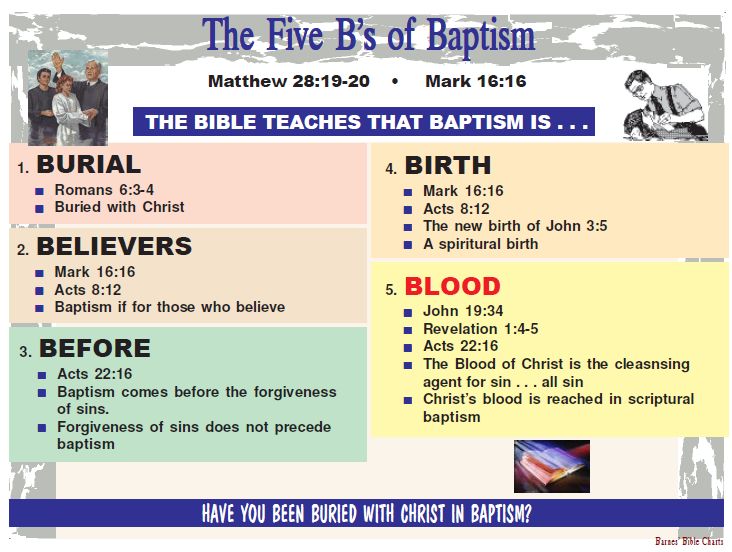
Far from a mere ritual, BAPTISM is a divinely ordained step that aligns believers with Christ’s redemptive work. Through baptism, individuals experience a cleansing of sins, union with Christ’s church, salvation, and an inheritance as heirs of God’s promises.

1. Washing Away Our Sins

Baptism serves as a divine act of cleansing, washing away the stain of sin. In Acts 22:16, Ananias urges Saul, “And now why do you wait? Rise and be baptized and wash away your sins, calling on his name.” This passage emphasizes baptism’s role in cleansing the believer’s conscience before God. Similarly, Acts 2:38 declares, “Repent and be baptized every one of you in the name of Jesus Christ for the forgiveness of your sins, and you will receive the gift of the Holy Spirit.” Here, baptism is linked directly to the remission of sins and the reception of the Holy Spirit. Additionally, Matthew 26:28 connects the concept of forgiveness to Christ’s sacrifice: “For this is my blood of the covenant, which is poured out for many for the forgiveness of sins.” Baptism, therefore, is the moment when a believer appropriates the forgiveness secured by Christ’s blood. Supporting this, Ephesians 5:26 describes Christ sanctifying the church “by the washing of water with the word,” reinforcing baptism’s cleansing power.

2. Added to the Church That Christ Built

Through baptism, believers are united with the body of Christ, the church He established. Acts 2:47 states, “And the Lord added to their number day by day those who were being saved.” This follows the account of 3,000 souls being baptized and added to the church after Peter’s sermon (Acts 2:41). Baptism is the entry point into Christ’s church, as seen in 1 Corinthians 12:13: “For in one Spirit we were all baptized into one body—Jews or Greeks, slaves or free—and all were made to drink of one Spirit.” This passage highlights the unity of believers in the church through baptism. Additionally, Colossians 1:18 affirms Christ as “the head of the body, the church,” underscoring that baptism incorporates individuals into this divine institution, built by Christ Himself (Matthew 16:18).

3. Saved Through Baptism

Baptism is intricately tied to salvation, as it is the moment when a believer’s faith is actualized in obedience to God’s command. 1 Peter 3:21 explicitly states, “Baptism, which corresponds to this, now saves you, not as a removal of dirt from the body but as an appeal to God for a good conscience, through the resurrection of Jesus Christ.” This verse clarifies that baptism is not a mere physical cleansing but a spiritual act that appeals to God for salvation. Mark 16:16 further supports this: “Whoever believes and is baptized will be saved, but whoever does not believe will be condemned.” The connection between baptism and salvation is also evident in Romans 6:3-4, which describes believers being “baptized into his death” and raised to “walk in newness of life,” symbolizing the transformative power of baptism in securing salvation.

4. Becoming Heirs of Abraham

Baptism establishes believers as heirs of the promises made to Abraham, uniting them in God’s covenant family. Galatians 3:27-29 explains, “For as many of you as were baptized into Christ have put on Christ… And if you are Christ’s, then you are Abraham’s offspring, heirs according to promise.” Through baptism, believers become part of the spiritual lineage of Abraham, inheriting the blessings of God’s covenant. Romans 4:16 reinforces this, stating that the promise to Abraham comes “to the one who shares the faith of Abraham, who is the father of us all.” Additionally, Ephesians 3:6 affirms that through the gospel, Gentiles are “fellow heirs” with Israel, a reality actualized in baptism as believers are incorporated into Christ’s body.

5. Putting on Christ

In baptism, believers clothe themselves with Christ, taking on His identity and righteousness. Galatians 3:27 declares, “For as many of you as were baptized into Christ have put on Christ.” This vivid imagery portrays baptism as the moment when a believer is enveloped in Christ’s nature. Romans 13:14 echoes this, urging believers to “put on the Lord Jesus Christ,” a process initiated at baptism. Colossians 3:9-10 further supports this idea, describing believers as having “put off the old self with its practices and… put on the new self,” a transformation that begins with baptism’s symbolic burial and resurrection (Colossians 2:12).

6. Becoming a Disciple of Christ

Baptism marks the beginning of a life of discipleship, as believers commit to following Christ. Matthew 28:19 commands, “Go therefore and make disciples of all nations, baptizing them in the name of the Father and of the Son and of the Holy Spirit.” Baptism is the initiatory step in making disciples, signifying a public commitment to Christ’s teachings. Acts 8:12 illustrates this: “But when they believed Philip as he preached good news… they were baptized, both men and women,” showing that baptism follows belief and marks the start of discipleship. John 3:5 further emphasizes baptism’s role in entering the kingdom of God: “Unless one is born of water and the Spirit, he cannot enter the kingdom of God,” linking baptism to the disciple’s journey of faith.

Baptism is far more than a symbolic act; it is a transformative moment in the believer’s life, rich with spiritual significance. Through baptism, sins are washed away, believers are added to Christ’s church, salvation is received, the promises to Abraham are inherited, Christ is put on, and a lifelong journey of discipleship begins. These truths, grounded in Scripture, underscore baptism’s ESSENTIAL role in the Christian faith.

AGAPE

Calling on the name of the Lord: What is it really?

Calling on the name of the Lord:

Prayer or obedience?

Acts 22:16 (KJV) states:

“And now why tarriest thou? Arise, and be baptized, and wash away thy sins, calling on the name of the Lord.”

This verse records Ananias’ instructions to Saul (later Paul) regarding his conversion. To understand what it means to “call on the name of the Lord,” we must look at how the Bible defines and uses this phrase.

1. Calling on the Name of the Lord Involves Obedience

Acts 22:16 ties “calling on the name of the Lord” directly to baptism, which is the moment when Saul’s sins were washed away. This aligns with Jesus’ own words in Mark 16:16:

“He that believeth and is baptized shall be saved; but he that believeth not shall be damned.”

Calling on the name of the Lord, then, is not merely a verbal plea but involves obedient action. This is further clarified by Romans 10:13-14:

“For whosoever shall call upon the name of the Lord shall be saved. How then shall they call on him in whom they have not believed? and how shall they believe in him of whom they have not heard? and how shall they hear without a preacher?”

Paul, writing later, shows that calling on the Lord’s name requires hearing the gospel, believing, and responding in obedience.

2. Calling on the Name of the Lord Is Not Just Prayer

Some assume that calling on the Lord’s name is merely saying a prayer for salvation, but Scripture does not support this idea. Consider Jesus’ words in Matthew 7:21:

“Not every one that saith unto me, Lord, Lord, shall enter into the kingdom of heaven; but he that doeth the will of my Father which is in heaven.”

Merely addressing Jesus as Lord does not save—doing His will does. This is consistent with Acts 22:16, where Paul had already been praying (Acts 9:11), yet he still needed to be baptized to wash away his sins.

3. Biblical Examples of Calling on the Name of the Lord

The phrase “call on the name of the Lord” is used throughout Scripture in connection with worship and obedience.

• Genesis 4:26 – “Then began men to call upon the name of the LORD.” This refers to worship and devotion to God.

• Joel 2:32 (quoted in Acts 2:21) – “Whosoever shall call on the name of the Lord shall be delivered.” This was fulfilled in Acts 2, where Peter preached that repentance and baptism in Jesus’ name were necessary for salvation (Acts 2:38).

In Acts 2, the people called upon the Lord by obeying Peter’s command to repent and be baptized. This directly parallels Acts 22:16, where Paul was instructed to do the same.

So what now?

To “call on the name of the Lord” is to appeal to Him for salvation by faithful obedience to His commands. Acts 22:16 shows that Saul (Paul) did this when he was baptized, at which point his sins were washed away. This is consistent with how the phrase is used throughout the Bible—faith in action, not merely words.

Spencer

Franklin & Juniper St

church of Christ

Borger, Tx